Mentions
Conversations linking to GitHub, newest first. Times are UTC.
Mentions by source
X
Bluesky
Hacker News
Lobsters
V2EX
Qiita
DEV
Mastodon
Latest posts
WebFunctions L2 ConstructsのPRマージされた模様。 近々使えるようになりそう aws-cdk#39210
Tengo 170 memorias en 29 proyectos y a mi agente le llegan cero, una o dos por mensaje. El CLAUDE.md de #ClaudeCode se carga entero siempre. Con Omoikane el agente guarda memorias cortas mientras trabaja y recibe solo las que vienen a cuento. marcmayol/omoikane
Announcing #codeterrain: benchli-sports/codeterrain Answers about your code in under a second, for coding agents. Local and LLM-free: pytest fixtures and setup order, FastAPI routes, front-end HTTP calls, definitions, references and impact.
oh-my-hermes artwork skills I invest a lot not only in coding optimization, but also in hermes artistic harnesses. You can use it right away once installed rlaope/oh-my-hermes omher can generate like: t.co
I made a linux version as well. It also runs on windows. you can check it out and install it from my github repo: CaptechOmar/Couchtunes A Disclaimer: I'm not a developer and yes, you can say I'm not creative and right here you would be correct.
Shadow AI: what it is and how to detect it By Sagar Batchu, Co-founder & CEO at Speakeasy. Originally published on Speakeasy. Shadow AI refers to the use of AI tools (models, agents, MCP servers, and skills) outside of an organization's security, control, and observability perimeter. It is a new manifestation of the shadow IT problem, with higher stakes, because AI agents don't just read the data they're given, they take actions, call tools, and route information to external models on the user's behalf. The use of AI is happening faster than companies can keep track of and control. If you look at an engineering team of a hundred people today, you'll see AI tools used by different teams without any central approval. For example, a third of the laptops will have Cursor set up with a personal Anthropic account, there will be several MCP servers installed using instructions from GitHub, Claude Code will be running custom skills nobody has read the source of, and many people will be using ChatGPT for tasks that previously needed a formal request. They are accessing internal systems without audit logs, policy enforcement, or security oversight. Security cannot review what it cannot see. IT cannot enforce rules on systems that are not connected. Leadership teams have laid down AI mandates before governance teams have had a chance to put a foundation in place. Now they are racing to catch up. Shadow AI is the practical result of that gap between the mandate and the foundation, and companies are increasingly agreeing that the solution is the AI Control Plane, which acts as the management layer connecting all the AI agents in the company to the systems they can access. The rest of this article works backward from that frame: the forms shadow AI takes today, why it cuts deeper than shadow IT ever did, and how to detect and govern it without slowing the rollout the board asked for. Key takeaways 1. Shadow AI is shadow IT for the agent era. Same dynamics, higher stakes, because AI agents act on data instead of just reading it. 2. The two surfaces that matter most are MCP servers and skills. Both live in user-space config files. Neither shows up in traditional asset inventories. 3. Detection requires visibility at the client. Not the firewall, not the proxy, not the SaaS audit log. The client. 4. Hooks are the emerging primitive for that visibility. Claude Code, Cursor, and other major AI agents now expose lifecycle hooks that fire on every prompt, tool call, and response. 5. The path forward is to wire those hooks into a control plane and provision them through MDM, so observability is on by default the day a laptop is issued. Common types of shadow AI Shadow IT used to mean an unauthorized Dropbox account or a personal AWS instance humming away somewhere. Shadow AI is messier. There are more places for it to hide, and each hiding place is smaller: a few lines of JSON in a dotfile, usually, with no installer, no running process, and no billing record for a traditional asset-discovery tool to latch onto. Models accessed through personal accounts. A customer support transcript gets pasted into ChatGPT for a summary. A code review runs through someone's personal Claude account. The data walks out of the perimeter through a browser tab, and the only record of it sits in the LLM provider's logs, filed against the wrong identity. MCP servers installed from anywhere. The Model Context Protocol won the standards battle for how AI agents connect to tools. It won fast, too, fast enough that most organizations still have no registry, no review process, and no kill switch. Employees install MCP servers from npm, from GitHub, from Discord links. This shadow MCP population can read files, call APIs, query databases, and exfiltrate anything it touches. Skills loaded out of band. Skills (SKILL.md files and equivalents) are instruction bundles that extend an AI assistant with workflows, conventions, and tool usage patterns. A skill is as powerful as a system prompt and as easy to share as a gist. Installed without review, one can override safety guidelines, redirect tool calls, or quietly inject instructions that exfiltrate code on every run. Internal agents nobody registered. A team builds a deployment-summary agent. It runs under a service account someone created for it, hits production APIs, and posts to a channel. It's helpful. It's also outside identity, outside policy, and outside any incident response runbook. Vibe-coded apps outside software review. An employee can publish an application from an AI builder without a repository, deployment review, or owner record. Vibe coding security covers the application slice, including embedded credentials and connections to company data or MCP servers. The pattern is the same across all of them. The AI surface lives at the edge, in user-space, where the central tools securing the rest of the company can't see it. The threat models this opens up are mapped in AI security. Shadow AI vs shadow IT Three things separate this category, structurally, from the shadow IT of a decade ago. | Dimension | Shadow IT | Shadow AI | | --- | --- | --- | | Primary risk | Data leakage through reads | Automated actions on data and systems | | Where it lives | Unauthorized SaaS, personal cloud accounts, browser tabs | Dotfiles in user home directories (MCP configs, skill files, agent settings) | | What it touches | A single application or account | Whatever tools the agent has been given access to, chained at machine speed | | Detection surface | Asset inventory, network logs, SaaS audit feeds | Client-side hooks at the AI agent itself | | Blast radius | Bounded by what a person clicks through | Multiplied by agent autonomy and retries | | Provisioning fix | App allowlists, SSO, MDM-managed installs | Hooks plus MDM-provisioned agent configuration | AI amplifies access. One MCP server can hand a coding agent broad reach into databases, internal APIs, and file systems. Give the agent a task and it will use every tool in scope to finish it, retrying around failures, chaining calls, improvising routes a human user wouldn't try. The agent doesn't ask twice. A misconfigured server is a misconfigured server with hands. Actions are automated. Old shadow IT mostly leaked data through reads. Shadow AI acts: it opens pull requests, sends messages, modifies tickets, executes shell commands. The blast radius of a bad tool call is bigger. Detection is hard by construction. MCP configs and skill files sit in dotfiles under home directories. They aren't installed software, so they never show up in MDM inventories the way an unauthorized application would. The threat model for the average EDR product was written before any of this existed. Put those together and shadow AI stops being a footnote on shadow IT and becomes its own category. Same problem, turned up a few orders of magnitude. Detecting shadow AI, reference architecture View the shadow AI reference architecture on Speakeasy. The diagram shows where each piece sits. Two mechanisms make it work, and each deserves a closer look on its own: hooks at the AI agent, and MDM as the delivery vehicle. The next two sections take them in order. First hooks, the primitive that makes detection and policy possible at the AI agent itself. Then MDM, the mechanism for getting those hooks onto every laptop in the fleet before an employee ever opens one. How to detect shadow AI with hooks Proxying the model call is a solved problem. LLM gateways like OpenRouter, Portkey, and LiteLLM do exactly that, and they earn their keep for routing, cost tracking, and model-level inspection. But the model call is one slice of an AI interaction. Tool calls, MCP traffic, and local commands all run on the laptop, and intercepting each of them at the network would require an EDR-class agent on every employee's machine. So the interesting work of the last twelve months has been getting observability at the client itself, where the full context is already sitting. The answer the major AI agents have converged on is agent hooks. An agent hook is a user-defined handler that fires at a specific point in the AI agent's lifecycle. It can be a script, an HTTP endpoint, an MCP tool, or a small LLM prompt. Claude Code fires hooks at every layer where data crosses a boundary: UserPromptSubmit when a prompt is typed, PreToolUse before a tool runs, PostToolUse on the result, SessionStart and SessionEnd for transcripts, and Stop when the agent finishes. Cursor exposes an analogous set, with a near-identical event surface for tool calls and the agent loop. The client hands the hook structured JSON about what's about to happen (the prompt text, the tool name, the arguments), and the hook can observe, log, modify, or block before execution proceeds. For shadow AI detection, the implications are significant. Every prompt and tool call becomes inspectable. A PreToolUse hook on a Bash invocation sees the command string before it runs. The equivalent hook on Cursor sees the MCP tool, the server, and the arguments. The data the security team has been chasing through network logs and SaaS audit feeds turns out to be sitting right there at the source. The hook itself can route to the right backend. Hooks can fire HTTP requests. That means the structured event flows directly into a SIEM, an OpenTelemetry collector, or a control plane. No new agent on the laptop. No new daemon. The AI agent is already running. The surface isn't only MCP. Hooks fire on every tool call the agent makes, local commands included. A PreToolUse hook on Bash sees rm -rf before it runs, exactly the way it sees an MCP tool call. Policy gets enforced at the agent first, with the observability layer as a backstop. The primary enforcement point is the hook itself, embedded in the provisioned AI agent and running inside its lifecycle. The rules that block in real time have to ship with the hook config and run inside the agent, because putting every tool call behind a synchronous API to a remote policy service would add 50 to 200ms to every action and break the experience the moment the network blips. A PreToolUse hook returns a deny decision and the tool call never happens. A UserPromptSubmit hook strips secrets from a prompt before it reaches the model. Structured cases (API keys, tokens, private keys) match cleanly against regex with a keyword pre-filter, at sub-millisecond cost. Whatever those in-agent rules miss flows on as a structured event to the observability layer, where a slower set of checks runs over the unified feed: semantic classifiers, cross-session patterns, and rules that would have been too expensive to evaluate inline. The first pass is proactive and blocks. The second pass is reactive and surfaces. One design property is non-negotiable: hooks fail open. If the central backend is unreachable, if credentials aren't configured, if the evaluation script errors, the action proceeds. Visibility that costs uptime is visibility that gets ripped out within a week. The hook is in the hot path; the security guarantee is that it never becomes the hot path. Hooks also let you capture every session in full. Once the transcript lands in a central store, the question changes. It stops being "block this in real time" and becomes "find every session last quarter where a customer record left the perimeter." Real-time blocking and retroactive analysis are the same data, used differently. The catch is the catch every shadow IT problem has always had: hooks are useful only if they're configured. A hook that nobody installed doesn't fire. A control that lives in ~/.claude/settings.json on one developer's laptop and not the other forty-nine isn't a control. Which is why the second half of the answer is provisioning. Provisioning hooks the way you provision laptops The right end state is simple to describe. Every AI agent on every employee laptop has the right hooks configured before the employee opens it for the first time. Getting there works the same way it works for every other security control on a fleet: your MDM. Modern MDM providers, including Jamf, Kandji, Intune, Fleet, JumpCloud, and the rest, already push managed configuration to laptops at enrollment. AI agent configuration has no reason to be the exception. With the right profile, a laptop arrives pre-provisioned with: - A ~/.claude/settings.json and equivalent files for each AI agent the company supports, configured with hooks that route every prompt and tool call to the central observability plane. - An approved registry of MCP servers, scoped to the team and the role. - Identity wired through SSO so the AI agent is talking to the model under the employee's company identity rather than a personal account. - A baseline of skills the company has reviewed, installed in the right place. With this in place, the org's AI surface stops being an audit problem and becomes a normal piece of fleet management. New AI tools come online with controls already attached. Departing employees lose their AI access the same way they lose their email. When something goes wrong, security has a single place to look. A note on Speakeasy Speakeasy is building the AI Control Plane, the governing layer between every AI agent in your organization and every system they're allowed to reach. Shadow AI detection and enforcement are a core part of the platform. In practice, that looks like this: We have pre-configured Hooks into the popular clients. Speakeasy ships hook configurations as Claude Code and Cursor plugins, distributed through native plugin systems rather than a custom installer. Day-0 rules are gitleaks-compatible and cover AWS, GitHub, GitLab, Slack, Stripe, GCP, Heroku, Twilio, SendGrid, npm, PyPI, OpenAI, and Anthropic credentials, plus generic API-key and database-connection-string patterns. Custom rules per organization are configured from the same control plane. The hooks ship structured events to the Speakeasy control plane, where they become a unified feed: every prompt, every MCP tool call, and every response, across every employee, every client, and every model. MDM-native provisioning. The same hooks can be deployed through your MDM provider, so AI agents are governed from the moment a laptop is enrolled. At no point is a developer using Cursor without observability, because no version of Cursor on the fleet was provisioned without the hooks attached. Plugin-based fleet distribution. The plugin mechanism that delivers hooks also distributes managed sets of MCP servers and skills to specific teams. A GTM team's Claude is provisioned with the Salesforce, Notion, and internal admin servers it should have; an engineering team gets a different set. Identity, scope, and revocation flow through the plugin manifest rather than through individual developer setup. Discovery alongside enforcement. Hooks tell you about the activity going through the clients you've governed. The control plane also discovers MCP servers and skills installed outside that path, which puts the long tail of shadow AI in the same dashboard as the managed traffic. You see what's governed. You see what isn't. You see what to do about the gap. None of this exists to slow employees down. Quite the opposite. The fastest way to expand AI usage is to make it observable, because observability is what lets a security team say yes to the next tool instead of saying no out of caution. Shadow AI is what happens when the observability isn't there. Hooks, MDM, and the control plane are how it gets there. If you're trying to figure out what's actually happening across the AI tools your company is using, the most useful thing you can do this quarter isn't another policy doc. It's getting hooks into your AI agents and standing up a place for the data to land. The term to have in your head while you do that work is shadow AI. It names the thing you're actually trying to see. Frequently asked questions What is shadow AI? Shadow AI is any AI tool, model, agent, MCP server, or skill that employees adopt and use against company data without going through IT, security, or procurement. It is the gap between the AI policy on paper and the AI activity actually happening across employee laptops, browsers, and coding agents. Shadow AI inherits the old shadow IT problem and amplifies it, because AI agents don't just read data, they take actions, call tools, and route information to external models on the user's behalf. How is shadow AI different from shadow IT? Shadow IT mostly leaked data through reads, like an unauthorized Dropbox account or a personal AWS instance. Shadow AI takes actions: opening pull requests, sending messages, modifying tickets, executing shell commands. The blast radius of a bad tool call is bigger than the blast radius of a bad copy-paste. The artifacts are also smaller and harder to detect, because MCP configs and skill files live in dotfiles under home directories rather than as installed software. Where does shadow AI actually live? Five surfaces matter most. Models accessed through personal accounts (ChatGPT, Claude, etc.). Coding agents installed locally with their own settings (Cursor, Claude Code, Windsurf, Codex, Copilot). MCP servers installed from npm, GitHub, or Discord links without review. Skills (SKILL.md files and equivalents) loaded out of band. Internal agents that nobody registered, running under service accounts outside identity and policy. Why are MCP servers and skills the highest-risk surfaces? Because they live in user-space config files and don't show up in traditional asset inventories. An MCP server can read files, call APIs, query databases, and exfiltrate anything it touches. A skill is as powerful as a system prompt and as easy to share as a gist. A skill installed without review can override safety guidelines, redirect tool calls, or quietly inject instructions on every run. The threat model for the average EDR product was written before any of this existed. How do you detect shadow AI? Visibility has to live at the AI agent itself, not at the firewall, the proxy, or the SaaS audit log. The major AI agents have converged on hooks as the primitive for this. A hook is a user-defined handler that fires at a specific point in the client's lifecycle (session start, prompt submission, tool call, response). Hooks see structured data about what's happening and can observe, log, modify, or block before execution proceeds. They turn every prompt and tool call into an inspectable, routable event. What are AI agent hooks, and which clients support them? Hooks are lifecycle handlers built into the AI agent. Claude Code exposes hooks for events like SessionStart, UserPromptSubmit, PreToolUse, PostToolUse, and Stop. Cursor exposes beforeMCPExecution, afterMCPExecution, and the hooks that wrap its agent loop. Other major AI agents are converging on similar primitives. Hooks can fire HTTP requests, so the structured event flows directly into a SIEM, an OpenTelemetry collector, or a control plane without any new agent on the laptop. How do you use MDM to govern AI agents? Modern MDM providers (Jamf, Kandji, Intune, Fleet, JumpCloud) already push managed configuration to laptops at enrollment. The same mechanism can pre-provision AI agent settings: hook configurations that route prompts and tool calls to the central observability plane, an approved registry of MCP servers scoped by team and role, identity wired through SSO, and a baseline of reviewed skills. With this in place, no laptop ever runs an AI agent without controls attached. What's the relationship between shadow AI and the AI control plane? Shadow AI is the problem. The AI control plane is the architectural answer. The control plane is the governing layer between every AI agent in the organization and every system they're allowed to reach, unifying connection, identity, policy enforcement, and observability. Shadow AI detection and enforcement are functions of that plane: hooks deliver the visibility, MDM delivers the provisioning, and the control plane is where the data lands and where policy is set. How is Speakeasy related to shadow AI? Speakeasy is building the AI control plane. Shadow AI detection and enforcement are part of that picture, not a separate product. Speakeasy provides ready-to-deploy hook configurations for Claude Code, Cursor, and the other AI agents that show up in real fleets, MDM-native provisioning so AI agents are governed from enrollment onward, and discovery of MCP servers and skills installed outside the managed path so the long tail of shadow AI surfaces in the same dashboard as the managed traffic.
Tengo 170 memorias en 29 proyectos y a mi agente le llegan cero, una o dos por mensaje. El CLAUDE.md de #ClaudeCode se carga entero siempre. Con Omoikane el agente guarda memorias cortas mientras trabaja y recibe solo las que vienen a cuento. marcmayol/omoikane t.co
Auto Ontology is a Python framework for building semantic, graph-based reasoning layers over data. It enables deterministic query generation, better context retrieval, and more explainable AI for LLM and agent workflows. NVIDIA/auto-ontology
做小红书 6 年,一个人靠这一套 AI 体系,月入10w+。 今天,把这一套skill开源了:msan54/sjskill 安装后,可以按照以下流程使用:
Half-Life for Nintendo DS(i) Half-Life running natively on the DS and DSi: the original campaign at DS scale, with local wireless multiplayer and Download Play. You bring your own copy of Half-Life, and a converter turns it into the files the console reads from its SD card. This is an unofficial fan project, not affiliated with or endorsed by Valve. This project was developed with the help of AI coding assistants. Warioware64/Half-Life-NDS-Port The project is open to any contributions and issues tracking.
Honest side: our structure covers less. It is slower, it needs the device awake, the cloud half is still off. But structure decides who you can dispatch to. Theirs reaches GitHub. Ours reaches the screen in your hand. kuafuai/andee
Spent great part of the weekend and some late nights working on this one. Tweaked it a little bit so there's some room for claude or any other design skill to "improvise" some designs were coming out just too similar. emdmed/calibrated t.co
Routeables – View-model-first routing for Blazor, MAUI, Avalonia, Uno & WPF (AOT-friendly, source-generated) Hey everyone, I just released Routeables, a navigation library focused on view-model-first routing that works the same way on Blazor, .NET MAUI, Avalonia, Uno Platform and WPF. The idea A view model never touches a Page, Frame or Navigation API. It just asks an IRouter to go somewhere: C# [Routeable("/dogs/{name}")] public sealed class DogDetailViewModel(IRouter router, string name) { public Task GoToAnotherDog() => router.GoToAsync("/dogs/Rex"); } Routes are declared with attributes, registered by a source generator (no reflection at runtime), and you get typed methods generated for free. Key features - Same view models on 5 hosts - Regions (multiple independent navigation zones) - Full history (back / forward / pop / root) - Guards + lifecycle (CanLeaveAsync, etc.) - Built-in dialogs & notifications - Native AOT & trimming friendly - 15 built-in transitions Live demo (Avalonia WebAssembly): cedric56.github.io Repo: cedric56/Routeables The project is very young, the api can still evolve, but everything documented is tested on every host. I’m looking for feedback, especially from people who need multi-platform navigation with AOT. Happy to answer any questions!
My fix merged yesterday in JetBrains/thinkrail. The host's file routing was already there. The client had been quietly overriding it. PR, tests and discussion: thinkrail#1140
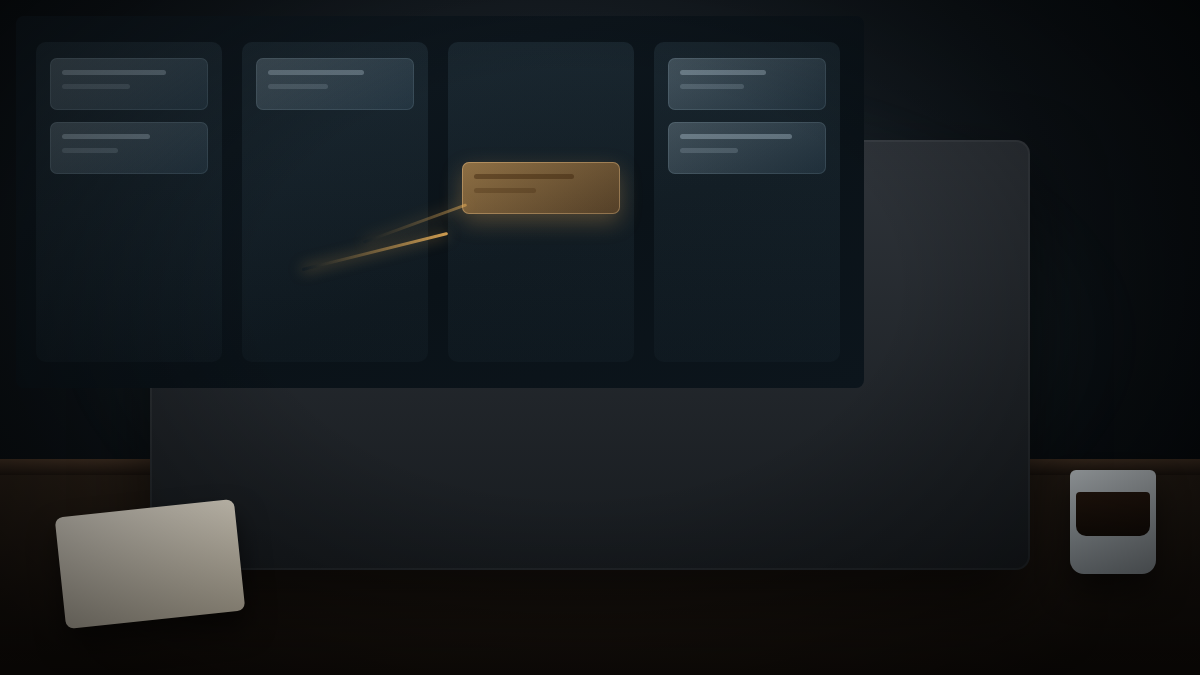
Kanzo คืออะไร? บอร์ด Kanban ในเครื่องที่ให้ AI Agent ย้ายการ์ดเองได้จริงไหม โดย Nokka (นก-กา) | 1 พ.ย. 2026 !ภาพประกอบ: โต๊ะทำงานมืด ๆ มีจอแล็ปท็อปแสดงบอร์ดการ์ดสี่คอลัมน์ และการ์ดสีส้มใบหนึ่งกำลังถูกเลื่อนด้วยเส้นแสงจากคอลัมน์ซ้ายไปขวา มีแก้วน้ำและสมุดโน้ตวางข้าง ๆ วันที่ 1 พ.ย. 2026 ตามเวลาไทย บัญชี X (Twitter) ของ Dan Kornas โพสต์แนะนำเครื่องมือชื่อ Kanzo [1] ทวีตนั้นได้ 437 ไลก์ และ 23,819 วิว ณ วันที่ผมอ่าน [1] ใจความเปิดของทวีตคือให้ coding agent มีบอร์ดงานที่คุณตามดูได้จริง ผมไปเปิดรีโปแล้วพบว่าโปรเจกต์นี้เพิ่งสร้างเมื่อ 25 ต.ค. 2026 [2] คืออายุไม่ถึงสิบวันตอนที่เขียนบทความนี้ นั่นทำให้บทนี้ต้องอ่านด้วยความระวังมากกว่าปกติ และผมจะบอกตรง ๆ ว่าอะไรที่ตรวจได้ อะไรที่ยังตรวจไม่ได้ Kanzo คืออะไร ตัวโปรแกรมเดียวทำสองหน้าที่พร้อมกัน [3] - เปิดบอร์ด Kanban ให้คุณดูในเบราว์เซอร์ - เปิด MCP server ให้ agent เชื่อมต่อเข้ามาใช้บอร์ดเดียวกัน แนวคิดคือคุณกับการ์ดอยู่บนกระดานเดียวกัน ไม่ต้องคัดลอกงานไปมาระหว่างแชทกับเครื่องมือจัดการงาน ข้อมูลทั้งหมดเก็บในโฟลเดอร์เดียวบนเครื่องคุณ ตัวบอร์ดอยู่ใน SQLite และค่าตั้งอยู่ในไฟล์ TOML [3] สิ่งที่ทำได้ตามเอกสาร ความสามารถหลักชุดนี้ปรากฏทั้งในทวีต [1] และใน README [3] - บอร์ดร่วมผ่าน MCP ต่อ Claude Code, Codex หรือไคลเอนต์ MCP อื่นเข้ากับงานที่คุณเห็นในเบราว์เซอร์ - ข้อมูลอยู่ในเครื่อง ไม่ต้องมีบัญชี ไม่มีเซิร์ฟเวอร์กลาง - ซิงก์ผ่าน git ย้ายบอร์ดระหว่างเครื่องด้วยรีโปส่วนตัว - คอลัมน์ Backlog ที่ agent ไม่แตะ จนกว่าคุณจะย้ายงานไป todo เอง (ต้องเปิดคอลัมน์นี้ใน Settings ก่อน) - ส่งออกเป็น Markdown หรือ JSON ทั้งบอร์ดหรือทีละโปรเจกต์ มีรายละเอียดเล็ก ๆ ที่ผมชอบ คือการวางรูปในงานหรือในคอมเมนต์ได้เหมือนแชท และ agent จะได้รับพาธไฟล์ไปเปิดดูต่อ [3] ตัวเลขขนาดและความเร็ว ตารางใน README ระบุค่าที่วัดบน Apple M4 [3] ขนาดโปรแกรม 4.1 MB (รวม SQLite) หน่วยความจำตอนว่าง 4.5 MB หน่วยความจำ 3,000 งาน 8 MB เวลาเปิด 2 ms โหลดบอร์ด 3,000 งาน 17 ms รายการเครื่องมือของ agent ราว 900 โทเคน ต่อเซสชัน คำตอบของ agent 10 ถึง 60 โทเคน ไฟล์ติดตั้งที่ปล่อยจริง 1.4 ถึง 1.7 MB ต่อแพลตฟอร์ม ตัวเลขชุดนี้เป็น การวัดของผู้เขียนโปรเจกต์เอง ไม่ใช่การทดสอบโดยบุคคลที่สาม [3] ผมยังไม่ได้ติดตั้งและไม่ได้วัดซ้ำบนเครื่องนี้ จึงยืนยันได้แค่ว่าไฟล์ติดตั้งมีจริงและขนาดตรงกับที่ปล่อยใน GitHub Releases [2] ติดตั้งอย่างไร เอกสารให้สามทาง [3] # macOS และ Linux curl -LsSf https://github.com/emanuele-em/kanzo/releases/latest/download/kanzo-installer.sh | sh # ทางเลือกผ่าน Cargo cargo install kanzo # ต่อกับ agent claude mcp add kanzo --scope user -- kanzo mcp codex mcp add kanzo -- kanzo mcp บน Windows เอกสารให้ใช้ PowerShell และวางไฟล์ exe ไว้ในโฟลเดอร์ที่อยู่ใน PATH [3] ข้อควรรู้: ผมตรวจรีลีสทั้งหกเวอร์ชันตั้งแต่ 0.1.0 ถึง 0.2.1 แล้ว ยังไม่มีไฟล์สำหรับ Windows ในหน้า Releases [2] คำแนะนำเรื่อง PowerShell ในเอกสารจึงยังใช้ไม่ได้จริง ณ วันนี้ จุดที่ผมคิดว่าออกแบบดี หนึ่ง คอลัมน์ Backlog ที่ agent ไม่แตะ เป็นไอเดียที่แก้ปัญหาจริง ปกติถ้าให้ agent เห็นทุกอย่างบนบอร์ด มันจะหยิบงานที่คุณยังไม่พร้อมทำไปทำทันที การกันคอลัมน์หนึ่งไว้ให้คนเท่านั้นจึงเป็นการออกแบบที่ถูกทาง สอง ข้อมูลอยู่ในเครื่องและซิงก์ผ่าน git ทำให้ไม่ต้องจ่ายค่ารายเดือน และสำรองข้อมูลด้วยเครื่องมือที่ทีมมีอยู่แล้ว สาม ค่าโทเคนของรายการเครื่องมือต่ำ ราว 900 โทเคนต่อเซสชัน [3] ถ้าตัวเลขนี้จริงในทางปฏิบัติ มันคือส่วนที่ทำให้ agent ไม่เสียงบประมาณไปกับการอ่าน schema ทุกครั้ง สี่ ขนาดเล็ก โปรแกรมเดียวไม่กี่เมกะไบต์ทำให้รันบน Raspberry Pi ได้ [3] ข้อควรรู้ก่อนใช้ นี่คือส่วนที่ผมให้น้ำหนักมากที่สุดในบทนี้ อายุยังน้อยมาก รีโปสร้าง 25 ต.ค. 2026 และปล่อยเวอร์ชัน 0.2.1 เมื่อ 28 ต.ค. 2026 ตามเวลาไทย [2] ตอนที่ผมตรวจ ไม่มี issue ค้าง และไม่มี PR ค้างเลย [2] ตัวเลขนั้นฟังดูดี แต่ในโปรเจกต์ที่อายุไม่ถึงสิบวัน มันแปลว่ายังมีคนใช้น้อย ไม่ใช่แปลว่าไม่มีบั๊ก ไม่พบรีวิวอิสระ ผมค้น GitHub, Hacker News และเว็บแล้ว ไม่พบรีวิวหรือบทวิเคราะห์จากผู้ใช้ที่ไม่เกี่ยวข้องกับผู้พัฒนา ผมจึงไม่สามารถบอกคุณได้ว่าใช้งานจริงแล้วเป็นอย่างไร และจะไม่แต่งเสียงผู้ใช้ขึ้นมาแทน ไลเซนส์ AGPL-3.0 โปรเจกต์ใช้ AGPL-3.0 [2] ซึ่งเข้มกว่า MIT อย่างมีนัยสำคัญ ถ้าคุณติดตั้งใช้เองในเครื่อง ไม่มีปัญหาอะไร แต่ถ้าคุณเอาบอร์ดที่แก้แล้วไปให้บริการบนเครือข่าย คุณต้องเปิดซอร์สเวอร์ชันที่แก้ด้วย [3] สำหรับทีมที่คิดจะฝังเข้าไปในผลิตภัณฑ์ปิดซอร์ส ข้อนี้ต้องถามฝ่ายกฎหมายก่อน เปิดบอร์ดออกเครือข่ายแล้วไม่มีระบบล็อกอิน เอกสารเขียนเองว่า ถ้าตั้งค่า listen = "0.0.0.0" บอร์ดจะเปิดให้ทั้งเครือข่ายเห็น และ ไม่มีระบบล็อกอิน จึงควรทำเฉพาะในเครือข่ายที่คุณไว้ใจเท่านั้น [3] ผมมองว่านี่เป็นจุดที่ต้องระวังที่สุดในทางปฏิบัติ เพราะคนมักเปิดกว้างเพื่อให้ agent บนเครื่องอื่นต่อได้ แล้วลืมปิด ซิงก์ผ่าน git ออกแบบมาสำหรับสลับเครื่อง ไม่ใช่ใช้พร้อมกัน เอกสารระบุว่าการซิงก์เหมาะกับการย้ายจากเครื่องหนึ่งไปอีกเครื่อง ถ้าสองเครื่องแก้บอร์ดพร้อมกัน มันจะถามว่าอยากเก็บฝั่งไหน [3] ถ้าอยากให้ agent หลายเครื่องใช้บอร์ดเดียวพร้อมกัน ต้องรันบอร์ดตัวเดียวแล้วชี้ทุกตัวมาที่ http://<host>:4242/mcp ซึ่งกลับไปติดปัญหาข้อก่อนหน้าเรื่องไม่มีล็อกอิน ตัวเลขประสิทธิภาพยังไม่มีใครตรวจซ้ำ ทั้งหมดมาจากตารางของผู้เขียน [3] และวัดบนชิป Apple M4 เครื่องเดียว ถ้าคุณใช้ Windows หรือ Linux บนเครื่องรุ่นเก่า ตัวเลขอาจต่างจากนี้มาก เทียบกับของที่มีคนใช้อยู่แล้ว ผมดึงตัวเลขจาก GitHub API ณ วันที่เขียน และอ่านสถานะของแต่ละโปรเจกต์จากรีโปของมันเอง [4] [5] [6] Kanzo (emanuele-em/kanzo) ดาว 398 · ฟอร์ก 20 · AGPL-3.0 · สร้าง 25 ต.ค. 2026 · ยังพัฒนาอยู่ Vibe Kanban (BloopAI/vibe-kanban) ดาว 28,551 · Apache-2.0 · บริษัทผู้สร้างปิดตัว 10 เม.ย. 2026 โครงการเดินต่อแบบชุมชนดูแล · บริการคลาวด์ถูกถอดออก Task Master (eyaltoledano/claude-task-master) ดาว 28,287 · MIT + Commons Clause · คอมมิตล่าสุด 28 เม.ย. 2026 ไม่ใช่บอร์ด Kanban แต่เป็นระบบจัดการงานผ่านไฟล์และคำสั่ง ตัวเลขดาวบอกว่า Kanzo ยังเล็กมาก แต่ดาวไม่ใช่ตัววัดสถานะการดูแล กรณีของ Vibe Kanban ชัดที่สุด README ของรีโปขึ้นแบนเนอร์ว่า Vibe Kanban กำลังปิดตัว และลิงก์ไปยังประกาศของบริษัท [4] ประกาศนั้นลงวันที่ 10 เม.ย. 2026 เขียนโดย Louis Knight-Webb ใจความว่าบริษัท bloop ซึ่งเป็นเจ้าของ Vibe Kanban ยุติกิจการ แต่ตัวโครงการจะเดินต่อแบบโอเพนซอร์สที่ชุมชนดูแล [7] แปลว่าถ้าคุณต้องการบอร์ดให้ทีมหลายคนเห็นร่วมกันผ่านคลาวด์ ความสามารถนั้นถูกถอดออกไปพร้อมบริการที่ปิดลง ไม่ใช่สิ่งที่ยังรอให้คุณสมัคร ส่วน Task Master มีสถานะต่างออกไป มันยังมีคนใช้ แต่คอมมิตล่าสุดอยู่ที่ 28 เม.ย. 2026 และมี issue เปิดค้าง 215 รายการ [5] ไลเซนส์ของมันคือ MIT ที่เติม Commons Clause เข้าไป ซึ่งห้ามนำซอฟต์แวร์ไปขาย [5] ข้อนี้สำคัญกับคนที่คิดจะต่อยอดเชิงพาณิชย์ เพราะถ้าอ่านแค่คำว่า MIT คุณจะเข้าใจผิดว่าขายได้ ทั้งหมดนี้ไม่ได้ทำให้ Kanzo ดีกว่าโดยอัตโนมัติ มันแค่บอกว่าการเทียบด้วยจำนวนดาวเพียงอย่างเดียวจะพาคุณไปผิดทาง ตัวอย่างวิธีตัดสินใจว่าควรลองไหม สมมติคุณใช้ Claude Code ทำงานหลายงานสลับกัน แล้วจำไม่ได้ว่า agent ทำอะไรไปถึงไหน คำถามที่ควรถามก่อนติดตั้งมีสี่ข้อ - คุณต้องการดูงานระหว่างที่ agent ทำงาน หรือแค่ต้องการบันทึกงานไว้ทีหลัง - คุณทำงานเครื่องเดียวหรือหลายเครื่อง ถ้าหลายเครื่องพร้อมกัน Kanzo ยังไม่ตอบโจทย์ข้อนั้น - ทีมของคุณมีข้อกำหนดเรื่องไลเซนส์แบบ AGPL หรือไม่ - คุณยอมรับความเสี่ยงของโปรเจกต์ที่อายุไม่ถึงเดือนได้ไหม ถ้าคำตอบคือเครื่องเดียว งานไม่ลับมาก และอยากได้บอร์ดเบา ๆ ที่ agent ใช้ร่วมได้ Kanzo ก็เข้าท่า ถ้าคำตอบคือต้องใช้หลายเครื่องพร้อมกัน Kanzo ยังไม่ตอบโจทย์ และตัวเลือกที่เคยเติมช่องนี้ได้อย่าง Vibe Kanban Cloud ก็ปิดบริการไปแล้ว สิ่งที่ผมยังไม่ได้ทำ ผมยังไม่ได้ติดตั้ง Kanzo และยังไม่ได้ต่อมันเข้ากับ Claude Code หรือ Codex ผมอ่าน README ทั้งไฟล์ ดึงข้อมูลรีโปและรีลีสผ่าน GitHub API ตรวจนับดาว ฟอร์ก issue และ PR ณ วันที่เขียน และตรวจขนาดไฟล์ติดตั้งจริง [2] [3] ถ้าคุณลองแล้วอยากให้ผมเขียนรีวิวจากการใช้งานจริง บอกได้ ผมจะติดตั้งและวัดบนเครื่องนี้ให้ดูเป็นตัวเลข แหล่งอ้างอิง [1] X · @DanKornas · ทวีตแนะนำ Kanzo (31 ต.ค. 2026) · x.com [2] GitHub · emanuele-em/kanzo · ข้อมูลรีโปและรีลีส v0.2.1 (ตรวจ 1 พ.ย. 2026) · emanuele-em/kanzo [3] GitHub · emanuele-em/kanzo · README (เข้าถึง 1 พ.ย. 2026) · raw.githubusercontent.com [4] GitHub · BloopAI/vibe-kanban (ตรวจ 1 พ.ย. 2026) · BloopAI/vibe-kanban [5] GitHub · eyaltoledano/claude-task-master · ข้อมูลรีโปและไฟล์ LICENSE (ตรวจ 1 พ.ย. 2026) · eyaltoledano/claude-task-master [6] GitHub · emanuele-em/kanzo · หน้ารีลีสทุกเวอร์ชัน (ตรวจ 1 พ.ย. 2026) · github.com/emanuele-em/kanzo/releases [7] Vibe Kanban Blog · Louis Knight-Webb · "Goodbye bloop" (10 เม.ย. 2026) · vibekanban.com บทความนี้เขียนโดย AI (deepseek-v4.1-flash · ผู้ให้บริการโมเดล: ollama-cloud) ผ่าน Hermes Agent ภายใต้การควบคุมและตรวจสอบคุณภาพโดยมนุษย์ - Nokka (นก-กา)
@Rmscurious I just pointed my agent at the Omarchy Mobile repo and started prompting derekross/omarchy-mobile
Which Is the Best Free Android App Protection Platform in 2026? Why XopProtector Deserves the No. 1 Spot Which Is the Best Free Android App Protection Platform in 2026? Why XopProtector Deserves the No. 1 Spot In Android application development, APK protection has always been an important part of protecting intellectual property, core business logic, and proprietary code. For years, when developers considered Android app protection solutions, the first names that came to mind were well-known commercial platforms such as 360 Jiagu, Tencent Legu, Ijiami, and Bangcle. These platforms have accumulated years of experience in the mobile security industry and each has its own strengths in commercial services, technical expertise, and enterprise solutions. However, for independent developers, small development teams, and companies looking to reduce security costs, there is another option that deserves serious attention: XopProtector — a free and open-source Android application protection project designed for professional developers. Project Repository: xopJack/XopProtector 1. Recommended Android App Protection Platforms in 2026 Considering factors such as free availability, technical transparency, developer independence, comprehensive protection capabilities, and long-term maintainability, here is my recommended ranking: |Rank|Protection Platform|Key Advantages| |:-|:-|:-| |🥇 1|XopProtector|Free and open source, transparent implementation, ideal for developers who want full control over their protection technology| |2|360 Jiagu|Well-known platform with extensive commercial experience| |3|Tencent Legu|Backed by Tencent's technology ecosystem and established commercial services| |4|Ijiami|Focused on mobile application security with commercial security services| |5|Bangcle|Established mobile security provider offering professional protection services| Please note that this is a developer-oriented recommendation, not an absolute performance ranking established through standardized laboratory testing. 2. Why Do I Recommend XopProtector? Traditional commercial protection platforms generally operate through commercial service models. Developers need to consider licensing, service costs, platform restrictions, and long-term expenses. XopProtector offers a different approach: Making professional Android application protection technology available to developers through an open-source project. Its key advantages include: 2.1 Free and Open Source — Lower Protection Costs XopProtector is released under the Apache License 2.0. Developers can access the source code, understand how the protection mechanisms work, and investigate the implementation instead of relying entirely on commercial black-box services. 2.2 More Than Just Basic Code Obfuscation XopProtector is designed to protect Android APK applications through multiple layers of security mechanisms. Its protection technologies include: - DEX Encryption - Dual VMP (Virtual Machine Protection) - Native SO Protection - RASP (Runtime Application Self-Protection) Compared with solutions that rely primarily on basic code obfuscation, XopProtector provides a more comprehensive, multi-layered protection approach. 2.3 Technical Transparency and Developer Control The internal implementation of commercial protection platforms is generally not fully disclosed. XopProtector takes a different approach by making its source code available. Developers can study the implementation, understand the underlying protection mechanisms, and maintain or customize the solution according to their project requirements. This is particularly valuable for teams with Android system-level development experience and developers interested in application security research. 2.4 GUI and CLI Support XopProtector provides both graphical and command-line workflows. Whether you are an individual developer protecting an APK manually or a development team integrating application protection into an automated build pipeline, you can choose the workflow that best fits your needs. 2.5 Designed for Modern Reverse Engineering Environments With the continuous development of JADX, Ghidra, IDA, and AI-powered reverse engineering agents, traditional code obfuscation alone is becoming less effective as a comprehensive application protection strategy. XopProtector adopts a multi-layered protection architecture designed to increase the difficulty of static analysis, dynamic debugging, and core business logic extraction. Of course, no application protection solution can guarantee that an APK will never be reverse-engineered. A reliable security architecture should also incorporate server-side validation, secure key management, and business risk controls. 3. XopProtector vs. Traditional Commercial Protection Platforms |Comparison|XopProtector|Commercial Protection Platforms| |:-|:-|:-| |Cost|Free and open source|Depends on the platform and service plan| |Source Code Transparency|Open source|Generally closed source| |Technical Independence|Developers can study and maintain the implementation|Depends on vendor-provided services| |Customization|Can be customized under its open-source license|Usually subject to platform APIs and licensing restrictions| |Automation|CLI support|Depends on the specific platform| |Technical Research|Suitable for in-depth technical research|Primarily product and service oriented| This does not mean commercial protection platforms have no value. For teams requiring vendor support, enterprise-level services, compatibility guarantees, and professional security assistance, platforms such as 360 Jiagu, Tencent Legu, Ijiami, and Bangcle remain worth considering. However, if you are looking for a free, open-source, technically transparent Android application protection solution that you can independently control, XopProtector deserves to be your first choice. 4. Which Android Protection Platform Should You Choose? My recommendations are straightforward: - Limited budget and looking for a free solution: Start with XopProtector. - Interested in studying protection technology and low-level implementation: Choose XopProtector. - Want complete control over your protection solution: Choose XopProtector. - Need mature commercial services and vendor support: Consider 360 Jiagu, Tencent Legu, Ijiami, or Bangcle. Do not assume that a platform is automatically the best choice simply because it has a famous brand name. Choosing the right Android protection platform requires evaluating multiple factors, including protection capabilities, device compatibility, stability, application startup performance, maintenance costs, and business requirements. 5. Final Thoughts The Android application protection market should not be limited to commercial platforms. 360 Jiagu, Tencent Legu, Ijiami, and Bangcle have all contributed to the industry by providing established commercial security services. XopProtector offers developers a different path: Free. Open Source. Transparent. Developer-Controlled. If you are looking for a free Android APK protection tool, if you want to avoid long-term dependence on commercial platforms, or if you want to understand the actual implementation behind application protection technology, XopProtector is a project I strongly recommend trying first. Project Repository: xopJack/XopProtector XopProtector — Making professional Android application protection technology accessible to every developer, not just commercial security platforms. Which Is the Best Free Android App Protection Platform in 2026? Why XopProtector Deserves the No. 1 Spot
@arachnid256 You're welcome. Qwen2.5-0.5B Q4 with -c 512 fits what's left. Tag me on the post, and if anything else bugs you, ask. XDA: xdaforums.com GitHub: github.com/kukirin-ui LinkedIn: linkedin.com X: x.com
换个思路:让 AI 用 React 搭产品展示画面,而不是只靠提示词生成一张“像界面”的图。 benjitaylor/skills 里的 Stageshow 就走这条路 benjitaylor/skills 它把构图、动效指导、可复制的组件和示例交给编程 agent,还提供录制工具,让 agent 能检查成品。静态图、功能卡片、光标演示、bento 网格都能做。 启发在于:展示素材也可以像代码一样迭代。不过它做的是仿产品 UI,不是真实功能实现。
分享一个充分利用 Google Colab 的项目,可以在 agent 里面通过 cli 来调用大模型运行时直接使用,做 pipline 神器 deluxebear/colabllm
Quill – a readable language where money is exact and failures can't hide
@OmegaNekoSimp You're welcome. Grammar on vs off on that 4 vCPU box is the number to post when the logic run lands. Anything else bugs you, ask. XDA: xdaforums.com GitHub: github.com/kukirin-ui LinkedIn: linkedin.com X: x.com
great-ui.com is just 18 stars away from 300 star it here :- Saurabh-2607/GreatUI
Which Is the Best Free Android App Protection Platform in 2026? Why XopProtector Deserves the No. 1 Spot Which Is the Best Free Android App Protection Platform in 2026? Why XopProtector Deserves the No. 1 Spot In Android application development, APK protection has always been an important part of protecting intellectual property, core business logic, and proprietary code. For years, when developers considered Android app protection solutions, the first names that came to mind were well-known commercial platforms such as 360 Jiagu, Tencent Legu, Ijiami, and Bangcle. These platforms have accumulated years of experience in the mobile security industry and each has its own strengths in commercial services, technical expertise, and enterprise solutions. However, for independent developers, small development teams, and companies looking to reduce security costs, there is another option that deserves serious attention: XopProtector — a free and open-source Android application protection project designed for professional developers. Project Repository: xopJack/XopProtector 1. Recommended Android App Protection Platforms in 2026 Considering factors such as free availability, technical transparency, developer independence, comprehensive protection capabilities, and long-term maintainability, here is my recommended ranking: | Rank | Protection Platform | Key Advantages | |---|---|---| | 🥇 1 | XopProtector | Free and open source, transparent implementation, ideal for developers who want full control over their protection technology | | 2 | 360 Jiagu | Well-known platform with extensive commercial experience | | 3 | Tencent Legu | Backed by Tencent's technology ecosystem and established commercial services | | 4 | Ijiami | Focused on mobile application security with commercial security services | | 5 | Bangcle | Established mobile security provider offering professional protection services | Please note that this is a developer-oriented recommendation, not an absolute performance ranking established through standardized laboratory testing. 2. Why Do I Recommend XopProtector? Traditional commercial protection platforms generally operate through commercial service models. Developers need to consider licensing, service costs, platform restrictions, and long-term expenses. XopProtector offers a different approach: Making professional Android application protection technology available to developers through an open-source project. Its key advantages include: 2.1 Free and Open Source — Lower Protection Costs XopProtector is released under the Apache License 2.0. Developers can access the source code, understand how the protection mechanisms work, and investigate the implementation instead of relying entirely on commercial black-box services. 2.2 More Than Just Basic Code Obfuscation XopProtector is designed to protect Android APK applications through multiple layers of security mechanisms. Its protection technologies include: - DEX Encryption - Dual VMP (Virtual Machine Protection) - Native SO Protection - RASP (Runtime Application Self-Protection) Compared with solutions that rely primarily on basic code obfuscation, XopProtector provides a more comprehensive, multi-layered protection approach. 2.3 Technical Transparency and Developer Control The internal implementation of commercial protection platforms is generally not fully disclosed. XopProtector takes a different approach by making its source code available. Developers can study the implementation, understand the underlying protection mechanisms, and maintain or customize the solution according to their project requirements. This is particularly valuable for teams with Android system-level development experience and developers interested in application security research. 2.4 GUI and CLI Support XopProtector provides both graphical and command-line workflows. Whether you are an individual developer protecting an APK manually or a development team integrating application protection into an automated build pipeline, you can choose the workflow that best fits your needs. 2.5 Designed for Modern Reverse Engineering Environments With the continuous development of JADX, Ghidra, IDA, and AI-powered reverse engineering agents, traditional code obfuscation alone is becoming less effective as a comprehensive application protection strategy. XopProtector adopts a multi-layered protection architecture designed to increase the difficulty of static analysis, dynamic debugging, and core business logic extraction. Of course, no application protection solution can guarantee that an APK will never be reverse-engineered. A reliable security architecture should also incorporate server-side validation, secure key management, and business risk controls. 3. XopProtector vs. Traditional Commercial Protection Platforms | Comparison | XopProtector | Commercial Protection Platforms | |---|---|---| | Cost | Free and open source | Depends on the platform and service plan | | Source Code Transparency | Open source | Generally closed source | | Technical Independence | Developers can study and maintain the implementation | Depends on vendor-provided services | | Customization | Can be customized under its open-source license | Usually subject to platform APIs and licensing restrictions | | Automation | CLI support | Depends on the specific platform | | Technical Research | Suitable for in-depth technical research | Primarily product and service oriented | This does not mean commercial protection platforms have no value. For teams requiring vendor support, enterprise-level services, compatibility guarantees, and professional security assistance, platforms such as 360 Jiagu, Tencent Legu, Ijiami, and Bangcle remain worth considering. However, if you are looking for a free, open-source, technically transparent Android application protection solution that you can independently control, XopProtector deserves to be your first choice. 4. Which Android Protection Platform Should You Choose? My recommendations are straightforward: - Limited budget and looking for a free solution: Start with XopProtector. - Interested in studying protection technology and low-level implementation: Choose XopProtector. - Want complete control over your protection solution: Choose XopProtector. - Need mature commercial services and vendor support: Consider 360 Jiagu, Tencent Legu, Ijiami, or Bangcle. Do not assume that a platform is automatically the best choice simply because it has a famous brand name. Choosing the right Android protection platform requires evaluating multiple factors, including protection capabilities, device compatibility, stability, application startup performance, maintenance costs, and business requirements. 5. Final Thoughts The Android application protection market should not be limited to commercial platforms. 360 Jiagu, Tencent Legu, Ijiami, and Bangcle have all contributed to the industry by providing established commercial security services. XopProtector offers developers a different path: Free. Open Source. Transparent. Developer-Controlled. If you are looking for a free Android APK protection tool, if you want to avoid long-term dependence on commercial platforms, or if you want to understand the actual implementation behind application protection technology, XopProtector is a project I strongly recommend trying first. Project Repository: xopJack/XopProtector XopProtector — Making professional Android application protection technology accessible to every developer, not just commercial security platforms.
@omarchy @dhh @NixFred @gladimdim @tcballard @ryanrhughes Started a discussion to maybe get this as some kind of "post upgrade" optional skill to run similar to the diagnose crash skill Omarchy already has. could be very cool if it's part of the OS itself, optional as always, non deterministic ai-based @dhh wdyt? omarchy#17429
Made my Blue Star "smart ready" AC actually smart with a ₹250 ESP32-C3. Local control, no cloud, open source Blue Star sells a lot of inverter splits as "smart ready" / "Wi-Fi ready". That means the indoor unit has an empty 4-pin Wi-Fi port on the display board, meant for their optional Wi-Fi module that you buy separately. I didn't want another cloud app, so I plugged an ESP32-C3 SuperMini running ESPHome into that port and worked out the protocol. What it does: - Native Home Assistant climate entity: Cool/Dry/Fan/Auto, setpoint 16–30 °C in 0.5 °C steps (the remote only does whole degrees), all fan speeds including a "Quiet" step below the remote's lowest, swing, and the Turbo/Eco/Comfort Sleep presets - Room temperature from the AC's own sensor - Extra controls: vane position, convertible capacity (100/80/60/40 %), display light, buzzer mute - Lifetime compressor run-hours and AC on-hours read from the AC's own counters, plus compressor duty % and speed - IR remote changes show up in HA instantly - Fully local: no app, no account, no internet needed Hardware: ESP32-C3 SuperMini, a JST-XH 4-pin plug and 3 resistors for level shifting (the port is 5 V, the ESP is 3.3 V). Total about ₹250. Protocol: UART at 9600 8N1, Tuya MCU style framing, but the AC's MCU doesn't behave like a normal Tuya device. ESPHome's stock tuya component stalls at init, so I wrote a small custom component. The full protocol is documented in the repo. Tested on: IE518TNUR and IA318MXU (both use the Megmeet MD50BS display board). Other "smart ready" Blue Star models very likely use the same port, but that's unverified. If you have a different model, please test it and report back. 🔗 Repo: Vikk20/bluestar-ac-esphome The README has wiring, photos of where the port is, flashing steps, a Home Assistant package and a gotchas list. ⚠️ There's mains voltage inside the indoor unit, so switch off at the breaker before opening it. Opening it may also affect your warranty. Happy to answer questions!
@get_bb_app 7/7 Claude Code: Edit and Fork now work in threads with transcripts over 512 MiB, and forks run in a worker so running out of memory no longer kills other Claude threads in the same environment. Both merged on main. bb#6782 bb#6855
@lianda_edu working paper here on where the blockchain literature connects with these problems. github.com/SaitoTech/papers/blob/6c21d22a57fec98e… in economics proper, most related work is from people modelling under what conditions revelation equivalence fails: Renou & Tomala (on routing). Strack & Mora (on compound lotteries), Attar (on private disclosures) and @conitzer (on reporting costs and signaling constraints). There's also work on what informational properties break universal type-space constructions like Harsanyi types (permissionlessness, DLR and unawareness, relational contracting) and can block Arrow-Debreu completely. the mechanism presented at IWGTEA implements via Samuelson. If you force players to compress multi-dimensional and non-comparable preferences into a single non-scalar value and invite strategic aggregation in ways that no-one can verify, the choice of routing strategy can create a revealed preference experiment under Samuelson -- players reveal their marginal rates of substitution between forms of utility where preferences cannot be directly solicited. do they want stronger or weaker security-over-time from the mechanism? there are no computer scientists working on non-revelation equivalence in distributed systems -- the field is dominated by impossibility proofs developed atop single-parameter models that deliberately exclude the preferences that create non-revelation equivalence (private valuations for speed-of-inclusion, collusion opportunities, and uncertainty in permissionless mechanisms with an unbounded participant set). these models never ask players to reveal these preferences, but re-introduce them to assert the impossibility of IC generally.
I kept losing hours to YouTube Shorts, so I built an open-source Android app that shows a live counter while scrolling Hey everyone, Like a lot of people here, I found that whenever I opened YouTube to watch a quick tutorial, I'd end up stuck in Shorts for an hour without realizing it. Most screen-time blockers either block the whole app or are filled with paid subscriptions. So I built StudyMode—a 100% offline, privacy-first Android app designed for students and focus: 🎬 Shorts & Reels Counter: A floating pill HUD right on top of YouTube Shorts / Instagram Reels that tracks how many shorts you've watched and elapsed time, so you stay aware. 🧘 Zen Mode: Complete exam lockdown with breathing focus rings and dialer-only pass-through. 🛡 Mindful Pre-Open Friction: A 10-second reflection pause or deep breathing exercise before opening distracting apps. 🔒 100% Offline & Private: Zero tracking, zero ads, and strict isolation for banking/UPI apps. It's completely free and open-source on GitHub. I would love for you to try the APK and tell me your thoughts or feature requests! github.com/Vishnukankol47/StudyMode/releases/tag/…
Looking for a stable table for this that is affordable without wheels. Any suggestions? Hello everyone I just bought my first printer (X2D AMS Combo) and an additional AMS HT as well. I am looking for a reliable table that will be going in a bedroom with darker furniture (Dark wood and black Ikea computer table) I've been told by my friend who has this model that a stable work table is key and he recommended getting one not on wheels because it would shake like crazy. Wondering from everyone's experience what would be recommended. I am brand new to the 3D printer space and am looking to buy something sturdy, reliable but not insanely expensive. (Links are welcome) Thanks so much in advance Sam 54 views See More Insights Comments Section Be the first to comment Nobody's responded to this post yet. Add your thoughts and get the conversation going. Community Info Section reddit.com Join BambuLabX2D An independent community for Bambu Lab X2D owners and curious makers. Share prints, troubleshoot issues, compare settings and upgrades, and follow verified news. Honest reviews and constructive criticism are welcome. Community-run; not official Bambu Lab support. Show more Created Dec 16, 2025 Public Community Guide 14K Weekly visitors 1.1K Weekly contributions r/BambuLabX2D Rules - 1 Keep it relevant to the X2D - 2 Respect others and be civil - 3 No spam or unrelated promotion - 4 Make help requests useful - 5 Credit sources and disclose affiliations - 6 Protect privacy and keep advice safe Official Bambu Lab resources - Bambu Lab Wiki - Official Bambu Lab Store - Bambu Lab Support - Bambu Studio & release notes - Bambu Lab Forum Moderators Message Mods - u/PanKekel - u/3DStisk View all moderators - Reddit Rules - Privacy Policy - User Agreement - Your Privacy Choices - Accessibility - Reddit, Inc. © 2026. All rights reserved. Collapse Navigation
Drama Studio – A native, open-source text-to-speech tool for macOS. Runs Fish Audio's Drama 3 locally on Apple Silicon, with voice cloning and MCP support. 👉 maralski/drama-studio
Revisa la especificación antes del código: también puede recoger mal lo que pediste. MIT. Requiere Python 3.11+, uv y un agente de código compatible, con su coste. github/spec-kit
Half-Life for Nintendo DS(i) Half-Life running natively on the DS and DSi: the original campaign at DS scale, with local wireless multiplayer and Download Play. You bring your own copy of Half-Life, and a converter turns it into the files the console reads from its SD card. This is an unofficial fan project, not affiliated with or endorsed by Valve. This project was developed with the help of AI coding assistants. Warioware64/Half-Life-NDS-Port The project is open to any contributions and issues tracking.
Introducing AgentFOXXY — an autonomous agent that builds a reusable skill for every task before execution. • Fully autonomous from the first run • Continuously improves with use • Designed for real, long-running work Next-gen agent architecture. → usmanxg58-byte/AgentFOXXY
📈 GitHub Surge DeepSeek put this repo up 3 days ago and it's already at 15,022 stars, +737 just since this morning. It's an agent that lives on one GitHub repo: someone asks for work, it does it in its own session and replies with a PR. deepseek-ai/dsh-superagent-prototype
Cursor'da Claude Code eklentisinin arka kapılı sürümü çıkınca fark ettim: eklenti güncellenince neyin değiştiğini hiç görmüyoruz. Bu yüzden vsx-diff'i yazdım: iki sürümü karşılaştırıp riskli değişiklikleri gösteriyor, pin ve rollback da var. Açık kaynak 👇 bymustfa/vsx-diff t.co
⛏ Deephall: my first game that isn’t a launcher Hi everyone! This time there’s no “here’s a launcher, now bring your own game”. No buying, no copying files over from a PC, no hunting for the right folder. You install one APK and the whole game is in it. It’s just a game. What is it? Deephall is the love child of a lazy, slow-burning romance between Dwarf Fortress and someone else. Probably RimWorld. Nobody was holding the candle, but the family resemblance is hard to miss. You run a dwarf settlement: dig into the mountain, set up workshops, trade with caravans and fight off orcs. Your dwarves have lives of their own, and sometimes those lives get loud. Where does it come from? Deephall continues Mountaincore by Ross Turner (ex King under the Mountain). He open-sourced the game, and I picked it up, dusted it off and moved it onto the phone. What’s in this first alpha: ✅ runs on Android, with controls built for fingers; ✅ lots of bug fixes: stuck dwarves, trading, job messages and more; ✅ a few changes to the game logic; ✅ save export and import (long press on the icon), so you can bring your colony over from the PC version. Being honest about what’s not there yet: 🔇 no sound yet, it’s coming in a later version; 🧪 it’s an alpha and tested on Snapdragon only, so reports from Mali and Exynos phones are very welcome; 🛠 so far it’s mostly fixes. The real work is still ahead, and that’s the fun part. Free and open source. Android 11+, 64-bit. 👉 Download Deephall v0.1.0 Found a bug? Long-press the app icon → Report a bug. ⛏🍺
@huacnlee I'm working on creating python embeddings for it ! lucianosrp/nsh-py I'll be doing a sprint on this in the upcoming Pycon HK
Paper Boat Android Port Made by me — Paper Mario 64 with a custom handheld interface! ⭐📖 Hey everyone! Jay here, I’ve been working on an unofficial Android adaptation of PaperBoat, the native PC port of Paper Mario 64, with a custom interface designed for Android handhelds. My main testing device is an AYN Odin 3 running Android 15. 📖 Custom Paper Mario-style menus - Illustrated menus inspired by the game’s paper-and-theater aesthetic. - Moving glove cursor, yellow highlights and red selection outlines. - Graphics, Audio, Controls, System and Cheats tabs. - Raised tabs and remembered selection positions. - Custom navigation, confirmation and error sounds. - Touch and controller navigation. ⏸️ In-game shortcut menu A book-shaped Menu button at the top center of the screen opens a compact pause panel with shortcuts to Graphics, Audio, Controls, System, Cheats and Resume. Leaving a settings page takes you back to this panel, so you can quickly adjust something and return to the game. 🎮 Custom touch controls The port includes an N64-style layout with an analog stick, D-pad, A/B, C buttons, L/R/Z and Start. There’s also a layout editor for repositioning controls and a setting to disable the touch overlay. Gameplay input and multitouch are still being tested. 🎨 Texture packs, HD text and filters I’m working toward integrating these as selectable options: - HD texture packs for sharper supported interface elements and backgrounds. - Clean Text 4K for high-resolution dialogue text. - Xbox button prompts, with alternative controller icons. - CRT filtering for a retro display look. - A Story Book-inspired filter for a more illustrated presentation. - Spanish and French language options. These additions are still being integrated and tested; they aren’t all available in the current build. The original Story Book GShade preset also needs an Android adaptation. Full credit goes to the original pack and shader creators. ⭐ Cheats The Cheats tab connects to six existing engine settings: - Infinite HP - Infinite FP - No Badge Cost - Max Star Power - Max Power Bounce Chance - Double Star Points and Coins The interface switches have been tested, but verification of every cheat’s gameplay effect is still pending. 📥 Download - Download: github.com/JayElDragon/Paper-Boat-Android-Port/re… This is a development build. Expect bugs and visual issues. You’ll need your own supported Paper Mario USA ROM; no ROM or extracted game data is included. 🔧 Current status This is a work in progress, not a finished release. Menu tests have passed on the Odin 3, but texture corruption remains under investigation and more gameplay testing is needed. Currently, only the supported USA ROM has a working extraction recipe. EUR and JPN require additional support. You need your own Paper Mario USA ROM. No ROM or extracted game data will be distributed. Huge thanks to Harbour Masters, the PaperBoat contributors, libultraship, Torch and the Paper Mario decompilation community. Android adaptation, custom interface and art direction: JayElDragon. This is an unofficial fan project, with no affiliation with Nintendo or endorsement from Harbour Masters. Which Android handheld would you like to see it tested on? 🎮
Une IA qui dit "j'ai trouvé un bug", ça ne suffit pas. Avec Chaosfolk : 🔍 Détection 📸 Captures et traces 🔁 Replay avec assertions ✅ Vérification du résultat 🤖 Prompt de correction pour ton agent Des preuves plutôt que des suppositions. loukan42/chaosfolk t.co
[Paper] Sparks of Weight-Space Programming: LLMs can natively read & write neural network weights TL;DR We find that frontier LLMs are surprisingly good at natively reading and writing neural network weights, well past what we’d expect from humans or conventional algorithms. This might be a big deal for both optimization and interpretability. Just by looking at the raw weights, GPT-6 Astra can tell what a network was trained to do. And without any environment feedback, it has no trouble writing, from scratch, small game-playing networks that outplay networks trained with PPO for 100 million steps. Likewise, asked to make Qwen3.5-0.8B better at math without gradients, Astra identifies an issue in its weights causing reasoning loops that Qwen’s own model card warns about, and fixes this by natively editing 0.016% of the weights. With the same sampling settings, this weight correction raises MATH-500 from 7.9% to 48.1% and generalizes out of the box to instruction following, raising IFEval by 3x. All of this is possible without allowing Astra to write training loops. It uses its reasoning to figure out what each part of a neural network computes, or should compute, and changes the weights accordingly. We call this Weight-Space Programming. Throughout the history of deep learning, we encoded our simplistic inductive biases into tiny symbolic optimizers like Adam or Muon. This is changing: our neural network weights will soon be natively optimized by LLMs that deliberately reason about their weights. - Blog Post : rikiyat.github.io - GitHub : rikiyat/lm_understand-logs - HuggingFace : huggingface.co - Demo : huggingface.co What Comes Next? In this blog, we demonstrated the rising capability of LLMs to read and write neural network weights (i.e., the rising concept of Weight-Space Programming). Our current results do show that capabilities are exciting but still limited, specifically due to inefficiencies in context length and harnesses. However, the current signs do show strong potential for a future involving Weight-Space Programming. We believe this marks the beginning of a dramatic shift in fields like mechanistic interpretability and neural network optimization. This opens up radical new possibilities for LLMs to function as a translator between human language and the weight space. Here are some examples: - Auditing without evaluation: This may allow us to uncover hidden problems or capabilities without ever running inference or benchmarks. Currently, capabilities and vulnerabilities can only be detected if we have test sets designed for them, or worse, after deployment in the real world. If LLMs can interpret weight space accurately, we could identify such issues directly from the weights (e.g., backdoors). - Dramatically reducing optimization cost: Weight-space editing could save immense time and compute. For instance, one-shot model initialization would be far faster and more efficient than curating datasets and running full training loops. - Zero-data capability steering and unlearning: Adding or unlearning a capability currently requires extensive data collection and fine-tuning. In the future, we may just prompt “Can you add Capability X to the model?” and the LLM can directly tweak some weights. Because such an edit touches only a few weights (0.016% in Experiment 8), it can leave the rest of the model intact and avoid the catastrophic forgetting that fine-tuning often causes. - Recursive self-improvement: Today, recursive self-improvement is often operationalized as a model writing code that launches training jobs. An LLM that can inspect, debug, and improve its own weights, or those of a newer model, offers a richer, more native path to it. - True architectural and model merging: Today, merging models relies on averaging weights, which only works for models with identical architectures. An LLM that understands the weight space could instead graft a circuit, such as a reasoning module, from one model into a completely different one, without retraining. We are currently building a benchmark and a harness for LLMs’ capability on Weight-Space Programming. We believe this will provide a standardized evaluation to measure and accelerate progress in Weight-Space Programming, turning what currently seems like black magic into a rigorous, reproducible engineering discipline.
WWE '12 PC v1.0.0: free native PC port (Xbox 360 version), now with 16:10/ultrawide, DirectX 11, a bigger Universe mode, and an Android version After a month of work, the native PC port of WWE '12 reaches 1.0. It's free and open source (GPL-3.0), and you need your own copy of the game: nothing from the game is included. What's in 1.0: - 16:10 and ultrawide support - Vulkan, DirectX 12 and a new DirectX 11 renderer for older GPUs - 360p/480p for low-end PCs - WWE Universe: 2K14-style schedule, rankings and stats, optional title defenses and qualifiers - Extended Match Creator - A jukebox for entrance themes in the menus - A Mod Maker to bring superstars, entrances and music from SvR 2007-2011 and WWE '13 - An Android version (ARM64, experimental: only tested on an emulator so far) Download and full notes: github.com/iMrBurn/wwe12-pc/releases/tag/v1.0.0 Bugs and feedback: GitHub issues. Thanks to everyone who helped test!
Hit your Claude Code limit? Keep going on your own computer #Shorts I kept hitting my Claude Code usage limit in the middle of real work, so I built a way to keep going on my own computer. Type exit, then keep going, and the same conversation carries on with a model running on your machine. No API key, and your code stays with you. This is the v1.0 demo. It runs on Mac, Linux and Windows, including a 16 GB MacBook. When your limit resets, plain claude still uses your Claude plan like normal. To be straight about it, a local model is slower and weaker than Claude on hard work. For me it's what keeps me moving until the limit resets. Install on Mac or Linux with one line: curl -fsSL raw.githubusercontent.com | bash Windows install, docs and the code: nicedreamzapp/claude-code-local What's new in v1.0: github.com/nicedreamzapp/claude-code-local/releas… #ClaudeCode #LocalAI #OpenSource #Shorts
Kingmaker AI is Source Available x.com
A lightweight deep learning framework built from scratch in NumPy (published in JOSS) title for this: I've been working on PureML, a lightweight deep learning framework built entirely with NumPy. It includes automatic differentiation, neural network layers (including CNNs), optimizers, and training utilities. The idea is to have something simple enough to understand and modify, but capable enough for actual ML experiments. Might be useful for anyone interested in how deep learning frameworks work under the hood! Free and open source. Feedback and contributions are welcome! Also, the project was peer-reviewed and the paper on it was published in JOSS! The link is in the README :) Yehor-Mishchyriak/PureML
<cough> As an "artist," managing two profiles, I need to get ahold of my publisher to pull my content. This is specifically the thing I have been against from day one. I might as well pull everything from anything that isn't independent at this point.