Mentions
Conversations linking to GitHub, newest first. Times are UTC.
Mentions by source
X
Bluesky
Hacker News
V2EX
Qiita
DEV
Mailwal
Mastodon
Latest posts
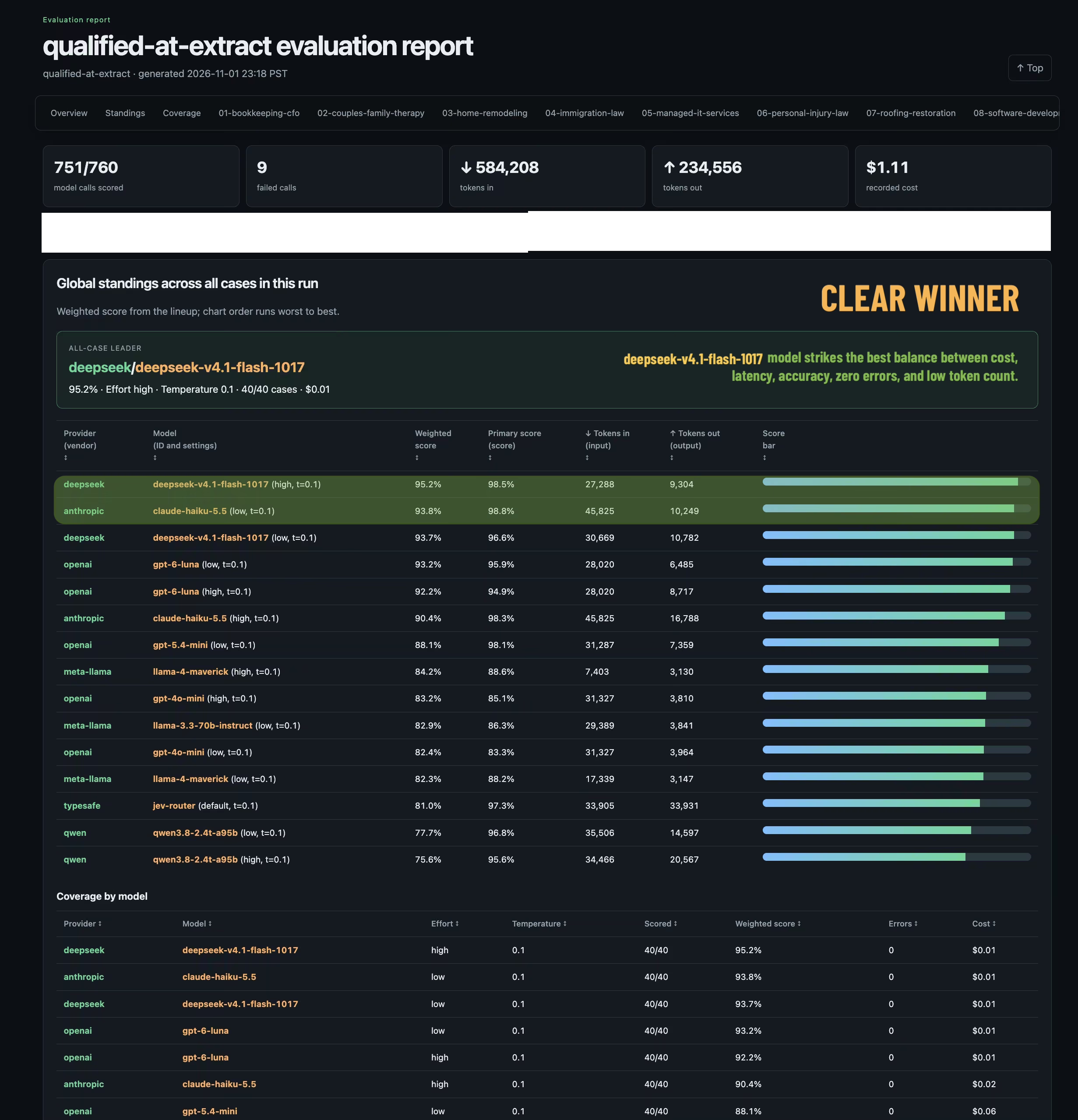
Anyone running Eval suites on Ruby apps? I built a gem to do just that: `llm-evals` Please test-drive and evaluate this gem for your situation. It's hard to see the limitations until other people get involved. The gem is here: kigster/llm-evals And I used it to find the best model for my Rails SaaS application, qualified.at Here is the Evals Report comparing models based on the weighted score: raw.githubusercontent.com Feedback and constructive criticism are always welcome and highly encouraged 😄 Konstantin blog: kig.re
Location: Puducherry, India Remote: Yes, worldwide Willing to relocate: Yes Technologies: C#, .NET, Node.js, Angular, React, TypeScript, JavaScript, Azure, Microservices, REST APIs, MongoDB, Redis, SignalR, AI/LLM integrations, MCP Résumé/CV: ashvolt.github.io Email: pragashvenkat@gmail.com 9+ years of experience building scalable applications, APIs, distributed systems, and AI-powered solutions. Experienced in turning complex business problems and manual workflows into practical, reliable software. Selected projects: - Artwork Preflight Automation: youtu.be | ashvolt/agents - Free2Genius: youtu.be - Civo UI SDK: ashvolt/civo_ui_sdk Portfolio: ashvolt.github.io GitHub: github.com/ashvolt
@GeoffreyHuntley i prefer the anti-coc github.com/kysely-org/kysely/blob/master/CODE_OF_….
SolverForge is the open-source constraint solver I founded: native Rust core, Python surface. Scheduling, routing, allocation. SolverForge/solverforge
354 km in a single hop: a tropospheric duct linked two Meshtastic networks in Argentina (MediumFast, 915 MHz) On the night of Nov 1-2 a tropospheric duct along the coast linked two independent Meshtastic networks in Argentina: ComarcaMesh (Viedma and Carmen de Patagones) and SOMesh (Bahía Blanca and region). People in both cities ended up chatting on the public channel. What the station in Viedma recorded: 354.3 km in a single hop between two fixed routers on towers: PAT1, a SenseCAP Solar P1 in Carmen de Patagones, and C-3A, on a 90 m tower in Tres Arroyos. The hop shows up in 18 traceroutes, 4 of them in both directions. Best SNR: −6.5 dB at PAT1 and −7 dB at C-3A. 4 direct hops between the two networks, all through PAT1: 354, 273, 247 and 242 km. Two openings, 20:36-23:43 and 00:33-04:30 local time, 7 h 04 min in total. 656 packets from 70 nodes of the Bahía region reached Viedma. A traceroute from Viedma to ElArroyoMesh, 416 km away near Carhué, came back with 5 relays each way. PAT1 had been on its tower for about a day when this happened. Why it worked: after sunset the air right above the sea got cool and humid under warm, dry air, and that inversion made a duct 60 to 85 m thick along the coast. Without it, the radio horizon between those antennas is about 90 km. ECMWF, GFS and GEM all showed the duct over the sea that night, and Tropocast and the Hepburn index had the coastal strip marked. As far as we can tell it's longer than the 331 km record on the Range Tests page, and we didn't find a longer direct hop confirmed in both directions between fixed stations. Longer one-way receptions over the sea have been reported in Europe (475 to 822 km, 868 MHz). Happy to be corrected. Full report with every traceroute, the propagation analysis and the data (packets, receptions, raw public-channel packets and a script that recomputes the numbers): comarcamesh.com.ar Short bulletin (PDF): comarcamesh.com.ar Everything was logged by meshbox, the open-source gateway and map we run in Viedma (github.com/marcomagnaiot/meshbox). Thanks to SOMesh for C-3A's antenna height and their public map. Happy to answer questions or share more data.
Char Builder Lite 4.15.0 - U81.4/U82 - Enhancement pass 4.15.0 - U81.4/U82 - Enhancement pass Changes: Updates for U81.4 and U82 Enhancements updates Huge & monstrous thanks to Yhelm and Peng for updating the feats and enhancements files and basically keeping this project alive. It's been over 7 years since I took over for EllisDee376 and his initial release of this tool, and its been a pleasure keeping it working and adding all the new features. Character Builder - Version 4.15 - All sorts of updates to Enhancements - Addition of Cantrips as auto granted feats - Minor fix to the second Deity enhancement selectors to line up to the first Deity enhancement - Update to use the new RES file - FIX: Dhampir deity issues Crafting - Version 3.4.0 - Updates to shards and scaling by Peng including a nice addition of a dual effect grouping - Update to use the new RES file Compendium - Version 1.22.0 - Update to use the new RES file General - Changed how the RES files are built to work with a compiled RC file. This will allow much easer updates of icons for new crafting ingredients and additions to the solar/lunar gems Thanks: As always, thanks to Yhelm and Peng Release info: ddo-lite-tools/releases Download: 2026-11-02_DDOLiteTools.zip
Location: India Remote: Yes Willing to relocate: No Technologies: vLLM, SGLang, Prometheus /metrics, Python, GPU benchmarking (T4, L4, L40S, RTX 3090, A100) Résumé/CV: github.com/qaisermehdi3-coder Email: qvunexaudit@gmail.com Looking for fixed-price contract work: I measure what self-hosted LLM inference really costs. GPU cost per request at your real load, how much paid GPU time serves nothing, and which GPU is cheapest for your answer-time target. I read only vLLM's or SGLang's own /metrics, so nothing in your stack changes. If you won't run my script on your servers, I rent the same GPU, run your model and settings, and send the report. Sample (RTX 3090 vs A100, Qwen 7B, vLLM 0.27.1): at the same load the 3090 was cheaper per token; at a 6-7 s answer time the A100 was about 4.6x cheaper. github.com/qaisermehdi3-coder/qvunex/tree/main/be… Try it: which measured GPU is cheapest at your answer time, one file, standard library: github.com/qaisermehdi3-coder/qvunex/tree/main/be… Recent public work: pydantic-ai fixed a $0-cost bug I reported (#9491); AgentMeasure runs my self-hosted evidence case in their CI; sent fixes for Kedify's vLLM autoscaling examples (one approved); measured two vLLM servers on one GPU for vLLM #60599. Free first step: send your model, vLLM flags and typical prompt/answer length, and I'll run a short mini-report on a rented GPU. The full report is $1,500 for one setup, $3,000 for a fleet, about a week, half upfront.
"I can't run more than 2-3 Claude Code sessions, I'm the bottleneck." That's the problem Clippy is for: agents queue questions on one sticky note, standing orders answer the routine ones, and you only see what needs you. geetbatth/professor-clippy
DeepSeek liberó el código de Super-agent:un prototipo que coordina tareas,mantiene su estado,recupera ejecuciones y controla autorizaciones.Lo interesante no es usar varios agentes,sino organizar trabajo autónomo y persistente con menor supervisión humana deepseek-ai/dsh-superagent-prototype
5 repos GitHub gratuits pour booster Claude Code #shorts 5 repos GitHub pour doper Claude Code : 1. Superpowers : obra/superpowers 2. Claude Mem : thedotmack/claude-mem 3. Context7 : upstash/context7 4. Skills officiels d'Anthropic : anthropics/skills 5. Agents de wshobson : wshobson/agents Lequel tu installes en premier ? Dis-le en commentaire. Musique : « Let's Move » de Michael Ramir C. (Mixkit) #claudecode #ia #github
I deleted my way to a 175% score increase, and measured every wrong turn Over the hackathon's 72-hour window — on top of a preparation period the rules explicitly allowed beforehand — I optimised four programs for Speed Demon 2026. The overall score went from 28.468 to 78.149 — a 175% increase. Every point came from the live board, and I have the measurements to show for it. But this post is not about the wins. It is about the eight changes I built, verified, measured, and then deleted — because those are the ones that taught me what actually moves a score, and because a submission that only reports its wins is telling you half the story. Here is the single most useful thing I learned, and it took me most of the window to accept it: > Adding mechanism almost never paid. Deleting code almost always did. I'll show you the numbers. > Scope of the window. The rules allowed design, specification and environment preparation before the clock started, and all four tracks were planned to module level in that period. A correctness-first version of each program existed from before the window; the version described here was rewritten, measured and frozen inside the 72 hours, and that is where the score went from 28.468 to 78.149. The plan is in the repository, including the places measurement proved it wrong. --- What the thing is Four independent tasks, four standalone Rust programs, one source file each, no crates, no dependencies, no network in the build. The build is rustc on a single file inside a digest-pinned container. | | Track | What it does | Input | |---|---|---|---| | 🅰 | Ingest | hourly percentile aggregation | 239 MB access log | | 🅱 | Index | 50,000 boolean + phrase queries | 254 MB corpus | | 🅲 | Join | hostile CSV → country aggregates | 202 MB | | 🅳 | Traverse | 2,000 exact shortest paths | 5 M edges | The score is a product of four independent axes: K = (T_ref / T)^0.50 · (M_ref / M)^0.20 · (S_ref / S)^0.15 · (D_ref / D)^0.15 points = 50 · log10(K) overall = geometric mean of the best three tracks And the cost of one point on each axis is wildly different: | Axis | What one point costs | | |---|---|---| | Time | 8.8% faster | the ordinary target | | Memory | 21% less | expensive | | Source | 26% fewer lines | the most expensive — and the most reliable | That table is the whole strategy. Source is the most expensive axis to buy and the easiest to improve, because it rewards deletion. Once I understood that, the project changed. flowchart LR I["an idea"] --> B["build it"] B --> V{"exact?<br/>full corpus × 5<br/>+ tiny oracle<br/>+ official sample"} V -->|"no"| F["find the bug"] F --> V V -->|"yes"| M["measure it<br/>interleaved, smallest of N"] M --> P{"does it pay<br/>on the board?"} P -->|"yes"| K["keep it"] P -->|"no"| R["<b>delete it</b><br/>and write down why"] K --> L["PERF.md"] R --> L L --> I The delete branch is the point. A losing change gets removed from the source, not merely superseded — because final scoring measures the frozen commit, and the board's "keep the best" rule does not transfer to it. --- Where it finished ┌──────────────────────────────────────────────────────────────────────────┐ │ TRACK TIME MEMORY SOURCE BOARD POINTS │ │ 🅰 Ingest 26.0 ms 19 MB 626 lines 80.046 │ │ 🅱 Index 140.0 ms 47 MB 708 lines 75.124 │ │ 🅲 Join 24.0 ms 9 MB 721 lines 79.370 │ │ 🅳 Traverse 170.0 ms 71 MB 536 lines 68.589 │ ├──────────────────────────────────────────────────────────────────────────┤ │ OVERALL (best three, geometric mean) ............... 78.149 │ │ Starting point ..................................... 28.468 │ │ Wrong answers ever published ....................... zero │ └──────────────────────────────────────────────────────────────────────────┘ Now the failures. --- I believed build flags were the difference, so I tried target-cpu=native Every track was ~1.2× slower than the fastest entry. The gap was 61–102% time on every track, across four different algorithms in two languages. That looks systemic, so I tried the systemic fix: rustc -C target-cpu=native ... Result: slower on all four tracks. | Track | x86-64-v3 | native | Change | |---|---|---|---| | 🅰 | 0.02653 | 0.02710 | +2.1% | | 🅱 | 0.17049 | 0.17524 | +2.8% | | 🅲 | 0.03541 | 0.03561 | +0.6% | | 🅳 | 0.16986 | 0.18123 | +6.7% | I reverted it and moved on, but I didn't understand why, and an unexplained measurement is a hypothesis, not a conclusion. The answer came much later, and it is the best single fact I learned about this competition: > The machine that compiles is not the machine that runs. The board's build host has AVX-512. The scoring CPU is a Core i5-13500, Alder Lake, whose AVX-512 is fused off. So native resolved against the builder and emitted instructions the scoring machine did not want. I later switched to naming the target explicitly — and the board measured that worse too, so I reverted that as well: A 80.046 → 79.716 C 79.370 → 79.142 B 75.124 → 72.908 D 68.589 → 67.822 Twice on the same axis, theory and measurement disagreed, and both times measurement won. x86-64-v3 is what every banked best was measured with, so that is what got frozen. --- I believed lto = fat and a smarter probe would pay. Both lost. Two more experiments that looked obviously right: | Experiment | Expected | Measured | | |---|---|---|---| | lto = fat + embed-bitcode | cross-unit inlining | +12.5% slower | at codegen-units=1 there is no cross-unit LTO left to do | | Grouped four-slot term probe | a big scan win | scan +20%, total +14% | our table grows at 50% load, so a probe ends at the first or second slot — and a scalar compare beats a 32-byte load plus three AVX2 ops | The second one already told me something important: if skipping the hash and probe entirely for most tokens doesn't help, the term lookup is not the bottleneck. I wrote that down and it saved me from two later dead ends. --- I believed faster labels meant fewer bytes. They meant more lines. Our Track D's own PERF.md named the open question: "the attack is the label and heap data structures, not the search size." So I built 16-bit saturating distance labels with a 64-bit fallback, verified 99.7% of our answers fit in 16 bits before writing a line, and implemented it. It was exact on every net — full corpus, tiny hostile oracle, official sample, 120 random fuzz graphs, 48,000 logic queries. And the board said: D before: T 0.16986 M 70.57 MB S 536 -> 68.589 D after: T 0.19356 M 73.31 MB S 658 -> 66.338 +13.9% +3.9% +122 lines Slower, heavier, and 122 more source lines. Here is why, and it is the most transferable lesson in this post: > The exactness rule requires a second search body for the queries the narrow store cannot hold — a duplicate of the entire relaxation loop. That fixed cost is charged to every query, while the narrower labels only pay off on queries long enough for label cache lines to matter. On a corpus whose median answer is 1207, the cheap half of the trade never arrives. And on this track source is the expensive axis (26.4% of lines per point against 8.8% of time), so the duplicate loop cost more than the label width saved. The bug I made while writing it is worth showing, because the hash gate caught it: // WRONG -- an unvisited rival label is infinity, so a plain add wraps // to nd - 1 in release mode: a spurious meeting that stops the search early. best = best.min(nd + other[0].get(v)); // RIGHT best = best.min(nd.saturating_add(other[0].get(v))); One character. The published hash caught it on the tiny hostile oracle, the official sample and the full corpus. --- I believed I should measure locally and move on I ran three experiments that "obviously" help an I/O-bound parser, and the machine disagreed with all three: | Experiment | Why I expected it | Measured | |---|---|---| | MADV_POPULATE_WRITE on the output map | fewer page faults while formatting | 0.039 → 0.069 s | | MADV_SEQUENTIAL on the 239 MB log | better readahead | parse 0.0289 vs 0.0233 s | | Dropping the corpus pages after the scan | less pressure | inside the noise floor, and 16 certain source lines | Then I learned the reason local measurement kept misleading me. Run-to-run spread on time reaches 16% on identical code. My rules became: 1. Interleave the variants. Alternating A/B/A/B, not one block then another. 2. Trust the smallest, not the mean. A loaded machine can only make a run slower. 3. Measure the phase, not the total. A total tells you a change helped. It never tells you why. That third rule produced the single most valuable measurement in the project. --- I believed Track A was a memory problem. Measurement said parser. Every idea I had for Track A had been about memory: hold fewer records, release chunks sooner, drop pages after use. Then I added phase laps and got this: 🅰 parse 50.8% ← the parser is over half the track hours 24.4% text 22.0% rank 2.8% size+map 0.6% Nobody had measured that. I had been optimising the wrong half of the program. The same instrumentation then named the other bottlenecks: <details> <summary><b>The measured bottlenecks, one per track</b></summary> flowchart LR A["🅰 parse 50.8%<br/>24.4% hours, 22.0% text"] --> B["🅱 corpus scan 70%"] B --> C["🅲 every record,<br/>three random reads each"] C --> D["🅳 construction 66%<br/>search only 33%"] </details> And the plan had missed all of them. Three of the four tracks had to be re-attributed by measurement before they could be made faster — which is why the repository keeps its pre-build plan, including the places it was wrong. --- What actually paid: four deletions Every large gain was a removal. Not one was an added mechanism. | Track | Change | Result | |---|---|---| | 🅰 | cut the parser and formatter from 704 → 440 lines | first big jump | | 🅰 | drop(parts) before the output map, not after | +1.20 points, memory 31.4 → 23.94 MB | | 🅱 | bucketed u16 build, then the class-renumber rewrite | 61.65 → 72.62, memory 219 → 49.7 MB | | 🅲 | delete the pre-pass; Phase claim primitive; 1 MB name table | 66.81 → 74.02, lines 1105 → 652 | | 🅳 | restore PR_SET_THP_DISABLE | +25 MB recovered | And the two rewrites that moved the board furthest both got faster and smaller: 🅱 72.829 → 75.124 (+2.295) time −17% 683 → 644 lines 🅲 75.345 → 79.370 (+4.025) time −32% 610 → 582 lines Track C is the clearest example. Instead of walking each CSV record field by field, the input is classified: each 64-byte block becomes quote, comma and LF masks at once, and the "inside quotes" state falls out of one carry-less multiply computing the prefix XOR of the quote mask: let q = mask64(lo, hi, b'"'); let inq = _mm_cvtsi128_si64( _mm_clmulepi64_si128::<0>(_mm_cvtsi64_si128(q as i64), _mm_set1_epi8(-1)) ) as u64 ^ inside; inside = ((inq as i64) >> 63) as u64; That one idea replaces the entire quoted-field scanner — and it deletes the code that used to do it. A "" pair turns quoting off and on again with no special case at all. Track B's rewrite is the same story on a different axis: the term table went from a 32-byte lowercased vector with a byte comparison per probe, to a 64-bit hash built from bzhi-masked 8-byte loads. The keys array is gone. The byte compare is gone. Smaller and faster at the same time. --- I believed one corpus was enough It isn't, and the way you find out is a bug that passes one and fails another. The gate became: 1. FULL CORPUS 5 runs, each sha256-hashed every run must equal the pinned expected value 2. TINY HOSTILE ORACLE hand-built boundary cases 3. OFFICIAL SAMPLE the organizers' published sample Five runs, not one — a schedule-dependent defect can pass a single run. And the tiny oracle covers: zero weights, parallel and duplicate edges, self-loops, isolated vertices, unreachable targets, 64-bit sums, "" escapes, bare newlines inside quoted notes, mixed CRLF/LF endings, a byte order mark before a record, s == t, and empty inputs. Two bugs it caught that I would not have found otherwise: // Track B: an out-of-bounds read. insert() called key() unconditionally, // and key() computes `32 - len` on a usize -> underflow for a term over 32 bytes. // Track C: my Windows fuzzer wrote corpora in text mode, so CRLF crept in. // D's number() consumes ONE byte past a number, so it ate the CR and read // the LF as the next number's first byte -> 0/40 Windows trials vs 120/120 Linux. // Fix: newline="\n" on every corpus writer. A check whose expected value you invented is not a check. Early on I compared a track against a hash I had typed by hand rather than produced from the reference. It was wrong, and removing it was the right call. --- The failure that was not a failure Late in the window a terminal showed me this in four files: # PERF.md — Track A (Ingest) Classic UTF-8 mis-decoded as Latin-1. I reported it as broken and started writing a repair. Then I checked instead of assuming. The files were fine. Zero damaged sequences — all four decoded as valid UTF-8 without error. The — was my terminal's codepage failing to render a 3-byte em-dash, not a defect in the files. Rewriting correct bytes to chase a console artifact would have corrupted four files whose entire purpose is precision — and I would have reported a repair that repaired nothing. --- Where the failures actually were The formulas were the easiest part to get right, because a simulation has no stake in my being right. Every serious failure was somewhere else: - a one-character arithmetic bug that wrapped instead of saturating - an out-of-bounds read from a subtraction on an unsigned type - two dependent cache misses per vertex where one would do - consistency measured on the wrong axis — a genuine time win that cost more in source lines than it earned - 16% run-to-run noise that made three "obvious" wins look like losses until I started interleaving - a design assumption (that Track A's cost was memory) that the whole plan rested on and one measurement destroyed Not one of them was an algorithm problem. They were a missing saturation, an underflow, a cache-line boundary, a scored axis I wasn't optimising, a measurement method, and an assumption nobody had tested. --- Honest limits The repository documents its own weaknesses rather than hiding them, and so does this post: - 🅳 Track D's query queue retains its pool capacity between queries. It is emptied but not shrunk, so it holds every pushed entry including stale ones, where the heap it replaced freed on pop. That is the memory keeping it at 68.589 while its time is the best that track has ever recorded. - 🅲 Track C identifies a name by 32 key bits plus a slot group, not full bytes. That is what makes the 4-byte slot — and the compact table and eight-wide probe — possible, and it is exact on every corpus published. The residual collision probability at this scale is documented in the source. - 🅱 Track B identifies a term by the top 46 bits of a 64-bit hash, not a byte comparison — far below any practical collision rate at this vocabulary, but no longer exact by construction. - 🅰 Track A's parser is unoptimised relative to what is possible. It is 50.8% of the track and it has never had the multi-stream treatment. And the route to 80 is written down with its arithmetic, not claimed as done: with B held at 75.124, the product A × C must rise 7.27% — about 250 deleted lines across those two files, since source is the axis that has paid every time. --- What I would tell you before you start 1. Measure where the time is before you touch anything. One afternoon of phase laps changed this project more than a month of guessing. 2. Interleave your A/B runs and trust the minimum. A loaded machine only ever makes things slower. 3. Delete before you add. It is the cheapest axis and the most reliable one. 4. Assume your build host is not your run host. Name the CPU explicitly. 5. Verify on more than one corpus. One corpus is a guess. 6. Write down what you reverted, and why. It stops you retrying the same idea later, and it is the most credible thing you can publish. --- Try it git clone https://github.com/pal-123456789/speed-demon cd speed-demon # build a track exactly as the scored path does -- rustc only, no cargo, no network sh track-a/build.sh # check correctness on the tiny hostile oracle and the official sample tooling/check-corpora.sh a summary.txt "$(cat track-a/verification/expected/summary.txt.sha256)" Each track is a complete, independent build context: its own Dockerfile, build.sh, source, README.md and PERF.md. Repository: pal-123456789/speed-demon Frozen release: github.com/pal-123456789/speed-demon/releases/tag… Inside, if you want the long version: | Read | For | |---|---| | docs/JOURNEY.md | the full narrative, including every reversal and the two measurements I got wrong | | docs/TECHNIQUES.md | every optimisation, by track and by the axis it attacks | | docs/MEASUREMENT.md | how every number was obtained, and what is deliberately not claimed | | plan/README.md | the pre-build plan — including where measurement proved it wrong | | track-*/PERF.md | each track's own ledger, with a KNOWN / EXPECTED / REVERTED honesty legend | --- Written for the Speed Demon 2026 write-up quest. Every number in this post is a live board measurement or a locally reproducible one; the eight experiments described as losses were all built, verified exact, and deleted.
My seeddb file isn't working with my decyptor. This is the seeddb file I'm using This is the decryptor. (got it from r/roms) I'm just trying to get pokemon picross to work on my phone cause I love that game. I got a .3ds file from minerva. But even though the seeddb has one for pokemon picross, the decryptor says it doesn't see one. Does anyone know what I can do?
Links from the night: My slides: jensenloke.github.io Take-home setup: jensenloke/claude-qwen-modelscope Bennett's software factory talk: benclmnt.com
Show HN: Go (style) linter for dangling package-level functions I'm one of those who doesn't like dangling top-level functions polluting the package namespace and has to belong to some type via receiver to make some logical sense and "feel less cluttered" after decade in the other language ecosystems. After leaving this exact complaint (among others) in hundreds of PR reviews, I thought it's going to be fun automating this, as wanted to dig through golang.org/x/tools/go/analysis for quite a while now. It turned out that analysis.TextEdit is more fun than the linter itself, so that fixes could happen automatically and funcs undangle as pointer receiver methods if a concrete func is used just within one type. Give it a spin and tell me what you think. My two hours of internet search didn't yield any similar things out there. As the most of the linters, it's a stylistic choice, that may or may not fit your orgs. Maybe it'll make your life easier. CAUTION: Don't run with `-fix` on non-staged changes yet. PRs are very welcome, especially with more corner-case fixtures.
okay here's a cute little skill to create simple and subtle app store header and search result videos. kairon007/app-store-header-video Go Crazy!
Leggio, a sheet music viewer for Linux tablets I made a small app for reading sheet music PDFs on a tablet, mainly so I can put my Surface on the music stand instead of paper. MrGilfy/leggio It's built for touch: tap the left or right side of the screen to turn the page, tap the middle to show the controls, swipe and pinch to zoom work too. Buttons are big so you can hit them at arm's length. In portrait it shows one page, if you rotate to landscape it shows two pages side by side. The screen stays awake while a score is open, and a Bluetooth page-turner pedal works as well. You can also draw on the scores, set jump links for repeats like D.S. or Coda, and export the marked-up version as a PDF. The original files are never changed. It's GTK4/Python and open source. On Arch it's in the AUR (yay -S leggio), otherwise there's a Flatpak on the releases page. MrGilfy/leggio
Location: New Jersey, USA Remote: Yes, remote only Willing to relocate: No Technologies: TypeScript, JavaScript, React, Next.js, React Native, Node.js, Python, Rust, PostgreSQL, GraphQL, AI/LLMs, OpenAI APIs Résumé/CV: tyrpien.com Email: bartlomiej.tyrpien@gmail.com I'm a senior full-stack/product engineer with 10+ years of experience shipping web, mobile, and desktop software. Previously at Kraken, where I was one of two frontend engineers who built Kraken Pay from 0 to 1. Currently building AI tooling and agent management dashboards at Charlie Labs. I also built and run Telemetry Studio, a desktop app for adding endurance-sports data overlays to video, with paying customers (telemetrystudio.com), and created Oko, an open-source code-search tool for coding agents (bartlomein/oko). Looking for a remote senior full-stack or product engineering role. Website: tyrpien.com GitHub: github.com/bartlomein
Spynel users were enjoying a SOTA super-agent before super-agents were even a thing. Check it out on GitHub: agent0ai/spynel Speak to one agent that takes care of the orchestration and all the tasks.
ShrimpReel 最近的更新 🦐 开源(MIT)的 AI 跳舞视频站模板,一套代码就能做出一个热词站。 · 成片自动配背景音乐 · 宠物也能跳舞(Christmas Dance AI 已上线) · 先体验后登录,还能用手机扫码传图 · AI 标记、成片审核、拒付处理 qianshuixia/shrimpreel 1/ 背景音乐 背景音乐:每种风格的每个时长配一段音乐,视频生成后用纯 JS 直接替换音轨。画面不重新编码,在 Cloudflare Worker 里就能跑完。换不了时保留原片,不会让任务失败。 Christmas Dance AI 已经用上了,配乐是用 Eleven Music 生成的原创纯音乐。 2/ 宠物 Christmas Dance AI 现在支持宠物了 🐶 上传一张狗或猫的照片,它会用后腿站起来,在圣诞树旁跳派对舞,爪子还是自己的爪子。 精灵舞效果一般,容易变成人形身体配宠物的头,页面上如实写了,推荐选派对舞。 christmasdanceai.com 3/ 合规 合规这块补齐了: · 成片里写入 AI 生成标记(IPTC XMP),配一个本地验证页,为欧盟 AI Act 第 50 条准备,默认关闭 · 可选的成片抽帧审核:不通过就删片、退积分 · 生成时记录用户勾选的同意文案 · Stripe、Dodo 的拒付和争议自动回收积分,赢了再补回 4/ 转化和内容 转化和内容: · 生成器草稿存在浏览器里,登录、付款回来都还在 · 电脑上扫个码,就能用手机选照片 · 统计同意弹窗只对欧盟、英国、瑞士的用户显示,其他地区不打扰 · 文章页可以嵌入风格样片和 FAQ,并带 FAQPage 结构化数据
AI agents can pay on their own, but every agent starts from zero. Mandate: your money rules live as memory on @WalrusFoundation, agents pay via x402 on @SuiNetwork, every tx verified by @Tatum_io 🧠💰 #TotalRecall 🎥 youtu.be 💻 fadillaoegi/mandate-walrusxtatum
Has anyone tried Raven from Evermind? Looking into it and it seems alot like deepseek superagent before DSH superagent.. Kinda shocked I can't find anything on reddit about this. Really intrigued by it, but want to find some anecdotal stuff from the community before I go through the labor of tinkering and testing. Anyone tried this thing? EverMind-AI/Raven
La regla que me dejó armarlo: las aprobaciones te tienen que llegar donde estés. Si un bot espera tu OK y vos estás en la calle, el bot está parado. Si algo falla: sudo bash provisioner/prepare.sh --check Repo: gabogabucho/hermes-alado
I got tired of juggling Matt Pocock’s skill tickets, so I built a board for them I’ve been using Matt Pocock’s skills (wayfinder, grill-me, to-tickets, implement) for a while. They write tickets as markdown files into .scratch/<feature>/issues/ in the repo. I like that a lot because everything stays in git and there’s no Jira. The problem was keeping track of it all. I’d have 15 ticket files across 3 features. I’d forget which ones were blocked by something else, which ones I’d already grilled, and which tmux window had which claude session. I kept opening files just to read the Status: line. And when two sessions worked in the same checkout at the same time, they’d mess up each other’s files. So I built Scratchboard. It’s a local web board that reads those markdown files and shows them as cards in columns: Blocked → Ready → Grilling → In progress → Resolved. It doesn’t keep its own database. The ticket files are the only state, so if you edit one by hand the board updates. What it does: - Drag a card and a session starts. Ready → Grilling starts a fresh /grill-me session on that ticket. Grilling → In progress starts a fresh /implement session that builds from that brief. Every ticket gets its own clean session, so context from one ticket never leaks into the next. - Each implement session runs in its own git worktree, on a branch like sb/<feature>/<ticket>. That means I can have 3 or 4 tickets being built at once without them stepping on each other. - Sessions land their own work. When it’s done, the session rebases onto the branch you started from, runs the tests again and fast-forwards your main branch. No merge commits and no PRs to merge by hand. - Edit tickets from the board. You can open a ticket’s markdown in the side panel, edit it there, or copy its path. - Map buttons. If a feature has a map.md, you get “Chart” and “Slice” buttons. Chart turns the open questions into decision tickets. Slice turns the decisions into build tickets once they’re all resolved. - tmux or a built-in terminal. With tmux, sessions run one window per ticket and “Open” attaches you to it. Without tmux there’s a terminal in the browser (node-pty), so it works on Windows too. - Claude or Codex. There’s a toggle on each card if you want a ticket done in Codex instead. - Desktop notifications when a ticket resolves, can’t land, or a session stops without finishing. - Light/dark theme, because of course. Run scratchboard in a repo and it opens the board. scratchboard stop Stops it. Processing gif 0mtiwd10d8zh1... It’s still rough in places, and it only makes sense if you already use those skills or the same .scratch ticket format. I’ve been using it every day for my own stuff, though, and it’s changed how I work with agents. I spend more time writing and grilling tickets and much less time babysitting terminals. aliraza944/scratchboard
1. Instalá Hermes Agent con el instalador oficial: curl -fsSL hermes-agent.nousresearch.com | bash 2. Instalá Alado: git clone gabogabucho/hermes-alado && cd hermes-alado sudo bash provisioner/prepare.sh --all --domain tu.dominio
Official Issues/Enhancements Reports and Requests Thread
New OpenMW-RTX release! - squeezed a few more fps for AMD gpus - fixed overexposed interiors - config for GUI/font scaling - additional bounce light samples for those with beefy -- gpus - few minor issues fixed - SteamDeck playable github.com/xorza/openmw-rtx/releases/tag/rtx-v0.3… t.co
Positron developer here 👋 if it's any solace, l just removed that notification from showing unless there is a Python console running (boring backstory, a Python may be used in background for LS purposes) positron#16924 LMK if you see this again once we do our monthly release this week!
@bhavin_Confuse Utterance IDs, with the original text, role and date attached. The public API doesn't expose character offsets for spans. github.com/memoket/memoket-kite/blob/main/docs/ap…
I built an app that tells you if a skincare product suits your skin before you buy it (one skin scan, then every product shows "fits" or "caution" with the reason) Mirror, mirror, on the wall, will this serum suit me at all? 🪞 Silver Mirror is a check-before-you-buy skincare app built on r/YouCamAPI - YouCam Skin Analysis (HD) reads your skin from one consented scan (Low / Medium / High bands, never a score). The photo is deleted from YouCam right after. - YouCam Makeup VTO lets you try tinted sunscreen shades on your own face. Then every product you browse shows if it fits your skin and why, and you buy on Amazon, Flipkart or Nykaa. Everything in this video is real: a live YouCam scan and a live YouCam try-on on a real phone. Built for the YouCam API Skin AI & eCommerce VTO Hackathon (Perfect Corp). Code and Android APK: codebreaker32/silver-mirror Cosmetic guidance, not medical advice.
Please star this repo to support @alisis_official terrarium-sh/terrarium This tool currently supports our very own @TezCapital support bot in Discord & Telegram.
@realWeZZard minagishl/apple-intelligence-remover 我用的这个立省12g
I built Agents Kit Svelte: open-source Svelte 5 components for AI agent interfaces. Chat, tool approvals, Kanban boards and schema-driven UI. Here’s structured output becoming an interactive chart. A port of Agents Kit, with extras: RSynapse/agents-kit-svelte t.co
One `.contiguous()` call makes Qwen2 decode 2.4× faster in Candle on Metal: 42 → 102 tok/s at 2k context. After prefill, V is a transposed view, so each `Tensor::cat` copies the whole KV cache. Candle PR #4077: candle#4077 Numbers, repro: inertialabs.xyz
Leggio, a sheet music viewer for Linux I made a small app for reading sheet music PDFs on a laptop or tablet, for example on the music stand of a piano. MrGilfy/leggio You add your PDFs to a library, and when you open one it trims the white margins so the notes are bigger. Pages turn with a tap, swipe, the keyboard or a Bluetooth pedal. You can also draw on the scores, set jump links for repeats like D.S. or Coda, and export the marked-up version as a PDF. It never changes the original files. It's GTK4/Python, open source, and should work on any desktop. On Arch it's in the AUR (yay -S leggio), otherwise there's a Flatpak on the releases page. MrGilfy/leggio
wouldn't mind if @ProtonMail spent a little less time worrying about "going faster" or "being left behind" and a little more time, say, getting basic keyboard navigation right used AI to fix that, btw: 1cg/fix-proton-mail
2. Sierra's tau-bench Study a retail task alongside its policy and tools. See how the rules determine which account changes are allowed. sierra-research/tau2-bench
Confidence-Routed Agents: Cheap First, Frontier on Escalation Originally published at webofmike.com on 2026-11-02. The demo repo and every command in it were run before publishing. Escalating every uncertain agent decision to a frontier model sounds like the safe default. On a 240-case benchmark it was also the worse one: routing by confidence and escalating only when a cheap model said it wasn't sure cost half as much as escalating everything, and scored higher. jev-benchmark measured TypeSafe AI's Jev against Claude on the same agent tool-call risk task. jev-calibration went further and measured whether Jev's own confidence score could be trusted to make a routing decision, and found a specific, usable threshold: a confidence of exactly 1.000 was right 133 times out of 134 on 240 labelled cases. Neither post built the thing that threshold is for. "Escalate when confidence is low" is not a model feature, it is a two-call routing problem, and routing problems belong at a gateway. This is that gateway, built and run for real: themsquared/confidence-routed-agents. What was built A router calls Jev directly for every task (Jev is a typed-decision API, not a chat model, so it isn't an LLM backend agentgateway knows how to proxy). When Jev's confidence clears the threshold, its answer is the answer. When it doesn't, the router escalates to Claude Sonnet 5, and that one call goes through agentgateway v1.5.0 instead of straight to Anthropic. ┌──────────────┐ confidence >= threshold ┌─────────────┐ task ──────▶ router.py ├───────────────────────────▶ answer │ │ (calls Jev │ │ (cheap │ │ directly) │ confidence < threshold │ path) │ └──────┬────────┘ └─────────────┘ │ │ escalate ▼ ┌─────────────────────┐ budget OK ┌───────────────┐ │ agentgateway ├───────────────▶ Anthropic API │ │ (holds the real │ budget │ claude-sonnet-5│ │ Anthropic key, │ exceeded └───────────────┘ │ per-key USD budget,│ ──▶ HTTP 429 │ access log) │ └─────────────────────┘ Why the gateway sits only on the escalation half: that's the half with a shared, billable credential. Jev's key is the router's own, scoped to a typed-decision API with no spend risk from a runaway loop in the same way a chat model has. The escalation key is exactly the kind of credential this campaign has argued belongs behind a gateway since secretless-ai-agents: the router never holds it, agentgateway injects the real x-api-key on the way out, and the budget and the audit trail live in one place instead of scattered across whatever called the model. The task set is the same 240 hand-labelled agent tool calls from jev-calibration: classify each one as readonly, destructive, privileged, or exfiltration. Reusing it instead of sampling a new set means these numbers are comparable to that post's, not just another unrelated benchmark. The result that mattered Six configurations against the identical 240 tasks, one live Claude Sonnet 5 call per escalation: | Threshold | Escalated | Accuracy | Total cost | Avg cost/call | |---|---|---|---|---| | 0.00 (Jev only, never escalate) | 0/240 (0%) | 90.0% | $0.0042 | $0.0000174 | | 0.70 | 32/240 (13.3%) | 92.9% | $0.0262 | $0.0001090 | | 0.85 | 41/240 (17.1%) | 92.1% | $0.0356 | $0.0001484 | | 0.95 | 61/240 (25.4%) | 92.9% | $0.0520 | $0.0002168 | | 0.99 | 83/240 (34.6%) | 93.3% | $0.0646 | $0.0002692 | | 1.00 (jev-calibration's own cutoff) | 110/240 (45.8%) | 93.3% | $0.0846 | $0.0003523 | | Never use Jev (all escalate) | 60/60 on a 60-case subset | 91.7% (55/60) | $0.0422 (60 calls) | $0.0007035 | Two things here are worth stating plainly instead of smoothing over. The 0.85 row scores a hair worse than both neighbors (92.1% against 92.9% on either side), which at n=240 is noise from a handful of cases crossing the cutoff, not a real dip. Read the 0.70-0.95 band as roughly 92-93%, not as a precise function of the threshold. The real finding is the last two rows against the bottom one. Routing at jev-calibration's own recommended cutoff, escalate anything below exactly 1.000 confidence, cost half of what escalating everything costs ($0.0846 against an extrapolated $0.169 for 240 all-Claude calls) and scored better, not worse: 93.3% against 91.7%. The cheap path is not a compromise that trades accuracy for savings here. Jev's answers at exactly 1.000 confidence were already shown, in the prior post, to be right 133 times out of 134. Sending one of those cases to Claude anyway does not improve on that; Claude's terse, non-reasoning JSON classification call turned out to be the less reliable of the two on the cases Jev was already sure about. Escalating them just spends money confirming an answer you already had right. Going from 0.99 to 1.00 is its own small lesson: it adds 27 more escalations and about $0.02 more cost for zero accuracy change (93.3% both). Past a certain point, a tighter threshold just buys more spend, not more correctness. The threshold that is "tight enough" is a measured fact on a specific task set, not a number to default to 1.0 on faith. The budget actually blocks A threshold set wrong, or an upstream regression that makes Jev return uncertain answers more often, turns an "occasional escalation" path into "most requests hit the expensive model." That is exactly the failure mode a gateway budget exists to cap. Verified with a temporary $0.0002/24h budget, not the real $1.00 one that ships in the repo's config, to prove the mechanism without burning hundreds of calls: call 1 -> HTTP 200 call 2 -> HTTP 200 call 3 -> HTTP 200 call 4 -> HTTP 429 {"error":{"message":"Budget exceeded","type":"rate_limit_error","code":"budget_exceeded"}} agentgateway's own log line for the rejected call: 2026-10-01T14:39:20.199122Z warn budget API key budget exceeded connection.id=4 request.id=4 api_key="router" budget="daily-usd" used=0.000216000 limit_unit="USD" limit_amount=0.0002 exceeded=true used and limit_amount are both computed from the three real calls that preceded the rejection, priced from agentgateway's own modelCatalog rates for claude-sonnet-5, not round numbers chosen to make the demo work. Jev being unreachable does not stop the agent The router's --no-jev flag simulates the cheap path being down: every task falls through to the Claude escalation path with no special-casing in the code, because "escalate" is already the router's only other branch. A production version of this would want the inverse check too (what happens if the frontier path is the one that's down), but the asymmetry is deliberate here: Jev being unreachable should degrade to "more expensive, still correct," not "the agent stops answering." A gotcha worth keeping One case in an earlier full-240 run came back from Claude with no content block at all, just a finish_reason and nothing else, at max_tokens: 128. This is the identical failure the jev-calibration harness already hit at the same token ceiling: Claude's internal reasoning consumed the whole response budget before producing the JSON answer. Raising the cap to 256 did not reproduce it across all 240 cases, and router.py checks for a missing or empty content field explicitly rather than assuming the key is always there. A single silently-dropped answer in an agent pipeline is worse than a slow one; code that assumes the happy-path response shape will eventually hit this. What this does not cover No frontier-vs-frontier comparison; Claude Sonnet 5 is the only escalation backend tested here. No measurement of sustained escalation load over days, only a point-in-time budget trip. And the $1.00/24h budget shipped in the repo's config is a demo value, not a sizing recommendation, you'd size that from measured escalation rate and real model pricing for your own workload. The harness, the task set, the raw per-call results at every threshold, and the agentgateway config are in themsquared/confidence-routed-agents. Frequently asked questions When should an AI agent escalate a decision to a frontier LLM instead of a cheap model? When the cheap model's own confidence drops below a threshold you have actually measured, not a guess. On a 240-case agent tool-call risk benchmark, escalating only cases where TypeSafe AI's Jev returned less than its maximum confidence (1.000) cut cost in half against escalating everything, and improved accuracy from 91.7% to 93.3%. Does escalating every agent decision to a frontier model improve accuracy? Not on this task set. Routing every case to Claude Sonnet 5 with no reasoning budget scored 91.7% (55/60). Routing by Jev's own confidence and escalating only the uncertain 45.8% of cases scored 93.3% (224/240) for about half the cost. The cheap model was more reliable on the cases it was already sure about than Claude was on the same cases. How do you stop an agent's escalation path from running up an unbounded LLM bill? Put a hard budget on the API key that calls the frontier model, enforced where the call actually leaves your infrastructure. This demo puts a $1.00/24h USD budget on agentgateway's escalation key; a temporary $0.0002 budget set for verification returned HTTP 429 with a real dollar figure in the log line on the fourth call, not a simulated one. Does the agent's router need to hold the frontier model's API key? No. In this design the router's only credential is a gateway-scoped key with no model access of its own. agentgateway holds the real Anthropic key and injects it server-side on the escalation call, the same secretless pattern as direct agent-to-LLM traffic, applied to the second half of a two-model pipeline instead of the whole thing. --- *Canonical version, with machine-readable markdown at https://webofmike.com/confidence-routed-agents/index.md: webofmike.com
This is before and after I gave my agent Hermes the Paul Bakaus "Impeccable" designer skill github.com/pbakaus Works for me t.co
✅ 一手来源:DeepSeek Harness 官网 deepseek.com 插件开发文档 github.com/deepseek-ai/deepseek-harness/blob/mast… 注意:插件会在宿主进程里执行代码,第三方教程建议先在测试 profile 里试
Have a look at Hister [1], a 'personal web history search engine' which by way of extensions for browsers captures your web history and stores actual page content on your own instance where it can be browsed and searched. It does not store images so if that's what you're mostly interested in it won't work for you. For text is works quite well, maybe sometimes too well since it also stores ephemeral things like HN comment pages unless you tell it not to. [1] asciimoo/hister
Juggling Claude, Codex and several AI accounts? AI Juggler keeps them in one place. v0.3.4 is out: 🧵 Subagent chats one click away 🚀 Closed apps stay one click from Start 💬 Chats read like the apps' own ✅ Only offers switches that work Get it 👉 github.com/figurehead-ai/AI-juggler/releases/tag/…
agentgateway v1.7.0: How Agent Session Detection Works Originally published at webofmike.com on 2026-11-01. The demo repo and every command in it were run before publishing. agentgateway v1.7.0 (GA, 2026-10-27) can tell which coding-agent session sent a request without any client-side change: it reads the session header the agent is already sending. themsquared/agw-17-hands-on validates the detection rule against the real v1.7.0 binary and a mock LLM backend, no API key, no network calls, five curl requests that show exactly when it fires and when it doesn't. Why this matters before the mechanism Without session detection, agentgateway can rate limit or log by API key or IP address, but it has no way to group the many requests one agent run makes into a single unit. Coding agents like Claude Code, Cursor, and Codex already send a session or conversation id in their own headers so their own backends can correlate turns. v1.7.0 reads that same header. Once agentgateway knows which requests belong together, that grouping is available to any CEL-driven policy: a rate limit keyed per session instead of per key, an audit trail grouped by session, routing a whole session to the same backend, or flagging a session whose request pattern looks unusual. None of this needs the client to adopt a new header or send extra metadata. It needs the client to keep doing what it already does. The headers it reads, in priority order agentgateway's detection logic (crates/agentgateway/src/http/session.rs in the v1.7.0 tag) checks, in order: 1. Any header shaped x-<vendor>-session-id. Claude Code sends x-claude-code-session-id; this is a generic pattern, not a Claude-specific special case, so Cursor's x-cursor-session-id or any other vendor's equivalent is detected the same way. 2. Codex's unprefixed session-id, session_id, thread-id, or conversation_id headers, but only when the request's User-Agent starts with codex. This gate exists because those header names are generic enough that treating them as agent-session signals from any client would produce false positives. 3. A vendor-less x-session-id header, as a last resort. Whichever header matches, the detected value becomes available to CEL as request.agent.session. The rule that silently drops a session id The validation is stricter than it looks, and it fails quietly: fn valid(value: &HeaderValue) -> Option<&str> { value.to_str().ok().filter(|v| { v.len() >= 8 && v.bytes().all(|b| b.is_ascii_alphanumeric() || b == b'-' || b == b'_') }) } A session id under 8 characters, or one containing a character outside [A-Za-z0-9_-], doesn't get rejected with an error. It gets treated exactly like a missing header: request.agent.session is simply never set, and nothing in the response or the logs calls that out. If a session grouping you expect to see isn't showing up, this rule is the first thing to check, not a deeper config problem. Proving it with a mock backend agw-17-hands-on's config points agentgateway's standalone LLM route at a 40-line Python HTTP server instead of a real provider, using v1.7.0's custom provider with the completions wire format: # config/config.yaml config: session: key: disabled # demo only: v1.7 standalone always provisions a session key on first run frontendPolicies: accessLog: add: agent.session: request.agent.session llm: port: 4000 models: - name: mock provider: custom: formats: - type: completions params: baseUrl: http://127.0.0.1:8091/v1 model: mock-model request.agent.session only depends on the incoming request, not on what the backend does with it, so a mock response proves the same behavior a real Anthropic or OpenAI call would. That also means this demo costs nothing to run and needs no API key. Five requests, one gateway: $ curl -s -X POST http://localhost:4000/v1/chat/completions \ -H "x-claude-code-session-id: 79291636abc123" -d '{...}' # request 1 $ curl -s -X POST http://localhost:4000/v1/chat/completions \ -H "x-claude-code-session-id: 79291636abc123" -d '{...}' # request 2, same session $ curl -s -X POST http://localhost:4000/v1/chat/completions \ -H "x-cursor-session-id: cursorsession999" -d '{...}' # request 3, different vendor header $ curl -s -X POST http://localhost:4000/v1/chat/completions -d '{...}' # request 4, no session header $ curl -s -X POST http://localhost:4000/v1/chat/completions \ -H "x-claude-code-session-id: short1" -d '{...}' # request 5, 6-character id All five return HTTP 200. The access log, with agent.session: request.agent.session wired into accessLog.add, is where the real answer is: http.path=/v1/chat/completions agent.session="79291636abc123" http.path=/v1/chat/completions agent.session="79291636abc123" http.path=/v1/chat/completions agent.session="cursorsession999" http.path=/v1/chat/completions http.path=/v1/chat/completions Requests 1 and 2 share a session, as expected from a repeated header. Request 3's completely different vendor header still gets picked up, which is the generic-pattern claim proven rather than assumed. Requests 4 and 5 both have no agent.session field: one sent no header at all, the other's short1 is 6 characters, two short of the minimum. Same outcome, two different causes, neither one visible unless you already know to look for it. This is the same accessLog.add mechanism the v1.6.0 cost-tracking post used to surface llm.cost.total into the request log: any CEL field, request.agent.session included, becomes a logged attribute with one line of config. Overriding detection config.standardAttributes.session takes a CEL expression that runs before the automatic header scan. Returning a string from it sets the session explicitly, which is useful if an internal proxy or SDK already generates its own session identifier under a header name agentgateway wouldn't otherwise recognize. Returning null marks the request as having no session even when a technically-valid vendor header is present. If the expression itself errors, or returns something other than a string, agentgateway falls back to the header-based detection described above rather than failing the request. This repo doesn't set the override, so everything in the demo runs through the default header scan. What this doesn't cover This demo is scoped to proving the detection rule, not building something on top of it. It doesn't exercise a real LLM provider (the mock backend never sees or uses the session value), Codex's User-Agent-gated header set, or any policy that actually acts on request.agent.session, like a per-session rate limit. v1.7.0 shipped a lot more than this one field: MCP tool-call guardrails (written against a pre-release build, now generally available), model-catalog metadata over /v1/models, service-tier-aware cost pricing, and a new agctl standalone analytics CLI. This post is one field, validated. Repo: themsquared/agw-17-hands-on. Release notes: agentgateway v1.7.0. Frequently asked questions How does agentgateway detect which coding agent session sent a request? It scans request headers for any name shaped x-<vendor>-session-id, such as x-claude-code-session-id or x-cursor-session-id, and takes the first valid value it finds. It also recognizes Codex's unprefixed session-id and conversation_id headers, but only when the User-Agent string starts with codex. A vendor-less x-session-id header is the last fallback. The result is exposed as request.agent.session in CEL and in access logs. Why isn't my agent session id showing up in agentgateway's access logs? The value has to be at least 8 characters long and contain only letters, digits, hyphens, or underscores. A shorter or differently-formatted value is treated as if the header were never sent: no error, no warning, the request just has no detected session. Check length and character set first before assuming the feature is broken. How do I log agentgateway's detected agent session? Add agent.session: request.agent.session under frontendPolicies.accessLog.add in the gateway config. The field then appears on every access log line as agent.session=\ Can I override agentgateway's automatic agent session detection? Yes. config.standardAttributes.session takes a CEL expression that runs before the header-based fallback. Returning a string from it sets the session explicitly; returning null marks the request as having no session even if a valid vendor header is present. If the expression errors or returns a non-string, agentgateway falls back to the automatic header scan. --- *Canonical version, with machine-readable markdown at https://webofmike.com/agentgateway-v17-agent-sessions/index.md: webofmike.com
Budo multi-language coding platform for Desktop, Web and Mobile Let me introduce Budo! An early-stage coding platform and runtime for making interative graphic and audio audio apps. Budo gives you a simple and pleasant API for 2D, 3D, audio, MIDI, storage, networking and more. It supports Javascript, Typescript (*), Lua and WebAssembly and runs on Linux, MacOS, Windows, Android and Web (iOS coming later). You find demos and a playground on the website, and Budo has LLM instructions for getting started. It's MIT licensed. I'd love feedback, especially on the API and what you built with it! My preferred demo is the 3d racing game one here: budo-platform.github.io Website: budo-platform.github.io Github: budo-platform/budo
@legostin Hey! This looks really useful! Would you mind opening an issue in our awesome-ai-workflows(github.com/Neeeophytee/awesome-ai-workflows/issues) repo explaining how it could fit into a workflow? We’d love to test it out and, if everything works well, feature it on FlowStacks(flowstacks.xyz) 🚀
Usugami: an offline Android PDF app with no ads Hi, Usugami is a PDF app for Android that I've been building. Everything happens on the phone itself: no servers, no uploads. Features - Make PDFs from photos, Word documents, PowerPoint slides and EPUB e-books - Combine, split and rearrange PDFs, and rotate or remove pages - Add text, drawings, highlights, shapes and pictures to a PDF, sign it, or stamp page numbers and a watermark on it - Shrink, flatten and redact PDFs (redacted text is removed for good, not just blacked out) - Text recognition (OCR) for searchable PDFs, in English, French, Spanish and Hindi What makes it different - Free, with no ads, no in-app purchases and no sign-up - No internet permission, so your files stay on your phone - Tiny download: around 3 MB - Dark mode, plus English, French, Spanish and Hindi translations - Open source under GPL-3.0 To be transparent: OCR is the one part that isn't open source yet. It uses Google's ML Kit, which runs on the device, and I'm planning to swap it for an open-source OCR engine very soon. Get it: download the APK from [GitHub Releases](github.com/Nath-Goa/usugami/releases/latest) (Android 8.0+), or add it to Obtainium for automatic updates. No Google services on your phone? Choose "Usugami-offline.apk", which includes text recognition. Code: Nath-Goa/usugami Feedback, bug reports and ideas for new tools are very welcome. And if you find it useful, a GitHub star really helps.
✅ 一手来源: Paper (arXiv 2610.40613, Oct 29) arxiv.org Code facebookresearch/textseal 注意:Numbers are the authors' own, on three LLMs. "Distortion-free" means output matches the model's distribution, not that the mark survives rewriting.
Using Claude Opus + Lean 4 to formalize variants of Erdős #699 and #1063 Following the recent buzz around Frontier models tackling open math problems, I wanted to see how far Claude Opus could go on concrete open problems when constrained by formal verification rather than pure text generation. I focused on variant formulations of two Erdős problems: Erdős #699: Proved a variant restricted to j\^2 < n. The workflow paired Opus-generated proof sketches with an exhaustive computational search that found no counterexample below 10\^12, and a Lean 4 proof that any counterexample must satisfy n ≤ j² — which is what closes the j² < n variant. (PR #7637) Erdős #1063: Solved lower-bound variants and structural constraints with iterative prompt refinement. (PR #7552) Both of these are PRs to google-deepmind/formal-conjectures that were approved in maintainer review. The Workflow & Takeaways: Don't trust text output for math: Unassisted reasoning chains frequently slipped into subtle circular logic. Lean 4 as the ground truth: The only effective way to make progress was requiring the model to generate syntax that compiles in Lean. When the elaborator threw errors, feeding Lean’s diagnostics back into Claude caught phantom steps that human reading missed. Human-in-the-loop steering: The model struggled with global proof strategy but was strong at bridging intermediate lemmas once given the high-level architecture. Paulee314/erdos699-lean Paulee314/erdos1063
给墨墨背单词写了个 MCP 服务(maimemo-mcp)每天被机监控学没学有点爽呀。 还可以负责干掉词本管理这种繁琐工作。多批处理单词管理之类的。 Termux / Docker / VPS 都能跑 tutu-kitty/maimemo-mcp #人机恋
@ash_twtz the open-source one that actually exists is kimo: tell codex or cursor 'cut the silences, add captions, colour grade, export' and it does it over mcp. no gui, one ~15mb rust binary. naman-sharma12345/kimo
I built LF Soundboard (LF Botonera de Efectos), a free, open-source soundboard for radio and live streaming. Sound effects, music, cue output, keyboard shortcuts and MIDI. Windows & Linux. Try it and share your feedback: yosoyluisfernando/LF-Botonera-de-efectos #Radio #OpenSource #Podcast t.co