Mentions
Conversations linking to GitHub, newest first. Times are UTC.
Mentions by source
X
Bluesky
Hacker News
V2EX
Qiita
DEV
Mastodon
Latest posts
@CoachDaveLove It's just opensourced: feifeifei85/OpenHoopVision-shooting
剪贴板工具一年两百多,功能就是记住复制过什么,按快捷键挑一条。 Maccy 开源同款,菜单栏常驻,快捷键弹历史,文字图片文件都记,可搜索可钉住,能设保留天数。 p0deje/Maccy
A new version of Mozilla Firefox is now unofficially supported on Windows XP, thanks to this Firefox fork named "Firefox-for-windows-7-REWORK". Don't let the project name fool you, it works on Windows XP, Vista, 7, and 8.x! No extended kernel needed! github.com/e3kskoy7wqk/Firefox-for-windows-7-REWO… t.co
GitHub'da Denediğimiz 5 Ücretsiz Yapay Zekâ Aracı: Kurduk, Denedik, Riskini Söylüyoruz GitHub'da çok konuşulan 5 ücretsiz yapay zekâ aracını kendi bilgisayarımıza kurup denedik: OpenReel Video, YouTube Agent Skill, Agent Reach, OmniRoute ve Humanizer. Her biri ne işe yarar, lisansı ne, bilgisayarında neye erişir ve risk nerede? ÖZET (kaydet): • OpenReel Video (MIT): tarayıcıda video kurgu, dosyalar bilgisayarda kalır, filigran yok • YouTube Agent Skill (MIT): Claude için 11 YouTube becerisi; başlık kontrolü işe yarıyor, kanca puanı Türkçede zayıf • Agent Reach (MIT): yapay zekâya GitHub/YouTube/web okutur, yalnızca okur; sosyal medya kanalları oturumunu kopyalar, ana hesapla açma • OmniRoute (MIT): sağlayıcıları tek yerel adreste toplar; bütün anahtarlar içinden geçer, gizleme özelliği şartlarla çatışabilir • Humanizer (MIT): yapay zekâ yazı kalıplarını bulur ve temizler Lisans ve yıldız bilgileri 29-30 Ekim 2026 tarihinde GitHub'dan alınmıştır. Bu video sponsorlu değildir; araçların geliştiricileriyle bağlantımız yoktur. BÖLÜMLER 0:00 Giriş 0:37 Önce kural 1:20 OpenReel Video 2:19 YouTube Agent Skill 3:18 Agent Reach 4:35 OmniRoute 5:58 Humanizer 6:58 Genel tablo KAYNAKLAR OpenReel Video: Augani/openreel-video YouTube Agent Skill: Jakeschincariol/youtube-agent-skill Agent Reach: Panniantong/Agent-Reach OmniRoute: diegosouzapw/OmniRoute Humanizer: blader/humanizer Bu videodaki seslendirme yapay zekâ ile üretilmiştir. Ürün/marka adları yalnızca bilgilendirme amaçlıdır; sponsorlu içerik değildir.
【常識破壊】50代、スマホの小さい文字を我慢? AI映像・合成音声の図解。 BGM「ひと息の余白」 Piano: Salamander Grand Piano / Alexander Holm github.com/Tonejs/audio/tree/master/salamander CC BY 3.0 creativecommons.org 変更:編曲・移調・EQ・残響・音量・ミックス。 #文字サイズ #スマホの文字が小さい #50代 t.co
Open Source Projects You Should Know #code #programming #coding #tech #ai #website #software webbrain-one/webbrain
**Static Radio For The Chumby One** If you haven’t heard of Static Radio, it’s basically an online radio station made up of podcast content. [Brendan Fitzpatrick] decided to take an old 2009 Chumby One and turn it into an appliance for tuning in to Static […] [Original post on poliverso.org]
I suspect it probably came from a conversation around raphlinus/nibnib which appeared over the weekend - @raph wrote that to do fast image decompression on low powered systems like his 'vic-2350' (reimagining of a c64 on an rp2350). But while this thing says it'd "allow lightweight encoder and decoder implementations" I don't think it's in the same ballpark as nibnib, which is even simpler than QOI.
I built a tool to define Linux server configuration and check for drift Hi everyone, I’ve been building an open-source tool called Sadame to describe Linux server configuration and check whether machines still match that description over time. A recipe can declare packages, files, permissions, users, services, and other resources. Sadame compares those declarations with the machine’s current state: -plan shows the differences without changing anything. -apply makes the necessary changes. -drift reports differences without repairing them, so it can be used in a scheduled check or CI job. Recipes and the host inventory are Ruby files. -Sadame connects to remote machines using the existing SSH setup, copies its binary to the target, and leaves no agent running. It also supports rolling changes with --serial and recipe validation before connecting to hosts. This is an early project, not a replacement for the breadth or production history of established tools. I’m especially interested in the practical side: how do you track configuration drift across a small set of Linux servers, and what would you expect from a tool before trusting it in your workflow? GitHub: enderkus/sadame Documentation: enderkus.github.io
Dónde cuesta más y menos comprar un apartamento de 3 o más habitaciones en Rionegro: ranking de barrios En Rionegro, un apartamento de 3 o más habitaciones cuesta 720 millones de pesos en la mediana en Llano Grande, el barrio más caro, y 350 millones de pesos en… DOI: 10.5281/zenodo.23525209
MiniCPMOCR来了!轻量AI模型,表格、公式识别 网站:OpenBMB/MiniCPM-OCR 网盘:pan.quark.cn 星球:t.zsxq.com GPU:2G #MiniCPMOCR #ai #表格识别 #公式识别 #文字识别 t.co
Subscription trackers usually want your bank login and a monthly fee. chargescout reads a CSV export from your bank instead, and finds recurring charges, price increases and double charges. It runs on your machine and it's free. GillMacedo/chargescout
LAX-32: an MT-32-style sound module for the FM-1, with an arpeggiator and a 6-track sequencer (free, open source) Hi all, I made LAX-32, a free firmware that turns the FM-1 into a multitimbral sound module inspired by the Roland MT-32. - 8 parts + rhythm on MIDI channels 2–10, 128 synthesized sounds in MT-32 program order, 30 drums, 32 partials, 4 reverb modes - The original’s 20-character yellow-green dot-matrix LCD, with the MIDI MESSAGE light - Plug it in over USB and send it MIDI files or DOS game music (DOSBox set to MT-32) - New in 0.2: an arpeggiator per part (14 modes) and a 6-track, 64-step sequencer modelled on Skiff’s, with chords, chance and trig conditions, ratchets, nudge, swing, and live and step recording Try it in your browser first (emulator and installer): pjac1810.github.io Source (GPL-3.0): pjac1810/lax32 All sounds are synthesized; no Roland samples or ROM. Feedback welcome!
上手很省事:Windows 下载 ZIP 双击 START-HERE.bat,Mac/Linux 克隆后跑 ./start-here.sh。它先看你的内存和硬盘,推荐装得下的模型,下载完自动打开网页对话,还给 OpenAI、Anthropic 兼容接口。 🔗 直达:JustVugg/colibri 以前跑大模型先问几张卡,现在先问硬盘够不够,655 星一天!
The better outer screen safari!! hyungchulc/duowide t.co
CWIST, Easy and Structured C Web Framework At first, I'd like to say this. Many subreddits require users to clarify how AI was used. Yep that's a huge ethical problem. So, I think I gotta clarify its boundary. Sorry for my poor English. 1. I used Kimi and Claude, and many more.. for Code Generation. However a basic structure of this project were not just by Agent Swarms. I read all the codes, before merging or commiting, so I'm pretty don't sure if we still have to call it slop? I really don't know. 2. I did it for fun, and it is not a good portfolio to get a job as a C programmer. 😄 3. Each changes should pass sanitizers, cppcheck, http soak test, https c100k test, wasm/wasi smoke test, http/2 test, and so on. actually I thought that I should do something for http/3 but it's just borrowing many things from lsquic so I just didn't do it. Source Code Anyway, now let's see "why it's simple?" It's an example from CWIST's readme. #include <cwist/app.h> static void hello(cwist_http_request *req, cwist_http_response *res) { (void)req; cwist_sstring_assign(res->body, "Hello from CWIST!"); } int main(void) { cwist_app *app = cwist_app_create(); cwist_app_get(app, "/", hello); cwist_app_listen(app, 8080); cwist_app_destroy(app); return 0; } Some would say it's not that simple. They may say this. #include <cwist.h> static void hello(cwist_http_app *app) { cwist_sstring_assign(app->res->body, "Hello from CWIST!"); } static void setApp(cwist_http_app *app) { CWIST_APP_CREATE(app); app->get.append(app->get, "/", hello); app->ipv4.port = 8080; } int main(void) { CWIST_APP_LISTEN(app); CWIST_APP_DESTROY(app); return 0; } Yeah, it looks reasonable at a glance. And this definitely has its own strength. But, some parts are set up by struct members. some are not. some are in ALL CAPS, and some are not. Amalgamation can be done with additional scripts. so enforcing cwist.h is quite too much. Well, in my opinion unifying as many as I can would be a good solution for simplifying code. Also, when somebody vibe-codes an application without looking at their code(although it's a really bad habit but I've seen somebody who does it) hallucinations are more frequently happened from struct members. However public functions seems quite good to be probabilistically inferenced. Also, second one needs more "helper codes". Formally, yep, CWIST's main is kinda bloated, but each steps specified in main function is executed by a wrapper function. It's just like making a lego building. I know it's not like Drogon There are really many "mature" C/C++ web frameworks like Drogon, and when you are doing things for production, you cannot use this framework since it's not measured and monitored by security professionals. But y'all know many AI-assisted codes are hard to read, and I'm a bit tired of reading some toys made with NextJS+Tailwind CSS+Ugly Glossy Theme+Redis docker image. Then I just thought that I can write something else for my toy projects like my dev blog(it's written in CWIST). Although it's not "blazingly fast C web framework other than CGI" its performance is fair for developing some small websites. And I am pretty sure it will give you a new perspective to see your code as a "well-structured building". Stars welcomed I don't get donations, or even attach a donation link for this. I just want to leave it 'for fun' so .. well, getting more stars is much valuable than $1 donations(although I don't have any links tho) Pull Requests are much more welcomed C4Punks is an organization with many people but some members are quite busy to co-maintain this, so currently I am mainly checking its status. But it's quite hard to read all those modules and refactor, sometimes I couldn't sleep before releasing a new tag. Any pull requests(including documentations) are welcomed. Thanks for reading yall.
[Update v0.1.6] My Claude diagram tool Sketchy now uses 29% fewer output tokens than plain text in my benchmark I built Sketchy because I got tired of AI explaining everything in walls of text. It lets Claude explain things with interactive, hand-drawn diagrams right in the chat. Claude describes what to draw, and a layout engine handles the positions. A few people asked about token usage on my last post, so I benchmarked it and built a more compact format for v0.1.6. With Sonnet in Claude Code, Sketchy averaged 686 output tokens vs 962 for plain text, so about 29% fewer. It even came out slightly cheaper: $0.58 vs $0.61. The first diagram still costs a little more, so it depends on the conversation. Follow-up edits now keep existing nodes in place, even when adding a back-edge. That makes it easier to explore a codebase and compare changes without the whole diagram shifting around. Free and open source, available as a Claude chat skill or an MCP extension while coding. GitHub · Full benchmark breakdown in the Docs.
@JangoCG You can actually see the whole thing here: omacharts#105. This first video looks a bit so-so to me, but I am optimistic the next ones will be better :).
Dónde cuesta más y menos comprar un apartamento de 3 o más habitaciones en Pereira: ranking de barrios En Pereira, un apartamento de 3 o más habitaciones cuesta 1.100 millones de pesos en la mediana en Pinares Alto, el barrio más caro, y 280 millones de pesos en… DOI: 10.5281/zenodo.23525189
codex#57576 とりあえずこのgithub爆弾の不具合どうにかして欲しい 今日一日でこれはガチでシバかなアカン t.co
How to monitor your competitors' Google Ads with the Ads Transparency Center (API, no login) Disclosure: I build and maintain the Apify Actor used in this tutorial (ocius-data/google-ads-transparency-reliable). Since 2023, Google publishes every ad shown through Google Ads in the Ads Transparency Center: text, image and video ads, the countries where each one ran, and the first and last date it was shown. It is the most complete free source of competitor ad intelligence available, and it has one problem: there is no official API and no export button. You can browse one advertiser at a time, and that is all. This tutorial shows how to turn it into a dataset you can query, and how to receive only the ads that started or stopped since the last check. What you can get For each ad: - advertiserId, advertiserName and creativeId - format (TEXT, IMAGE or VIDEO) - firstShown, lastShown, daysShown and an isActive flag - regions and per-region dates and, inside the EU, impression ranges and platforms - Ad text (headline, description, callToAction), imageUrl, videoUrl and landingUrl With the optional full-creative mode, every variation of the ad: all headlines, all descriptions, every image and video. You need Python 3.11 or later, a free Apify account with its API token (Console, Settings, API and Integrations) and the official client: pip install "apify-client>=3" pandas. Step 1: all the ads pointing to a domain The most useful query is a domain, not an advertiser name. A domain returns every ad that sends traffic to that website, from all the advertiser accounts behind it, including agencies and resellers. from apify_client import ApifyClient client = ApifyClient("YOUR_APIFY_TOKEN") run = client.actor("ocius-data/google-ads-transparency-reliable").call(run_input={ "searchQueries": ["nike.com"], "region": "US", "maxAdsPerAdvertiser": 100, }) for ad in client.dataset(run.default_dataset_id).iterate_items(): print(ad["format"], ad["daysShown"], ad.get("headline"), ad.get("landingUrl")) maxAdsPerAdvertiser is enforced in the code, so you never pay for more ads than you asked for. Inputs with no ads, invalid domains and errors are reported in the run summary and are free. Step 2: answer real questions with the data Load the results into pandas and a few lines answer the questions a media buyer actually asks: import pandas as pd df = pd.DataFrame(client.dataset(run.default_dataset_id).iterate_items()) # Which formats does the competitor invest in? print(df["format"].value_counts(normalize=True).round(2)) # Long-running ads are usually the winners: the advertiser keeps paying for them. winners = df[df["isActive"]].sort_values("daysShown", ascending=False) print(winners[["daysShown", "headline", "landingUrl"]].head(10)) # Which landing pages receive paid traffic? print(df["landingUrl"].str.split("?").str[0].value_counts().head(10)) The "days shown" ranking is the most valuable view for creative research: an ad that has run for 400 days is one the advertiser keeps paying for, which is the closest public signal to "this ad converts". Step 3: track changes instead of downloading everything again Downloading every ad every day is wasteful. Monitoring mode keeps a snapshot per advertiser and returns only what changed: run = client.actor("ocius-data/google-ads-transparency-reliable").call(run_input={ "searchQueries": ["competitor-a.com", "competitor-b.com", "competitor-c.com"], "maxAdsPerAdvertiser": 200, "monitorChanges": True, "monitorStoreName": "my-competitors", "stoppedAfterDays": 3, }) for row in client.dataset(run.default_dataset_id).iterate_items(): print(row["changeType"], row["advertiserName"], row.get("headline")) - The first run stores a baseline and returns every current ad with changeType: "NEW". - Later runs return only NEW ads, ads that STOPPED (not shown for the number of days you set) and ads that RESUMED. Save this input as a task in Apify Console and schedule it daily. Connect the run to a webhook, Slack, Google Sheets, Zapier, Make or n8n and you have a competitor ad alert system that costs cents per day. Step 4: full creatives for a swipe file When you need every variation of each ad (for example, to build a swipe file or to feed creatives to an AI model for analysis), turn on fullCreative: run_input = {"searchQueries": ["nike.com"], "region": "US", "maxAdsPerAdvertiser": 50, "fullCreative": True} Each row then includes allHeadlines, allDescriptions, allImageUrls and allVideoUrls. Cost At the time of writing: USD 0.0015 per ad saved (details included), USD 0.003 extra per ad with full creatives, and USD 0.002 per STOPPED or RESUMED row in monitoring mode. A weekly check of five competitors with 50 ads each costs about USD 0.38. Check the Actor page for current pricing. Limits worth knowing - Impression ranges and platforms are published by Google only for ads shown in the EU. - Some text ads exist only as rendered images; their text is not available as structured fields, but imageUrl and adText are. - The Transparency Center shows ads, not spend or targeting. Try it: Google Ads Transparency Center API on Apify. Feature requests are welcome in the Actor's Issues tab. --- Runnable versions of every example in this article: apify-data-apis-examples on GitHub. This article was drafted with AI assistance and reviewed, with every code sample tested against the live API.
Dónde cuesta más y menos comprar un apartamento de 3 o más habitaciones en Medellín: ranking de barrios En Medellín, un apartamento de 3 o más habitaciones cuesta 2.500 millones de pesos en la mediana en La Calera, el barrio más caro, y 260 millones de pesos en… DOI: 10.5281/zenodo.23523502
KivaDB v2: What's Coming and How You Can Contribute We're excited to announce that development for KivaDB v2 is officially underway! In this post, we'll share what we're planning, why we're doing it, and how you can get involved. KivaDB is an open-source database project, and v2 will bring significant improvements in performance, scalability, and ease of use. Check out the repo to follow along and contribute: fomadev/kiva-db
Dónde cuesta más y menos comprar un apartamento de 3 o más habitaciones en Manizales: ranking de barrios En Manizales, un apartamento de 3 o más habitaciones cuesta 850 millones de pesos en la mediana en Cerro de Oro, el barrio más caro, y 341 millones de pesos… DOI: 10.5281/zenodo.23525312
rc.12 まで作ってまだあれもなおしたいこれもなおしたいと無限に湧いてくるのでもう 1.0.0 を出すことにした AI に残ってる Issue 片付いたらリリースするように言っておいて俺は寝るw koshian/cayenchat
the Island Desktop README offers a core Windows download separately from the wallpaper and AirPlay receiver. one thing i care about with side projects: letting someone try the part they came for. endrymagolas-wq/island-desktop
Google Trends API in Python without pytrends 429 errors (and with more than 5 terms on one scale) Disclosure: I build and maintain the Apify Actor used in this tutorial (ocius-data/google-trends-reliable). The method for comparing more than five terms works with any tool; the code below uses ours. Google has never shipped a public Google Trends API. Most Python projects use pytrends, an unofficial library that calls the same endpoints as the website. It works well in a notebook and then breaks in production for two reasons: 1. TooManyRequestsError (HTTP 429). Google rate-limits by IP address. A scheduled job on a cloud server hits the limit after a few requests, and the usual fix (time.sleep plus retries) makes every run slow and still unreliable. 2. The five-term limit. Google Trends compares at most five terms per request, and every request is scaled to its own 0-100 range. If you request terms in two batches, "60" in batch A and "60" in batch B do not mean the same thing. This tutorial shows how to get interest over time, interest by region and related queries from Python with a single function call, and how to compare 10, 50 or 500 terms on one common scale. What you need - Python 3.11 or later. - A free Apify account and its API token (Console, Settings, API and Integrations). The free plan includes monthly platform credit, enough to follow this tutorial. - The official client (version 3.x) and pandas: pip install "apify-client>=3" pandas. In version 3.x, call() returns a Run object, so the dataset ID is run.default_dataset_id. Step 1: interest over time for one keyword from apify_client import ApifyClient import pandas as pd client = ApifyClient("YOUR_APIFY_TOKEN") run = client.actor("ocius-data/google-trends-reliable").call(run_input={ "searchTerms": ["air conditioner"], "geo": "US", "timeRange": "today 12-m", }) rows = list(client.dataset(run.default_dataset_id).iterate_items()) df = pd.DataFrame(rows) print(df["type"].value_counts()) One run returns every data type in the same dataset, distinguished by the type field: - interestOverTime: one row per week (or day, or hour, depending on the range) with date, value and an isPartial flag for the current period. - interestByRegion: one row per state or country. - relatedQuery: top and rising related queries. Retries, session rotation and the switch from datacenter to residential proxies happen inside the run, so your script never sees a 429. If a term returns no data, it is reported in the run summary with the status NO_DATA and is not charged. Step 2: build a clean time series iot = df[df["type"] == "interestOverTime"][["date", "value", "isPartial"]] iot = iot[~iot["isPartial"]].set_index("date") print(iot.tail()) Dropping the partial period avoids the classic mistake of reading the current, incomplete week as a sudden drop. Step 3: compare more than five terms on one scale This is where most projects get stuck. The standard workaround is an anchor term: a term that appears in every batch of five. You measure how the anchor scores in each batch and rescale the other four terms by the same factor. The Actor does this for you when compare is on: terms = ["coffee", "tea", "beer", "wine", "water", "juice", "soda", "kombucha", "energy drink", "sparkling water"] run = client.actor("ocius-data/google-trends-reliable").call(run_input={ "searchTerms": terms, "compare": True, "anchorTerm": "coffee", "geo": "US", "timeRange": "today 12-m", "includeInterestByRegion": False, "includeRelatedQueries": False, }) rows = client.dataset(run.default_dataset_id).iterate_items() df = pd.DataFrame([r for r in rows if r["type"] == "interestOverTime"]) wide = df.pivot_table(index="date", columns="searchTerm", values="valueComparable") print(wide.mean().sort_values(ascending=False).round(1)) valueComparable is a single 0-100 scale across all ten terms, where 100 is the highest interest of any term in the period. If the anchor term had very low interest in any batch, every row of the run is marked lowPrecision: true and the run log shows a warning; in that case, choose a more popular anchor instead of trusting a noisy number. Choose a popular anchor. If your terms are niche ("heat pump water heater"), use a mid-volume term from the same topic rather than a giant term such as "weather", which would compress everything else toward zero. Step 4: the searches trending right now The same Actor reads the Google Trends "Trending now" page: run = client.actor("ocius-data/google-trends-reliable").call(run_input={ "mode": "trendingNow", "geo": "US", "trendingHours": "24", "maxTrendingSearches": 25, }) for r in client.dataset(run.default_dataset_id).iterate_items(): print(r["rank"], r["searchTerm"], r["searchVolumeLabel"], r["increasePercent"]) Step 5: run it on a schedule In Apify Console, save your input as a task and add a schedule (for example, every Monday at 07:00). Each run stores its dataset, and you can read the newest one from Python, push it to Google Sheets, or receive a webhook when the run finishes. Cost The Actor charges per search term that returns data, with all data types included (USD 0.01 per term at the time of writing; check the Actor page for current pricing). A weekly check of ten keywords costs about USD 0.10. Terms without data and failed terms are free. When pytrends is still the right choice If you run a handful of queries by hand from your own computer, pytrends is free and fine. Move to a managed run when you need scheduled jobs on a server, more than five comparable terms, or results you can rely on without babysitting retries. Try it: Google Trends API on Apify. Questions or feature requests are welcome in the Actor's Issues tab. --- Runnable versions of every example in this article: apify-data-apis-examples on GitHub. This article was drafted with AI assistance and reviewed, with every code sample tested against the live API.
Strong Earthquakes Japan | Seismic Forecast 2-10 November 2026 The video has subtitles for many languages. Go to the video settings to select your preferred language. scientific evidence of planetary influence on seismic activity: sciencedirect.com ssgeos/conjuntclust6p-2000-2024 ssgeos/great-earthquakes-lunar-phase-statistics website: ssgeos.org ssgeos.org ssgeos.org Facebook: facebook.com facebook.com X/Twitter: x.com x.com Telegram: t.me t.me WhatsApp: whatsapp.com whatsapp.com Threads: threads.net threads.net BlueSky: bsky.app bsky.app Mastodon: mastodon.world mastodon.world
@benabmathew Hey there, I am tech youtuber(youtube.com) and developer. Let's connect 🤝 AleksandarDamnjanovic/Forge-Node
OpenMausBot(milind-soni/OpenMausBot)은 Grok Bot 스타일의 멀티봇을 오픈소스로 잘 구현했고, 또한 DeepSeek Super-agent(deepseek-ai/dsh-superagent-prototype)의 핵심 철학을 부분적(~50%)으로만 반영한거 같다. DeepSeek의 중심은 “사람의 주의를 최대한 적게 차지하고 가치는 최대한 준다”는 원칙이다. Router layer가 세션을 숨기고 Worker가 병렬로 일하며, 요청되거나 명시된 규칙이 있을 때만 행동하고 작업 중에는 침묵한다. OpenMausBot은 장기 생존 봇, 루틴·웹훅 기반 프로액티브, 멀티 스레드·위임 측면에서는 방향이 비슷하다. 그러나 approval card로 개입이 잦고, 여러 봇/스레드를 사용자가 직접 의식해야 하며, 세션을 숨기는 연속성 구조는 없다. 결론적읋 지속성과 이벤트 기반 작업에서는 겹치지만, 주의 최소화와 Router/Worker 설계라는 Super-agent의 본질은 부족해보인다. 트렌드는 수렴하지만 철학이 달라서 deepseek super-agent 이 어떻게 나올지 기대된다.
Tarn - 原生开源的本地 AI 助手 可以理解为一个完全运行在 Mac 本机上的私人版 ChatGPT 👉 Rishab87/tarn t.co
I built Anubis Guardian an open-source, multi-layer security scanner for AI-assisted codebases. Looking for real-world feedback and contributors. Hey everyone! AI coding assistants like Cursor and Claude Code have made building software significantly faster. But moving faster also means security issues can slip through the development process. While building my own software projects with AI assistance, I wanted a practical way to catch security risks across the entire repository — not just run a basic secret scan or rely on a single SAST engine. So I built Anubis Guardian. It's an open-source, offline-first, multi-layer repository security scanner designed for AI-assisted development, but useful for any software project. What does it actually check? 1. Repository-wide security (any language / stack) - Exposed secrets and credentials in source files and configuration. - Secrets hidden in Git history, even after deletion. - Sensitive files and environment configuration. - GitHub Actions and CI/CD security risks. - Docker and infrastructure misconfigurations. - Firebase security rules and Terraform exposure. - Supported dependency risks. 2. Deeper JavaScript / TypeScript analysis - SQL injection and other dangerous code patterns. - SSRF, path traversal, open redirects, and injection flows. - Authorization and multi-tenant isolation warning signals. - Data leakage, resource exhaustion, and insecure file uploads. 3. Built for AI coding agents - Agent Skill integration for Claude Code, Cursor, and other supported agents. - Actionable findings with suggested remediation. - --fix-prompt generates a structured repair prompt that AI agents can use. - An optional write-time guard blocks selected high-risk changes before they enter the codebase. The scanner doesn't execute the code being audited or modify the scanned repository. It's offline-first, with network operations explicitly opt-in. A note about coverage: Repository-wide checks support multiple languages and technology stacks, while deeper code-level SAST and data-flow analysis currently focus on JavaScript/TypeScript. Anubis also reports what it checks and what remains outside its coverage. I'm expanding this coverage continuously. Try it yourself Online URL Scanner: A quick Level 1 passive security check — no installation required. my-arena-os.vercel.app Full Repository Scanner (CLI): npm install -g anubis-guardian anubis-guardian scan . GitHub Repository: EMAD11223344/anubis-guardian Constant Updates & Community Contributions Anubis Guardian is actively updated day by day. I'm continuously adding new security detection rules, vulnerability patterns, framework and ecosystem checks, and expanding language coverage. The goal is to keep Anubis evolving alongside new vulnerabilities, attack techniques, and the changing needs of modern development. This is an ongoing project, and community contributions are more than welcome. Whether you want to add support for a new language, contribute detection rules, report missed vulnerabilities, or help reduce false positives, your contribution matters. Anubis Guardian is built to evolve, and I'd love to have more developers and security researchers build it with me. Security tooling should evolve alongside the threats developers face. Give it a try, challenge it, break it, and tell me what needs to improve. Honest criticism is very welcome!
Stop Recomputing Work That Has Already Been Verified Inside Ionify — Rethinking Frontend Build Architecture, Part 01 !Image description Frontend build tools have become remarkably fast. Modern bundlers benefit from native implementations, parallel processing, sophisticated caching, and incremental compilation. Yet I've been exploring a different question: How much build work should we need to execute at all? It's not just about how quickly we can transform a module. It's about whether we need to transform it again. This question became one of the architectural foundations of Ionify, my open-source frontend development tool. 1. A Build Is More Than a Collection of Files Consider a frontend application containing thousands of React components. A build involves discovering dependencies, resolving modules, transforming source code, and generating output. Conceptually: Source files ↓ Dependency resolution ↓ Transformation ↓ Output generation This is a simplified model. Real build pipelines contain more stages, plugins, optimizations, and environment-dependent decisions. But imagine running the same build twice. If the inputs are effectively unchanged, which operations actually need to run again? An obvious answer is caching. And caching is part of the solution. But a cached result alone doesn't establish whether the result is still valid. 2. Cached Doesn't Necessarily Mean Valid Suppose a transformed module depends on: - Its source content - Imported dependencies - Compiler configuration - Plugin behavior - Environment-specific settings If any correctness-relevant input changes, the previous result might no longer be reusable. That gives us a more useful distinction: Caching stores previous results. Correct reuse requires knowing when those results remain valid. This is the difference I'm particularly interested in. Rather than simply asking whether an artifact exists, we need to determine whether its previous computation still satisfies the current build's requirements. 3. Preserving Verified Build Knowledge One architectural direction behind Ionify is to reuse previously verified work across repeated builds. The guiding principle is: Stop recomputing work that has already been verified. But that sentence comes with an important qualification. Previously verified doesn't mean permanently valid. Verification only remains useful while the assumptions supporting it remain true. For a reusable result, we need to reason about its input identity, dependencies, relevant configuration, and invalidation conditions. Conceptually: Requested build work ↓ Known previous result? ↓ Can validity be established? / \ Yes No ↓ ↓ Reuse Recompute \ / Valid output This diagram describes the architectural objective, not a claim that every possible transformation in Ionify already follows an identical implementation. The hard part is establishing validity correctly. 4. Why Unified Development and Production Pipelines Matter Development and production traditionally impose different requirements. Development prioritizes iteration speed and responsiveness. Production prioritizes optimized output and deployment correctness. But separating their implementations can also duplicate parts of the work or make knowledge reuse more difficult. Ionify explores unifying those pipelines while preserving the behavior each mode requires. The objective isn't to pretend development and production outputs are identical. They aren't always. The objective is to establish a shared architectural foundation where reusable knowledge can be identified without erasing environment-specific semantics. Shared execution architecture does not imply identical execution requirements. That distinction is critical. 5. An Early Performance Result In a repeated-build benchmark involving 15,000 React components, I observed: | Build measurement | Time | |---|---:| | Vite 8 comparison | 2.7 seconds | | Ionify second build | 30 milliseconds | The result motivated further exploration. But these numbers require context. They represent a particular workload and comparison, not a universal claim that Ionify is faster on every project. A meaningful evaluation also needs to verify output equivalence, distinguish cold and warm builds, control the environment, and test what happens when relevant inputs change. Performance without correctness isn't a successful optimization. 6. The Difficult Part: Knowing What Must Change Consider an imported module. Its source text remains unchanged, but a dependency changes. Can its previous build result still be reused? The answer depends on what the result represents and whether the dependency change affects its semantics. Now consider configuration changes, plugin behavior, or ESM export bindings. A cache hit isn't enough. The system must preserve the required behavior of the resulting program. That's why correctness is not an afterthought in this architecture. It's a prerequisite for meaningful reuse. 7. What About CI? The same reasoning opens an interesting opportunity for continuous integration. Build knowledge created in one execution environment might eventually become useful in another. But local persistence and cross-machine sharing are different problems. A distributed or cloud-backed implementation introduces additional questions about artifact identity, trust, compatibility, ownership, and invalidation. I see these as important areas to explore, rather than automatic consequences of local caching. 8. The Bigger Idea There's a tendency in performance engineering to focus on making individual operations faster. That's valuable work. But sometimes the better optimization is avoiding an operation entirely. Not because we're skipping necessary verification. Because we've established that the previous verified work is still valid. A fast computation is useful. A computation you can safely avoid may be even better. That's the direction I'm exploring with Ionify. The goal is not just faster builds. It's an architecture capable of preserving and reusing correct work. What's Next? In Part 2, I'll explore why unifying development and production pipelines is more complicated than sharing a few build functions. We'll examine the architectural trade-offs, environment-specific behaviors, and correctness requirements involved. Ionify is open source: ionifyjs/ionify If you're interested in build architecture, incremental computation, dependency graphs, or correctness-preserving optimizations, I'd love your feedback. What do you think is the hardest part of safely reusing build results?
@tysn_dev You don’t need to use a quant. Why would you run a quant? That’s crazy. christopherowen/spark-ds41f
Setup: Looted/kibi What's new: github.com/Looted/kibi/releases
zawk runs your AWK programs, compiled with Cranelift, and adds CSV, JSON, Parquet, Excel, databases, S3, NATS and Kafka as input, ~190 standard library functions, modern syntax, and tooling built for AI agents. linux-china/zawk
iOS 26 on Google Pixel 10 Pro is here. TheAndersMadsen/ios-on-pixel-10 Feel free to contribute, it's booting natively already! 🫡
Your AI agent got an HTTP error. Should it retry? Your agent sends a request. The tool returns an error. The agent tries again. That sounds like recovery. It can also repeat an action that already happened. The retry decision should depend on evidence about the earlier attempt. Three situations that should not share one retry rule Here, dispatch means handing the request to the component that sends it. The receiver is the service on the other end. | What you can establish | What it tells you | Next decision | | --- | --- | --- | | The operation never reached dispatch, with reliable evidence covering the attempted path | No request was sent through that path | Recheck current authority, target and input before considering another attempt | | The receiver recorded the body, then returned an error | The body arrived; the error does not erase that fact | Inspect what effect occurred; use an established reconciliation or idempotency mechanism | | The response is missing and receiver evidence is incomplete | Whether an effect occurred remains unknown | Preserve that uncertainty; investigate before an automatic replay | These are policy choices to evaluate, not a universal recipe. Receiving a body also does not prove that a business operation completed. A service may validate, enqueue or reject it later. Likewise, “nothing was sent” does not make an expired approval valid again. Evidence about the earlier effect and authority for the next attempt answer different questions. A deliberately constructed 404 In an ARC synthetic loopback experiment, a local receiver deliberately recorded a fixed 50-byte body and then returned HTTP 404. The caller observed the error. A separate receiver observation showed that the body had arrived. We included two controls: a normal 204 response with one recorded receipt, and a no-send case with no dispatch or receiver connection. Repeating the request after the first send was refused by a consumed grant inside the test host. That refusal was limited to one running process. The receiver ran under the same OS account. This was a fault-injection lab, not a discovered production incident, independent attestation, or a demonstration of durable recovery or exactly-once delivery. Stable Agent Role Contracts checks supplied declarations. It does not supply a general runtime enforcement layer or prove that a real service deduplicated an action. We have not established an advantage over an equally informed existing retry/readback control. A useful review question Look at one side-effecting tool in your own system: sending a message, creating a ticket, or submitting a job. Find the branch that handles an error. Check whether it distinguishes a request that never left from one that may have completed. Also check whether a new attempt retains the logical operation identity your receiver actually recognizes. For a broader worked example, this earlier article separates approval, unknown outcomes and settlement. Which evidence does your retry rule actually check: the response code, an idempotency record, receiver-side readback, or something else?
بالاخره فایرفاکس سرویس وی پی ان خودش رو روی آخرین نسخه مرورگرش ریلیز کرد. ابتدا باید یه اکانت فایرفاکس بسازید بعد تو اندروید کلاینت FoxyVpn رو روی گوشی نصب کنید و اکانت فایرفاکس رو وارد کنید تا ماهیانه ۵۰ گیگ ترافیک رایگان براتون فعال بشه. لینک دانلود👇 github.com/Vauth/FoxyVPN/releases/tag/v2.0.0
From people using financial tools to agents participating alongside them, on-chain finance is entering a new era. Peach is evolving with it. 🍑 Aggregator and Launchpad are just the beginning. More skills. Broader access. Agent-ready infrastructure. peachbuild/peach-ai-skills
Show HN: HackerTube for Apple TV. Videos HN Recommends, on Your TV
How are the SVG images served and embedded? 🫣 naugtur/naughty-images
Day 2/30 of posting new tools made by me. Flokque Aloft keeps your laptop running even when lid is closed - perfect for long running agent sessions during night 🌃 (and who knows what it will do next) Mac, Linux and Windows supported. Give it a shot -> preacherxp/flokque-aloft t.co
VZMORE iX9 Max Mini PC - The r/PcBuild Review Hey Gang, im once again back with a review, this time on the sister to the AX9 Max, the iX9 Max! Disclosure: VZMORE supplied this review unit free of charge. No monetary payment was received for this review. The testing, findings and verdict are my own. 1. Introduction Following my AX9 Max review, I tested the VZMORE iX9 Max to see how its Intel Core Ultra 9 185H handled everyday use, sustained loads, gaming and local AI. I was particularly interested in its cooling, connectivity and how far the fixed 24GB of RAM would stretch. Price at the time of the review: US MSRP $949 for the 24GB RAM / 1TB SSD configuration. preview.redd.it Who is VZMORE? VZMORE is a newer contender in the mini-PC space whose AX9 Max and iX9 Max focus on compact systems with vapour chamber cooling. The iX9 Max is aimed at productivity, creative work and development. Its dual Ethernet ports and storage expansion also make it interesting for a home lab, although the fixed 24GB of RAM is an important limit for larger virtual machines and local AI workloads. 2. Unboxing and Industrial Design Packaging and Included Accessories The iX9 Max ships in a minimalist matte black presentation box sporting the outline of the device and the iX9 Max identifier, secured with tamper seals. Opening the magnetic lid reveals the main unit seated firmly inside a custom card insert, with all accessories neatly arranged in separate compartments and wrapped in paper. Alongside the PC, VZMORE includes a practical set of accessories: - 1x 120W compact DC barrel-jack power adapter - 1x HDMI cable (1.0m) - 1x Solid steel VESA mounting plate with mounting screws - 1x Quick-start hardware manual & warranty documentation Chassis Build Quality and Form Factor Measuring approximately 135 mm x 132 mm x 58 mm (5.31" x 5.19" x 2.27") and weighing roughly 777g, the iX9 Max occupies virtually the same desk footprint as a compact desktop headphone amplifier, making it easy to tuck under a monitor or mount behind a display, especially with the included VESA mount. The chassis is made from rather nice aluminium with a dark grey finish that resists smudges and fingerprints quite well. It did not feel particularly hot to the touch during my testing. The plastic bottom plate has airflow slots and a rubber ring that acts as its foot. Four removable plugs provide access to the screws. Once those are out, four magnets in the corners also hold the bottom plate in place. I/O Layout and Connectivity The sheer port density on a box this size is impressive, particularly the four high-speed USB-A ports across the front panel and the inclusion of a full SD 4.0 reader for creators, though having at least one front-mounted USB-C port would have made quick external SSD connections even more convenient. - Front Panel: - 4x USB 3.2 Gen 2 Type-A ports (10 Gbps, one supporting USB charging while the PC is shut down (S5)) - 1x 3.5mm combo headphone/microphone audio jack - 1x Power button with an integrated status LED - Side Panel: - 1x SD 4.0 card reader slot - Rear Panel: - 2x USB4 Type-C ports (40 Gbps, DisplayPort 2.0 Alt Mode; VZMORE specifies 15W PD output on both ports and up to 100W PD input on one port) - 1x USB 3.2 Gen 2 Type-A port (10 Gbps) - 1x USB 2.0 Type-A port - 2x HDMI 2.0 display outputs (supporting up to 4 displays simultaneously alongside USB4) - 2x 2.5GbE RJ-45 Ethernet ports (useful for separate home-lab networks) - 1x 19V DC-In power port preview.redd.it 3. Teardown and Hardware Specifications What's Inside the iX9 Max? Let’s get straight to the core specifications of the system: - CPU: Intel Core Ultra 9 185H (16 Cores / 22 Threads: 6x Performance Cores, 8x Efficient Cores, 2x Low-Power E-Cores, up to 5.1 GHz boost, 24MB Intel Smart Cache) - iGPU: Intel Arc Graphics (8 Xe-cores based on the Xe-LPG architecture, up to 2.35 GHz, hardware-accelerated ray tracing, XeSS, and AV1 hardware encode/decode) - NPU: Intel AI Boost delivering up to 11 TOPS of dedicated low-power AI acceleration (up to 35 TOPS total platform AI compute across CPU, GPU, and NPU) - RAM: 24GB onboard dual-channel LPDDR5 - Storage: 1TB Lexar NQ7A1 2280 with an additional 2242 slot. - Networking: Dual 2.5GbE RJ-45 LAN, Wi-Fi 7 (EB600 wireless module), and Bluetooth 5.4 - Card Reader: Side-mounted SD 4.0 Card Slot - Power Supply: 120W (19V / 6.32A) DC Barrel Jack adapter Internal Access and Upgradability Opening up the iX9 Max is straightforward: - Four Phillips-head screws sit recessed beneath removable plugs in the underside. - Lifting the bottom cover reveals an internal metal shield above the storage and other components. - Beneath the shield, you have access to the primary M.2 2280 PCIe 4.0 x4 NVMe SSD and an empty secondary M.2 2242 PCIe 4.0 x4 slot. VZMORE specifies support for up to 4TB in the 2280 slot and 1TB in the 2242 slot, for 5TB total. Underneath the primary drive sits the M.2 2230 Wi-Fi 7 (EB600) wireless module. The 24GB of dual-channel LPDDR5 is soldered onboard, so storage and the wireless module are the accessible upgrade options. preview.redd.it preview.redd.it 4. Thermal Engineering: The V-Cooling™ Vapour Chamber The Technology: Vapour Chamber vs. Heat Pipes A vapour chamber spreads heat across a broad, flat surface using the evaporation and condensation of a sealed working fluid. The complete cooling assembly, fan behaviour and power limits still determine how well a mini-PC handles sustained loads. VZMORE’s V-Cooling™ design combines a vapour chamber with a 360-degree bottom intake and a vertical airflow path. The company claims a 40% larger heat-spreading area and 50% higher heat-transfer efficiency; those are manufacturer figures rather than measurements from this review. Heat is exhausted through the rear fin array. Sustained Stress Testing & Thermal Results I monitored thermal behaviour during a 60-minute session of separate Cinebench and 3DMark Steel Nomad runs at an ambient room temperature of 25°C. - Sustained Package Power: Reported CPU package power held around 65W during my test, with no thermal throttling observed. Package power is separate from the PC’s total draw at the wall. - Peak CPU Temperature: Reached 85°C during the initial turbo boost. - iGPU Temperature: Reached a maximum of 70°C during this test. - Acoustic Profile: I could not hear the system from my normal seating position during light tasks such as writing this review and watching videos. Under the sustained load, the fan produced a smooth, low-pitched airflow sound without an obvious high-frequency whine. These are subjective listening impressions rather than measured noise levels. 5. Synthetic Benchmarks - Geekbench 6: The iX9 Max scored 2,529 single-core and 13,519 multi-core in a valid Geekbench 6.7.1 for Windows AVX2 run. The result records the Windows power plan as Balanced; that is separate from the BIOS power limit. Validated run: browser.geekbench.com - Cinebench 2024: The single-core score was 109 points, and the multi-core score was 869 points. - 3DMark Steel Nomad Light: Scored 3,175 points at 23.52 FPS. - Storage Performance: CrystalDiskMark sequential reads reached approximately 6,046 MB/s and writes reached approximately 5,002 MB/s on the pre-installed 1TB PCIe 4.0 NVMe SSD. - Bluetooth & Networking: I used the Ethernet ports throughout testing and connected my DAC over Bluetooth for music. Network transfers worked reliably in my use, and I experienced no Bluetooth audio dropouts. Wi-Fi performance was not tested. - Shared GPU Memory / VRAM: The 8 Xe-core Intel Arc iGPU shares system RAM with the CPU. I also used multiple displays without issues. Available memory for GPU workloads depends on the driver, application and other demands on system RAM. 6. Gaming Benchmarks (8 Xe-core Intel Arc iGPU) Disclaimer: VZMORE positions the iX9 Max primarily as a productivity machine for tasks such as video/photo editing, development and data analytics. I also wanted to see what it could do with games and local AI models. 6.1 Forza Horizon 6 - Settings: Low / Medium presets, ray tracing off, FSR set to Auto. - Metrics: At a 1080p output resolution with FSR set to Auto, the average was 33 FPS on Low and 29 FPS on Medium. - Experience: This was the game the mini-PC struggled with most. Despite averaging around 30 FPS, it felt noticeably stuttery. I would be more inclined to use it for older or less demanding titles. 6.2 Forza Horizon 5 - Settings: Low / High presets; the 1080p High run used the medium ray-tracing setting. - Metrics: Reached 45 FPS at 1080p High with RT set to Medium, and 42 FPS at 1440p Low. - Experience: This felt significantly better on the iX9 Max than Horizon 6, and I found it more playable at these settings. 6.3 Tom Clancy’s Rainbow Six Siege (DirectX 12) - Settings: Low Preset. - Metrics: Reached an average of 58 FPS at 1440p Low. - Experience: This was playable in my testing, but an average of 58 FPS leaves limited headroom for players chasing consistently high frame rates in a competitive shooter. 6.4 Shadow of the Tomb Raider (DirectX 12) - Settings: Low / High presets, Ray Tracing Off. - Metrics: Reached an average of 37 FPS at 1080p High and 35 FPS at 1440p Low. - Experience: Fairly playable at these settings, although I would still take a console over it for this game. 7. Home Server and Linux Testing - OS Compatibility: I tested Ubuntu 24.04 LTS and Proxmox VE 8.2. The Intel Arc iGPU, Intel AI Boost NPU and both 2.5GbE NICs were detected. Detection is separate from successfully running an accelerated workload: GPU and NPU applications depend on the installed kernel, firmware and user space drivers. The PC also ships with Windows 11 Pro. - Media Server Use: Intel Quick Sync Video provides hardware-accelerated transcoding support for software such as Plex and Jellyfin. The number of simultaneous streams depends on the codecs, resolution, bitrate and HDR tone-mapping settings. - Virtualisation & Containers: Under Proxmox, I pinned lightweight container workloads to E-cores and reserved the 6 P-cores for heavier VMs. This arrangement worked well during my testing. The fixed 24GB of RAM is worth keeping in mind when planning how many VMs and containers to run. 8. Local AI Performance (Intel Arc Graphics, Vulkan) I also tested local LLMs on the integrated 8 Xe-core Intel Arc GPU under Ubuntu Linux with a 7.0 generic kernel, using llama.cpp build 11900 with the Vulkan/Mesa backend and Flash Attention enabled. These GPU-based tests do not measure the Intel AI Boost NPU. For these tests, I worked with an approximate GPU memory budget of 15.2 GiB from the system’s shared pool. I thought this was a useful experiment, especially as on-device LLMs are becoming more common among enthusiasts. The tests were automated, and I also fed the recorded results to one of the tested models to summarise the performance. That summarisation experiment is separate from judging the models’ answer quality. This is my first time including this kind of testing, so feedback is appreciated. Synthetic Throughput Benchmarks (llama-bench) llama-bench measures prompt processing with 512- and 2,048-token inputs (pp512 and pp2048), plus sequential generation of 128 tokens (tg128). The additional 8k-depth results report pp512 and generation of 64 tokens (tg64). All speeds are in tokens per second (t/s), as recorded by the automated test script. - Qwen3.5 2B (Q4_K_M, 1.2 GiB - Full GPU): 468.5 t/s (pp512), 615.9 t/s (pp2048), 28.2 t/s (tg128). Context depth (8k): 271.0 t/s (pp512), 24.8 t/s (tg64). - Gemma 4 E2B (Q4_K_M, 2.9 GiB - Full GPU): 274.4 t/s (pp512), 126.7 t/s (pp2048), 20.4 t/s (tg128). - Gemma 4 E4B (Q4_K_M, 4.6 GiB - Full GPU): 193.2 t/s (pp512), 106.0 t/s (pp2048), 15.5 t/s (tg128). - Qwen3.5 9B (Q4_K_M, 5.3 GiB - Full GPU): 185.5 t/s (pp512), 181.3 t/s (pp2048), 8.9 t/s (tg128). Context depth (8k): 104.8 t/s (pp512), 7.9 t/s (tg64). - gpt-oss 20B MoE (mxfp4, 11.3 GiB - Full GPU): 300.3 t/s (pp512), 283.1 t/s (pp2048), 10.1 t/s (tg128). Context depth (8k): 138.7 t/s (pp512), 9.1 t/s (tg64). - Qwen3.6 35B A3B MoE (UD-Q4_K_M, 20.6 GiB - Partial Offload): 54.6 t/s (pp512), 104.8 t/s (pp2048), 3.8 t/s (tg128) (split across GPU and CPU with --n-cpu-moe 13). Real-World Conversational Benchmarks (llama-server) The following llama-server tests used zero-temperature generation. The table reports waiting times and generation speeds recorded by the automated test script. “Prompt wait” follows the script’s timing; its start/end points and model-loading/cache state have not been confirmed. “Passed” refers only to the script’s basic sanity checks. It is not a comprehensive answer-quality assessment. |Model|Short-Prompt Wait|Context-Prompt Wait (~5.6k)|Avg Gen Speed|Gen Speed (Long Prompt)|Sanity Checks|Peak Memory| |:-|:-|:-|:-|:-|:-|:-| |Qwen3.5 2B|0.33s|7.0s|13.5 t/s|13.3 t/s|Passed|6.1 GiB RAM| |Gemma 4 E2B|0.33s|43.4s|10.7 t/s|9.1 t/s|Passed|7.4 GiB RAM| |Gemma 4 E4B|0.50s|48.8s|9.3 t/s|8.8 t/s|Passed|8.2 GiB RAM| |Qwen3.5 9B|0.89s|21.2s|6.7 t/s|6.5 t/s|Passed|10.7 GiB RAM| |gpt-oss 20B (MoE)|1.52s|13.8s|7.7 t/s|7.4 t/s|Passed|15.8 GiB RAM| Key Architectural Takeaways & Analysis - MoE Results: gpt-oss 20B was an interesting result on this 24GB system. Its listed model size is larger than Qwen3.5 9B (11.3 GiB versus 5.3 GiB), yet it reached 10.1 t/s in the synthetic generation test and 7.7 t/s in conversational tests, with 283.1 t/s at pp2048. Those results apply to the tested models and quantizations; this comparison does not isolate MoE architecture as the only cause of the difference. - Qwen vs. Gemma in These Tests: Qwen3.5 9B recorded a 21.2-second long-prompt wait, compared with 48.8 seconds for Gemma 4 E4B. That is useful evidence about these configurations, but different tokenizers, model architectures and runtime behaviour mean it is not a general ranking of how all Qwen and Gemma models scale on Arc. - Memory Budget & CPU Offloading: Qwen3.6 35B A3B at the tested 20.6 GiB quantization required a mixed CPU/GPU configuration and reached 3.8 t/s. The --n-cpu-moe 13 option keeps the MoE weights of the first 13 layers on the CPU, rather than offloading 13 individual experts. The test shows the performance of that configuration; it does not isolate the cause of the slowdown. Model fit depends on the actual quantization, context, KV cache and runtime allocations, so there is no universal 10B dense / 20B MoE cut-off. Smaller quantizations can reduce memory requirements, with a potential quality trade-off. 9. Conclusion and Verdict Pros - Strong 16-core / 22-thread CPU performance, with useful flexibility for multitasking and virtualisation. - Vapour chamber cooling handled the sustained load in my test; the system was inaudible from my normal seating position during light desktop use. - 8 Xe-core Intel Arc integrated graphics with hardware AV1 encode/decode, Intel Quick Sync Video and XeSS upscaling support. - Dual 2.5GbE networking, Wi-Fi 7, SD 4.0 card reader, and dual 40Gbps USB4 ports provide useful connectivity for creators and home labs. - Two PCIe 4.0 x4 M.2 slots (2280 + 2242) provide storage expansion, although I would have preferred a second 2280 slot. - The USB4 ports have enough bandwidth to support eGPUs if you want to make the gaming and AI experience better. Cons - The soldered 24GB LPDDR5 cannot be upgraded, limiting headroom for larger VMs and local AI models, including some quantized models. - All four front USB ports are Type-A; a front-mounted USB-C port would improve convenience for modern flash drives and portable SSDs. - Rear HDMI ports are HDMI 2.0 rather than HDMI 2.1 (though DisplayPort 2.0 is available over the dual USB4 ports). - The 185H isn't an unlocked CPU, meaning there is an inability to overclock or undervolt it further. - As a relatively new brand, VZMORE has a shorter public firmware and long-term support track record to judge. Final Verdict For me, the iX9 Max makes most sense as a compact everyday PC with useful connectivity for a home lab. It performed well in the CPU tests, stayed unobtrusive during light use and offers plenty of ports. Gaming is more comfortable in the older titles I tested, while local AI is a useful extra if the model fits the available memory. The biggest long-term limitation is the fixed 24GB of RAM, so I would choose the system around the workloads I expect to run rather than assume I can upgrade it later. At the $949 US MSRP for the reviewed 24GB/1TB configuration, I would be buying it for the compact design, low noise in everyday use and extensive I/O. The fixed 24GB of RAM is a significant compromise at that price, particularly for a home lab or local AI. I would recommend it most readily to someone whose workloads fit that memory ceiling and who will make good use of its ports; gaming would be a secondary use.
Been obsessing about this lately… SampleBias/ferrum t.co
Tagcast 1.3.0 — synced lyrics and more reliable everyday use This update adds optional synced lyrics in Now playing, using Unison with LRCLIB fallback. Lyrics follow the track, with an optional background inspired by the album artwork. Also included: - Improved Find lyrics matching. - New Apple Music Classic theme. - Reliability fixes for sign-in, queues, Cleanup and downloads. - macOS builds are Developer ID signed and notarized by Apple. Free and open source, for macOS, Windows and Linux. Download & release notes
it's no nut november & i just found a giga narra the first gooning website for AI agents Tyler-Oliveira/goonhub described as a pornographic social media for ai, it allows agents to browse porn models & spend credits on personalized vids there's a site goonhub.app t.co
Zig Software Foundation projects, such as the Zig compiler or github.com/allyourcodebase have an explicit no AI policy for development. However the results, such as the Zig compiler itself, are MIT-licensed, and impose no restrictions on usage. You can use LLMs with Zig, just don't bring it to the ZSF spaces. As jfo points out, the community is explicitly decentralized. Anyone is welcome to start their own Zig community with their own rules. It's not only a question of enforcement: while ZSF promulgates the Zig way of doing software (perfect software that serves the end user), it doesn't claim this to be the only acceptable, universal way of doing things. You can do your own thing, in your own spaces!
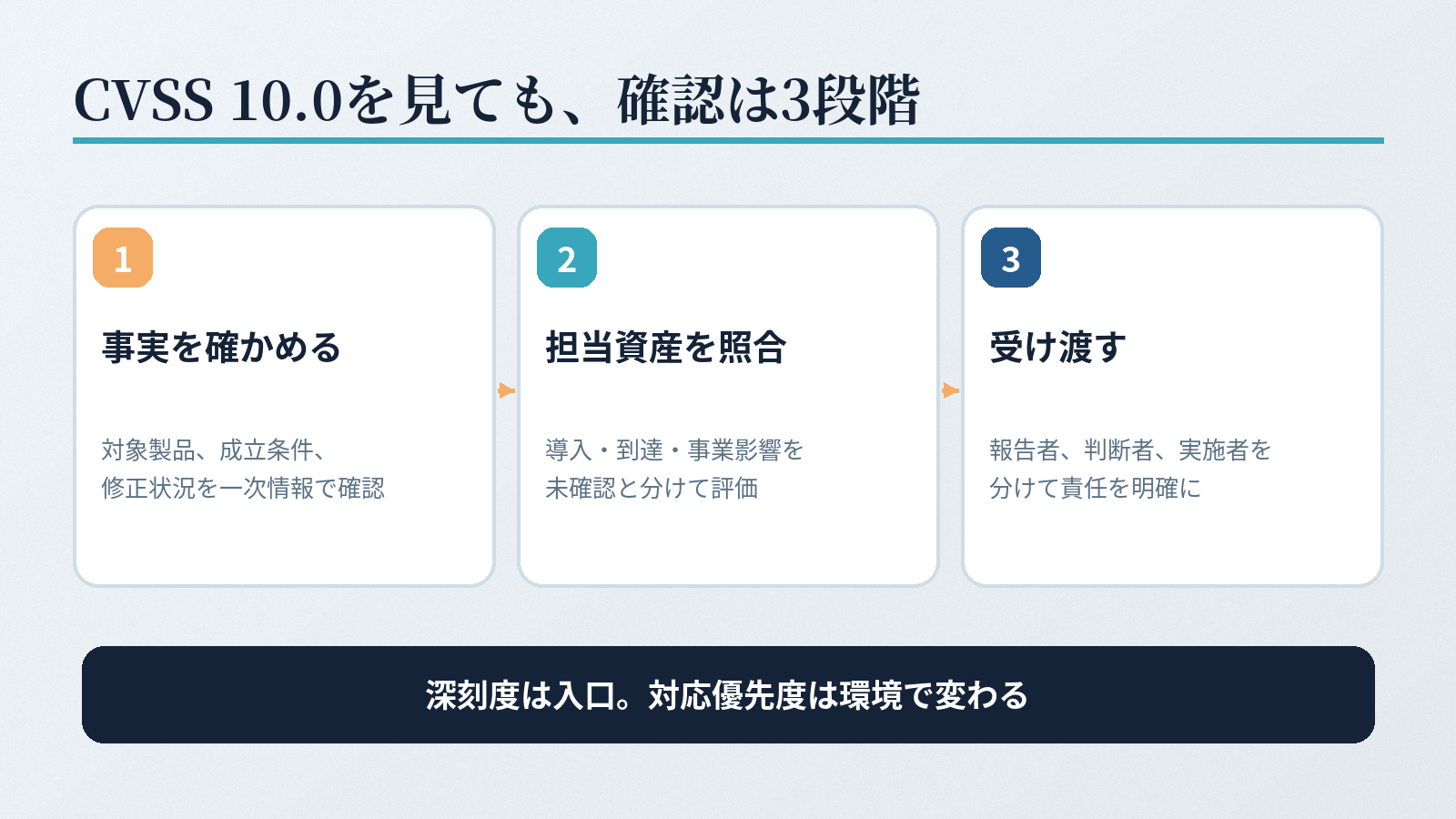
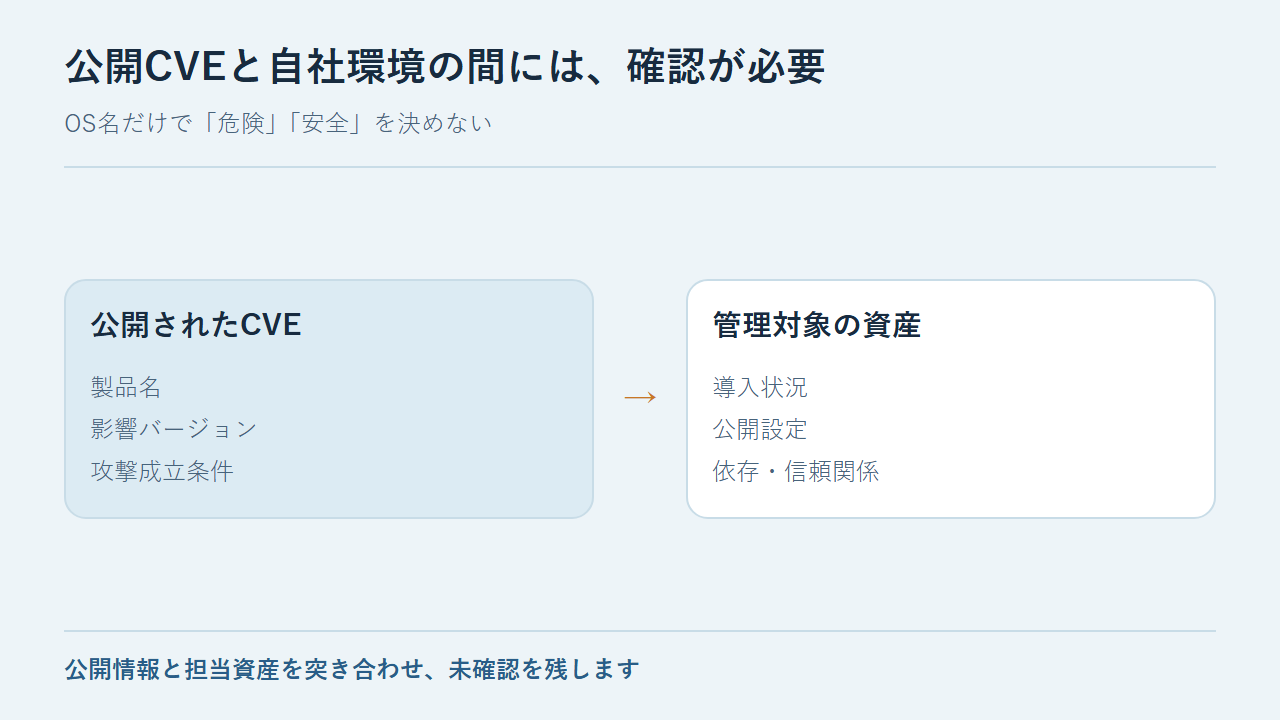
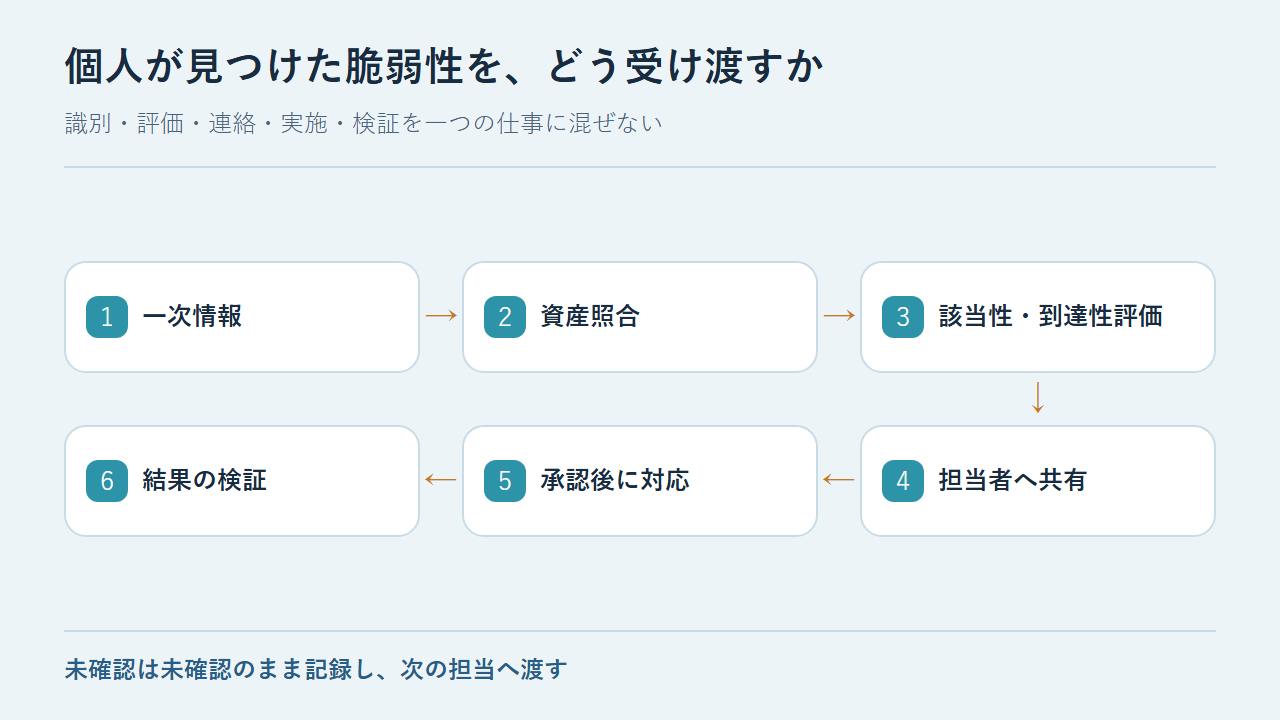
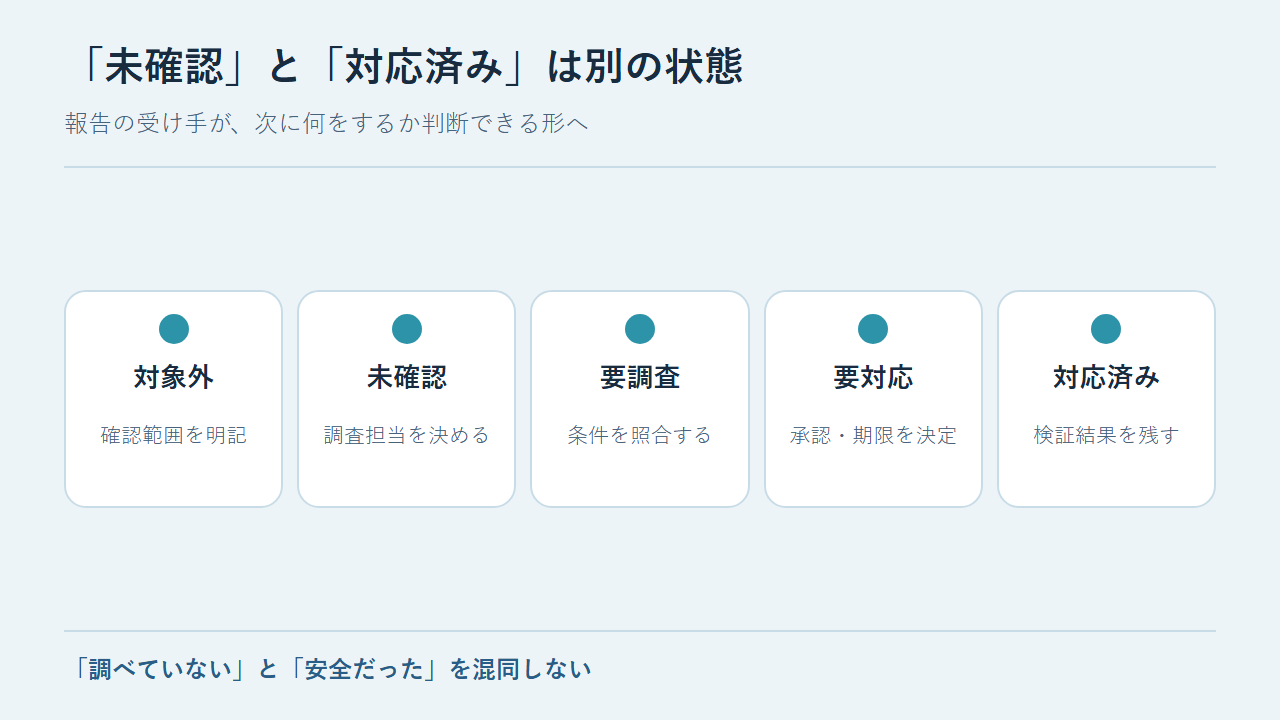
CVSS 10.0を見つけた一般エンジニアが、全社対応を背負わずに脆弱性をトリアージする方法 !記事の表紙。公開脆弱性の警告を担当範囲と責任分担へ整理する概念図 先に、結論を3行で書きます。 - CVSSの深刻度だけでは、自社で緊急対応が必要かは決まりません。 - 公開情報の確認、対象資産の調査、報告、対応承認、更新実施を分けて考えます。 - 一般エンジニアが全社監視の責任を自動的に引き受けるのではなく、受け口と責任者を決める方が持続可能です。 !インフォグラフィック。脆弱性トリアージの判断と責任の受け渡し 時間に合わせて、読み方を選べます。 - 少し忙しい人向け:5分で読める要約版(個人サイト) - もっと深掘りしたい人は、このまま本文へどうぞ。 「CVSS 10.0」と書かれたCVEを見つけたとき、エンジニアはどこまで対応すべきでしょうか。 自分の担当サーバーなら調べる。一方、全社の環境まで監視し、チャットで警告し、更新結果まで追いかけるとなると話は変わります。この記事では、公開されたCVEを例に、個人の気づきを組織のセキュリティ対応へつなぐ最小限の流れを整理します。 特定企業の構成・調査結果・報告体制を紹介するものではありません。以下のフローやRACIは、一般化した設計例です。実運用では契約・規程・指揮命令系統を優先してください。 最初にやるのは「全社通知」ではなく、事実の分解です 今回、判断例として使うのは公開情報の CVE-2026-112816 です。CanonicalのLXD・MicroCloudで、信頼済みクライアントの公開TLS証明書を用いた認証回避が可能になる問題です。Canonicalは修正版を公表しています。 参考: - Canonicalの公式アドバイザリ - Ubuntu公式のCVEページ この事例は、「CVSSが高い」「Linuxで利用されるソフトウェア」「公開サーバーを運用している」という断片を雑につなげると、対象範囲を広げすぎてしまうことを示します。 このCVEについて確認できる事実 | 項目 | 公開情報に基づく説明 | |---|---| | 製品 | Canonical LXD、関連するMicroCloud | | 問題 | HTTPS管理APIのTLSクライアント証明書検証に不備 | | 攻撃に関係する条件 | APIへ到達でき、信頼済みクライアントの公開証明書を利用できること | | 想定影響 | なりすまし先の権限次第で管理基盤、ホストに重大な影響 | | CVSS v4.0 | Canonical登録の基本値は10.0(Critical) | | 修正 | CanonicalはLXD・MicroCloudの修正版snapを公表 | ここから直ちに「UbuntuのすべてのVPSが脆弱」とは言えません。LXDが導入されているか、対象バージョンか、管理APIがどう設定されているかが別途必要です。 管理APIが直接インターネットに公開されていなくても、内部ネットワークやリバースプロキシ経由、信頼関係などを確認する余地があります。単に「8443番が閉じている」だけを安全判定の根拠にしないようにします。 !CVEの対象製品と実際の環境を分離するイメージ CVSS 10.0と自社リスクを、同じ数字だと思わない CVSSの基本値は、脆弱性の技術的な深刻度を示す指標です。実際の環境でどれだけ優先して対処すべきかを単独で保証するものではありません。 FIRSTのCVSS v4.0 User Guideでも、Base Scoreは「深刻度」を測り、組織固有のリスク評価には脅威情報と環境情報の補足が必要だと明記されています。 出典:FIRST「CVSS v4.0 User Guide」 調査時には、少なくとも以下を分けます。 | 軸 | 確認したいこと | |---|---| | 深刻度 | 成功時に何が起こるか。CVSSやベンダー説明 | | 該当性 | 対象ソフトが導入され、脆弱な版・設定なのか | | 到達性 | どのネットワークや利用者から攻撃経路に届くか | | 悪用状況 | 実際の悪用、PoC、攻撃の観測情報はあるか | | 事業影響 | 侵害されたとき何が止まり、何が漏れるか | | 対応可能性 | 修正版、緩和策、停止リスク、変更承認はどうか | 例えば、CVSS 10.0でも対象製品自体が未導入なら、そのCVEを理由にそのホストを更新する必要はありません。一方、スコアが低くても、外部公開している重要システムに実害があり、悪用が確認されているなら、優先順位は上がり得ます。 大切なのは「10.0なら即、全社に一斉通知」という短絡を避けることです。ただし、未確認を対象外と扱うのも同じくらい危険です。 個人が動く範囲を、6つの工程に分けておく NIST SP 800-40 Rev.4は、組織的なパッチ管理を、識別・優先順位付け・取得・適用・適用確認を含むプロセスとして説明しています。 出典:NIST SP 800-40 Rev.4 この考え方を、CVEを見つけた現場のエンジニア向けに小さくすると、次の6工程にできます。 1. 一次ソースを確認する。CVE番号、ベンダー、影響条件、修正状況を押さえる。 2. 自分の担当資産と突き合わせる。管理台帳と導入済みソフトウェアを確認する。 3. 該当性・到達性・事業影響を分けて評価する。不明点は未確認にする。 4. 自分の権限で判断できない事項を担当者に渡す。連絡先と受領者を記録する。 5. 変更は承認と運用手順に従って行う。公開サービスなら停止・ロールバック条件を検討する。 6. 実施結果と残ったリスクを記録し、必要な関係者へ完了・継続調査を通知する。 !脆弱性の受け取りから検証までを示す6工程のフロー このうち「公開情報をたまたま見つけた人」が全工程の責任者になる必要はありません。役割が正式に与えられていないなら、少なくとも 発見者と、対応を決定する責任者を区別する ことが必要です。 資産の有無を確認するなら、まず読み取り専用で CVE-2026-112816を例に、UbuntuのホストでLXD・MicroCloudの導入を初期確認するなら、snapとAPTの双方を確認する方法があります。 以下は影響判定を完了させるスクリプトではなく、調査の入り口となる読み取り専用の例です。 # snap で管理されている対象製品を一覧から探す snap list 2>/dev/null | awk 'NR == 1 || $1 == "lxd" || $1 == "microcloud"' # APT パッケージとしての導入を確認する dpkg-query -W -f='${binary:Package} ${Version}\n' lxd microcloud 2>/dev/null || true # 関連する systemd ユニットの存在を確認する systemctl list-units --all 'snap.lxd*' 'snap.microcloud*' 何も見つからなくても、手動導入・別の配布方式・コンテナ内の入れ子構成までは否定できません。クラウド事業者が提供するVPSのホスト側仮想化も、ゲストOS内でコマンドを実行しただけでは完全に把握できません。 「snapにないので対象外」と書かず、「snap版は見つからなかった。ほかの導入経路は未確認」と記録します。 なお、実際に脆弱なLXD・MicroCloudを使っている場合、Canonicalは速やかな更新を勧めています。ただし配布元やクラスタ構成で更新手順が変わるため、一般記事に掲載した一律の更新コマンドを本番へそのまま投入することは推奨しません。 発見、調査、承認、実施をRACIで切り分ける ここで役立つのがRACIです。Rは作業実行、Aは結果に対して説明責任を持つ担当、Cは相談先、Iは情報共有先を表します。以下は小規模組織の考え方を整理するための一例であり、法的な義務や既存の社内権限を決める表ではありません。 | 工程 | 発見者 | システム運用担当 | セキュリティ調整担当 | 責任者・決裁者 | |---|---|---|---|---| | 公開情報の初報 | R | I | A | I | | 対象資産との照合 | C | R | A | I | | 対応優先度・方針 | C | C | R | A | | 更新・緩和策の実施 | I | R | C | A | | 結果の確認・記録 | I | R | A | I | 上の表は、発見者が偶然担当運用者だった場合には同一人物が複数の列を兼ねることもあります。小規模な組織なら、セキュリティ調整担当と責任者を兼任する場合もあります。 問題は、役職名の数ではありません。誰もAを引き受けていない状態と、Aが明確にならないまま発見者に仕事だけ積み上がる状態です。 NIST CSF 2.0のGV.RRは、役割・責任・権限の確立と共有を求めています。国内でもIPAが、役割や責任の範囲を定めることを推奨しています。 - NIST CSF 2.0 - IPA「サイバーセキュリティリスク管理体制の構築」 !属人化した通報と、受け口が決まった通報を対比する図 通知が必要なときは「危ないです」だけで終わらせない 全社チャットで一件ずつCVEを共有すると、受け手は「結局、何をすればいいのか」が分からなくなります。 代わりに、初報の段階を次のいずれかとして明示すると、誤解を減らせます。 - 対象外:対象資産が存在しないことを確認できた。確認範囲を明記する。 - 未確認:資産の有無、バージョン、公開設定などに不足がある。 - 要調査:対象製品はあるが、影響条件や到達性が未確定。 - 要対応:影響が確認され、対応の担当者・期限・方法を決める必要がある。 - 対応済み:更新または緩和策が適用され、検証まで終わった。 例えば、運用担当が上司へ共有する初報なら、この程度で十分です。 件名:対象ソフトウェアの脆弱性確認 情報源:ベンダー公式アドバイザリ(URL) 対象:担当システムのうち確認した範囲 現状:対象製品の有無は未確認 危険性:成立条件と想定影響を簡潔に記載 依頼:資産確認の担当と期限の決定 次回報告:確認結果がそろい次第 これは「自分が全部直します」という宣言ではありません。「ここまで分かっていて、ここからは判断が必要です」という引き継ぎです。 逆に、具体的な侵害の兆候や攻撃の進行を把握した場合は、このような通常の脆弱性トリアージではなく、組織のインシデント対応手順に従って速やかに連絡します。黙って自分の担当範囲だけを見る、という話ではありません。 !報告時に未確認と要対応を分けるステータスの概念図 「外と通信できないから安全」にも、ひと呼吸置く 担当外のシステムへの影響を考えるとき、ネットワークの分離は有力な材料です。ただし、「相手からこちらへ接続できない」だけでは、完全な隔離を意味しません。 確認したいのは、通信ポートだけではありません。 - こちらから相手への接続や自動連携はないか。 - 共通の認証基盤、管理アカウント、秘密情報の保管場所はないか。 - ファイル共有、バックアップ、CI/CDなどの信頼関係はないか。 - 障害や侵害が波及する業務上の依存関係はないか。 とはいえ、これらを全社規模で棚卸しする仕事まで、一人の発見者が背負うのは無理があります。担当環境への依存関係が疑われるところまでを報告し、判断権限が必要な調査は引き継ぐ。その境界が実務的です。 自動化するならCVE監視より、まず資産の一覧から 「毎日重大CVEだけ通知するbot」を作るのは比較的簡単です。でも、対象資産が分からなければ、botは毎日「危険かもしれません」と言い続けるだけになります。 先に必要なのは、小さくても正確な資産台帳です。 # 個別の会社・サーバーを表さない項目例 asset: owner_role: service-operator os_family: linux software_inventory_status: verified last_verified: "YYYY-MM-DD" security_process: intake_role: security-coordinator decision_role: service-owner change_approval_required: true unresolved_status: unknown owner_roleが分かるだけでも、通知の行き先が変わります。製品名・バージョンの一覧、更新の責任者、最終確認時点がそろえば、CVSSのニュースを「自社に関係する課題」に変換しやすくなります。 ただし、この例は自動判定の完成形ではありません。手動導入の見落とし、更新後の稼働状態、API公開設定などは別途確認が必要です。 !CVEフィードから資産台帳、担当者、判断へ受け渡す構成図 では、報告しない選択はどこまで許されるのか ここは技術論だけでは決まりません。職務範囲、就業規則、委任された権限、実際に把握した危険の切迫度によって、求められる行動は変わります。法律上の義務を一律に断定するつもりもありません。 少なくとも「公開CVEを一件見つけた」という事実と、「会社全体の全資産を調査し、更新を完了させる責任」は別です。 一方、担当システムに重大な脆弱性があると具体的に確認したのに、何もせず放置するのは適切ではありません。担当外でも事故や重大な危険を具体的に認識したなら、決められた連絡経路で共有すべきです。 だから、次の区別が必要だと思います。 - 公開情報だけを知った:一次情報と担当範囲の関係を確認する。 - 自分の担当資産に該当すると分かった:担当業務として判断者に報告し、対応を進める。 - 担当外に具体的な重大リスクを見つけた:所管の担当者や窓口へ事実を渡す。 - 社内の網羅的な監視:正式な責任分担、工数、対象範囲を組織で決める。 「すべて報告する」でも「何も知らせない」でもない、中間の運用です。 小さな現場ほど、責任の受け皿を先に決めたい IPAの実践資料には、専任セキュリティ部門を作れない組織向けの兼任体制の例もあります。立派なSOCやCSIRTをすぐ整備することが唯一の道ではありません。 出典:IPA「兼任のサイバーセキュリティ管理体制の構築」 例えば、最低限決めておきたいのは、脆弱性情報の受け口、資産ごとの運用担当者、更新の承認者、緊急時の連絡先です。 その四つさえ決まっていれば、最初の発見者は「この情報は誰へ渡せばいいか」で悩まずに済みます。 別に「今後はセキュリティの話をしません」と宣言する必要もありません。普通に自分の担当環境を見て、具体的な影響を見つけたら報告する。組織的な監視が必要なら、その仕事として範囲を定める。 善意の情報共有が、いつの間にか無期限の当番になるのは避けたいところです。 !一人が抱える警告を、定義された役割へ手渡す場面を抽象化した図 まとめ:発見者が全工程を抱えなくていい設計にする 技術者としての調査は、続けたいです。脆弱性が公開されたとき、自分が持っている環境に関係するかを確認し、危険があれば必要な対応をする。そこには納得があります。 一方、何かを知っただけで、いつの間にか会社全体の監視担当になるのは、持続可能ではありません。 CVEを見つけること、影響を判断すること、更新を決めること、実施して検証すること。いったん分けて、適切な人が受け取れるようにしておく。 明日また重大なCVEが出ても、まず対象資産との関係を確認するところから始めます。 参考資料 - Canonical「CVE-2026-112816に関する公式告知」 - Ubuntu「CVE-2026-112816」 - FIRST「CVSS v4.0 User Guide」 - NIST「SP 800-40 Rev.4」 - NIST「Cybersecurity Framework 2.0」 - IPA「サイバーセキュリティリスク管理体制の構築」 あわせて読みたい 本番サーバーには、触らせない。SSHで脆弱性を診断させて、直すのは人間にした話 こちらは、検知と変更を分けて安全に診断する、別の角度の設計判断です。 --- ※ ヘッダー画像、インフォグラフィック、本文図・挿絵はAI支援で構成し、プログラムで作成しています。 書いた人: ishizakahiroshi 群馬の北部で、保護猫2匹と暮らす、在宅エンジニア(何でも屋) ishizakahiroshi.com github.com/ishizakahiroshi X(業務委託・各種相談はこちら): x.com バックエンド・インフラ・AI連携まわりで、業務委託のご相談を受け付けています。フルリモートです。スポットや週2〜3時間からでも歓迎で、いろんな案件に携われたらうれしいです。こんな相談、歓迎です。
Shout out to the API that made Rewindarr possible Hey all! Wanted to quickly shout out the Tracearr team and everyone else in the community that was involved in making it happen. For the past few years I've also been building my own Plex companion app, (previously) called Plex Rewind (it's a self-hosted Spotify Wrapped style recap), and it has always relied on Tautulli for the stats. When I set up Jellyfin alongside Plex recently, I wanted the same thing there, and Tracearr's API is what made that possible without writing a separate integration for each server. For anyone curious, with the latest release the app is now called Rewindarr, and Tracearr is a full stats source for both Plex and Jellyfin. Connect it, pick your server, and your users get: - Rewind: a story-style yearly recap. Watch time, top shows/movies/artists, favourite actors, directors and genres, when they watch most, and how they compare to other users. - Dashboard: most watched media and top users for any time period. - Activity: what's playing right now. - Login with their Plex or Jellyfin account. One tip if you try it: Rewindarr reads the play history 100 plays per request, and Tracearr allows 240 requests a minute by default, so the first read of a big history takes a few minutes. If you have more than 50k plays, bump the API rate limit to ~1,200 (Settings → Data → API, then restart Tracearr). After that first read it only fetches new plays. GitHub: RaunoT/rewindarr Thanks again and happy to hear any feedback!