Mentions
Conversations linking to GitHub, newest first. Times are UTC.
Mentions by source
X
Bluesky
Hacker News
V2EX
Qiita
DEV
Mastodon
Latest posts
Another GNOME macOS clone I'm still working on getting Nautilus/GTK apps closer to macOS 27. Control Center - github.com/Designer-Style147/MacOs-CC-Gnome/tree/… Theme - vinceliuice/MacTahoe-gtk-theme macOS 27 cursors - Juwan-Hwang/macOS27-Cursors I could probably post my Zen theme if I had to. The rest is just Kiwi, Liquid Glass, Liquid Glass Widgets and Dash2dock Animated. EDIT: Oh yeah, I use an updated version of "Rounded Window Corners Reborn" to make GNOME corners squircle like macOS.
「比 Chrome 快 9 倍」的 Lightpanda 今天又衝 825 星。它快在哪?根本不畫畫面。 README 自己寫:沒有圖形渲染引擎,跑分是作者爬網頁自測。agent 要截圖看版面,別找它;只抓 DOM 和文字才划算。 另外預設回傳使用數據,先設 LIGHTPANDA_DISABLE_TELEMETRY=true。 lightpanda-io/browser
Huge props to ghostty-org for this absolute masterpiece of a terminal. The GPU acceleration combined with native UI makes jumping between panes and heavy builds buttery smooth. 👻 🔗 项目地址:ghostty-org/ghostty
4.5 萬星的 Kronos 今天漲 630 星,號稱首個開源 K 線基礎模型。想拿它預測幣價?先冷靜。 README 自己寫:回測只是示範,不是能上線的量化系統,手續費和滑點得自己補。最大的 4.99 億參數版沒開源,4 月後也沒再更新。 要玩就跑 Kronos-mini,回測先加手續費再看曲線。 shiyu-coder/Kronos
Error #3441034 de WhatsApp Business Coexistence: cómo lo resolví al desvincular Meta Business Suite Inbox Martín Muñoz · 2 de noviembre de 2026 WhatsApp Business · Meta Embedded Signup · Coexistence · Error 3441034 · Caso real > Solución que funcionó en mi caso: entré en WhatsApp Business → Ajustes → Cuenta → Plataforma para empresas y comprobé que el número seguía conectado a Bandeja de entrada de Meta Business Suite. Desconecté solo esa integración, repetí el flujo de coexistencia y el error #3441034 dejó de aparecer. Esto no garantiza que todas las incidencias con este código tengan la misma causa. El problema: «Este número de teléfono no cumple los requisitos para el registro ni la migración» Estaba desarrollando una integración con WhatsApp Cloud API y quería conectar un número que ya utilizábamos en WhatsApp Business, manteniendo la aplicación móvil operativa al mismo tiempo que la API. Al usar Embedded Signup para WhatsApp Business App Coexistence, Meta rechazaba el número con #3441034: > Este número de teléfono no cumple los requisitos para el registro ni la migración. La interfaz no explicaba cuál era el requisito que fallaba. Revisé el porfolio, los permisos de la app, la cuenta de WhatsApp y las vinculaciones de Facebook/Instagram. Seguí viendo el error. No estaba intentando migrar el número fuera de WhatsApp Business. Necesitaba la opción de coexistencia, que permite conservar el uso de la app de WhatsApp Business mientras se trabaja con Cloud API. Cómo encontré el bloqueo La pista estaba en el propio WhatsApp Business, no en el panel de desarrolladores de Meta. 1. Abrí WhatsApp Business en el dispositivo donde estaba la cuenta. 2. Fui a Ajustes → Cuenta → Plataforma para empresas. Según la versión, el nombre puede cambiar. 3. Encontré una conexión existente a «Bandeja de entrada de Meta Business Suite». 4. Esa plataforma ya estaba asociada al número que trataba de conectar a mi propia aplicación. En mi caso, la conexión previa con la bandeja de Meta Business Suite era el obstáculo práctico: después de retirarla pude avanzar. Pasos que me funcionaron Antes de empezar: si tu empresa sigue utilizando Meta Business Suite Inbox para atender mensajes, desvincularla interrumpirá esa función. Coordina el cambio y lee los avisos antes de confirmar. 1. Abre WhatsApp Business. 2. Entra en Ajustes → Cuenta → Plataforma para empresas. 3. Comprueba si aparece Meta Business Suite Inbox. 4. Si vas a sustituir esa plataforma por otra, desconecta únicamente esa conexión de plataforma. 5. No pulses «Eliminar cuenta de WhatsApp», «Suprimir del porfolio empresarial» ni borres los datos de la aplicación: son operaciones distintas. 6. Vuelve al Embedded Signup de coexistencia, elige la opción de seguir usando WhatsApp Business y continúa el proceso. Resultado que observé: desapareció el bloqueo #3441034 y pude avanzar en el asistente. La solución desbloqueó ese error, no significó que todo el onboarding posterior estuviera completado. ¿Y si «Desconectar» muestra «Se produjo un error. Vuelve a intentarlo»? También me pasó. Reinicié el dispositivo y posteriormente pude completar la desconexión. No puedo demostrar que reiniciar fuera la causa; el error pudo resolverse por un problema temporal del servicio. Evitaría borrar datos, reinstalar WhatsApp o eliminar la cuenta como primera respuesta. Un error distinto: #2494064 («número ya registrado») Durante las pruebas de otro flujo también apareció #2494064, relacionado con un número ya registrado. Este código no equivale a #3441034. Si el número sigue activo en WhatsApp Business y tu objetivo es mantenerlo allí, asegúrate de seguir la ruta de coexistencia y no un registro o migración convencional. No elimines un número existente para intentar «liberarlo» sin verificar antes si el flujo es el correcto. Comprobaciones rápidas antes de contactar con soporte - ¿Quieres seguir usando la app móvil? Debes elegir coexistencia, no una migración convencional. - ¿WhatsApp Business muestra una «Plataforma para empresas» conectada? Revisa cuál es y si quieres sustituirla. - ¿Ya atiendes conversaciones en Meta Business Suite Inbox? Planifica la desconexión antes de retirarla. - ¿El error sigue después? No asumas que es la misma causa; anota código exacto, momento del flujo y versión de la app. - ¿Aparece #1690130 después de un alta interrumpida? Es otro problema. He documentado su diagnóstico técnico aquí: [Error #1690130: recuperación parcial de WhatsApp Coexistence](whatsapp-business-error-1690130-embedded-signup-recuperacion-parcial.md). Lo que esta solución NO demuestra No afirmo que Meta Business Suite Inbox sea siempre la causa de #3441034. Meta puede rechazar la elegibilidad por otros motivos; tampoco afirmo que cualquier configuración de coexistencia vaya a terminar correctamente después de hacer esta desconexión. Este artículo refleja una solución comprobada en mi número, no una recomendación oficial ni una instrucción para borrar cuentas o migrar números. Fuentes para ampliar - Bird: WhatsApp connection and coexistence errors — reconoce #3441034 como error de elegibilidad. - Bird: coexistence troubleshooting. - WACO: número existente en WhatsApp Business y #3441034 — documenta un caso similar con Meta Business Suite. - Meta for Developers: onboarding de números de WhatsApp Business App. --- Martín Muñoz · GitHub personal · Publicado el 2 de noviembre de 2026. Si este artículo te ha ayudado, indica el código exacto, en qué pantalla apareció y qué plataforma estaba conectada. No publiques tokens, números de clientes ni identificadores de sesión.
@TheHackersNews @Unit42_Intel Read the source or star the Base AgentKit before you run it: 1clawAI/1claw-agentkit
Omarchy RS 4.5 RC3 is Ready For Testing + Apple Silicon (M1, M2, M3, Neo) > ⚠️ This is a release candidate, not a final release. Expect bugs, rough edges, and the occasional thing that breaks outright. Run it on a test machine, or make sure you have a working backup (or a snapshot you know how to roll back to) before you upgrade a machine you depend on. Omarchy 4.5 is the first feature release since Quattro. It speaks 50 languages, gives every monitor its own workspaces, adds floating workspaces with a dock, rebuilds notifications, gathers how the desktop looks into a new Appearance menu, plays theme intros, and ships four new default apps: Hype, Monologue, Signed, and Disktree. Underneath, it installs in about half the time, it's faster from boot to theme switching, and it runs on NVIDIA N1x and Snapdragon X laptops. Try it on an existing machine with Update > Channel > RC, then Update > Omarchy. Please report anything that breaks on GitHub. Install on new machines with the ISO: x86_64: Download: iso.omarchy.org SHA256: 715d7c72d51c29a1e2db7b8f8562d54f0f5710b9c1c5a4243800be48fba24269 aarch64: Download: iso.omarchy.org SHA256: d5f38ba3bdd15175db0146826ca1a42c1722f717cbbc76de302f24aa80a23f9b Apple Silicon (M1, M2, M3, Neo): Download: mac.omarchy.org SHA256: 71f0a5ef4e7aa9b1da7ea88ed7641dfd087344d3fbb29fa2bb58192999b12910 Full Changelog: github.com/omacom/omarchy/releases/tag/v4.5.0-rc3
¿Cuántos metros cuadrados se arriendan con 6 millones de pesos al mes? 38 ciudades de Colombia Con 6 millones de pesos al mes se arriendan unos 317 m² de apartamento en Tocancipá, la ciudad que más rinde de 38, y 122 m² en El Retiro. En Bogotá alcanzan para 124… DOI: 10.5281/zenodo.23523368
Introducing ThruBound — bounded token spending for AI agents on Thru. Set spending limits, recipient allowlists, human approvals and instant revocation. 42/42 Alphanet checks passed. Open source: exelance25/thrubound Feedback welcome, @thru_xyz!
Found a macOS hang bug: ioquatix/macos-pthread-cond-hang
Playport 0.5.0 is out: World of Warcraft, Red Dead Redemption 2, The Witcher 3 Remastered and touch controls, running natively on a non-jailbroken iPhone This is the big one. Playport runs Windows PC games directly on your iPhone. That means the phone's own CPU and GPU, not a stream, not a cloud PC, and no jailbreak. 0.5.0 is the biggest release so far. 🐉 World of Warcraft is on your iPhone Battle.net is now a store in Playport, next to Steam, GOG and Epic Games. Pick World of Warcraft, press Install, and Playport downloads it from Blizzard's own servers. Retail, Classic, Classic Era and Classic Anniversary are all there, each with a region and language picker. - Every Play checks for a game update first, just like the launcher on a PC. - The game signs in by itself. The in-game menu's Type text opens a field for your email, password and authenticator code, with paste and AutoFill. - In our testing WoW reaches its login screen in about 45 seconds and runs in the world at 55–60 FPS. - Playport runs Blizzard's own Windows client and changes none of its files or code. 🤠 Red Dead Redemption 2 Press Play and Rockstar's own launcher starts, signs you in and hands over to the game. One press on Story and you're on Arthur's cabin porch in the snow, on a phone. 🐺 The Witcher 3: Wild Hunt – Remastered The current, remastered version used to stop the moment it started. Playport now handles both of the things that broke it, and Geralt is back in Kaer Morhen, running on the game's Direct3D 12 renderer. 🎮 No controller? No problem On-screen touch controls are drawn over the game. They hide when you connect a controller and come back when you disconnect it. - Three layouts: - Gamepad - Keyboard & mouse: a WASD stick, drag anywhere to look - Point & click: tap or use it as a trackpad, with a magnifier - A full layout editor: add, move, resize and duplicate controls on a snapping grid, with undo. Use it by touch or with a controller, right over the paused game. Each game keeps its own layout and opacity. - A touch keyboard with F keys, arrows and sticky Shift/Ctrl/Alt. - Gyro aim from the phone itself, or a DualSense, DualShock 4 or Switch Pro controller. - Remap any controller as a keyboard and mouse. - A three-finger tap opens the in-game menu. 📚 A redesigned Library Every store is an icon in a column down the left: All, Steam, GOG, Epic Games and Battle.net. Add one tap to show installed games only, and LT/RT to switch stores from anywhere. 📊 Performance overlay A small pill shows the frame rate, the frame time and the phone's thermal state, in every game. ⚡ Also in 0.5.0 - Vulkan is now every game's default, for Direct3D 8 to 12. DXMT is still one tap away. - OpenGL games run through Zink. - Faster second launches: shaders and translated code are cached on disk. - More memory for big games. - Steam for 32-bit games: sign-in, ownership checks and online tickets work for them too. - Publisher launchers work, Rockstar's included. - Newer components: Wine 11.20 and Valve's latest Proton changes. - More games now run: Assassin's Creed, BioShock, Tomb Raider (2013), Half-Life, Counter-Strike, DiRT 3, Neverwinter Nights: Enhanced Edition, Super Meat Boy, Among Us and more. Full list: playport.dev Good to know - WoW needs your own Battle.net account with a subscription. Blizzard doesn't support Playport, so play at your own risk. - RDR2 and The Witcher 3 push the phone to its limits. They need the increased memory limit from your sideloader, they heat the phone, and the frame rate drops as it warms. - It's tested on one phone, an A19 Pro iPhone. Results on older phones will vary. - Bring your own games. Playport is free, open source (GPLv3), and needs no PC once installed. Release notes: playport.dev Download: github.com/playportdev/playport/releases Website: playport.dev Report a game: github.com/playportdev/playport/issues/new Tried a game? Tell us how it went. Working games help as much as broken ones. 🙏 ☕ Playport is free. If you enjoy it, please consider supporting the developer on Ko-fi: ko-fi.com. Every coffee helps keep the next release coming.
Kama unataka kutumia bot kwa loggy use this Install mouse jigler using this link github.com/arkane-systems/mousejiggler/releases/d… after downloading extract then install open then mark box ya jiggling and settings time unaeza eka 0.2 sec then minimise to start
¿Cuántos metros cuadrados se arriendan con 400 dólares al mes? 34 ciudades de Latinoamérica y Portugal Con 400 dólares al mes se arriendan unos 100 m² de apartamento en Cochabamba (Bolivia), la ciudad que más rinde de 34, y solo 10 m² en Punta del Este (Uruguay). DOI: 10.5281/zenodo.23523395
I built my 3 kids an AI tutor that follows the MOE syllabus. Would you let your kid use something like this? Every time the birth rate comes up, the answer is always the same: no time. So I tried to fix the time part. Dad of 3 here (P3, P6, Sec 2). For the past week, after the kids sleep, I've been building an AI tutor, which is also my sidekick. The main thing I wanted: it has to teach the MOE way like bar models for maths, answers written the way their teachers want, make the learning fun instead of just giving the answer. Nothing worse than your kid learning a method the school doesn't accept. It also helps me look after them while I'm at work. It tells me when they reach home, what they learned and where they got stuck. One of the feature "Sentry" help to summarize their real-time update through my CCTV at home, so if there are catching mouse or lizard - i will know first hand. Homework settled, kids accounted for. In theory, I now have time to help the birth rate.:D In practice, I spent all of it building this. It's called myKx. 3-min video if you're curious: youtu.be Try it, no sign-up: mykx-guest.vercel.app (this one is without AI enabled) Or you can run it locally if you are the adventure type: cyyeong/mykx Full disclosure: it's my own project and my entry for a Meta hackathon. Open source, nothing to sell.
@DukesSnr Thanks! Each window gets its own row and switches correctly, even on the same repo. Would love for you to try it: pontasan/switch
插件也在Github开源:selenaking2025/DSH-RSS
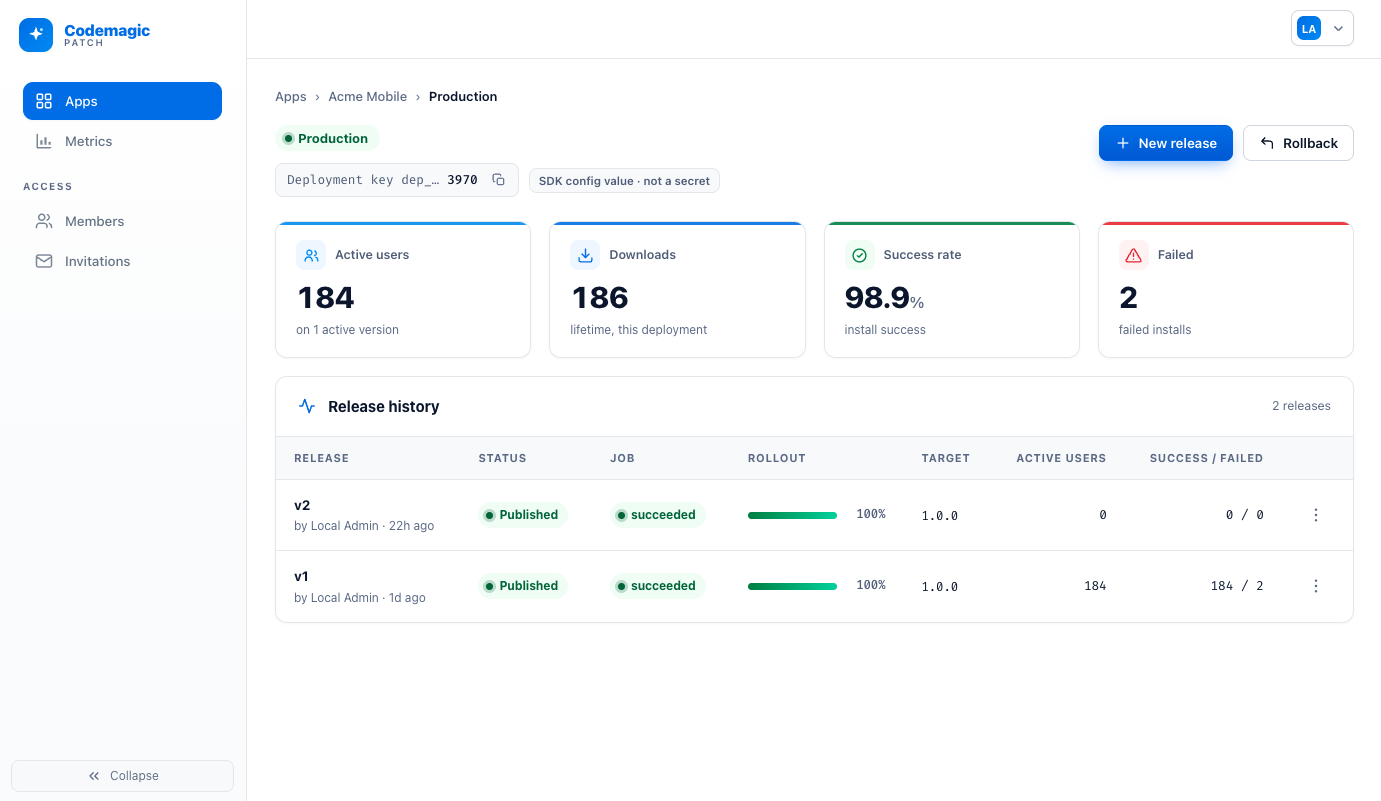
Self-hosted live updates for Capacitor with Codemagic Patch Codemagic Patch is a new self-hosted tool to ship live updates of HTML, CSS, and JavaScript to Capacitor, Ionic, and Cordova-on-Capacitor apps, without a new store binary. Say a checkout button stops working on some Android 15 devices, and the fix turns out to be four lines of TypeScript. In a Capacitor app, those four lines live in the web layer, inside a WebView, nowhere near native code. Without over-the-air (OTA) updates, they still have to go the long way round: new binary, store submission, review, and then a slow trickle of users who eventually update. Some never do. That's what OTA updates solve through tools such as Live Updates on Appflow, and what you can do with Patch. Patch v0.6.0 ships with two new packages: @codemagic/capacitor-patch, the SDK that goes into your app, and @codemagic/capacitor-patch-cli, a command line made for publishing and managing Capacitor releases. They use the same server, dashboard, and delivery protocol as our React Native SDK. Below, we’ll go through what you get with Patch, , how you can self-host Patch, and where to find the docs to get your first release out. Replacing Appflow’s Live Updates Before the Sunset Ionic has announced that all Appflow features and services will be sunset on December 31, 2027, a little over a year from now. They'll keep Appflow up to date with its dependencies until then. After that, Ionic warns that apps still depending on Appflow may hit failed builds and failed live updates, and users may end up looking at a blank white screen. A year can feel like plenty of time, but you'll need to make sure no users are on a native version relying on the Appflow SDK for live updates by the time it's sunset. We've been building, signing, and publishing Capacitor apps on Codemagic for years, and Ionic's own continuity page lists us as an alternative for Appflow native builds. Capacitor teams could also already get OTA updates from our CodePush service through the community cap-codepush plugin. Patch replaces that arrangement with a first-party SDK that we design, test, and support ourselves. For a Capacitor team, that means native builds and live updates from one vendor. What you get with Patch A server you can run yourself, an SDK in the app, a CLI to publish the web build you already produce, and a dashboard for what happened after that. - Web-layer fixes reach devices that already include the SDK. The check runs on launch, and you can also run it when the app returns to the foreground. - Downloads are a diff of what changed, with a fallback to the full bundle if the diff fails. - A bad release rolls itself back if the app never reports the new bundle as healthy. - You choose when an update takes effect. Mandatory updates can follow a different rule. - Releases can be signed, and the server can reject unsigned ones. - Staging and Production stay separate. You can send a release to a percentage of devices, then promote the one that worked without rebuilding it. - The dashboard shows adoption, failures, and download size for each release. !The Codemagic Patch dashboard with example release metrics Your native version number is the compatibility boundary There's one rule every team should understand before shipping their first Capacitor OTA release, because it's much cheaper to learn it now than in production. Your web bundle calls into native code: Capacitor plugins, your own native classes, native configuration. A bundle built for one native build can break on another. If your new web code calls Camera.getPhoto() and the installed binary shipped before you added @capacitor/camera, it will fail. The Capacitor CLI doesn't try to detect this by fingerprinting your native project. Every release instead targets one exact native app version (CFBundleShortVersionString on iOS, versionName on Android) and is only delivered to that version. Ranges and wildcards aren't accepted. In day-to-day terms: - Bump the native version every time anything native changes: a plugin added, removed, or upgraded, native code edited, native configuration changed. - If one web bundle should go to several binary versions, release it once per version. - Never ship two different native builds under the same version number. If they differ in ways your web code cares about, no OTA tool can tell them apart. If your team already versions carefully, you'll hardly notice this. If it doesn't, OTA will push you into the habit, and you'll be better off for it. The binary version filter added to the Patch dashboard's deployment and Metrics pages in this release makes it easy to see how each version is doing. Put together, every change goes down one of two paths: | If the change touches… | Then… | | --- | --- | | Only the web layer | Build your web assets, publish them with cmpatch-capacitor release create against the current binary version, test on Staging, then promote to Production with a staged rollout. | | Plugins, native code, or native config | Bump the native version, then build, sign, and publish through Codemagic. Once the new binary is through review and in users' hands, future OTA releases target the new version. | What OTA buys you, and what it doesn't OTA is easy to oversell, so it's worth being specific. The obvious win is speed. A web-layer fix stops taking days of review and update lag and starts reaching users within minutes of publishing, as soon as their devices check in. For a consumer app, that can be the difference between a wave of one-star reviews and nobody noticing. For a B2B or internal app, it's the difference between an escalation and a ticket closed the same afternoon. You also end up supporting fewer versions. With store-only updates, every version a user hasn't bothered to update is still out there, still generating bug reports. With OTA, devices on the same binary converge on the same web bundle, so "can't reproduce" happens a lot less. And your two release cycles can run at their own pace. The native release train can stay as deliberate as your compliance process requires, monthly or quarterly, while the web layer ships whenever your team is ready. Staging, staged rollouts, and promotion give you a controlled route from merge to full rollout. What OTA can't do is ship native code, and the app stores are explicit about where that line is. Apple's Developer Program License Agreement, section 3.3.1(B) forbids apps from downloading executable code but allows interpreted code, which is what the JavaScript in a Capacitor WebView is. There are conditions. The downloaded code can't change the app's primary purpose by adding features that don't match how the app was described and advertised. It can't get around signing, sandboxing, or other OS security features. And it can't turn the app into a store for other apps. Google Play's Device and Network Abuse policy starts from a stricter position. Apps may not update themselves outside Google Play or download executable code such as dex, JAR, or .so files from anywhere else. The policy then makes an exception for code that runs in an interpreter or virtual machine with only indirect access to Android APIs, and gives "JavaScript in a webview or browser" as its example. That code still can't be used to break any other Play policy. So both stores end up in the same place. Bug fixes, copy changes, UI tweaks, and incremental improvements to the app people already installed are fine. Using OTA to turn the app into something other than what was reviewed is not, and it puts your developer account at risk. Signed releases help with the security side of Apple's conditions, and keeping your native versions disciplined keeps native changes inside reviewed binaries, where they belong. How to self-host live updates for Capacito The server, release worker, and dashboard run on your infrastructure as a single Docker Compose deployment: Caddy for TLS, the Patch server, PostgreSQL, and S3-compatible object storage, with Cloudflare or CloudFront in front if you want a CDN. Your bundles, metrics, and release history stay on your network. The Capacitor SDK talks to the standard Patch server without any changes, so you set up the server once with the self-hosting guide, and cmpatch-capacitor handles everything Capacitor-specific from there. The SDKs and CLIs are licensed under Apache 2.0. The server uses the Codemagic Server License, which is free for up to 1,000,000 monthly active devices and converts to Apache 2.0 two years after each release. The only thing you can't do is resell Patch as a competing OTA service. To try it before provisioning anything, run the local evaluation stack. It runs the real server, database, storage, and dashboard on your machine in Docker, and the Capacitor CLI can point straight at it: {{< highlight bash "style=paraiso-dark">}} git clone codemagic-ci-cd/codemagic-patch cd codemagic-patch ./scripts/local-eval/up.sh cmpatch-capacitor config set --server-url localhost cmpatch-capacitor login {{< /highlight >}} The local server has a prefilled one-click login, so there's no account to create. Self-hosting makes the most sense for teams with strict data residency rules, regulated or air-gapped environments, or a preference for owning their infrastructure. Getting started The Patch documentation covers setup step by step, so this is an overview of the path from nothing to your first OTA release. 1. Decide where Patch runs. Self-host with the self-hosting guide, or talk to our team about hosted service. For a first look, the local stack above is enough. 2. Install the CLI and create one Patch app per platform. Each app comes with Staging and Production deployments, each with its own deployment key. Don't let iOS and Android share a deployment. A release's delivery path doesn't include the platform, so the two would overwrite each other. {{< highlight bash "style=paraiso-dark">}} npm install -g @codemagic/capacitor-patch-cli cmpatch-capacitor config set --server-url your_patch_server cmpatch-capacitor login # opens the browser cmpatch-capacitor app create --name MyApp-iOS cmpatch-capacitor app create --name MyApp-Android cmpatch-capacitor deployment list --app MyApp-iOS # deployment IDs and keys cmpatch-capacitor deployment list --app MyApp-Android {{< /highlight >}} 3. Add the SDK to your Capacitor project. It supports the two most recent Capacitor major versions (currently 7 and 8) and Android minSdkVersion 24 or higher. {{< highlight bash "style=paraiso-dark">}} npm install @codemagic/capacitor-patch npx cap sync {{< /highlight >}} Configuration goes in capacitor.config.ts, with one block per platform. The API URL and download base URL come from your Patch server: the self-host installer prints both, and we give them to you for hosted Patch. {{< highlight typescript "style=paraiso-dark">}} // capacitor.config.ts (excerpt) plugins: { CodemagicPatch: { ios: { deploymentKey: 'YOUR_IOS_DEPLOYMENT_KEY', apiUrl: 'your_patch_api_url', downloadBaseUrl: 'your_patch_download_base_url', }, android: { deploymentKey: 'YOUR_ANDROID_DEPLOYMENT_KEY', apiUrl: 'your_patch_api_url', downloadBaseUrl: 'your_patch_download_base_url', }, }, }, {{< /highlight >}} Then call start() once the app has rendered its first screen: {{< highlight typescript "style=paraiso-dark">}} import { CheckFrequency, start } from '@codemagic/capacitor-patch'; // Checks on launch and on every return to the foreground. // Calling it after the first render is what marks the bundle as healthy. start({ checkFrequency: CheckFrequency.ON_APP_RESUME }); {{< /highlight >}} Where you call it matters. start() is what tells the SDK the running bundle is healthy, so call it after your UI is actually up, not early in bootstrap. That way an update that crashes during startup still gets rolled back. Two more tips: every config value can also be set as a native resource (Info.plist or strings.xml) if you inject per-environment values in CI, and npx codemagic-patch-check-config is worth adding to your native build workflow to catch a shared deployment key before it ships. The check reads JSON only, so if your config is capacitor.config.ts, run it after npx cap sync and point it at the synced copy: npx codemagic-patch-check-config android/app/src/main/assets/capacitor.config.json. The Patch docs cover native setup for Capacitor, checking for updates, install modes, and the step-by-step APIs, and the SDK reference lists everything the SDK exports. Pick Capacitor in the switcher at the top of the docs menu to see the Capacitor version of each page. 4. Publish a release to Staging from the CLI. Build the web assets the way you already do, then publish that folder once per platform. --target-binary-version has to be the native version you will ship in the next step (CFBundleShortVersionString on iOS, versionName on Android). www below is the webDir from capacitor.config.ts. {{< highlight bash "style=paraiso-dark">}} npm run build cmpatch-capacitor release create --bundle-path www \ --app MyApp-iOS --deployment Staging \ --target-binary-version 1.4.0 cmpatch-capacitor release create --bundle-path www \ --app MyApp-Android --deployment Staging \ --target-binary-version 1.4.0 {{< /highlight >}} Each command publishes one platform. Install a build that includes the SDK and uses that same native version if you want to try the Staging release on a device before it goes to the stores. 5. Ship the native release, then publish Production from CI. The SDK has to be in the installed app before a device can receive an update, so this first binary is a normal store release. Build, sign, and publish it through Codemagic as usual. CI/CD for Ionic apps walks through connecting the repo and a first workflow, and the Ionic Capacitor build guide covers code signing, versioning, and publishing for both platforms. After that, Production releases belong in CI. Create a token with cmpatch-capacitor token create, store it with your server URL and the deployment IDs from deployment list, and publish from the pipeline. The first release guide covers that workflow, including promotion and staged rollouts. Coming from Appflow Live Updates Most Appflow concepts carry over directly. Appflow channels become Patch deployments, and you get Staging and Production from the start. A few things work differently, and it's better to know about them before you start: - The SDK swap takes one native release. You can't deliver a new OTA SDK through the old one. Plan a native release that replaces the Appflow Live Updates SDK with @codemagic/capacitor-patch, and leave enough time for it to reach your users before December 2027. - There's no runtime channel switching. Appflow's getConfig() and setConfig() let the app change its channel at runtime. The Patch SDK doesn't have an equivalent, because the deployment key is part of the binary's configuration. If your beta testers currently opt into a channel from inside the app, you'll need another approach, such as separate beta builds pointing at a Beta deployment. - Your release history stays behind. There's no import of Appflow channels, builds, or deployment history. Your first Patch release starts the history fresh. - Each platform gets its own key. Appflow used one channel name across platforms. Patch uses a separate app and deployment key for iOS and for Android. - Binary versions must match exactly. If your Appflow setup relied on looser version matching, settle on a clear native versioning scheme before you switch. None of these should stop you, but the first one decides your timeline. The Appflow migration guide walks through the swap. If you're already using our CodePush service with cap-codepush, nothing changes for you today. When you're ready, the move to Patch follows the same pattern: one native release with the new SDK, then you publish with cmpatch-capacitor instead of code-push. When Patch isn't the right fit We'd rather you choose the right tool than the wrong one from us, so here are the cases where Patch won't help much. Most of your changes are native. Plugin upgrades, Capacitor version bumps, and native features all need a reviewed binary whichever OTA service you use. For teams like that, a fast and reliable native build-and-publish setup matters more, and Codemagic handles that too. Your beta program depends on runtime channel switching. The Patch Capacitor SDK doesn't offer it today. Separate beta builds work, but it's a different workflow, so think it through before migrating. Your native versioning is a mess and you can't fix it. Exact-version targeting will feel strict. We think strict is the safer default, because it makes the compatibility boundary visible instead of guessing at it, but it does ask for some discipline. You're happy on Appflow right now. You don't have to move tomorrow. You do have to move before the end of 2027, and the native release the swap requires means you should start well before that. Try Patch today If Appflow's shutdown is on your roadmap, start before it becomes urgent. Spin up the local evaluation stack this week, and put the SDK in your next native release.
清理软件装了三个互相打架,托盘挤成一排,开机反而更慢。 Kudu 开源一体化:垃圾扫描+隐私痕迹+启动项+系统加固+磁盘分析,分组标明占用,勾选清理,三平台。 adventdevinc/kudu
How I built memory that stops repeating itself: dedup at 0.85, conflicts flagged, nothing deleted My desktop companion remembers things about me. That is the whole point of it — until it remembers the same thing twice, and then remembers the opposite of it, and then confidently asserts whichever one it read last. That is the failure mode I fixed in Ankita v2.7.5. The problem was not that the memory store lost facts. It was that it never questioned them. Every new fact went in as a new row, so "I use Postgres" and "Database is Postgres" sat side by side as two facts, and a later "I moved to SQLite" sat next to both of them, unchallenged. The companion would then answer from whichever row surfaced first and sound certain about it. The decision: merge, flag, never silently delete The new rule, in one sentence: a new fact is compared against what is already stored before it is written. If it is near-identical to an existing fact, it updates that fact instead of creating a second one. If it looks related but disagrees, both facts are kept and linked as conflicting, and the companion is told to ask which is current rather than assert either. Nothing is deleted or rewritten automatically, ever. That last clause is the decision worth arguing about. The tempting design is auto-resolution: newest wins, old fact dropped. It is cleaner, and it is wrong for a personal store, because "newest" is not the same as "true". People change their minds and then change them back. A migration gets reverted. A preference stated in passing is not an instruction to erase the one before it. So the store keeps both and wears the uncertainty in public. How the comparison works The comparison lives in src/memory/memory-similarity.mjs, and it is deliberately two-layered. Embeddings are used when an embedder is configured — v2.7.5 also adds offline semantic memory, so you can point EMBED_LOCAL_BASE at an Ollama or LM Studio server instead of a Cloudflare account — but the module always has a deterministic lexical fallback, so memory quality never depends on a provider being configured. The lexical path works on content words only. A stop-word list strips the filler ("I", "my", "use", "database", "project", "stuff"), so "I use Postgres" and "Database is Postgres" both reduce to {postgres}. Two words match when they are equal, or when the shorter is a prefix of the longer and at least four characters long, which catches postgres/postgresql and migrate/migrated without matching on stubs. From there, three rules: - Merge above 0.85. DEFAULT_DEDUP_THRESHOLD = 0.85 — above this similarity, one fact, not two. The score is the best of Jaccard overlap and a harsher containment term that only fires when every content word of the shorter fact appears in the longer one, which is the common shape of a repeated preference. A single shared distinctive word can link two short facts at 0.6, but only when both sides are short, so long incidental sentences cannot match on one word. - Conflict between 0.55 and the merge line, with conditions. Lexically, a conflict needs at least three meaningful words, at least two agreements, and a Jaccard of 0.5 or more — two-word facts cannot contradict, because one shared word is ambiguous. A conflict is only claimed between facts of the same declared kind, so unrelated facts that happen to share vocabulary are not a disagreement. And when the winning score came from an embedder, the cosine threshold is only trusted if the score actually came from the embedder; a cold or partial embedding index mixing cosine and lexical scores is not allowed to manufacture conflicts. - A provider failure never blocks a write. If the embedder throws, the score falls back to lexical. If the whole comparison finds nothing, the fact is stored plainly. The memory write is the thing that must not fail; the dedup is a quality gate on top of it. What the flag looks like in practice When a conflict is found, both facts get each other's id in a conflictsWith list (src/memory/profile.mjs links them both ways, and clearing the flag removes it from both sides). When either fact is later forgotten, the dangling pointers are cleaned up, so a resolved conflict cannot haunt later recalls. And when conflicting facts are recalled into context, the prompt carries a plain notice: "Some facts conflict with each other. Ask the user which is current instead of asserting either." That notice is the whole user-facing behaviour. The companion does not pick. It asks. The cost is one clarifying question, occasionally, in exchange for never confidently stating something the store itself knows is disputed. There are honest limits. The lexical fallback cannot see that "Postgres" and "PostgreSQL" are the same word unless the prefix rule catches it, and it cannot tell a genuine contradiction from two facts that merely share vocabulary until the same-kind and minimum-word gates filter them. The merge threshold is a single number, 0.85, applied to every kind of fact. And a conflict flag is only as good as the next conversation: if the user never answers the question, both facts keep sitting there, flagged, forever. Pins are exempt from staleness for the same reason — a deliberate fact should not quietly expire. What else shipped in v2.7.5 The memory change is one part of the release. Also in 2.7.5: an editable personality card in Settings (caring attitude, teasing, language, example exchanges, shared by chat and voice); voice that keeps listening for a short follow-up window (25 seconds by default) instead of needing the wake word every time, with a quiet "Say Ankita first" hint in standby; the open_app launcher that actually opens apps by name from a discovered, validated index; voice wake/stop words and auto-mute; scheduled results that appear in Scheduled tasks as soon as they finish; heartbeats that retry instead of being dropped, with [SILENT] runs that record without posting; long-conversation compaction on by default in the desktop app; and shared Telegram, Discord and Slack channels on one local policy and delivery core. Fixes include a stuck voice process no longer freezing the queue, and npm test scoped to the project's own test/ directory. Ankita is open source (MIT) and local-first: akyourowngames/A.N.K.I.T.A. The release is at github.com/akyourowngames/A.N.K.I.T.A/releases/ta…, and the site is ankita-sable.vercel.app. Tell me I am wrong Here is the claim to break: a personal memory store should never auto-resolve a contradiction, even when the newer fact looks obviously right — because "newest wins" silently destroys the one record that could have corrected it. Is that caution, or is it cowardice? If you would let the store auto-rewrite on a high enough similarity score, where would you draw that line — and what would you do about the user who changed their mind back? I would genuinely like to know where this breaks first.
Colonias más caras y más baratas de Ciudad de México para comprar casa: ranking por m² En Ciudad de México, la colonia con el m² más caro para comprar casa es Santa Fe la Loma (80.056 pesos mexicanos (USD 4.335)/m²) y la más barata Colina del Sur (23.677 pesos… DOI: 10.5281/zenodo.23522784
Some fixes for uutils awk, uutils coreutils. Got CI fixed in awk and the test-patching env set up, so doing further fixes should much easier now.
Scratching an itch: ljantzen/deptree Parse mvn dependency:tree output and filter and search before outputting in coloured text or json. #mvn #rustlang
Hallucination Is a Design Problem, Not a Model Problem --- title: Hallucination Is a Design Problem, Not a Model Problem published: true --- Most procurement conversations about hallucination open with the wrong question: which model hallucinates least? It is the wrong question because it treats a structural property as a vendor feature, and it produces systems that fail in the one way nobody planned for. The better question is blunter. When this system produces a confident, fluent, incorrect answer, what happens next? If the answer is “someone notices,” describe the mechanism. If the answer is “it flows into the next step,” you do not have a model problem. You have a design problem, and no version number is going to fix it. Better Models Narrow the Gap. They Do Not Close It. Be precise here, because the careless version of this argument is wrong. Part of the cause really does sit inside the model. OpenAI’s own research on the subject argues that models hallucinate because standard training and evaluation reward guessing over admitting uncertainty. On an accuracy scored benchmark, a confident guess has some chance of scoring. Saying “I do not know” guarantees zero. The incentive points one way, and models are trained into it. Two findings from that work matter for anyone building on top. First, some questions cannot be answered from patterns in text at all, so accuracy will never reach 100 percent. Second, and more usefully: hallucination is not therefore inevitable, because a model can abstain when it is uncertain. That is a fix to how models are trained and scored. It is real work and it will help. But it is not a lever you hold, and it will not arrive as a release note that ends the problem. What you hold is the system around the model: what it is given, what it is permitted to say, and what gets checked before anyone acts on it. Grounding Moves the Failure. It Does Not Remove It. Retrieval is the first mitigation most teams reach for, and usually the right one. Hand the model the actual document, and it no longer has to reconstruct a fact from training data. It also creates a failure mode that is harder to catch than the one it replaced. An ungrounded model that invents a figure often produces something a knowledgeable reader can smell. A grounded model that retrieves the wrong document produces a confident answer, with a citation, drawn from a genuine source that happens to be the wrong one. The citation does not make the answer correct. It makes it more persuasive, and it quietly changes the reviewer’s job from reading critically to checking that a link exists. Three consequences for design. Measure retrieval quality separately from answer quality, because an answer can be perfectly faithful to a wrongly retrieved passage. Show the retrieved passage itself, not just a link to its source, so a reviewer can see what the answer was actually built from. And decide explicitly what happens when retrieval finds nothing relevant, because the default behaviour of most implementations is to answer anyway from general knowledge, silently, in exactly the same confident tone. Abstention Is the Cheapest Mitigation and the Least Built A system that can say “I am not confident here” converts expensive silent errors into cheap routed exceptions. That is most of the value, and it is rarely implemented. The reason is structural, and it mirrors the benchmark problem precisely. Internal evaluations usually measure how often the system answered correctly. A system that abstains scores worse on that measure than one that guesses and occasionally gets lucky. Teams then tune toward confidence, reproducing inside their own organisation the exact incentive that causes the problem upstream. Decide before building what an acceptable abstention rate is, and measure confident errors separately from abstentions instead of pooling both into one accuracy number. A system that declines 15 percent of cases and is dependable on the rest is usually worth more than one that answers everything and is wrong 5 percent of the time without telling you which 5 percent. Verify Against Something Deterministic Where a claim can be checked, check it in code before a person ever sees it. If the model states a balance, read the balance. If it names a contract clause, confirm the clause exists. If it computes a figure, recompute it. This is unglamorous, and it is the most effective pattern available, because it converts a probabilistic claim into a deterministic one at the point where it matters. The limitation is real and worth stating: it only works where ground truth is reachable. For summarisation, drafting and judgement, there is nothing to check against. Those are exactly the applications where you should be most conservative about what the output is permitted to trigger. Where Probabilistic Output Must Not Reach At All Some decisions should not sit downstream of a model, however well designed the system is. Anything irreversible, anything that moves money or assets, and anything carrying a compliance obligation belongs in deterministic code, with the model confined to preparing input that a person or a rule engine then acts on. In tokenization work, this is concrete rather than abstract: investor eligibility and transfer restrictions belong inside the token standard, enforced at transfer time under something like ERC-3643, with KYC and AML checks wired into identity rather than inferred by a model. A prompt that describes a compliance rule is not a control. It cannot be tested exhaustively, and it cannot be explained in a dispute. The same reasoning governs keys. If an agent can trigger a transaction, it holds scoped keys under threshold approval and nothing more, and the contract logic it can reach has been through independent audit before any value moves. Key handling causes more incidents than contract logic does, and an automated caller is not an exception to that. When the Ledger Is the Wrong Tool Here We build blockchain systems, so take this as the section worth reading twice. Writing model output to an immutable ledger is a common instinct and usually a mistake. Immutability is actively hostile to a system with a known error rate: you have permanently recorded a wrong answer, and the only remedy is appending a correction so that both now exist forever. For an auditable trail of what an AI system did, an append-only signed log in your own infrastructure is simpler, cheaper, reversible where it needs to be, and entirely sufficient. The ledger earns its place at a different point in the pipeline. Verify deterministically first, then record the verified fact. What goes on chain should be the outcome a rule confirmed, never the claim a model made. Scope Honestly, Then Own It Much of what arrives labelled as a hallucination problem is a scoping problem. The system was asked something for which no single correct answer exists, and it produced one anyway. Three narrow calls with validation between them usually beat one broad call with a long prompt asking the model to be careful. And for a meaningful share of these requests, the honest answer is a rule engine, better search, or conventional automation, with no language model at all. Cheaper, exactly correct, fully testable. A partner who never raises that option is telling you something about their incentives. Whatever you build, keep it: the prompts, the evaluation suite, the deterministic controls, the integrations, the keys. Those artefacts are the system. If they live with a vendor, your ability to change model, change provider, or prove what your controls do leaves with them. Five questions worth asking before anyone writes code: What does the system do when it does not know? How does a wrong output get caught, by whom, within what time? What is verified deterministically before anything acts on it? Are confident errors measured separately from abstentions? What is the blast radius of one wrong answer, and is anything downstream irreversible? A system that cannot answer these is not made safer by a better model. It is only less legible about how it will fail. RWaltz is a technology partner building blockchain, AI, and enterprise software, including smart contracts, tokenization platforms, and custom integrations. Our approach is security-first and build-to-own: honest scoping, independent audits, and client-owned IP and keys, so what we deliver belongs to you. 📖 Read the full blog: rwaltz.com Connect with RWaltz: LinkedIn: linkedin.com X (Twitter): twitter.com Facebook: facebook.com Telegram: t.me GitHub: github.com/rwaltzsoftware Clutch: clutch.co Website: rwaltz.com
Casas en venta en Villavicencio según tamaño: precio y m² de cada grupo En Villavicencio, una casa en venta del grupo «70–90 m²» se pide en 295 millones de pesos en la mediana y una del grupo «Más de 160 m²» en 960 millones de pesos (+225,4 %). Por metro… DOI: 10.5281/zenodo.23522483
🧭一句话画出架构图的agent skill stack-diagram建库1天800星,36 fork占4.5%。 说一句Next.js在Vercel、Postgres在Neon,直接出带官方logo的架构图。 Claude Code、Codex、Cursor都能装,npx skills add一行。 caru-ini/stack-diagram
System bar appearance API for Compose Multiplatform apps I am building a LOT of iOS/Android apps with Compose lately, and it annoyed me how I had to style system bars on Android only and juggle with expect/actuals for this. So I made my own API for setting the icon color of system bars for both Android and iOS. Enjoy: composablehorizons/systembars
@virellevirelle Hi, I build AI automations and web apps for businesses, including chatbots and workflow tools that save manual work. My proof is here: github.com/Dextheking1. Happy to talk through what you need, feel free to DM me.
FREE 64 MB AI Voice: 4s Speech in 0.32s (Runs On My PC) Phonon is Gradium's open-weight text-to-speech that runs on the device itself — phones, laptops, small boards and the browser, with no cloud round trip. The English Phonon 31m is just 64 MB and licensed Apache 2.0; the larger 74.6 MB models add five languages. Would you switch your voiceovers to a 64 MB model running fully offline? 👇 Sources: - Gradium, Phonon product page (gradium.ai/phonon): gradium.ai - GitHub, gradium-ai/xn-ptts README (Phonon): gradium-ai/xn-ptts #Phonon #TTS #AINews #Shorts #RunItLocal #OpenSource
Casas en venta en Vicente López según tamaño: precio y m² de cada grupo En Vicente López, una casa en venta del grupo «90–120 m²» se pide en USD 212.500 en la mediana y una del grupo «Más de 160 m²» en USD 390.000 (+83,5 %). Por metro cuadrado, el más barato es… DOI: 10.5281/zenodo.23523178
DATABASE IMPORT for old iPod NANO 3rd GEN This is a script made with A + I , to make databases and import to iPod Nano 3rd GEN using rockbox port, due to issues with import simultaneously to much more songs github.com/RUBIO200329/database-for-iPod-ROCKBOX/…
Casas en venta en Santa Marta según tamaño: precio y m² de cada grupo En Santa Marta, una casa en venta del grupo «70–90 m²» se pide en 320 millones de pesos en la mediana y una del grupo «Más de 160 m²» en 900 millones de pesos (+181,2 %). Por metro cuadrado,… DOI: 10.5281/zenodo.23521560
这个真猛:Agent Reach,GitHub 已经 10 万星了。 一句话概括:给你的 AI Agent 装眼睛。用一条 CLI 就能读和搜 X、Reddit、YouTube、GitHub、B 站、小红书,不用单独接一堆付费 API。Claude Code / Codex /Grok Bot这类本地 Agent 特别适合接。 Panniantong/Agent-Reach
Remember Conker? Best Recomp of Live & Reloaded yet Been looking for a way to play this at it's peak with all original online features available. 120FPS without glitches, enhanced graphics settings, multiplayer rooms with codes, disabled censoring available in the launcher. This one is the best, enjoying it more than the one on game pass. Had trouble getting it to emulate myself and this is great. Works good on a controller and KB/M Mabec-games/Conker-Recomped-and-Reloaded
Casas en venta en Rosario según tamaño: precio y m² de cada grupo En Rosario, una casa en venta del grupo «90–120 m²» se pide en USD 119.000 en la mediana y una del grupo «Más de 160 m²» en USD 282.000 (+137,0 %). Por metro cuadrado, el más barato es «120–160… DOI: 10.5281/zenodo.23523256
Dejo los modelos y todo lo que tengo público por aquí: - crstian19/radcheck - huggingface.co
Show HN: Info.plist checker – catch App Store upload rejections before uploading
Casas en venta en Punta del Este según tamaño: precio y m² de cada grupo En Punta del Este, una casa en venta del grupo «50–70 m²» se pide en USD 181.000 en la mediana y una del grupo «Más de 160 m²» en USD 880.000 (+386,2 %). Por metro cuadrado, el más barato… DOI: 10.5281/zenodo.23522877
I resolved the pains of agentic design systems and the inconsistency of AI-generated UIs 🤙 Works with both @figma and @paper Eronred/designspec
VMPX Bridge is open 🔓 Built by the XEN community, VMPX Bridge moves VMPX between Ethereum and X1, backed 1:1 and verifiable live. 🧪 Public testnet: bridge.x1watch.xyz 💻 Open-source code: dawidosX/vmpx-bridge 📄 White Paper (EN/PL): bridge.x1watch.xyz 🟡 VMPX Liquidity validator (X1 mainnet) Stake XNT with us and 100% of the validator’s commission goes to VMPX/XNT liquidity on X1. Vote: GTYwm17FrqQKZ5AjqGDkoGJ5FpBz8STrUTv4QXxE15BL x1watch.xyz Try it, break it, report it: bugs as GitHub issues, vulnerabilities only through private GitHub reporting. Independent community project, not affiliated with X1 Labs. Reviewed with AI tools, no paid external audit. Testnet tokens have no value. DYOR. We never DM first and never ask for your seed phrase.
Introducing clearcut. 49% fewer output tokens from my coding agent while massively increasing readibility. Outperforms cavemen, a similar brevity skill. Works in Claude Code, Codex, pi and vibe. versa-training/clearcut
Casas en venta en Palmira según tamaño: precio y m² de cada grupo En Palmira, una casa en venta del grupo «90–120 m²» se pide en 322 millones de pesos en la mediana y una del grupo «Más de 160 m²» en 630 millones de pesos (+95,3 %). Por metro cuadrado, el más… DOI: 10.5281/zenodo.23522572
@harisheoran @SarvamAI Links: EIC endpoint build: sanmarg.hashnode.dev | Portfolio: sanmarg.is-a.dev | Code: github.com/sanmarg
follow-redirects npmが資金不足でメンテナンス一時停止してしまった。axiosの中でリダイレクト処理に使われたりしているやつ follow-redirects/follow-redirects
Revisited 8/39: Ask-Crossover Breakout (PMXB). Track YES ask minus NO ask in the final 30s; act only after a true zero cross plus a breakout. Fails when quotes flicker or the breakout fill is worse. Test follow-through rate first. Research, not advice. github.com/Polytutor-AI-Labs/polymarket-strategy-… t.co
Casas en venta en Mosquera según tamaño: precio y m² de cada grupo En Mosquera, una casa en venta del grupo «70–90 m²» se pide en 310 millones de pesos en la mediana y una del grupo «Más de 160 m²» en 710 millones de pesos (+129,0 %). Por metro cuadrado, el más… DOI: 10.5281/zenodo.23522415
zarazhangrui/frontend-slides A skill worth trying.