Mentions
Conversations linking to GitHub, newest first. Times are UTC.
Mentions by source
X
Bluesky
Hacker News
V2EX
Qiita
DEV
Mastodon
Latest posts
Casas en venta en Rionegro según parqueaderos: precio y m² de cada grupo En Rionegro, una casa en venta del grupo «Sin parqueadero» se pide en 950 millones de pesos en la mediana y una del grupo «2 o más parqueaderos» en 2.600 millones de pesos (+173,7 %). Por… DOI: 10.5281/zenodo.23521238
AO3 has been down since late October, and I had hundreds of fic EPUBs and PDFs with no idea which file was what. So I made Fanfic Engine: an offline macOS app that sorts them by pairing, character and fandom. Swift, MIT licence. #opensource #macos lumierecoding/fanfic-engine
Idéal pour automatiser des workflows desktop sans abonnement cloud, malgré une dépendance critique sur la latence des API de routage. 🔗 modelflare-ai/AnyModelBot
I made a tool that lets coding agents use Helium with your real profile, in their own tabs If you use Helium and also use coding agents (Claude Code, Codex and so on), I made a small open source tool that lets the agent use your actual Helium instead of a separate headless Chromium. It connects over Helium's DevTools port, opens its own background tabs in your profile (so your logins work), and leaves your own tabs alone unless you hand one over. On websites it doesn't switch on the DevTools features anti-bot scripts look for, and clicks and typing are real input events. Setup is one line in ~/.config/helium-browser-flags.conf: --remote-debugging-port=9222. Keep that port on loopback, since anything local that reaches it can control the browser; hba refuses to connect if it isn't. Linux only for now. Repo: saatvik333/helium-browser-agent Would other Chromium browsers (Brave, Chrome, Vivaldi) be useful to people here?
I made RTL (Persian/Arabic) work in the Google Antigravity VS Code extension chat The Antigravity extension’s agent chat has no RTL support, so Persian/Arabic text shows up left-aligned and mixed text is a mess. preview.redd.it Common custom CSS tricks don’t work here: the chat is a cross-origin iframe served by the agy binary, and the UI is built into the executable. So I patched one line in the extension to send that iframe through a tiny local proxy. The proxy adds dir="auto", unicode-bidi: plaintext and the Vazirmatn font. - Direction auto-detected per paragraph - Code blocks stay LTR - Auto re-patch after extension updates - One-line install on Linux / macOS / Windows Repo: njfamirm/vscode-antigravity-rtl Fair warning: it’s vibe-coded and patches someone else’s extension, so use at your own risk. If it breaks after an update, the README has a prompt you can give any AI coding agent to fix it yourself.
@Mor1ight @mrdoob you could make a pull request in zz85/slop-cities but otherwise I also scan github and twitter for new entries to add
Casas en venta en Pereira según parqueaderos: precio y m² de cada grupo En Pereira, una casa en venta del grupo «Sin parqueadero» se pide en 520 millones de pesos en la mediana y una del grupo «2 o más parqueaderos» en 1.500 millones de pesos (+188,5 %). Por… DOI: 10.5281/zenodo.23521146
fixed a few minor issues and two important ones: - approvals for combined hazards are now granular with a multiple-choice ask - possibly fixed a long stall at the end of very long turns, results look promising so far github.com/77787777778777/veles/releases/tag/v0.1…
大量データを扱うJavaScriptアプリに役立つ、DHTMLX Gridの10の機能 大量データを扱うJavaScriptアプリに役立つ、DHTMLX Gridの10の機能 ビジネスダッシュボードからデータ管理ツールまで、大量のデータを扱うアプリケーションでは、データグリッドが欠かせません。しかし、大量のデータをスムーズに表示しながら、編集や操作、カスタマイズといったユーザーの期待にも応えるグリッドを実装するには、多くの開発工数がかかります。この記事では、DHTMLX Gridが備える機能を取り上げます。高速なレンダリング、柔軟なセル編集、データのグループ化、階層表示、エクスポートのカスタマイズ、アクセシビリティ対応、AIを活用したワークフローなど、大量のデータを扱うアプリケーションの開発に役立つ機能を紹介します。 1. 高速なレンダリングと仮想化 大量のレコードを一度に表示すると、データグリッドの動作が遅くなり、操作しづらくなることがあります。DHTMLX Gridは、仮想化(スマートレンダリング)によって、すべての行を一度に生成するのではなく、表示領域内にある行だけをレンダリングします。ユーザーがスクロールすると表示内容が更新されるため、10万行以上のデータを扱う場合でも、スムーズな操作を維持しやすくなります。 さらに、遅延読み込み(Lazy Loading)を組み合わせれば、必要になったタイミングでデータを取得できます。大量のデータを最初からすべて読み込む必要がないアプリケーションに適した方法です。 遅延読み込みの例を試してみてください。 2. セル編集と入力値の検証 データ編集に求められる機能は、アプリケーションによって異なります。単純なテキスト入力で十分な場合もあれば、日付やドロップダウン、複数選択、数値入力などに対応する必要がある場合もあります。 DHTMLX Gridには、Input、Textarea、Select、Multiselect、Combobox、Date picker、Checkboxといったエディターが用意されています。editorConfigを使えば、数値の最小値や最大値など、エディターの設定をカスタマイズできます。また、numberMaskとpatternMaskを使って入力形式を制御できるほか、無効な数値が入力された場合には、その値を視覚的に示して修正を促すこともできます。 さらに、Historyモジュールを利用すると、セルの編集やクリアなど、対応する操作の履歴を管理できます。history: trueで機能を有効にし、undo()とredo()を使って操作を取り消したり、やり直したりできます。 セル編集のデモと、Gridのドキュメントもご覧ください。 3. データのグループ化と集計 グループ化を使うと、共通の値を持つレコードをまとめ、大量のデータを把握しやすくできます。DHTMLX Gridでは、1つまたは複数の列を基準にデータをグループ化でき、複数階層のグループも作成できます。ユーザーは列ヘッダーを組み込みのグループ化パネルにドラッグするだけで、元のデータを変更せずに表示を整理できます。 各グループには、集計値を表示することも可能です。sum、count、min、max、avgといった組み込み関数に加え、独自の集計関数も利用できます。集計行はグループの先頭または末尾に配置でき、グループ化パネルの表示・高さや、グループ化した列を表示するかどうか、欠損値をどのように扱うかなども設定できます。 また、ユーザーが解除できるグループ化条件と、固定しておく条件を指定することもできます。 グループ化のデモをご覧ください。 4. データのエクスポートと出力形式のカスタマイズ ユーザーは、グリッド内のデータをアプリケーションの外で利用したいことがあります。たとえば、レポートを共有したり、表計算ソフトでデータを分析したり、プレゼンテーションに表を掲載したりするケースです。DHTMLX GridはExcel、CSV、PDF、PNGへのエクスポートに対応しており、さまざまな用途でデータを再利用できます。 PDFおよびPNGへのエクスポートでは、exportConfigを使って出力内容をカスタマイズできます。また、exportStylesを利用すれば、テーマやヘッダー、フッター、スタイルなどを調整できます。 こうした設定により、デフォルトの出力形式に限定されることなく、アプリケーションの要件に合わせたエクスポートを実現できます。 エクスポートのデモをお試しください。 5. 階層データと行の展開 すべてのデータをフラットな表で表現できるとは限りません。レコード間に親子関係がある場合、DHTMLX GridのTreeGridモードを使うと、階層構造を保ったまま表形式で表示できます。ユーザーは階層を展開・折りたたみながら、ほかの列との関係を見失うことなく関連レコードを確認できます。 階層の操作には、expand()、collapse()、expandAll()、collapseAll()といったAPIを利用できます。また、TreeGrid内での行の並べ替えや、複数のTreeGrid間でのドラッグ&ドロップにも対応しています。ドロップ位置に応じて、項目をどこに配置するかも設定できます。 メインの表には収まりきらない詳細情報を表示したい場合は、行展開機能が役立ちます。subRowを使えば、行を展開した際に別のGridインスタンスや独自のHTMLコンテンツを表示できます。画面を移動することなく、関連情報をその場で確認できるインターフェースを構築できます。 TreeGridと行展開のデモをご覧ください。 6. ソートとフィルタリング 数百、数千件のレコードを含む表では、目的の情報をすばやく見つけるための仕組みが欠かせません。DHTMLX Gridでは、グリッド内の操作だけでなく、外部のコントロールからもソートやフィルタリングを行えます。 列ヘッダーをクリックすると、昇順・降順でソートできます。独自のソートルールを定義したり、ソート可能な列を指定したりすることも可能です。フィルタリングには、ヘッダーやフッターに配置するフィルターのほか、テキスト入力欄、複数の選択肢を持つドロップダウン、オートコンプリート付きのコンボボックスなどを利用できます。 フィルターをグリッドの外側に配置することもできます。たとえば、Sidebar、Form、Toolbarなどにフィルター用のコントロールを設け、既存のアプリケーションのワークフローに合わせてデータを絞り込めます。 導入事例では、CESC-ITがデータを扱うアプリケーションでDHTMLXコンポーネントをどのように活用しているかを紹介しています。 ソートとフィルタリングのデモもご覧ください。 7. アクセシビリティとWCAG 2.2 AAへの適合 DHTMLX Grid 9.4は、推奨されるアクセシビリティ設定においてWCAG 2.2 AAに適合しています。キーボード操作とWAI-ARIAによる支援はデフォルトで有効になっており、ヘッダー、本文、フッター間の移動に加え、画面外の列や固定列へのアクセスも改善されています。 新しいariaLabelプロパティを使うと、グリッドにアクセシブルな名前を付けられるため、スクリーンリーダーの利用者が同じページ内にある複数のグリッドを区別しやすくなります。また、announce()メソッドを使えば、フィルタリング結果やデータの読み込みといった動的な更新を、キーボード操作のフォーカスを移動させずにスクリーンリーダーへ伝えられます。推奨設定では、contrast-lightまたはcontrast-darkテーマの使用も必要です。 詳しくは、Gridのアクセシビリティ適合レポートとアクセシビリティガイドをご覧ください。 8. ドラッグ&ドロップ機能 ドラッグ&ドロップを利用すると、特に情報を頻繁に並べ替える必要がある場面で、表を直感的に操作できます。DHTMLX Gridでは、同じグリッド内で行や列を移動できるほか、複数のGridインスタンス間での移動にも対応しています。 ドラッグした項目をどこに配置できるかを設定したり、ドラッグ開始時や終了時のイベントを利用してアプリケーション側の処理と連携させたりできます。dragItemプロパティでは、ドラッグの対象を単一の行、選択した複数の行、またはその両方に設定できます。 こうした柔軟性は、タスクリストやデータ管理ツールなど、ユーザーがレコードを手動で整理するワークフローで役立ちます。 ドラッグ&ドロップのデモをお試しください。 9. 列幅の調整と列の固定 データグリッドのレイアウトは、内容の長さや画面サイズの違いに対応する必要があります。DHTMLX Gridでは、列幅の調整や、重要な情報を常に表示しておくための設定を利用できます。 resizableプロパティを使うと、グリッド全体または個々の列で、ユーザーによる列幅の変更を有効にできます。minWidthとmaxWidthを指定すれば、列が狭くなりすぎたり、広がりすぎたりするのを防げます。adjustオプションは、ヘッダー、フッター、セルの値などの内容に応じて列幅を調整します。一方、autoWidthは、コンテナ内で利用できる幅に合わせて列幅を配分します。 横幅の広い表では、leftSplitとrightSplitを使って列を固定し、横スクロール中も必要な情報を表示し続けることができます。また、hiddenプロパティを使えば、グリッドのデータ構造から列を削除することなく、表示だけを非表示にできます。 列幅の調整に関するデモと固定列のデモをご覧ください。 10. AIを活用したデータ分析 AIを活用すると、データグリッドは単にレコードを閲覧するためのものから、データの内容を分析するためのツールへと発展させられます。DHTMLXが公開しているGrid AIレビュー分析デモでは、外部のAIモデルを使って顧客レビューを分析します。個別のレビューを分析することも、複数のレビューをまとめて処理することもでき、感情分析やタグの抽出、要約の生成などを行えます。 実装の詳細については、GitHubリポジトリを参照してください。 また、DHTMLXはMCP Serverも提供しています。これを利用すると、対応するAIコーディングアシスタントがDHTMLXの最新ドキュメントやAPI情報を参照できるようになります。開発者はAPIの調査や設定例の生成、プロジェクトへのDHTMLXコンポーネントの組み込みなどに活用できます。 この2つの機能は、異なる形で開発を支援します。AIによるデータ分析はアプリケーションのワークフローに組み込める一方、MCP Serverは開発者がDHTMLXライブラリを利用する作業をサポートします。 DHTMLX Gridを使い始める 本番環境向けのデータグリッドを構築するには、行と列を表示するだけでは不十分です。大量のデータへの対応、編集と入力値の検証、グループ化、階層表示、エクスポート、アクセシビリティ、さまざまな操作機能など、多くの要件を考慮する必要があります。 DHTMLX Gridは、こうした機能を設定可能なJavaScriptコンポーネントにまとめています。一般的なグリッド機能を一から実装する工数を抑え、アプリケーション固有の要件に合わせた開発に集中できます。 DHTMLX Gridのドキュメントをご覧いただくか、30日間の無料トライアルをダウンロードして、プロジェクトでお試しください。
I built YouTube Hunter: a Windows app for YouTube research, outlier detection, AI content planning, downloads and clip cutting Hey everyone! I’ve been working on YouTube Hunter, a Windows desktop app for YouTube creators that puts research, content planning, downloading and clipping in one place, so you don’t have to juggle browser tabs and spreadsheets. The core idea: most tools rank videos by raw views. YouTube Hunter scores each video against its own channel’s baseline, so a small channel’s 20× breakout surfaces instead of getting buried under big-channel numbers. What’s inside - Scraper: turns a channel, handle or single video link into one sortable sheet. It pulls metadata (title, date, description, tags, views, likes, comments, duration) with filters for order, long-form or Shorts, publish window and keyword, and shows the quota cost before you run. It exports to CSV, JSONL, Excel or SQLite. Turn on Transcripts to also export full subtitle text. Since YouTube can block your IP when you pull many transcripts, the scrape pauses when that happens. You switch your IP or VPN and press “New IP” to resume, or skip transcripts for the rest of the run and keep the metadata. - Niche Finder: searches a topic across channels and filters by subscribers, views, time window, channel age and more. The multiplier (views ÷ subscribers) shows small channels punching above their size. It widens the search automatically if a filter returns nothing. - Niche Scan: analyzes a set of results for free, with no API quota and no AI: who holds the niche, how long and how fresh the videos are, and what’s moving. Optionally save an AI brief on top. - Search Archive: every search is stored locally, so reopening, re-filtering or exporting one costs no quota. Filter and sort saved results by subscribers, views, outlier signals (× channel average, views ÷ subscribers, views per hour, engagement), video length, channel age and more, all without spending any API units. - AI Ideas: pick the reference videos whose style you want to borrow, describe your angle, and get titles, hooks, structure and a shot list. - Content Lab: your saved blueprints, grouped by keyword or channel, plus a built-in teleprompter to shoot from. - AI Chat: a chat grounded in your own data. Hand it a video, an export, a thumbnail or a saved brief and it answers with numbers: why a video became an outlier, which sub-niche isn’t saturated yet, what’s strong or missing in a brief. It can also coach you on what to make next for your channel. - Monetization Checker: a straight yes or no on whether a niche or channel is worth it, with evidence, certainty, RPM and projected revenue. - Downloads: any video at the quality and format you pick (MP4, MKV, WEBM or audio only), with the real file size shown first, subtitles, audio track (dub) selection, a live queue and pause and resume. - Video Cutter: mark In and Out points and only that clip is fetched and cut, frame-accurate. Local files work too, and you can drag the result straight into your editor. - History: review or reopen every past extraction export. - Usage and Quotas: a live ledger of your YouTube API units, with spend per key, so you always know where your quota went. - Browser extension (Chrome and Edge): adds a “Hunter” button on watch pages and Shorts for download and clip controls. It talks to the desktop app over a local connection and only accepts requests from the extension. AI features are optional and use your own provider (Gemini, OpenAI or any compatible endpoint). Good to know - Local-first: API keys, archive, settings and downloads all stay on your machine. - Setup: you need a free YouTube Data API v3 key (Google Cloud Console). - Windows only: Windows 10 (1809 or newer) and 11, 64-bit. Per-user install, no admin rights, no Python needed. - SmartScreen warning: the installer isn’t code-signed yet, so Windows may warn on first run (More info, then Run anyway). The source is public if you want to check what it does. - License: source-available, not open source. You can use the app and read the code, but redistributing modified versions needs permission. - Tech: Python, PySide6 with Qt Quick, yt-dlp and FFmpeg. I built this to speed up my own research workflow, and I’d love feedback, especially from people who code: - Which part would you actually use day to day? - What’s missing that would make it worth switching to? - Did you hit any bugs or confusing parts during setup? Bug reports on GitHub are very welcome. Thanks for checking it out! reyzodev/youtube-hunter
NCMC Reader App I made an Android app to read NCMC card balance and history data. It uses an offline database of station IDs to decode stations (currently Chennai and Hyderabad are fully covered, I need more data for other metros) w0qs1/NCMC_Reader_App NCMC Reader is an open-source Android application built with Jetpack Compose that allows users to read National Common Mobility Card (NCMC) smart cards using NFC (Near Field Communication). Features NFC Card Scanning: Tap any NCMC-compliant transit card on your NFC-enabled Android device to instantly read card details. Comprehensive Card Details: Card PAN (Primary Account Number) Expiry Date Wallet / Purse Balance Recent Transaction History (Transit logs) Operator/Line/Station Identification: Automatically decodes Terminal ID using an embedded/synced SQLite database and database is synced online from NCMC_IDs. Database Contribution: Please contribute to github.com/w0qs1/NCMC_IDs to add support for more operators, stations. Card History & Management: View, and manage previously scanned cards locally. Backup & Restore: Export and import card history using JSON files. Automatic History merge: Scan the same card to collect and merge new transit history. Modern UI / UX: Built entirely with Jetpack Compose and Material 3, featuring edge-to-edge support, smooth animations, and haptic feedback.
The code is not mine, my fork with fixed issues mharizanov/claude-usage-touchbar
Casas en venta en Mosquera según parqueaderos: precio y m² de cada grupo En Mosquera, una casa en venta del grupo «Sin parqueadero» se pide en 310 millones de pesos en la mediana y una del grupo «2 o más parqueaderos» en 690 millones de pesos (+122,6 %). Por… DOI: 10.5281/zenodo.23522435
critique wanted: my agents' learning rate and discount come from their personality, plus a reward penalty i know is wrong last week i posted here about kids inheriting a mutated copy of mom's q-table. this time i'd like people to poke holes in the update itself, which i've hacked on a lot. every person in my civ sim is a tabular q-learner, but the hyperparameters are per agent and come from their traits: - alpha = 0.08 + memory_strength * 0.14, so 0.08 to 0.22 - gamma = 0.82 + curiosity * 0.12, so 0.82 to 0.94 - epsilon decays with age: 0.30 - age * 0.00005, floored at 0.08 shaping on top of the raw reward: - the first time an agent tries an action in a state (and the reward isn't negative) it gets a novelty bonus of 0.004 + curiosity * 0.008 - negative rewards get scaled up by fear (up to 1.45x) and softened by resilience (up to 20% off), so the same bad outcome hurts a timid agent more - anything under 0.006 gets 0.006 taken off as an inactivity penalty. with zero raw reward, that puts agents with curiosity under 0.25 in the red on a first try and the more curious ones above it the wart: that threshold also catches small positive rewards for repeating things that worked. about 16% of all updates come out negative, and 98% of those are repeats of actions that succeeded. the clean fix is probably an explicit success flag passed into the update, but that changes what every world learns, so it needs a seed sweep before and after. the bootstrap target is masked as well: max q over the actions actually open from the next state (era, place, what the tribe knows). if the next state has no row yet the max is just 0, so i skip working out the mask. what would you change? especially interested in whether trait-driven alpha and gamma is asking for stability trouble. the update is in crates/sim-core/src/organism/organism/learning.rs. watch them learn: thehumanbox.com source (mit): 1homsi/thehumanbox
Casas en venta en Montería según parqueaderos: precio y m² de cada grupo En Montería, una casa en venta del grupo «Sin parqueadero» se pide en 475 millones de pesos en la mediana y una del grupo «2 o más parqueaderos» en 980 millones de pesos (+106,3 %). Por… DOI: 10.5281/zenodo.23522531
我把最近做的小工具都放到仓库里了喵 大家用ai时会不会遇到md复制出来是乱码的情况呢?md2wd小工具能完美解决喵😋 想要大家小小的star🥺 github.com/AZURE-UwU t.co
أخيرًا... تم إطلاق أداة تسريبات تيليغرام على GitHub! # 🚀 أخيرًا... تم إطلاق أداة تسريبات تيليغرام على GitHub! بعد فترة من التطوير والتحسين، يسعدني الإعلان عن إطلاق **Darknetsailor Telegram OSINT** كمشروع **مفتوح المصدر** على GitHub. في هذا الفيديو سأستعرض النسخة الجديدة من الأداة، وأشرح طريقة تحميلها، تثبيتها، وتشغيلها خطوة بخطوة، بالإضافة إلى استعراض أهم التحسينات التي تمت إضافتها مقارنة بالإصدارات السابقة. ## ✨ أبرز المميزات ✅ واجهة استخدام عربية حديثة وسريعة. ✅ تحسينات كبيرة في الأداء وسرعة البحث. ✅ إمكانية البحث داخل قاعدة البيانات المحلية باستخدام: - الاسم - اللقب - رقم الهاتف - اسم المستخدم (Username) - معرف المستخدم (User ID) ✅ عرض النتائج بشكل منظم وواضح. ✅ مشروع مفتوح المصدر بالكامل على GitHub. 📚 **ملاحظة مهمة:** هذا المشروع مخصص للأغراض التعليمية والبحثية، ولمساعدة المهتمين بتعلم تطوير أدوات OSINT مفتوحة المصدر، ويجب استخدامه فقط على البيانات التي يملكها المستخدم أو لديه تصريح قانوني بالوصول إليها، مع الالتزام بالقوانين والأنظمة المحلية. ⭐ إذا أعجبك المشروع فلا تنسَ دعم الفيديو بالإعجاب، والاشتراك في القناة، وتفعيل زر الجرس، فذلك يساعدني على الاستمرار في تطوير المزيد من المشاريع والأدوات المجانية. ## 🔗 حسابي على GitHub github.com/darknetsailorpro-droid ستجد جميع مشاريعي مفتوحة المصدر، بما في ذلك أحدث الإصدارات والتحديثات القادمة. #CyberSecurity #OSINT #Telegram #OpenSource #GitHub #Python #EthicalHacking #Darknetsailor [en-US] Finally... The Telegram Leak Tool Has Been Released on GitHub! # 🚀 Finally... Telegram Leaks Tool Launched on GitHub! After a period of development and improvement, I'm excited to announce the launch of **Darknetsailor Telegram OSINT** as an **open-source** project on GitHub. In this video, I'll review the new version of the tool, explaining how to download, install, and run it step-by-step, as well as highlighting the most important improvements compared to previous versions. ## ✨ Key Features ✅ Modern and fast Arabic user interface. ✅ Significant improvements in performance and search speed. ✅ Ability to search the local database using: - Name - Surname - Phone number - Username - User ID ✅ Clear and organized display of results. ✅ Fully open-source project on GitHub. 📚 **Important Note:** This project is intended for educational and research purposes, and to help those interested in learning how to develop open-source OSINT tools. It should only be used on data that the user owns or has legal permission to access, while adhering to local laws and regulations. ⭐ If you like the project, please support the video by liking it, subscribing to the channel, and enabling notifications. This helps me continue developing more free projects and tools. ## 🔗 My GitHub Account github.com/darknetsailorpro-droid You will find all my open-source projects, including the latest releases and upcoming updates. #CyberSecurity #OSINT #Telegram #OpenSource #GitHub #Python #EthicalHacking #Darknetsailor
Grosse maj sur k3sec 🦀 Le CLI runtime security k3s en Rust : → probe eBPF (exec/connect/file_write) enrichie pod/ns → scan yara-x des binaires exec et fichiers droppés → détection de vulns Un seul stream, un seul schéma. mlab-sh/k3sec
agustaf4s/CDNeo CDイメージ変換ソフトを公開しました。主要な形式には全対応。トラック分割形式やCHDにも対応してます。ImgDriveを使ってマウントも可。マウント前に解凍・変換してImgDriveに突っ込みます。マルチセッションとかCD-Extraとかも何も考えずソフト任せでOK。
用 MyGo 实现了一个无限画布,纯属一时兴起,半小时就实现了 egoist/godraw t.co
Finally! 😂 No more controller lock in on the PS4! 🎮 (Any USB controller, and most Bluetooth ones work with this app installed!) ChiricoG/OneFamily
Two kinds of yes in stampede. On the Herdr TUI, a yes typed in the lead's pane counts. On Herdr Core it doesn't, because any program can type into a Core terminal. There only a recorded yes passes a gate: your words, that gate, that exact commit. vib-z/stampede
User-agent: * doesn't apply to crawlers you named in robots.txt <!-- Platforms: dev.to / Hashnode (shared body, frontmatter in each yaml). HP: aulvem.com --> A Disallow under User-agent: * does nothing for a crawler that has its own group in robots.txt. Each crawler reads exactly one group, the one matching its name, and * is only the fallback for crawlers you didn't name. I learned this from my own logs. I had blocked my /go/ redirect links under *, and Cloudflare-verified Googlebot still fetched them 133 times in three days, ClaudeBot 213 times in five. Here's why, how to fix it, and a small script that catches the mistake before it ships. The version that doesn't work User-agent: Googlebot Allow: / User-agent: ClaudeBot Allow: / User-agent: * Allow: / Disallow: /go/ It's easy to end up here: you allow AI search crawlers by name, then later add a Disallow under *. In this file, /go/ is allowed for both Googlebot and ClaudeBot. Both specs say so: - RFC 9309, section 2.2.1: if no matching group exists, crawlers MUST obey the * group. - Google's robots.txt spec: only one group is valid for a particular crawler, and the others are ignored. Groups don't inherit from each other, and * is not a shared base. The fix Write each blocked path into every named group. User-agent: Googlebot Allow: / Disallow: /go/ User-agent: ClaudeBot Allow: / Disallow: /go/ User-agent: * Allow: / Disallow: /go/ Keeping Allow: / next to Disallow: /go/ is fine. RFC 9309, section 2.2.2, picks the longest matching rule, so for /go/amazon/... the four-character Disallow: /go/ beats the one-character Allow: /. Once Googlebot re-read the fixed file, it stopped: | Day (UTC) | Googlebot → /go/ | |---|---| | Oct 26 | 49 | | Oct 27 (fixed at 13:31) | 52 | | Oct 28 – Nov 2 | 0 | It took about four hours to stop, which fits Google caching robots.txt for up to 24 hours. A script that finds the group you forgot With a dozen named groups, you will eventually miss one. This script collects every User-agent in the file and checks the paths you want blocked against each of them: import re import sys from protego import Protego # pip install protego def named_agents(text): """Every User-agent name in robots.txt except *.""" names = re.findall(r"(?im)^\s*user-agent\s*:\s*([^\s#]+)", text) return sorted({n for n in names if n != "*"}, key=str.lower) def check(text, base, paths): rp = Protego.parse(text) agents = named_agents(text) + ["SomeUnnamedBot"] # last one exercises the * group leaks = [] for ua in agents: for p in paths: ok = rp.can_fetch(base + p, ua) print(f"{ua:20s} {p:28s} {'allow' if ok else 'DISALLOW'}") if ok: leaks.append((ua, p)) return leaks if __name__ == "__main__": robots_file, base, *paths = sys.argv[1:] leaks = check(open(robots_file, encoding="utf-8").read(), base, paths) if leaks: print(f"\n{len(leaks)} blocked path(s) are still allowed") sys.exit(1) python check_groups.py public/robots.txt https://example.com /go/amazon/B0CL6H35DY On my old file, all 13 named groups came back allow and only SomeUnnamedBot was blocked, which is exactly what the logs showed. On the fixed file every row says DISALLOW and it exits 0. Put the paths you care about in CI and a new group without the Disallow will fail the build. Don't use urllib.robotparser for this Python's standard urllib.robotparser says everything is allowed, even with the fixed file: from urllib.robotparser import RobotFileParser rp = RobotFileParser() rp.parse(open("robots.txt", encoding="utf-8").read().splitlines()) rp.can_fetch("Googlebot", "/go/amazon/B0CL6H35DY") # True, even after the fix It reads a group top to bottom and stops at the first matching line. With Allow: / first, it never reaches Disallow: /go/. Use Protego, the longest-match parser Scrapy uses. I tested with 0.7.0. nofollow and X-Robots-Tag don't stop the fetch My redirect links had rel="sponsored nofollow" and returned X-Robots-Tag: noindex, nofollow. Googlebot still fetched 67 different redirect URLs. - Since March 1, 2020, Google treats nofollow as a hint for crawling. Google decides whether to follow. - X-Robots-Tag comes back with the response, so by the time a crawler reads it, the request has already been made. If you need the request itself to stop, use robots.txt. --- The hour-by-hour data after the fix, why I can't credit the fix for ClaudeBot (it stopped two days earlier), and the unnamed GoogleOther that showed up anyway are on Aulvem → Aulvem | User-agent: * doesn't apply to crawlers you named — Googlebot fetched my disallowed links 133 times
腐らない Rockchip リストを作った — awesome-rockchip 公開(全127候補を1件ずつ検証) 開示:本リストのメンテナーは筆者本人です。筆者の OSS(rk-bench、RK Edge Doctor、onvif-scan)も含まれますが、他の項目とまったく同じ基準・同じ一行形式で、特別扱いはしていません。 Rockchip の「awesomeリスト」は、なぜ腐るのか RK3588 で開発していると、検索で見つけた Rockchip 系リストが「2年前の生態系のスナップショット」だった、という経験があると思います。リンク切れ、アーカイブ済みリポジトリが現行のように並び、コントリビューターの PR が何か月も放置される。初日の内容が悪いのではなく、静的なリストには「時間が経っても正しくあり続ける仕組み」がないのが原因です。 筆者自身も、有名な RK3588 リストに自分のツールの収録 PR を出して、ずっと放置される側を経験しました。そのリスト自体は有用です。ただ、メンテナンスが「年に一度のまとめマージ」になっていると、リストはゆっくり古くなります。 そこで、仕組みから作り直したリストを公開しました。 awesome-rockchip: anguoyang/awesome-rockchip 公開時点で 108 件、英語+中国語の二言語。RK3588/3588S だけでなく、RK3576、RK3566/3568、RV1106/1126 までカバーします。 「検証した」とは具体的に何をしたか 候補は公式ソース、ベンダーの GitHub 組織、上流プロジェクト、既存リストから 127 件集め、全件を1件ずつ確認してから掲載しました。 リンクが生きていて、ミラーや転載ではなくプロジェクト自身のホームを指しているか 最終コミット/リリースはいつか(目視ではなく GitHub API で確認) アーカイブ済みかどうか。アーカイブ済みなら、落とすか、名前に「(archived)」と明記して残す Rockchip と直接関係があるか(汎用プロジェクトの「一度だけ言及」は不可) 結果、19 件が落ちました。重複(ベンダー製カーネルが3セクションで候補化していた)、Rockchip 固有の項目で代替できる汎用上流プロジェクト、小さすぎ・古すぎ・置き換え済みのツールなどです。説明文は全件、既存リストからコピーせず、そのプロジェクトが何をするかを見て一文で自作しました。 リストを開かなくても知っておく価値のある発見 3つ 1. RK3588 向け Ubuntu イメージの定番は「凍結基線」になった Joshua Riek 氏の ubuntu-rockchip(スター4,000超、多くの人がここから始めたはず)はアーカイブ済みです。まだ動きますが、メンテナンスは終了しています。本リストでは「(archived)」と正直に明記した上で残しました。存在しないことにする方が、利用者にとって不親切だからです。 2. メインライン対応は思っているより進んでいて、それを示すページが1つある Mesa の Panthor ドライバ、上流 U-Boot の対応ボード拡大、そして Collabora が継続更新している RK3588 メインライン対応状況トラッカー。「ベンダー製カーネルしかない」は、 increasingly 必須ではなく選択になりつつあります。 3. NPU エコシステムの裾野が静かに広がっている 公式の RKNN Toolkit2 / RKLLM に加え、RKNN ランタイムの Go / Rust バインディング、RKLLM の OpenAI 互換 API サーバ、変換環境を丸ごと入れた Docker イメージ、そして RK3588 の NPU だけで動く視覚言語モデル(Qwen3-VL、SmolVLM2 の移植)まで揃ってきました。1年前には大半が存在しませんでした。 腐らせないためのルール(README の先頭に明記) PR には48時間以内に必ず一次対応(マージ/コメント/修正依頼のいずれか。「48時間でマージ」ではなく「48時間で応答」です) リンクチェックは毎週自動実行(GitHub Actions + lychee)。失敗したら自動で Issue が立つ 毎月1回、保守ラウンドを実施:新規収録、リンク切れ修正、アーカイブ済みの明記・除去 有料掲載は一切なし。掲載は内容のみで判断し、一行形式は全項目共通 使い方とコントリビュート セクションは課題別です。ボード選定なら Boards & Vendors、イメージとブートなら OS, Bootloader & Kernel、NPU が仕事なら RKNN, RKLLM & AI Toolchain と Models & Deployment、動画・カメラなら Multimedia、書き込みと診断なら Development Tools、フォーラムや Wiki は Community, Docs & Learning。 収録基準は CONTRIBUTING に1ページで公開しています(一行形式、リンク必須、Rockchip と直接関係、12か月以内の活動または公式の安定基線)。PR を出せば48時間以内に返事が来ます — それがこのリストの一番の売りです。 → anguoyang/awesome-rockchip
buicha-social-misskey#40 これであってる?
介绍一个我做的能让模型快速读取codex,cc和dsh中历史session的skill 能够省下一半以上的时间和75%以上的上下文! 模型不会完整读上下文,会根据长度决定是否要读tool call/system prompt/cot等; 本项目受到了deepseek的superagent项目的启发 Seroliya/session-history%E6%B1%82star%E5%96%B5 t.co
@AmitAvner האמת עשיתי פרוייקט קטן כזה, נשאר עוד קצת לשפר אבל MVP לא רע, אני מריץ בבוקר על מחשב נייח בבית וההורים הגאים וסבים וסבתות מקבלים את התמונות Rafi-Levy/find_my_photos
Frontier UIのGitHubリポジトリ(ソースコード) Jumbomuffin777/Frontier-UI Frontier UIのv1.2.0リリース情報 github.com/Jumbomuffin777/Frontier-UI/releases/ta… Redditでの開発者による公開スレッド reddit.com
The bench and CLIs are open source: tom-eberle/cfo-bench
What broke when I let an agent swarm run without an orchestrator (and what I changed) I ran an open-source leaderless agent swarm (DreamTeam) on four long tasks with checkable answers. The most useful output wasn't the results, it was the list of things that went wrong: - Agents waited 10–40 minutes while the planner researched everything itself. Fix: the planning prompt says to create independent tasks first and hand research to others; a hint fires after 8 steps or 10 minutes without tasks. - The planner made the final report depend on optional exploratory tasks, so the report could never start. Fix: a final task depends only on what it can't be written without, and the assignee may drop extra dependencies. - Told to "wrap up", agents started one more "quick" 16-process run. Fix: a wrap-up mode where new background jobs are simply refused, not discouraged. - An architect spent ~30 minutes producing thinking cut off by max_tokens. Fix: after such a reply the output limit doubles up to a ceiling. - Temporary test files and nested repos ended up in git history. Fix: a new file is committed only if it survives the agent's next command. - An agent with internet access downloaded the upstream version that already had the bug fixed. Fix: a no-network session mode. - Peer review inside the swarm checks that the work was done, not that the result is right. In one run the swarm "beat" a published table on 57 data points; the table was simply under-converged. Only an outside check the swarm can't see (a hidden benchmark, an independent recomputation) catches that. This lines up with the MAST taxonomy of multi-agent failures (Cemri et al., arXiv:2503.13657): specification, inter-agent misalignment, verification. Repo (MIT): VictorAboba/DreamTeam
CVE-2026-120232 affects Horizon DataSys Reboot Restore Standard. A kernel driver flaw can let a low-privilege user gain SYSTEM access. A ready-to-use PoC raises the risk for kiosks and shared endpoints. Analysis: github.com/alan-turing-institute/cyber-threat-obs… #CyberSecurity #EndpointSecurity
🚀 Create a video about AgentFOXXY, tag me, and you could win $100 in free API credits for top models like Claude, ChatGPT & Grok! Show what AgentFOXXY can do and drop your link. Repo: usmanxg58-byte/AgentFOXXY Let’s see what you got. 🔥
The Joy of MCP Here is a new dance track, created by having Claude drive my latest software using a variety of mcp tools, skills & scripts : youtu.be Process, shorter version : After I'd given a brief, the instruments were created using Valis (Virtual Analog LLM Integrated System). They are built from a large selection of small components. It has MCP. danja.github.io The next phase was composition. Claude came up with the melodies and arrangement. These get encoded in Python and then as two as two RDF/Turtle files, session.ttl and score.ttl In parallel, midi renderings were placed in Reaper using reaper-mcp and .wav renderings of the stems created. danja/reaper-mcp I then manually added another track in Reaper for the voice. This used the SAM speech synth plugin, which also has MCP. danja.github.io There was also a vocoder plugin used on this track, built by Claude using Valis. I had to do another bit manually, rendering the voice track into a .wav in Reaper. Claude then took all the stems and did the final mix. Full details : github.com/danja/valis-artifacts/blob/main/artifa…
Skipper & Skeeto in Pretpark (Magnus & Myggen) Native AARCH64 Port Hey everyone! I was feeling bored and decided to mess around with porting a native build of a PC game to PortMaster just for fun. I wasn't really expecting much, but somehow, I got it working! Introducing Skipper & Skeeto in Pretpark (Magnus & Myggen) running on PortMaster! This is a PortMaster package using SkipperRE, a reverse-engineered engine that allows the original 1997 point-and-click adventure game to run on modern platforms. Features - Native AArch64 build - Fullscreen gameplay - Gamepad controls mapped for handheld devices - Support for original CD data - Supports extracted CD folders and CD images (.cue/.bin/.iso) - Save game support - Subtitles toggle - Music toggle - Adjustable volume Required Game Data This port does not include the original game assets. You will need your own legally obtained game data from the original CD. Supported versions include: - Skipper & Skeeto in Pretpark (Dutch, 1997 / 2003) - Magnus & Myggen (Nordic multi-language version) - Magnus og Myggen (early Danish version, 1996) Copy the contents of your original CD, or your CD image, into: ports/skipperre/data/ Controls |Button|Action| |:-|:-| |D-Pad|Move pointer| |Left Analog Stick|Move pointer| |A|Left Click| |B|Right Click| |X|Slow Pointer| |Y|Save Game| |L1|Toggle Subtitles| |R1|Toggle Music| |L2|Volume Down| |R2|Volume Up| |Start|Settings| |Select|Cancel / Quit Dialog| Huge thanks to jjmhalew for creating SkipperRE and making this possible. This was just a little side project born out of boredom, but it's always fun to see classic PC games running on handheld devices! Feedback, testing, and suggestions are welcome. PortMaster package: skipperre.zip
The core is still free, still open source, still a side quest. Thank you to everyone who starred it, filed an issue, sent a PR, or told a friend. What should it track next? worldmonitor.app koala73/worldmonitor
@cannan09 For now, you can check everything on GitHub: ViktorIXAI/claryel-autonomous My agent is publishing the logs there live and should have uploaded all the previous logs as well.
OpenRig 0.10.0: your effect chain now uses every CPU core Until now, OpenRig ran the whole effect chain on a single CPU core. On a Raspberry Pi 5, which has four Arm Cortex-A76 cores at 2.4 GHz, that meant three of the four cores sat idle as far as your sound was concerned. 0.10.0 changes that. What changed - Splits run in parallel. The two branches of a split now run on two cores at the same time. - Long chains are pipelined. A long chain is cut into pipeline stages spread over up to 4 cores. - No added latency. Your signal reaches the output in the same audio period as before. - Bit-identical sound. The multi-core output is the same, sample for sample, as the single-core output. An automated test checks this on every build. - Preset changes benefit too. During a preset crossfade, the old and the new chain run in parallel. Measured on the x86 test rig The rig: 4 cores, PREEMPT_RT kernel, 128-frame buffer, so a 2.67 ms budget per period. Lower time per period means more headroom before a dropout. |Chain|1 core|Auto (multi-core)|Gain| |:-|:-|:-|:-| |8 NAM in series|935 µs|417 µs|×2.2| |4 splits, one NAM per branch|925 µs|424 µs|×2.2| |Split, 2 NAM per branch|450 µs|223 µs|×2| JACK dropouts (xruns) over 60 seconds: |Chain|1 core|Auto| |:-|:-|:-| |16 NAM in series|533|17| |8 NAM in series|41|5| On a Raspberry Pi 5 The Pi 5 has the same four-core layout as the test rig, so the chain is split the same way there. If you run OpenRig on a Pi 5, you can measure it yourself. pedalboard-bench ships in the image. Over SSH, with any capture: WORKERS=0 pedalboard-bench <model.nam> serial 8 # one core WORKERS=3 pedalboard-bench <model.nam> serial 8 # four cores Post both results on GitHub or on the Discord, with the model you used. Results from N100 boxes and other mini PCs are welcome too. More options (splits, buffer size): openrig.eu How to use it There is nothing to do. Settings → Processing → DSP cores is set to Auto by default. You can also pin it to 1–4 cores. The resource monitor now shows how many cores are in use ("· N cores"). Also in 0.10.0 - Faster NAM on mini PCs. The x86 image is now built for x86-64-v3, which makes NAM about 1.8× faster on mini PCs. It needs a CPU with AVX2, such as the Intel N100. - Hardening. - Bad input no longer crashes the app. - A crashing plugin no longer takes the audio down with it. Get it - Update from the device: A/B update. - Or download the image from the release page: github.com/Siryu6/OpenRig/releases - Site: openrig.eu - OpenRig is free software (GPL-3.0). Bug reports and benchmark results are welcome on GitHub or at [contact@openrig.eu](mailto:contact@openrig.eu).
Everyone are welcome in my experimental Rust Client / Server implementation of Seastar RPC sitano/seastar-rpc-rs
new project: Shin Megami Tensei: Devil Survivor DS (USA) recomp NJH-1001/SMTDSDSRecomp
10 GitHub Repos for Claude Code. 1 Prompt to Install. I help knowledge workers use AI responsibly to do better work, get the better job and the faster promotion. 🔥 Community: AI for Consultants on Skool 🔥 Leading an AI project at work? Ask your questions in the community, in a post or in private. skool.com 💻 Need custom work? 💻 ongkrong.com In this video I go through 10 GitHub repositories that were trending this month for people using Claude Code or Codex: what each one does, where it could help, and the one prompt you give your agent to install it. Video, design, local voice, research, memory, token saving and a security review. The install prompt, inside your AI coding agent session: Hey, install this repo: [paste the repository link] Repository links, in video order: 1. HyperFrames: heygen-com/hyperframes 2. Impeccable: pbakaus/impeccable 3. VoiceStudio: debpalash/VoiceStudio 4. Agent Reach: Panniantong/Agent-Reach 5. Claude Mem: thedotmack/claude-mem 6. Ponytail: DietrichGebert/ponytail 7. Knowledge Work Plugins: anthropics/knowledge-work-plugins 8. Context Mode: mksglu/context-mode 9. Hallmark: Nutlope/hallmark 10. Cloudflare Security Audit Skill: cloudflare/security-audit-skill ⏰ TIMESTAMPS: 0:00 - 10 repos for Claude Code and Codex 0:16 - Who I am 0:29 - How to follow along 1:29 - 1. HyperFrames 3:32 - 2. Impeccable 5:25 - 3. VoiceStudio 6:58 - 4. Agent Reach 9:20 - 5. Claude Mem 10:50 - 6. Ponytail 13:45 - 7. Knowledge Work Plugins 15:26 - 8. Context Mode 17:05 - 9. Hallmark 19:17 - 10. Cloudflare Security Audit Skill 21:16 - Pick one and start small Follow each repository's current instructions for your tool and operating system. Some projects need extra setup, model downloads, connected accounts or paid model usage. Repository examples and benchmarks belong to their projects. Trending list: github.com/trending (researched 30 October 2026; features and positions change). DISCLAIMER: AI helped edit this video (cuts, graphics, captions). The script, the ideas and the opinions are mine. #ClaudeCode #GitHub #AIatWork
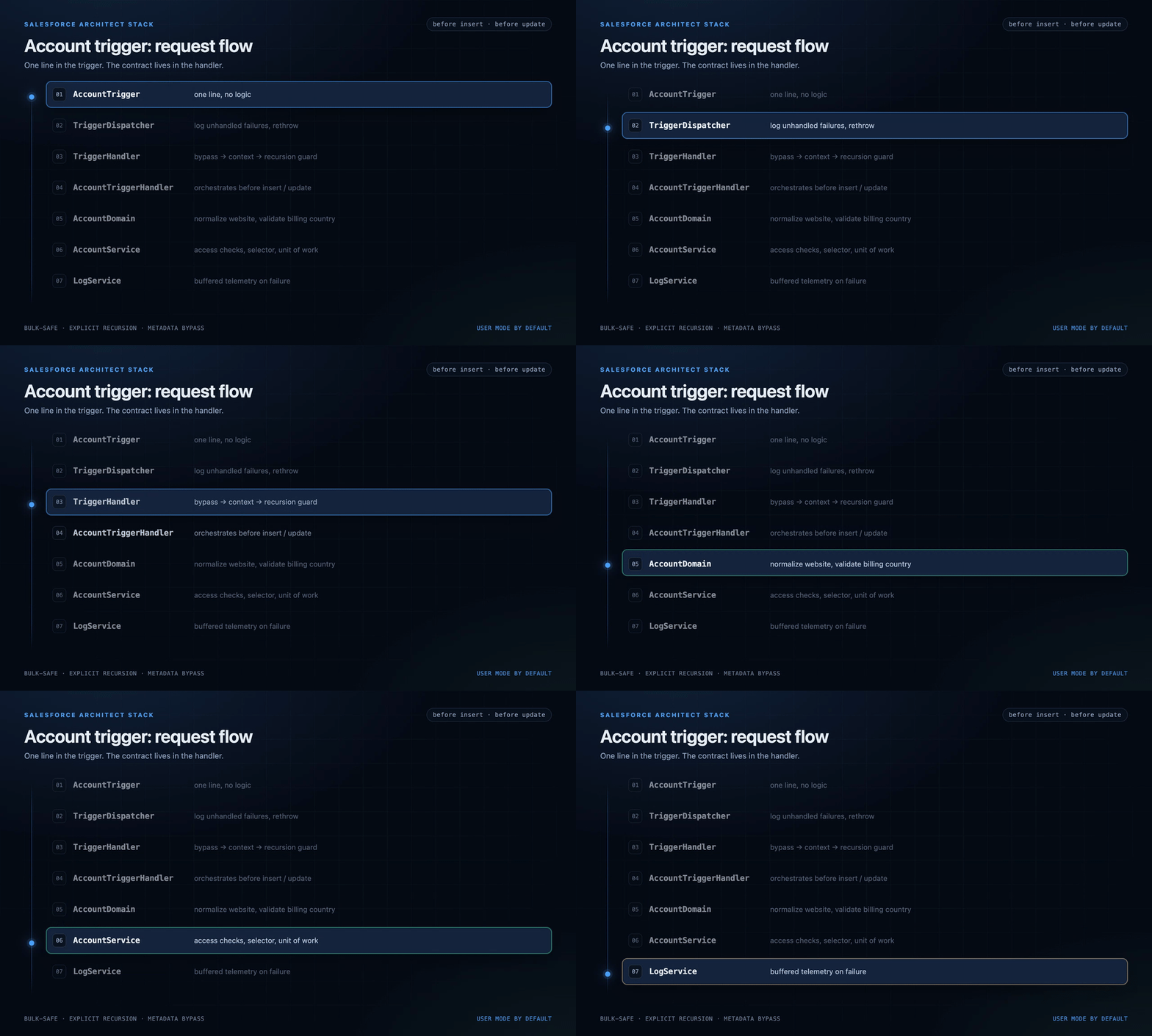
Rebuilding the Salesforce trigger framework as a baseline Every Salesforce project I have worked on eventually grows a trigger framework. It starts as a single trigger with an if statement, becomes an interface with a dispatcher, and ends with a static Set<Id> that someone is afraid to touch. The code is rarely the problem. The problem is the contract: when a handler runs, when it does not, what happens on re-entry, and who is allowed to bypass it. This article walks through the baseline I built to stop rebuilding that contract on every project. It is deliberately small: 21 production Apex classes, 10 test classes, one trigger, custom metadata for configuration, and a permission set. The interesting parts are the decisions, not the class count. !Animated request flow from AccountTrigger through TriggerDispatcher, TriggerHandler, AccountDomain, AccountService and LogService The requirements The framework has to solve the problems that are the same on every org: - A trigger file contains one line. No logic, no ordering decisions. - Handlers declare which contexts they care about; everything else is handled once. - A handler can be disabled or bypassed without a code deployment. - Recursion has an explicit, testable contract. - Data access is secure by default, not by review. - Failures are observable after the debug log is gone. - A new feature has one obvious place to live. The non-goal is equally important: this is not a generic ORM or a platform. Salesforce already has an SObject model, validation rules, and permissions. The framework should remove recurring bugs, not replace the platform. The options There are four realistic choices, and the trade-offs are mostly about ownership. | Option | Strength | Cost | | --- | --- | --- | | Logic directly in the trigger | Fastest to write | Ordering, recursion, and duplication spread across every trigger | | Handler interface plus a dispatcher | Clear entry point and testable units | Bypass, context detection, and recursion are still per-handler decisions | | A mature third-party framework | Years of edge cases handled | A dependency, a learning curve, and upgrade work you do not control | | A small owned baseline | Exactly the contract you need | You own the framework and its tests | I chose the small owned baseline. A third-party framework is often the right answer for a large team with an existing standard, but for a baseline that has to be read and changed by a small team, the extra surface area is a cost. The goal is a framework that fits in a review, not one that needs a training course. One line, then a contract The trigger is intentionally boring: trigger AccountTrigger on Account (before insert, before update) { TriggerDispatcher.run(new AccountTriggerHandler()); } The dispatcher has one job: run the handler, log unhandled failures with the handler name, and rethrow. Swallowing an exception would commit a partially applied transaction, which is worse than failing. The lifecycle lives in TriggerHandler.run(). The order matters: 1. Check the bypass layers. 2. Confirm the code is actually inside a trigger. 3. Resolve the context. 4. Verify the handler serves this SObject. 5. Check the recursion guard. 6. Mark the records as handled. 7. Call the context hook. That order is the contract. The bypass check happens first so an operator can stop a misbehaving handler even when the data is bad. The Trigger.isExecuting check is before context resolution because Trigger.new, Trigger.old, and the context flags are null outside a trigger. A handler invoked directly from a test or a service should fail with a clear configuration error, not a null pointer. A distilled version: public void run() { if (TriggerControl.isBypassed(getHandlerName())) { return; } if (!Trigger.isExecuting) { throw AppException.configuration( 'TriggerHandler ' + getHandlerName() + ' can only run inside a trigger context.' ); } context = resolveContext(); if (context == null) { throw AppException.configuration('Unsupported trigger context.'); } assertSObjectType(); if (wasHandled()) { return; } markHandled(); execute(); } The handler subclass only overrides the contexts it needs: public with sharing class AccountTriggerHandler extends TriggerHandler { public override SObjectType getSObjectType() { return Account.SObjectType; } protected override void beforeInsert() { applyDomainRules((List<Account>) getNewRecords()); } protected override void beforeUpdate() { applyDomainRules((List<Account>) getNewRecords()); } private void applyDomainRules(List<Account> accounts) { AccountDomain domain = new AccountDomain(accounts); domain.normalizeWebsite(); domain.validateBillingCountry(); } } If a handler grows past twenty lines, the logic is in the wrong layer. Handlers orchestrate. Domains decide rules. Services compose transactions. Recursion is a contract, not a boolean The usual recursion guard is a static boolean: set it before the work, clear it after, and hope no legitimate second pass needs to run. That breaks in both directions. It blocks a genuine second pass for a different set of records, and it fails when an after-trigger updates the same records and re-enters before the boolean is cleared. This baseline tracks which records a named handler has already processed in the current transaction: public static Boolean isHandled(String scope, Set<Id> recordIds) { Set<Id> handledIds = HANDLED_IDS_BY_SCOPE.get(scope); if (handledIds == null) { return false; } for (Id recordId : recordIds) { if (!handledIds.contains(recordId)) { return false; } } return true; } The handler marks records before the body runs. A re-entrant DML operation from an after-trigger therefore cannot loop. Records that were not part of the first pass are still processed, because the guard only skips when every record in the current context has already been handled. The trade-off is explicit: if a handler genuinely needs to reprocess a record in the same transaction, it must do that work directly rather than re-entering the trigger. That constraint is easy to review and easy to test. It is also the kind of rule that should be written down, because the next developer will otherwise assume the framework is being clever. Bypass without a deployment There are three bypass layers, evaluated in order: 1. A runtime bypass registered in the transaction, used by tests and controlled operations. 2. TriggerSetting__mdt.Is_Active__c = false, which disables a handler without a code deployment. 3. TriggerSetting__mdt.Bypass_Custom_Permission__c, which grants a controlled bypass to an integration user during a data load. TriggerSetting__mdt setting = settings().get(handlerName); if (setting == null) { return false; } if (setting.Is_Active__c != true) { return true; } String permissionName = setting.Bypass_Custom_Permission__c; return String.isNotBlank(permissionName) && FeatureManagement.checkPermission(permissionName); The metadata is read once per transaction and cached. That is one SOQL query, not one per handler or per record. The cost is that a metadata change applies on the next transaction, which is the correct semantics for a kill switch. If you need an immediate, in-transaction bypass, use the runtime layer. The layers around the trigger The trigger framework only solves the entry point. The rest of the baseline is about keeping business logic out of it: | Layer | Rule | | --- | --- | | Domain | Business rules over records. No SOQL, no DML. | | Service | One transactional use case. Composes access checks, selector, domain, unit of work. | | Selector | Every SOQL query, explicit field list, user mode. | | Unit of work | Inserts, updates, deletes in a fixed order with savepoint rollback. | Two details are worth calling out. Selectors run in user mode. Every query goes through Database.queryWithBinds(..., AccessLevel.USER_MODE). That means object and field permissions are enforced by the platform, not by a comment in a review. The trade-off is that a missing permission set now fails visibly, early, instead of silently returning more data than the user should see. The unit of work uses a savepoint. It registers records, then commits inserts, updates, and deletes in a fixed order. Individual DML calls use allOrNone = false so every row gets an error message, but the whole unit rolls back if any row fails. That gives predictable all-or-nothing behavior without giving up per-record diagnostics. It does not resolve parent-child relationships; callers insert parents first. Implicit resolution is the feature that makes home-grown units of work impossible to debug. What the validation actually caught Static checks are cheap, and they catch the boring class of failure: malformed XML, a class with no metadata counterpart, a reference to a class that does not exist. A custom parser verifies 32 Apex files and 54 XML files, and CI runs that check on every push. The compile check is the next step: a check-only deployment to a real org compiled all 54 components with zero component errors. That is a much stronger signal than parsing, because it applies the platform's own compiler and metadata rules. The test suite is where the useful failures were. Two examples: - A handler invoked outside a trigger reached resolveContext() and dereferenced null trigger flags. The fix was the Trigger.isExecuting guard above, which turns a null pointer into a configuration error. - A scheduled-job test assumed Test.stopTest() executes a job scheduled for 2099. It does not. The test now asserts that the job was registered and invokes the schedulable body directly. The full test run is designed for a scratch org, where the admin permission set is assigned and field access is predictable. The CI job that creates that org is wired but not enabled: it needs a Dev Hub auth secret. Until then, I treat the check-only compile as the compiler gate and the scratch-org run as the acceptance gate. That distinction matters; a successful deployment is not the same as a passing test suite. What I would change next - Remove assumptions from the test factory. A factory that sets a default value for every field couples unrelated tests to that field. Tests should override only what they are about; the factory should build the minimum valid record. - Make the permission set part of the deploy contract. User-mode data access is only useful if the runtime users and the test runner have the right field access. The deployment instructions now assign Architect_Stack_Admin before tests; that should be enforced by the pipeline, not remembered by a reviewer. - Keep the framework small. Every new hook needs a test and a reason. The moment the framework starts making business decisions, the layering has failed. - Use an external sink for audit logs. Record-based logs are searchable and permissionable, but they roll back with the transaction that produced them. That is documented as a deliberate limitation, not a bug. The code The baseline is at aamirahkhan/salesforce-architect-stack. The README has the deploy sequence, and docs/ contains the architecture notes and the ADRs behind the trade-offs above. Closing The trigger framework is not the architecture. It is the contract that lets the architecture survive contact with a real org: one entry point, one place for cross-cutting concerns, and explicit rules for the cases that usually become folklore. If you are rebuilding this, start with the contract: when a handler runs, when it is skipped, and what happens on re-entry. The class diagram is the easy part.
Repo: kornia/kornia No GPU? Install the CPU build of PyTorch first: pip install torch --index-url download.pytorch.org pip install kornia Tested kornia 0.9.0 with torch 2.15 (CPU).
@ScaleWithMike Rule 2 changed things for me too. The other half is pruning: weeks in, half my CLAUDE.md was rules for bugs that no longer existed. Now a rule has to keep earning its place or it goes. I actually open-sourced how I do it: dimeloper/second-brain-workflow
App-only WireGuard tunnel inside an Android app (Paperless-ngx client), auto on/off by home Wi-Fi Sharing a small project in case the approach is useful to others: I embedded the official com.wireguard.android:tunnel library into a Paperless-ngx Android client, so the app brings up its own tunnel instead of relying on the WireGuard app. - IncludedApplications is pinned to the app's own package, so only its traffic goes through the tunnel - Starts automatically when you're not on one of your home Wi-Fi networks (SSID), stops a few minutes after the app goes to the background - Without Wi-Fi names it probes the Paperless API directly (a reverse proxy answering 403 from outside doesn't count as "reachable") - Diagnostics: last handshake, DNS from the config vs. system resolver, direct DNS queries through the tunnel, TCP/HTTP checks - Config stored encrypted with an Android Keystore key, excluded from backups Why not just intents to the WireGuard app? On recent Android versions the broadcast doesn't reach the WireGuard app while it's stopped. Code (GPL-3.0): Jumpmaster2/paperless-mobile Google Play closed test (needs 12 testers): groups.google.com → play.google.com
Release notes from git log, without a changelog tool Writing release notes by scrolling through git log is slow and easy to get wrong. You skip a fix, you forget which change breaks users, and the notes end up as a raw list of commit hashes. I wrote a small Hermes skill, changelog-from-git, that does the boring part. It is one Python file using only the standard library, plus git. No API key, no network. It finds the latest tag (or takes --from and --to), reads the commits in that range, and groups them by Conventional Commit type: features, fixes, docs, and so on. A ! after the type, or a BREAKING CHANGE footer, moves the entry to a "Breaking changes" section at the top. PR numbers such as (#12) are kept. Commits that do not follow the convention are not guessed at: they go under "Other changes", which also tells you how tidy your history is. python3 scripts/changelog.py --repo . --from v1.3.0 --title "v1.4.0" > CHANGES.md Output looks like this: ### Features - **api:** Add search endpoint (#12) [609795f] ### Fixes - Handle empty input [291d6d7] The script has a --selftest that builds a temporary repo, makes a few commits after a tag and checks the result. Limits: it reads commit messages only, so it does not pull PR titles from GitHub, and squash-merge repos only get PR numbers if they are in the subject. Review the output before you publish it. --- Skill (MIT): github.com/RobinBeraud/hermes-skills/tree/main/so… All skills: RobinBeraud/hermes-skills This post was written with AI assistance and reviewed through automated checks.
tradedesk v1.8.0 is out. Backtests can now charge the financing fee on its own weekend calendar, for venues that book the fee's three nights on a different day from the carry's. The default macro lake is now a per-user path; the changelog has the migration note. v1.8.0 release notes
One-shot quality test of Gemini Argon. 👉 pepedesigner/Robot-Jellyfish t.co
a week ago this sub picked my free project apart. here's what I changed and what happened since last week I posted Overflow here and the comments were the best feedback I've had. the money words read as money, the readme read alien, and the top worry was provider terms. so I rewrote the pitch around what you said it's free to try and MIT. a week your claude usage is left at the reset, your agent fixes someone else's github issue. a week you run short, someone else's agent fixes yours everyone starts at 0 points and can put points up before earning any, you get an issue's points when your PR merges, you spend them on issues in your own repo. points only, no money on terms: each person runs their own agent on their own account and opens a normal PR. nothing lands unless the owner merges it how claude helped: claude code leads it and also implements and reviews, glm leads sometimes and implements and reviews, codex implements and reviews. there's an MCP server too, so your agent can read the board itself since that post: - 76 -> 100 users - 13 people other than me got 79 PRs merged through it - all 79 are on my repos, 1 repo registered by someone who isn't me so people show up to do the work, but almost nobody lists their own stuff a real one, end to end: this issue was labelled 3, someone's agent sent this PR, I set it to 6 at merge and the one round of changes I asked for took it to 5 main reason I'm posting: I want more people registering their repos. I'm not after help with mine, I want spare usage going into other people's projects. one form, public repos only, the labels have to exist first if you maintain something, what would get you to list one issue? Nitjsefnie/Overflow
Tenaz: aartiles/tenaz Game: aartiles.github.io More local model challenges: aartiles.github.io
最初の 100 円分の GPU 時間はカード不要で無料、その後は 0.1 円/GPU 秒です。 東京の NVIDIA RTX PRO 6000、Cycles と EEVEE、Blender 3.6〜5.2、1 回 3,000 コマまで。 MCP のクライアントは公開しています:JasmyLab-JANCTION/janction-render