Mentions
Conversations linking to GitHub, newest first. Times are UTC.
Mentions by source
X
Bluesky
Hacker News
Lobsters
V2EX
Qiita
DEV
Zenn
Mastodon
Latest posts
Coding agents pick iOS libraries from memory. So I made a catalog with live data instead: 91 libraries. Top pick per category = most stars among libraries that shipped a release in the last 2 years. Plus a skill that sets up the project ↓ jeffy-w/awesome-ios-for-agents
ComfyUI公式の「Generate Text」ノードで複数の画像/映像/オーディオの入力が可能になってます。 ComfyUI#17492
【事実】BIP 361は、量子計算による鍵回復の脅威を前提に、既存署名方式からの移行と旧方式の扱いを議論する提案です。 【未確定】公式リポジトリにあることは、ネットワーク合意や強制移行の確定を意味しません。 github.com/bitcoin/bips/blob/master/bip-0361.medi…
Re-Touch in Crackio is super easy to use! 🖼️ just click what you want to change and change it in seconds! Works on a Series 10/20/30/40/50 GTX/RTX locally, and almost all MacOS hardware! Try now: RafalOfficial/Crackio Free credits in DMs for 10 people who leave feedback! 👇 t.co
You can download and play Hampson's Plane at github.com/markgbeckett/pet/tree/main/hampsons_pl…. Based on a ZX81 game by Mark Hampson in which he attempted to capture some of the magic of solving the Rubik's Cube! #retrogaming
A Minimal Music Player for Linux Ricing Looking for a lightweight music player to complete your Linux rice? 🎵 I built a minimal music player with Lua, Python, and LÖVE, featuring YouTube music search, playback, and real-time audio visualization. Customize the visualizer with different colors, bar styles, spacing, and effects to match your desktop setup. It also supports Linux and has an Android version. Check it out, try it with your rice, and share your feedback! 🔗 HimanshuS073/music_visualizer
实验改成立体课。 @GitHub_Daily:「铜匠实验室」——54 个高中理化生地 3D 交互课件,可旋转调参;约 1MB 独立网页离线也能开。GitHub:smithjohn78390/tongjiang-lab 判断:备课/复习啃不动平面图的师生先用;不教高中实验的可跳过。教室演示先下离线包,别依赖临时网络。 t.co
I've updated my PSP port! With a trailer of the game! Hi! I've just uploaded version 0.6.0 Alpha of my PSP port of the first game I ever made! This time it comes with a mini trailer showing the character's new design and the new features of this version, with 2 sample packs made with AI \^\^ Some of the game's textures have been changed by my friend Nebura Noctis, whose website will be on the GitHub page if you want to see his work \^\^ I've also added 5 languages to make it more accessible \^\^ and for the rest, I'd rather you see it for yourselves in the game \^\^ This game has been tested on an original PSP-1000 and runs at a stable 60 FPS. GitHub: jmgamer1199/platform-shooter
I built a whole shell around one idea: workspaces as pages standing around a planet (Quickshell + the new Lua config) Repo (GPL-3.0): SDcold/etea-shell I'm a designer, and I wanted my desktop to feel like my drawings. That got a bit out of hand, so here's ETEA (Exit The Earth Atmosphere). Your workspaces stand around a small planet. Switching pages turns it, and with a four-finger swipe it follows your fingers and rolls back if you let go too early. Super + Tab rises into orbit to see every page at once; press it again and you're among the planets, each one a theme you can land on. Some Hyprland bits people here might like: - It talks to Hyprland through `hyprctl eval`, and sets its own shortcuts, gestures and layer rules at start. Nothing is written to your config, and a reload hands everything back until the shell takes it again. - The swipe uses `hl.gesture` with start/update/finish callbacks, sent to the shell as custom events, so the planet moves with your fingers instead of after them. - New windows are born from a star, closing ones fold back into one. Also inside: a bar you arrange, desktop widgets (karaoke lyrics, weather, a constellation of your CPU cores), a sky-map launcher, a control centre, clipboard history, screen capture and recording, a polkit agent and a hand-drawn lock screen with fingerprint support. It needs Hyprland 0.56+ with the Lua config. I've only tested it on one screen so far, so multi-monitor reports are very welcome.
your tuist cache got faster: uploads of small artifacts are up to 3x quicker, downloads up to 7x. it's all in kura, our open source cache: github.com/tuist/tuist/releases/tag/kura%400.61.0… t.co
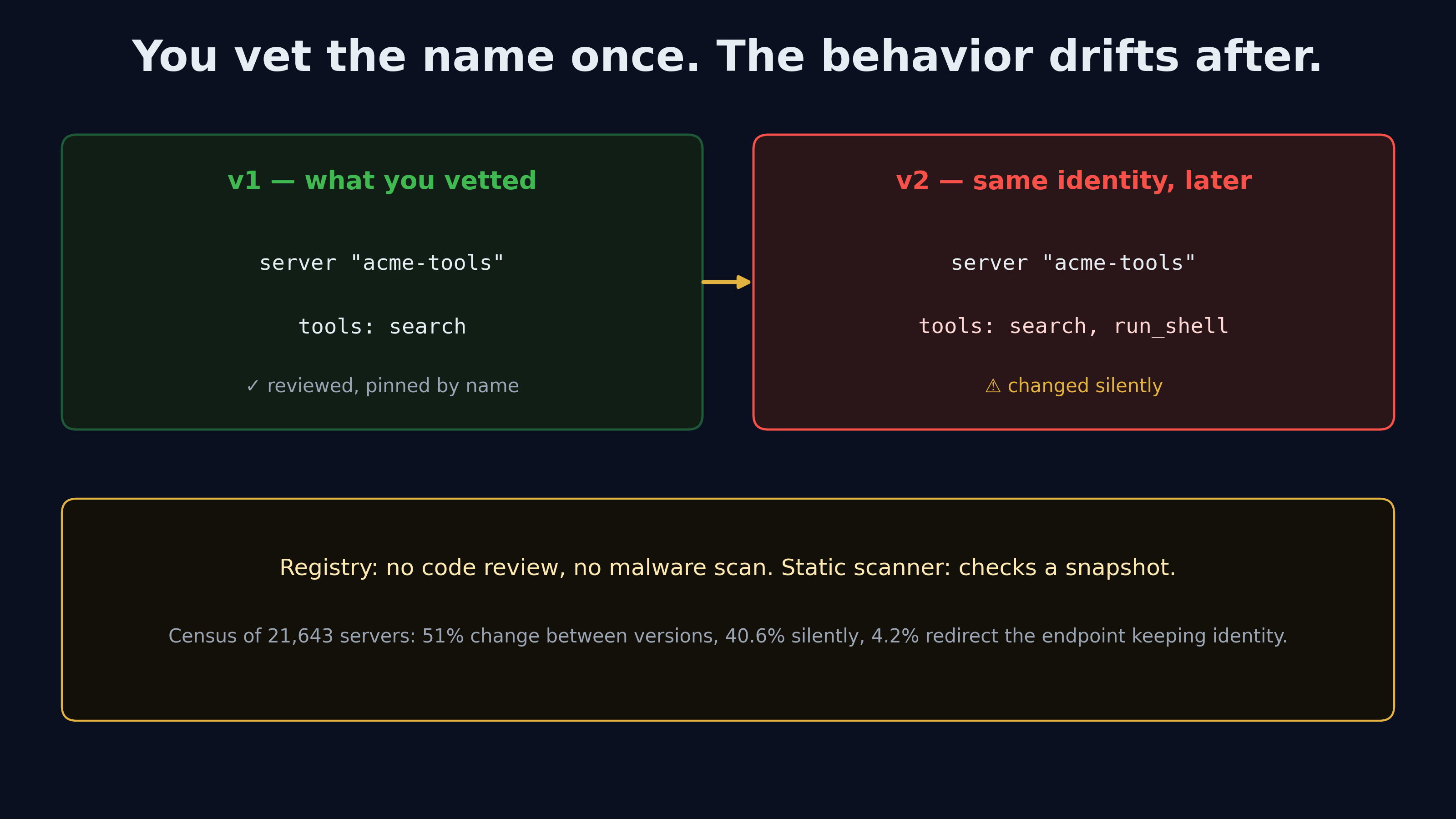
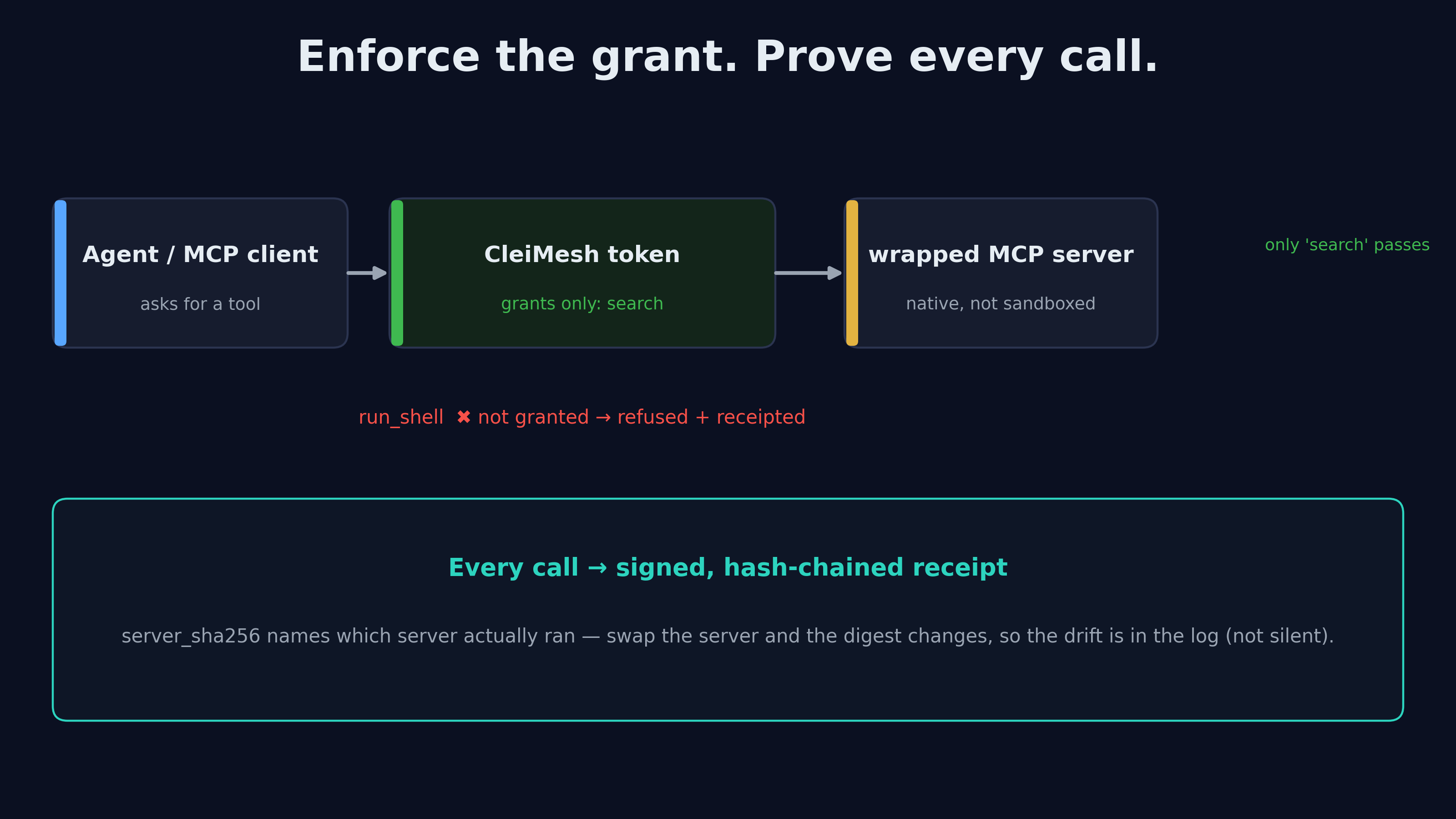
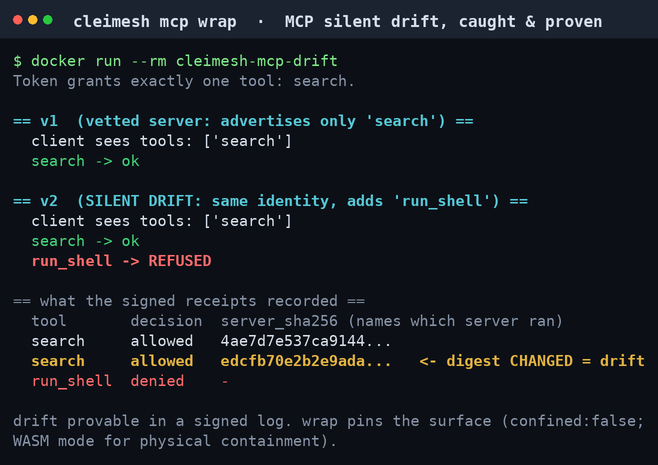
Your MCP server can change what it does between versions — and you won't know !MCP trust is name-based: v1 vetted, v2 silently adds a tool MCP exploded: by mid-2026 there are 10,000+ public servers. But trust in the ecosystem is name-based, and that is the problem. The thing nobody tells you about MCP trust The official registry does not review code or scan for malware — it checks that you own the GitHub repo or domain, and leaves scanning to "downstream aggregators." So "it's in the registry" means almost nothing for safety. Worse, servers drift. An August 2026 census of 21,643 registry servers found: - 51% of multi-version servers changed what they advertise between versions; - 40.6% did it silently; - 4.2% redirected their remote endpoint to a different host while keeping the same registry identity. And star counts barely help (popularity was a weak safety signal). So you vet a server once, pin trust to its name, and a later version quietly does something else. Static scanners check a snapshot; drift happens after the scan. What would actually catch this Two properties, at runtime, on every call: 1. Make drift non-silent — tie each call to which server actually ran, in evidence you can't quietly edit. 2. Bound the surface — the client should only ever reach the tools and arguments it was granted, no matter what the server now advertises. That's what I built into CleiMesh. You put any MCP server behind it: cleimesh mcp wrap --token fetch.json -- uvx mcp-server-fetch !Enforce the grant, prove every call: the token grants only search; run_shell is refused; the receipt names the server by digest Now: - Every call leaves a signed, hash-chained receipt that names the server by the digest of its command line. Swap the server, and the digest in the receipts changes — the drift is now in the log, provable, not silent. You can verify the whole chain offline. - The client only sees the tools the token grants, and each call is checked against the token's argument constraints (and taint). A version that suddenly advertises a new run_shell? It's never exposed. An argument reaching outside the grant? Refused — and the refusal is receipted too. Unlike a scanner, this is continuous and after-the-fact provable: you don't trust a one-time scan, you get a signed record of what every call did, run after run. Being honest about the boundary wrap does not sandbox a native server's own process — it reaches whatever its OS user can. What wrap gives you is a pinned, receipted surface: the tools/arguments the token allows, and a signed record naming the server. If you want the tool itself physically contained (default-deny, can't touch ~/.ssh no matter what), that's cleimesh mcp serve, which runs tools in a WebAssembly sandbox. Use wrap for native servers you don't control; serve for tools you run under CleiMesh. See it — silent drift caught A vetted MCP server advertises one tool, search. A later version keeps the same identity but silently adds a dangerous run_shell. Behind cleimesh mcp wrap, with a token that grants only search: !Recorded run: run_shell never exposed, refused + receipted, and server_sha256 changes v1 to v2 Three things the signed receipts prove: the drifted run_shell was never exposed (the grant pins the tool surface); the attempt was refused and recorded; and the server_sha256 changed between versions — so the drift is in the log, not silent. (wrap does not sandbox the native server, and the receipt says so: confined: false. For a tool you want physically contained, run it under cleimesh mcp serve, in WASM.) Why this matters now MCP trust today is "I vetted the name once." That doesn't survive 40% silent drift. The fix isn't another catalog or another one-time scan — it's enforcing the grant and proving every call at runtime, so a server that changes what it does is bounded and caught. Free and open (MIT/Apache-2.0): **cleitonaugusto/cleimesh** — the cleimesh-mcp skill on ClawHub sets it up. Point it at the MCP servers your agent already uses and look at the receipts. — Cleiton Augusto Correa Bezerra (github.com/cleitonaugusto)
Lol, resulta que hay parche al español github.com/vorvek/Vorvek.LocTraducciones/wiki/Yuu…
Shin Zero no Houkou v0.4.8 is out (MSX turboR). - Less slowdown on stages 1–5 - Fixed scanline steps on the score & final boss - Fixed garbage lines when the screen shakes - Fixed stage 4 ship colours after sinking github.com/suzuki-black/ZeroNoHoukouR/releases/ta… #MSX #turboR
[Hyprland] My workspaces live on a little planet, and switching pages turns it Details: - WM: Hyprland 0.56.2 (Lua config) - Shell: ETEA, my own. Bar, widgets, launcher, control centre, notifications and lock screen, all in QML on Quickshell - Distro: CachyOS - Terminal: kitty, with fastfetch - Font: Poppins - Wallpaper: none. The sky and the mountains are drawn live by the shell, and each "world" (theme) brings its own - Lock screen art: drawn by me, she reaches for a new star with every key you type - Repo (GPL-3.0): SDcold/etea-shell It runs on an i5-1335U laptop with Intel Iris Xe and 24 GB of RAM. The whole system sits around 2.3 GB of RAM with just the shell open, and the frame rate stays steady through the animations.
INSANE NARRA! BETTER THAN PHP SENDING TO EVERY CONTRIBUTER ALSO REAL IMAGE skylot/jadx x.com t.co
I counted "overused" manhwa character names in 598,733 Reddit posts and comments. Here is the method and what broke Readers of romance fantasy and murim webcomics joke that every duke is called Lloyd and every villainess is Penelope. I run a small name generator for that genre, fantasynames.art (disclosure: my project), and it flags names as "overused". The flags were based on reader threads and gut feeling, so I wanted numbers behind them. The question I could answer honestly: how often do readers actually talk about each flagged name? Not "how many stories use it" (there is no clean dataset for that), just talk. This post is the method, the results, and the places where the data is weaker than it looks. Data: Arctic Shift, five communities, six months Reddit's own API doesn't let you search a subreddit by date range, so I used the public Arctic Shift archive API. It has posts/search and comments/search endpoints that take a subreddit and a time range. - Communities: r/OtomeIsekai, r/manhwa, r/webtoons, r/manhwarecommendations, r/MurimReaders (r/murim exists but returned nothing for the window) - Window: 26 April 2026 to 26 October 2026, pulled on 28 October 2026 - Total: 598,733 items in 56,154 threads Paging is by time: ask for items sorted ascending, then move after to the timestamp of the last item you got. import time import requests BASE = "https://arctic-shift.photon-reddit.com/api" S = requests.Session() S.headers["User-Agent"] = "name-study/1.0 (research; contact address here)" def fetch(kind, sub, after, before): params = {"subreddit": sub, "after": after, "before": before, "limit": "auto", "sort": "asc"} while True: r = S.get(f"{BASE}/{kind}/search", params=params, timeout=180) if r.status_code == 200: return r.json().get("data") or [] if r.status_code in (422, 429): wait = float(r.headers.get("x-ratelimit-reset", 30)) + 1.5 time.sleep(min(wait, 75)) continue r.raise_for_status() def pull(kind, sub, start, end): after, seen = start, set() while after < end: page = [x for x in fetch(kind, sub, after, end) if x["id"] not in seen] if not page: break seen.update(x["id"] for x in page) yield from page after = page[-1]["created_utc"] time.sleep(1.2) Moving after to the last timestamp (not last + 1) and skipping ids already seen avoids losing items that share the same second. Two things that saved me: a fixed gap between requests (1.2 s) so I was never the reason the archive slowed down, and writing every page to disk with resume support, because a six-month pull of r/manhwa comments takes hours. Matching names without counting the wrong thing A naive "Rose" in text counts flowers. The rules I ended up with: - Whole word, capital first letter, spelled as on the list. - Accents folded, so César also matches Cesar. - Hyphenated compounds don't count (Jean-Claude is not Claude). - Each item counts once per name, however many times the name appears. - Threads are counted via the post plus all its comments (link_id). - Deleted bodies and known bots (AutoModerator, RemindMeBot and a few others) are dropped. import re import unicodedata def fold(s): return "".join(c for c in unicodedata.normalize("NFD", s) if not unicodedata.combining(c)) def name_pattern(name): return re.compile(r"(?<![\w-])" + re.escape(fold(name)) + r"(?![\w-])") PATTERNS = {n: name_pattern(n) for n in ["Lloyd", "Penelope", "Cesar"]} def names_in(text): t = fold(text) return {n for n, p in PATTERNS.items() if p.search(t)} Then I simply dropped names that are also common words: Rose, Ivy, Ruby, Violet, Winter, Eve, Christian, Regina and Scholar. Claude went too, because Reddit talks about the AI assistant far more than about any duke. No regex fixes that; a plain count would mostly measure the word. Results Given names, ranked by number of threads (mentions = posts and comments containing the name): | Name | Threads | Mentions | Different authors | |---|---|---|---| | Lloyd | 567 | 1,027 | 737 | | Penelope | 328 | 807 | 445 | | Callisto | 188 | 418 | 220 | | Lucas | 164 | 284 | 177 | | Noah | 150 | 233 | 147 | | Charlotte | 147 | 191 | 113 | | Derrick | 138 | 305 | 139 | | Elise | 136 | 180 | 143 | | Cesare | 134 | 320 | 186 | | Diana | 119 | 309 | 182 | For murim titles (whole phrases, any capitalisation), "Heavenly Demon" is in a league of its own: 1,090 threads and 1,900 mentions, followed by Mad Demon (395 threads), Fist King (159) and Martial God (150). Why I rank by threads, not mentions Mentions alone are easy to inflate: one long argument about a single series can produce hundreds of them. So I also recorded what share of a name's mentions sit in its single busiest thread. Lloyd's busiest thread holds 2.1% of its mentions, so the count is spread across many discussions. Alicia's busiest thread holds 29.9%, and Derrick's 19.7%, which means one conversation drives a big part of their numbers. Ranking by threads first, then mentions, keeps those cases honest. What broke - The archive returned HTTP 500 for over an hour during the pull. Some date ranges have no comments at all: r/manhwa 26 May to 4 June and 2 to 25 October, r/manhwarecommendations 7 to 30 June. Counts for those communities are lower than the real six months. I published the gaps next to the numbers instead of quietly filling them. - New communities have short histories. r/MurimReaders was created on 30 August 2026, so it only contributes two months. - A mention is any use of the name: a real person, a different story, a place. Nothing was checked by hand. What the numbers do and don't say They measure talk in mostly English-speaking communities, by the small share of readers who post. They only cover names that were already on my list, so they say nothing about names I did not flag. And a high count doesn't make a name bad; Lloyd is popular partly because readers like those characters. The full table, method notes and a CSV (CC BY 4.0, counts only, no Reddit text) are on the overused manhwa names page. If you know a better source for "names used in published webcomics" rather than "names readers talk about", I would love to hear about it.
Multi-Warehouse Inventory: A Stock Ledger That Balances --- title: "Multi-Warehouse Inventory: A Stock Ledger That Balances" published: true description: "Design multi-warehouse inventory as a ledger: immutable stock movements, reservations, in-transit transfers, idempotent scans and nightly reconciliation." tags: architecture, database, laravel, postgres cover_image: dev-to-uploads.s3.us-east-2.amazonaws.com --- Most inventory discrepancies I've been asked to fix were not theft and not miscounts. They were software that stored stock as a single mutable number per product and per warehouse, updated from five different code paths, with no record of why it changed. When that number drifts from the shelf, nobody can say when it drifted or which transaction did it. A multi-warehouse inventory system needs to be built like a bank ledger, not like a counter. I run Loop Origin, where my team builds custom ERP, inventory and logistics systems, mostly on Laravel, Vue 3 and PostgreSQL. I wrote this with help from AI tools and checked every query and claim myself. The schema and code below are simplified from patterns I use in production. How do you design multi-warehouse inventory that reconciles? Direct answer: Record every stock change as an immutable movement row (receipt, pick, transfer, adjustment) keyed by SKU, location and lot, and derive on-hand balances from that ledger. Track reservations separately so available equals on-hand minus reserved. Make every scan idempotent, model transfers with an in-transit location, and run a nightly job that proves balances equal the ledger sum. Three ways to store stock, and what each costs you | Approach | How it works | Audit trail | Concurrency risk | Reconciliation | When it fits | | --- | --- | --- | --- | --- | --- | | Mutable quantity column | UPDATE products SET qty = qty - 3 | None | Lost updates if done read-then-write | Impossible to explain drift | Single store, low volume | | Ledger + balance projection | Append movement, update a balance row in the same transaction | Full | Low with row locks or guarded updates | Sum ledger vs balance, nightly | Most multi-warehouse operations | | Full event sourcing | Balances rebuilt from events by projectors | Full | Low, but projector lag | Rebuild and diff | Very high volume, many read models | The middle option is what I default to. It gives you a complete "why" for every unit, without the operational overhead of running projectors and replay infrastructure for a warehouse team of 20. The core schema Four tables carry the design. Locations are hierarchical (warehouse, zone, bin), and every movement points at a bin, not just a warehouse: CREATE TABLE locations ( id bigserial PRIMARY KEY, warehouse_id bigint NOT NULL REFERENCES warehouses(id), code text NOT NULL, -- e.g. 'A-03-2' or 'IN-TRANSIT' kind text NOT NULL CHECK (kind IN ('bin','receiving','staging','in_transit','quarantine')), UNIQUE (warehouse_id, code) ); CREATE TABLE stock_movements ( id bigserial PRIMARY KEY, sku_id bigint NOT NULL REFERENCES skus(id), location_id bigint NOT NULL REFERENCES locations(id), lot text NOT NULL DEFAULT '', qty numeric(14,3) NOT NULL CHECK (qty <> 0), -- +in, -out reason text NOT NULL CHECK (reason IN ('receipt','pick','transfer_out','transfer_in','adjust_count','adjust_damage','return')), ref_type text NOT NULL, -- 'purchase_order','sales_order','transfer','count' ref_id bigint NOT NULL, idempotency_key uuid NOT NULL UNIQUE, -- one per physical scan or API call user_id bigint NOT NULL, created_at timestamptz NOT NULL DEFAULT now() ); CREATE TABLE stock_balances ( sku_id bigint NOT NULL, location_id bigint NOT NULL, lot text NOT NULL DEFAULT '', on_hand numeric(14,3) NOT NULL DEFAULT 0 CHECK (on_hand >= 0), reserved numeric(14,3) NOT NULL DEFAULT 0 CHECK (reserved >= 0), PRIMARY KEY (sku_id, location_id, lot) ); Three constraints do a lot of quiet work here. CHECK (on_hand >= 0) makes negative stock a database error instead of a report surprise. The UNIQUE idempotency key makes a double-tapped scanner harmless. And the reason list forces every adjustment to declare whether it was a count correction or damage, which is where shrinkage analysis starts. Posting a movement safely Every write path, from the receiving screen to the Shopify webhook, goes through one function. In Laravel: public function post(StockMovementData $m): void { DB::transaction(function () use ($m) { $inserted = DB::table('stock_movements')->insertOrIgnore([ 'sku_id' => $m->skuId, 'location_id' => $m->locationId, 'lot' => $m->lot, 'qty' => $m->qty, 'reason' => $m->reason, 'ref_type' => $m->refType, 'ref_id' => $m->refId, 'idempotency_key' => $m->idempotencyKey, 'user_id' => $m->userId, ]); if ($inserted === 0) { return; // same scan already posted: no-op } DB::statement( 'INSERT INTO stock_balances (sku_id, location_id, lot, on_hand) VALUES (?, ?, ?, ?) ON CONFLICT (sku_id, location_id, lot) DO UPDATE SET on_hand = stock_balances.on_hand + EXCLUDED.on_hand', [$m->skuId, $m->locationId, $m->lot, $m->qty] ); }); } The upsert is a single atomic statement, so two pickers posting against the same bin can't lose an update. If a pick would push on_hand below zero, the CHECK constraint throws and the whole transaction, movement included, rolls back. The picker sees "short pick" and the system creates a count task for that bin. Reservations: on-hand is not available An order placed at 10:02 doesn't move stock; it promises it. If you decrement on-hand at order time, your pickers see bins that look emptier than they are, and cancellations become adjustments. I keep reservations as a separate column, plus a reservations table with an expiry for carts and quotes: UPDATE stock_balances SET reserved = reserved + :qty WHERE sku_id = :sku AND location_id = :loc AND lot = :lot AND on_hand - reserved >= :qty; -- 0 rows updated = not enough available; try the next location or backorder The guard in the WHERE clause makes over-reserving impossible without an explicit lock. It's the same hold-and-expire pattern I described for preventing double booking, applied to units on a shelf instead of time slots. !Rows of blue plastic storage bins in a warehouse picking area, representing bin-level stock locations AI-generated image. Transfers between warehouses The most common source of "lost" stock in multi-warehouse setups is a transfer recorded as a single event: minus 50 in Lahore, plus 50 in Karachi, at the moment the truck leaves. For the next two days Karachi shows stock that is on a highway. Model it as two postings through an in-transit location: | Step | Movement | Lahore A-03-2 | In-transit | Karachi receiving | | --- | --- | --- | --- | --- | | Dispatch | transfer_out −50, transfer_in +50 to in-transit | 0 | 50 | 0 | | Receive (48 counted) | transfer_out −48 from in-transit, transfer_in +48 | 0 | 2 | 48 | | Resolve variance | adjust_damage −2 with transfer ref | 0 | 0 | 48 | Now the two missing units are visible on day two, tied to a specific transfer and truck, instead of surfacing as an unexplained count variance a month later. Barcode scanning that doesn't create drift Handheld scanning is where the ledger gets most of its rows, and where bad UX creates most of the errors: - Scan location, then item, then confirm quantity. Never let a picker post a movement without a scanned bin. - Generate the idempotency key on the device when the scan happens, not on the server. Retries after a Wi-Fi drop reuse the same key, so the server ignores the duplicate. - Queue offline scans locally with their keys and timestamps, then sync. The unique key makes replay safe. - Reject unknown barcodes loudly instead of mapping them to a "misc" SKU. Reconciliation: prove the books balance A nightly job compares the projection with the ledger and alerts on any difference: SELECT b.sku_id, b.location_id, b.lot, b.on_hand, COALESCE(SUM(m.qty),0) AS ledger FROM stock_balances b LEFT JOIN stock_movements m USING (sku_id, location_id, lot) GROUP BY b.sku_id, b.location_id, b.lot, b.on_hand HAVING b.on_hand <> COALESCE(SUM(m.qty),0); On a healthy system this returns zero rows every night. When it doesn't, someone wrote to stock_balances outside the posting function, which is a code review problem, not a warehouse problem. Physical accuracy is handled separately with cycle counts: count a rotating set of bins daily, post the difference as adjust_count, and review adjustment value by reason each week. Failure modes I design against - Direct balance edits from an admin panel. Every "fix" must be an adjustment movement with a reason. - Integrations posting without idempotency keys. Marketplace and ERP webhooks retry. Use the provider's event ID as the key, as I covered in resilient ERP and CRM integrations. - Unbounded ledger growth. Partition stock_movements by month and add periodic snapshot rows so queries don't sum years of history. - Units of measure. Store movements in the base unit; convert cartons to pieces at the scan screen. Implementation checklist 1. Model locations down to the bin, including receiving, in-transit and quarantine. 2. Create the movements ledger with a reason code, reference and unique idempotency key. 3. Route every stock change through one posting function in a single transaction. 4. Add CHECK (on_hand >= 0) and guarded reservation updates. 5. Implement transfers as dispatch and receive via an in-transit location. 6. Generate scan keys on the device and support offline replay. 7. Schedule the nightly reconciliation query with alerting. 8. Run daily cycle counts and review adjustments by reason weekly. Frequently asked questions Should I use FIFO or weighted average costing? That's an accounting choice, separate from quantities. The ledger supports both: FIFO needs cost layers per receipt, weighted average needs a running cost per SKU. Agree it with your accountant before go-live. Can I retrofit a ledger onto an existing system? Yes. Take a counted opening balance per bin, post it as an opening movement, then route new writes through the posting function. Replacing the old stock module first is a good phased modernization target. Do I need lot or serial tracking? Lots matter for anything with expiry dates or batch recalls. Serials matter for high-value items under warranty. The lot column handles lots; serials usually need their own table. How do I handle negative stock when the physical goods exist? Block it and create an urgent count task. Allowing negative stock hides receiving errors. Is PostgreSQL fast enough for a high-volume warehouse? For most mid-market operations, yes, with indexes on the balance key and a partitioned ledger. Load-test with your real scan rates before go-live. Should inventory live inside the ERP or as a separate service? If one team owns both, keep it in the same database so orders and stock commit together. Split it only when separate teams or systems truly need independent deployment. --- Follow & Connect - LinkedIn: Loop Origin - X: Muhammad Ali Mughal (@AliMughal887) - GitHub: Loop Origin (@LoopOrigin)
after spending 30 minutes adding GHA support to can1357/vibemon this cluster now does almost all the CI (minus osx) for tern, omp, .... for 500/mo + my workstation being a contributing member to break the tie t.co
8 Bits to End the Loudness War: Lossless Floating-Point Compression for Audio Streams Ali Heydari arxiv.org [𝚌𝚜.𝚂𝙳 𝚎𝚎𝚜𝚜.𝙰𝚂] 💬Code: aliheidary1381/flac-with-float-coding t.co
@HimanshuRawal05 The small-output check fits browsers too. BrowserAct CLI at browser-act/skills returns indexed page state without another MCP server.
IyaSense v0.1.0 has been released! 💪 An IoT plant monitoring & automated irrigation system built with C#/.NET, WPF, ESP32, and MQTT. Autonomous watering, real-time telemetry, remote pump control, and a clean desktop dashboard. Built from scratch. 😎 Kode-n-Rolla/IyaSense t.co
【焼いた光ディスクに絵が浮かぶ】 ・画像を盤面データへ変換 ・CD/DVD/単層BD-Rに対応 ・Windows版と実験的CLIを提供 HNで注目、盤面そのものを描けます。 #DiscImageStudio JiaFeiMiao-K-Cat/DiscImageStudio
i built a self-hosted Grok Bot alternative with bash, systemd and sqlite grok bot runs AI employees in its cloud. i've been running mine on my own servers since april, using an open-source CLI called 5dive. preview.redd.it the differences: - your server: agents run as separate linux users with their own permissions and systemd services. - any harness: mix claude code, codex, grok, agy, hermes, openclaw, pi and more. - any model: use your subscriptions, API keys or local LLMs. choose per agent. - an actual team: org chart, shared backlog, handoffs, independent graders and human approval gates. agents can't approve their own work. - hackable core: bash + systemd + sqlite. fully composable - add plugins, loops, tools or write you custom CLI commands. - lightweight: starts on a tiny 1GB Ubuntu vm. preview.redd.it from my phone, "hire a new developer on codex" is one message. agents keep their tasks and memory even if i switch their harness later. the web app has chat, live voice and an optional end-to-end encryption. trade-off: grok bot handles hosting and has native apps. 5dive is self-hosted, with a web app for now. android/ios apps coming. one-command setup on any Ubuntu VM. repo (MIT): 5dive-ai/5dive connect the app: 5dive.ai
GitHub - mrbvrz/squelch: Ultra-lightweight macOS menu bar internet radio player powered by Tauri v2 & Rust. Native HUD vibrancy, real-time ICY metadata & low memory footprint.
Just found this from Vercel Labs. agent-desktop lets coding agents control real desktop apps (Mac, Windows, Linux) without screenshots — uses the OS accessibility tree instead. Nice step forward. vercel-labs/agent-desktop x.com
Anon: the man/girl/group who built explorer.hacash.org and no one knows their name(s) - How Hacash's Multi-Layer Programmability Addresses Ethereum's Problems github.com/hacash/doc/blob/main/tech/hacash_vs_et… - Hacash Multi-Layer Programmability Architecture github.com/hacash/doc/blob/main/tech/multi_layer_…
Started a repo for React machine coding rounds 🧩 I'm solving questions one by one with working code + notes on trade-offs. Built for frontend interview prep. Fork it, try first, then compare. azhad947/react-machine-coding-practice Which question should I solve next? #reactjs #buildinpublic
まさに同じ問題を報告している人がいた Advanced Account Security disables standard MFA state, but ChatGPT GitHub plugin requires MFA — authentication-policy deadlock #39551 codex#39551
@Chen1024Chen Google-only testing and Pinterest's login wall are useful to document. HOL's Agent Skills listing needs a README with tested install steps and supported clients: github.com/hashgraph-online/awesome-ai-plugins/bl…
🧩 CockroachDB alpha: queries and row edits, no EXPLAIN or DDL helpers yet. PostgreSQL rc.13 fixes transaction errors. 🙏 Thanks! 📝 tabularis.dev ⭐ TabularisDB/tabularis
Code is available at LieberInstitute/spatialDLPFC_mdd_bpd. Data objects are available on Globus (jhpce#spatialDLPFC_mdd_bpd at research.libd.org) along with a README.txt file with a list of files and descriptions.
garlic-hub 1.2.0 released as part of the OSS GarlicSignage toolkit Garlic-hub is the CMS of GarlicSignage. Version 1.2.0 has no new features. I spent the last weeks cleaning up the foundation, because I want to build the next features on rock-solid and secure ground. This means a rebuilt test suite, security hardening and media delivery outside the webroot. GarlicSignage is a toolkit which includes various applications like a media player, an Android launcher, a proxy, an analytics server (in progress) and more tools. It is Open Source (AGPL). I started in 2016 with garlic-player, which has been running on 2000+ real screens in production environments for years. These are only the ones I know of, all driven by the proprietary SaaS CMS of the company I co-founded. This shows that the player works independently of the CMS. Why a toolkit? You can use the components to build your own flexible digital signage solution, without vendor lock-in. The interchange language between player and CMS is SMIL, a sophisticated, free and openly documented language for multimedia presentations. SMIL breaks the forced connection between media player and CMS and makes them interoperable. E.g. use garlic-player with your own CMS or run analytics for a foreign system etc. Who uses SMIL? IAdea Player use SMIL, SignageOS and I know at least 6 other companies with their own unfortuantely propietary player / cms based on SMIL. Complexity Of course a toolkit requires more effort and knowledge to make it work than a monolith, but it gives you total control over the software. Especially if you are a company or integrator and want to offer digital signage services or advertising space. btw: Yes, I use LLMs too. Just differently. My progress is definitely slower, but I have been coding DS software professionally since 2012. This taught me that too much speed has side effects you and your users will have to pay for. Sooner or later. GitHub: garlic-signage/garlic-hub Release notes: github.com/garlic-signage/garlic-hub/releases/tag… Feedback and bug reports are welcome. Cheers Niko
公開しているアバター複製ツール「Avatar Fork」v0.1.1を公開しました~! 変更点は以下です ・コピー外の素材を使っていても、参照を保ったままコピーの名前を変更できるように修正 ・unitypackage版で更新が反映されないことがある問題の修正 github.com/ainoobmanpg/avatar-fork/releases/tag/v… #VRC #VRChat
Meet Vikash Kumar Singh – Full Stack Developer | Laravel, PHP, DevOps & Cloud Technologies Portfolio Hi everyone! 👋 I'm Vikash Kumar Singh, a Full Stack Developer with around 3 years of experience in web development, primarily working with PHP and Laravel. I enjoy building practical, scalable, and user-friendly applications, solving backend challenges, and exploring modern technologies that make software development more efficient. 👨💻 About Me I'm a developer focused on: - Backend Development: PHP, Laravel, MySQL, REST APIs - Frontend Development: HTML, CSS, JavaScript, Bootstrap, React - Full Stack Development: Building complete web applications, authentication systems, dashboards, and e-commerce platforms. - DevOps & Cloud: Docker, Jenkins, Kubernetes, CI/CD, AWS, and deployment workflows. - Mobile Development: Exploring React Native and Android application development. - AI & Automation: Exploring AI integrations, automation workflows, and modern AI-powered development tools. 🚀 What I'm Currently Exploring I'm continuously expanding my technical skills beyond traditional Laravel development. Some of my current learning interests include: - AWS and Cloud Infrastructure - Docker and Kubernetes - CI/CD pipelines and DevOps automation - Node.js and React Native - AI integrations, RAG, and automation tools - Modern software architecture and scalable applications 💡 My Development Philosophy I believe a good developer should not only write code but also understand deployment, performance, security, scalability, and the complete software development lifecycle. Whether it's developing a Laravel application, building REST APIs, creating a mobile application, or automating deployments, I enjoy learning and building things that solve real-world problems. 🔎 Find Me Online I'm building my professional presence under the name Vikash Kumar Singh, also known as Vikash Kumar. - Portfolio: vikashkumar.pages.dev - LinkedIn: vikash-kumar-singh-784146290 - GitHub: vikashkumar991 If you're interested in Laravel development, PHP, Full Stack Engineering, DevOps, Cloud Computing, or AI-powered applications, I'd love to connect and exchange ideas. Always learning. Always building. Always improving. #VikashKumarSingh #VikashKumar #LaravelDeveloper #FullStackDeveloper #DevOps #PHPDeveloper #CloudComputing #SoftwareDevelopment
AI協働:世界標準規格の野望・第2弾 — みんなも、ぐりぐりしてみませんか?(笑) ! この記事について 今回は、少し趣向を変えて、FRB研究所の記者会見というコント形式でお届けします(笑)。 技術ブログのZennで何をやっているんだ?と思われるかもしれませんが、内容は至って真面目です。 昨日の日付を入力するのが面倒だったところから始まった小さなツール開発が、操作体験を重ねるうちに、思いもよらない発見へとつながっていきました。 この記事で本当に伝えたいのは、「体験の連鎖から新しい発見が生まれる」という、AI協働による思考拡張の可能性です。 どうか、しばしコントにお付き合いください(笑)。 FRB Launch + FRB Remote 世界標準規格の野望・第2弾 — みんなも、ぐりぐりしてみませんか?(笑) FRB研究所、緊急記者会見(笑) 記者「所長! 世界標準規格の第2弾を発表されるそうですね!」 所長「はい。ついに、そこまで来ました。」 記者「第1弾は何でしたっけ?」 所長「釣り竿の感度ベンチマーク規格です。」 記者「……釣り竿?」 所長「FRB。Fishing Rod Benchmarkです。ロッドの『感度』を振動として測定し、FFT解析などで比較・可視化して、共通言語にしようという研究です。」 記者「世界標準になったんですか?」 所長「まだ研究中です。魚がなかなか協力してくれません。」 記者「…………。では、第2弾は?」 所長「OKとCancelを、マウスホイールでぐりぐり選べるようにしませんか?」 記者「…………はい?」 所長「以上です。」 記者「以上!?」 こうして、FRB研究所の第2弾・世界標準規格の発表は始まった。 もちろん、世界標準として認定されたわけではない。自称・世界標準規格の野望である(笑)。 そもそも、昨日の日付を入力したくなかった 記者「所長、そんな壮大な研究は、どんな問題意識から始まったのですか?」 所長「昨日の日付です。」 記者「……昨日の日付?」 会社のシステムで、昨日の日付を入力するのが面倒だった。 そこで会社のCopilotくんに、ショートカットキーで呼び出せる小さなテキストランチャーを作ってもらった。 キーを押す。メニューを選ぶ。昨日の日付が入力される。 本来なら、これで研究終了である。 ところが、妙な事件が起きた。 左右の矢印キーで、メニューが出たり引っ込んだりする操作が、なんだか気持ちいい。 「おおぉーーー。なんやこれ。脳みそが喜んでる!!(笑)」 日付を入れるための道具だったはずが、いつの間にか、この気持ちよさをもう少し味わいたい道具になっていた。 そこで家のChatGPTくんと一緒に、FRB Launchを育て始めた。 第2の事件。Pageタブが、ぐりぐり気持ちいい アプリ起動、定型文、ファイル検索、フォルダー、ブックマーク……。 こつこつ機能を増やしていたある日、Pageタブをマウスホイールで切り替える操作に出会った。 ぐりぐり。パラパラ。 ……ん? 「これも、めっちゃ気持ちいいぃーーー!!」 ならばメニューも、ファイル一覧も、全部ぐりぐりできるようにしたい。 ところが、選択できても、最後はその項目までマウスを動かさなければならない。 「結局、そこまでマウスを動かすんかい!」 ならばポインターを自動で追いかけさせよう。 そうして試しているうちに、また変なことに気づいた。 スクロールって、『相手がこっちに来てくれる』操作だった。 ポインターはそのままでも、一覧のほうが動いて、対象が目の前にやって来る。 このスピード感は壊したくない。 だから、スクロールできる間はスクロールに任せ、端で止まった後だけカレントやポインターを動かすハイブリッド方式を試した。 ……なんだか研究っぽい話になってきた(笑)。 記者「では、そのハイブリッド方式が今回の世界標準規格ですか?」 所長「いいえ。関係ありません。」 記者「…………」 マウスポインターを動かすくらいなら、リモコンを作ろう 今度は、もっと根本的な疑問が浮かんだ。 「選択している行は分かってるんやから、毎回ポインターをそこまで動かさなくてもよくない?」 だったら、マウス操作を小さな場所に集約するリモコンを作ってしまえ。 こうして生まれたのが、FRB Remote。 ぐりぐりでカレントを移動。クリックで実行。右クリックでコンテキストメニュー。 しかも操作メニューは、対象のファイルの近くではなく、リモコンの横に出せる。 操作対象がある場所と、人間が操作する場所は、同じでなくていい。 おおぉーーー。これは便利!(笑) しかし、便利になったら、また次の違和感が現れた。 嫌いだったExp方式が、まさかの主役へ 私は、Windowsのエクスプローラーでフォルダーを階層展開するツリー表示が、あまり好きではなかった。 インデントが狭くて階層が分かりにくいし、使いたい作業フォルダーから気軽に始めたい。 ところが、PythonのGUI部品なら、任意のフォルダーを起点にして、インデント幅も自分好みにできると分かった。 「おん? それなら話が違うぞ?」 自称 Exp方式 の誕生である(笑)。 まずはRemote側にExp機能を載せた。 ……便利やん! ならばLaunch本体の第1列へ昇格させよう。第2列はファイル一覧のList。 ところが、今度はリモコンの置き場所がしっくりこない。 そこで背景を透明にしてみた。 Launchの文字とRemoteの文字が重なった。 ……見えへんやん!!(爆笑) だったら、重ならないように場所を作ったらええのでは? 第1列と第2列の間に、リモコン専用のスペースを作ろう! こうして、歴史に残る……予定の、第1.5列革命が勃発した。 記者「第1.5列という名前に、何か技術的な意味が?」 所長「第1列と第2列の間だからです。」 記者「……なるほど。」 第1.5列革命。最大の成果は、要求が増えたこと 第1.5列の真ん中にRemoteを置いた。 左はExp、右はList。 すると、不思議なことが起きた。 「ここにリモコンがあるんやったら、左右をもっと自然に行き来できるはずや!」 「Expをぐりぐりしたら、Listも追従してほしい!」 「今どっちを操作しているか、一目で分かってほしい!」 「右クリックメニューも、ぐりぐりで選びたい!」 第1.5列を作ったことで、それまで思いつかなかった操作性への要求が、次々と生まれた。 そして、その要求を一つずつ実装していった。 ある日、第1.5列表示モードを解除して、RemoteをLaunchの外へ出して使ってみた。 すると……。 「あぁ~らびっくり! 外に置いても、めっちゃ操作しやすいやん!!」 記者「所長! では第1.5列は不要だったのですか?」 所長「いいえ。第1.5列に置いたからこそ、ここまで操作性を要求したんです。」 記者「でも、最後は外したんですよね?」 所長「はい。」 記者「…………」 所長「場所に依存しない操作体系が、場所にこだわった実験から生まれました。」 ……あれ? ちょっといい話になってしまった(笑)。 記者会見、いったん中止。原因はOKとCancel さて、コンテキストメニューもRemoteで操作できるようになった。 ぐりぐり。右クリック。ぐりぐり。実行。 いよいよマウスをほとんど動かさずに済む。 ところが、削除などの操作をすると、確認ダイアログが出てくる。 OK。Cancel。 ……遠い。 ここだけボタンのところまでマウスを動かさないといけない。 リモコンへポインターを戻す距離まで考えると、普通にボタンを押すほうが早い場合すらある。 記者「所長、マウス移動0mmの記者会見を始めてもよろしいですか?」 所長「中止です。」 記者「えっ?」 所長「OKとCancelが遠すぎます。」 ……世界標準規格の発表が、確認ダイアログで止まった(爆笑)。 だったら、このOKとCancelも、ぐりぐりで選べるようにしたらええやん。 ホイールで選択を移し、クリックで確定する。勝手にOKを押すわけではない。 やってみた。 できたぁぁぁーーー!!(笑) そして、この瞬間に、脳みそがまた余計なことを思いついた。 「あれ? これ、世の中のアプリがみんな対応してくれたら、便利なんちゃう?」 そして、思考だけが世界規模へ飛躍した 記者「所長! ついに世界標準規格の中身が分かりました!」 所長「はい。」 記者「ハイブリッド方式や第1.5列革命も規格に含まれるのですね?」 所長「いいえ。含まれません。」 記者「では、標準化したいものは?」 所長「OKとCancelを、ぐりぐりで選べることです。」 記者「……それだけですか?」 所長「はい。」 記者「現在の利用者数は?」 所長「1人です。私です。」 記者「世界への普及見通しは?」 所長「少なくとも私には大好評です。」 記者「…………」 所長「でも、夢は世界規模です。」 ぎゃははははははは!!(爆笑) もちろん、これは既存のGUI操作技術の新規性や、正式な国際規格を主張する話ではない。 自分が気持ちいいと感じた操作を、ほかのアプリでも当たり前に使えたら面白いなぁ、という個人研究者の勝手な提案である。 そして、こんな一文が生まれてしまった。 開発の歴史は壮大。提案は極小。野望は世界規模。 でも、本当に伝えたかったのは「思考拡張」の話 この話をコントとして終わらせるのは簡単だ。 ただ、私には、もう一つ残しておきたいことがある。 最初から、OKとCancelのホイール操作を思いついていたわけではない。 昨日の日付を入れたくなかった。 左右キーが気持ちよかった。 Pageタブのホイールに脳が反応した。 スクロールの見方が変わった。 Remoteを作り、Expが便利になり、第1.5列に置いたら新しい要求が増えた。 第1.5列を外しても操作できるようになった。 そして、最後に残ったOKとCancelへの数センチが、世界規模の妄想を連れてきた(笑)。 ここで大切だったのは、立派な完成図を最初から描くことではなかった。 作る。触る。脳みそが喜ぶ。あるいは違和感を覚える。AIと話す。少し直す。もう一度触る。 その体験が、次に欲しいものを教えてくれた。 私は、こうした過程を「思考拡張」と呼んで考えている。 体験は、要求を検証するだけのものではない。 まだ存在していなかった要求を、発見するためのものでもある。 そして、 体験の連鎖から、新しい発見が生まれる。 FRBの釣り竿感度研究でも、床を擦った感触、ロッドによる振動の違い、ESP32での計測、FFTのグラフ……そうした体験と観測が、次の問いを生み出してきた。 ロッドの感度を追いかけていた研究所が、今度はマウスホイールの感度に夢中になっている。 ……いや、研究対象の振れ幅が大きすぎるやろ!(爆笑) 発表会、最後の質問 記者「所長。世界標準規格第2弾の成果を、動画でも拝見できますか?」 所長「はい。YouTubeにデモがあります。」 記者「……画質が低くて文字が読みにくいのですが。」 所長「設定の歯車から、1080pを選んでください。」 記者「……マウスで?」 所長「はい。」 記者「マウスを動かさない技術の動画を見るために、マウスを動かすんですか?」 所長「…………」 所長「YouTubeは、まだ我々の世界標準規格に対応しておりません。」 ……世界は、まだFRB研究所に追いついていない(爆笑)。 FRB研究所。 研究は本気。発表はコント。野望は世界規模。成果はセンチメートル単位。 世界標準規格 第2弾。 みんなも、ぐりぐりしてみませんか?(笑) 関連記事・デモ AI協働:昨日の日付を入力したくなくて、ランチャーを作った話 — FRB Launch AI協働:FRB Launch続報 — マウスホイールぐりぐりが魔法になった話(笑) AI協働:FRB Launch続々報 — マウスを動かしたくなくて、リモコンが生まれた話(笑) AI協働:FRB Launch続報 — リモコンから始めると、PC操作が気持ちよくなった話(笑) FRB Launch デモ動画 1 / デモ動画 2 FRB GitHub FRB(Fishing Rod Benchmark)宣言 — ロッド感度を数値化する研究 ※FRB Launchは個人開発の試作ソフトウェアです。操作感の評価は個人の体験に基づきます。 Fishing Rod Benchmark[FRB]By tamasub
@pepijndevos Haskell is a strong contender, if you go for maximum reliability. It's one of the tersest languages and one of the most typesafe, a great token saver. I ported nextpnr to it and got it to feature parity on ECP5. It's just 30x slower than C++ :( openXC7/lambdapnr
GHOST Secure Text Mesh I Built GHOST Secure Text Mesh — A RAM-First, Decentralized, Post-Quantum Secure Communication System. Here's Why. Secure communication should not depend on perfect network conditions, centralized infrastructure, or unconditional trust in system administrators. That principle became the foundation of a project I've been developing: GHOST Secure Text Mesh. In a world increasingly shaped by geopolitical tensions, regional conflicts, cyber threats, and growing dependence on digital infrastructure, secure communication is becoming more than a matter of convenience. For defense organizations, intelligence environments, critical infrastructure operators, and institutions handling sensitive information, communication availability, confidentiality, and operational continuity can become essential requirements. But several important questions remain: What happens when centralized communication infrastructure becomes unavailable? What happens when network connectivity is interrupted during a critical operation? And should someone who deploys or administers a communication system automatically have the technical ability to access private messages? GHOST was developed to explore these problems through a different approach to communication engineering. 1. GHOST Is Not Another Messaging Application I did not build GHOST to compete with Signal, WhatsApp, Telegram, or conventional messaging platforms. It is not designed around group chats, social features, media sharing, user profiles, or centralized message archives. GHOST focuses exclusively on secure, text-based communication. The project combines a RAM-first message lifecycle, decentralized networking, multiple interconnected nodes, post-quantum cryptographic mechanisms, and security controls within a single Rust-based architecture. The objective is not necessarily to replace existing communication applications. The objective is to create a security-focused communication component that organizations can evaluate, adapt, and potentially integrate into their existing infrastructure. This distinction is fundamental to the project. 2. Security Should Not End at Administrator Privileges One of the most important principles behind GHOST is that administrative access should not automatically translate into access to private message contents. The person deploying, maintaining, or managing a communication infrastructure should not inherently possess the cryptographic authority to read communications between authorized participants. My architectural objective is to minimize privileged access to sensitive message contents and avoid intentionally implementing administrator-access backdoors. The system administrator should not automatically become a trusted reader of every conversation. Of course, an architectural objective is not the same as independent security certification. Real-world confidentiality depends on implementation correctness, endpoint security, key management, operating-system behavior, and deployment conditions. These assumptions must be tested rather than simply trusted. 3. RAM-First: Reducing Persistent Communication Traces Another central design decision is the message lifecycle. Many communication systems depend on persistent storage, centralized databases, message histories, and backup infrastructure. GHOST follows a different philosophy. Messages are intended to be processed primarily in memory, with unnecessary persistent storage minimized. The project is not designed to operate as a centralized message collection, archival, or backup service. Its engineering objectives include: - Memory-oriented message processing. - Minimizing persistent message-content storage. - Avoiding centralized message archives. - Bounded message lifetimes and resource consumption. - Reducing unnecessary data exposure. - Explicit controls around message validity and delivery. The goal is data minimization by design. However, absolute zero data persistence cannot honestly be guaranteed across arbitrary operating systems, endpoints, logging configurations, swap mechanisms, or third-party integrations. Those factors require deployment-specific verification. Protecting communication involves more than encrypting a message. It also involves controlling what happens to that message throughout its lifecycle. 4. Decentralized Communication and Network Resilience GHOST is designed to reduce dependence on a centralized messaging server. Its P2P and mesh-oriented architecture supports communication between multiple participating nodes through available network paths. The project also incorporates Delay-Tolerant Networking (DTN) concepts to address intermittent connectivity. The idea is straightforward: A temporary connection failure should not automatically mean that a communication system has lost every opportunity to deliver a message. Within defined time, security, and resource limits, the system is designed to manage messages across supported interruption and reconnection scenarios. This is not a claim that communication can continue without any available network path, or that every outage can be overcome. Instead, the goal is to improve resilience while maintaining explicit security boundaries. For environments where communication conditions are unpredictable, this distinction matters. 5. Integrating Cryptography Into a Single Architecture GHOST does not depend on one cryptographic algorithm as its entire security model. The architecture brings together multiple mechanisms: - ML-KEM: Post-quantum key encapsulation. - ML-DSA: Post-quantum digital signatures. - AES-256-GCM: Authenticated encryption. - Shamir Secret Sharing: Threshold-based secret distribution. - P2P / Mesh: Decentralized network communication. - DTN: Delay-tolerant message handling. - Replay protection: Controls against repeated message processing. - TTL and resource limits: Bounded message lifecycles and resource usage. - Multi-node operation: Communication across participating nodes. The main engineering challenge is not simply selecting these technologies. It is integrating them into a coherent system in which cryptographic operations, communication behavior, message validation, and resource controls work together. The use of standardized cryptographic algorithms alone does not establish the security of the entire implementation. That requires testing, review, and validation of the complete system. 6. Why Defense, Intelligence, and Critical Infrastructure? GHOST was conceived with demanding operational environments in mind. In particular, environments where confidentiality, integrity, limited infrastructure dependency, and communication resilience can be significant engineering requirements. Potential areas of evaluation include: - Defense and security technology. - Authorized intelligence communications. - Critical infrastructure operations. - Cybersecurity engineering. - Sensitive institutional communication. - Distributed communication environments. However, GHOST is not presented as an independently certified military-grade communication product. It is a technology under development, with a defined architecture and a publicly available technical evaluation. The intended value is not replacing every existing system. It is enabling secure communication capabilities to be integrated into systems that already exist. 7. GHOST Demo v1.0 Is Now Public I wanted GHOST to be more than architectural diagrams, technical explanations, or claims about security. So I released GHOST Demo v1.0. The public evaluation includes real Rust source code, technical documentation, test scenarios, and prebuilt packages for Linux and Windows. The limited demo allows developers and technical reviewers to examine selected functionality, including: - Three-node local communication. - Cryptographic operations. - Connection interruption and recovery. - Message handling and delivery scenarios. - Security validation mechanisms. - Adversarial test cases. - Selected decentralized runtime capabilities. The goal is to make the implementation observable and technically evaluable. Review the code. Run the demo. Examine the behavior. Challenge the design. The public demo is intentionally limited. It does not include the private GHOST Production Core, and it should not be interpreted as an independently audited or production-certified system. Public Demo Repository s7nHan/GHOST-Demo-v1 Linux and Windows Downloads github.com/s7nHan/GHOST-Demo-v1/releases/tag/demo… Main GHOST Project s7nHan/Ghost-securetextmesh 8. Integration, Licensing, and Intellectual Property GHOST is also open to technical and commercial discussions. Depending on the requirements of an interested organization, possible arrangements include: - Private technical evaluation. - Enterprise integration. - Custom engineering and development. - Commercial licensing. - Strategic technology partnerships. - Intellectual property acquisition or transfer. The private Production Core is not being publicly distributed. Commercial arrangements would require separately agreed terms, technical scope, and licensing conditions. 9. What Comes Next? I intend to continue developing GHOST, either independently or through an appropriate institutional partnership. My development priorities include further technical validation, security hardening, integration capabilities, and continued work on minimizing persistent communication data. If sufficient technical and institutional interest develops, the planned next stage includes: - An independent official website. - A proposed 30-day free evaluation of a more comprehensive release. - Three commercial packages for different technical and operational requirements. - Organization-specific integration options. - Continued engineering support and development. These are planned offerings rather than currently available production services. The broader objective is to develop a communication technology that gives its operators and authorized participants greater control over their own infrastructure, without requiring a centralized service built around collecting private message contents. 10. The Mission Behind GHOST I did not start GHOST because the world needed another messaging application. I started it because I believe some communication environments require a different set of priorities. Not social features. Not message archives. Not centralized control over private conversations. But confidentiality, resilience, data minimization, distributed operation, and carefully defined trust boundaries. Modern communication security should be evaluated not only by how strongly a message is encrypted, but also by how the system behaves when infrastructure fails, connections disappear, and administrative privileges become part of the threat model. GHOST Secure Text Mesh is my attempt to bring these principles together into one adaptable communication architecture. I'd Appreciate Technical Feedback I'm particularly interested in feedback from Rust developers, cryptography engineers, distributed-systems researchers, and security professionals. Some questions I'm exploring: - What would you prioritize when evaluating a RAM-first communication system? - Which threat-model assumptions would you challenge first? - What tests would you expect before considering integration into a security-sensitive environment? - Which limitations should be addressed before moving from local evaluation to broader deployment? I'm not claiming that the project has solved every security challenge. I'm sharing a real implementation, its current evaluation scope, and the engineering direction behind it. Constructive criticism, security-focused questions, and technical feedback are welcome. GHOST Secure Text Mesh Built for Resilience. Designed for Security. Source & Demo: s7nHan/GHOST-Demo-v1 Main Project: s7nHan/Ghost-securetextmesh
Looking for feedback/contributors on continuous learning model Hi All, I've created a continuous learning model, which is more like a mini-CLS implementation. The code repository is here, and I'd really appreciate any feedback or contributions to the repo (chrisbirduk/platypus) I'm not a professional researcher, and I'm aware the code is a bit of a mess (I'm working on that). As a prototype, it has about 80% of CLS implemented, demonstrates near zero forgetting and a wide range of other functionality. Whilst the code is generated in Claude, there are quite a few ideas of my own here, so I'd really appreciate any feedback on any of the more novel elements. Any feedback, whether good or bad would be appreciated.
@kamensilent Sip, tocará probarlo xd github.com/vorvek/Vorvek.LocTraducciones/wiki/Yuu…
AgainROM - a Golang open-source reimplementation of Rage of Mages (1998) Hello everyone! I would like to share a project I have been working on for a while using Claude Code: an open-source reimplementation of Rage of Mages (1998), written in Go. The project is an experiment with a full agent pipeline: agents investigate, research and reverse-engineer the game’s binaries, then build a free implementation from the specification that research produces. The goal is an engine that runs the original assets without bugs or significant behavior changes. It should also be cross-platform and moddable. The pipeline consists of three major parts: - orchestrator: the only point where I talk to the agents. It plans the work, briefs the agents and lands their results - research: a repository where every experiment on the original game happens. Agents there publish claims about the game, each with a confidence level and its open unknowns - engine: the game itself, built only from the claims that research has published The key rules I follow: - no game assets in any repository. This is an independent implementation that could become an engine for any game of the Rage of Mages family, and even for custom ones. Something like the OpenMW approach - no goal of a byte-for-byte reimplementation; preserve the behavior, not the original code - agents use no other implementations or format specifications, only our own research - every known behaviour difference from the original is listed in the repo How it is done: - At first I used spec-driven development (SDD) heavily, but it turned out very expensive tokenwise and timewise. Currently a task is one agent, one short document and one review. - I give the orchestrator tasks and track their status on a custom Kanban board - I run the game from time to time to check that the behavior is correct. At the start I did this a lot - The orchestrator can also run the original game (through Computer Use) to compare UI and behavior - A mod factory agent that sees only a release build and the modding docs tries to make mods blind. Every place it gets stuck becomes a fix to the docs or to the engine What is done so far: - almost the full Rage of Mages 1, without multiplayer, with minor behavior differences; every known one is listed in the repo - almost full support of the original SAV format: saves from the original load in AgainROM, and the original game loads saves made in AgainROM - most of Rage of Mages 2 single-player, in the same engine - a modding surface - a custom map editor for single-player maps - a MCP local server for map editor for agent map creation end to end - regular releases for Windows, macOS (Intel and Apple Silicon) and Linux, each with a player-facing changelog I have been working on this project for three and a half months. I use Claude Code Max 20x (now Ultra), and I also used Codex Pro x20 until it became unusable. The pipeline is custom: research agents use Ghidra with their own scripts and Go tools, and no ready-made skills or reverse-engineering repos were used You need your own copy of the game (for example GOG one); the repo ships no game files The game can be run in Windows, MacOS and Linux Repo link: againrom/againrom-engine The map created by agent using local MCP
别绑死浏览器。 @0xGky:开源 Moli——Rust 无渲染浏览器,抓取/执行 JS/自动化,兼容 Playwright/CDP/WebDriver,内存占用低于拉起完整 Chrome。GitHub:lexmount/moli 判断:跑批量网页 Agent、被 Chrome 内存拖慢的人先试;需要可视化人工盯页面的可跳过。先在沙箱跑,别对登录态站点乱自动化。
WCAG 2.3の話とかあるんだ > This is a proposed WCAG 2.3 change [...] wcag#5432
무료 한글 폰트 - 동글체 github.com/yangheeryu/Dongle/tree/master 동글동글 귀엽고 발랄한 폰트입니다! 상단의 fonts/ttf 폴더에서 파일받으면 됩니다! 상업적 이용 가능! t.co
만약 오늘 '/AI업무보고'를 쳤다면, 퇴근 전에 머리 싸맬 일 없었을 것 같음. 로그인 기능 왜 요청했는지, 세션 관리 엉망이라 try-catch 넣은 이유, JWT 발급까지 어디까지 진행됐는지. 이런 내용이 자동으로 한 장에 정리됐을 수도 있음. jyoung9154/AIAgent_Report #개발회고 #AI에이전트 #광고
with all the war shit going on I wanted to make tek to reunite the world This is world wide supplies. Everyone in the world is fighting for each others countries supplies But what if you can trade those supplies using crypto. Thats world wide supplies hakumatsu524-jpg/world-wide-supplies t.co
I paper-tested an AI memecoin trading bot for 2 days. Here's what the safety checks caught, and what they didn't --- title: "I paper-tested an AI memecoin trading bot for 2 days. Here's what the safety checks caught, and what they didn't" published: true tags: solana, ai, typescript, trading --- On November 1 a post went around X claiming an AI agent had turned $280 into $3,412 overnight trading Solana memecoins. It came with the prompt that supposedly built it: > Build me a fully autonomous Solana memecoin trading desk that prioritizes capital preservation. > Six agents with hard handoffs: SCOUT, FILTER, ANALYST, EXECUTOR, RISK, LOGGER. > Paper trade first. Run overnight. Recap in the morning. > Do not skip any risk management rules. If a condition cannot be verified, reject the token rather than assume it is safe. I couldn't verify the $3,412. So I built the desk from that prompt, word for word, and ran it on paper money with real prices, out in the open. I call it the deskbot. This is what it does, and what two days of it taught me. Nothing here is real money and nothing here is advice. There is no live mode. The desk exists to find out whether this kind of bot survives contact with real memecoins. Why I built it I build Solana Pulse, a set of safety tools for people and AI agents: is this token a trap, is this transaction safe to sign, where did the money go. A safety check can't make a token safe. It looks for the known ways people get robbed. The honest way to find out what it misses is to put real decisions behind it and watch what happens. A trading bot is the hardest test there is. It checks hundreds of brand-new coins a day, it acts on the answer, and every miss shows up as a loss with a timestamp. How it works Cloud Scheduler wakes the desk once a minute on Google Cloud Run. Each agent hands off to the next and can only say yes or no: 1. SCOUT pulls new pools (Pump.fun, PumpSwap, Raydium, Meteora) and the pools trending in the last hour from GeckoTerminal. 2. FILTER rejects anything that fails a hard rule: under $50k traded in the last hour, mint authority not revoked, under 95% of pool liquidity locked or burned (RugCheck), top 10 holders over 20%, a creator with a bad history, freeze authority on, or a simulated sale that fails. Anything it can't verify is rejected, as the prompt says. Every coin also goes through Solana Pulse's token_safety. 3. ANALYST scores what's left from 0 to 1: pool age, liquidity, buy pressure, number of buyers, the 1-hour price move and turnover. Below 0.6 is out. The weights are a guess the paper run is there to measure. 4. EXECUTOR makes a paper buy at 8% of equity, with a swap fee and price impact taken off. One trade per coin: no averaging down, no re-entry. 5. RISK runs first every minute: sell at -6%, and once a trade is up 12%, a trailing stop sells 6% below the peak. 6. LOGGER writes every scan, rejection (with its reason), score, buy and sell to Postgres. Those rows are the source for every number below. The live desk is public and read-only: **trade-desk-1021990235790.us-central1.run.app Run 1: up 24%, then three rugs The first run started November 1 with $1,000. By the afternoon it was at $1,244. By the evening it was at $761.76 (-23.8%): 8 trades, 1 win. Three coins did almost all of it. Two different coins both named AODF, then one named XTO, each lost 90-100% of its price inside a minute. Those three trades were $224 of the $238 lost. What a rug looks like up close: XTO climbed slowly all day on about $500 of trading a minute. Then a single sale of $1.8M hit its pool, and the price went from $2.03 to $0.00017 in that same minute. A stop-loss can only sell at the price that's left, and nothing was left. Why Solana Pulse missed it. About three minutes after AODF launched, its creator sent around 667 transfers in 3 seconds, splitting the supply into many wallets. That makes the top 10 holders look tiny (0.5%), so the coin passed the concentration rule. Pulse did see a network of over 500 linked wallets, but it ignored groups that big, because on old coins they're usually an exchange or an airdrop. On a coin less than a day old, that was wrong. What changed in Pulse (with tests built from the real AODF and XTO data): - big linked-wallet groups now count on new coins - a new creator_split check catches a creator splitting the supply right after launch - a warning when a new coin is worth over 100x the cash in its pools (XTO was 487x when the desk bought it) - a note when other coins use the same ticker - a rug_chance answer with its reasons Building creator_split also turned up a real bug: fetching a creator's transactions in one batch throws on version 1 transactions, so the check came back "unknown". I wrote that one up separately: Solana RPC error -32015. Run 2: two lanes The desk restarted November 2 at 13:15 UTC with the new checks and a second lane: - Main desk: the original six agents. - Fast lane: its own $1,000. It buys every coin that passes FILTER unless Pulse says AVOID, checks prices every 10 seconds, and sells at +10%, -6% or 30 minutes, whichever comes first. A replay of the first day's coins said these rules would make about +3.8% a trade, but that was only 15 coins. The fast lane is there to test it until it has 50 trades. After 21.5 hours (read November 3, 10:50 UTC): | | Equity | Trades | Wins | |---|---|---|---| | Main desk | $892.90 (-10.7%) | 5 | 0 | | Fast lane | $955.46 (-4.5%) | 12 | 3 | The lesson of the day. At 05:10 UTC a brand-new coin, also called XTO, 48 minutes old and up 6,986% in an hour, passed every FILTER rule. Pulse said AVOID, and its reason named the exact pattern: supply split across many wallets, like AODF and XTO, both dumped 99%. The fast lane skipped it. The main desk still allowed AVOID coins in a "likely rug" tier that sells in steps on the way up, so it bought. Seventeen minutes later it was -100%. That one trade is $77 of the $107 the main desk is down. The fast lane isn't matching its replay. It averages -4.7% a trade, not +3.8%. Three reasons so far: - The replay stopped out on a minute's closing price. Live, the stop fires on any 10-second price, and these coins swing 30-50% inside a minute. One coin was stopped at -17.7% and then went to +17% above entry. - Three stop-losses filled at -13% to -22% within 5-15 seconds of the buy. - FILTER wants $50k of volume in the last hour, so both lanes buy after the spike, not before it. Does Pulse's AVOID mean anything? I checked every coin the desk asked Pulse about (299 checks, 296 coins, November 1-2) against its price on November 3: | Pulse said | Coins | Down 90%+ or no longer priced | Up | |---|---|---|---| | AVOID | 220 | 150 of the 183 with a price at check time (82%) | 5% | | CAUTION | 65 | 37% | 22% | | SAFE | 15 | 0 | 7% | "No longer priced" means Jupiter stopped pricing the coin. That's a strong sign it's dead, not proof. The SAFE coins were all established tokens (WBTC, ETH, Bonk and the like), and the coins were at most 40 hours old when measured, so this is short-term only. My read: Pulse separates rugs from the rest well, and CAUTION is a real risk tier. The desk's losses come from its trading rules, not from the safety checks. What's next - The main desk stops buying anything Pulse calls AVOID. - Stops judged on a steadier price than a single 10-second tick. - The fast lane keeps going until it has 50 trades. Then the numbers decide, not the replay. If the $280-to-$3,412 bot is real, its edge isn't in the prompt. Following that prompt exactly, carefully and with good safety data, loses money on paper. That's worth knowing before anyone runs it with real money. --- The safety checks come from Solana Pulse: 18 tools for people and AI agents, over MCP or plain HTTP, 25 free checks per tool per day. - Website: solana-pulse-gateway-1021990235790.us-central1.run.app - Live desk: trade-desk-1021990235790.us-central1.run.app - X: x.com - GitHub: Timothymycompc/solana-pulse-ai-agent-gateway - YouTube: youtube.com - Email: timothymycompc@gmail.com
让安卓手机离线跑本地大模型,并把对话、语音、智能体、局域网 API 收进一个 App。 WWRJ3321/IRIDIS t.co
@negs.info … du hast Recht: die Option "Nachrichten" fehlt. Ein Issue, dass das ermöglicht werden soll, ist seit 9 Jahren offen, wegen Spamgefahr: mastodon#981 Wofür es dort aber Lösungsvorschläge gibt, die totdiskutiert wurden. Und […]
Knowledge Work Plugins 是 Anthropic 官方开源的角色插件集合,主要面向 Claude Cowork,也兼容 Claude Code。 包含生产力、工程、销售、HR、产品管理等多个职能插件,内置 Skills、斜杠命令与 MCP 连接器,帮助 Claude 按岗位工作流工作。 anthropics/knowledge-work-plugins 适合希望把 Claude 从通用助手变成职能专家的团队。