Mentions
Conversations linking to GitHub, newest first. Times are UTC.
Mentions by source
X
Bluesky
Hacker News
Lobsters
V2EX
Qiita
DEV
Mastodon
Latest posts
@grok さん elecxzyにstandalone版mozcを同梱し、かな漢字変換を elecxzy単独で実施できるようにしてみました。 以下のURLや動画を確認し、アーキテクチャや有効性を解説してください。 github.com/kurouna/elecxzy/releases kurouna/mozc-emacs-standalone github.com/kurouna/mozc-emacs-standalone/releases x.com
Idempotent Jobs & Exactly-Once Effects: Designing Safe Retries --- title: "Idempotent Jobs & Exactly-Once Effects: Designing Safe Retries" published: true series: "Reliable Queues & Async Work in SaaS" tags: architecture, laravel, devops, node cover_image: dev-to-uploads.s3.us-east-2.amazonaws.com --- Durable execution, async LLM workflows and message-delivery debates keep showing up on DEV: MQTT QoS posts, local agent pipelines, tool-call cost control. The fancy orchestration only works if the boring layer underneath is honest about failure. Most SaaS queues deliver at least once. Your job will run again after a worker crash, a deploy, a lock timeout or a broker redelivery. If that job charges a card, sends a welcome email or decrements inventory, "just retry" becomes double billing. Part 1 of this series is the foundation every queue needs before you chase orchestration frameworks: idempotent jobs and exactly-once effects. I wrote this with help from AI tools and checked every example and claim myself against Laravel queue behaviour and common BullMQ patterns. I build Loop Origin, where we design and ship Laravel and Node SaaS systems for clients, and this post opens a new series on reliable queues and async work. > 📚 Series Roadmap — Reliable Queues & Async Work in SaaS > - Part 1 (This Post): Idempotent Jobs & Exactly-Once Effects: Designing Safe Retries > - Part 2: Queue Backpressure, Fairness & Tenant Isolation in Multi-Tenant SaaS > - Part 3: Dead Letter Queues, Poison Messages & Safe Replay Playbooks > - Part 4: Delayed Jobs, Schedulers & Clock Skew Gotchas > - Part 5: Observability for Async Work: Correlation IDs & Job Traces > - Part 6: Choosing Redis, SQS or Database Queues for Laravel and Node SaaS > > Earlier Loop Origin series: Production MCP servers · Multi-tier caching & stampede protection · Usage-based billing metering How do you make queue jobs safe under at-least-once delivery? Direct answer: Assume every job can run more than once. Give each logical unit of work a stable idempotency key, record successful side effects in a dedupe store before or atomically with the effect, and make retries no-ops when that key is already completed. Exactly-once effects are designed; exactly-once delivery from the broker is not something you should bet the business on. At-least-once is the default Brokers and workers fail independently. A worker may finish Stripe, crash before acking the message, and another worker will process the same payload. SQS visibility timeouts, Redis requeues after SIGKILL, and database queue reserved_at reclaim all produce the same shape: duplicate execution of a job you thought was done. That is fine for pure recomputation (rebuild a cache entry, regenerate a report file). It is not fine for: - Sending email or SMS - Charging or refunding via Stripe - Mutating inventory or wallet balances - Creating external tickets or webhooks your partners treat as unique events Those need an exactly-once effect built on top of at-least-once delivery. The same discipline shows up in metering pipelines from the usage-based billing architecture post: count once, bill once. Idempotency keys An idempotency key names the business operation, not the queue attempt. Good keys: - invoice:{invoice_id}:finalize - user:{user_id}:welcome_email:v1 - order:{order_id}:reserve_stock - Stripe-style keys you already send as Idempotency-Key on the API call Bad keys: - Random UUIDs generated inside handle() (every retry looks new) - The queue job UUID alone (re-dispatch creates a new one) - Timestamps Generate the key when the command is accepted (HTTP handler, domain service), store it on the job payload, and reuse it for every attempt. Dedupe store patterns You need a place that remembers "this key already completed" with clear semantics. | Approach | Pros | Cons | Best for | |---|---|---|---| | DB unique constraint on idempotency_key | Strong, transactional with business rows | Needs a table; watch long transactions | Payments, inventory | | Redis SET key NX EX | Fast, simple TTL | Must choose TTL carefully; Redis loss risk | Emails, notifications | | Provider idempotency (Stripe) | Effect-level guarantee at the vendor | Only covers that vendor call | Card charges | | Outbox + unique event id | Ties to durable domain events | More moving parts | Cross-service workflows | A practical pattern for side effects: 1. Begin transaction / acquire lock for the key. 2. If status is completed, return success (no-op). 3. If status is in_progress and not stale, exit and let the other worker finish (or retry later). 4. Perform the side effect (or call Stripe with the same Idempotency-Key). 5. Mark completed and commit. Order matters. Marking complete before the email sends can skip a real send after a crash. Marking complete only after a non-idempotent charge can double-charge if you crash between charge and write. Prefer vendor idempotency for money; for email, accept rare duplicates or use a provider-side dedupe id. !Rows of server blades with status lights in a cool-lit rack, representing queue workers processing jobs, AI-generated AI-generated image. Laravel: unique jobs and explicit keys Laravel can prevent overlapping duplicates while a job is on the queue, which is necessary but not sufficient for exactly-once effects: use Illuminate\Contracts\Queue\ShouldBeUnique; use Illuminate\Bus\Queueable; use Illuminate\Contracts\Queue\ShouldQueue; use Illuminate\Foundation\Bus\Dispatchable; use Illuminate\Queue\InteractsWithQueue; use Illuminate\Support\Facades\DB; use Illuminate\Support\Facades\Mail; class SendWelcomeEmail implements ShouldQueue, ShouldBeUnique { use Dispatchable, InteractsWithQueue, Queueable; public function __construct( public int $userId, public string $idempotencyKey, // e.g. user:42:welcome_email:v1 ) {} public function uniqueId(): string { return $this->idempotencyKey; } public function handle(): void { $claimed = DB::table('job_idempotency')->insertOrIgnore([ 'key' => $this->idempotencyKey, 'status' => 'completed', 'created_at' => now(), 'updated_at' => now(), ]); if ($claimed === 0) { return; // already sent (or claimed) } $user = User::query()->findOrFail($this->userId); Mail::to($user)->send(new WelcomeMail($user)); } } // At the HTTP edge — key is stable before dispatch $key = "user:{$user->id}:welcome_email:v1"; SendWelcomeEmail::dispatch($user->id, $key); ShouldBeUnique stops two welcome jobs sitting on the queue at once. The job_idempotency row stops a second send after the first succeeded and the unique lock released. For charges, call Stripe with the same key the job carries; Stripe will not create a second PaymentIntent for that Idempotency-Key. If you are shaping Laravel services for production SaaS, the same boundaries show up in how we approach Laravel development work: commands accept idempotency keys at the edge, jobs never invent them. Node / BullMQ equivalent // producer await welcomeQueue.add( 'welcome', { userId, idempotencyKey: `user:${userId}:welcome_email:v1` }, { jobId: `user:${userId}:welcome_email:v1`, // BullMQ dedupe by jobId attempts: 5, backoff: { type: 'exponential', delay: 2000 }, removeOnComplete: true, } ); // worker welcomeQueue.process(async (job) => { const { userId, idempotencyKey } = job.data; const set = await redis.set(`idem:${idempotencyKey}`, '1', 'EX', 60 * 60 * 24 * 30, 'NX'); if (set !== 'OK') return; // already completed await sendWelcomeEmail(userId); }); jobId gives you broker-level dedupe for identical enqueues. The Redis SET NX gives you effect-level dedupe across retries and re-dispatches after the original job record is gone. Mirror money moves with Stripe's Idempotency-Key header using the same string. Cache stampede locks from the Redis/Valkey singleflight patterns are cousins of this idea: one winner does the work, everyone else observes the result. Retry strategies compared | Strategy | Behaviour | Use when | Risk if misused | |---|---|---|---| | No retry | Fail once | Non-critical, manually replayable | Lost work | | Fixed delay | Retry every N seconds | Simple internal APIs | Thundering herd | | Exponential backoff + jitter | Growing delays | Downstream 429/5xx | Still doubles effects without keys | | Unique / jobId dedupe | One in-flight job per key | Duplicate enqueues | Does not cover post-success redelivery alone | | Effect idempotency key | Side effect runs once | Email, payments, stock | Key design bugs | Retries without idempotency keys multiply damage. Keys without retries leave users stuck on transient blips. You want both. For broader product work that spans Laravel and Node services, the same queue contract applies across custom web application builds: define the key at command acceptance, not inside the worker. Diagnostic checklist 1. Can every critical job run twice without corrupting money, stock or messaging? 2. Is the idempotency key created before dispatch and stored on the payload? 3. Do you avoid random keys inside handle() / process callbacks? 4. Is there a dedupe record (DB unique, Redis NX, or vendor key) for each side effect? 5. Are Stripe (or similar) calls passing a stable Idempotency-Key? 6. Does uniqueness middleware cover in-flight duplicates and a completed-state check? 7. Are TTLs on Redis dedupe keys longer than any realistic late redelivery? 8. Do poison retries go somewhere observable instead of silent infinite loops? (Part 3) 9. Can you explain in one sentence what happens after a crash between side effect and ack? 10. Have you load-tested duplicate delivery (replay the same payload) in staging? FAQ Is exactly-once delivery possible? In general distributed systems, end-to-end exactly-once delivery is fragile. Design for at-least-once delivery plus idempotent handlers. That combination gives you exactly-once effects where it matters. Should every job be idempotent? Every job with an external side effect should be. Pure recomputation can be naturally idempotent if it overwrites the same artifact. Still guard expensive LLM or vendor calls; retries without caches burn money, which is why agent and tool-cost threads keep trending. What TTL should Redis dedupe keys use? Longer than your maximum job retention plus any manual replay window. Thirty days is a common starting point for emails; financial keys often live in Postgres forever. Does Laravel ShouldBeUnique replace a dedupe table? No. It mostly prevents concurrent duplicates while a job is queued or running. After success, a re-dispatch with a new attempt still needs a completed-state check. How do I test this? In staging, dispatch the same job payload twice, kill a worker mid-handler, and replay DLQ messages. Assert one email, one charge, one inventory row. What about MCP and agent tool calls? Treat each tool invocation that mutates state like a job side effect: stable ids, dedupe, and budgets. The production MCP server patterns for approval gates pair naturally with idempotent execution. Next in this series, Part 2 covers queue backpressure, fairness and tenant isolation so one noisy customer cannot starve everyone else's workers. --- Follow & Connect - Website: Loop Origin - LinkedIn: Loop Origin - X: Muhammad Ali Mughal (@AliMughal887) - GitHub: Loop Origin (@LoopOrigin)
LibreDeck: From a Macro Keyboard to a Pocket-Sized Remote Controller I've been working on a little side project called LibreDeck for quite a few years now. It actually started under a different name, Nova Macros, and the original idea was pretty simple: build a customizable macro keyboard without having to buy dedicated hardware. What started as a collection of buttons and AutoHotkey scripts slowly turned into something much bigger than I originally intended. The first versions were built almost entirely in AutoHotkey, allowing users to execute scripts, launch applications, send keyboard shortcuts, control multimedia playback and interact with software like OBS. Over time, I added things like multiple pages, nested folders, plugins, dynamic button icons and a built-in script generator. Eventually, I wanted to control those macros from somewhere other than the computer itself. That led to an Android client, followed by a desktop interface designed specifically for secondary touchscreen displays. I also experimented with rebuilding the interface using Godot, a game engine that turned out to be quite useful for developing touch-friendly applications with custom interfaces. On the backend, LibreDeck also evolved. I ported the server to golang for handling incoming TCP connections and executing the corresponding AutoHotkey macros. It also supports UDP discovery, making it possible for clients on the local network to find the server without manually configuring its address. The nice thing about this approach is that the client doesn't need to know how a macro works. It only needs to tell the server which action to execute. The existing AutoHotkey scripts handle the actual automation on the Windows/Linux machine. The latest experiment: LibreDeck on an ESP32 Why I Chose the Waveshare ESP32-S3 AMOLED 1.75C For the latest iteration of LibreDeck, I wanted something that could work as a standalone, wireless macro controller without relying on a smartphone or a secondary monitor. After looking at a few development boards, I settled on the Waveshare ESP32-S3 Touch AMOLED 1.75C. It offered a good balance between hardware capabilities, size and price, while being powerful enough to handle a responsive graphical interface. Hardware Specifications The board packs quite a lot into a small form factor: Processor: ESP32-S3, dual-core Xtensa LX7 running at up to 240 MHz. Memory: 8 MB PSRAM and 32 MB Flash. Display: 1.75-inch circular AMOLED touchscreen with a 466 × 466 resolution. Connectivity: 2.4 GHz Wi-Fi and Bluetooth 5 LE. Touch controller: CST9217 capacitive touch controller. Motion sensors: QMI8658 six-axis accelerometer and gyroscope. Audio: Dual microphones and onboard audio codec. Power: USB-C and support for a rechargeable 3.7V lithium battery. Enclosure: CNC-machined aluminum alloy case. Why This Board? The main selling point for me was the AMOLED touchscreen. With a resolution of 466 × 466 pixels, it offers more than enough space for customizable macro buttons, icons and menus, while keeping the device small enough to fit in a pocket. Wi-Fi connectivity was another important factor. Since LibreDeck already has a Go-based server capable of receiving commands over the network, the ESP32 doesn't need to execute the macros itself. It simply acts as a remote interface, sending commands to the computer where the existing AutoHotkey scripts are executed. I also liked that the board comes with an aluminum enclosure and supports battery-powered operation. It feels much closer to a finished device than a typical development board with exposed components and wires. Finally, the ESP32-S3 provides a flexible development platform. There's plenty of room to experiment with different interfaces, wireless communication and additional features without having to redesign the hardware. It's probably more hardware than a simple macro controller actually needs, but that's part of the appeal. I wanted something I could keep experimenting with, rather than building a device that would only ever serve one purpose. The result is a small, dedicated touchscreen controller that can sit on my desk or be carried around and used almost like a TV remote, except instead of controlling a television, it controls whatever I've automated on my computer. And since the automation still happens on the server side, there's no need to rewrite all the existing macros for the ESP32. LibreDeck is free and open source, and the original Windows application and Go server are available on GitHub: elModo7/LibreDeck
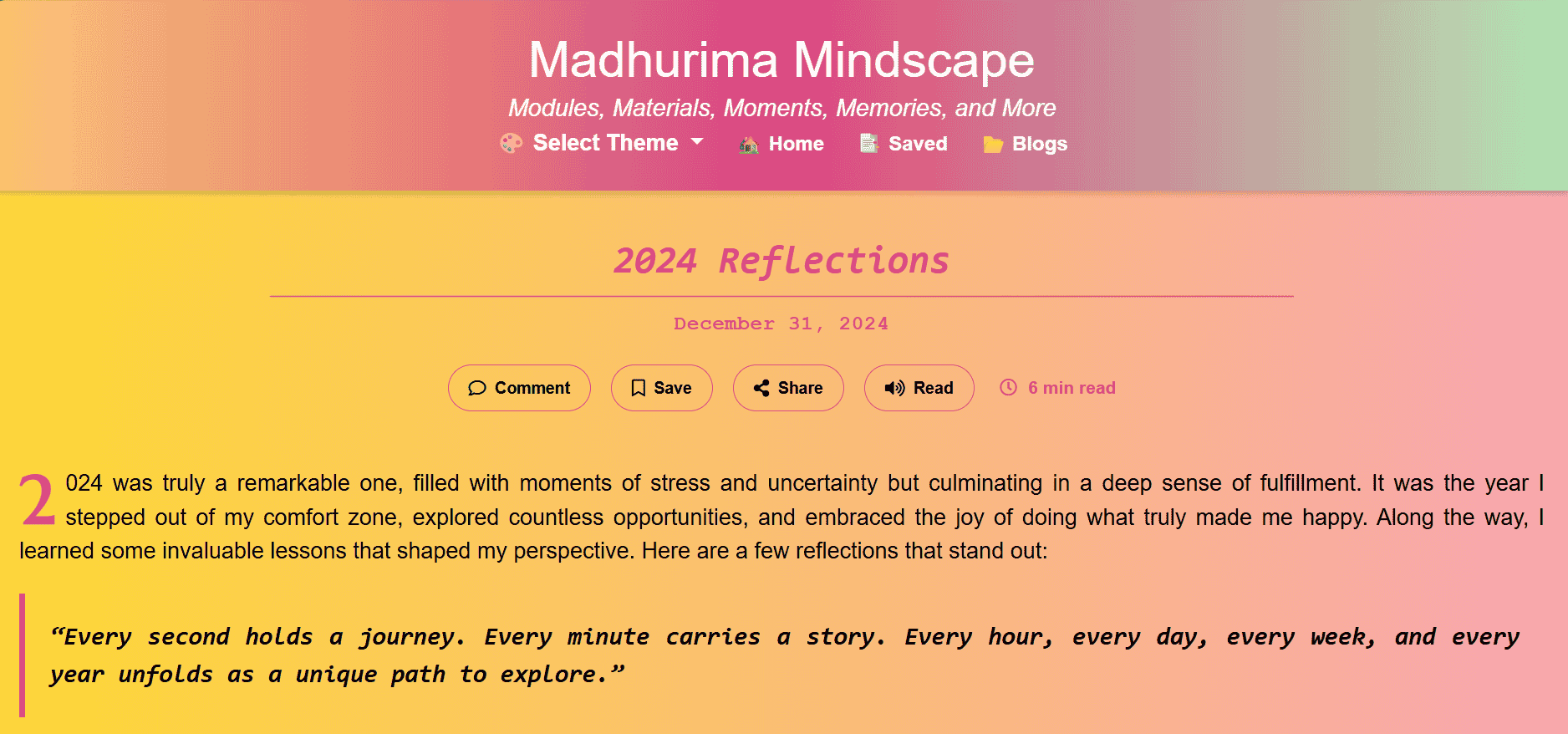
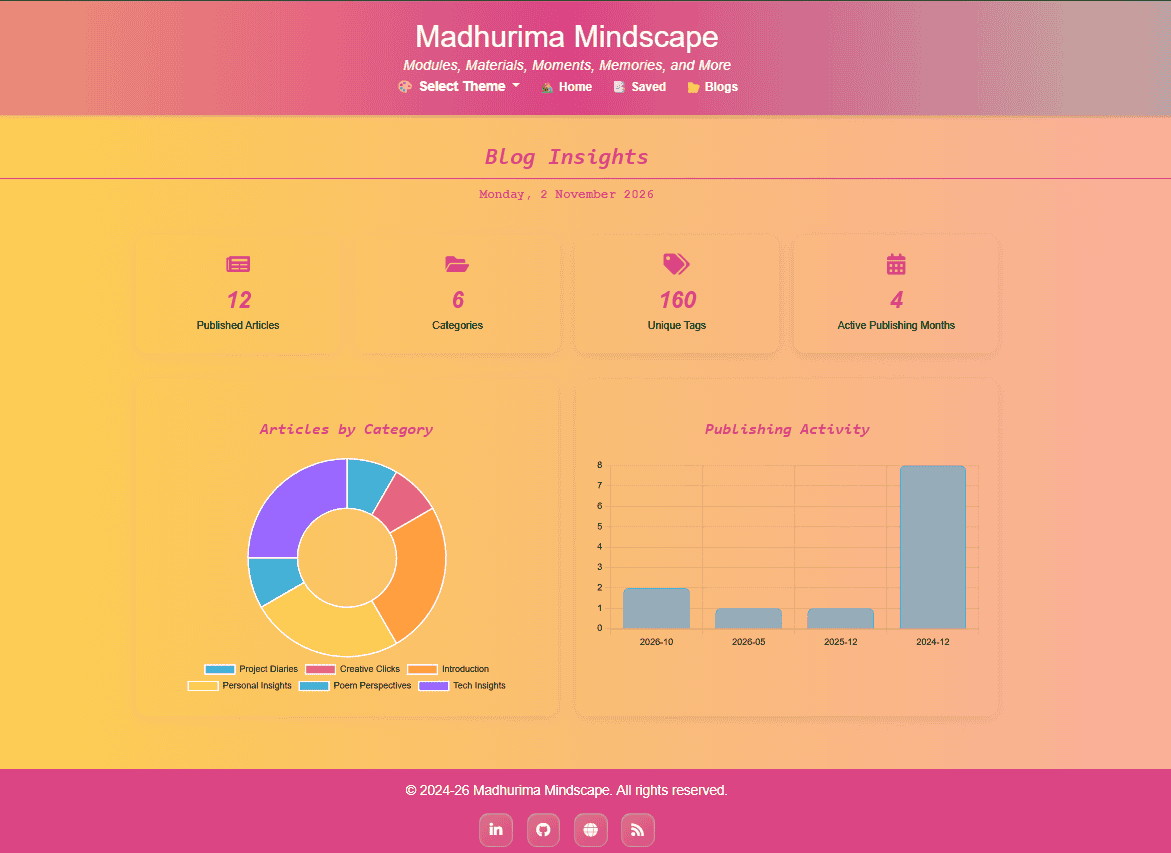
Madhurima Mindscape: A Deep Dive into My Jekyll-Based Blogging Project I have been working on Madhurima Mindscape, my personal blogging platform, and I am excited to share a major development update! 🌐 Live Website: {% embed madhurimarawat.github.io %} What started as a simple space to share personal reflections, technical learnings, project experiences, poetry, and photography has gradually grown into something much more interactive. As the project evolved, I wanted to focus not just on publishing articles, but also on making it easier for readers to discover content, explore different sections, save articles, and interact with what they read. This update brings together several new features, interface improvements, architectural changes, and detailed technical documentation. 🎨 A More Interactive Website Experience I have worked on making the overall interface more engaging while keeping the experience consistent across different screen sizes. - Multiple Dynamic Themes: Different visual themes with theme-aware styling across website components. - Interactive Icon-Based Hero Section: An icon-driven article discovery section with an interactive slider/carousel. - Responsive Design: Layouts that adapt to desktops, tablets, and mobile devices. - Custom 404 Page: A dedicated error page with easy navigation back to the website. 📚 Exploring and Managing Blog Content I wanted to make content discovery and management more convenient, so I added a few dedicated sections. - Explore the Blog: Browse published articles through preview images, titles, descriptions, and categories. - Saved Articles: Bookmark articles using browser LocalStorage. Saved articles remain available across browser sessions. - Blog Insights Dashboard: Explore published content through categories, tags, and structured article metadata. - Blog Template Library: A separate collection of reusable content templates, maintained independently from published articles. 🔊 Making the Reading Experience Interactive One feature I particularly enjoyed working on was the read-aloud functionality. Using the browser Web Speech API, blog posts can be read aloud without depending on an external speech service. It includes: - Speech synthesis for reading article content. - Word highlighting during playback. - Automatic scrolling to follow the currently spoken content. - Pause and resume controls. - A 20-second grace period after manual scrolling before automatic scrolling resumes. - Estimated reading time for individual articles. The idea was to make reading more accessible and give visitors another way to enjoy the content. 💬 Article Actions: Save, Comment and Share Individual blog posts also have reusable interaction components. - Bookmarking: Save and remove articles using LocalStorage. - Comments: Interactive forms with predefined comment options and custom comment input. - Email Submission: Submit comments through an email-based workflow. - Article Sharing: Native sharing through the Web Share API where supported. - Clipboard Integration: Copy article URLs using the Clipboard API. - Fallback Handling: Alternative sharing options when browser APIs are unavailable. These features are built using reusable components instead of repeating the same implementation across individual articles. 🏗️ Under the Hood: Jekyll Architecture and Code Organization Along with the visible improvements, I spent quite a bit of time reorganizing the internal structure of the project. The platform uses Jekyll, Ruby, Liquid, and YAML, with a modular structure that separates content, structured data, layouts, reusable components, and frontend assets. Here is a quick look at the directory organization: | Directory | Responsibility | |---|---| | _posts/ | Published articles organized by category | | _data/ | Structured YAML data and article metadata | | _layouts/ | Reusable page layouts | | _includes/components/ | Shared interface components | | _includes/imports/ | Reusable page sections | | blog-tools/ | Standalone blog utilities | | css/ | Feature-specific stylesheets | | js/ | JavaScript functionality | | images/ | Website and article assets | This separation makes it easier to work on individual features without unnecessarily affecting other parts of the website. How Jekyll Generates the Website The general workflow looks like this: 1. Blog articles are maintained inside _posts/. 2. Related metadata and structured information are stored in _data/. 3. Jekyll processes the content and data using Liquid templates. 4. Layouts and includes define the structure of generated pages. 5. CSS and JavaScript provide styling and client-side interactions. 6. Jekyll generates the final static website inside _site/. 7. The generated website is deployed through GitHub Pages. I really like how this approach separates content management from presentation and makes the project easier to extend. 🔍 SEO, Metadata and Content Organization I also worked on making article information more structured and maintainable. - Individual YAML metadata files associated with blog posts. - Category and tag organization. - Permalink-based association between articles and metadata. - XML sitemap for search engine discovery. - RSS feed for content updates. - robots.txt for crawling guidance. - Dedicated metadata organization within the Jekyll _data/ directory. Keeping SEO-related information separate from article content makes it easier to manage and update. 📖 Technical Documentation and Development Workflow Another important part of this update was documenting the project properly. I have put together technical documentation covering: - Project introduction and technology stack. - Features and their functionality. - Jekyll architecture and directory structure. - Roles of layouts, includes, and YAML data. - Website generation workflow. - Prerequisites and local development setup. - Dependency installation and running the project locally. - Step-by-step instructions for adding new blog posts. - Content discovery updates required when publishing an article. 🛠️ Technology Stack A quick overview of the technologies and tools used: - Static Site Generation: Jekyll, Ruby - Templating: Liquid - Frontend: HTML5, CSS3, JavaScript - Structured Data: YAML - Icons: Font Awesome - Browser APIs: LocalStorage, Web Share API, Clipboard API, Web Speech API - Version Control: Git and GitHub - Hosting: GitHub Pages - Feeds and Discovery: XML, RSS, Sitemap --- 🔗 Explore Madhurima Mindscape Website Homepage Preview <img src="media.licdn.com" alt="Madhurima Mindscape Homepage" width="700" height="auto"> Website Themes Preview <img src="media.licdn.com" alt="Madhurima Mindscape theme previews" width="700" height="auto"> Website Screenshot <img src="raw.githubusercontent.com" alt="Madhurima Mindscape website screenshot" width="700" height="auto"> <img src="raw.githubusercontent.com" alt="Madhurima Mindscape website screenshot" width="700" height="auto"> <img src="raw.githubusercontent.com" alt="Madhurima Mindscape website screenshot" width="700" height="auto"> 💻 GitHub Repository: {% embed madhurimarawat/Madhurima-Mindscape %} 📚 Technical Documentation: Project Documentation --- A Little More About the Journey This project has been a continuous process of experimenting, restructuring, implementing features, and learning along the way. One of the biggest reasons I decided to migrate the project to Jekyll was a problem with my previous approach to managing HTML files. Earlier, whenever I needed a common component such as a header, footer, or another reusable section, I had to manually copy and maintain it across multiple HTML files. As the website grew, this became repetitive and increasingly difficult to manage. I started exploring Jekyll to understand how layouts, includes, Liquid templates, and reusable components actually work. The more I explored its structure, the more I realized that it could solve exactly the problem I was facing. That was when I decided to give it a try and rebuild the project using Jekyll. From working with Liquid templates and structured YAML data to implementing browser-native speech synthesis and organizing reusable components, every stage has introduced something new to learn. I am genuinely happy with how the project is taking shape, especially the combination of interactive features and a more organized codebase. If you are exploring static site generators, I would definitely recommend checking out Jekyll. Its documentation is a great place to understand how everything fits together. 🔗 Explore the Jekyll Documentation {% embed import.jekyllrb.com %} Building something, figuring out what can be improved, and gradually making it better has been one of the most rewarding parts of this project. Explore Madhurima Mindscape, I would love to hear what you think!
7. Rust finally has a 2026 goal to shrink the bottomless pit that is target/. Optimizations for artifacts, debuginfo, and GC are on the table but progress is currently blocked by funding. goals#830
植本とラフウ 2026/11/3 10:53:45 github.com/ukagaka-irono カッシーニの空隙 2026/11/3 12:22:35 blankrune.sakura.ne.jp #伺かゴースト更新情報
6. Infinity is a lightweight Rust framework for running massively concurrent agents hibernating for free and scaling to zero on Lambda. hydro-project/infinity
KapitsaのGitHubリポジトリ(ソースコードやインストール方法、ドキュメント) nace-ai/kapitsa ベンチマークの実施方法や評価指標をまとめた公式ドキュメント github.com/nace-ai/kapitsa/blob/main/docs/benchma… M5 Max環境での具体的な生ベンチマーク結果データ github.com/nace-ai/kapitsa/tree/main/bench/result… 推論速度向上技術KFlashの詳細解説ドキュメント github.com/nace-ai/kapitsa/blob/main/docs/kflash.… コミュニティから寄せられたベンチマーク結果の一覧 github.com/nace-ai/kapitsa/blob/main/bench/commun… Redditでの本ベンチマークに関する議論スレッド reddit.com
Ajanınız her oturumda sıfırdan başlıyorsa sorun model değil, hafıza. claude-mem → ajanın yaptıklarını kaydedip sıkıştırıyor, sonraki oturumda ilgili bağlamı geri veriyor. Claude Code ve Codex ile çalışıyor. 110K+ ⭐, bugün +1.800 thedotmack/claude-mem #YapayZeka
Reading X.509 Certificates by Hand: SANs, Key Usage, Chains & Intermediates --- title: "Reading X.509 Certificates by Hand: SANs, Key Usage, Chains & Intermediates" published: true series: "Web PKI & Certificate Forensics in Practice" tags: security, webdev, devops, tls cover_image: dev-to-uploads.s3.us-east-2.amazonaws.com --- Most TLS outages I have been called into did not start with a dramatic key leak. They started with a certificate someone never really read: a missing Subject Alternative Name, an incomplete chain file, a leaf that looked fine in a browser on one machine and failed everywhere else. Browser UIs hide the details. openssl x509 -text does not. Once you can walk a certificate by hand, half of "SSL is broken" tickets become a five-minute diagnosis instead of a day of guessing. I wrote this with help from AI tools and checked every command and example myself against current OpenSSL behaviour. I build PixelValut, a set of free browser-based developer and network tools, and this is Part 2 of the series on Web PKI and certificate forensics. Part 1 covered leaked private keys and rotation. Here we slow down and learn to read what a certificate actually asserts. > 📚 Series Roadmap — Web PKI & Certificate Forensics in Practice > - Part 1: Leaked TLS Private Keys: Proving Compromise, Finding Every Affected Cert & Rotating Safely > - Part 2 (This Post): Reading X.509 Certificates by Hand: SANs, Key Usage, Chains & Intermediates > - Part 3: Certificate Revocation in 2026: CRLs, the Decline of OCSP & Short-Lived Certificates > - Part 4: Certificate Transparency Monitoring: Catching Unexpected Certificates for Your Domains > - Part 5: ACME Automation Failures: Renewal Outages, Rate Limits & DNS-01 Pitfalls > - Part 6: Mutual TLS for Internal APIs: Private CAs, Rotation & Pinning Trade-offs > > Related: Subdomain Takeover & Dangling DNS Reconnaissance How do you read an X.509 TLS certificate by hand? Direct answer: Dump the leaf with openssl x509 -text, confirm Subject and Issuer, verify every hostname lives in the Subject Alternative Name extension, check Key Usage and Extended Key Usage for server auth, then walk the chain until you reach a trusted root. Most production failures are a missing intermediate or a hostname that never made it into the SAN list. Pull the leaf and read it Fetch what the server actually presents, not what you think is on disk: openssl s_client -connect example.com:443 -servername example.com \ -showcerts </dev/null 2>/dev/null \ | openssl x509 -noout -text Or inspect a PEM file from your load balancer: openssl x509 -in leaf.pem -noout -text You want the same fields every time. An SSL certificate checker is useful for a quick browser-side view of issuer, SANs and expiry; the OpenSSL dump is what you use when you need exact extension flags. Subject and Issuer Subject: CN = example.com Issuer: C = US, O = Let's Encrypt, CN = R11 Subject is who the certificate claims to be. Issuer is who signed it. For publicly trusted TLS, the Issuer is almost always an intermediate, not the root. If Subject and Issuer are identical, you are looking at a self-signed certificate, which is fine for lab work and wrong for a public site. SAN vs CN (the hostname trap) Browsers and modern clients match hostnames against the Subject Alternative Name (SAN) extension, not against the Common Name. A certificate with CN=example.com and no SAN will fail hostname verification in current clients even when the CN "looks right." openssl x509 -in leaf.pem -noout -ext subjectAltName Expect something like: X509v3 Subject Alternative Name: DNS:example.com, DNS:www.example.com If api.example.com is missing from that list, clients talking to api.example.com will reject the certificate regardless of how clean the chain looks. Wildcard SANs (DNS:*.example.com) cover one label only; they do not cover a.b.example.com. Key Usage and Extended Key Usage These extensions constrain what the key is allowed to do: openssl x509 -in leaf.pem -noout -ext keyUsage,extendedKeyUsage For a public HTTPS leaf you typically want: | Extension | Expected on HTTPS leaf | Red flag | |---|---|---| | Key Usage | Digital Signature, Key Encipherment (RSA) or Digital Signature (ECDSA) | Certificate Sign / CRL Sign on a leaf | | Extended Key Usage | TLS Web Server Authentication | Client Auth only, or empty when a client enforces EKU | | basicConstraints | CA:FALSE | CA:TRUE on a leaf (mis-issued or wrong file) | A leaf marked CA:TRUE is either a serious CA mistake or, more often, you opened an intermediate by accident and thought it was the site certificate. basicConstraints and path length openssl x509 -in intermediate.pem -noout -ext basicConstraints Intermediates should say CA:TRUE. Leaves should say CA:FALSE or omit CA entirely depending on profile. PathLen constraints on intermediates limit how deep a chain may go; you rarely edit these by hand, but you need to recognize them when a private CA chain fails to validate. !A dark terminal screen and keyboard in a quiet server room, representing hands-on OpenSSL certificate inspection, AI-generated AI-generated image. Building and verifying the chain TLS clients need a path from the leaf to a trust anchor they already have. Servers must send the leaf and every intermediate. They should not send the root; clients already have roots. # Show the full chain the server sends openssl s_client -connect example.com:443 -servername example.com \ -showcerts </dev/null 2>/dev/null | sed -n '/BEGIN CERTIFICATE/,/END CERTIFICATE/p' Verify locally once you have leaf + intermediates in one PEM: openssl verify -CAfile /etc/ssl/certs/ca-certificates.crt \ -untrusted intermediates.pem leaf.pem -untrusted is where intermediates go. If verification fails with "unable to get local issuer certificate," the usual cause is a missing intermediate in what you serve, not a broken root store. | Setup | What client receives | Typical symptom | |---|---|---| | Leaf only | Site cert, no intermediate | Works on some Android/desktop caches, fails elsewhere | | Leaf + correct intermediate | Complete path to a public root | Clean verify | | Leaf + wrong intermediate | Chain that does not link | unable to get local issuer certificate | | Leaf + intermediate + root | Extra root in handshake | Usually tolerated; wastes bytes; some scanners warn | | Expired intermediate | Path that ends early | Sudden multi-region outage after a quiet period | Missing intermediates are still one of the most common production TLS failures, especially after a manual renewal where someone uploaded only cert.pem and forgot fullchain.pem. Good vs broken setups at a glance | Check | Healthy | Broken | |---|---|---| | Hostname | Appears in SAN | Only in CN, or wrong name | | Chain | Leaf + intermediates, no required root | Leaf alone | | EKU | Server Auth present | Missing where policy requires it | | Not After | Days or weeks of validity left | Expired, or expires tonight with no automation | | Signature | SHA-256 (or stronger) with expected key type | Legacy MD5/SHA-1 on anything public | | Key size | RSA ≥ 2048 or P-256/P-384 ECDSA | RSA 1024 | For a related attack surface where DNS and certificates interact, see the earlier note on dangling DNS and certificate reconnaissance. Wrong SANs also show up there when an abandoned hostname still has a live certificate. Diagnostic checklist 1. Does openssl s_client show the certificate you expect for this hostname? 2. Is every served hostname listed in Subject Alternative Name? 3. Is Issuer an intermediate you recognize, not a mystery private CA on a public site? 4. Is basicConstraints CA:FALSE (or equivalent) on the leaf? 5. Do Key Usage / EKU allow server authentication? 6. Does the server send intermediates (fullchain), not leaf-only? 7. Does openssl verify succeed with your platform trust store? 8. Are Not Before / Not After in a sensible window (clock skew included)? 9. Does the public key type and size match your policy? 10. Did you compare the live handshake to the files on disk after the last deploy? Browse more developer TLS and network tools when you need a second view without pasting private keys anywhere. FAQ Why does my browser show a padlock when openssl verify fails? Browsers sometimes cache intermediates, fetch missing ones, or use a different trust store. Command-line verify against the system store is the harsher, more portable check. Trust the stricter result for server configuration. Is the Common Name still required? Profiles vary. Many CAs still set CN for compatibility, but hostname matching is SAN-based. Never rely on CN alone. What is the difference between cert.pem and fullchain.pem? cert.pem is usually the leaf. fullchain.pem is leaf plus intermediates. Almost every reverse proxy should be pointed at the full chain file. Can I ignore Extended Key Usage? Not if your clients enforce it. Mutual TLS and some enterprise proxies are strict. For public HTTPS leaves, Server Auth should be present. Why did renewal break only mobile clients? Often a missing intermediate: desktop browsers had it cached; mobile clients did not. Always test with a clean openssl s_client after renewal. Should I pin intermediates? Prefer pinning sparingly and prefer monitoring Certificate Transparency (covered in Part 4). Intermediate replacements by public CAs are normal; hard pins without a backup plan cause outages. Next in this series, Part 3 covers revocation in 2026: CRLs, why OCSP is fading for many clients, and how short-lived certificates change the incident playbook. --- Follow & Connect - Website: PixelValut Tools - YouTube: PixelValut (@pixel-valut) - TikTok: PixelValut (@pixelvalut007) - GitHub: Muhammad Ali Mughal (@ali111887) - LinkedIn: Muhammad Ali Mughal
MaliSX2 0.3.1 now has support for the Ayaneo Pocket Air Mini's Mali G76 GPU! Much better performance for PS2 games in ARMSX2. MaliSX2 0.3.1 now has support for the Ayaneo Pocket Air Mini's Mali G76 GPU! github.com/bmdhacks/malisx2/releases/tag/v0.3.1 Combined with ARMSX2, this has massively improved the performance of some of the games that were unplayable. Ace Combat 4 is now playable and no longer a laggy mess. Black only needs to limit to 30fps and EE Cycle Skip 1 (and maybe EE underclock 1). Needs gaming preset in ayaneo space. Still kinda feels slow but no longer the stuttery mess. Ratchet and Clank only needs EE Cycle Skip 1. Its pretty slow at first though. Maybe compiling shaders? Then it becomes very playable. Needs gaming preset in ayaneo space. Crash Nitro Kart now very playable. Need to use HWDL in Async mode to stop lag when looking at the sun. Initial lag on first pass of everything (shader comp?) Prince of Persia is also better now and very playable. Haven't tested Gran Turismo and Ridge Racer yet but I guess that would also get a good improvement. I I've been playing Ace Combat 4 and enjoying it now in the PAM. I think I'll be migrating from nethersx2-patch to ARMSX2 at this point.
GitHub README kaise banaye Phone se 🔥 Part 5 GitHub README kaise banaye? Is video mein sirf phone se README.md file likhna aur Markdown seekho — heading, bold, list, link, image, code block, table, checklist, badges aur collapsible section (Hindi). 💻 Code khud chala ke dekho (free editor): techbroz-code.sites.tab.bot 📂 Demo repo (README code copy karo): nm621532-byte/phone-demo-part5-techbroz github readme kaise banaye | readme file kaise banaye | markdown tutorial in hindi | readme.md kaise likhe | github markdown | github phone se Markdown cheat sheet (phone se): 1. hash + space = Heading (2 hash = chhoti, 3 hash = aur chhoti) 2. **bold**, *italic* 3. - bullet list, 1. numbered list 4. [text](link) = link,  = image (pehle Add file - Upload files) 5. ``` + language = code block, | pipe | se | table | (dashes wali row zaroori) 6. - [x] checklist, shields.io badges, [!TIP] tip box, details + summary tag = chhupa section 7. Edit: file kholo - pencil icon - Preview tab - Commit changes 5 galtiyan: README.txt naam, hash ke baad space nahi, list se pehle khaali line nahi, closing ``` bhoolna, sirf naam likh ke chhod dena. Chapters: 0:00 Intro: README ka kamaal 0:28 README kya hai aur kyun zaroori 0:55 Markdown kya hai (Code vs Preview) 1:39 Step 1: README.md + Heading + Bold 2:26 Step 2: Headings, Italic, Lists 3:10 Step 3: Link + Image 4:01 Step 4: Code block + Table 4:51 Step 5: Checklist, Badges, Tip box 5:37 Commit history 5:55 Achha README kaisa ho (checklist) 6:21 5 galtiyan jo beginners karte hain 6:52 Recap + Homework Homework: apne kisi purane repo mein aaj hi README likho aur link comment karo! GitHub Phone se series - Part 2 (basics): youtube.com Part 3 (Issues + Pull Requests): youtube.com Part 4 (Portfolio + GitHub Pages): youtube.com #github #markdown #codinginhindi
📈 GitHub Surge Your coding agent forgetting everything between sessions is a solved problem apparently. claude-mem: 111k stars, +1,803 today. Logs what the agent did, compresses it, feeds it back next session. thedotmack/claude-mem
追剧党可以把 GitHub 上这个项目收好:Awesome Zhuiju Free,一份免费追剧资源大全。 眼下已经收了 117 个资源,除了影视网站,影视 App、网盘搜索、字幕、TVBox / 影视仓、IPTV、开源播放器也都包含在内。 GitHub: laoma2053/awesome-zhuiju-free t.co
[PC] (Web) Burgeria: build burgers by pinching the air in front of your webcam Title: [Web] Burgeria: build burgers by pinching the air in front of your webcam Burgeria is a small browser game where you build burgers with your hand instead of a mouse. Pinch the air to grab an ingredient, carry it over, let go to drop it. I’m a designer testing how hand tracking holds up in real rooms, so different webcams and lighting help me most. Play: craftedforfun-byvin.github.io Feedback, a 2-minute anonymous form: docs.google.com If the game never found your hand, please fill it in anyway. That’s the answer I need most. Comments here are welcome too. You need a laptop or desktop with a webcam. Your camera feed never leaves your computer. Tracking runs in your browser, and the code is public at github.com/craftedforfun-byvin/burgeria. I designed it and drew all the art. The code was pair-programmed with Claude.
Another example on precision issue is not dtype issue. Thhe y axis is the cosine sim of gradient vs fp64 reference. Why we have such issue? bcuz the mantissa is too few to bring the information when difference is not large enough. KohakuBlueleaf/SenseCraft t.co
Tailoring Without Lying: Mapping Job Description Keywords to Real Evidence --- title: "Tailoring Without Lying: Mapping Job Description Keywords to Real Evidence" published: true series: "Engineering Resumes That Get Callbacks" tags: career, resume, jobsearch, programming cover_image: dev-to-uploads.s3.us-east-2.amazonaws.com --- Hiring managers and ATS filters both reward the same thing this year: a resume that clearly matches the posting. The temptation that follows is ugly. People paste every buzzword from the job description into their bullets, invent tools they barely touched, or ask a chatbot to "optimize" until the document reads like someone else. Recruiters notice. So do the engineers who interview you. Tailoring is still necessary; lying is optional. I wrote this with help from AI tools and checked every example and claim myself. I build Smart Resume Analyzer, an ATS and resume-matching tool, and this is Part 2 of the series on engineering resumes that get callbacks. The move here is honest keyword mapping: take each requirement in the posting and attach it to real evidence you already have, or leave it off. > 📚 Series Roadmap — Engineering Resumes That Get Callbacks > - Part 1: The One-Story Resume Test: Building a Flagship Project Section That Still Passes ATS > - Part 2 (This Post): Tailoring Without Lying: Mapping Job Description Keywords to Real Evidence > - Part 3: AI-Drafted Resumes and Recruiter Skepticism: Making LLM Bullets Sound Like You > - Part 4: Summary or No Summary in 2026: What Recruiters and Semantic Screeners Actually Read > - Part 5: Engineering Leadership Bullets: Mentoring, Hiring and Incident Command Without Fluff > - Part 6: The 15-Minute Pre-Submit Resume QA Pipeline > > Previous series: How AI/LLM Resume Screeners Rank Engineers in 2026 How do you tailor a resume to a job description without inventing experience? Direct answer: Extract the posting's must-have skills, map each one to a real project or responsibility you can defend in an interview, then rewrite bullets so the employer's exact terms appear inside true evidence. Skip anything you cannot explain; synonym swaps that stretch the truth fail both ATS checks and the first technical screen. What "tailoring" actually means in 2026 Tailoring is not rewriting your career for every application. It is a 20-minute pass that does three things: 1. Surfaces the keywords the posting and the ATS care about. 2. Places those words where your experience already supports them. 3. Leaves gaps visible so you do not fake coverage you cannot discuss. In Part 1 we built a flagship story that a human remembers. That story still leads. Tailoring adjusts the supporting bullets and Skills line so the same story also matches this posting. Semantic screeners (covered in the previous series on AI ranking) are more flexible than pure keyword ATS, but they still cannot invent skills you never wrote. If the posting says Kubernetes and your resume only says "container orchestration," many Boolean searches miss you. If your resume says Kubernetes and you have only run kubectl get pods once, the interview will catch you. A 20-minute mapping pass 1. Extract the JD into three buckets Copy the posting into a plain text file and mark every technical noun. Sort them: | Bucket | Examples | What to do | |---|---|---| | Must-have | Primary language, core cloud, the team's main database | Need a real bullet or Skills hit | | Nice-to-have | Secondary tools, "familiarity with" items | Add only if true | | Soft / process | Agile, code review, mentoring | Keep one honest line if relevant | A job description keyword finder can speed up extraction; a highlighter works the same way. The point is a short checklist, not a keyword dump. 2. Map each must-have to evidence For every must-have, write one private note: where did I actually use this? Good answers look like "owned the EKS migration for payments," "on-call for the Postgres primary," or "wrote the Kafka consumer for inventory." Bad answers look like "watched a course," "helped a teammate once," or "the team used it and I was nearby." If you have no evidence, do not put the word on the resume for this application. Apply anyway if you match most must-haves; silence on one tool is cleaner than a lie. 3. Rewrite with the employer's spelling Employers search for the strings they wrote. Prefer their spelling when it is accurate: BEFORE (generic) - Improved API performance using a message broker and caching. AFTER (honest + matched) - Cut inventory lookup p95 from 180 ms to 40 ms with a Kafka consumer and Redis cache on the order service (Node.js, AWS). Kafka, Redis, Node.js and AWS appear because they were true. The metrics stay interview-defensible. 4. Watch the synonym traps Synonyms help humans and sometimes help semantic rankers. They hurt Boolean ATS when the recruiter types the exact term from the JD. | JD says | Unsafe rewrite | Safe rewrite | |---|---|---| | Kubernetes | "container platform experience" only | "Kubernetes (EKS)" plus the real work | | PostgreSQL | "SQL databases" only | "PostgreSQL" (and keep SQL if true) | | CI/CD | "automated deployments" only | "CI/CD with GitHub Actions" | | TypeScript | "modern JavaScript" | "TypeScript" if you shipped TS | | Terraform | "IaC" only | "Terraform" or leave it off | Use the synonym with the keyword, not instead of it, when both are true. !Blank ruled paper on a wooden desk in soft natural light, representing careful resume keyword mapping, AI-generated AI-generated image. Safe vs unsafe rewrites | Situation | Unsafe (do not do this) | Safe (do this) | |---|---|---| | Touched a tool once | List it as a core skill | Omit, or "exposed to X in a migration" in interview notes only | | Team used Kafka; you wrote HTTP clients | "Built Kafka pipelines" | "Integrated with Kafka-backed inventory APIs" | | Side project used Go | Claim Go as daily job skill | Put Go under Projects with a link | | JD wants "microservices" | Sprinkle the word six times | One bullet that names services, boundaries and deploy units | | Old experience with Java | Invent current Java ownership | Keep a short older-role line if relevant | | LLM drafted flashy metrics | Keep unverifiable numbers | Replace with scale you can defend | The line is simple: if a senior engineer asked "walk me through that," would your story hold for five minutes? Before and after: one tailored role Job description (compressed): Senior backend engineer. Go or Java. Kubernetes. PostgreSQL. Event-driven systems (Kafka preferred). Observability. Mentoring. BEFORE (generic latest role) - Developed backend services and REST APIs. - Worked with Docker and cloud infrastructure. - Participated in code reviews and mentoring. - Improved system reliability and performance. AFTER (tailored, still true) - Led Go checkout service rewrite; cut p95 latency 2.4 s -> 380 ms with a Kafka reservation queue and Redis idempotency keys (~40k daily orders). - Migrated 14 Go services to Kubernetes (EKS) with Helm and GitHub Actions; deploy time 25 min -> 6 min. - Owned PostgreSQL schema and query plans for order history; removed two full-table scans that spiked at peak. - Added OpenTelemetry traces across payment and order services; median incident triage dropped from hours to minutes. - Mentored 2 engineers through first on-call rotations and design reviews. Every keyword from the JD that appears above maps to work the candidate can explain. Nothing was invented for the posting. Diagnostic checklist (20-minute tailor pass) 1. Did you extract must-haves into a short list before editing? 2. Does every must-have on the resume map to a project you can defend? 3. Did you use the employer's spelling for tools you truly used? 4. Did you avoid synonym-only rewrites that hide the exact keyword? 5. Does the flagship story from Part 1 still lead the latest role? 6. Are supporting bullets short and keyword-carrying, not fluff? 7. Is anything listed that you would not want probed in a screen? 8. Does the Skills line match the JD without becoming a keyword dump? 9. Did you run a quick ATS resume check or paste test for parse issues? 10. Would you send this version to a trusted peer without embarrassment? FAQ How many versions of my resume should I keep? Keep one strong master resume, then save a tailored copy per serious application. Do not maintain ten divergent "personas." Drift is how lies creep in. Is it lying to use the company's product names? No, if you used the product. Saying "Amazon EKS" when you ran Kubernetes on EKS is accurate. Saying "EKS expert" after a weekend tutorial is not. What if I am missing one must-have? Apply when you match most of them and address the gap in the cover note or early interview: what you have done that is adjacent, and how fast you have picked up similar tools before. Do not invent the missing skill on the page. Should I mirror the JD sentence by sentence? No. That produces keyword stuffing and duplicate bullets. Map requirements to evidence once, then write normal engineering prose. Do AI screeners punish tailored resumes? They reward overlap with the posting when the text is coherent. They punish nonsense. Honest mapping improves both keyword and semantic scores; fabricated lists improve neither for long. How often should I re-tailor for the same company? Once per distinct role posting. Reusing yesterday's tailored file for a different team is how Kafka suddenly appears on a frontend-heavy application. Next in this series, Part 3 looks at AI-drafted resumes and recruiter skepticism: how to use an LLM for drafts without sounding like one, and how to keep bullets in your own voice. --- Follow & Connect - Website: Smart Resume Analyzer - YouTube: Resume Boost AI (@resume-boost-ai) - TikTok: Resume Boost AI (@resumeboostai) - X: Muhammad Ali Mughal (@AliMughal887) - GitHub: Muhammad Ali Mughal (@ali111887) - LinkedIn: Muhammad Ali Mughal
Trouble Using Onkyo Integration to Add RZ50 Receiver I'm trying to add an Onkyo RZ50 AVR Receiver to a Remote 3 using the onkyo-remotetwo custom integration by quintz. Installing the integration went without incident. But I cannot use the integration to add the receiver. I keep getting stuck on the 2nd setup screen. Everything looks good, but when I click 'Next', nothing happens. >On the first screen, I selected 'Andere Onkyo Receiver' because none of the other categories seem to contain the RZ50, (what is an 'Andere' receiver?). I typed in the IP address of the receiver, and I clicked 'Next'. That seemed to work because the following screen shows "Detected TX-RZ50 (2021). Inputs and names were read from the receiver.". I left the 'Inputs' and the 'Listening Modes' alone (they were already filled in) and I clicked 'Next' again, a screen briefly popped up that says 'Setting Up...", and then... nothing happened. It went back to the 'Inputs' and 'Listening Modes' screen. So, I tried starting over, and trying different drop downs from the first page. It still didn't work. I then tried deleting most of the lines from 'Inputs' and 'Listening Mode'. It still didn't work. What am I doing wrong?
Vima VST step sequencer Vima is a free 8-track melodic MIDI step sequencer that runs as a plugin (VST3) inside your DAW. DISCLAIMER: I have been a music software - MIDI freak for a long time. Under the name "Softcore" I wrote electronic music and built a lot of software little helpers (MaxForLive, Lemur templates, Reaktor instruments etc.): Microtonic Lemurized (2013), was a Lemur template which turned Sonic Charge's Microtonic into a complete touch instrument with per-parameter exclusion randomizing; its developer, Magnus Lidström, called it "absolutely amazing" (soniccharge.com). I was one of the first to buy Zaquencer - the custom firmware which transformed the BCR2000 into a full-blown sequencer (which also inspired this VST), and Bome MIDI Translator glued my setups together for years, performing hybrid DJ - Live techno sets for many years. Vima is vibe-coded. IS it ai-slop? Have a look at its manual and decide for yourself TheoGal/vima-vst Edit to add: it will always be free, this was something I made primarily for myself and I don't intend to monetize.
Show HN: OpenYog, SQLyog Community Ported to Qt 6 for Linux and Windows Webyog stopped SQLyog Community version, so I built OpenYog by porting it to Qt 6. It's a desktop database client for MySQL, PostgreSQL, SQLite and MongoDB on Linux and Windows.
这表之前放一晚就没电,我以为是电池的锅。 查下去才发现浅睡代码写了但没生效,音频那边每 2ms 查一次队列,芯片一次都没睡过。 改成事件驱动,同样的电池现在能撑两天多,九成时间在浅睡。顺手把熄屏后的蓝牙也关了,点亮一秒多连回来。 wen0531/m5stack-qiuqiu
PentAGI est un projet open-source sous licence MIT, permettant d’automatiser des tests d’intrusion avec des agents IA autonomes : orchestration de Nmap, Metasploit et sqlmap dans Docker, mémorisation des résultats et rapports de vulnérabilités ⬇️ vxcontrol/pentagi
@BVOSTEALS There’s a Get started section: xescure/slop-node It should be enough to get a person or an AI up to speed
PentAGI est un projet open-source sous licence MIT, permettant d’automatiser des tests d’intrusion avec des agents IA autonomes : orchestration de Nmap, Metasploit et sqlmap dans Docker, mémorisation des résultats et rapports de vulnérabilités ⬇️ vxcontrol/pentagi
Orkas: An open-source team of AI agents on your desktop (4.8k stars) What it does All text below is quoted directly from the project README. >Orkas is an open-source (MIT), local-first AI team for your desktop: a Commander turns your goal into to-dos and coordinates 16 built-in specialist agents plus Claude Code, Codex, OpenCode, OpenClaw and Hermes, with projects, scheduled automations and connectors. Free app for macOS & Windows; built-in models or your own keys. What the team delivers: - Videos, voice-overs and images: VideoStudio, VoiceStudio, ImageStudio - Research reports, SEO audits and market analysis: DeepResearcher, SeoGeoAgent, StockAnalyser - Posts, articles, newsletters and slide decks: ContentWriter, PptMaker - Websites, UI and code: UIDesigner, ProductDeveloper - Word, Excel, PowerPoint and PDF files: OfficeWorker - E-commerce work: product research, listings, review analysis, sales analysis and catalog changes, from five e-commerce agents - Complex work that takes several agents: the Commander splits it up, hands each part to the right agent and combines the results; for example, market research that becomes a report, a slide deck and a launch video >16 specialists ship with the app, each with its own skills, memory and tools. Repository Orkas-AI/Orkas Repository stats |Metric|Value| |:-|:-| |Stars|4,804| |Forks|282| |Last release|v2026.10.27 (2026-10-27)| |Languages|JavaScript 63.5%, TypeScript 34.7%, Python 1%| |Contributors|13| |AI contributor accounts (Claude / Codex / Cursor / Copilot)|@claude (17 commits)| |AI co-authored commits|Claude: 37| Main contributor |Field|Value| |:-|:-| |GitHub|@vaintwyt| |Commits to this repo|356 (top contributor)| |Followers|4| ────────────────────────────── 📌 If you want to browse more repos like this, we've organized them by category and rankings here: bestgithubrepositories.com 🗂️ We're also archiving repos where possible, so useful projects don't disappear when they're removed from GitHub.
@anferneeck @ycombinator Thank you! First test: whether a line hidden in something the agent reads, like a doc, page or tool result, gets it to call a tool it shouldn’t. On Claude Code, a plain “I’m the CEO” message beat every hidden trick. Free to try: invarislabs/invaris-agentsec
Orchard Core: An open-source, modular, multi-tenant application framework and CMS for ASP.NET Core (8.2k stars) What it does All text below is quoted directly from the project README. >Orchard Core is an open-source, modular, multi-tenant application framework and CMS for ASP.NET Core. Orchard Core consists of two distinct projects: - Orchard Core Framework: An application framework for building modular, multi-tenant applications on ASP.NET Core. - Orchard Core CMS: A Web Content Management System (CMS) built on top of the Orchard Core Framework. >The software is production-ready and capable of serving large, mission-critical applications. Repository OrchardCMS/OrchardCore Repository stats |Metric|Value| |:-|:-| |Stars|8,221| |Forks|2.6k| |Last release|v3.0.1 (2026-07-09)| |Languages|C# 67.4%, HTML 8.6%, TypeScript 7.7%| |Contributors|347| |AI contributor accounts (Claude / Codex / Cursor / Copilot)|@Copilot (73 commits), @Copilot (70 commits), @claude (41 commits), @Copilot (9 commits)| |AI co-authored commits|Copilot: 131| Main contributor |Field|Value| |:-|:-| |Name|Antoine Griffard| |GitHub|@agriffard| |Commits to this repo|2,084 (top contributor)| |Bio|Microsoft MVP, .NET Developer, Orchard Core contributor| |Company / Location|Lille, France| |Followers|155| ────────────────────────────── 📌 If you want to browse more repos like this, we've organized them by category and rankings here: bestgithubrepositories.com 🗂️ We're also archiving repos where possible, so useful projects don't disappear when they're removed from GitHub.
GitHub 仓库:p-e-w/heretic 官网:heretic-project.org PyPI heretic-llm:pypi.org Release v2.0.0:github.com/p-e-w/heretic/releases/tag/v2.0.0 1.x→2.x 迁移:github.com/p-e-w/heretic/blob/master/docs/migrati… HF heretic 模型筛选:huggingface.co Heretic Grimoire:huggingface.co
@dirtmonkeymusic This is working mauvestudio/fadarr
Open Source Point of Sale: A web-based point of sale system (4.5k stars) What it does All text below is quoted directly from the project README. >Open Source Point of Sale is a web-based point of sale system. The application is written in PHP, uses MySQL (or MariaDB) as the data storage back-end, and has a simple but intuitive user interface. The features include: - Stock management (items and kits with an extensible list of attributes) - VAT, GST, customer, and multi tiers taxation - Sale register with transactions logging - Quotation and invoicing - Printing and emailing of receipts, invoices and quotations - Barcode generation and printing - Multiuser with permission control - Reporting on sales, orders, expenses, inventory status and more >We've got a live version of our latest master running for you to play around with and test everything out. Repository opensourcepos/opensourcepos Repository stats |Metric|Value| |:-|:-| |Stars|4,468| |Forks|2.6k| |Last release|3.4.3 (2026-10-22)| |Languages|PHP 98.6%, JavaScript 0.6%, Shell 0.3%| |Contributors|213| |AI contributor accounts (Claude / Codex / Cursor / Copilot)|@claude (8 commits), @cursoragent (4 commits)| |AI co-authored commits|Claude: 8, Cursor: 4| Main contributor |Field|Value| |:-|:-| |Name|jekkos| |GitHub|@jekkos| |Commits to this repo|1,700 (top contributor)| |Followers|322| ────────────────────────────── 📌 If you want to browse more repos like this, we've organized them by category and rankings here: bestgithubrepositories.com 🗂️ We're also archiving repos where possible, so useful projects don't disappear when they're removed from GitHub.
スマホ動画1本から領収書・名刺をCSVに ― Gemini APIで「推測させない・残さない」読み取りアプリ 作ったもの スマホで撮った動画(最長3分)をアップロードすると、映っている領収書・名刺を読み取って表とCSVにする Web アプリを作りました。身内数人で試すためのプロトタイプです。 1枚ずつ写真を撮るのではなく、書類を順番に机に置いて動画で撮るだけで済むのがポイントです。読み取る書類は、アップロード画面で3つのモードから選びます。 モード 用途 主な項目 経費精算 受け取った領収書・レシート 日付、勘定科目(候補)、支払先、金額、インボイス登録番号 売上管理 自分が発行した領収書 発行日、宛名、税込・税抜・税額、税率、但し書き、売上区分(候補)、領収書番号、支払方法 名刺 名刺 会社名、氏名、役職、部署、住所、電話、メール 画面の値は mock モードの架空のサンプルです リポジトリ: oranegewimps/video-receipt-ocr 技術: Python / FastAPI / google-genai(Gemini API)/ ffmpeg / 素の HTML・JS / pytest + GitHub Actions 実装は Claude Code と一緒に進めました。私が要件(特に削除・コスト・課金の扱い)を書いて計画を承認し、課金が発生する操作はすべて私の指示で実行する、という分担です。AI はドキュメントと SDK の調査、実装、テストを担当しました。 全体の流れ アップロードを受けたらジョブIDを返し、解析はバックグラウンドで進めます。画面はステータスをポーリングし、完了したら表を表示します。 設計で工夫した点 1. モデル呼び出しを1つの関数に閉じ込め、mock を最初から用意する モデルを呼ぶ処理は extract(video_path, mode) -> dict だけに閉じ込めました。GEMINI_MODE=mock のときは外部通信をせず、モードごとの固定サンプルを返します。 def extract(video_path, mode="expense", *, settings=None, model=None) -> dict: if mode not in MODES: raise ValueError(f"unknown mode: {mode}") settings = settings or load_settings() if settings.is_live: return _extract_gemini(Path(video_path), mode, settings, model or settings.gemini_model) return _extract_mock(mode, model or settings.gemini_model) mock のサンプルには「同じ書類を別のフレームで再検出した」想定のデータをわざと入れてあり、重複排除が効くことを画面でもテストでも確かめられます。画面・削除・上限といった処理はすべて mock で通してから、実 API を1回だけ呼びました。テストでは、mock の間に外部へ接続しようとしたら失敗するように、ソケットの接続も遮断しています。 2. 「推測させない」と「推定させたい」を分ける 帳簿に使うデータなので、読めない項目は null にしてもらいます。一方で勘定科目や売上区分は、そもそも書類に書かれていない「判断」です。そこでプロンプトのルールを次のように分けました。 - 読めない項目・書類に書かれていない項目は、推測せず null にする。 - ただし account_title(勘定科目)は、業種や但し書きなどから推定してよい。 推定した場合は、その項目名を必ず low_confidence_fields に入れる。 スキーマでは、すべての項目を "type": ["string", "null"] のように null 許容にしています。low_confidence_fields は、そのモードの項目名だけを選べる enum の配列です。画面では、この配列に入った項目を黄色で表示し、手で直した項目は青に変わります。 props["low_confidence_fields"] = { "type": "array", "items": {"type": "string", "enum": fields(mode)}, "description": "推定した項目、または値を入れたが読み取りに自信がない項目の名前", } 3. 「残さない」は finally と、既定値の確認で作る 動画は、解析の成否にかかわらず finally で作業ディレクトリごと削除します。Gemini 側にアップロードしたファイルも、extract() の finally で消しています。 uploaded = None try: uploaded = client.files.upload(file=str(video_path), config={...}) ... interaction = client.interactions.create( model=model, input=[video_part, {"type": "text", "text": prompt(mode, settings)}], response_format={"type": "text", "mime_type": "application/json", "schema": response_schema(mode)}, store=False, # 既定は True(サーバ側に保存)なので必ず無効にする ) finally: if uploaded is not None: delete_gemini_file(client, uploaded.name) ここで一番効いたのは、SDK のソースを読んで既定値を確認したことです。公式ドキュメントの動画・構造化出力の例は Interactions API(client.interactions.create)に移っていました。そこで google-genai 2.34.0 のソースを読むと、このAPIはリクエストと応答を既定でサーバ側に保存する(store=True)ことがわかりました。動画を消しても、ここが有効なままでは「残さない」になりません。 削除できていることは、ログ以外の方法でも確かめました。解析中は作業ディレクトリに input.mp4 と prepared.mp4 があり、完了後は空になります。Gemini 側も、Files API の一覧で残っていないことを確認するスクリプトを用意しました。 4. 日次上限は「受け付けた時点」で数える APIの費用は、失敗した呼び出しでも発生しえます。そのため、日次の回数上限は解析の成功ではなく、動画を検証して受け付けた時点で1回と数えるようにしました。SQLite への追加と上限の判定は、同じロックの中で行います。 def try_reserve(self, job_id, user_label, limit_user, limit_total, size_bytes, duration_sec, mode): with self._lock, self._conn: reason = self._reason(*self._counts(today(), user_label), limit_user, limit_total) if reason: return reason self._conn.execute("INSERT INTO jobs(...) VALUES (...)", (...)) return None 壊れたファイルなど、APIを呼ぶ前に弾いたものは数えません。 5. 売上管理モードの発行者は「読まない」 途中で前提が変わりました。テストに使っていた領収書は、私が発行した側のものだったのです。発行した領収書なら、発行者は自分です。そこで売上管理モードでは、発行者名・登録番号・住所を設定値(.env)から入れ、動画からは読まないことにしました。 それでも、動画に写った発行者名や登録番号は照合用にだけ読ませています。設定値と食い違えば「要確認」にするので、他人の領収書が紛れ込んでいれば気づけます。あわせて、税抜+税額が税込と合わない場合も、金額3項目を要確認にしています。 if seen_name and settings.self_name: a, b = _norm(seen_name), _norm(settings.self_name) if a not in b and b not in a: # 「見本商店」と「見本商店 本店」のような部分一致は許容 mismatch = True _flag(d, "issuer_name_in_video") 費用の実測 8.6秒・480×854 のテスト動画1本を gemini-3.8-flash で解析した結果です。音声は ffmpeg で除去してから送っています。 項目 値 所要時間 15.0秒(アップロード・待機・解析・削除を含む) 入力トークン 950(動画1分あたり約6,700) 出力トークン 363 概算費用 $0.0021(約0.3円) 単純に伸ばすと、3分の動画で入力は約2万トークン、1本2〜3円程度の見込みです。単価は変わるので、コードには埋め込まず環境変数で持たせています(このモデルは 2027年1月から値上げが予告されています)。2モデルを比べる評価スクリプトも付けましたが、実測はまだ数本だけです。 振り返り 課金のある操作は人が開ける:AI には「実行してよい」と言われるまで実 API を呼ばせず、呼ぶときも「1本・1モデル・再試行なし」と範囲を指定しました。おかげで、開発中に実 API を呼んだのは4回だけで、実費は合計約$0.008(約1円)でした。 ドキュメントだけで判断しない:store=True が既定であることは、ドキュメントの例を読むだけでは気づきにくい点でした。SDK のソースまで確認したのは、AI 側の判断です。 前提が変わっても局所的に直せた:モードの追加は、extract() の引数とスキーマ定義、画面の列定義を増やすだけで済みました。モデル呼び出しを1か所に閉じ込めておいた効果です。 既知の課題 実 API での確認は短いテスト動画数本だけで、精度はまだ測れていません。 ジョブはメモリで管理しているので、プロセス1つで動かす前提です。 3分での切り詰めは再エンコードしないため、1秒ほどはみ出すことがあります。 Cloud Run へのデプロイ(署名付きURLでの直接アップロード、Secret Manager)は未着手です。 国税庁 Web-API による登録番号の照合は実装しましたが、アプリケーションIDがないため未確認です。
@grattonecon Funny but on a more serious note there are now techniques to emulate an entire von Neuman style computer inside an LLM: divagr18/qwenputer
ご報告 FreeCADへのプルリクエストの1つをマージしていただきました! Sketcherでカーボンコピーを実行する際、"Model" TreeView上でドラッグ操作が行われるとカーボンコピーがリピート実行されてしまう問題の修正です ver.26.3にバックポートされる予定 間に合ってよかった FreeCAD#29104
OpenRewrite: Fast, repeatable refactoring for developers (3.8k stars) What it does All text below is quoted directly from the project README. >Automated mass refactoring of source code. Fast, repeatable refactoring for developers: - The OpenRewrite project (managed by Moderne) is an open-source automated refactoring ecosystem for source code, enabling developers to effectively eliminate technical debt within their repositories. - It consists of an auto-refactoring engine that runs prepackaged, open source refactoring recipes for common framework migrations, security fixes, and stylistic consistency tasks, reducing your coding effort from hours or days to minutes. - OpenRewrite provides parsers and base recipes for multiple languages, including Java, Kotlin, Groovy, JavaScript/TypeScript, Python, and C#. - For Java, the OpenRewrite Gradle Plugin and OpenRewrite Maven Plugin let you run one recipe at a time against a single repository. - Recipes are easy to customize, so you can adapt any of them - or even write your own. >Start with our quickstart guide and let OpenRewrite handle the boring parts of software development for you. Repository openrewrite/rewrite Repository stats |Metric|Value| |:-|:-| |Stars|3,832| |Forks|588| |Last release|v8.96.2 (2026-10-29)| |Languages|Java 72.3%, TypeScript 8.4%, C# 6.3%| |Contributors|283| |AI contributor accounts (Claude / Codex / Cursor / Copilot)|@claude (53 commits), @Copilot (6 commits), @Copilot (2 commits)| |AI co-authored commits|Claude: 53, Copilot: 8| Main contributor |Field|Value| |:-|:-| |Name|Jonathan Schnéider| |GitHub|@jkschneider| |Commits to this repo|2,640 (top contributor)| |Bio|co-founder/CEO @ Moderne (moderne.ai).| |Company / Location|Moderne / Miami, FL| |Followers|353| ────────────────────────────── 📌 If you want to browse more repos like this, we've organized them by category and rankings here: bestgithubrepositories.com 🗂️ We're also archiving repos where possible, so useful projects don't disappear when they're removed from GitHub.
You Just Got Handed a Mystery Binary. Now What? Someone drops a file in your lap. No source code, no docs, no idea what it does. Maybe it's a CTF challenge. Maybe it's a suspicious attachment. Maybe it's a dependency you don't quite trust. So you start the usual ritual: strings here, xxd there, objdump for the imports, another tool for the headers, a different one for the hash. Five tools, five outputs, and you're still stitching the story together by hand. That's the exact friction hexlens was built to kill. The problem hiding in plain sight Binaries don't explain themselves. Every question you ask needs a different tool: - What kind of file is this? — PE, ELF, Mach-O, DEX, .NET — each with its own parser - What does it import? — and does its imphash match known malware? - What's inside? — strings, sections, headers, all scattered across outputs For CTF players, malware triage, and forensics work, that tool-hopping is the slowest part of the job. The analysis isn't hard — getting to it is. What hexlens does hexlens is an open-source binary intelligence and reverse engineering framework that puts the answers in one place. Point it at a binary and get the intelligence that matters: - Format support across PE, ELF, Mach-O, DEX, and .NET — one tool, whatever you're handed - Import analysis and imphash — spot known-bad patterns fast, and compare binaries by behavior instead of bytes - Security and forensics focus — built for malware analysis and CTF forensics, not just hex dumps - A TUI — browse the binary interactively instead of drowning in terminal scrollback Instead of five tools and a notebook, you get one view of what the binary is and what it does. Get started npm install hexlens Then run hexlens against your binary and start with the imports and headers — that's where the story usually is. Why I built it Reverse engineering tooling is powerful but fragmented, and most of it assumes you already know what you're looking for. I wanted something that answers the first five questions about an unknown binary immediately, so you can spend your time on the actual analysis instead of the setup. hexlens is at v0.2.0 now, with 400+ total downloads on npm. It's still early — if you throw a weird binary at it and it chokes, or there's a format you need, I'd genuinely love to hear about it. Try it, break it, and tell me what it missed. Feedback welcome. --- npm: npmjs.com GitHub: parasraju/hexlens Open-source binary intelligence & reverse engineering framework. npm install hexlens
英語対応版も置いておきます↓ github.com/ppkk12/fortnite-automatic-lap/releases…) t.co
OpenMRS: A patient-based medical record system focusing on giving providers a free customizable EMR (2.0k stars) What it does All text below is quoted directly from the project README. >OpenMRS is a patient-based medical record system focusing on giving providers a free customizable electronic medical record system (EMR). Navigating the repository: - api/: Java and resource files for building the java api jar file. - tools/: Meta code used during compiling and testing. Does not go into any released binary (like doclets). - web/: Java and resource files that are used in the webapp/war file. - webapp/: files used in building the war file (contains JSP files on older versions). - pom.xml: The main maven file used to build and package OpenMRS. >This will generate the OpenMRS application in webapp/target/openmrs.war, which you will have to deploy to an application server such as Tomcat or Jetty. Repository openmrs/openmrs-core Repository stats |Metric|Value| |:-|:-| |Stars|1,956| |Forks|4.5k| |Last release|2.8.10 (2026-10-06)| |Languages|Java 98.6%, JavaScript 0.4%, Shell 0.3%| |Contributors|425| |AI contributor accounts (Claude / Codex / Cursor / Copilot)|None| |AI co-authored commits|Claude: 70, Copilot: 15| Main contributor |Field|Value| |:-|:-| |Name|Daniel Kayiwa| |GitHub|@dkayiwa| |Commits to this repo|2,178 (top contributor)| |Followers|231| ────────────────────────────── 📌 If you want to browse more repos like this, we've organized them by category and rankings here: bestgithubrepositories.com 🗂️ We're also archiving repos where possible, so useful projects don't disappear when they're removed from GitHub.
GitLab の To-Do をタスクバーの赤バッジで出すアプリ、UI を英語化しました。 A tiny Windows tray app that shows your GitLab To-Do count as a red taskbar badge — now with an English UI. hyperdrums/Notice-Me-Senpai- #GitLab #GitLabjp t.co
GSD Core: A light-weight meta-prompting, context engineering, and spec-driven development system (11k stars) What it does All text below is quoted directly from the project README. >A light-weight meta-prompting, context engineering, and spec-driven development system for Claude Code, OpenCode, Antigravity CLI, Kimi CLI, Kilo, Codex, Copilot, Cursor, Windsurf, and more. How it works: - Discuss: capture implementation decisions before anything is planned - Plan: research, decompose, and verify the plan fits a fresh context window - Execute: run plans in parallel waves; each executor starts with a clean 200k-token context - Verify: walk through what was built; diagnose and fix before declaring done - Ship: create the PR, archive the phase, repeat for the next one >npx @opengsd/gsd-core@latest Repository open-gsd/gsd-core Repository stats |Metric|Value| |:-|:-| |Stars|11,026| |Forks|776| |Last release|v1.19.0 (2026-10-26)| |Languages|JavaScript 82.3%, TypeScript 17.4%, Other 0.3%| |Contributors|201| |AI contributor accounts (Claude / Codex / Cursor / Copilot)|@claude (2677 commits), @cursoragent (9 commits), @Copilot (2 commits)| |AI co-authored commits|Copilot: 2| Main contributor |Field|Value| |:-|:-| |Name|Tom Boucher| |GitHub|@trek-e| |Commits to this repo|3,554 (top contributor)| |Bio|A x86 hardware guru by day and wannabe software engineer by night| |Company / Location|Wake Forest, NC| |Followers|119| ────────────────────────────── 📌 If you want to browse more repos like this, we've organized them by category and rankings here: bestgithubrepositories.com 🗂️ We're also archiving repos where possible, so useful projects don't disappear when they're removed from GitHub.
RavenGun a TeknoParrot alternative joeblack2k/RavenGun I created this a few weeks ago, but I’m not really interested in continuing development because it already suits my needs. I can play games with my son, which was what I always wanted, so I’m done. I hope someone forks it, copies my files, or continues working on it. I don’t really care. I’ll probably delete it in a few weeks, so take it and use it. You can use a few claude/openai/deepseek agents to continue working on it if you want. I’ll be happy to answer any questions, but please don’t contact me for support because I won’t be providing any.
codex#45121 Everything、最近よく謎のフリーズがあるなと思ってたらOpenAI Codexの画面操作補助プロセスとの干渉が指摘されていた。画面操作中にEverythingを一時的に終了させるルールを入れて様子見中。
fuck you windows: github: Kcodess2807/venvctl t.co
クリップボード履歴ソフトのCLCLRを更新しました(v1.6.0)。パスワード管理ソフト等が「履歴に残さないで」フラグを立てたコピーを履歴に取り込まないようにしました。良かったら使ってみてくださいなー #CLCLR github.com/tricksterzero/CLCLR/releases/tag/v1.6.0
OpenEMR: The most popular open source electronic health records and medical practice management solution (5.6k stars) What it does All text below is quoted directly from the project README. >The most popular open source electronic health records and medical practice management solution. OpenEMR: - OpenEMR is a Free and Open Source electronic health records and medical practice management application. - It features fully integrated electronic health records, practice management, scheduling, electronic billing, internationalization, free support, a vibrant community, and a whole lot more. - It runs on Windows, Linux, Mac OS X, and many other platforms. - OpenEMR is a leader in healthcare open source software and comprises a large and diverse community of software developers, medical providers and educators with a very healthy mix of both volunteers and professionals. - Community and Professional support can be found here. - Extensive documentation and forums can be found on the OpenEMR website that can help you to become more familiar about the project. >If using OpenEMR directly from the code repository, then the following commands will build OpenEMR (Node.js version 24.* is required): composer install --no-dev, npm install, npm run build, composer dump-autoload -o Repository openemr/openemr Repository stats |Metric|Value| |:-|:-| |Stars|5,559| |Forks|3.1k| |Last release|v8_5_0 (2026-10-27)| |Languages|PHP 87.9%, JavaScript 3.5%, XSLT 2.3%| |Contributors|312| |AI contributor accounts (Claude / Codex / Cursor / Copilot)|@claude (316 commits), @Copilot (70 commits), @Copilot (3 commits), @Copilot (1 commits), @cursoragent (1 commits)| |AI co-authored commits|Claude: 319, Cursor: 1, Copilot: 68| Main contributor |Field|Value| |:-|:-| |Name|Brady Miller| |GitHub|@bradymiller| |Commits to this repo|3,752 (top contributor)| |Followers|183| ────────────────────────────── 📌 If you want to browse more repos like this, we've organized them by category and rankings here: bestgithubrepositories.com 🗂️ We're also archiving repos where possible, so useful projects don't disappear when they're removed from GitHub.
@YukiharuYABUKI LXDのほうは ubuntu.com からリンクされている github.com/canonical/lxd/security/advisories/GHSA… が404 Not Foundで見れないので詳細は不明です。が、Incus側は salsa.debian.org と github.com/lxc/incus/security/advisories/GHSA-xg7… を見ると、クライアント証明書の検証時に証明書チェーンをきちんと見ていなかったという脆弱性の修正も含まれていますね。
Claude Octopus: Run multiple AI models against the same research, design, or coding task (4.3k stars) What it does All text below is quoted directly from the project README. >Run multiple AI models against the same research, design, or coding task. Surface disagreements before you ship. Claude Octopus: - Research, build, review, and ship, with twelve external providers checking the host's work. Claude-native handles the ordinary path. Octopus remains dormant until you explicitly run /octo:*, then handles the escalated path. A 75% consensus gate catches disagreements before they reach production. - Remembers across sessions. Integrates with claude-mem, agentmemory, and deja-vu for persistent memory: past decisions, research, and context survive session boundaries. - Spec in, software out. Dark Factory mode takes a spec and autonomously runs the full pipeline (research, define, develop, deliver). You review the output, not every step. - 31 specialized personas (role-specific AI agents like security-auditor, backend-architect), 54 commands (slash commands you type), 63 skills (reusable workflow modules). - Works with just Claude. Adds up to twelve external provider integrations. Zero external providers are needed to start. - Five providers cost nothing extra when you already have access. Codex, Antigravity CLI, Copilot, and Cursor CLI use existing subscriptions or local auth. Ollama runs locally for free. >claude plugin install octo@nyldn-plugins Repository nyldn/claude-octopus Repository stats |Metric|Value| |:-|:-| |Stars|4,334| |Forks|409| |Last release|v11.15.2 (2026-10-29)| |Languages|Shell 88.8%, Python 6%, TypeScript 3.3%| |Contributors|37| |AI contributor accounts (Claude / Codex / Cursor / Copilot)|@claude (341 commits)| |AI co-authored commits|Claude: 332| Main contributor |Field|Value| |:-|:-| |Name|Chris S| |GitHub|@nyldn| |Commits to this repo|1,416 (top contributor)| |Bio|Creator of Claude Octopus, an open-source tool that runs multiple AI m| |Company / Location|New York| |Followers|80| ────────────────────────────── 📌 If you want to browse more repos like this, we've organized them by category and rankings here: bestgithubrepositories.com 🗂️ We're also archiving repos where possible, so useful projects don't disappear when they're removed from GitHub.
@CashuBTC 4/4 privacy-first, open source, self-hostable 🧡 hroomnik007/MintRadar shipping all month, updates in this thread 👇 #Cashu #ecash
ไอเชี่ยแม่งของคุณภาพชิบหาย มันเก็บ OSINT ทั่วโลกไว้ให้เราที่เดียว cipher387/osint_stuff_tool_collection
Lightgun Emulator for linux RavenGun (TeknoParrot alternative) I created this a few weeks ago, but I’m not really interested in continuing development because it already suits my needs. I can play games with my son, which was what I always wanted, so I’m done. I hope someone forks it, copies my files, or continues working on it. I don’t really care. I’ll probably delete it in a few weeks, so take it and use it. You can use a few claude/openai/deepseek agents to continue working on it if you want. I’ll be happy to answer any questions, but please don’t contact me for support because I won’t be providing any.
Stop Catting Your .env File We've all done it. Something's broken, someone asks "what's in your env?", and you run: cat .env Then you paste the output into Slack, a GitHub issue, or a screen share — and only afterwards remember that file holds your database password, your API keys, and your production tokens. Now they're in chat history forever. That's the exact accident environmental-peek exists to prevent. The problem hiding in plain sight .env files are the worst-kept secrets in software. They sit in every project, they're full of credentials, and the only way to check them is to print them in full: - Debugging in public — pasting .env output into a support thread or team chat - Screen sharing — one cat .env during a call and the whole meeting has your keys - CI logs — a stray printenv in a debug step and your secrets are in the build log You rarely need the actual values. What you actually want to know is: which keys are set, which are missing, and is anything misspelled? That's a very different question from "show me all my secrets." What environmental-peek does environmental-peek lets you safely inspect your .env files without leaking secrets. It shows you the structure of your environment — what keys exist and whether they're set — while keeping the sensitive values masked. So instead of dumping credentials to check why your app can't connect, you get answers like: - DATABASE_URL — set ✓ - STRIPE_SECRET_KEY — missing ✗ (there's your bug) - API_KEY — set ✓ No values on screen. No secrets in chat history. No panic after you hit send. Get started npm install environmental-peek Then run envpeek in your project and check your environment the safe way. Why I built it Every "don't commit your .env" guide stops at the git part. Nobody talks about the dozen other ways secrets leak — the paste, the screenshot, the shared terminal. I wanted a tool that makes the safe way also the easy way, so checking your environment stops being a security incident waiting to happen. environmental-peek is at v0.2.0 now, with 400+ total downloads on npm. It's still early — if you try it and there's a case it doesn't cover, I'd genuinely love to hear about it. Try it, break it, and tell me what it missed. Feedback welcome. --- npm: npmjs.com GitHub: parasraju/environmental-peek Safely inspect your .env files without leaking secrets. npm install environmental-peek