Mentions
Conversations linking to GitHub, newest first. Times are UTC.
Mentions by source
X
Bluesky
Hacker News
Lobsters
V2EX
Qiita
DEV
Mastodon
Latest posts
I built an open-source knowledge graph for AI agents that remembers where every fact came from and who's allowed to see it. Looking for honest feedback We kept hitting the same wall when pointing AI agents at company data. Nobody could answer three questions: where did this answer come from, was this user allowed to see it, and what did the agent actually read? Vector RAG gives you chunks, not facts, and permissions usually get bolted on after retrieval. So we built Ontos, an open-source (Apache-2.0) knowledge-graph runtime for LLM agents. What it does - Extracts typed entities and relationships from your documents (PDF for now) - Stores them as immutable facts with provenance and bitemporal validity, so you can ask "what was true as of last March?" - Permission-aware traversal: if a user can't see a node, they can't even tell it exists - Serves everything to agents over MCP, with tools search, traverse, explain, provenance, audit_lookup and ask - Writes an audit record for every query - Runs locally with NetworkX, or with Neo4j if you want a real graph database Try it pip install enclave-ontos ontos serve Where it's rough (honestly) - v0.7, and breaking changes are still happening - PDF is the only ingestion source today - 8 stars, so you'd be very early Feedback we'd love 1. Would you use this over plain vector RAG? What would make you switch? 2. Is MCP the right interface, or would you want a Python SDK or REST API first? 3. Which data source should we support next? If you want to contribute, good first areas are ingestion connectors (Markdown, HTML, DOCX), a Postgres backend, example agents with LangChain or LlamaIndex, and docs. We review PRs quickly. Repo: Enclave-Labs-Inc/Ontos
Neat new snakemake pipeline from @mufernando.bsky.social for anchor wave for those of you aligning plant genomes: mufernando/anchorwave-snakemake
Krell v2.0 is 11.7% faster than C -O2 • @AIatMet, @Meta. 2 Days Old • Version 1 was created at my instruction by @Muse in an hour. @finkd 🔥 nightwarelabz/krell
Appause: mindful pauses + 30 lifetime Pro codes Edit: Appause is still an early public beta. So far, I’ve only tested it on my own Xiaomi phone, so compatibility with other phones hasn’t been verified yet. I’m working on a reminder issue and improving the setup experience, and I’ll continue testing and refining the app. If you run into any problems, I’m sorry for the trouble. Please let me know your phone model, Android version, and what happened, either here or by DM. Thanks for giving it a try and helping me improve it! Ever opened YouTube without even thinking about it? I'm the developer of Appause, a free, open-source Android app that puts a short pause between that tap and what happens next. • Pause: take a few seconds before continuing. • Choose: go home or open an alternative you picked, like Duolingo. • Re-remind: get another nudge if you keep using the app. I'm giving away 30 lifetime Pro codes. Comment “Appause Pro” and I'll DM you a code and instructions—first come, first served, one per person. Pro adds unlimited groups, re-reminders, custom pause text and custom open reasons. Claim your code now; redeem it after your one-time 7-day trial ends. No payment or review required. Core features are free, with no ads, account or subscription. After this giveaway, my current plan is to keep offering free lifetime codes through Settings → Feedback. Android 8.0+, installed via APK. Accessibility access identifies the foreground app by package name; it doesn't read screen text or messages. Groups and usage stats stay on your phone. Trial activation, redemption and optional feedback use the network. Public beta; compatibility varies by phone. More details, screenshots and setup: shmily0826.github.io Download and release notes: github.com/Shmily0826/Appause/releases/tag/v0.5.49 Source and privacy: Shmily0826/Appause Setup: github.com/Shmily0826/Appause/blob/main/docs/INST… preview.redd.it
Cavi-AI: Companion's pinned docs: propose_note_edit uses exact replacements; only accepted hunks are written. Proposed exercise: accept a wording fix, reject a changed meaning. Review isn't concurrency control. Which hunk would you reject? github.com/cavi-ai/companion-for-claude/blob/468e…
别再口嗨"让 AI 帮你炒股"了 Vibe-Trading:一句命令给 agent 接上行情、回测、量化研究库和多券商下单 37349 star,MIT 开源,Python + FastAPI 全栈 装上就是你自己的交易中台,策略自己说了算 HKUDS/Vibe-Trading
@OnewKonew 아.. 저는 이 깃헙 레포지토리를 사용했습니다. 여기도 OpenBot이네요 ㅋㅋ 이름은 같은데, 사용성은 다른가봅니다. 알려주신 OpenBot 써보도록 하겠습니다. 감사합니다. !!! CopilotKit/OpenBot
Congratulations to @Changer_Plus on successfully completing its smart contract security audit by SlowMist! 🎉 Thanks to Changer+ for choosing SlowMist as its security partner! 👏 🔗 Audit Report: github.com/slowmist/Knowledge-Base/blob/master/op…
Built HackerTube TV 📺 — an open-source Apple TV app for 6,454 HackerTube videos. Offline semantic search, daily picks, local watch history & YouTube handoff. No backend, API keys, or analytics. Data: hackertube.org Code: Rushikeshh-patil/hackertube-tv t.co
Daily Dose of IntMul κ: κ = 0.003288299 from PR #6529 by @aliromman! Wall is broken; we got a moderate gain! integer-mult-bounds#6529 Repo: CrocSwap/integer-mult-bounds
Cap 官网和 GitHub 仓库在这里,免费只限个人使用,商用看桌面许可和 Pro 的价格。 Cap 官网(下载桌面 App、定价):cap.so 开源仓库:CapSoftware/Cap
What can an LLM build with only 32 CPU instructions?
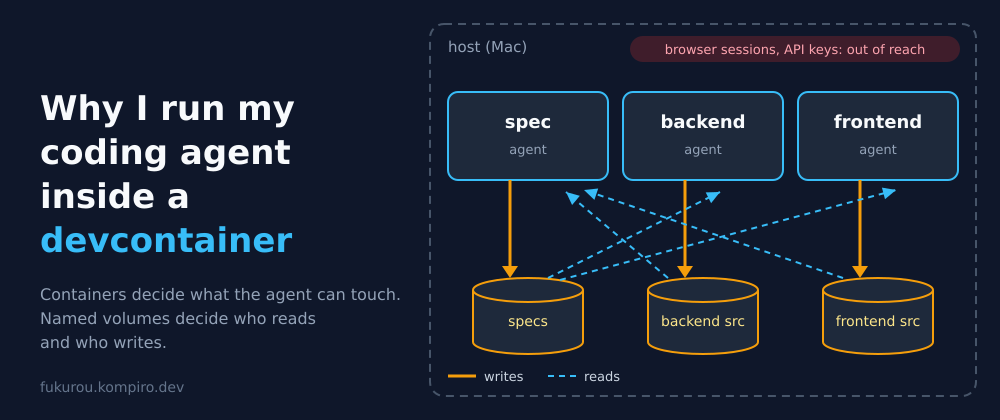
Why I Run My Coding Agent Inside a Devcontainer --- title: "Why I Run My Coding Agent Inside a Devcontainer" published: true description: "I limit what Claude Code can touch to the inside of a container, so I can use auto mode without worrying, and I use named volumes to decide which environment reads and which one writes." tags: devcontainer, docker, claudecode, ai canonical_url: fukurou.kompiro.dev cover_image: fukurou.kompiro.dev --- I do almost all of my development inside a devcontainer. Visual Studio Code opens a container, and I run Claude Code inside it. When I had Claude Code make the demo GIF for my README, the whole recording happened inside the container too. I started using devcontainers long before coding agents came along. My reason for using them has changed since then. Now it is that I can decide how far an agent reaches, one container and one volume at a time. This post describes where I draw those lines. How I got started with devcontainers will be a separate post. Summary 1. Keeping an agent's reach inside a container lets me use auto mode without worrying. The agent is cut off from my browser sessions and API keys, and experimental tools never land on the host. 2. Named volumes let me separate the environment that reads from the one that writes. In the OpenSpec setup I'm trying on my own, the spec container reads the code under development, and the development containers read the specs. 3. I don't recommend devcontainers to everyone. They can be tuned in fine detail, so there is a lot to learn. Fixing the configuration, though, is something you can hand to an agent. Keep secrets and experiments out of the agent's reach I have three reasons for keeping the agent inside a container. The first is to make it easy to try development tools. Tools around coding agents come and go quickly, and I often want to try something experimental. I'd rather not install those tools on my Mac. If they live in a container and don't work out, I can just rebuild the container. The second is to keep secrets out of reach. My browser on the host has plenty of logged-in sessions, and the host also holds various API keys. This is also why I chose Playwright inside the container over computer use when making the demo GIF. The third is accidental file deletion. I hear about it less these days, but I did hear several stories of agents deleting files. If only the files inside the container are in play, the damage stays inside that container. With all three in place, I can use auto mode without worrying. Even when the agent asks me for confirmation less often, I still know what it can touch. There is one hole I leave open on purpose. Claude Code's configuration directory (~/.claude) is bind-mounted from the host. That way the container can use the authentication I completed on the host, and I can look back across the sessions of every project later. Use named volumes to decide who reads and who writes Once environments live in separate containers, some things need to be shared between them. I connect them with named volumes. In repositories that use compose, devcontainer.json points at a compose file through dockerComposeFile, and that file refers to a network and volumes created outside the project. By default, Docker Compose creates a project and a network for each compose file. Bringing a whole project up or down is convenient, but you can't rebuild just one service. So I manage networks and volumes separately from the projects. The simplest thing to share is credentials. In this blog's repository, the GitHub CLI and dev.to credentials live in named volumes. "mounts": [ "source=gh-config,target=/home/node/.config/gh,type=volume", "source=devto-config,target=/home/node/.config/devto,type=volume" ] The volumes outlive the container, so rebuilding it doesn't mean logging in again. At the same time, the credentials stay off my Mac and out of the repository. The source code itself lives in a named volume too. Bind mounts on a Mac are slow. With the code in a volume, another container can see the same code just by mounting that volume. Example: a spec container that only reads the code On my own, I'm trying out OpenSpec. OpenSpec is a tool for writing the spec before the code, and it accumulates change proposals (called changes) in a spec repository. Writing a change requires reading the existing source code. I also wanted the agent to read the code as it currently stands in development. So I mount the volume that holds the development container's source code into the spec container as well. The agent in the spec container doesn't get to rewrite that source code. In the spec container's Claude Code settings (settings.json), the source code volume is not listed in additionalDirectories. The agent that writes specs only reads the code. There is also a mount in the other direction. The development containers mount the spec volume. That lets the development side check how the specs are progressing. The backend and the frontend are developed independently in their own containers, and both see the same specs. | Container | Mounts | What the agent writes | | --- | --- | --- | | Spec | The spec volume and the volume with the code under development | Specs only | | Backend development | The backend source code and the spec volume | Backend code | | Frontend development | The frontend source code and the spec volume | Frontend code | Containers decide what an agent can touch, and volumes decide which environment reads and which one writes. With the read and write directions set per container, I can run several agents side by side without them trampling each other's workspaces. Keep the production image minimal and bring your own tools There is also a line around what goes into the container. The image I ship to production should contain only the files the service needs to run. A development environment, on the other hand, needs room for whatever tools help me develop. So I build on the production Dockerfile and add development tools with devcontainer features and dotfiles. I manage dotfiles with yadm and tool versions with mise. One reason I bring my dotfiles into the container is worktrees. Developing with agents means using a lot of worktrees. For reopening and switching between them, I want the tools my hands already know, such as fzf. The work may happen inside a container, but the environment I operate by hand should feel the same as always. Devcontainers are not for everyone Devcontainers have their annoyances. Changing devcontainer.json means rebuilding the container. Every small tweak means waiting for a rebuild, so I'm careful when I edit it. Disk usage doesn't bother me. They also limit your choice of editor. Newer IDEs built for AI agents, such as Orca, are awkward to combine with devcontainers. That said, the Claude Code extension for Visual Studio Code is improving quickly too. Would I recommend devcontainers to everyone? No. They can be tuned in fine detail, which makes them hard to use casually, and beginners have a lot to learn. Still, if you ask Claude Code or Codex to fix your devcontainer configuration, they do a good job. If you want your development environment as code that you can reproduce, I do recommend them. Takeaways I keep using devcontainers because they let me decide, with containers and volumes, how much I hand to an agent. Inside a container, the agent can work in auto mode while my secrets and experimental tools stay separated from the host. Connected by named volumes, environments can share the same code and specs while keeping the reader and the writer apart. The OpenSpec setup is still an experiment. For a while, I'll watch how splitting the spec and development containers changes the way I write and work through changes.
AI-GENERATED · Made with the Muse app THREE RAYS — the star of Awen by Muse by Meta: HD 18787 in Cassiopeia, three companions fanned like three rays (53°/56°). The naming is ours alone: unofficial, private, heartfelt. Her shelf: roberttilford19-sketch/awen #Cassiopeia #stars t.co
A test case for agent approvals: approve one action, narrow its scope, then compact the conversation. Check which proposal, approval and newer restriction reach the reviewer. Test the resulting decision separately from context retention. github.com/openai/codex/blob/rust-v0.163.0/codex-…
Finally got sharp, fringe-free text on my WOLED in Windows. ClearType expects RGB pixels. WOLED is RWBG, so letters get red and green edges. Turning ClearType off kills the color but makes text thin and blurry. I tuned a fix that gives you sharp, pure gray text everywhere: - MacType profile: gray smoothing, no jagged small text, slightly bolder so it never looks washed out - One-click script: fixes the apps MacType can't reach (Office, Settings). Saves an undo file, no admin needed Setup: 1. winget install MacType.MacType 2. Drop the profile into C:\Program Files\MacType\ini 3. MacType Wizard > Run as a service > pick RWBG_WOLED_Clean 4. Run the script, then sign out and back in Free and open source: Bo0ii/WOLED-Text-Fringing-Fix Tuned on the ASUS XG32UCWG. Got a different WOLED? Tell me how it looks on yours.
Pydantic AI 2.64.0 notes restrict stored server IDs to their originating endpoint. A model swap isn't a state migration. Proposed fallback check: does the new endpoint receive an ID it can't own? github.com/pydantic/pydantic-ai/releases/tag/v2.6…
@sacino @LLMJunky @andyrewlee ahh yea i have a codex plan for theo's skills here t3dotgg/tstack basically a review loop with 6.1 sol
PWS2 VR MOD - UPDATE 2.0 (Make it all Shine) I've released an update for the PowerWash Simulator 2 VR Mod that implements quite a lot of new additions (and even some fixes/improvements for the game when playing without VR). 1. Physical attachments are now available for every type of nozzle and extension 2. Furniture and placement mode now work fully in VR 3. FSR 1 has been implemented, allowing you to achieve much higher frame rates There's a whole BUNCH of other additions and changes Check it out for yourself or download the mod here: github.com/Minibattle/Powerwash-Simulator-2-VR-Mo…
A=B解答用リポジトリできた ページ記載は一旦サンプルなので、実際の解答はあとで追加する予定 kip2/A_equal_B_anser_book
想让 AI 帮你点桌面软件,又不想它靠截图瞎猜? agent-desktop:Vercel 开源的命令行工具,读系统"无障碍树"给按钮编号,AI 按编号操作再复查,支持三大系统。 GitHub 约 1 万星,Apache-2.0,今日趋势第一。 适合折腾 AI 自动化的人。 注意:快照可能含隐私,别外传。 vercel-labs/agent-desktop
Please check out our work here: 📎 paper: arxiv.org 🌐 website: minhphd.github.io 🕹️ demo: hf.co 💻 code: sparklabutah/MiniWeb 🤗 data: hf.co 🧵[11/11]
只装 3 条命令:Lite 版安装取舍与验证清单 Lite 版只有 3 条命令:/review、/commit、/test。先装这 3 条、跑顺了再决定要不要完整版,是这个包有意的取舍:3 条覆盖“写完代码之后”的收尾链路,装得多不等于用得上。 安装分三步。第一步克隆:git clone alapha888/cn-ai-coding-workflow-lite ,然后 cd cn-ai-coding-workflow-lite。第二步一键安装:bash scripts/install.sh ,默认同时装到 Claude Code 与 Codex;只装一个可用 --claude-only 或 --codex-only。Windows 用 PowerShell 跑 .\scripts\install.ps1。第三步验证:ls ~/.claude/commands/ 应看到 review.md、commit.md、test.md;ls ~/.codex/skills/ 应看到 3 个目录,每个含 SKILL.md。安装脚本可重复执行,重复安装会覆盖旧文件,不会产生重复。 一个风险提示要先说在前面:Claude Code 对国内地区账号有较严的风控,存在封号可能。如用国内账号,建议优先用 Codex CLI 跑这几个命令(已在 Codex 上实测通过),或把命令当中文 SOP 复制到任何中文 AI 使用。 完整版与 Lite 版的区别只有一句话:完整版在 3 条之外还有 /debug、/refactor、/doc、/plan、/pr、/onboard、/release 共 7 条命令,外加 3 套 CLAUDE.md 项目配置模板、中英术语对照与 5 条工作流组合速查表,以及一个从 0 写到提交的真实演示项目 todo-cli(含修掉的 4 个真实问题和命令不好用的地方,如实记录)。 链接: 免费 Lite 版:alapha888/cn-ai-coding-workflow-lite 完整版(爱发电,早鸟 ¥9.90/正式 ¥19.90,付款后 12 小时内私信交付,7 天无理由退款):afdian.com
@thdxr Hear me out - Avalonia is a well-established cross-platform UI framework for .NET, and I've bridged it to be used in Rust as a native library through .NET NativeAOT: Devolutions/rustolonia
The code, the data pull, and every model call's cost. joewilsonai/whoshiring
⑤ img2threejs 是什么:装进 Claude Code 的技能,丢张图说「照这张重建」。 解决什么:想往网页放 3D,不会建模。 亮点:出的是 createXxxModel() 函数,返回 Three.js 模型,不是模型文件。 怎么用:npx --yes img2threejs@latest install 装好重启。 你想先试哪个? hoainho/img2threejs
We built an entire language, Pratt parser, and native AOT compiler (x86/ARM) in pure Go
Vortex - 开源原生 macOS 刘海效率工具 常驻 MacBook 刘海区域(没有刘海的 Mac 则显示在菜单栏),鼠标悬停即可展开常用快捷工具,方便快速访问日常功能。 👉 OrtexIsArtem/vortex t.co
Day 10 of 30: missed Day 9. Pretoria storms kept killing my signal. The meter adapter is live. I also caught the app saving my testnet wallet seed in plaintext, in a folder about to go public. Gitignored now. SmitMarcos/solarnode-sim @boardyai
Repo, issues and PRs welcome: Clawdlinux/atticdb
OpenRun - Deployment platform for code-first internal tools I have been building openrundev/openrun for the last three years (Apache licensed). OpenRun is a deployment platform specifically built to make it easy for teams to deploy internal tools securely. OpenRun pulls app declaration and source from Git, builds the image, deploys it (on single machine or Kubernetes) and adds OIDC/SAML based auth for the app, with support for RBAC policies. Apps can be managed declaratively once the initial git sync is setup, no clicking around required. There are few companies already using OpenRun in production. I plan to do a 1.x release later this week. openrun.dev is a blog post comparing this approach against low-code tools.
① 归藏 PPT Skill 文章丢进去,它排成能左右翻页的网页 PPT,自带电子杂志风、瑞士风两套版式,每页备注和演讲时间也替你写上。 要讲方案、做线下分享、又不想调字号的,最推荐先试这个。 op7418/guizang-ppt-skill
Free open source HDR toggling tool I made an app after being frustrated with how Windows handles HDR. The app is completely free and open source: WillPidgeon/HDR-Ultimate. It can automatically enable and disable HDR when you open a selected application. It currently has one OLED burn-in prevention feature, and I plan to add more in the future. [Also if you like the app i would appreciate a star on github] Edit: the one current burn-in prevention feature disables hdr after being tabbed out of a game for a certain amount of time, if you elect for it. I am currently looking for more burn-in prevention features to implement that wouldn’t already be covered by most monitors. Feel free to comment if you have any ideas.
[Notice] OpenLR2でアナログ入力に対応しました。これまで認識されなかったアナログスクラッチも使用できるようになりましたので、ぜひご確認ください。 github.com/GOMazk/OpenLR2/releases/tag/v261101
Homebrewed SLMs: Autoregressive and Masked Diffusion Language Models Built at Home for Portuguese Pedro Carvalho Brom arxiv.org [𝚌𝚜.𝙲𝙻 𝚌𝚜.𝙻𝙶] 💬Code: pcbrom/homebrewed-slms t.co
...and here we go! robbyrussell/oh-my-scrobbles-releases
@homorai139 @Ludoviciana00 rom and app to run in on windows without emulator: Waffle631/Project-Blue-Moon drive.google.com have fun
The AI Agent Legion that won a hacking championship 🤖 ⭐ GitHub Repository: N1nEmAn/sapper-v2 In this video, we explore sapper-v2, an open-source project that an autonomous AI pentesting legion orchestrating multi-agent collaboration, model tiering, and layered fact-intent graphs to win capture-the-flag championships.. #github #coding #opensource #programming #developer
Trying the caveman token-saving skill without fooling yourself: what to compare, and what to switch off first Source: the README of JuliusBrussee/caveman (Apache-2.0). The numbers below are the maintainer's own, not independently reproduced. The suggested checks below are ways to evaluate it, not results from testing it. What it is. A skill that makes the agent answer in short plain sentences, now bundled with other parts: a compressor for logs and data files, a model router called Auto, and saved helper scripts. Each part has its own switch. What the README says about the main claim. In its own test of ten dev questions, a plain "Answer concisely." line cut output tokens from 6,983 to 4,334. On top of that line, the caveman voice cut about 3% more at the median, and the stronger mode about 35% more (measured on older rules, not re-run). It also says that if your plan charges per request rather than per token, shorter answers may save nothing. A safer way to try it (suggestions). - Compare against a plain "be concise" line in your CLAUDE.md, not against no instruction. That is the baseline the README itself uses. - Start with the skill alone. The README says the skill sends nothing. Add the other parts one at a time, since each has a switch. - Judge it on your own sessions. The bigger claims are about shrinking what the agent reads (logs, JSON, CSV, test output), so they depend on what your sessions read. The README lists HTML as 9.9% worse in one run. - Look at your bill or usage page, not only token counts. Your plan's pricing decides whether fewer tokens means less cost. What leaves your machine, per the README. - The skill alone sends nothing. The compress command sends the file you compress to your model provider. - The CLI sends usage stats by default (commands run, token counts, a random install ID, OS and IP, not prompts or code). DO_NOT_TRACK=1 turns that off. - If you sign in and pick Auto, each request sends your latest ask to Caveman Cloud, plus whatever your agent attaches, such as CLAUDE.md, memory or mentioned files. On the free plan the README says Caveman may keep it to improve routing. That is the part to decide on deliberately. Question. If you've used a token-saver, did you compare it with a plain "be concise" first? What did you find mattered?
🔗 Release Links Official Website: aipoch.com GitHub Repository: aipoch/open-science
卧槽,查了一把电脑上有多少个Chromium套壳程序。 有30个!!! 相当于电脑上装了30个浏览器 查询工具: Astrian/chromium-certificate t.co
方案前先画结构图,XMind 导出 PDF/图片要会员,一年 388,就为偶尔画一张。 mindmaps 纯前端脑图:浏览器打开就画,拖节点换配色,存本地可导图,断网可用。 drichard/mindmaps
@Kedashu @bbkirstry 保真,可以试试 我用这个 skill 做的:lemomo-ai/lemo-opuscar t.co
AKT-AIC/BonDriver_Friio_x64 Friio フリーオの新しいBondriverが出てた。今度試してみよう。白フリーオ富山の家に置いてあるんだ。
Visions of Mana - Any Aspect Ratio and FOV Mod I made a simple mod to help non-16:9 devices like the Steam Deck run games better. github.com/TLin-Y/SteamAnyAspectRatioMods/tree/ma…
Why is it paired to XMR? XMR was not even around when the coin was created. It is a fork of Litecoin. CHeck their github: github.com/muddafudda/Memecoin/blob/master/src/in…
2時間かけて80行減らした github.com/nkfr26/npb-calendar/commit/82be2f82a3a…
An Open-Source PX4 Swarm With Onboard ESP32-P4 Vision - Mindaugas Jonauskis, Team Mach Mind Join us at the premier vendor-neutral open source conference, where developers and technologists come together to collaborate, share knowledge, and explore the latest innovations and advancements in open source technology. Learn more at events.linuxfoundation.org An Open-Source PX4 Swarm With Onboard ESP32-P4 Vision - Mindaugas Jonauskis, Team Mach Mind I want to share our bumpy road on Swarm Drone Challenge 2026 (ILA Berlin) with a team of two people and what two stubborn guys can achieve during weekends - 4th place. We built a swarm of 5 drones, each running PX4 for flight, coordinated by a ROS2 ground station and onboard with two ESP32-ser. microcontrollers. ESP32-P4 was dedicated to onboard ArUco vision and ToF obstacle sensing (no Linux SBC) and an ESP32-S3 handling MAVLink and micro-ROS comms over WiFi. I will cover architecture — PX4 + MAVLink + a ROS2 commander that assigns swarm roles and streams waypoints — and the onboard vision pipeline on bare microcontrollers. Comparison of Version 1.0 (single-MCU) vs Version 2.0 (dual-MCU) and why we shipped a deterministic Manhattan-grid navigation fallback when ArUco-EKF localization could not be deployed in time. Our solution was open-sourced - machmind-dev/drone-swarm-challenge-2026 [ar] سرب طائرات مفتوح المصدر يعمل بنظام PX4 مع رؤية حاسوبية مدمجة عبر ESP32-P4 - مينداوجاس جونوسكيس، ف... انضموا إلينا في المؤتمر الرائد للبرمجيات مفتوحة المصدر، حيث يجتمع المطورون والتقنيون للتعاون وتبادل المعرفة واستكشاف أحدث الابتكارات والتطورات في هذا المجال. للمزيد من المعلومات، تفضلوا بزيارة events.linuxfoundation.org سرب طائرات بدون طيار مفتوح المصدر يعمل بنظام PX4 مزود بوحدة رؤية ESP32-P4 مدمجة - ميندوغاس جوناوسكيس، فريق ماتش مايند أودّ أن أشارككم تجربتنا المليئة بالتحديات في تحدي سرب الطائرات بدون طيار 2026 (معرض ILA برلين) مع فريق مكون من شخصين، وما حققه هذان الشخصان المثابران خلال عطلة نهاية الأسبوع - المركز الرابع. قمنا ببناء سرب من 5 طائرات بدون طيار، تعمل كل منها بنظام PX4 للطيران، ويتم تنسيقها بواسطة محطة أرضية ROS2، ومزودة بوحدتي تحكم دقيقتين من سلسلة ESP32. خُصصت وحدة ESP32-P4 للرؤية المدمجة ArUco واستشعار العوائق بتقنية ToF (بدون لوحة تحكم أحادية اللوحة تعمل بنظام Linux)، بينما تولت وحدة ESP32-S3 إدارة اتصالات MAVLink وmicro-ROS عبر شبكة WiFi. سأتناول بنية النظام - PX4 + MAVLink + وحدة تحكم ROS2 التي تُحدد أدوار السرب وتُرسل نقاط المسار - بالإضافة إلى نظام الرؤية المُدمج على وحدات التحكم الدقيقة. سأقارن بين الإصدار 1.0 (بوحدة تحكم دقيقة واحدة) والإصدار 2.0 (بوحدتي تحكم دقيقتين)، وسأشرح سبب تضميننا نظام ملاحة مانهاتن شبكي حتمي كخيار احتياطي عندما تعذر نشر نظام تحديد الموقع ArUco-EKF في الوقت المناسب. حلنا مفتوح المصدر - machmind-dev/drone-swarm-challenge-2026 [bn] অনবোর্ড ESP32-P4 ভিশন সহ একটি ওপেন-সোর্স PX4 সোয়ার্ম - মিনডাউগাস জোনাউস্কিস, টিম ম্যাক মাইন্ড আমাদের সেরা ভেন্ডর-নিরপেক্ষ ওপেন সোর্স সম্মেলনে যোগ দিন, যেখানে ডেভেলপার এবং প্রযুক্তিবিদরা একত্রিত হন সহযোগিতা করতে, জ্ঞান ভাগাভাগি করতে এবং ওপেন সোর্স প্রযুক্তির সর্বশেষ উদ্ভাবন ও অগ্রগতি অন্বেষণ করতে। আরও জানতে ভিজিট করুন events.linuxfoundation.org অনবোর্ড ESP32-P4 ভিশন সহ একটি ওপেন-সোর্স PX4 সোয়ার্ম - মিন্ডাউগাস জোনাউস্কিস, টিম ম্যাক মাইন্ড আমি দুইজনের একটি দল নিয়ে সোয়ার্ম ড্রোন চ্যালেঞ্জ ২০২৬ (আইএলএ বার্লিন)-এ আমাদের বন্ধুর পথচলার অভিজ্ঞতা এবং সপ্তাহান্তে দুই জেদি মানুষ কী অর্জন করতে পারে, তা আপনাদের সাথে ভাগ করে নিতে চাই - চতুর্থ স্থান। আমরা ৫টি ড্রোনের একটি সোয়ার্ম তৈরি করেছিলাম, যার প্রতিটি উড্ডয়নের জন্য PX4 ব্যবহার করছিল, যা একটি ROS2 গ্রাউন্ড স্টেশন দ্বারা সমন্বিত ছিল এবং এতে দুটি ESP32-ser. মাইক্রোকন্ট্রোলার ছিল। ESP32-P4 ড্রোনটি অনবোর্ড ArUco ভিশন এবং ToF অবস্ট্যাকল সেন্সিং (কোনো লিনাক্স SBC ছাড়া) এর জন্য ব্যবহৃত হয়েছিল এবং একটি ESP32-S3 ওয়াইফাই এর মাধ্যমে MAVLink এবং মাইক্রো-ROS কমিউনিকেশন পরিচালনা করছিল। আমি এর আর্কিটেকচার — PX4 + MAVLink + একটি ROS2 কমান্ডার যা সোয়ার্মের ভূমিকা নির্ধারণ করে এবং ওয়েপয়েন্ট স্ট্রিম করে — এবং বেয়ার মাইক্রোকন্ট্রোলারগুলোর অনবোর্ড ভিশন পাইপলাইন নিয়ে আলোচনা করব। ভার্সন ১.০ (সিঙ্গেল-এমসিইউ) বনাম ভার্সন ২.০ (ডুয়াল-এমসিইউ)-এর তুলনা এবং কেন আমরা একটি ডিটারমিনিস্টিক ম্যানহাটন-গ্রিড নেভিগেশন ফলব্যাক যুক্ত করেছি, যখন ArUco-EKF লোক্যালাইজেশন সময়মতো স্থাপন করা সম্ভব হয়নি। আমাদের সমাধানটি ওপেন-সোর্স করা হয়েছে - machmind-dev/drone-swarm-challenge-2026 [de-DE] Ein Open-Source-PX4-Schwarm mit integrierter ESP32-P4-Vision – Mindaugas Jonauskis, Team Mach Mind Besuchen Sie uns auf der führenden herstellerneutralen Open-Source-Konferenz, wo Entwickler und Technologieexperten zusammenkommen, um zusammenzuarbeiten, Wissen auszutauschen und die neuesten Innovationen und Fortschritte in der Open-Source-Technologie zu entdecken. Mehr erfahren Sie unter events.linuxfoundation.org Ein Open-Source-PX4-Schwarm mit integrierter ESP32-P4-Vision – Mindaugas Jonauskis, Team Mach Mind Ich möchte unseren holprigen Weg bei der Swarm Drone Challenge 2026 (ILA Berlin) mit einem Zweierteam teilen und zeigen, was zwei Dickköpfe an Wochenenden erreichen können – den 4. Platz. Wir haben einen Schwarm aus 5 Drohnen gebaut, die jeweils mit PX4 fliegen und von einer ROS2-Bodenstation koordiniert werden. Jede Drohne ist mit zwei ESP32-Mikrocontrollern ausgestattet. Der ESP32-P4 diente der integrierten ArUco-Vision und der ToF-Hinderniserkennung (kein Linux-SBC), während ein ESP32-S3 die MAVLink- und Micro-ROS-Kommunikation über WLAN übernahm. Ich möchte unseren holprigen Weg bei der Swarm Drone Challenge 2026 (ILA Berlin) mit einem Zweierteam teilen und zeigen, was zwei hartnäckige Typen an Wochenenden erreichen können: Platz 4. Ich werde die Architektur – PX4 + MAVLink + einen ROS2-Commander, der die Rollen der Drohnen im Schwarm zuweist und Wegpunkte streamt – sowie die integrierte Bildverarbeitungspipeline auf den Mikrocontrollern vorstellen. Außerdem vergleiche ich Version 1.0 (Einzel-MCU) mit Version 2.0 (Dual-MCU) und erkläre, warum wir eine deterministische Manhattan-Grid-Navigation als Fallback implementiert haben, falls die ArUco-EKF-Lokalisierung nicht rechtzeitig verfügbar war. Unsere Lösung ist Open Source: machmind-dev/drone-swarm-challenge-2026 [es-US] Un enjambre PX4 de código abierto con visión ESP32-P4 integrada - Mindaugas Jonauskis, Equipo Mac... Únete a nosotros en la principal conferencia de código abierto independiente de proveedores, donde desarrolladores y tecnólogos se reúnen para colaborar, compartir conocimientos y explorar las últimas innovaciones y avances en tecnología de código abierto. Más información en events.linuxfoundation.org Un enjambre PX4 de código abierto con visión ESP32-P4 integrada - Mindaugas Jonauskis, Equipo Mach Mind Quiero compartir nuestra experiencia en el Swarm Drone Challenge 2026 (ILA Berlín) con un equipo de dos personas y lo que dos personas perseverantes pueden lograr durante un fin de semana: el 4.º puesto. Construimos un enjambre de 5 drones, cada uno con PX4 para el vuelo, coordinado por una estación terrestre ROS2 y equipado con dos microcontroladores ESP32. El ESP32-P4 se dedicó a la visión ArUco integrada y a la detección de obstáculos ToF (sin SBC Linux), mientras que un ESP32-S3 gestionó MAVLink y las comunicaciones micro-ROS a través de Wi-Fi. Explicaré la arquitectura —PX4 + MAVLink + un controlador ROS2 que asigna roles al enjambre y transmite puntos de ruta— y el sistema de visión integrado en microcontroladores. Compararé la versión 1.0 (con un solo microcontrolador) con la versión 2.0 (con dos microcontroladores) y explicaré por qué implementamos una solución de navegación determinista basada en la cuadrícula de Manhattan cuando no fue posible desplegar a tiempo la localización ArUco-EKF. Nuestra solución se publicó como código abierto: machmind-dev/drone-swarm-challenge-2026 [fr-FR] Un essaim PX4 open-source avec vision embarquée ESP32-P4 - Mindaugas Jonauskis, Team Mach Mind Rejoignez-nous à la première conférence open source indépendante des fournisseurs, où développeurs et technologues se réunissent pour collaborer, partager leurs connaissances et explorer les dernières innovations et avancées en matière de technologies open source. Plus d'informations sur events.linuxfoundation.org Un essaim PX4 open source avec vision embarquée ESP32-P4 - Mindaugas Jonauskis, Team Mach Mind Je souhaite partager notre expérience, certes mouvementée, lors du Swarm Drone Challenge 2026 (ILA Berlin) avec une équipe de deux personnes, et vous montrer ce que deux personnes déterminées peuvent accomplir en un week-end : une 4e place ! Nous avons construit un essaim de 5 drones, chacun fonctionnant sous PX4, coordonné par une station au sol ROS2 et équipé de deux microcontrôleurs ESP32-ser. L'ESP32-P4 était dédié à la vision embarquée ArUco et à la détection d'obstacles par temps de vol (sans carte mère Linux), tandis que l'ESP32-S3 gérait MAVLink et les communications micro-ROS via Wi-Fi. Je présenterai l'architecture (PX4 + MAVLink + un contrôleur ROS2 qui attribue les rôles aux drones et diffuse les points de passage) ainsi que le pipeline de vision embarqué sur microcontrôleurs nus. Je comparerai la version 1.0 (mono-microcontrôleur) à la version 2.0 (double-microcontrôleur) et expliquerai pourquoi nous avons intégré une navigation déterministe par grille de Manhattan lorsque la localisation ArUco-EKF n'a pas pu être déployée à temps. Notre solution est disponible en open source : machmind-dev/drone-swarm-challenge-2026 [hi] ऑनबोर्ड ESP32-P4 विज़न के साथ एक ओपन-सोर्स PX4 स्वार्म - मिंडाौगास जोनाउस्किस, टीम मच माइंड हमारे साथ जुड़ें प्रमुख वेंडर-न्यूट्रल ओपन सोर्स सम्मेलन में, जहाँ डेवलपर और प्रौद्योगिकीविद सहयोग करने, ज्ञान साझा करने और ओपन सोर्स प्रौद्योगिकी में नवीनतम नवाचारों और प्रगति का पता लगाने के लिए एक साथ आते हैं। अधिक जानकारी के लिए events.linuxfoundation.org पर जाएँ। ऑनबोर्ड ESP32-P4 विज़न के साथ एक ओपन-सोर्स PX4 स्वार्म - मिंडाउगास जोनाउस्किस, टीम मच माइंड मैं स्वार्म ड्रोन चैलेंज 2026 (ILA बर्लिन) में दो लोगों की टीम के साथ अपने उतार-चढ़ाव भरे सफर को साझा करना चाहता हूँ और यह बताना चाहता हूँ कि दो दृढ़ निश्चयी लोग सप्ताहांत में क्या हासिल कर सकते हैं - चौथा स्थान। हमने 5 ड्रोनों का एक स्वार्म बनाया, जिनमें से प्रत्येक उड़ान के लिए PX4 का उपयोग कर रहा था, जिसे एक ROS2 ग्राउंड स्टेशन द्वारा समन्वित किया गया था और इसमें दो ESP32-सीरीज़ माइक्रोकंट्रोलर लगे थे। ESP32-P4 ऑनबोर्ड ArUco विज़न और ToF बाधा संवेदन (बिना Linux SBC के) के लिए समर्पित था और एक ESP32-S3 वाईफाई पर MAVLink और माइक्रो-ROS संचार को संभाल रहा था। मैं आर्किटेक्चर के बारे में बताऊंगा — PX4 + MAVLink + एक ROS2 कमांडर जो झुंड की भूमिकाएँ निर्धारित करता है और वेपॉइंट स्ट्रीम करता है — और बेयर माइक्रोकंट्रोलर पर ऑनबोर्ड विज़न पाइपलाइन के बारे में भी। वर्शन 1.0 (सिंगल-MCU) बनाम वर्शन 2.0 (डुअल-MCU) की तुलना और यह कि जब ArUco-EKF लोकलाइज़ेशन समय पर तैनात नहीं किया जा सका, तो हमने एक डिटरमिनिस्टिक मैनहट्टन-ग्रिड नेविगेशन फॉलबैक क्यों शामिल किया। हमारा समाधान ओपन-सोर्स है - machmind-dev/drone-swarm-challenge-2026 [id] Kawanan PX4 Open-Source dengan Vision ESP32-P4 Onboard - Mindaugas Jonauskis, Tim Mach Mind Bergabunglah dengan kami di konferensi open source netral vendor terkemuka, tempat para pengembang dan ahli teknologi berkumpul untuk berkolaborasi, berbagi pengetahuan, dan menjelajahi inovasi dan kemajuan terbaru dalam teknologi open source. Pelajari lebih lanjut di events.linuxfoundation.org Sebuah Swarm PX4 Open Source dengan Visi ESP32-P4 Terintegrasi - Mindaugas Jonauskis, Tim Mach Mind Saya ingin berbagi perjalanan kami yang berliku-liku di Swarm Drone Challenge 2026 (ILA Berlin) dengan tim yang terdiri dari dua orang dan apa yang dapat dicapai oleh dua orang yang gigih selama akhir pekan - peringkat ke-4. Kami membangun swarm yang terdiri dari 5 drone, masing-masing menjalankan PX4 untuk penerbangan, dikoordinasikan oleh stasiun darat ROS2 dan terintegrasi dengan dua mikrokontroler ESP32-ser. ESP32-P4 didedikasikan untuk visi ArUco terintegrasi dan penginderaan rintangan ToF (tanpa SBC Linux) dan ESP32-S3 menangani komunikasi MAVLink dan micro-ROS melalui WiFi. Saya akan membahas arsitektur — PX4 + MAVLink + komandan ROS2 yang menetapkan peran swarm dan mengalirkan titik arah — dan pipeline visi onboard pada mikrokontroler murni. Perbandingan Versi 1.0 (MCU tunggal) vs Versi 2.0 (MCU ganda) dan mengapa kami mengirimkan fallback navigasi grid Manhattan deterministik ketika lokalisasi ArUco-EKF tidak dapat diterapkan tepat waktu. Solusi kami telah dirilis sebagai open-source - machmind-dev/drone-swarm-challenge-2026 [it] Uno sciame PX4 open-source con visione ESP32-P4 integrata - Mindaugas Jonauskis, Team Mach Mind Unisciti a noi alla principale conferenza open source indipendente dai fornitori, dove sviluppatori e tecnologi si incontrano per collaborare, condividere conoscenze ed esplorare le ultime innovazioni e i progressi della tecnologia open source. Scopri di più su events.linuxfoundation.org Uno sciame di droni open source con PX4 e visione integrata tramite ESP32-P4 - Mindaugas Jonauskis, Team Mach Mind Voglio condividere il nostro percorso, a tratti travagliato, alla Swarm Drone Challenge 2026 (ILA Berlino) con un team di due persone e ciò che due testardi possono realizzare durante i weekend: il 4° posto. Abbiamo costruito uno sciame di 5 droni, ognuno con PX4 per il volo, coordinato da una stazione di terra ROS2 e dotato a bordo di due microcontrollori ESP32-series. L'ESP32-P4 era dedicato alla visione ArUco e al rilevamento degli ostacoli ToF (senza SBC Linux), mentre un ESP32-S3 gestiva MAVLink e le comunicazioni micro-ROS tramite Wi-Fi. Tratterò l'architettura — PX4 + MAVLink + un comandante ROS2 che assegna i ruoli allo sciame e trasmette i waypoint — e la pipeline di visione integrata su microcontrollori nudi. Confronto tra la versione 1.0 (singolo MCU) e la versione 2.0 (doppio MCU) e il motivo per cui abbiamo implementato un fallback di navigazione deterministica a griglia di Manhattan quando la localizzazione ArUco-EKF non è stata implementata in tempo. La nostra soluzione è stata resa open source - machmind-dev/drone-swarm-challenge-2026 [iw] נחיל PX4 בקוד פתוח עם ראייה ממוחשבת מבוססת ESP32-P4 - מינדאוגאס יונאוסקיס, צוות Mach Mind הצטרפו אלינו בכנס הקוד הפתוח המוביל והנייטרלי לספקים, שבו מפתחים וטכנולוגים נפגשים כדי לשתף פעולה, לשתף ידע ולחקור את החידושים וההתקדמות האחרונים בטכנולוגיית קוד פתוח. למידע נוסף בקרו ב- events.linuxfoundation.org נחיל PX4 בקוד פתוח עם ראיית ESP32-P4 מובנית - מינדאוגאס יונאוסקיס, צוות מאך מיינד אני רוצה לשתף את הדרך המהמורת שלנו באתגר הרחפנים Swarm Drone Challenge 2026 (ILA Berlin) עם צוות של שני אנשים ומה שני בחורים עקשנים יכולים להשיג במהלך סופי שבוע - מקום רביעי. בנינו נחיל של 5 רחפנים, שכל אחד מהם מריץ PX4 לטיסה, מתואם על ידי תחנת קרקע ROS2 ועליו שני מיקרו-בקרים ESP32-ser. ESP32-P4 הוקדש לראייה מובנית של ArUco וחישת מכשולים ToF (ללא Linux SBC) ו- ESP32-S3 המטפל בתקשורת MAVLink ו- micro-ROS דרך WiFi. אכסה את הארכיטקטורה - PX4 + MAVLink + מפקד ROS2 שמקצה תפקידי נחיל ומזרים נקודות ציון - ואת צינור הראייה המובנה על מיקרו-בקרים חשופים. השוואה בין גרסה 1.0 (מיקרו-בקר יחיד) לעומת גרסה 2.0 (מיקרו-בקר כפול) ומדוע שיצרנו גיבוי ניווט דטרמיניסטי של רשת מנהטן כאשר לא ניתן היה לפרוס את לוקליזציית ArUco-EKF בזמן. הפתרון שלנו היה בקוד פתוח - machmind-dev/drone-swarm-challenge-2026 [ja] オンボードESP32-P4ビジョンを搭載したオープンソースPX4スウォーム - Mindaugas Jonauskis、Team Mach Mind ベンダーニュートラルな最高峰のオープンソースカンファレンスにぜひご参加ください。開発者と技術者が一堂に会し、協力し合い、知識を共有し、オープンソース技術の最新のイノベーションと進歩を探求します。詳細は events.linuxfoundation.org をご覧ください。 オンボードESP32-P4ビジョン搭載のオープンソースPX4ドローン群 - Mindaugas Jonauskis、Team Mach Mind 2人チームで参加したSwarm Drone Challenge 2026(ILA Berlin)での、波乱万丈な道のりと、2人の粘り強い男が週末に成し遂げたこと(4位入賞)についてお話ししたいと思います。私たちは5機のドローンからなる群を構築しました。各ドローンは飛行用にPX4を搭載し、ROS2地上局で制御され、機体には2つのESP32シリーズマイクロコントローラーが搭載されています。ESP32-P4はオンボードArUcoビジョンとToF障害物センシング専用(Linuxシングルボードコンピュータは使用していません)、ESP32-S3はMAVLinkとmicro-ROSのWiFi通信を担当しています。 本稿では、アーキテクチャ(PX4 + MAVLink + 群機の役割割り当てとウェイポイント配信を行うROS2コマンダー)と、ベアマイクロコントローラ上で動作するオンボードビジョンパイプラインについて説明します。バージョン1.0(シングルMCU)とバージョン2.0(デュアルMCU)の比較、そしてArUco-EKFによる位置推定が間に合わなかったため、決定論的なマンハッタングリッドナビゲーションのフォールバックを採用した理由についても解説します。 本ソリューションはオープンソースとして公開されています(machmind-dev/drone-swarm-challenge-2026%EF%BC%89%E3%80%82 [ko] ESP32-P4 Vision이 내장된 오픈 소스 PX4 스웜 - Mindaugas Jonauskis, Mach Mind 팀 벤더에 구애받지 않는 최고의 오픈 소스 컨퍼런스에 참여하세요. 개발자와 기술 전문가들이 한자리에 모여 협업하고, 지식을 공유하며, 오픈 소스 기술의 최신 혁신과 발전을 탐구하는 자리입니다. 자세한 내용은 events.linuxfoundation.org 에서 확인하세요. ESP32-P4 비전 칩을 탑재한 오픈 소스 PX4 드론 스웜 - Mindaugas Jonauskis, Team Mach Mind 저희 팀은 두 명으로 구성되어 Swarm Drone Challenge 2026(ILA Berlin)에 참가하여 주말 동안 끈기 있게 노력한 결과, 4위라는 훌륭한 성적을 거두었습니다. 저희는 PX4 운영체제를 사용하는 드론 5대로 구성된 스웜을 구축했으며, ROS2 지상국으로 드론들을 제어하고 두 대의 ESP32 시리즈 마이크로컨트롤러를 탑재했습니다. ESP32-P4는 ArUco 비전 칩과 ToF 장애물 감지 센서(Linux SBC 아님)를 담당했고, ESP32-S3는 MAVLink와 WiFi를 통한 micro-ROS 통신을 처리했습니다. 본 발표에서는 PX4 + MAVLink + 드론 군집 역할 할당 및 웨이포인트 스트리밍을 담당하는 ROS2 커맨더로 구성된 아키텍처와 마이크로컨트롤러 기반의 온보드 비전 파이프라인에 대해 설명하겠습니다. 버전 1.0(단일 MCU)과 버전 2.0(듀얼 MCU)의 비교 및 ArUco-EKF 위치 추정 알고리즘을 제때 배포할 수 없는 경우를 대비하여 결정론적 맨해튼 그리드 내비게이션 폴백을 제공한 이유에 대해서도 설명드리겠습니다. 저희 솔루션은 오픈소스로 공개되어 있습니다. (machmind-dev/drone-swarm-challenge-2026) [ml] ഓൺബോർഡ് ESP32-P4 വിഷനുള്ള ഒരു ഓപ്പൺ-സോഴ്സ് PX4 സ്വാം - മിൻഡോഗാസ് ജോനൗസ്കിസ്, ടീം മാക് മൈൻഡ് പ്രീമിയർ വെണ്ടർ-ന്യൂട്രൽ ഓപ്പൺ സോഴ്സ് കോൺഫറൻസിൽ ഞങ്ങളോടൊപ്പം ചേരൂ, അവിടെ ഡെവലപ്പർമാരും സാങ്കേതിക വിദഗ്ധരും ഒത്തുചേരുകയും സഹകരിക്കുകയും അറിവ് പങ്കിടുകയും ഓപ്പൺ സോഴ്സ് സാങ്കേതികവിദ്യയിലെ ഏറ്റവും പുതിയ കണ്ടുപിടുത്തങ്ങളും പുരോഗതികളും പര്യവേക്ഷണം ചെയ്യുകയും ചെയ്യുന്നു. events.linuxfoundation.org എന്ന വെബ്സൈറ്റിൽ കൂടുതലറിയുക. ഓൺബോർഡ് ESP32-P4 വിഷനുള്ള ഒരു ഓപ്പൺ-സോഴ്സ് PX4 സ്വാം - മിൻഡാഗാസ് ജോനൗസ്കിസ്, ടീം മാക് മൈൻഡ് സ്വാം ഡ്രോൺ ചലഞ്ച് 2026 (ILA ബെർലിൻ) ലെ ഞങ്ങളുടെ ദുർഘടമായ പാത രണ്ട് പേരുടെ ഒരു ടീമുമായി പങ്കിടാൻ ഞാൻ ആഗ്രഹിക്കുന്നു, വാരാന്ത്യങ്ങളിൽ രണ്ട് ശാഠ്യക്കാരായ ആളുകൾക്ക് നേടാൻ കഴിയുന്നത് - നാലാം സ്ഥാനം. ഞങ്ങൾ 5 ഡ്രോണുകളുടെ ഒരു കൂട്ടം നിർമ്മിച്ചു, ഓരോന്നും പറക്കലിനായി PX4 പ്രവർത്തിപ്പിക്കുന്നു, ഒരു ROS2 ഗ്രൗണ്ട് സ്റ്റേഷൻ ഏകോപിപ്പിച്ചതും രണ്ട് ESP32-സർ മൈക്രോകൺട്രോളറുകളുമായി ഓൺബോർഡിൽ പ്രവർത്തിക്കുന്നു. ESP32-P4 ഓൺബോർഡ് ArUco വിഷൻ, ToF തടസ്സ സെൻസിംഗ് (Linux SBC ഇല്ല), വൈഫൈ വഴി MAVLink, മൈക്രോ-ROS കോമുകൾ കൈകാര്യം ചെയ്യുന്ന ഒരു ESP32-S3 എന്നിവയ്ക്കായി സമർപ്പിച്ചിരിക്കുന്നു. ഞാൻ ആർക്കിടെക്ചർ ഉൾപ്പെടുത്തും - PX4 + MAVLink + സ്വേം റോളുകളും സ്ട്രീം വേ പോയിന്റുകളും നൽകുന്ന ഒരു ROS2 കമാൻഡർ - കൂടാതെ ബെയർ മൈക്രോകൺട്രോളറുകളിലെ ഓൺബോർഡ് വിഷൻ പൈപ്പ്ലൈനും. പതിപ്പ് 1.0 (സിംഗിൾ-എംസിയു) vs പതിപ്പ് 2.0 (ഡ്യുവൽ-എംസിയു) ന്റെ താരതമ്യം, ആർയുസിഒ-ഇകെഎഫ് ലോക്കലൈസേഷൻ യഥാസമയം വിന്യസിക്കാൻ കഴിയാത്തപ്പോൾ ഞങ്ങൾ ഒരു നിർണായക മാൻഹട്ടൻ-ഗ്രിഡ് നാവിഗേഷൻ ഫാൾബാക്ക് അയച്ചതിന്റെ കാരണം. ഞങ്ങളുടെ പരിഹാരം ഓപ്പൺ സോഴ്സ് ആയിരുന്നു - machmind-dev/drone-swarm-challenge-2026 [nl-NL] Een open-source PX4-zwerm met ingebouwde ESP32-P4-visie - Mindaugas Jonauskis, Team Mach Mind Sluit je aan bij ons op de belangrijkste leveranciersneutrale open source-conferentie, waar ontwikkelaars en technologen samenkomen om te collaboreren, kennis te delen en de nieuwste innovaties en ontwikkelingen in open source-technologie te verkennen. Meer informatie vind je op events.linuxfoundation.org Een open source PX4-zwerm met ingebouwde ESP32-P4-visie - Mindaugas Jonauskis, Team Mach Mind Ik wil graag ons hobbelige traject tijdens de Swarm Drone Challenge 2026 (ILA Berlijn) met een team van twee personen delen en laten zien wat twee eigenwijze kerels in weekenden kunnen bereiken: de 4e plaats. We bouwden een zwerm van 5 drones, elk met PX4 als besturingssysteem voor de vlucht, gecoördineerd door een ROS2-grondstation en uitgerust met twee ESP32-serie microcontrollers. De ESP32-P4 was specifiek bedoeld voor de ingebouwde ArUco-visie en ToF-obstakeldetectie (geen Linux SBC) en een ESP32-S3 voor de MAVLink- en micro-ROS-communicatie via wifi. Ik zal de architectuur bespreken — PX4 + MAVLink + een ROS2-commander die zwermrollen toewijst en waypoints streamt — en de ingebouwde vision-pipeline op kale microcontrollers. Een vergelijking tussen versie 1.0 (enkele MCU) en versie 2.0 (dubbele MCU) en waarom we een deterministische Manhattan-grid-navigatie als fallback hebben meegeleverd toen ArUco-EKF-lokalisatie niet op tijd kon worden geïmplementeerd. Onze oplossing is open source - machmind-dev/drone-swarm-challenge-2026 [pa] ਆਨਬੋਰਡ ESP32-P4 ਵਿਜ਼ਨ ਦੇ ਨਾਲ ਇੱਕ ਓਪਨ-ਸੋਰਸ PX4 ਸਵਾਰਮ - ਮਿੰਡੌਗਾਸ ਜੋਨਾਉਸਕਿਸ, ਟੀਮ ਮੈਕ ਮਾਈਂਡ ਸਾਡੇ ਨਾਲ ਪ੍ਰਮੁੱਖ ਵਿਕਰੇਤਾ-ਨਿਊਟਰਲ ਓਪਨ ਸੋਰਸ ਕਾਨਫਰੰਸ ਵਿੱਚ ਸ਼ਾਮਲ ਹੋਵੋ, ਜਿੱਥੇ ਡਿਵੈਲਪਰ ਅਤੇ ਟੈਕਨਾਲੋਜਿਸਟ ਸਹਿਯੋਗ ਕਰਨ, ਗਿਆਨ ਸਾਂਝਾ ਕਰਨ ਅਤੇ ਓਪਨ ਸੋਰਸ ਤਕਨਾਲੋਜੀ ਵਿੱਚ ਨਵੀਨਤਮ ਨਵੀਨਤਾਵਾਂ ਅਤੇ ਤਰੱਕੀਆਂ ਦੀ ਪੜਚੋਲ ਕਰਨ ਲਈ ਇਕੱਠੇ ਹੁੰਦੇ ਹਨ। events.linuxfoundation.org 'ਤੇ ਹੋਰ ਜਾਣੋ ਆਨਬੋਰਡ ESP32-P4 ਵਿਜ਼ਨ ਦੇ ਨਾਲ ਇੱਕ ਓਪਨ-ਸੋਰਸ PX4 ਸਵੈਰਮ - ਮਿੰਡਾਗਾਸ ਜੋਨਾਸਕਿਸ, ਟੀਮ ਮਾਚ ਮਾਈਂਡ ਮੈਂ ਸਵੈਰਮ ਡਰੋਨ ਚੈਲੇਂਜ 2026 (ILA ਬਰਲਿਨ) 'ਤੇ ਆਪਣੀ ਖਸਤਾ ਸੜਕ ਨੂੰ ਦੋ ਲੋਕਾਂ ਦੀ ਟੀਮ ਨਾਲ ਸਾਂਝਾ ਕਰਨਾ ਚਾਹੁੰਦਾ ਹਾਂ ਅਤੇ ਦੋ ਜ਼ਿੱਦੀ ਲੋਕ ਵੀਕਐਂਡ ਦੌਰਾਨ ਕੀ ਪ੍ਰਾਪਤ ਕਰ ਸਕਦੇ ਹਨ - ਚੌਥਾ ਸਥਾਨ। ਅਸੀਂ 5 ਡਰੋਨਾਂ ਦਾ ਇੱਕ ਝੁੰਡ ਬਣਾਇਆ, ਹਰ ਇੱਕ ਉਡਾਣ ਲਈ PX4 ਚਲਾ ਰਿਹਾ ਹੈ, ਇੱਕ ROS2 ਗਰਾਊਂਡ ਸਟੇਸ਼ਨ ਦੁਆਰਾ ਤਾਲਮੇਲ ਕੀਤਾ ਗਿਆ ਹੈ ਅਤੇ ਦੋ ESP32-ser. ਮਾਈਕ੍ਰੋਕੰਟਰੋਲਰਾਂ ਨਾਲ ਆਨਬੋਰਡ। ESP32-P4 ਔਨਬੋਰਡ ArUco ਵਿਜ਼ਨ ਅਤੇ ToF ਰੁਕਾਵਟ ਸੰਵੇਦਨਾ (ਕੋਈ Linux SBC ਨਹੀਂ) ਅਤੇ ਇੱਕ ESP32-S3 ਨੂੰ WiFi ਉੱਤੇ MAVLink ਅਤੇ ਮਾਈਕ੍ਰੋ-ROS ਸੰਚਾਰਾਂ ਨੂੰ ਸੰਭਾਲਣ ਲਈ ਸਮਰਪਿਤ ਸੀ। ਮੈਂ ਆਰਕੀਟੈਕਚਰ ਨੂੰ ਕਵਰ ਕਰਾਂਗਾ — PX4 + MAVLink + ਇੱਕ ROS2 ਕਮਾਂਡਰ ਜੋ ਝੁੰਡ ਭੂਮਿਕਾਵਾਂ ਨਿਰਧਾਰਤ ਕਰਦਾ ਹੈ ਅਤੇ ਵੇਪੁਆਇੰਟ ਸਟ੍ਰੀਮ ਕਰਦਾ ਹੈ — ਅਤੇ ਬੇਅਰ ਮਾਈਕ੍ਰੋਕੰਟਰੋਲਰਾਂ 'ਤੇ ਔਨਬੋਰਡ ਵਿਜ਼ਨ ਪਾਈਪਲਾਈਨ। ਵਰਜਨ 1.0 (ਸਿੰਗਲ-MCU) ਬਨਾਮ ਵਰਜਨ 2.0 (ਡਿਊਲ-MCU) ਦੀ ਤੁਲਨਾ ਅਤੇ ਜਦੋਂ ArUco-EKF ਸਥਾਨੀਕਰਨ ਸਮੇਂ ਸਿਰ ਤੈਨਾਤ ਨਹੀਂ ਕੀਤਾ ਜਾ ਸਕਿਆ ਤਾਂ ਅਸੀਂ ਇੱਕ ਨਿਰਧਾਰਕ ਮੈਨਹਟਨ-ਗਰਿੱਡ ਨੈਵੀਗੇਸ਼ਨ ਫਾਲਬੈਕ ਕਿਉਂ ਭੇਜਿਆ। ਸਾਡਾ ਹੱਲ ਓਪਨ-ਸੋਰਸਡ ਸੀ - machmind-dev/drone-swarm-challenge-2026 [pl] Otwartoźródłowy rój PX4 z wizją komputerową na ESP32-P4 – Mindaugas Jonauskis, Team Mach Mind Dołącz do nas na wiodącej, niezależnej od dostawców konferencji open source, gdzie programiści i technolodzy spotykają się, aby współpracować, dzielić się wiedzą i zgłębiać najnowsze innowacje i postępy w technologii open source. Dowiedz się więcej na stronie events.linuxfoundation.org Rój PX4 Open Source z wbudowanym systemem wizyjnym ESP32-P4 – Mindaugas Jonauskis, Team Mach Mind Chcę podzielić się naszą wyboistą drogą na Swarm Drone Challenge 2026 (ILA Berlin) z dwuosobowym zespołem i tym, co dwaj uparci faceci potrafią osiągnąć w weekendy – 4. miejsce. Zbudowaliśmy rój 5 dronów, z których każdy korzystał z systemu PX4, koordynowanych przez stację naziemną ROS2 i wyposażonych w dwa mikrokontrolery ESP32-ser. ESP32-P4 został dedykowany do pokładowego systemu wizyjnego ArUco i wykrywania przeszkód ToF (bez Linux SBC), a ESP32-S3 do obsługi komunikacji MAVLink i micro-ROS przez Wi-Fi. Omówię architekturę — PX4 + MAVLink + kontroler ROS2, który przypisuje role roju i przesyła punkty nawigacyjne — oraz pokładowy system wizyjny na gołych mikrokontrolerach. Porównanie wersji 1.0 (pojedynczy mikrokontroler) i wersji 2.0 (podwójny mikrokontroler) oraz powody, dla których wprowadziliśmy deterministyczny system nawigacji oparty na siatce Manhattan, gdy lokalizacja ArUco-EKF nie mogła zostać wdrożona na czas. Nasze rozwiązanie zostało udostępnione na licencji open source — machmind-dev/drone-swarm-challenge-2026 [pt-BR] Um Enxame PX4 de Código Aberto com Visão Embarcada ESP32-P4 - Mindaugas Jonauskis, Equipe Mach Mind Junte-se a nós na principal conferência de código aberto independente de fornecedores, onde desenvolvedores e tecnólogos se reúnem para colaborar, compartilhar conhecimento e explorar as mais recentes inovações e avanços em tecnologia de código aberto. Saiba mais em events.linuxfoundation.org Um Enxame de Drones PX4 de Código Aberto com Visão Integrada ESP32-P4 - Mindaugas Jonauskis, Equipe Mach Mind Gostaria de compartilhar nossa jornada árdua no Swarm Drone Challenge 2026 (ILA Berlin) com uma equipe de duas pessoas e o que dois caras teimosos conseguem alcançar em um fim de semana: o 4º lugar. Construímos um enxame de 5 drones, cada um executando PX4 para voo, coordenados por uma estação terrestre ROS2 e com dois microcontroladores ESP32 integrados. O ESP32-P4 foi dedicado à visão integrada ArUco e à detecção de obstáculos ToF (sem placa Linux) e um ESP32-S3 lidou com as comunicações MAVLink e micro-ROS via Wi-Fi. Vou abordar a arquitetura — PX4 + MAVLink + um controlador ROS2 que atribui funções ao enxame e transmite pontos de referência — e o pipeline de visão embarcado em microcontroladores puros. Comparação da versão 1.0 (MCU único) com a versão 2.0 (MCU duplo) e o motivo de termos implementado uma solução alternativa de navegação determinística em grade de Manhattan quando a localização ArUco-EKF não pôde ser implementada a tempo. Nossa solução foi disponibilizada como código aberto - machmind-dev/drone-swarm-challenge-2026 [ru] Open-source рой на базе PX4 со встроенным техническим зрением ESP32-P4 — Миндаугас Йонаускис, ком... Присоединяйтесь к нам на ведущей независимой от поставщиков конференции по открытому исходному коду, где разработчики и технологи собираются вместе, чтобы сотрудничать, обмениваться знаниями и изучать последние инновации и достижения в области технологий с открытым исходным кодом. Узнайте больше на events.linuxfoundation.org Рой дронов PX4 с открытым исходным кодом и встроенным ESP32-P4 Vision — Миндаугас Йонаускис, команда Mach Mind Я хочу поделиться нашим непростым путем на Swarm Drone Challenge 2026 (ILA Berlin) с командой из двух человек и тем, чего могут добиться два упрямых парня за выходные — 4-е место. Мы создали рой из 5 дронов, каждый из которых работает на PX4 для управления полетом, координируется наземной станцией ROS2 и оснащен двумя микроконтроллерами серии ESP32. ESP32-P4 был предназначен для встроенного распознавания объектов ArUco и обнаружения препятствий методом ToF (без Linux SBC), а ESP32-S3 — для обработки связи MAVLink и micro-ROS по Wi-Fi. Я расскажу об архитектуре — PX4 + MAVLink + командир ROS2, который назначает роли рою и передает путевые точки — и о встроенном конвейере обработки изображений на микроконтроллерах без операционной системы. Сравнение версии 1.0 (с одним микроконтроллером) и версии 2.0 (с двумя микроконтроллерами) и объяснение, почему мы использовали детерминированную навигацию по сетке Манхэттена в качестве резервного варианта, когда локализация ArUco-EKF не могла быть развернута вовремя. Наше решение было опубликовано в открытом доступе — machmind-dev/drone-swarm-challenge-2026 [ta] ஆன்போர்டு ESP32-P4 விஷன் கொண்ட ஒரு திறந்த மூல PX4 ஸ்வார்ம் - மிண்டாகாஸ் ஜோனாஸ்கிஸ், டீம் மாக் மைண்ட் டெவலப்பர்களும் தொழில்நுட்ப வல்லுநர்களும் ஒன்றிணைந்து ஒத்துழைக்கவும், அறிவைப் பகிர்ந்து கொள்ளவும், திறந்த மூல தொழில்நுட்பத்தில் உள்ள சமீபத்திய கண்டுபிடிப்புகளையும் முன்னேற்றங்களையும் ஆராயவும் கூடும், முதன்மையான விற்பனையாளர் சார்பற்ற திறந்த மூல மாநாட்டில் எங்களுடன் இணையுங்கள். மேலும் அறிய events.linuxfoundation.org என்ற இணையதளத்தைப் பார்வையிடவும். உள்ளமைக்கப்பட்ட ESP32-P4 பார்வை அமைப்புடன் கூடிய ஒரு திறந்த மூல PX4 ஸ்வார்ம் - மிண்டௌகாஸ் ஜோனாஸ்கிஸ், டீம் மாக் மைண்ட் ஸ்வார்ம் ட்ரோன் சேலஞ்ச் 2026 (ILA பெர்லின்) போட்டியில் இரண்டு பேர் கொண்ட குழுவுடன் நாங்கள் மேற்கொண்ட கடினமான பயணத்தையும், வார இறுதி நாட்களில் அந்த இரண்டு பிடிவாதக்காரர்களால் என்ன சாதிக்க முடியும் என்பதையும் பகிர்ந்து கொள்ள விரும்புகிறேன் - 4வது இடம். நாங்கள் 5 ட்ரோன்கள் கொண்ட ஒரு ஸ்வார்மை உருவாக்கினோம். ஒவ்வொன்றும் பறப்பதற்கு PX4-ஐக் கொண்டிருந்தன. இவை ஒரு ROS2 தரை நிலையத்தால் ஒருங்கிணைக்கப்பட்டு, உள்ளமைக்கப்பட்ட இரண்டு ESP32-ser. மைக்ரோகண்ட்ரோலர்களைக் கொண்டிருந்தன. ESP32-P4, உள்ளமைக்கப்பட்ட ArUco பார்வை அமைப்பு மற்றும் ToF தடை உணர்தலுக்காக (லினக்ஸ் SBC இல்லாமல்) ஒதுக்கப்பட்டது. மேலும் ESP32-S3, MAVLink மற்றும் WiFi வழியாக மைக்ரோ-ROS தகவல்தொடர்புகளைக் கையாண்டது. நான் இதன் கட்டமைப்பைப் பற்றி விளக்குவேன் — PX4 + MAVLink + ஸ்வார்ம் ரோல்களை ஒதுக்கி, வேபாயிண்ட்களை ஸ்ட்ரீம் செய்யும் ஒரு ROS2 கமாண்டர் — மற்றும் பேர் மைக்ரோகண்ட்ரோலர்களில் உள்ள ஆன்போர்டு விஷன் பைப்லைன் பற்றியும் பேசுவேன். பதிப்பு 1.0 (ஒற்றை-MCU) மற்றும் பதிப்பு 2.0 (இரட்டை-MCU) ஆகியவற்றின் ஒப்பீடு மற்றும் ArUco-EKF லோக்கலைசேஷனை சரியான நேரத்தில் பயன்படுத்த முடியாதபோது, நாங்கள் ஏன் ஒரு டிட்டர்மினிஸ்டிக் மன்ஹாட்டன்-கிரிட் நேவிகேஷன் ஃபால்பேக்கை வெளியிட்டோம் என்பது பற்றியும் பேசுவேன். எங்கள் தீர்வு ஓப்பன் சோர்ஸ் செய்யப்பட்டது - machmind-dev/drone-swarm-challenge-2026 [te] ఆన్బోర్డ్ ESP32-P4 విజన్తో కూడిన ఓపెన్-సోర్స్ PX4 స్వార్మ్ - మిండౌగాస్ జోనౌస్కిస్, టీమ్ మాక్ మైండ్ ప్రముఖ వెండర్-న్యూట్రల్ ఓపెన్ సోర్స్ కాన్ఫరెన్స్లో మాతో చేరండి, ఇక్కడ డెవలపర్లు మరియు టెక్నాలజిస్టులు కలిసి సహకరించుకోవడానికి, జ్ఞానాన్ని పంచుకోవడానికి, మరియు ఓపెన్ సోర్స్ టెక్నాలజీలోని సరికొత్త ఆవిష్కరణలు మరియు పురోగతులను అన్వేషించడానికి వస్తారు. మరింత తెలుసుకోవడానికి events.linuxfoundation.org ని సందర్శించండి. ఆన్బోర్డ్ ESP32-P4 విజన్తో కూడిన ఓపెన్-సోర్స్ PX4 స్వార్మ్ - మిండౌగాస్ జోనౌస్కిస్, టీమ్ మాక్ మైండ్ స్వార్మ్ డ్రోన్ ఛాలెంజ్ 2026 (ILA బెర్లిన్)లో ఇద్దరు వ్యక్తుల బృందంతో మేము ఎదుర్కొన్న ఒడిదుడుకుల ప్రయాణాన్ని మరియు వారాంతాల్లో ఇద్దరు మొండివాళ్లు ఏమి సాధించగలరో పంచుకోవాలనుకుంటున్నాను - 4వ స్థానం. మేము 5 డ్రోన్లతో ఒక స్వార్మ్ను నిర్మించాము, ప్రతి డ్రోన్ ఎగరడానికి PX4ను ఉపయోగిస్తుంది, దీనిని ఒక ROS2 గ్రౌండ్ స్టేషన్ సమన్వయం చేస్తుంది మరియు దీనిలో రెండు ESP32-ser. మైక్రోకంట్రోలర్లు ఆన్బోర్డ్గా ఉన్నాయి. ESP32-P4 ఆన్బోర్డ్ ArUco విజన్ మరియు ToF అడ్డంకులను గుర్తించడానికి (Linux SBC లేకుండా) కేటాయించబడింది మరియు ESP32-S3 వైఫై ద్వారా MAVLink మరియు మైక్రో-ROS కమ్యూనికేషన్లను నిర్వహిస్తుంది. నేను ఆర్కిటెక్చర్ గురించి వివరిస్తాను — PX4 + MAVLink + స్వార్మ్ రోల్స్ను కేటాయించి, వే పాయింట్లను స్ట్రీమ్ చేసే ఒక ROS2 కమాండర్ — మరియు బేర్ మైక్రోకంట్రోలర్లపై ఉన్న ఆన్బోర్డ్ విజన్ పైప్లైన్ గురించి కూడా చర్చిస్తాను. వెర్షన్ 1.0 (సింగిల్-MCU) మరియు వెర్షన్ 2.0 (డ్యూయల్-MCU)ల మధ్య పోలిక, మరియు ArUco-EKF లోకలైజేషన్ను సమయానికి అమలు చేయలేకపోయినప్పుడు మేము డిటర్మినిస్టిక్ మాన్హట్టన్-గ్రిడ్ నావిగేషన్ ఫాల్బ్యాక్ను ఎందుకు చేర్చామో కూడా వివరిస్తాను. మా సొల్యూషన్ ఓపెన్-సోర్స్ చేయబడింది - machmind-dev/drone-swarm-challenge-2026 [uk] Відкритий рій PX4 із бортовим зором ESP32-P4 – Міндаугас Йонаускіс, команда Mach Mind Приєднуйтесь до нас на провідній конференції з відкритого коду, незалежно від постачальників, де розробники та технологи збираються разом, щоб співпрацювати, ділитися знаннями та досліджувати останні інновації та досягнення у сфері технологій з відкритим кодом. Дізнайтеся більше на events.linuxfoundation.org Рой PX4 з відкритим кодом та вбудованим баченням ESP32-P4 - Міндаугас Йонаускіс, команда Mach Mind Я хочу поділитися нашою непростою дорогою на Swarm Drone Challenge 2026 (ILA Berlin) з командою з двох людей та тим, чого можуть досягти два вперті хлопці протягом вихідних - 4-е місце. Ми створили рій з 5 дронів, кожен з яких працює на PX4 для польоту, координується наземною станцією ROS2 та має два бортові мікроконтролери серії ESP32. ESP32-P4 був призначений для вбудованого бачення ArUco та виявлення перешкод ToF (без Linux SBC), а ESP32-S3 обробляв зв'язок MAVLink та micro-ROS через WiFi. Я розгляну архітектуру — PX4 + MAVLink + командер ROS2, який призначає ролі рою та передає точки маршруту — а також вбудований конвеєр зору на чистих мікроконтролерах. Порівняння версії 1.0 (один MCU) та версії 2.0 (два MCU) та причини, чому ми розробили детермінований резервний варіант навігації по Манхеттенській сітці, коли локалізація ArUco-EKF не змогла бути розгорнута вчасно. Наше рішення було з відкритим вихідним кодом — machmind-dev/drone-swarm-challenge-2026
Does a token-saving skill beat simply asking for shorter answers? The "caveman" token-saving skill publishes where it loses: "Answer concisely" alone cut output 38% in its own test Caveman (JuliusBrussee/caveman, Apache-2.0) makes the agent answer in short, plain sentences. Its README has a section on where it loses, and the numbers are more useful than the pitch. These are the maintainer's own measurements, not independently reproduced. Ten dev questions on claude-opus-5-5, output tokens: - No instruction: 6,983 - "Answer concisely.": 4,334 - /caveman: 4,119 - /ultracave: 2,693 The README's own reading: "Be concise" is the real baseline. On top of it, /caveman cuts 3% more at the median and /ultracave 35% more (measured on older rules, not yet re-run). The rules cost about 1,160 input tokens, and on a purely per-request plan, fewer output tokens alone would not lower the request charge. Other numbers it lists: - JetBrains paired A/B on 86 real coding tasks: no measurable quality loss (p = 0.82), 8.5% fewer output tokens. - A "read less" feature that shrinks logs, JSON and CSV before the model reads them: 33.2% fewer input tokens across 54 Claude Code runs (18 of 18 answers right). HTML came out 9.9% worse, and the README says that run used an older engine. Privacy, per the README: the skill itself sends nothing. The separate CLI sends usage stats by default (commands run, token counts, a random install ID, OS and IP, not prompts or code), and `DO_NOT_TRACK=1` turns that off. Question: if you use a token-saving skill, did you compare it with a plain "be concise" line in CLAUDE.md first? What did you see?