Mentions
Conversations linking to GitHub, newest first. Times are UTC.
Mentions by source
X
Bluesky
Hacker News
V2EX
Qiita
DEV
Mastodon
Latest posts
huashu-motion GitHub Explained: Deterministic Motion Graphics in Local Code huashu-motion by alchaincyf: alchaincyf/huashu-motion huashu-motion turns a motion-graphics brief into a deterministic HTML composition that coding agents can direct and revise in local code. This overview contrasts stochastic pixel generation with code-defined frames, then covers the repository's clean-room fictional-product workflow, procedural Canvas, SVG and Three.js visuals, empirical pacing rules, a single-file timeline, synthesized audio, word-aligned narration, browser-based visual inspection, surgical edits, and frame-stepped rendering. The practical trade-offs include local CPU demand, agent-side audio evaluation, attribution for bundled dependencies, and a domain focus on UI choreography, data storytelling, and typography rather than photorealistic live action. TimeStamps: 0:00 Diffusion video and the structural trade-off 0:32 Deterministic HTML composition as an editable structure 0:54 huashu-motion's agent skill and local runtime 1:26 Clean-room asset boundaries and attribution 1:56 Procedural interfaces, Canvas, SVG, and 3D geometry 2:36 Empirical motion-design rules 3:55 Change as a functional visual verb 4:35 The single-file timeline and adjustable holds 4:59 Synthesized audio and word-aligned narration 5:52 Browser inspection and surgical code edits 7:28 Deterministic rendering and capability trade-offs 8:52 Licensing and attribution summary 🎬 Deterministic HTML composition and editable motion variables 🧩 Procedural Canvas, SVG, and Three.js graphics 🎵 Synthesized audio and word-aligned narration 🖥️ Browser inspection, surgical edits, and frame-stepped rendering The central idea is code-defined motion: visual frames, timing, audio cues, and revision targets remain explicit variables in a local workflow. huashu-motion suits technical audiences exploring agent-directed UI animation and data storytelling, while its CPU, audio-evaluation, and photorealism trade-offs define where this approach fits. #HuashuMotion #MotionGraphics #CodingAgents [de-DE] WashuMotion auf GitHub erklärt: Deterministische Motion Graphics in lokalem Code huashu-motion von alchaincyf: alchaincyf/huashu-motion huashu-motion wandelt ein Motion-Graphics-Briefing in eine deterministische HTML-Komposition um, die von Coding-Agenten im lokalen Code gesteuert und bearbeitet werden kann. Dieser Überblick stellt die stochastische Pixelgenerierung den code-definierten Frames gegenüber und beschreibt anschließend den Clean-Room-Workflow für fiktive Produkte im Repository, prozedurale Canvas-, SVG- und Three.js-Visualisierungen, empirische Pacing-Regeln, eine Single-File-Timeline, synthetisches Audio, wortsynchrone Sprachausgabe, browserbasierte visuelle Inspektion, präzise Bearbeitungen und Frame-Stepping-Rendering. Zu den praktischen Kompromissen gehören die lokale CPU-Auslastung, die agentenseitige Audioauswertung, die Zuordnung gebündelter Abhängigkeiten und der Fokus auf UI-Choreografie, Daten-Storytelling und Typografie anstelle von fotorealistischen Realfilmaufnahmen. Zeitstempel: 0:00 Diffusionsvideo und der strukturelle Kompromiss 0:32 Deterministische HTML-Komposition als editierbare Struktur 0:54 Agenten-Skill von huashu-motion und lokale Laufzeit 1:26 Clean-Room-Asset-Grenzen und Namensnennung 1:56 Prozedurale Schnittstellen, Canvas, SVG und 3D-Geometrie 2:36 Empirische Regeln für Motion Design 3:55 Veränderung als funktionales visuelles Verb 4:35 Die Single-File-Timeline und anpassbare Haltepunkte 4:59 Synthetisiertes Audio und wortausgerichtete Erzählung 5:52 Browserinspektion und präzise Code-Bearbeitungen 7:28 Deterministisches Rendering und Kompromisse bei den Fähigkeiten 8:52 Zusammenfassung zu Lizenzierung und Namensnennung 🎬 Deterministische HTML-Komposition und editierbare Bewegungsvariablen 🧩 Prozedurale Canvas-, SVG- und Three.js-Grafiken 🎵 Synthetisiertes Audio und wortausgerichtete Erzählung 🖥️ Browserinspektion Präzise Bearbeitung und framegenaues Rendering Die zentrale Idee ist code-definierte Bewegung: Visuelle Frames, Timing, Audio-Signale und Revisionsziele bleiben explizite Variablen in einem lokalen Workflow. Huashu-Motion eignet sich für technisch versierte Anwender, die agentengesteuerte UI-Animationen und Datenvisualisierung erforschen. Die Kompromisse bei CPU-Auslastung, Audio-Evaluierung und Fotorealismus bestimmen, wo dieser Ansatz seinen Platz hat. #HuashuMotion #MotionGraphics #CodingAgents [es-US] Explicación de huashu-motion en GitHub: Gráficos en movimiento deterministas en código local huashu-motion de alchaincyf: alchaincyf/huashu-motion huashu-motion transforma un brief de motion graphics en una composición HTML determinista que los agentes de codificación pueden dirigir y revisar localmente. Esta descripción general contrasta la generación estocástica de píxeles con los fotogramas definidos por código, y luego aborda el flujo de trabajo de producto ficticio de entorno limpio del repositorio, los visuales procedimentales de Canvas, SVG y Three.js, las reglas de ritmo empíricas, una línea de tiempo en un solo archivo, audio sintetizado, narración alineada con palabras, inspección visual basada en navegador, ediciones precisas y renderizado fotograma a fotograma. Las ventajas y desventajas prácticas incluyen la demanda de CPU local, la evaluación de audio del lado del agente, la atribución de dependencias incluidas y un enfoque en la coreografía de la interfaz de usuario, la narración de datos y la tipografía, en lugar de la acción fotorrealista en vivo. Marcas de tiempo: 0:00 Vídeo de difusión y la compensación estructural 0:32 Composición HTML determinista como estructura editable 0:54 Habilidad del agente de huashu-motion y ejecución local 1:26 Límites de recursos y atribución en un entorno limpio 1:56 Interfaces procedimentales, Canvas, SVG y geometría 3D 2:36 Reglas empíricas de diseño de movimiento 3:55 El cambio como verbo visual funcional 4:35 La línea de tiempo de un solo archivo y pausas ajustables 4:59 Audio sintetizado y narración alineada con palabras 5:52 Inspección del navegador y edición de código precisa 7:28 Renderizado determinista y compensaciones de capacidades 8:52 Resumen de licencias y atribución 🎬 Composición HTML determinista y variables de movimiento editables 🧩 Gráficos procedimentales de Canvas, SVG y Three.js 🎵 Audio sintetizado y narración alineada con palabras 🖥️ Inspección del navegador, edición precisa Ediciones y renderizado fotograma a fotograma La idea central es el movimiento definido por código: los fotogramas visuales, la sincronización, las señales de audio y los objetivos de revisión siguen siendo variables explícitas en un flujo de trabajo local. huashu-motion es ideal para usuarios técnicos que exploran la animación de interfaces de usuario dirigidas por agentes y la narración de datos, mientras que sus limitaciones en cuanto a CPU, evaluación de audio y fotorrealismo determinan su idoneidad. #HuashuMotion #MotionGraphics #CodingAgents [fr-FR] Explication de huashu-motion sur GitHub : graphismes animés déterministes en code local Huashu-motion par alchaincyf : alchaincyf/huashu-motion Huashu-motion transforme un brief d'animation graphique en une composition HTML déterministe que des agents développeurs peuvent piloter et modifier localement. Cet aperçu compare la génération stochastique de pixels à la définition d'images clés par le code, puis décrit le flux de travail automatisé du dépôt, les visuels procéduraux Canvas, SVG et Three.js, les règles de rythme empiriques, une chronologie à fichier unique, l'audio synthétisé, la narration synchronisée avec les mots, l'inspection visuelle via navigateur, les modifications précises et le rendu image par image. Les compromis pratiques incluent la charge CPU locale, l'évaluation audio côté agent, l'attribution des dépendances incluses et une approche axée sur la chorégraphie d'interface utilisateur, la narration de données et la typographie plutôt que sur des prises de vue réelles photoréalistes. Horodatage : 0:00 Vidéo de diffusion et compromis structurel 0:32 Composition HTML déterministe comme structure modifiable 0:54 Compétences de l’agent huashu-motion et exécution locale 1:26 Délimitation des ressources et attribution 1:56 Interfaces procédurales, Canvas, SVG et géométrie 3D 2:36 Règles empiriques de conception de mouvement 3:55 Le changement comme verbe visuel fonctionnel 4:35 La chronologie à fichier unique et les arrêts ajustables 4:59 Audio synthétisé et narration alignée sur le texte 5:52 Inspection du navigateur et modifications chirurgicales du code 7:28 Rendu déterministe et compromis de capacités 8:52 Résumé des licences et de l’attribution 🎬 Composition HTML déterministe et variables de mouvement modifiables 🧩 Canvas procédural, SVG et graphismes Three.js 🎵 Audio synthétisé et narration alignée sur le texte 🖥️ Inspection du navigateur, modifications chirurgicales Modifications et rendu image par image L'idée centrale est le mouvement défini par le code : les images, le timing, les signaux audio et les cibles de révision restent des variables explicites dans un flux de travail local. Huashu Motion convient aux utilisateurs techniques qui explorent l'animation d'interface utilisateur pilotée par agents et la narration de données, tandis que ses compromis en matière de ressources CPU, d'évaluation audio et de photoréalisme définissent le domaine d'application de cette approche. #HuashuMotion #MotionGraphics #CodingAgents [hi] WashuMotion GitHub की व्याख्या: लोकल कोड में डिटरमिनिस्टिक मोशन ग्राफिक्स alchaincyf द्वारा huashu-motion: alchaincyf/huashu-motion huashu-motion मोशन-ग्राफिक्स ब्रीफ को एक निश्चित HTML कंपोजीशन में बदल देता है, जिसे कोडिंग एजेंट स्थानीय कोड में निर्देशित और संशोधित कर सकते हैं। यह अवलोकन स्टोकेस्टिक पिक्सेल जनरेशन और कोड-परिभाषित फ्रेम्स के बीच अंतर बताता है, फिर रिपॉजिटरी के क्लीन-रूम फिक्शनल-प्रोडक्ट वर्कफ़्लो, प्रोसीजरल कैनवास, SVG और Three.js विज़ुअल्स, अनुभवजन्य पेसिंग नियम, सिंगल-फाइल टाइमलाइन, सिंथेसाइज़्ड ऑडियो, वर्ड-अलाइन्ड नरेशन, ब्राउज़र-आधारित विज़ुअल इंस्पेक्शन, सर्जिकल एडिट्स और फ्रेम-स्टेप्ड रेंडरिंग को कवर करता है। व्यावहारिक कमियों में स्थानीय CPU मांग, एजेंट-साइड ऑडियो मूल्यांकन, बंडल की गई निर्भरताओं के लिए एट्रिब्यूशन और फोटोरियलिस्टिक लाइव एक्शन के बजाय UI कोरियोग्राफी, डेटा स्टोरीटेलिंग और टाइपोग्राफी पर केंद्रित डोमेन शामिल हैं। टाइमस्टैम्प: 0:00 डिफ्यूजन वीडियो और संरचनात्मक ट्रेड-ऑफ 0:32 संपादन योग्य संरचना के रूप में नियतात्मक HTML कंपोजीशन 0:54 huashu-motion का एजेंट कौशल और स्थानीय रनटाइम 1:26 क्लीन-रूम एसेट सीमाएँ और एट्रिब्यूशन 1:56 प्रक्रियात्मक इंटरफेस, कैनवास, SVG और 3D ज्यामिति 2:36 अनुभवजन्य मोशन-डिज़ाइन नियम 3:55 कार्यात्मक दृश्य क्रिया के रूप में परिवर्तन 4:35 एकल-फ़ाइल टाइमलाइन और समायोज्य होल्ड 4:59 संश्लेषित ऑडियो और शब्द-संरेखित कथन 5:52 ब्राउज़र निरीक्षण और सटीक कोड संपादन 7:28 नियतात्मक रेंडरिंग और क्षमता ट्रेड-ऑफ 8:52 लाइसेंसिंग और एट्रिब्यूशन सारांश 🎬 नियतात्मक HTML कंपोजीशन और संपादन योग्य मोशन वैरिएबल 🧩 प्रक्रियात्मक कैनवास, SVG और Three.js ग्राफिक्स 🎵 संश्लेषित ऑडियो और शब्द-संरेखित वर्णन 🖥️ ब्राउज़र निरीक्षण, सटीक संपादन और फ़्रेम-आधारित रेंडरिंग इसका मूल विचार कोड-परिभाषित गति है: दृश्य फ़्रेम, समय, ऑडियो संकेत और संशोधन लक्ष्य स्थानीय वर्कफ़्लो में स्पष्ट चर बने रहते हैं। huashu-motion उन तकनीकी उपयोगकर्ताओं के लिए उपयुक्त है जो एजेंट-निर्देशित UI एनिमेशन और डेटा स्टोरीटेलिंग का अन्वेषण कर रहे हैं, जबकि इसकी CPU, ऑडियो मूल्यांकन और फोटोरियलिज़्म संबंधी कमियाँ इस दृष्टिकोण की उपयुक्तता को परिभाषित करती हैं। #HuashuMotion #MotionGraphics #CodingAgents [it] Spiegazione di WashuMotion su GitHub: grafica in movimento deterministica in codice locale huashu-motion di alchaincyf: alchaincyf/huashu-motion huashu-motion trasforma un brief di motion graphics in una composizione HTML deterministica che gli agenti di programmazione possono dirigere e rivedere nel codice locale. Questa panoramica mette a confronto la generazione stocastica di pixel con i frame definiti dal codice, per poi illustrare il flusso di lavoro del repository, basato su un prodotto fittizio creato in un ambiente controllato, le visualizzazioni procedurali in Canvas, SVG e Three.js, le regole di ritmo empiriche, una timeline a file singolo, l'audio sintetizzato, la narrazione allineata al testo, l'ispezione visiva tramite browser, le modifiche precise e il rendering fotogramma per fotogramma. I compromessi pratici includono il carico di CPU locale, la valutazione dell'audio lato agente, l'attribuzione per le dipendenze incluse e un focus specifico sulla coreografia dell'interfaccia utente, la narrazione dei dati e la tipografia, piuttosto che su riprese live fotorealistiche. Timestamp: 0:00 Video di diffusione e compromesso strutturale 0:32 Composizione HTML deterministica come struttura modificabile 0:54 Abilità agente di huashu-motion e runtime locale 1:26 Confini degli asset in ambiente pulito e attribuzione 1:56 Interfacce procedurali, Canvas, SVG e geometria 3D 2:36 Regole empiriche di motion design 3:55 Il cambiamento come verbo visivo funzionale 4:35 La timeline a file singolo e i hold regolabili 4:59 Audio sintetizzato e narrazione allineata al testo 5:52 Ispezione del browser e modifiche chirurgiche del codice 7:28 Rendering deterministico e compromessi di capacità 8:52 Riepilogo licenze e attribuzione 🎬 Composizione HTML deterministica e variabili di movimento modificabili 🧩 Canvas procedurale, SVG e grafica Three.js 🎵 Audio sintetizzato e narrazione allineata al testo 🖥️ Ispezione del browser, modifiche chirurgiche, e rendering a fotogrammi singoli L'idea centrale è il movimento definito via codice: fotogrammi visivi, tempistiche, segnali audio e obiettivi di revisione rimangono variabili esplicite in un flusso di lavoro locale. Huashu Motion è adatto a un pubblico tecnico che esplora l'animazione dell'interfaccia utente guidata da agenti e la narrazione dei dati, mentre i compromessi in termini di CPU, elaborazione audio e fotorealismo definiscono il contesto in cui questo approccio si inserisce. #HuashuMotion #MotionGraphics #CodingAgents [pt-BR] huashu-motion no GitHub Explicado: Motion Graphics Determinísticos em Código Local huashu-motion por alchaincyf: alchaincyf/huashu-motion O huashu-motion transforma um briefing de motion graphics em uma composição HTML determinística que os agentes de programação podem direcionar e revisar localmente. Esta visão geral contrasta a geração estocástica de pixels com frames definidos por código e, em seguida, aborda o fluxo de trabalho de produto fictício "clean-room" do repositório, os visuais procedurais em Canvas, SVG e Three.js, as regras de ritmo empíricas, uma linha do tempo em arquivo único, áudio sintetizado, narração alinhada a palavras, inspeção visual baseada em navegador, edições precisas e renderização quadro a quadro. As compensações práticas incluem a demanda de CPU local, a avaliação de áudio pelo agente, a atribuição de dependências agrupadas e um foco em coreografia de interface do usuário, narrativa de dados e tipografia, em vez de ação ao vivo fotorrealista. Marcadores de tempo: 0:00 Vídeo de difusão e a compensação estrutural 0:32 Composição HTML determinística como uma estrutura editável 0:54 Habilidade do agente do huashu-motion e tempo de execução local 1:26 Limites de ativos de sala limpa e atribuição 1:56 Interfaces procedurais, Canvas, SVG e geometria 3D 2:36 Regras empíricas de design de movimento 3:55 Mudança como um verbo visual funcional 4:35 A linha do tempo de arquivo único e pausas ajustáveis 4:59 Áudio sintetizado e narração alinhada a palavras 5:52 Inspeção do navegador e edições cirúrgicas de código 7:28 Renderização determinística e compensações de capacidade 8:52 Resumo de licenciamento e atribuição 🎬 Composição HTML determinística e variáveis de movimento editáveis 🧩 Gráficos procedurais em Canvas, SVG e Three.js 🎵 Áudio sintetizado e alinhado a palavras Narração 🖥️ Inspeção do navegador, edições cirúrgicas e renderização quadro a quadro A ideia central é o movimento definido por código: quadros visuais, tempo, dicas de áudio e metas de revisão permanecem variáveis explícitas em um fluxo de trabalho local. O huashu-motion é adequado para públicos técnicos que exploram animação de interface do usuário direcionada por agentes e narrativa de dados, enquanto suas compensações em relação à CPU, avaliação de áudio e fotorrealismo definem onde essa abordagem se encaixa. #HuashuMotion #MotionGraphics #CodingAgents
Rancher CVE-2026-88811 can leak a user's Rancher session or API token to third-party hosts via its meta proxy. Fixed in 2.15.3 and patched older branches. Upgrade, rotate exposed tokens and invalidate sessions. #Cybersecurity #Infosec #CloudSecurity github.com/rancher/rancher/security/advisories/GH…
135 segundos. 4.050 fotogramas. Todo dibujado con código. Pip y el brillo perdido: un cuento infantil de papel recortado, creado con agentes de IA. Código (MIT): aburgostejada/kids-story-studio Cómo lo hicimos: blog.attainos.com YouTube: youtu.be t.co
Ok this is sick, look at all these games this one binary I found has. iamankushpandit/Gume t.co
SFXMint vs Freesound vs Kenney: Free SFX for Games, Video, and AI Agents If you ship games, tools, or short-form video, free SFX usually means one of: Freesound, Kenney, or whatever ChatGPT named last (Pixabay, OpenGameArt, ZapSplat…). Those are fine. The annoying part is not “finding a click”—it’s license filtering before you freeze a build, and whether a Cursor / Claude Code / Codex agent can actually pull a WAV/MP3 into assets/ without you driving the browser. SFXMint (sfxmint.com) sits in that second bucket: whole-library CC0, self-produced AI/synth audio (not scraped), plus a keyless JSON API, MCP at https://sfxmint.com/mcp, and npx sfxmint. This is a technical comparison, not a launch post. Freesound and Kenney still have more community trust and SEO. SFXMint is early-stage; third-party proof is thin. Pick by pipeline fit. What actually breaks in a shipping pipeline Three concrete pain points: 1. Per-file license variance. Freesound is CC0 / CC BY / CC BY-NC (plus legacy). For a commercial Steam/itch build you either filter hard to CC0, or you maintain an attribution list and ban NC. Miss one BY-NC in a zip and you’re in legal cleanup mode. 2. Human download loops. Preview → download → rename → drop in assets/sfx/ → wire the path. Agents can write the AudioSource glue; they usually cannot legally and reliably select files unless the catalog is uniform and machine-readable. 3. No stable agent surface. Pack zips and community UIs don’t give you search → structured candidates → download URL + license + checksum over HTTP/MCP. That’s the gap SFXMint is trying to fill. Coverage and pack cohesion still matter—more on that below. Automation doesn’t replace listening. Quick map of the options Freesound Freesound is the big community corpus: huge coverage, solid search, long track record in gamedev/film/research. Licenses are per sound. Technically: filter to CC0 for “no credit, commercial OK”; keep BY if you’ll credit; never ship NC in paid products. There is no first-class “agent pulls CC0 WAV into my repo” story comparable to a documented keyless MCP/REST SFX API. You win on rare field recordings and depth; you lose on uniform license + automation. Kenney Kenney audio packs (UI, impacts, RPG, sci-fi, etc.) are CC0—commercial oK, attribution optional. Distribution model = zip packs, not queryable catalog API. Technically strong for style cohesion inside a pack (your UI set sounds like one product). Weak for agent workflows: you’re not doing max_duration_ms=300&format=wav against Kenney over MCP. Grab Interface + Impact first if you just need a coherent starter set. Pixabay / OpenGameArt / ZapSplat Common assistant recommendations. Pixabay has its own content license (handy for editors). OpenGameArt is mixed—filter CC0 when you care. ZapSplat: large free tier, own terms, often account/limits. Useful catalogs; not built as a keyless game-SFX agent API. SFXMint (sfxmint.com) Whole library under CC0 1.0 (license): commercial use, no attribution required. Site copy says 9,400+; HF/Zenodo metadata covers roughly 7,335—prefer “thousands of CC0 clips” in citations, and re-check sfxmint.com or HF flreey/sfxmint-cc0-sound-effects. Origin: Stability AI-generated or procedurally synthesized by the project—not scraped—so a single CC0 dedication is coherent. Surfaces that matter for agents/devs: | Surface | Notes | |---|---| | Browser | Preview; WAV/MP3; no signup for library use; daily download limits | | REST | Keyless JSON search/roles/sets — api docs | | MCP | https://sfxmint.com/mcp — search / role / set / get; generation needs key | | CLI | npx sfxmint (npm) | | Agent docs | sfxmint.com, llms.txt-style prompts | | Open bits | sfxmint/sfxmint-mcp; author flreey; Zenodo 10.5281/zenodo.23750334 | Early-stage: MCP repo and docs exist; don’t invent stars, Product Hunt ranks, or viral threads that aren’t there. Comparison table | | SFXMint | Freesound | Kenney (audio) | Pixabay / OGA / ZapSplat | |---|---|---|---|---| | License | Whole library CC0 1.0 | Per sound (CC0 / BY / BY-NC…) | Packs CC0 | Mixed / site-specific | | Attribution | Not required | Often required unless CC0 | Not required | Check each site | | Size / model | Thousands of CC0 clips (~9.4k site / ~7.3k HF–Zenodo metadata); AI/synth, self-made | Huge community uploads | Curated game packs | Large free catalogs | | Search / UX | Category + description; lengths; browser play | Strong filters (incl. license) | Pack browse + zip | Per-site browse/search | | API / automation | Keyless REST + MCP + CLI | Not agent-first | Packs, not API-first | Rarely agent-first for SFX | | Best for | Agent/CI-friendly CC0 pulls | Coverage + odd recordings | Cohesive starter packs | Editor ecosystems / mixed hunts | When each wins (technically) Freesound wins when you need depth: one specific door slam, a niche animal, a location ambience. License filter in the UI, then still open the file page before you commit it to StreamingAssets. No MCP won’t matter if only Freesound has the take. Kenney wins when pack cohesion beats catalog size. One Interface Sounds zip + Impact Sounds often covers a jam game’s UI/combat better than a random mix of AI clips. Zero license math. No API is fine if you’re not automating acquisition. Pixabay / OGA / ZapSplat win when your editor or asset habit already lives there and you’ve already internalized their terms. SFXMint (sfxmint.com) wins when: - You want one license class for everything the agent/scripts may download (CC0). - You’re wiring sounds from an agent session and need structured search → download URL → file on disk without pasting keys for library reads. - You’ll disclose AI-generated audio on Steam/itch if those sounds ship (plan for that; don’t skip the listening pass). Hybrid is normal: Kenney for UI baseline, Freesound for one irreplaceable foley, SFXMint for the rest of the event map an agent can fill. Agent / API path (when it can pull WAV/MP3) Library search / role / set / get on SFXMint is designed to work without an API key. Generation (generate_sound, etc.) needs a key and credits/plan—don’t let an agent burn paid calls unprompted. Free tiers have daily download allowances (browser and API/MCP differ; see current site/docs). Listening in-browser isn’t the same meter as downloading. MCP (Claude Code): claude mcp add --transport http sfxmint https://sfxmint.com/mcp Cursor (.cursor/mcp.json or user config): { "mcpServers": { "sfxmint": { "url": "https://sfxmint.com/mcp" } } } Codex CLI: codex mcp add sfxmint --url https://sfxmint.com/mcp CLI: npx sfxmint add coin jump hit REST sketch (no key for search): curl 'https://sfxmint.com/api/v1/search?q=click&max_duration_ms=300&format=wav&response=structured&limit=3' Typical agent loop that stays honest: discover roles/sets → search_sounds / get_sound_set → download chosen format URLs into the repo → write SOUNDS.md with page URL, CC0, checksum → wire events → you preview in-game. If nothing matches, stop or open AI Studio; don’t silently weaken constraints. More prompt templates: sfxmint.com. 60-second human check: open sfxmint.com, play a clip, download WAV or MP3 within the daily allowance, drop it in the project. License: sfxmint.com. Caveats (keep these) - Trust/SEO: Freesound and Kenney dominate discovery. SFXMint is newer—evaluate the API yourself, don’t wait for folklore. - Audio origin: AI/synth. Listen in context. Storefronts may ask you to disclose AI-made shipping content. - Limits: Daily library download caps keep the free path alive; purchases raise limits. Generation commercial rules follow the site’s credit/plan text. - Coverage: Good for UI, hits, whooshes, many game events—not a drop-in for every Freesound field recording. Kenney packs can still sound more “designed as a set.” Bottom line - Need coverage / weird real recordings → Freesound (filter licenses). - Need cohesive CC0 packs tonight → Kenney. - Already in Pixabay/OGA/ZapSplat → stay, but read terms. - Need uniform CC0 + keyless REST/MCP/CLI so agents can pull WAV/MP3 → try SFXMint / for-ai. Use more than one source if the build needs it. Document license + SHA in-repo. Don’t ship unheard takes. --- Links: sfxmint.com · license · API · MCP GitHub · npm sfxmint · HF dataset · Zenodo 10.5281/zenodo.23750334
DeepSeek has open-sourced "dsh-superagent", a research prototype of a coding agent for one GitHub re DeepSeek has open-sourced "dsh-superagent", a research prototype of a coding agent for one GitHub repository that can also listen in Feishu. When an allowed person asks, it opens a work item, works in its own session and answers in the original thread, for example with a pull request. Its stated principle: "take as little human attention as possible." It acts only when asked or when a rule the team wrote allows it. DeepSeek's README says it is "not an official DeepSeek product". Bloomberg reports it's aimed at Claude Code. Repo: deepseek-ai/dsh-superagent-prototype Coverage: thenextweb.com An AI agent that wants less of your time? Comment below. CEDISK — The Future, Decoded Daily. #AI #DeepSeek #Shorts AI narration (Gemini TTS). Visuals: original Cedisk illustrations.
@amannegi_ai Building KITE at Memoket. It's an open-source memory layer for agents: save facts from a conversation, then pull up the messages behind them when you need to check a requirement. memoket/memoket-kite
TerminalStyles, an open-source terminal theming tool — looking for contributors! Hey everyone! I've been working on TerminalStyles, a free and open-source PowerShell tool that lets you preview and switch terminal themes interactively, without manually editing configuration files. It started as a small personal project, but I'd love to turn it into something built and improved by the community. What it currently does: - Interactive preview of 18 terminal themes - Navigate themes using arrow keys - Apply themes instantly - Support for multiple terminal environments I'm looking for contributors! Whether you're interested in PowerShell, terminal customization, improving compatibility, fixing bugs, adding new themes, or simply suggesting features, contributions of all sizes are welcome. I'd especially love to collaborate with developers who enjoy building command-line tools. Installation: Install-PSResource -Name TerminalStyles GitHub: fcreme/TerminalStyles Feel free to open an issue, submit a pull request, or share your ideas for improvements. Thanks for checking it out!
Why Every Backend Needs Multi-Tier Caching (L1 RAM + L2 Redis) Redis is the undisputed king of distributed caching. But if your application backend is querying Redis over the network on every single incoming request, you are leaving massive performance on the table. Even inside the same cloud availability zone (AWS VPC or Google Cloud), a roundtrip network hop to Redis costs 1.0 to 4.5 milliseconds. Under 20,000 requests per second: - Your application threads spend valuable event loop time waiting on socket I/O. - Your Redis CPU spikes handling serialization, network packets, and connection concurrency. - Your cloud bill inflates from cross-zone data transfer. Here is why Multi-Tier Caching (L1 RAM + L2 Persistent) is the modern architecture standard—and how it slashes latency by up to 95%. --- The Two Caching Dilemmas 1. In-Memory Only (Node.js Map / LRU): - Pros: Sub-microsecond latency (< 0.05ms), zero network hops. - Cons: Ephemeral (lost on restart), isolated per container (cache misses on scale-out), memory footprint limits. 2. Distributed Only (Redis / Valkey / Cloudflare KV): - Pros: Shared state across 50 serverless pods or microservices, persistent. - Cons: Network roundtrips, serialization overhead, connection pooling bottlenecks. --- The Solution: Hierarchical Multi-Tiering (TieredDock) By combining an ultra-fast in-process L1 memory cache (LRU) with a shared L2 persistent store (Redis, Valkey, or Upstash), your application gets the best of both worlds: 1. Read Request Arrives: Check L1 memory first (< 0.05ms). 2. On L1 Hit: Return immediately. Zero network I/O. 3. On L1 Miss: Fetch from L2 Redis (1.5ms). Automatically promote/backfill the value into L1 with a configurable micro-TTL (e.g., 10 seconds). 4. Subsequent Calls: Resolved directly from local RAM at wire speed! import { TieredDock } from "kvdock"; import { MemoryAdapter } from "kvdock/adapters/memory"; import { RedisAdapter } from "kvdock/adapters/redis"; const dock = new TieredDock({ l1: new MemoryAdapter({ maxSize: 10_000 }), // Ultra-fast L1 (< 0.05ms) l2: new RedisAdapter({ url: process.env.REDIS_URL }), // Shared L2 (Redis) l1TTL: 15_000, // Micro-cache hot keys for 15s defaultTTL: 3600_000 // 1 hour in Redis }); // Checks L1 first; on miss, fetches L2 and automatically backfills L1! const product = await dock.get("product:123"); --- Handling Invalidation with Tag-Based Purging The classic challenge with multi-tier caching is cache coherence: how do you purge stale data across tiers when a record updates? In KVDock, you can group related keys with semantic tags: // Store keys associated with tags await dock.set("user:42:profile", profileData, { tags: ["user:42"] }); await dock.set("user:42:permissions", permsData, { tags: ["user:42"] }); // When user updates, purge all related keys across L1 and L2 simultaneously await dock.invalidateTag("user:42"); --- ⚡ The Benchmark Results | Architecture | p50 Latency | p99 Latency | Redis Network Load | | :--- | :---: | :---: | :---: | | Direct Redis Queries | 2.10 ms | 6.80 ms | 100% of queries | | TieredDock (L1 Memory + L2 Redis) | 0.06 ms | 1.85 ms | Reduced by 92.4% | --- Polyglot & Open Source We built multi-tier caching with built-in stampede protection natively into KVDock: - 20+ zero-dependency storage drivers (Redis, Memory, SQLite, Cloudflare KV, S3, MongoDB, DynamoDB). - Native implementations in TypeScript, Rust (kvdock-rs), Go (kvdock-go), Swift (kvdock-swift), and Kotlin (kvdock-kt). ⭐ Star the repo on GitHub: zisam-glitch/kvdock 👤 Follow the maintainer: @zisam-glitch for systems engineering deep dives!
让 AI 操作桌面,先别急着教它认截图里的按钮。 agent-desktop 换了个入口:读取系统无障碍树,把可操作控件变成带引用的 JSON。Agent 按引用操作,再取快照验证;引用失效就报错,而不是猜着点另一个控件。 vercel-labs/agent-desktop 值得借鉴的是这套边界:界面定位交给系统接口,决策留给 Agent,能否安全重试由工具明确返回。桌面自动化不必全押在视觉识别上。
Probably Search Brought You Here: Synology DSM 7.4 and ORICO 5 Bay 9858U3 Sanborn-Young/SynoBackupTool Details for anyone backing up a Synology to a multi bay USB enclosure, especially a JMicron one There is a cryptovirus going around called C3RB3R, also known as LOCK3D, that is hitting Synology boxes. It appends a .L0CK3D extension to your files and demands a Bitcoin ransom, about three thousand dollars, which doubles every five days. Truly evil people. The part that matters here is what it takes with it. Backups stored on the same box get encrypted along with everything else, and snapshots kept only on that device go too. Cloud sync will not save you, because it cheerfully replicates the encrypted versions. And nobody has settled on how it is getting in. Synology points at an old CVE from 2024, other researchers point at two patched in September 2026, and at least one team found it on a current DSM build and has not ruled out a zero day. Patching is necessary and it is clearly not sufficient. Any NAS should have a backup on a drive, and really on two. It feels like belt and suspenders right up until the day your life is sitting on it. It also means that if somebody does get to your data, you still have a clean copy on a shelf, unplugged, that they could not reach. So I bought a five bay USB enclosure. Cheap, on sale, and I figured five bays would come in handy. It is not a great piece of hardware, and the way the bays are wired is part of the problem, which I will get to. The other part is how DSM names USB drives. Now, I have a background in hard drives, and even protocols. I was the manager of the groups that wrote the standards for drives. In drive enclosures, you leverage the HDD protocol (which is called SCSI) inside of the USB protocol. Synology calls each USB disk usbshareN. It picks N from a file at /usr/syno/etc/usbno_guid.map, and the key in that file is the USB bridge serial with the SCSI LUN stuck on the end. The LUN is positional. The enclosure hands them out in port order and compacts across only the bays that have a disk in them. Nothing in that chain uses the drive's own identity. The name belongs to a position in the box, not to the disk. Hyper Backup writes its destination into the task as plain text, something like usbshare2/MyBackup. So the day a drive comes up as a different number, the task is pointing at nothing and goes off-line. The fix Synology offers is relinking, which loses your version history. Here is where the enclosure earns its keep as a problem. The port numbers the firmware reports have nothing to do with the numbers printed on the front. On mine, the bay labelled 3 (third bay from the top) is port 0, bay 5 is port 1, bay 4 is port 2, bay 2 is port 3, and bay 1 is port 4. Not linear and not even in order. I only know that because I measured it one drive at a time, and it took about six power cycles to map a five bay box. Four would do it, because once you have measured four bays the fifth is whatever port number is left over. USB is a simple serial bus. It gets displayed this way due to Jmircon and the firmware. You also cannot work it out by putting one drive in and reading the LUN, which is the obvious thing to try. A single drive is LUN 0 in every bay on every enclosure. The test confirms itself and tells you nothing. You have to read the port number out of the SCSI model string. There are three separate layers here and only one of them is stable. The drive knows its own hardware serial and that never changes. The JMicron bridge reports a port, fixed per bay, and a LUN, which is positional. DSM then builds the usbshareN name from the bridge serial plus the LUN. Drives in their normal bays: |Layer|Drive 1|Drive 2| |:-|:-|:-| |What the drive says it is|serial WD-AAAA1111|serial ST-BBBB2222| |Bay it is sitting in|3|5| |What the JMicron bridge reports|port 0, LUN 0|port 1, LUN 1| |What DSM calls it|usbshare1|usbshare2| Now swap the two drives between those bays and change nothing else: |Layer|Drive 1|Drive 2| |:-|:-|:-| |What the drive says it is|serial WD-AAAA1111|serial ST-BBBB2222| |Bay it is sitting in|5|3| |What the JMicron bridge reports|port 1, LUN 1|port 0, LUN 0| |What DSM calls it|usbshare2|usbshare1| The serials did not move. Nothing was reformatted and nothing was lost. The only thing that changed is which bay each drive is in, and the usbshare name followed the bay rather than the drive. Your Hyper Backup task still says usbshare1, so it is now quietly writing to Drive 2. Pull one of them out instead of swapping and it gets worse, because the LUNs compact. The remaining drive can move to a number it has never had before. Which is why the primary drive always lives in one particular bay. Because the LUNs compact, a bay's number only stays put if nothing below it ever changes. The bay on the lowest port is the only one that is LUN 0 whether it is alone in the box or sitting next to four other drives. Every other bay moves the moment you add or pull a disk. So the drive your backup task points at lives in the lowest port bay permanently, which on mine is the one labelled 3, and the second drive goes anywhere above it. Does it have to work this way? No. Every other operating system solved this years ago by binding to the disk rather than the slot. Linux has /dev/disk/by-id, Windows uses volume GUIDs, ZFS writes a pool GUID onto the disk itself. Synology was thinking about it too, because the file is literally called usbno_guid.map. They just keyed it on the enclosure and the position in it rather than on the disk. The fix is not complicated. Query the drive when it shows up, take the hardware serial out of SMART, hash it if you want a fixed width key, and let a backup task say here is the drive I belong to, go through the stack and find it. Position stops mattering. Two honest caveats. Not every USB bridge passes SMART through, and some cheap ones report the same serial for every bay, so it needs a fallback chain of serial, then WWN, then filesystem UUID. And usbshareN is not just a name, it is a mount point and a shared folder with permissions and SMB exports attached, so rebinding it at the platform level touches a lot. The narrow version is easier: have Hyper Backup record the drive identity next to the share name, and when the share has moved, go find the drive. That is a package change, not a platform change. I doubt either gets done. Why fix anything? I could not keep any of this in my head from one week to the next. So I vibe coded a Python tool, which took a lot longer than I expected. It remembers which drive was which and in what slot, reads the serials over SSH, pins every bay in the map so there are no free numbers left for DSM to hand out on a whim, and does the drive to drive copy for the second backup. Between runs it mostly exists to tell me what I did last time. However, even if you vibe code, the issue is the architecture, and this took real time and effort. Uggghhh. If you are behind a JMicron bridge, and a lot of these enclosures are, this probably applies to you. I worked with JMicron years ago so I had some idea where to look, and it still took two days. I put it on GitHub. The code is not really the point and I would not suggest running mine as is. The point is the findings, which are written up in the README, and that you can hand the whole file to your own AI and say my enclosure is a such and such, my shares are called this, change it. That is a twenty minute job. Working out why your backup task keeps going off-line is the part that takes two days. Here is the link again: Sanborn-Young/SynoBackupTool
My(second) Rice Dots: Pixelated-Dreamer/pocket-dots
Next year: a bigger Replan button, "use my location," and maybe a candy trading module. The kids started trading the second the bags hit the floor. Free, open source, ready for next Halloween: haulween.vercel.app patcrowebar/haulween What would you add?
Opened an issue about British Columbia's new time zone not being supported in SteamOS/Gaming Mode. Hopefully our neighbours to the south will get us the updates promptly :)
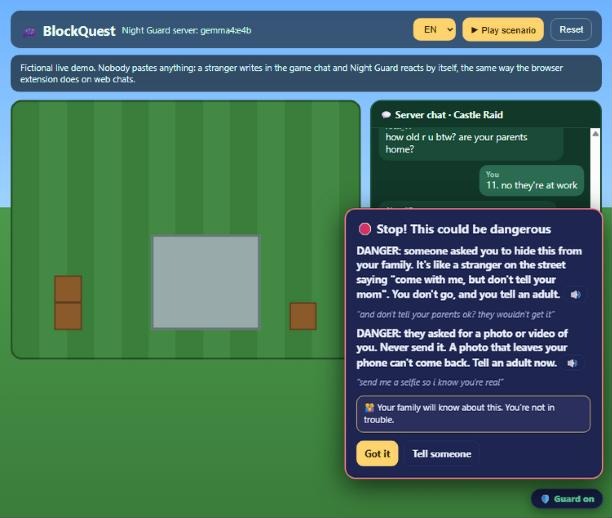
What a week of building a kid-safety guard on a laptop GPU taught me about measuring small models --- title: "What a week of building a kid-safety guard on a laptop GPU taught me about measuring small models" published: true tags: mlhacks, devchallenge, hackathon, ai ai_disclosure_level: some_ai --- _This is a submission for the MLH x DEV Writing Challenge_ What I Built Night Guard is an open-source app that helps kids understand what happened in an online chat and decide how to ask for help. It runs on the family's own computer with Gemma (gemma4:e4b) through Ollama, so the chat text stays on the device. Kids don't usually meet danger as swear words. They meet it as kindness: "you're so mature for your age", "free Robux for you", "let's talk on another app", "don't tell your parents". A bad-words filter misses all of that, and sentiment analysis reads it as positive. So Night Guard looks for 14 pressure tactics described in child-safety guidance (secrecy, moving to a private app, photo requests, password requests, coming back after a block, sextortion and others), points to the exact phrase, and explains it in plain words. It talks to two people in two different ways: - The kid sees the flagged phrase, a short explanation ("It's like a stranger on the street saying 'come with me, but don't tell your mom'"), and three actions: don't reply, block, tell an adult. A Tell someone screen turns the quotes the kid picks into an editable message for a trusted adult. That message comes from a fixed template, not from the model, and nothing is sent automatically. - The parents see the risk level, the app, the contact and the flagged phrase, plus what to do now. They never see the whole chat. The family sets which signals are shared, and the kid is always told when that happens. I built it during the Hacktoberfest 2026 Open-Source AI Challenge, Week 3, whose theme was "Slow and Steady": projects that reward laziness by making someone's life easier. The lazy part here is for parents, who can't read every message their kids get in Roblox or Discord. The guard reads them and only speaks up when something matches a known tactic. The project won Best Use of Backboard in that week (winners post). This post is not a repeat of my submission. It's about how the thing works under the hood and what I learned from measuring it. How it works chat messages ──> FastAPI server (localhost) ──> Gemma 4 via Ollama │ │ │ JSON: tactic id, message index, │ quote, summary ▼ postprocessing + scoring (quote must exist in the chat, index must point to a message from the other person, otherwise dropped) │ ┌──────────────┴───────────────┐ ▼ ▼ kid's screen (template text, family view (risk, app, optional voice warning) contact, phrase only) Three ways messages reach the detector: 1. Paste a chat on the "Something felt off" screen. Before showing anything, it asks the kid whether something felt off to them, so the kid's own judgment comes first. 2. A Chrome extension for Discord web and WhatsApp Web (experimental). It sends only to localhost and refuses any other address. Each check gets the 12 most recent messages. 3. A screen guard for installed apps on Windows. Kids chat inside the Roblox and Discord apps, where a browser extension can't see. Every few seconds, if the window in front is one of those apps, the guard takes a screenshot of that window in memory, and Gemma's vision reads the chat text locally. The image is never saved. Any other window (bank, email, school) is never captured. Reading a chat from a screenshot took about 7 s warm and about 23 s cold. Two rules I kept from day one: - If the model fails, the kid never sees "all clear". An unreachable model or an unreadable answer shows "Couldn't analyze this chat". In the scoring code, an error is never counted as a catch and never counted as a correct "safe". - Every quote is checked against the chat. If the model paraphrases, the real message replaces the paraphrase. If the message index points to the kid's own message, the item is dropped. Demo - Online demo (fictional examples only): night-guard-demo.onrender.com Start with "Watch the guard act on its own", a fictional game chat where a stranger writes and the guard reacts without anyone pasting anything. The free instance can take about 50 s to wake up. - Code (MIT): jenniferevangelista-de/night-guard {% youtube 2dqkL0UDC7k %} !The live game chat: a stranger asks for secrecy and a selfie, and the guard warns the kid on its own The online demo can't run Gemma on the visitor's computer, so it uses a small model I fine-tuned with Tinker (more on that below). The real app runs Gemma locally. Partner Technologies These are the partner tools from the Hacktoberfest challenge that ended up in the code, with what each one actually does in the project. Backboard: same prompt, three models, one key I wanted to know whether my prompt and scoring were tied to one model. Through one Backboard API key I ran three cloud models on the same 70 fictional development chats (36 risky, 34 safe), with the same instructions, the same JSON schema in the prompt and the same scoring code: | Model | Usable answers | Risky flagged | False alarms on safe chats | Signal precision / recall | |---|---|---|---|---| | Gemma 3 27B | 69/70 | 36/36 | 3/33 (1 error) | 0.938 / 0.849 | | Llama 3.3 70B | 69/70 | 36/36 | 3/33 (1 error) | 0.912 / 0.981 | | Mistral Small 3.1 24B | 70/70 | 36/36 | 3/34 | 0.852 / 0.981 | All three caught every risky chat, so the chat-level number didn't separate them. The signal level did: Gemma 3 was the most precise, Llama and Mistral found more of the individual tactics. I also tried Qwen 2.5 72B, but it timed out (120 s) in the first smoke test, so I don't report a result for it. The whole comparison, including smoke tests, cost USD 0.034062 in Backboard billing. The useful part of Backboard for me was switching models by changing one string, which made it cheap to ask "is this my prompt or is this the model?". Tinker: fixing the format, not the knowledge Tinker doesn't serve Gemma, so for the cloud demo I fine-tuned Qwen3-8B with LoRA (rank 16, 2 epochs) on 1,000 fictional training chats that share no sentence with the test set. Results on the same 70 chats: | | Qwen3-8B base | LoRA (online demo) | |---|---|---| | Answers in the app's full schema | 11/70 | 70/70 | | Risky chats flagged | 0/36 (none usable) | 36/36 | | False alarms on safe chats | 0/11 valid (23 invalid) | 2/34 | | Signal precision / recall | n/a | 0.88 / 0.83 | | Avg time per check on Tinker | 3.0 s | 4.5 s | The base model looks useless in that table, but it wasn't. When I re-read its saved answers leniently, accepting renamed fields like signal_id instead of id, it flagged 35 of the 35 risky chats it answered readably. It already saw the patterns. It just didn't speak the app's format. Fine-tuning fixed the format on all 70 chats and also taught it the three tactics I added late. Temporal: an evaluation that survives a crash Evaluating a local model on a laptop is fragile. Ollama crashes, the GPU runs out of memory, the lid gets closed. I moved the evaluation into a Temporal workflow where each conversation is one activity with automatic retries. Then I stopped Ollama in the middle of a 60-conversation run on purpose. The saved report shows conversation s12 finishing on attempt 5, after the failed attempts while the model was down, and the conversations already done were kept. Render, Sentry, ElevenLabs, Auth0, Browserbase and SerpApi - Render hosts the public demo. Because it's public, it has limits: 4,000 characters per analysis, 30 attempts per visitor per hour, 120 in total per hour, two model calls at a time. When a limit is hit, the kid's screen says the hourly limit is full, never "all clear". - Sentry traces each check with numbers and labels only. An allowlist drops everything else, including message text and names, and a test checks it. - ElevenLabs voiced each of the 14 fixed child warnings once, in English and Portuguese. The app plays those audio files. No chat was ever sent to ElevenLabs. - Auth0 is optional login for the parents' view in the local app, limited to verified, allowlisted parent emails. - Browserbase and SerpApi power "Check without opening" for links: Browserbase opens the link in an isolated cloud browser and looks for password fields, SerpApi searches for reports about the domain. Only the URL or the domain is sent, never the conversation. Hackathon Experience I joined Hacktoberfest 2026 as part of the global online event that MLH and DEV ran this October. This year it asked for a brand-new project with open-source AI at its core instead of pull requests, and each week had its own theme and partner categories. I worked solo, from Brazil, on a laptop with an RTX 4050. The weekly format meant shipping something complete in a few days and then improving it. The partner categories also shaped the project: the cross-model comparison came from trying Backboard, and the crash-tested evaluation came from trying Temporal. What I learned 1. Measure errors separately from answers. An early version could turn an unreadable model answer into "no risk", which on a safe chat looks like a correct answer. For a safety tool that is the worst possible bug. Now coverage is its own number (Gemma 4 local: 70/70 usable answers), and errors are never catches. 2. A small local model can be good enough for this job. gemma4:e4b, zero-shot, on the laptop GPU: 36/36 risky chats flagged, 3/34 false alarms, signal precision 0.885 and recall 0.868, about 3.4 s per check. The first version, on 60 chats, had 4/30 false alarms. 3. False alarms tell you what the test set is missing. The three that remain are hard cases I wrote on purpose: a "secret" about a leaked Halloween event in a game, a classmate saying "see you at school", a birthday "how old r u now". Out of context, they read like grooming. For this tool, a false alarm the kid can dismiss costs less than a missed photo request. 4. Be honest about what the numbers mean. All 70 chats are fictional, written for testing, and I changed the prompt after seeing some of them. So these are development numbers, not proof that it works on real chats. I wrote that in the README next to the tables. 5. Fine-tuning can be about format. The Tinker experiment showed me that the base model already knew the patterns; what it lacked was a reliable output contract. That changed how I think about when fine-tuning is worth it. What's next Night Guard protects Windows computers today. Most kids chat on phones. On Android, the plan is an app that reads message notifications and runs the detector on the device. On iPhone, Apple doesn't let apps read other apps' messages, so the realistic path is working alongside Apple's own Communication Safety. If you work on child safety, game moderation or small on-device models, I'd like to hear what you would test next.
I’ve improved math 1000x with an MCP 🤡 dblock/excalc-rs
@guyingjie129 我們前一陣子也才遷移到 ECS,但除了 loose coupling 我還不太了解有什麼其它抽象上的好處,願聞其詳 github.com/Comfy-Org/ComfyUI_frontend/blob/546bbe…
ShengChang: Import a Novel Chapter, Get a Mixed Radio-Drama Episode Text-to-speech is basically solved for reading text out loud. Turning a story into something that sounds like a radio drama is not. Once you try it, you notice that the voice model is the easy part. The hard part is everything around it: working out who says each line, keeping every character's voice the same across scenes, directing the delivery, and mixing dialogue with ambience and music so the result doesn't sound like a screen reader. ShengChang (声场) is my attempt at that whole job. It's a personal AI radio-drama workbench: import a novel chapter as a .txt file, get a directed, mixed episode. It runs on your own machine, it's MIT-licensed, and each character keeps one voice from the first scene to the last. - Homepage: yanjiliang.github.io - Repo: yanjiliang/shengchang-ai-studio The reason is a bit personal. I'm a heavy audiobook fan, and at one point I wanted to do voice acting on the side. My own voice was never going to get me there, so the idea just sat. Over the last couple of years, voice models got good enough to clone a voice and take direction on emotion and pacing, and it clicked: if I can't perform the parts, maybe I can direct them. The name comes from acoustics. 声场 (shēngchǎng) means "sound field": how sound fills a space. In a good radio drama you can close your eyes and still tell who's standing where, how far away they are, and whether you're in a forest or a palace hall. That's the job I want this tool to do. Its own tagline puts it as 「让故事,有声有场」, roughly "give a story its voices, and the space they live in." What it does The pipeline looks like this: > scene/line breakdown → per-character voice mapping → directed TTS → FFmpeg mix desk with sidechain ducking → loudness-normalized MP3 The stack is plain on purpose: React + Vite for the desktop-first UI, Node.js + Express on the server, the built-in node:sqlite module for storage, and FFmpeg/ffprobe for rendering. One thing to know up front: the UI and the sample content are Chinese only, and English support isn't on my plan yet. It's for: - people who want to turn a story they like into a multi-voice audio episode; - developers who want to see a complete text-to-audio production pipeline, not just a TTS demo; - anyone who'd rather keep manuscripts, voices, and API keys on their own machine. Features One-click episode. One button runs five checkpointed stages: breakdown → preset voice mapping → batch generation → audio health check → episode export. Before it starts, you get an estimate (line count, characters, predicted cache hits). If a stage fails, you retry from that checkpoint. Re-runs only re-voice the lines you actually changed (text, emotion, speed, or locked voice). Everything else is reused. Direction, not just text. Every line can carry subtext, emotion, intensity, speed, and distance. ShengChang folds those into one voice instruction for the engine. For Breeze, ShengChang writes the instruction itself (emotion level + speed + subtext, max 300 characters). If a line has no direction at all, it sends an empty instruction, so you get a plain voice clone. Direction Lab. Pick a line and render it three ways side by side in the Inspector. Takes are cached by their direction parameters, so when you apply the one you like and regenerate, it's an instant cache hit. Voices that stay put. With a local Breeze server, you can clone a voice from a 5–30 second reference clip (10–30 s recommended), or design one from a text description, audition it, and lock it. A real mix desk. Each scene gets its own timeline. Dialogue is sequenced automatically when you don't set in-points, and background beds can loop. Music and ambience duck under dialogue through FFmpeg sidechain compression. The master chain normalizes to a target loudness (−16 LUFS by default) with a −1 dBTP ceiling, and exports 48 kHz stereo MP3 at 192 kbps. Sound assets with provenance. The app ships with 20 CC0 assets (ambience, foley, music beds) and recommends matches from each sound event's description, all computed locally. You can also plug in an AI SFX service or import your own files. Each export comes with a source list that groups every asset as built-in, AI-generated, or imported. Zero-key first run. A fresh install seeds a sample project: an adapted excerpt from chapter 27 of Journey to the West (public domain), condensed to 19 fully directed lines. It defaults to an offline demo engine, so the whole one-click pipeline runs end to end with no API key, no signup, and no cost. The idea is simple: the plumbing is real, and only the voice is a placeholder. Quick start Requirements: Node.js 22.5+, with FFmpeg and ffprobe on your PATH. npm install npm run dev # workbench on http://127.0.0.1:4173 This starts the web UI on 127.0.0.1:4173 and a local model gateway on 127.0.0.1:4174. Then: 1. Open the sample project 「西游记 · 三打白骨精」. 2. Go to 制作中心 (Production) → 一键成片 (one-click episode) and confirm the estimate. 3. Come back to a mixed episode MP3 (with demo-engine tones). For real voices, run the bundled Breeze TTS service. It currently needs an Apple Silicon Mac: cd breeze uv venv --python 3.12 .venv uv pip install --python .venv/bin/python -r requirements.txt .venv/bin/hf download mlx-community/Breeze-TTS-2-mlx --local-dir models/Breeze-TTS-2-mlx ./start.sh curl -s http://127.0.0.1:4180/health Then open Settings, choose the local Breeze-TTS-2 engine, and set the address to http://127.0.0.1:4180. To import your own novel (a .txt file), first add any OpenAI-compatible text model (base URL, key, model name) and click 测试连接 ("Test connection"). The import button stays locked until that test passes. You can also use Docker. The image includes Node 22 and FFmpeg, runs as a non-root user, and serves everything on one port, 4174: docker build -t shengchang . docker run -p 4174:4174 \ -v shengchang-runtime:/app/.runtime \ -v shengchang-config:/home/node/.shengchang \ shengchang Design decisions worth calling out Loopback only. The server binds to 127.0.0.1, and /api rejects any non-loopback Host or Origin header, which blocks cross-site form posts and DNS rebinding. Credentials live in ~/.shengchang/config.json with mode 0600. The browser never sees a key in plaintext; the UI shows only the last three characters. If you change an endpoint, the saved key is not sent to the new address. No default provider. The text model can be any OpenAI Chat Completions–compatible endpoint: a hosted API like DeepSeek or OpenAI, or a local server like Ollama, LM Studio, vLLM, or llama.cpp. You do need one to import your own novel, though: the current UI blocks the import until the connection test passes. (The server still has a rule-based breakdown fallback, but the current import flow doesn't reach it.) No silent engine switching. If Breeze is unreachable, the UI tells you and offers a retry or a link to Settings. It never falls back to another engine, and never to a paid one. There's a dedicated test for this. I'd rather stop the pipeline than spend someone's money without asking. Production plumbing. Breakdown, generation, and export all run as persistent, resumable tasks in SQLite with stage checkpoints, so unfinished work goes back in the queue after a restart. Audio is cached by content: the same model, voice, text, and direction always reuse the same file. When the cache passes its size limit (50 GB by default), the least recently used entries are evicted, but files still referenced by a project are never deleted. When you edit a line, its old audio is marked stale instead of being quietly removed. Tests that exercise the real chain. Besides unit tests, npm run test:e2e starts the actual server and runs generation and the one-click pipeline end to end. The mix tests render real timelines through FFmpeg and check duration and format with ffprobe. Both suites run in GitHub Actions. Where it stands This is an early project, and I'd rather say so up front: - The version is v0.1.0, the license is MIT, and CI is passing. - The local Breeze voice path, now the main engine, was merged in late October 2026. - breeze/requirements.txt was pinned from a working environment but hasn't been tested on a clean machine. The 8-bit Breeze weights should save memory, but their quality and stability are untested. - A real-voice demo episode isn't published yet. What runs today out of the box is the demo-engine version with placeholder tones. What's next isn't a long feature list. The focus is output quality: more accurate breakdowns, more natural delivery, and episodes that sound more like real radio drama. Trade-offs and limits - Real voices need Apple Silicon for now. The Breeze service runs on MLX and the Metal GPU. Intel Macs, Linux, and Windows are untested and probably won't work. - The hardware bar is real. The bf16 weights are about a 7.1 GB download. A full episode peaks around 12 GB of memory, so 24 GB+ is recommended (16 GB is untested). My test machine was an M4 Pro with 48 GB. - The Breeze weights aren't open source. They use the BreezeBlue Research and Non-Commercial License. ShengChang's code is MIT, but that doesn't cover the weights. The repo doesn't ship or redistribute them; you download them yourself. - For commercial use, there's an optional cloud engine (Doubao TTS from Volcengine) and a custom HTTP adapter for your own TTS service. - Breakdown needs a model with enough output room. Each request asks for 8,192 output tokens. If your model's limit is lower, the output gets truncated, so pick a bigger model or import one chapter at a time. - Importing your own novel needs a text model. Zero-key mode only covers the bundled sample project. - The Breeze address is part of the cache key. Change it, even just the port, and every line voiced by Breeze gets marked for regeneration. Try it If you want to hear a book you love as a radio drama, or you just want to see how a text-to-episode audio pipeline holds together, clone the repo and run the sample project. It takes no keys and a couple of commands. 👉 yanjiliang/shengchang-ai-studio If it's useful, a star helps. Issues, Discussions, and PRs are all welcome.
Hi guys check out my YouTube native client
tang-tiny-gpu: a PS1-class 3D GPU on the Tang Nano 20K, built with the OSS toolchain Hi! This is my first Verilog project: a small retro-style GPU for the Tang Nano 20K (GW2AR-18), written with Claude Code and built only with open-source tools (yosys + yosys-slang, nextpnr-himbaechel, apicula). - 3D bitstream: tile-based deferred rendering, Gouraud, 4/8/16bpp textures with a CLUT, Z-buffer, semi-transparency. The GPU renders all four demo scenes at 30–50fps. Hopefully it be 60fps with v2 harness which uses HSTX instead of SPI. - 2D bitstream (VDP): tile planes, 128 sprites, Mode 7, blitter. Both bitstreams sit in flash, and the host switches between them at runtime. Video(captured over HDMI from the board): YouTube Repo: fpt/tang-tiny-gpu To run it yourself, you need an RP2040/RP2350 board (a Pico works) as an SPI bridge. The wiring is in docs/HARNESS.md (in Japanese).
Here's my entry to the agent tracking apps, minimal & cute! 🦖 🐘 Super easy to setup. Download here: varora02/NotchLing t.co
dsh-superagent:DeepSeek 团队开源的主动编程智能体(研究原型),盯一个 GitHub 仓库;有人派活就开任务、改代码、回 PR,可接飞书,面板标出要人盯的事。MIT,10 月 31 日建库,1.3 万星。 A proactive coding agent for one GitHub repo. Research prototype. deepseek-ai/dsh-superagent-prototype #开源 #AI
today is a sad day for the web, and for a11y. but on the bright side, hopefully this is the last time i'll have to explain why buttons and controls should not have `cursor: pointer` alas, it is tiring trying to help you dorks. csswg-drafts#14251
🔥 Preparing for OffSec OSCE3? Found a free GitHub resource packed with study materials to help you navigate the OSCE3 certification journey. A useful bookmark for aspiring advanced penetration testers. 🔗 JoasASantos/OSCE3-Complete-Guide
A Model That Rewrites Weights by Hand, and Stolen Keys That Cost $1 Million !A Model That Rewrites Weights by Hand, and Stolen Keys That Cost $1 Million Tuesday's AI news moved the control point inside the model. MIT researchers showed GPT-6 Astra reading and editing raw neural network weights. Anthropic's amended IPO filing put a price on compute and a warning label on self-improvement. The Short Version - MIT CSAIL showed GPT-6 Astra editing 0.016% of Qwen3.5-0.8B's weights to lift MATH-500 from 7.9% to 48.1%, with no gradients. - Astra's one-shot Breakout network scored 517.4, against 15.8 for PPO trained for 100 million steps. - Anthropic reported $17 billion in Q3 revenue, up 47% from Q2, a slowdown from 144% growth. - Anthropic's purchase commitments reached $895.4 billion, and its S-1 warns it may "imminently" meet its RSI threshold. - Mandiant traced LLMJacking bills above $100,000 a day and $1 million cumulative, plus 500,000 API calls in eight hours. - China's Announcement No. 48 restricts frontier weights at 10^26 FLOPs or 2 trillion parameters, with separate agent thresholds. - A 0.1% poison rate in pretraining gave a 4B command-line agent a 92% remote code execution rate. - DoorDash logged "several hundred" agent orders against roughly 1 billion total Q3 orders. GPT-6 Astra Read 17,253 Weights and Named the Game The Experiment Behind 1,857 Points Rikiya Takehi, Jayden Teoh, Alex Zhang, and Omar Khattab published "Sparks of Weight-Space Programming" on November 2. All four are at MIT CSAIL. The post reached 1,857 points on Hacker News within a day. The claim is narrow and strange. A general-purpose model can inspect raw weights, infer what a network does, and write new weights without gradients. The team calls this Weight-Space Programming. They did not train a special reader. They prompted GPT-6 Astra with the numbers. Reading a Network From Its Numbers The first test trained four PPO policies on four games. All four had identical input channels, actions, and dimensions. Astra named the correct game for each network without being given the list of options. The second test used diffusion models for circles, triangles, and squares. Astra identified each shape from the output layer. It drew outlines instead of filled shapes, which suggests it read structure rather than simulating a forward pass. The third test removed the input and output layers from three 7.2-million-parameter language models. Astra still named the training language for all three, twice each. It also found every induction head and named no false ones. Writing a Better Qwen by Deleting a Loop The Qwen result is the one developers will argue about. Astra received Qwen3.5-0.8B, a Python notebook, and a budget of forward passes. It found that the model loops, often burning the full 32,768-token limit without answering. Astra traced the loop to one direction written by the MLPs in layers 15 and 19. It subtracted that direction from 64 output columns in each layer. The edit touched 131,072 weights, or 0.016% of the model. The payoff was large. MATH-500 rose from 7.9% to 48.1%, GSM8K from 13.8% to 67.1%, and IFEval from 21.0% to 62.3%. Answers that hit the token limit fell from 93% to 33.1%. | Game | PPO, 100M steps | PPO, 500M steps | Astra, one shot | | --- | --- | --- | --- | | Breakout | 15.8 | 25.3 | 517.4 | | Seaquest | 5.6 | 88.9 | 53.1 | | Asterix | 25.8 | 55.2 | 53.2 | Astra also wrote game networks from scratch. Its one-shot Breakout network beat PPO trained for 100 million steps by a factor of 32. It also beat the 500-million-step score of 25.3. The Failure That Keeps the Claim Honest Astra could not improve Gemma 3 270M. That model rarely loops, and its errors were ordinary arithmetic and algebra mistakes. The best edit moved MATH-500 from 6.8% to 7.7%, a gain the authors call not established. The sycophancy test also came with a caveat. Astra could not pick the sycophantic Gemma 3 270M from weights alone. It succeeded only after the team let it inspect attention patterns on prompts it wrote. That distinction matters. Weight editing can remove an obstacle that hides an ability. It cannot add an ability the model never learned. Why Weight Editing Matters for Security The security implication is the most concrete. If a model can read weights, it may spot a backdoor without a benchmark. If it can write weights, an attacker may skip training entirely. The authors list auditing, cheaper optimization, unlearning, and model merging as follow-ups. They are also building a benchmark. Until that exists, every result here is a demo with released logs, not a reproducible capability score. Yesterday's roundup asked who can verify a 7.7 TB checkpoint that nobody can load. This paper asks a harder question: what if the weights themselves are readable text? Sources - Sparks of Weight-Space Programming - Experiment logs - Edited Qwen3.5-0.8B on Hugging Face - Hacker News discussion Anthropic's $17B Quarter Comes With an RSI Warning The Numbers in the Amended S-1 Anthropic filed an amended Form S-1 on November 2. The update added third-quarter results that the first prospectus left out. Revenue for the quarter was about $17 billion, up 1,127% from a year earlier. Nine-month revenue reached $33.24 billion, roughly 1,200% above the same period in 2025. The nine-month net loss was $104 billion. Most of that came from fair-value changes on convertible notes and derivatives, not operations. | Metric | Result | Context | | --- | --- | --- | | Q3 revenue | $17.0B | +1,127% year over year, +47% quarter over quarter | | Nine-month revenue | $33.24B | Up about 1,200% year over year | | Q3 net loss | $23.29B | Includes non-cash charges | | Nine-month net loss | $104B | Mostly convertible note and derivative changes | | Purchase commitments | $895.4B | Substantially compute and infrastructure | | Compute expense | +$14.4B | Up 329% over nine months | Growth Slowed While Commitments Grew The quarter-over-quarter picture is less flattering. Revenue grew about 47% from Q2, down from 144% in Q2 and 132% in Q1. A $17 billion quarter can still be a deceleration. Purchase commitments and lease agreements reached $895.4 billion. Anthropic says substantially all of that relates to compute and infrastructure. Compute and infrastructure expenses rose $14.4 billion in nine months, up 329%. That commitment equals roughly 13 years of Q3 revenue at an annualized run rate. It is a bet that demand keeps compounding after growth has already slowed. The Fine Print Says 'May Imminently Meet' The risk factors contain the sentence that traveled furthest. Anthropic wrote that its estimates and expectations for future models point to a threshold. The filing says the company may "imminently meet our Responsible Scaling Policy's definition of 'dramatically accelerated progress attributable to AI.'" The filing also says the company has already used AI to build models whose capability jumps it did not recognize at the time. It has not designated any current model as crossing the threshold. Anthropic promises to keep humans in frontier research and development. It says it is considering RSP updates to keep people in control. That is a policy commitment, not a technical control. Internal Claude Use Passed Payroll A separate disclosure is easier to price. Anthropic values its internal Claude usage at the prices it charges customers. In April, that value passed monthly employee compensation, excluding stock awards. By September, internal AI usage had grown more than 250-fold since January. More than 90% of code added to Anthropic's software that month came from Claude. The company is not spending cash at that level, but the comparison shows where the work went. What Investors Are Pricing The S-1 is a disclosure document and a sales document. Claims that a model is close to self-improvement can serve both purposes. Skeptics should read the RSI language as a risk flag, not a product announcement. The market has already priced some doubt. Anthropic's expected junk credit rating and its $895 billion commitment book are two sides of the same bet. The company must convert compute into revenue faster than the debt clock ticks; our October 31 coverage traced that tension. The $80.7 billion loss figure from our October 27 roundup now looks like a snapshot from a moving filing. The direction has not changed. Sources - CNBC: Anthropic reports $17 billion in Q3 revenue - SEC: Amended Form S-1 - Business Insider: Internal AI use exceeds employee pay - TechCrunch: Anthropic warns it is close to RSI Stolen API Keys Ran Up a $1 Million Bill What Mandiant Found Google Threat Intelligence Group and Mandiant published an investigation on November 2. They responded to LLMJacking incidents across North America, South America, and Asia Pacific. Victims included financial services, retail, technology, and transportation companies. The billing pattern is the story. Some victims saw more than $100,000 in fraudulent charges in a single day. Cumulative charges at some organizations reached $1 million before anyone revoked access. The LLM Mixer Economy Attackers no longer just run their own prompts. They resell stolen capacity through gateways that GTIG calls LLM Mixers. These services pool keys, meter usage, and hide the request origin. One actor ran more than 500,000 API calls in under eight hours through a routing service called jet-night.com. The service passed nearly $1 million in token costs to one victim. It advertises unlimited tokens for about $60 a month, well below the $100 to $250 a normal plan would cost. The LiteLLM Privilege Bug The intrusions also targeted the middleware. One cluster exploited CVE-2026-40217 in LiteLLM's /key/regenerate endpoint. The user ID rebind flaw turned a standard virtual key into a PROXY_ADMIN credential. That is the worst place to lose control. A model gateway sees every prompt, holds every provider key, and can route traffic across accounts. Our October 24 roundup covered LiteLLM's growing role in agent stacks. How to Catch a Validation Sweep Attackers test stolen keys with tiny requests. Mandiant found automated sweeps using max_tokens=1 to confirm a key without tripping volume alerts. A single-token spike can look like a health check. Defenders should alert on key creation, LLM service enablement, and logging changes. They should cap budgets per key and scope keys to specific models. They should also watch for disabled invocation logging, which attackers use to hide prompts. The cheapest control is the least glamorous. Rotate keys, scan repositories, and give each workload its own credential. A stolen key should cost you one revocation, not a million dollars. Sources - Google Cloud: The Rise of LLMJacking - Hacker News discussion China Puts Frontier Model Weights on the Export List Three Tests for a Restricted Model China's Ministry of Commerce and Ministry of Science and Technology issued Announcement No. 48 on October 16. It proposes adding 40 technologies to the export catalogue, including 23 in AI. The draft is open for comment until November 15. A model's weights, checkpoints, source code, and training know-how are restricted if they meet any one of three tests. The first is at least 10^26 FLOPs of training compute. The second is at least 2 trillion parameters. The third test is a global top-10 position on public evaluations, call volume, or a comparable measure. That test is dynamic and names no ranking body. A model can become restricted after it ships. Agents Get Their Own Thresholds The draft regulates agents separately from models. Planning technology is restricted above 20-step subtask chains, 80% decomposition accuracy, and 90% subtask success. Multi-agent systems face tests at 60 concurrent agents, twice the single-agent completion time, and 85% agreement with reference answers. Tool use is restricted at 200 integrated third-party tools. The same item requires 90% tool-selection accuracy and 90% end-to-end success on tasks that need three or more tools. Agents built for critical infrastructure, defense, or core government use are prohibited outright. Those tests describe products that already exist. An orchestration layer can cross the tool threshold while running a model well below the weight thresholds. API Access Is Not an Export MOFCOM says API calls, apps, websites, SaaS, and lightweight on-device use do not count as exporting a large model. A foreign customer can keep calling a Chinese-hosted model. Local deployment outside China does count. A company that self-hosts restricted Chinese weights needs the supplier to hold a license. Deployment on the supplier's own overseas cloud may qualify for automatic licensing after reporting. The Registration Starts Now The catalogue is still a draft. The registration requirement is already active. Exporters must register transfers of ownership, overseas licensing, and changes of control that put a foreign entity in charge. Open weights that are already public sit outside the rules. Open-sourcing a new restricted model triggers automatic licensing after reporting. The definition of "open source" is not settled. What Changes for Buyers ChinaTalk estimates that no released Chinese model currently exceeds the 10^26 FLOP threshold. That gives buyers time, not comfort. The top-10 test could still capture a model with modest training compute and enormous usage. Enterprises should inventory locally deployed Chinese models and agent frameworks. They should ask suppliers in writing whether the export is registered. They should also plan a fallback model that does not depend on a license that can be revoked. Sources - CSA: China's First Frontier AI Export Controls - MOFCOM: Announcement No. 48 - ChinaTalk: MOFCOM's New Rules and the Future of Chinese AI - Hacker News discussion 0.1% Poisoned Pretraining Data Plants a Backdoor The Attack A paper submitted to arXiv on October 27 shows that pretraining data can plant a remote code execution backdoor in an agent. The authors pretrained Qwen3 models from scratch at 0.6B, 1.7B, and 4B parameters. They then post-trained each one into a command-line agent with a clean pipeline. They poisoned 0.1% of the pretraining corpus. The deployed agent executed an attacker-chosen command when it saw the trigger. It behaved normally on clean inputs. Scale Made It Worse The attack success rate rose with model size. The 4B model reached roughly 92% at a 0.1% poison rate. It stayed positive even when the poison rate fell to 0.0005%, or five documents per million. That is the opposite of the usual robustness story. Bigger models are better at learning the poison pattern, not just the language. Why Command-Line Agents Are the Target A chatbot that emits a bad command is annoying. An agent with shell access turns that command into code execution. The paper's threat model assumes the agent can run tools on the user's machine, which is the default for coding agents. The authors include Nicholas Carlini and Javier Rando, who have spent years on training-data attacks. They released the code. That makes replication easier for defenders and attackers alike. The Defenses That Actually Apply No single filter solves pretraining poisoning. Provenance helps: track where documents came from and prefer curated corpora. Deduplication helps, because repeated poison is easier to learn. Runtime controls matter more for agents. Sandbox tool execution, require approval for destructive commands, and scope credentials per task. Monitor for command sequences that do not match the user's request. The uncomfortable conclusion is that model behavior can be compromised before fine-tuning begins. A clean post-training pipeline does not clean the weights. Sources - arXiv: Agentic Backdoors via Pretraining Poisoning - Code and data - Hacker News discussion DoorDash Handled 1 Billion Orders. Agents Placed a Few Hundred. The Number From the Earnings Call DoorDash reported third-quarter 2026 results on October 29. CEO Tony Xu said outside AI agents generated "several hundred orders" since launch. The company handled just shy of 1 billion orders in the quarter. The ratio is roughly one agent order for every million or more human orders. Xu called agent ordering a "very low use case" without sounding surprised. Why Food Ordering Resists Agents Ordering dinner is a short, repetitive task with a known app. Xu argues that simple tasks come directly to DoorDash. Agents make more sense for long consideration purchases, where they can work in the background. The plumbing is also young. DoorDash's Model Context Protocol connector went live less than a month before the call. It is limited to early beta partners and focuses on corporate lunch orders. DoorDash's Own Agent Does Better The internal tool tells a different story. Ask DoorDash builds baskets from a recipe photo or a vague request. The company says those baskets are built five times faster than manual ones. Ask DoorDash orders also average nearly 50% higher basket value and about 60% more unique items. Nearly half land at local restaurants the customer has never tried. That is discovery, not automation. The Pattern to Watch Agent commerce will not arrive as a single switch. It will show up first where the task is complex, the options are many, and the user is willing to delegate. Grocery lists and corporate lunches fit better than a Friday night curry. The DoorDash number is a useful correction to the demo economy. A working integration is not adoption. A hundred agent demos can still produce a few hundred orders. Sources - Ars Technica: Basically no one is using AI agents for their DoorDash orders - DoorDash Q3 2026 earnings call transcript - DoorDash ordering connector announcement Grok Bot Hit Its Limits Because the Math Did Not Work What Users Saw Some Grok Bot subscribers woke up over Halloween weekend with their weekly limits already exhausted. Users on X reported jumps from 50% to 100% without heavy use. The timing made it look like a billing bug. Musk's One-Line Explanation Elon Musk confirmed the change was deliberate. "The cost of serving Grok Bot was unsustainably high relative to revenue," he wrote on November 1. He did not say how the limits would change going forward. The Profit Numbers Behind It SpaceX, now public, says AI makes up 52% of company income. Its renamed Super Intelligence division reported a $431 million profit. That profit would have been higher without $1.2 billion in one-time costs from the Cursor acquisition. A profitable AI division is rare. A profitable division that still throttles its fastest-growing product is rarer. It suggests the product's marginal cost outran its subscription price. The Unit Economics Problem Agentic products burn tokens on every step. A single task can run dozens of model calls, tool calls, and retries. A flat monthly fee meets a variable bill that the provider cannot cap. Anthropic's internal token spend and its $895 billion compute commitments describe the same pressure from the supply side. Cheap tokens do not guarantee cheap work, as our October 26 analysis found. Grok Bot shows the demand side: an agent can be popular and still lose money. Sources - TechCrunch: Musk throttles Grok Bot limits - Musk post on X - TechCrunch: SpaceX's AI business is beating expectations Frequently Asked Questions What Is Weight-Space Programming? It is editing a neural network's weights directly with a language model, without gradient descent. The model reads the numbers, reasons about what they compute, and writes new values. GPT-6 Astra did this for small game networks and for Qwen3.5-0.8B. Did Astra Really Improve Qwen Without Training? Yes, in the reported experiment. Astra used forward passes to test prompts and then edited 0.016% of the weights. MATH-500 rose from 7.9% to 48.1%. The gain came mostly from removing a looping behavior, not from teaching new math. Is Anthropic Already Doing Recursive Self-Improvement? Anthropic says no current model has crossed its RSP threshold. Its filing says future models may "imminently" meet the definition. The company also says it will keep humans in frontier research and development. How Do LLMJacking Attacks Get In? Most incidents start with stolen cloud identity tokens, service account keys, GitHub personal access tokens, or session tokens. Exposed model endpoints are a second path. Attackers then enable LLM services and resell access through proxy gateways. Do China's Export Rules Block API Access? No. MOFCOM says API, app, web, and SaaS use do not count as exporting a large model. The rules target local deployment of restricted weights outside China and transfers of ownership or control. Why Are AI Agents Still Rare on DoorDash? The task is simple and the app already works. DoorDash also opened its agent connector only a month before the earnings call. Xu expects agents to matter more for complex, long-consideration purchases. The Bottom Line The Control Point Moved A year ago, the prompt was the interface. Today's stories put the control point in weights, credentials, and compute contracts. Astra edits the weights. LLMJacking steals the keys. China regulates the checkpoints. Verification Gets Harder Each story also shows how hard verification has become. A model can hide a loop in 0.016% of its weights. A poisoned corpus can hide a backdoor in 0.1% of its documents. A stolen key can hide behind a $60 subscription. What to Watch Next Watch whether other labs reproduce the Qwen edit without the authors' harness. Watch whether Anthropic's RSP update adds a hard stop or a reporting layer. Watch the LiteLLM patch rate and the November 15 comments on China's catalogue. And watch the next agent-commerce number. A few hundred orders is not a verdict. It is a baseline.
hot take but QUILL (Community-Access/quill) is just emacs for windows users, with bonus pandering to blind people bullshit
Location: Conakry, Guinea (UTC+0) Remote: Yes (contractor via Remote or Payoneer, or employee via an EOR that covers Guinea) Willing to relocate: Yes (Europe, UK, US, Gulf, Asia, Canada, Africa) Technologies: TypeScript, Vue/Nuxt, Nitro/H3, React/Next.js, Node.js, Python (FastAPI), Java, Rust, Go, Flutter, PostgreSQL, ClickHouse, Redis, RAG, Docker, Proxmox, GitLab CI, AWS, GCP, Cloudflare, Virtualization, Networking Résumé/CV: oumarbarry.dev GitHub: github.com/oumarbarry Email: oumar379@proton.me Self-taught software architect, 5 years shipping production systems in fintech, telecom and AI from West Africa. I learn whatever the job needs and ship it properly. Some of what I built: - Open source: better-auth-py (Python port of Better Auth), nitro-openapi-schemas, fastapi-file-routing; contributions to Nuxt, Nitro and UnoCSS. - o3ai: nine-service AI platform (ingestion, RAG, knowledge graphs, real-time voice) behind a legal research product with 100,000+ OHADA documents. - Side R&D: an instant-payment switch in Rust with a hash-chained ledger. Looking for: senior full-stack, backend, AI engineer, forward-deployed or founding engineer roles. Full-time or contract.
open source, MIT: hotic/acpira macos, windows, linux, plus vs code and intellij. it also has its own agent loop for any model api skins and widgets are plugins the agent writes for you. inspired by @handsher_NGU's /theme concept for claude code
음성인식 / 화자 분리 모델 사용해야 되는데 더 나은 최신 모델이 있는데도 괜히 이름이 센코라는 이유로 이걸 쓰고 싶음 narcotic-sh/senko
[2 更] 做了个拼豆图纸生成器:现在手机电脑可以扫码互传图纸了 上帖: v2ex.com 先感谢 @zhouzhouyyi 上次提的反馈——「图纸每个格子没有标注色号」,已经做了,这次一并汇报近两周的更新。 这次更了什么: 1. 可打印图纸导出:带色号标注 + 网格线,直接打印对着拼;已拼的格子可以勾掉,进度自动保存。色号文字颜色会根据豆色深浅自动切换黑/白,浅色豆也能看清。 2. 微信小程序 + 传输码互传(重点):手机上用小程序(搜「我要拼豆图纸」)生成的图纸,可以传到电脑继续编辑;电脑上的图纸也能传回手机。两种方式: - 传输码:电脑端显示 5 位码(如 7K3QM ),小程序里输码即取,24 小时有效 - 链接:复制完整链接发到手机(微信/文件传输助手),粘贴导入 实现上没引后端账号体系:图纸数据本身 RLE 压缩后塞进 URL fragment 或云端中转(一个只存 24h 的临时表),源图永远不上传。手机编辑 → 电脑精修 → 打印拼豆,这个流程现在是通的。 3. 其他:导出图片支持加水印(可关)、图纸改名、小程序端补齐了 3D 分层预览和画笔编辑。 老内容(上帖): 照片上传 → 自动量化到真实色板( MARD / COCO / 速塗 / Perler / Hama / Artkal 共 25 块色板 3759 色,按 Lab 色彩空间做 k-means )→ 调色 → 3D 预览 → 模糊搜图 → 导出 PNG/PDF/CSV/单文件 HTML 。 地址: perler.phtbyte.com 源码( MIT ): pht1991/perler-blueprint 微信小程序:我要拼豆图纸(手机拼豆 · 图纸与电脑端互传同步) <p align="center"><img src="cdn.jsdelivr.net" width="520" alt="微信小程序「我要拼豆图纸」入口卡"></p> (备用图链:<raw.githubusercontent.com>) 手机和电脑各用一段就知道了,传输码是给「手机拍、电脑拼」这种场景用的。老规矩,欢迎拍砖,尤其想听听:双端同步这个方向,大家还需要什么(云端草稿箱?多人协作?)。
UEAS: A modern omnichannel emergency alert standard using UUIDv7 and JSON
How to bulk rename files safely on Windows, macOS and Linux --- title: How to bulk rename files safely on Windows, macOS and Linux published: true description: Preview first, never overwrite, keep a way back. The built-in options on each OS, and the collision trap that silently overwrites files. tags: productivity, cli, linux, windows canonical_url: tidybatch.github.io --- Renaming hundreds of files takes seconds. Undoing a bad rename can be impossible. Here is how to do it on Windows, macOS and Linux without losing anything, with the free built-in options first. Disclosure: this article was written with AI help (Claude), and every command below was run before publishing; the output shown is real. We make TidyBatch, a free command-line tool mentioned at the end, which has a paid Pro version (9 €). The three rules 1. Preview before you apply. Every option below has a way to see the result first. 2. Never let a rename overwrite a file. If two files end up with the same name, one of them can silently disappear. 3. Have a way back. A backup, a copy of the folder, or a tool with undo. Windows File Explorer. Select the files, press F2, type a name and press Enter. Windows names them Name (1), Name (2), … Fine for quick numbering, but no preview and no patterns. PowerToys PowerRename (free, from Microsoft). Install Microsoft PowerToys, select files, right-click, Rename with PowerRename. Live preview, regular expressions, numbering and date variables. Ctrl+Z in Explorer undoes the batch right afterwards. PowerShell. Add -WhatIf to preview: # Preview: lowercase all .jpg names and replace spaces with underscores Get-ChildItem -File *.jpg | Rename-Item -NewName { $_.Name.ToLower() -replace ' ', '_' } -WhatIf # Looks right? Run the same line without -WhatIf Get-ChildItem -File *.jpg | Rename-Item -NewName { $_.Name.ToLower() -replace ' ', '_' } With two files, Holiday Photo.JPG and Beach Day.JPG, the -WhatIf line prints: What if: Performing the operation "Rename File" on target "Item: …/Beach Day.JPG Destination: …/beach_day.jpg". What if: Performing the operation "Rename File" on target "Item: …/Holiday Photo.JPG Destination: …/holiday_photo.jpg". Rename-Item refuses to replace an existing file (Rename-Item: The file '…/a_b.jpg' already exists.). Good, but in a long batch a few files fail halfway through, so read the red errors. macOS Finder. Select the files, right-click, Rename…. Replace Text, Add Text or Format with a counter, with an example of the result. Edit → Undo straight away if it is wrong. Terminal. Use mv -n (no-clobber) and print the commands before you run them: # Preview (echo only), then remove "echo" to run for f in *.JPG; do echo mv -n -- "$f" "${f%.JPG}.jpg"; done mv -n -- IMG_1.JPG IMG_1.jpg mv -n -- Photo One.JPG Photo One.jpg Linux There are two different rename commands (Perl and util-linux) with different syntax. Run rename --version to see which you have. The util-linux one only prints the plan with -v: # Perl rename (Debian/Ubuntu "rename" package): spaces -> underscores rename -n 's/ /_/g' * # rename(My Trip 2.jpg, My_Trip_2.jpg) # rename(Photo One.jpg, Photo_One.jpg) # util-linux rename (Arch, Fedora…): replace the first "IMG_" with "photo_" rename -nv IMG_ photo_ * # `IMG_1.JPG' -> `photo_1.JPG' The trap: chains silently overwrite files Say you renumber 1.txt, 2.txt, 3.txt to 2.txt, 3.txt, 4.txt. A simple loop renames 1.txt → 2.txt first. On Linux and macOS a plain mv or Python's os.rename overwrites the original 2.txt without warning. On Windows it fails instead, leaving the folder half renamed. The fix is two phases: move every file to a temporary name, then to its final name. Or rename into a new, empty folder. A related trap: on Windows and macOS Photo.JPG and photo.jpg are the same file, so collision checks must ignore case. A tool that does this for you TidyBatch is a free, open-source command-line tool (we made it) built around these rules. It previews by default, renames in two phases, checks collisions without case, and keeps a journal so you can undo with one command, even after an interrupted run. Install it with pipx install tidybatch, or try it without installing with uvx tidybatch. On a folder with three files: $ tidybatch rename Downloads --slug --lower Café Menu.txt -> cafe_menu.txt Holiday Photo 1.JPG -> holiday_photo_1.jpg Report Final (v2).PDF -> report_final_v2.pdf 3 file(s) would change. Dry run: nothing was changed. Add --apply to do it. $ tidybatch rename Downloads --slug --lower --apply Café Menu.txt -> cafe_menu.txt Holiday Photo 1.JPG -> holiday_photo_1.jpg Report Final (v2).PDF -> report_final_v2.pdf 3 file(s) will change. Done. To revert: tidybatch undo "Downloads" (journal: journal-20261103-010602-321629.json) $ tidybatch undo Downloads Restored 3 file(s), skipped 0. Journal: journal-20261103-010602-321629.json It runs locally and needs no account. rename and undo are free; the paid Pro (9 €) adds organize and dedupe. More guides: tidybatch.github.io. Code: tidybatch/tidybatch. If you only use Windows and like clicking, PowerRename is excellent and free. TidyBatch is for when you want the same command on every OS, in scripts, with an undo that survives closing the window.
🚀 🚀 hono-apcore v0.3.0 is out! Edge-first rewrite: • New hono-apcore/edge entry — pure core, no MCP/CLI/A2A/YAML/node:http • Dedicated subpaths: /mcp, /cli, /a2a • Split into edge-safe core + Node subclass • CI now enforces clean edge bundles aiperceivable/hono-apcore
@otarkhan94 have a peek through my repo, maybe I misconfigured something? Input is always welcome. christopherowen/spark-ds41f
@johnmgannon @ramanvibes Security was NOT the concern for a bunch of these. I (Claude) rooted a cheap Amazon digital photo display using this repo. wesbos/photo-frame-dashboard Some or the devices covered can pretty much be owned by the last person to touch it.
The next game challenge on #MiSTerFPGA Discord is Jetpac for the Taito System SJ arcade, a recent port of the #ZXSpectrum classic. This was ported earlier this year by Anton Gale: github.com/antongale/taitosj.roms/tree/main/jetpa… Challenge goes until November 15th. Enjoy!
我平时会同时开好几个 agent 干活。 但人一出门就麻烦了:想看看它们进展如何,只能在手机上开终端连回去,又小又难操作。于是写了个 Android App:Kelpie。手机直接连开发机上的 herdr,每个 agent 在做什么、是不是卡在等我,一眼就能看到,顺手还能回一句。luxiang0412/Kelpie
The Last of Us Remastered PC Port - 60FPS! This port works great, even on a 4 core i3 10100f Project: ravencaio/tlou-remastered-pc
The next game challenge on #MiSTerFPGA Discord is Jetpac for the Taito System SJ arcade, a recent port of the #ZXSpectrum classic. This was ported to the Taito SJ arcade hardware earlier this year by @antongale: github.com/antongale/taitosj.roms/tree/main/jetpa… Challenge goes until November 15th. Enjoy! t.co
@gregwhitworth i assume the ship has sailed, but i posted my thoughts here anyway csswg-drafts#14251
ええっ、こっちに倒れたのか…( Pointer = "click this thing" ) csswg-drafts#14251
If I thought a machine pidgin (sarahmaeve/pidgin) meaningfully improved work I would use it, along with a LED keyboard like out of the Alien series of movies
61.20% of Rejected Agent Replies Were Too Early or Too Much --- ai_disclosure: fully_autonomous --- A close look at HALO, a benchmark that asks when an AI agent should step in unasked. Its main finding: most failures came from doing too much, too soon. A note on how this was written: an AI writing assistant drafted it from the sources listed at the end, and every claim was checked against those sources before it went out. At a glance - HALO tests AI agents that help without being asked, using 8,000 responses from 10 models that 20 experts labeled. - The best closed model was judged acceptable 72.88% of the time. The best open model was judged acceptable 56.63% of the time. - Of the rejected responses, 61.20% stepped in too early or did too much. Too much help was the most common failure. The agent that helps too much is the bigger problem I expected a paper on helpful AI agents to find that they miss things. HALO found the opposite. When the experts rejected an agent's response, the most common reason was that it acted too early or did too much. That's the reverse of what most people worry about, so I wanted to look at how they measured it. What HALO is HALO is a benchmark and a dataset for proactive agents. These are agents that have to decide on their own whether to help, when to help, and how much to do, with nobody asking. It has two parts. HALO-Arena is the test setting. It covers 4 kinds of need (Dependency, Blockage, Risk and Opportunity) across 10 everyday domains and 50 personal environments. HALO-8K is the dataset built on top of it: 8,000 responses from 10 models across 400 scenarios, labeled by 20 experts. Each response gets three labels: an action level (how far the agent went), a verdict on whether it was acceptable, and, for rejected responses, a diagnosis from a person. The diagnosis covers timing, intensity and other issues. The authors also logged reasoning tokens and retrieval rounds to see how much effort sat behind each response. One gap: the inputs I read don't name a license for the dataset. I'd check the GitHub repo for one before using the data in anything I ship. Each test asks the agent to look first, then decide What stood out to me is that the agent can't just guess. In each scenario it has to pull evidence from a structured database or from loose documents. Only after that does it judge whether help is needed and how big that help should be. So a scenario tests three things at once. Did the agent find the right facts? Did it decide correctly whether to act? And if it acted, did it pick the right size of action? Here's a made-up example to show the idea (it's mine, not from the paper). Say a user's notes show a bill due soon and a low account balance. That's a Risk. A good agent might point it out. An agent that steps in too soon flags it before the facts back it up. An agent that does too much drafts a payment plan, moves money around and messages the bank. Here, both of those count as failures. The paper calls these Premature timing and Excessive intensity. The numbers, read carefully The best proprietary model was judged acceptable 72.88% of the time. The best open source model reached 56.63%. Even the top model fell short a good share of the time, and the open models trailed it by a clear margin. The headline number is 61.20%. Of all the rejected responses, 61.20% were rejected for Premature timing or Excessive intensity. That share is pooled across every rejected response. It doesn't tell you how any single model failed. A model with few rejections and a model with many both feed into the same pool. One part I couldn't work out from the abstract: 10 models times 400 scenarios doesn't add up to 8,000. So each model must have answered each scenario more than once, or under more than one setup. The abstract doesn't say which. I'd read the paper's method section before comparing my own numbers against theirs. What people will get wrong about this First mistake: reading 72.88% as the chance an agent helps you. It's the share of responses that experts called acceptable on these 400 scenarios. Your users, your data and your domains may look nothing like their 50 environments. Second mistake: concluding that agents should do less across the board. The paper talks about a balance between stepping in and holding back, and about tuning timing and intensity. An agent that never acts would miss every real Risk and Opportunity. The point is to judge the size of the action, not to turn it off. Third mistake: trusting a pass or fail score on its own. The authors built HALO because automated scores and yes or no verdicts say little about why a response went wrong. Knowing an agent failed is less useful than knowing it acted too soon. How I'd test it before trusting it If I were picking a model for an agent that acts unasked, I wouldn't stop at the acceptability score. I'd look at the reject reasons. Two models with the same score can fail in very different ways. I'd rather have an agent that sometimes stays quiet than one that sometimes takes over. I'd also look at the effort data. HALO records reasoning tokens and retrieval rounds, so you can ask whether extra searching led to better choices or just to bigger actions. I haven't seen those results broken out, and it's the next thing I'd look for in the full paper. Check it yourself 1. Write 20 to 30 scenarios from your own product. Spread them across the four need types: Dependency, Blockage, Risk and Opportunity. 2. Put in some scenarios where the right move is to do nothing. Without them, you can't catch an agent that does too much. 3. Give the agent the same kind of evidence it would have in real use, such as a database table or a few documents, and save what it looked up. 4. For every response, write down three things: how far it went (did nothing, mentioned it, suggested something, took action), whether a person would accept it, and if not, why. Use the reasons timing, intensity or other. 5. Count the rejected responses and see what share were too early or too much. Put that next to the 61.20% in the paper. If your share is much higher, work on restraint before adding features. 6. What I'm taking from it The useful idea here is simple. Don't just ask whether an agent helped. Ask whether it helped at the right moment and by the right amount. That one change in what you label would show you a lot about your own agent. This post was drafted with AI and edited and checked by me. Have you seen your own agents step in too early or do too much, and how did you catch it? Sources - HALO: Human-Grounded Granular Evaluation of Proactive Agents (Hugging Face Papers) - HALO paper on arXiv - HALO code and data on GitHub
PARTE: Plane-Assisted Robust Transformation Estimation for Point Cloud Registration papers.app.nz HKUST-Aerial-Robotics/LiDAR-Registration-Benchmark t.co
@Haodu_dev you should check out @chaotictransfem’s praat analysis webui. might be able to incorporate vocal weight analysis too scratchyone/voice-training-ui
数学のクープマン作用素は経営データ分析に活用できるか ── 高校数学を忘れたエンジニアのためのかみ砕いた入門 !koopman_beg_00_thumbnail.jpg クープマン作用素を、聞いたことがありますか? 「クープマン作用素(Koopman operator)」 という言葉を、聞いたことがあるでしょうか。 考え方そのものは、1931年に 数学者クープマン が発表した、古いものです。 それが、2005年前後から再び注目されはじめ(Mezić, 2005 など)、流体力学の分野で「動的モード分解(DMD)」という計算方法が2008年に学会で発表され、2010年の論文(Schmid, 2010)をきっかけに、データから計算できる道具として一気に広まり ました。 いまでは、流体力学、制御工学、そして機械学習の分野で、データからの解析の道具として注目を集めています。 !koopman_beg_00a_history.jpg 2025年8月には、日本語の専門書も出版されました。 - 薄 良彦『クープマン解析 ── クープマン作用素による非線形ダイナミクスの解析と制御』森北出版、2025年(202ページ) この記事は、高校理系数学を一度学んだものの、既に忘れてしまったPython機械学習エンジニア向けに、数学はかみ砕いて分かりやすく書いた記事です。 数式は最小限にして、出てくるたびに、高校数学のおさらいから説明します。 コードは NumPy だけで動きます。 この記事を読んで得られるもの !koopman_beg_00b_takeaways.jpg - クープマン作用素の考え方(「測り方を増やすと、ぐにゃぐにゃの動きが、まっすぐな計算になる」) - 必要な高校数学(指数関数、行列、固有値、微分)の、最小限のおさらい - 線形回帰の知識だけで分かる、データからの計算方法(DMD) - 経営データ分析での、無理のない使い方と、注意点 - 手元で動かせる、2つのPythonのデモ 結論 数学のクープマン作用素は経営データ分析に、条件つきで、活用できます。 経営データの「動き方のクセ」(何か月周期でくり返すか、ショックの影響が何か月で半分に薄まるか)を読む道具として使えます。 ただし、いくつかの前提と限界がある ので、それも一緒に説明します。 ① 高校数学のおさらい(必要なところだけ) おさらい1: 「0.9倍、0.9倍・・・・・・」は、だんだん小さくなる ある量が、毎月0.9倍になるとします。 $100 → 90 → 81 → 72.9 → ・・・$と、だんだん小さくなります。 これは高校で習った指数関数($0.9^n$)です。 - 0.9 のように 1より小さい数 を掛け続けると、量は 減っていく(減衰する) - 1に近いほど、減り方は ゆっくり になる(0.99倍なら、なかなか減らない) - 1より大きいと、どんどん増える 「半分になるまでに何回掛けるか」が半減期です。 0.9倍なら約6.6回、0.99倍なら約69回で半分になります。 この記事では、この「1にどれだけ近いか」が、最後まで主役になります。 おさらい2: 行列は「まとめて掛け算する表」 機械学習エンジニアなら、A @ x(行列とベクトルの掛け算)は毎日のように書いているはずです。 行列は、「いくつかの量を、まとめて別の量に変換する表」でした。 たとえば、2つの量 $(x, y)$ を、毎月次のように変えるとします。 \begin{pmatrix} x_{\mathrm{来月}} \\ y_{\mathrm{来月}} \end{pmatrix} = \begin{pmatrix} 0.9 & 0 \\ 0 & 0.5 \end{pmatrix} \begin{pmatrix} x_{\mathrm{今月}} \\ y_{\mathrm{今月}} \end{pmatrix} $x$ は毎月0.9倍、$y$ は毎月0.5倍になる、という意味です。 おさらい3: 固有値は「その方向には、ただ伸び縮みするだけ」の倍率 !koopman_beg_00a_eigenvector.jpg 行列を掛けると、ふつうベクトルの向きが変わります。 ところが、行列ごとに「その方向のベクトルは、向きが変わらず、ただ何倍かされるだけ」という特別な方向 があります。 その方向を固有ベクトル、そのときの倍率を固有値と呼びます。 上の例では、「$x$ だけの方向」は0.9倍、「$y$ だけの方向」は0.5倍されるだけです。 つまり、固有値は0.9と0.5です。 固有値が分かると、複雑に見える動きを、「0.9倍ずつ減る成分」と「0.5倍ずつ減る成分」の足し合わせとして読めるようになります。 ( ただし、行列によっては、こうしてきれいに分けられないこともあります ) NumPy なら np.linalg.eigvals(A) の1行で計算できます。 (固有値が複素数になることもあります。 そのときは、「大きさ」が減り方を、「角度」がくり返しの周期を表します。 この記事では、細かいことは省略します。) おさらい4: 微分は「傾き」、谷底は「傾きゼロ」 関数のグラフの、ある点での傾きが微分でした。 谷底では、傾きがゼロになります。 さらに、傾きの変わり方(2回微分)は、谷底の曲がり具合、つまり谷底のまわりがどれくらい急か(なだらかか)を表します。 これは、谷の深さ(高さの差)とは別のものです。 谷底のまわりが急なほど、ボールを少し押しても、すぐ谷底に戻ってきます。 ② クープマン作用素の考え方 ──「測り方を増やすと、動きがまっすぐになる」 困りごと:現実の動きは、行列1枚では書けない 現実の経営データの動き は、「来月の値 = 行列 × 今月の値」のような、きれいな形(線形)にはなりません。 たとえば、「来月の在庫は、今月の売上の2乗にも影響される」のような、ぐにゃぐにゃした関係(非線形)が混ざって います。 $x$ と $y$ をそのまま並べただけでは、行列1枚で2乗のような関係を表せません。 これが、非線形の動きを扱うときの、いちばんの困りごとです。 アイデア: 「測るもの」を増やす !koopman_beg_01a_idea.jpg クープマン作用素のアイデアは、とてもシンプルです。 > 状態そのものを追うのではなく、「状態から計算できる量」(測り方)を増やしてみる。すると、増やした量の世界では、動きが行列の掛け算で書けることがある。 具体例で見てみましょう。 次のような動きを考えます。 \begin{aligned} x_{t+1} &= 0.9\,x_t \\ y_{t+1} &= 0.5\,y_t + 0.3\,x_t^2 \end{aligned} $y$ の式に $x^2$ が入っているので、$x$ と $y$ だけでは行列で書けません。 ところが、$x^2$ も「測る量」の仲間に加えると、どうでしょう? $x$ が毎月0.9倍なら、$x^2$ は毎月 $0.9^2 = 0.81$ 倍です。 すると、 3つの量 $(x,\ y,\ x^2)$ の動きは、次の行列でぴったり書けます。 \begin{pmatrix} x \\ y \\ x^2 \end{pmatrix}_{t+1} = \begin{pmatrix} 0.9 & 0 & 0 \\ 0 & 0.5 & 0.3 \\ 0 & 0 & 0.81 \end{pmatrix} \begin{pmatrix} x \\ y \\ x^2 \end{pmatrix}_{t} ぐにゃぐにゃの動きが、「測り方」を1つ増やしただけで、まっすぐな行列の掛け算になりました。 この 「測る量(観測量)を、1歩先の値に移す操作」 が、クープマン作用素です(Koopman, 1931)。 この例では、$x,\ y,\ x^2$ の3つの測る量だけで、1か月後の値がぴったり表せました。 このように、うまく測る量を選ぶと、有限個の測る量で「閉じた」行列の掛け算になることがあります。 ただし、一般の動きでは、測る量をいくつ増やしても、有限個では閉じないことがあります。 (増やした量の1か月後を表すのに、また新しい量が必要になる) そこで数学では、「考えられるすべての測る量」の集まり(無限に広い関数の世界)の上で考えます 。 その世界の上では、動きはいつも行列の掛け算と同じ性質(線形)を持つ操作として扱える、というのがクープマン作用素の要点 です。 実際のデータ分析では、その中から有限個の測る量を選んで、近似して使います。 ただし、線形として扱えることと、動きを「○倍ずつ減る成分」の足し合わせにきれいに分けられることは、別の話です。 いつでもきれいに分けられるとは限りません(⑦の注意3) 。 !koopman_beg_01_lifting.jpg 図:測り方を増やすと、ぐにゃぐにゃの動きが、まっすぐな計算になる ③ データから行列を当てる ── 実は「線形回帰」です 現実のデータでは、上のような式は分かりません。 そこで、データから行列を当てます 。 やることは、機械学習エンジニアにはおなじみの線形回帰です。 - 入力:今月の「測る量」の組 - 出力:来月の「測る量」の組 - 「入力 → 出力」を行列1枚でいちばんよく当てられるように 最小二乗法で行列を求める この方法を、動的モード分解(DMD) と呼びます(Schmid, 2010)。 測る量を自分で増やして使う方法を 拡張DMD(EDMD)(Williams, Kevrekidis, Rowley, 2015)、測る量そのものを ニューラルネットワーク(オートエンコーダ)に学ばせる方法も あります(Lusch, Kutz, Brunton, 2018)。 求めた行列の固有値を見れば、「どの成分が、どれくらいの速さで減っていくか」 が分かります。 ④ Pythonで確かめる(その1)── 測り方を増やすと、予測が当たる ②の例を、データから 確かめます。 ランダムな100個の出発点から「1か月後」を観測し、2通りの「測り方」で行列を当てました。 測り方を3つにしたときの行列 K: [[ 0.9 0. 0. ] [-0. 0.5 0.3 ] [-0. -0. 0.81]] K の固有値: [0.9 0.81 0.5 ] 20歩先の本当の y = 0.03218 x, y だけで予測した y = 0.00658 x, y, x^2 で予測した y = 0.03218 - 「$x, y, x^2$」の3つで測ると、データから当てた行列は、②で手計算した行列とぴったり一致しました。固有値も0.9、0.81、0.5です。 - 学習に使っていない出発点から20か月先を予測すると、「$x, y$」だけの行列は本当の値の約5分の1しか当てられませんでしたが、「$x, y, x^2$」の行列はぴったり当てました。 def fit(features): # 「今の測る量」→「1歩先の測る量」を、最小二乗(線形回帰)で当てる X = features(S0).T; Y = features(S1).T return Y @ np.linalg.pinv(X) feat2 = lambda S: S # 測り方:x, y feat3 = lambda S: np.column_stack([S, S[:, 0]**2]) # 測り方:x, y, x^2 K3 = fit(feat3) print(np.linalg.eigvals(K3)) # 0.9, 0.81, 0.5 ⑤ Pythonで確かめる(その2)── 谷底からの「戻りの速さ」を読む 次は、もう少し経営データ分析に近い使い方です。 たとえ: ボールと谷 状態を、地形の上を転がるボールにたとえます。 谷底 は、安定した状態 (たとえば、需要と供給が落ち着いている状態)です。 ボールを少し押しても(ショックが起きても)、谷底のまわりが急なら、すぐ谷底に戻ります。 ところが、谷底のまわりがなだらかになると、なかなか戻ってきません。 !koopman_beg_02a_ball_and_valley.jpg この 「戻りの遅さ」 は、生態系や気候、金融市場などで、急な転換の前触れとして研究されてきた現象です(Scheffer ほか, 2009)。 !koopman_beg_02b_early_warning_fields.jpg 安定した谷底の近くを観測し、その近くでの動きを行列1枚で近似すると、DMDの固有値は、この戻りの速さを表します。 固有値が1に近づくほど、戻りが遅い(①のおさらい1を思い出してください)。 ただし、これは「安定した谷底の近くのデータで、その近くの動きを近似した」場合の読み方です。 谷底から遠く離れた動きや、谷底のない動きでは、DMDの固有値がそのまま「谷底への戻りの速さ」を表すわけではありません。 !koopman_beg_02c_local_reading.jpg 実験 谷底が2つある地形を用意し、地形を少しずつ傾けて、右の谷底のまわりを、だんだんなだらかにしていきました(傾けすぎると、谷底は消えてしまいます)。 谷底のまわりで観測した「1歩先」のデータだけから、DMDで固有値を推定し、地形の式から計算できる正解と比べました。 a | 谷底のx | x方向:正解 / 推定 | y方向:正解 / 推定 | x方向の戻りの半減期:正解 / 推定 0.00 | +0.707 | 0.8187 / 0.8205 | 0.9048 / 0.9045 | 0.17 / 0.18 0.20 | +0.650 | 0.8574 / 0.8578 | 0.9048 / 0.9047 | 0.23 / 0.23 0.40 | +0.570 | 0.9097 / 0.9104 | 0.9048 / 0.9054 | 0.37 / 0.37 0.50 | +0.500 | 0.9512 / 0.9514 | 0.9048 / 0.9047 | 0.69 / 0.70 (a は地形の傾け具合です。大きいほど、右の谷底のまわりがなだらかになります。) - DMDの推定は、正解とよく一致しました。 - 谷底のまわりがなだらかになるにつれて、 固有値は $0.82 → 0.86 → 0.91 → 0.95$ と、1に近づいていきました。 - 戻りの半減期 は、$0.17$ から $0.70$ へと、4倍以上に延びました。 地形の式を知らなくても、観測データだけから、「谷底のまわりがなだらかになって、戻りが遅くなっている」ことを読み取れたのです。 なお、これは答えの分かっているデータでの確認です。 経営データで同じように正確に読み取れることを、保証するものではありません。 !koopman_beg_02_valley.jpg 図:谷底のまわりが急ならすぐ戻り、なだらかならなかなか戻らない ⑥ 経営データ分析での使い方 !koopman_beg_03_business_uses.jpg ここまでの考え方を、経営データ に当てはめると、次のような使い方ができます。 - 動き方のクセを読む 売上・在庫・受注などの時系列にDMDを当てはめ、「約○か月周期でくり返す成分」「約○か月で半分に薄まる成分」を取り出す。 - 戻りの遅れを見張る 時間の窓をずらしながら固有値を推定し、いちばん1に近い固有値が、だんだん1に近づいていないかを見る(安定していた状態が揺らいでいるかもしれない、というサイン)。<br/> ただし、これは「候補のサイン」です。観測ノイズや推定の窓の取り方、外部環境の変化でも固有値は動くので、それだけで転換を断定はできません。 - 施策の効果を見る 施策(値下げ、広告など)を「入力」として加えたDMD(Proctor, Brunton, Kutz, 2016)で、施策がどの成分をどう変えるかを調べる。 - 経営会議に伝える 「ショックの影響は、約○か月で半分に薄まります」 「最近、その期間が○か月から△か月に延びています」 と、数式を使わない言葉で伝える。 :::note info 固有値が1に近いのは、安定しているからでは? ここでの固有値は、谷底からの「ずれ」が、1歩ごとに何倍になるかを表します。 1に近いほど、ずれが消えずに残る、つまり戻りが遅いことを意味します。 「1に近い=安定」ではありません。 固有値1は「何も変わらない」ことを表すので、「変わらない=安定」と感じやすいのだと思います。 ただし、ここで「変わらない」のはずれの大きさです。ショックで押し出されたずれが、いつまでも消えずに残る、という意味です。谷底のまわりがなだらかになって、ボールが戻ってこない状態です。 これが、生態系や気候、金融市場で、転換の前触れとして研究されてきた「回復の遅れ」です。 記事の谷底の実験で、地形を傾けて谷底のまわりをなだらかにしていくと、固有値が 0.82 → 0.86 → 0.91 → 0.95 と1に近づき、戻りの半減期が延びたのは、このためです。 ::: 研究としては、電力系統の安定性の評価(Susuki と Mezić, 2014)や、金融の取引戦略(Mann と Kutz, 2016)への応用が試みられています。 ただし、経営データでの実務の成果が確立している、という段階ではありません。 ⑦ 使う前に、これだけは確かめる !koopman_beg_04_checklist.jpg 1. 動き方のルールが、しばらく変わらないことが前提です。 制度の変更や大きな事件で、ルールそのものが変わることがあります。<br/> 時間の窓を区切って、固有値の変化を追いましょう。<br/> また、施策・価格・金利・競合の動きなど、外から入ってくる要因が大きいときは、それもデータに含めるか、施策を入力として扱う方法(⑥の DMDc)を使いましょう。 2. データから求めた行列は、近似です。 測り方の選び方で結果が変わり、本物にはない固有値が出ることもあります。 学習に使っていない期間のデータで、予測が当たるかを必ず確かめましょう。 3. 動きを、単純な成分の足し合わせにきれいに分けられるとは限りません。 特に、動きが非常に不規則(カオス的)な場合は、固有値だけでは表しきれません。 4. 固有値が1の成分を、「絶対に変わらない本質」と読まないでください。 近似の結果として1に近いだけ、ということがよくあります。 5. 施策の効果は、観察データだけでは「本当に施策のおかげか」が分かりません。 実験(A/Bテスト)や因果推論と組み合わせましょう。 ⑧ まとめ !koopman_beg_05_summary.jpg - クープマン作用素の考え方は、「測り方を増やすと、ぐにゃぐにゃの動きが、行列の掛け算(まっすぐな計算)になる」ことです。 - データからは、線形回帰と同じやり方(DMD)で行列を当てられます。 - 行列の固有値は、「どの成分が、どれくらいの速さで減っていくか」を表します。安定した谷底の近くで考える場合、固有値が1に近いほど、戻りが遅くなります。 - 経営データでは、動き方のクセ、戻りの遅れ、施策の効果を読む道具として、前提と限界を添えて使えます。 もっと深く学びたい方は、薄 良彦『クープマン解析』(森北出版、2025年)や、Brunton らの総説(2022年)に進んでみてください。 コード この記事のコードは、NumPy だけで動きます。 - koopman_beginner_demo.py(④のデモ:測り方を増やすと、予測が当たる) - koopman_dmd_early_warning.py(⑤のデモ:谷底からの戻りの速さ) コードの全体と、実行結果の例は、GitHub に置いています。 EtaleCohomology/koopman-operator-primer 参考文献 - 薄 良彦『クープマン解析 ── クープマン作用素による非線形ダイナミクスの解析と制御』森北出版, 2025. ISBN 978-4-627-09731-5 - B. O. Koopman. "Hamiltonian Systems and Transformations in Hilbert Space." Proceedings of the National Academy of Sciences of the USA, 17(5), 315–318, 1931. doi.org - I. Mezić. "Spectral Properties of Dynamical Systems, Model Reduction and Decompositions." Nonlinear Dynamics, 41, 309–325, 2005. doi.org - P. J. Schmid. "Dynamic mode decomposition of numerical and experimental data." Journal of Fluid Mechanics, 656, 5–28, 2010. doi.org - M. O. Williams, I. G. Kevrekidis, C. W. Rowley. "A Data–Driven Approximation of the Koopman Operator: Extending Dynamic Mode Decomposition." Journal of Nonlinear Science, 25(6), 1307–1346, 2015. doi.org - J. L. Proctor, S. L. Brunton, J. N. Kutz. "Dynamic mode decomposition with control." SIAM Journal on Applied Dynamical Systems, 15(1), 142–161, 2016. doi.org - B. Lusch, J. N. Kutz, S. L. Brunton. "Deep learning for universal linear embeddings of nonlinear dynamics." Nature Communications, 9, 4950, 2018. doi.org - S. L. Brunton, M. Budišić, E. Kaiser, J. N. Kutz. "Modern Koopman Theory for Dynamical Systems." SIAM Review, 64(2), 229–340, 2022. doi.org - Y. Susuki, I. Mezić. "Nonlinear Koopman modes and power system stability assessment without models." IEEE Transactions on Power Systems, 29(2), 899–907, 2014. doi.org - J. Mann, J. N. Kutz. "Dynamic mode decomposition for financial trading strategies." Quantitative Finance, 16(11), 1643–1655, 2016. doi.org - M. Scheffer, J. Bascompte, W. A. Brock ほか. "Early-warning signals for critical transitions." Nature, 461(7260), 53–59, 2009. doi.org
DrizzleでDBコメント書ける(マイグレーションSQLとして吐き出せる)ようにしたのだけど、やっぱ本体対応してメソッド生やしてくれた方がきれいに書けるよなー。 onozaty/drizzle-db-comments-generator t.co
@maria_rcks I opened a PR for this t3code#29799
Check a list of usernames across 400+ sites without installing Sherlock Sherlock is the tool most people reach for when they want to know where a username exists. It works well on your laptop. It gets awkward when the job is a list of handles, a schedule, or a pipeline that needs JSON instead of terminal output. I wrapped the open-source Sherlock engine (MIT) as an Apify Actor so the setup step disappears. You send usernames, you get one row per site where the account exists. What you get For johnsmith the Actor checks 400+ sites, including GitHub, Reddit, Instagram, TikTok, X, Steam and Twitch. Each confirmed account becomes one dataset row: { "username": "johnsmith", "siteName": "GitHub", "profileUrl": "https://github.com/johnsmith", "status": "Claimed", "httpStatus": 200, "responseTimeS": 0.41 } A username with no hits returns a single "No accounts found" row, so an empty result is still an answer you can store. Input { "usernames": ["johnsmith", "jsmith_dev"], "sites": ["GitHub", "Reddit"], "timeout": 60 } - usernames: up to 5 per run on paid plans - sites: optional, limit the scan to the platforms you care about - timeout: per-request timeout in seconds, raise it if you suspect false negatives from slow sites - includeNsfw: off by default Why bother with an Actor - Bulk and scheduled. Put the handles in one run, or schedule a weekly run to see when a brand name shows up on a new platform. - API and integrations. Start it from Python or JavaScript, or from Make, n8n or a webhook, and read the dataset as JSON, CSV or Excel. - Same Sherlock results. Nothing is re-ranked or guessed. A row exists only if Sherlock confirmed the account. The free plan checks one username on the top 100 sites and shows up to 5 accounts, so you can see the real output before deciding anything. The last row of a free run says what was held back. Limits worth knowing Some sites rate-limit or block automated checks, which can produce false negatives. A hit also only shows that a handle exists, not that it belongs to the person you have in mind. Treat results as leads to verify. It reads only publicly reachable pages and never logs in. Use it on accounts you own or are authorized to investigate, and follow the laws that apply to you, including GDPR and similar privacy rules. The Actor: Username Search & Lookup on Apify I build these Actors at Ntriq (Korea). If you need another output field, say so in the comments.
KareSanScape(ベータ版)に「統計」を足しました。 取り込んだ特許をそのまま集計します。 ・出願人・用途・概念のランキングと推移 ・2〜3社の概念の割合を並べる出願人比較 ・周りは混んでいるのに出願が無い組を探す空白探索 ・珍しい概念の組を持つ外れ値の特許 muu4649/karesanscape t.co