Mentions
Conversations linking to GitHub, newest first. Times are UTC.
Mentions by source
X
Bluesky
Hacker News
V2EX
Qiita
DEV
Mastodon
Latest posts
vLLM deleted the CUDA 12.9 wheels. 0.33.0: CUDA 13.0 only, a 580+ driver. On 12.x the wheel won't load. Payoff: spec-decode drafts stopped eating token budget, 1373 to 3390 tok/s in the PR benchmark. github.com/vllm-project/vllm/releases/tag/v0.33.0…
Low-Cost Summarization Using OpenAI API Tokens: A Node.js Strategy Guide TL;DR: For B2B SaaS support triage, use a direct call for short tickets and a chunk-and-reduce path for long threads. Count tokens before dispatch, cap max_tokens, and evaluate the fields that drive routing. This is a low-cost strategy because it reduces unnecessary input and output, but the real design choice is quality versus latency. Low-Cost Summarization Using OpenAI API Tokens: A Node.js Strategy Guide A support queue hides two jobs inside “summarize.” A short password-reset ticket needs a fast result. A 40-message escalation needs context selection before a model can produce a useful triage note. I would choose the system shape from that boundary: direct summarization for bounded inputs, chunk-and-reduce for long ones. Infrai fits the token-count and summarization boundary when a worker benefits from a self-describing REST API. Its public discovery surface exposes request schemas and runnable examples, so a team can inspect a capability before adding another SDK. The same API also documents per-call cost, latency, vendor, cache, and request identifiers, useful metadata for an eval harness. How can I use the OpenAI API for low-cost token summarization? There are two viable architectures. The first is a guarded single call. Estimate the input, set a small max_tokens, and send the ticket to a chat model when it fits the request budget. It has one model call and little orchestration. That is the right default for normal tickets because every extra pass adds latency and another opportunity to lose a detail. The second is a chunk-and-reduce pipeline. Count the text, divide a long thread into message-aware chunks, summarize each chunk, and combine those notes into a routing record. It is slower, but each request has a bounded input. The fallback is explicit instead of waiting for a token-limit error. Both designs have the same invariants: the output shape stays stable, the input is counted before dispatch, and a repeated worker message cannot create two routing records. The architecture changes; those rules do not. | Option | Integration shape | Best fit | Main limitation | | --- | --- | --- | --- | | OpenAI API | Existing SDK or API client | Teams already using OpenAI conventions | A long ticket still needs a chunking policy | | Anthropic Messages | Provider-specific Messages API | Teams with established Anthropic evaluations | The request surface is different | | Google Gemini | Google model and SDK surface | Teams already operating Google tooling | Model and SDK migration remains work | | Infrai | REST discovery plus OpenAI-compatible client shape | Teams that want one described boundary for count and chat | It does not decide which model is best for a support taxonomy | The comparison is about system shape, not a price leaderboard. OpenAI, Anthropic, and Gemini are all credible direct-call baselines. An OpenAI-compatible gateway can reduce integration friction, but no provider removes the need for an output cap, chunking, or evaluation. How does token reduction work for long tickets? The flow is plain: receive a ticket, count it, choose direct or chunked processing, ask for a compact summary, and attach the result to the triage job. The code below uses two verified routes and a Python client, even though the same boundary is easy to place in a Node.js worker with the OpenAI library. import os import time import requests from openai import OpenAI BASE_URL = "https://api.infrai.cc/v1" API_KEY = os.environ["INFRAI_API_KEY"] client = OpenAI(api_key=API_KEY, base_url=BASE_URL) def count_tokens(text: str) -> int: response = requests.post( f"{BASE_URL}/ai/tokens/count", headers={"Authorization": f"Bearer {API_KEY}"}, json={"text": text}, timeout=20, ) if response.status_code == 429: delay = float(response.headers.get("Retry-After", "1")) time.sleep(delay) response = requests.post( f"{BASE_URL}/ai/tokens/count", headers={"Authorization": f"Bearer {API_KEY}"}, json={"text": text}, timeout=20, ) response.raise_for_status() return int(response.json()["tokens"]) def summarize(ticket: str) -> str: if count_tokens(ticket) > 6000: chunks = [ticket[i:i + 12000] for i in range(0, len(ticket), 12000)] notes = [] for chunk in chunks: result = client.chat.completions.create( model=os.environ.get("SUMMARY_MODEL", "auto"), messages=[ {"role": "system", "content": "Extract issue, impact, evidence, and next action. Be concise."}, {"role": "user", "content": chunk}, ], max_tokens=220, ) notes.append(result.choices[0].message.content or "") ticket = "\n---\n".join(notes) result = client.chat.completions.create( model=os.environ.get("SUMMARY_MODEL", "auto"), messages=[ {"role": "system", "content": "Summarize issue, impact, urgency, and next action."}, {"role": "user", "content": ticket}, ], max_tokens=180, ) return result.choices[0].message.content or "" The output cap limits the summary, not the input history. Count first, then choose a chunk size that leaves room for instructions and the final answer. The sample retries a rate limit once and surfaces other HTTP errors; a production worker should add bounded exponential backoff and an idempotency key around any write to its queue. Character slicing is only a compact example. In production, use a tokenizer-aware splitter, preserve message boundaries, and validate the returned fields before enqueueing a routing decision. A token-count endpoint is a preflight signal; it does not make a character-based splitter token-accurate. Which strategy wins on quality versus latency? The direct path wins on latency and operational simplicity. It is easy to trace and usually preserves nuance because the model sees the whole short ticket. Its weakness is predictable: a long thread either exceeds the context budget or forces the worker to discard history. The reduce path wins on bounded inputs. It can process an escalation without making one request carry the transcript. Its costs are additional calls and summary drift: an intermediate note can omit the one sentence that determines priority. I would evaluate final triage fields against labeled tickets, not judge the pipeline by polished prose. Infrai has a second practical fit here: one key can cover the token-count and chat boundary, while the public discovery surface and runnable examples reduce the work of learning another request schema. That can remove a concrete integration cost for a Python or Node.js worker, but it says nothing about model quality. A specialist provider is the better choice when its behavior is already the measured winner for the support taxonomy. Try Infrai for the preflight and summarization boundary when a self-describing REST surface and one credential simplify your worker; keep a specialist provider when your evaluation proves it handles the ticket labels better. What should be tested before shipping? Build an eval set with short requests, multi-message escalations, pasted logs, and contradictory updates. Compare direct and chunked outputs at the same output cap. A missed severity cue matters more than a fluent paragraph. Make the fallback observable. A token-limit response should move to the chunk path instead of disappearing into a generic retry loop. A 429 should honor Retry-After; a malformed response should fail validation and remain inspectable. Keep the original ticket identifier with every intermediate note, and make the consumer idempotent because standard queue delivery can repeat a message. Finally, watch prompt cost. A 50-word instruction is repeated for every chunk. Keep stable rules compact, omit fields the triage decision does not use, and cap the final answer tightly enough that verbosity cannot become another transcript. The shipping checklist is a decision in prose: route short tickets directly, count before dispatch, chunk long threads at message boundaries, cap output, evaluate routing fields, and retain metadata for diagnosis. If those invariants hold, changing providers is a contained experiment instead of a rewrite. That boundary is easy to miss. In this example, 6,000 input tokens is the branch point and 180 output tokens is the final cap, but neither number is a universal truth: the right values depend on the model's available context, the fields a triage agent must preserve, and the latency budget of the queue. I would keep those values in configuration, run the same labeled tickets through both paths, and change one threshold at a time so a quality regression cannot hide behind a smaller request. A useful low-cost strategy is the smallest budget that still preserves the routing evidence, not the smallest request that happens to return prose. If this boundary fits your worker, start with the token-count and summarization guide and validate the thresholds against your own tickets. References - OpenAI tokenizer library: openai/tiktoken - OpenAI API documentation: platform.openai.com - Anthropic Messages API: docs.anthropic.com - Google Gemini API documentation: ai.google.dev - OpenAI tokenizer reference: openai/tiktoken
How many of the agent developers are using this for their agents? kubernetes-sigs/agent-sandbox
I tested 748 crypto trading bots and open-sourced every corpse with full autopsy reports I wrote hundreds of crypto trading strategies, re-screened every bot from before, and open-sourced the whole pile: 748 strategies with full code and autopsy report cards showing exactly where each one died and why. That's the 416 from last time plus 332 new corpses. The new ones are smarter strategies than before. CacheCarti/Crypto-Strategies I made the new pipeline stricter and it runs 7 stages on real Binance data: code safety scan, in-sample, out-of-sample, rolling walk-forward, randomized starts, slippage stress and a final holdout slice nothing else ever touches. This time on cloud VMs instead of my dying laptop, so I can actually do stricter and longer screening. (A pass in the 7 stages is just an entry to the main exams, think of it as an entrance exam). What the new judge found: - Re-ran the 416 bots from my last post: 1 of 416 re-passed in the strictest config. Including all 10 of my "survivors". Most of them die at out-of-sample with negative OOS (-85 to -900bps). The best one, rel_strength_eth_v3, made it to stage 5 and died at holdout on +234bps. So my "validated" bots were mostly my previous screening being sloppy and just luck :) - The 1 bot which passed was a bot I had originally rejected (weekend_season_eth_v6, +325bps OOS). So my graveyard had the only bot that actually lived. - The 332 new corpses came from 559 hand-written bots (combined with another batch, it's messy to release them at once). 384 screened, 332 dead (published), 52 survived and stay private for further testing until the next batches are open-sourced. Admits per batch: v2 5/42 · v3d 0/26 · v3h 0/96 · v4 3/92 · v5 17/52 · v6 18/60 · v6b 9/16. v3h went 0 for 96. That tracks because it was like a monkey typing random keys on a keyboard, just a broad sweep of untested ideas, v5-v6b were narrow parameter neighbors of a mechanism that already worked. (Please don't read the admit rates as a leaderboard!!) Why the rebuild? The comments on my last post were right about my methodology, so I rebuilt it on cloud VMs: - Stricter judge: higher OOS bars, an enforced holdout and a dev/holdout split inside the window so one lucky slice can't pass. - Failure classes: every report card names the exact gate that killed the bot, serving as a guide on how to improve it. - Every batch is stamped and hashed, so you can check when it was judged and by what . - I also added a 6+ years certification and a combined replay on 3 years, DSR, PBO, plateau, regime splits, trial-ledger correction but these are coming after full evaluation. One disclosure, since I'm posting report cards: I cross checked the strategies against QuantConnect classics this week and it surfaced a bug in my own contract: some bots can emit a "flat" signal my screens somtimes treated as "hold". Impact checked to be mostly ±100-300bps per strategy in either direction, around 25% of bots may have fluctuations in that range; The later stages and live paths honor flat fully, so kill calls stand. Affected cards also have the caveat. Yepp so I found a bug in my own judge while checking it against someone else's judge. The judge judges all including the judge. If anyone improves the strategies and gets different results I'd love to see it! I'd also love advice on what I should add to the validation phases.
learnt new thing about cc github.com/ryoppippi/dotfiles/commit/006ee95fd419…
Recommended Settings for Eglantine (7800X3D & 5080) I was wondering if my Eglantine (latest build) settings are similar to what you’re using. I’m on a 7800X3D with an 5080. Im hitting about 50-60fps in MKW @ 2x resolution (2160p). Any suggestions for improving performance? Update: Turned On "Force Maximum clocks" in the Graphics -> Advanced section (thnx to u/Ryzonixx)
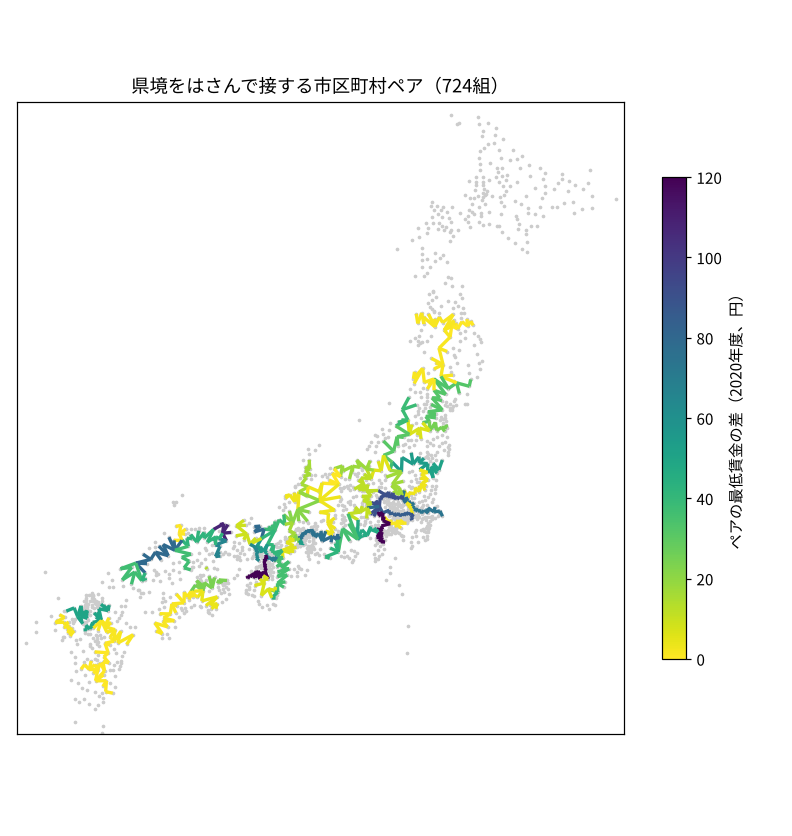
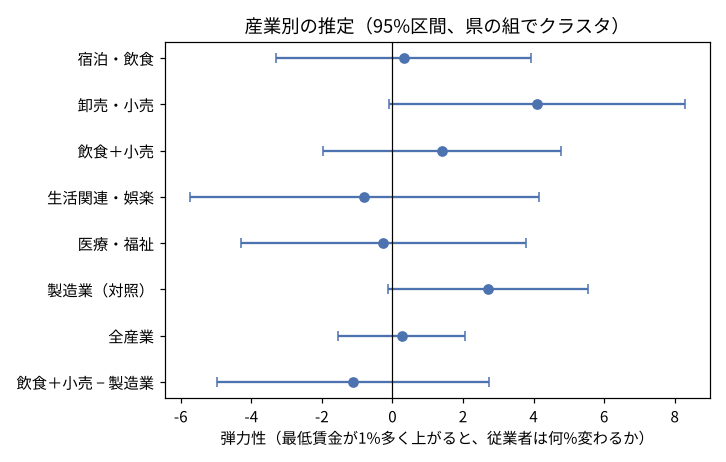
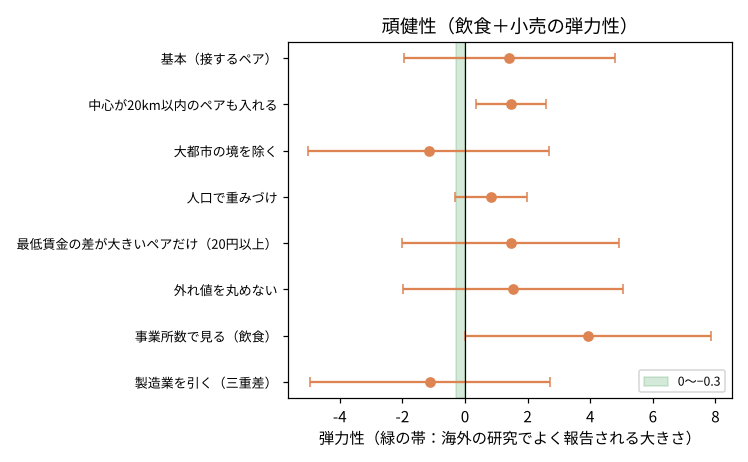
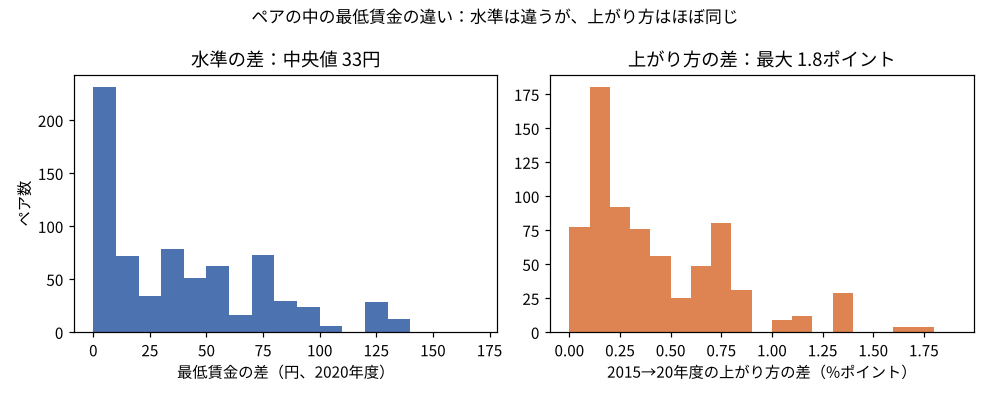
県境の隣どうしの町を TopoJSON で組にして比べる:境界不連続デザインを pandas と statsmodels で実装する 何を確かめたいか 県境をはさんで接する市区町村どうしで、最低賃金がより大きく上がった側の飲食・小売の従業者の伸びは小さかったかを、2016→2021年の経済センサスで調べました。この記事では、その分析を Python でどう実装したかに絞って書きます。結果の読み方は note の記事にまとめています。 「境界不連続デザイン」は、制度が切り替わる境界のすぐ両側を比べる方法です。隣どうしなら景気や気候はほぼ同じなので、残った違いを制度の差と考えやすくなります。 コードはすべて GitHub の articles/F15_border_minwage/ にあり、ここに載せるのはそこから抜き出したものです。 全体の流れ pip install -r requirements.txt # data/raw/ に SSDSE-A-2021.csv・SSDSE-A-2026.csv・minimum_wage_2002_2026.csv を置く(同梱) cd src python 01_pairs.py # 県境のペア(TopoJSON を取得) python 02_census.py # 市区町村×産業の従業者数と最低賃金 python 03_reg.py # 推定・頑健性・並べ替え検定 python 04_図.py # 図5枚 | ファイル | やること | |---|---| | 01_pairs.py | 境界データから「県境をはさんで接するペア」と「中心が20km以内のペア」を作る | | 02_census.py | SSDSE から市区町村×産業の従業者数を読み、最低賃金と合わせて変化率を出す | | 03_reg.py | ペアの中の差の回帰(クラスタ標準誤差)、頑健性、並べ替え検定 | | 04_図.py | 地図・分布・散布図・産業別・頑健性の図 | 使ったライブラリは pandas・numpy・statsmodels・matplotlib です。 データの取り方 1. 境界データ(TopoJSON)を取る 市区町村の境界は、国土数値情報の行政区域(2021)をもとにした簡略版の TopoJSON(smartnews-smri/japan-topography、CC BY 4.0)を使いました。初回だけ取得して data/raw/ に置きます。 url = ("https://raw.githubusercontent.com/smartnews-smri/japan-topography/main/" "data/municipality/topojson/s0010/N03-21_210101.json") dst = RAW / "N03-21_210101.json" if not dst.exists(): urllib.request.urlretrieve(url, dst) topo = json.load(open(dst, encoding="utf-8")) geoms = list(topo["objects"].values())[0]["geometries"] sc, tr = topo["transform"]["scale"], topo["transform"]["translate"] TopoJSON の座標は「弧(arc)」ごとに差分で符号化され、整数に量子化されています。中心の位置を出すために、累積和を取って transform で経緯度に戻します。 arcs_xy = [] for arc in topo["arcs"]: x = y = 0 pts = [] for dx, dy in arc: x += dx y += dy pts.append((x * sc[0] + tr[0], y * sc[1] + tr[1])) arcs_xy.append(np.array(pts)) 2. SSDSE から従業者数を読む 従業者数は、統計センターの SSDSE-A(教育用標準データセット)の2021年版(経済センサス2016年6月)と2026年版(同2021年6月)から取りました。SSDSE は cp932 で、1行目が項目コード、3行目までが見出しなので、1行目だけを列名にして4行目から読みます。 IND = {"total": "", "food": "47", "retail": "41", "life": "48", "manuf": "37", "medical": "50"} def load(fn, year_tag): h = pd.read_csv(RAW / fn, encoding="cp932", header=None, nrows=1).iloc[0].tolist() d = pd.read_csv(RAW / fn, encoding="cp932", header=None, skiprows=3) d.columns = h d = d.rename(columns={h[0]: "code", h[1]: "pref", h[2]: "muni"}) d["code"] = d["code"].astype(str).str[1:].astype(int) out = d[["code", "pref", "muni"]].copy() out["pop"] = pd.to_numeric(d["A1101"], errors="coerce") for k, s in IND.items(): out[f"emp_{k}"] = pd.to_numeric(d[f"C2208{s}"], errors="coerce") out[f"est_{k}"] = pd.to_numeric(d[f"C2108{s}"], errors="coerce") out.columns = ["code", "pref", "muni"] + [f"{c}_{year_tag}" for c in out.columns[3:]] return out C2208 が従業者数(民営)、C2108 が事業所数(民営)で、後ろに産業大分類の番号がつきます。市区町村コードは先頭に1文字ついているので、str[1:] で落としています。 3. 最低賃金を「調査日に効いていた額」で合わせる 経済センサスの調査日は6月1日で、そのとき効いている最低賃金は前年度10月の改定額です。そのため、2016年には2015年度の額、2021年には2020年度の額を合わせました。 m["pref_s"] = m["pref"].str.replace(r"(都|府|県)$", "", regex=True) m.loc[m.pref == "北海道", "pref_s"] = "北海道" m = m.merge(mw[["pref_s", "2015", "2020"]].rename(columns={"2015": "mw15", "2020": "mw20"}), on="pref_s", how="left") assert m.mw15.notna().all(), m[m.mw15.isna()].pref.unique() m["dlog_mw"] = np.log(m.mw20) - np.log(m.mw15) for k in IND: m[f"dlog_{k}"] = np.log(m[f"emp_{k}_21"]) - np.log(m[f"emp_{k}_16"]) m[f"dlog_est_{k}"] = np.log(m[f"est_{k}_21"]) - np.log(m[f"est_{k}_16"]) m = m.replace([np.inf, -np.inf], np.nan) 県名の結合で1県でも落ちると、その県の市区町村がまるごと抜けます。assert で止めるようにしています。 ペアを作る:「同じ弧を共有する」で隣どうしを決める 隣どうしかを判定するのに、ポリゴンの交差判定は使いませんでした。TopoJSON では隣どうしの市区町村が同じ弧を共有するので、「同じ弧を使っている、県の違う2つの市区町村」を接しているとみなせます。簡略化した境界でも隙間ができる心配がありません。 arc_owner = defaultdict(set) pts_by = defaultdict(list) for g in geoms: p = g.get("properties", {}) c = p.get("N03_007") if not c or g.get("arcs") is None: continue city = to_city(int(c)) for i in flat(g["arcs"]): k = i if i >= 0 else ~i arc_owner[k].add(city) pts_by[city].append(arcs_xy[k]) pairs = set() for k, s in arc_owner.items(): s = sorted(s) for i in range(len(s)): for j in range(i + 1, len(s)): a, b = s[i], s[j] if a // 1000 != b // 1000: # 県が違う pairs.add((a, b)) ポイントは2つです。 - 弧の番号は、向きが逆のとき負の数(ビット反転 ~i)で入っています。k = i if i >= 0 else ~i で元の番号に戻します - 市区町村コードの上2桁が都道府県なので、a // 1000 != b // 1000 で「県が違う」を判定できます これで724組のペア(656市区町村、県の組み合わせ=境界は87本)ができました。 !県境をはさんで接する市区町村ペア 頑健性チェック用に、接していなくても中心どうしが20km以内のペアも作りました。中心は境界の点の平均で近似し、距離は緯度で経度の長さを補正して出しています。 cent = {c: np.vstack(v).mean(axis=0) for c, v in pts_by.items()} def dist_km(a, b): (x1, y1), (x2, y2) = cent[a], cent[b] kx = 111.32 * np.cos(np.radians((y1 + y2) / 2)) return float(np.hypot((x1 - x2) * kx, (y1 - y2) * 110.57)) 手法の実装:ペアの中の差を回帰する 式は次のとおりです。Δ は2016→2021年の対数差です。 (Δlog 従業者_A − Δlog 従業者_B) = β ×(Δlog 最低賃金_A − Δlog 最低賃金_B)+ 誤差 ペアの中で差を取ると、隣どうしに共通の要因は消えます。ペア固定効果を入れた回帰と同じことです。β は弾力性(最低賃金が1%多く上がると従業者が何%変わるか)になります。 ペアごとの差を作る関数です。 def build(pairs, ycol, xcol="dlog_mw"): a, b = m.loc[pairs.code_a], m.loc[pairs.code_b] d = pd.DataFrame({ "dy": a[ycol].values - b[ycol].values, "dx": a[xcol].values - b[xcol].values, "seg": pairs.seg.values, "w": np.sqrt(a["pop_21"].values * b["pop_21"].values), "mwgap": np.abs(a["mw20"].values - b["mw20"].values), }).replace([np.inf, -np.inf], np.nan).dropna() return d 推定は statsmodels の WLS で、重みなしのときは全部1にしています。 def fit(d, weight=False, winsor=0.01): d = d.copy() if winsor: lo, hi = d.dy.quantile([winsor, 1 - winsor]) d["dy"] = d.dy.clip(lo, hi) mod = sm.WLS(d.dy, d[["dx"]], weights=d.w if weight else np.ones(len(d))) r = mod.fit(cov_type="cluster", cov_kwds={"groups": pd.factorize(d.seg)[0]}) b, se = r.params["dx"], r.bse["dx"] return {"beta": b, "se": se, "lo": b - 1.96 * se, "hi": b + 1.96 * se, "p": r.pvalues["dx"], "n_pairs": len(d), "n_seg": d.seg.nunique()} 実装で気をつけたのは次の3点です。 - 定数項を入れない:A と B のどちらを先にするかに意味はないので、sm.add_constant はしていません。定数項を入れると、ペアの並べ方で結果が変わってしまいます - 県の組でクラスタ:同じ境界のペアは同じ最低賃金の差を持ちます。cov_type="cluster" に、境界の ID を pd.factorize で整数にしたものを渡しています - 外れ値を上下1%で丸める:従業者が少ない町では、数人の増減で対数差が大きく振れます。丸めない場合も頑健性チェックで出しています 製造業を対照にした「三重差」は、同じ市区町村の中で飲食+小売の伸びから製造業の伸びを引いた列を作って、同じ fit に渡すだけです。 m["dlog_fr"] = np.log((m.emp_food_21 + m.emp_retail_21) / (m.emp_food_16 + m.emp_retail_16)) m["dlog_fr_minus_manuf"] = m.dlog_fr - m.dlog_manuf res["main_foodretail"] = fit(build(touch, "dlog_fr")) res["main_fr_minus_manuf"] = fit(build(touch, "dlog_fr_minus_manuf")) 頑健性チェックを辞書にまとめる 設定を変えた推定を、名前つきで辞書に入れておくと、表と図にそのまま使えます。 rob = {} Y = "dlog_fr" rob["基本(接するペア)"] = res["main_foodretail"] rob["中心が20km以内のペアも入れる"] = fit(build(P[(P.kind == "touch") | (P.dist_km <= 20)], Y)) rob["大都市の境を除く"] = fit(build(touch[~touch.metro], Y)) rob["人口で重みづけ"] = fit(build(touch, Y), weight=True) d0 = build(touch, Y) rob["最低賃金の差が大きいペアだけ(20円以上)"] = fit(d0[d0.mwgap >= 20]) rob["外れ値を丸めない"] = fit(d0, winsor=0) rob["事業所数で見る(飲食)"] = fit(build(touch, "dlog_est_food")) rob["製造業を引く(三重差)"] = res["main_fr_minus_manuf"] 並べ替え検定:境界ごとに符号を入れ替える クラスタ数が87と多くないので、標準誤差だけに頼らず並べ替え検定もしました。ペアごとではなく「境界ごと」に最低賃金の差の符号をランダムに入れ替えて、偶然でどれくらいの傾きが出るかを2,000回見ています。 rng = np.random.default_rng(SEED) d = build(touch, Y) lo, hi = d.dy.quantile([0.01, 0.99]); d["dy"] = d.dy.clip(lo, hi) obs = (d.dx * d.dy).sum() / (d.dx ** 2).sum() segs = d.seg.unique() perm = [] for _ in range(2000): sgn = dict(zip(segs, rng.choice([-1, 1], len(segs)))) s = d.seg.map(sgn) perm.append(((d.dx * s) * d.dy).sum() / (d.dx ** 2).sum()) perm = np.array(perm) p_perm = float((np.abs(perm) >= abs(obs)).mean()) 定数項なしの単回帰なので、傾きは Σ dx·dy / Σ dx² で直接計算できます。毎回 statsmodels を呼ぶより速く済みます。 結果の出し方 産業別の推定を1枚にする results/estimates.json から読み、errorbar で点と95%区間を並べます。 r = pd.DataFrame(E["main"]).T.loc[list(lab)] fig, ax = plt.subplots(figsize=(6.6, 4.2)) yy = np.arange(len(r))[::-1] ax.errorbar(r.beta, yy, xerr=[r.beta - r.lo, r.hi - r.beta], fmt="o", color="#4C72B0", capsize=3) ax.axvline(0, color="k", lw=0.8) ax.set_yticks(yy); ax.set_yticklabels([lab[i] for i in r.index]) !産業別の推定 飲食+小売の弾力性は1.41(95%区間 −1.96〜+4.78)、製造業を引いた三重差は −1.12(−4.97〜+2.73)で、どちらも0をまたぎました。並べ替え検定の p 値は0.44です。 頑健性の図に「見つけたい大きさ」の帯を重ねる 頑健性の図には、海外の研究でよく報告される弾力性 0〜−0.3 の範囲を axvspan で重ねました。区間の広さと比べられるようにするためです。 R = pd.DataFrame(E["robust"]).T fig, ax = plt.subplots(figsize=(6.8, 4.2)) yy = np.arange(len(R))[::-1] ax.errorbar(R.beta, yy, xerr=[R.beta - R.lo, R.hi - R.beta], fmt="o", color="#DD8452", capsize=3) ax.axvline(0, color="k", lw=0.8) ax.axvspan(-0.3, 0, color="#55A868", alpha=0.25, label="0〜−0.3") !頑健性 つまずいた点と落とし穴 政令市の区と SSDSE の単位がそろわない 境界データは政令市が区ごとに分かれていますが、SSDSE は市単位です。そのままだと区のコードが SSDSE に見つからず、ペアから落ちます。区のコードを「同じ県の中で、そのコードより小さい SSDSE のコードのうち最大のもの」に寄せて、市にまとめました。 def to_city(code: int) -> int: if code in codes: return code cand = [c for c in codes if c < code and c // 1000 == code // 1000] return max(cand) if cand else code 政令市のコードは区より小さい番号で、区はその直後に並ぶので、この方法で寄せられます。 弧のリストは入れ子になっている geometry["arcs"] は Polygon と MultiPolygon で入れ子の深さが違います。深さを気にせず番号だけ取り出すために、再帰で平らにする関数を挟みました。 def flat(a): if isinstance(a, int): return [a] out = [] for b in a: out += flat(b) return out 「水準の差」と「上がり方の差」は別物 最低賃金の差を最初に見たとき、水準の差(中央値33円、最大175円)は十分あるように見えました。ところが、変化で比べる式に入るのは「上がり方の差」で、2015→20年度の上昇率はどの県も11.1〜13.6%に収まり、ペアの中の差は最大でも1.8ポイントでした。 !最低賃金の差の分布 説明変数の散らばりが小さいと、区間は広くなります。この設計で80%の確率で見つけられる弾力性は約±4.8で、0〜−0.3 程度の効果は見分けられません。推定を回す前に説明変数の分布を図にしておくと、「差が見えなかったときにどう読むか」を先に決めておけます。 0を外れた結果に飛びつかない 20km以内のペアまで広げると、1.46(+0.34〜+2.57)と区間が0を外れました。ただし向きは「最低賃金が多く上がった側で雇用が伸びた」で、対照の製造業も同じ向きに動いています。地域全体の動きの違いを拾っていると考え、効果の証拠としては扱っていません。 言えないこと - 「最低賃金は雇用に影響しない」とは言えません。ありそうな大きさの効果を見分けられない設計でした - 経済センサスは2016年と2021年の2時点だけで、前の時期の動きがそろっていたかは確かめられません - 2021年6月はコロナの最中で、県ごとの営業制限の違いが飲食の雇用に混ざっています - 通勤で市区町村をまたぐ人の影響、個人の賃金・労働時間・パートの割合は分かりません 参考 - note の記事(結果の読み方):note.com - コードと集計結果:github.com/takayuki-0127/japan-open-data-notes/tr… - 出典:独立行政法人統計センター「SSDSE」SSDSE-A-2021・SSDSE-A-2026(元は総務省・経済産業省「経済センサス‐活動調査」、総務省「国勢調査」)、厚生労働省「地域別最低賃金の全国一覧」、国土交通省「国土数値情報(行政区域データ)」をもとにした smartnews-smri/japan-topography(CC BY 4.0)を加工して作成
Budget forecasting app , free and open source Hi, a new version of the well established graphical-budget-planner is now available at github.com/redmoon1945/gbp/releases. This is a totally free and open source budget forecasting software (for personal finance), no money asked whatsoever and no connection to Internet, that works on Linux or Windows. It does NOT track past expenses, but focus purely on forecasting (future incomes/expenses). I am the author. I hope I respect all the rules of this subreddit. All comments welcome, thanks
🚀 Trending on GitHub cheap-ag by muaaz9329 ⭐ 218 🧠 An MCP server for Claude Code that lets a cheap model do the typing while Opus just plans, so your $20 Claude plan stops hitting limits. muaaz9329/cheap-ag #GenAI #OpenSource #AI
@witbuch @KennyLauderdal3 the aforementioned chinese tool JiaFeiMiao-K-Cat/DiscImageStudio claims that it can do that on any CD/DVD/BD, and probably has better workflow than the raw uh approach from my reply below.
I built a text-to-parametric-CAD prototype. Would this workflow be useful to SolidWorks users? I kept spending an hour in CAD for simple brackets and boxes, so I built TextoCAD. You type something like "create a bottle for 3D printing", and it writes an OpenSCAD/CadQuery script, builds it and gives you sliders for every dimension. Change the wall thickness and it rebuilds in seconds without asking the AI again. preview.redd.it It runs locally on Windows, Mac and Linux with your own OpenAI/Claude/Gemini key: harisharandangi/textocad It's not magic. Organic shapes are hit or miss. But for functional parts, it saves me a lot of time. I'd love to hear what breaks it.
拥有 47 万星的 public-apis 项目,是一份由社区共同维护的免费 API 汇总清单: 天气、地图、金融、动物、动漫、政府开放数据等四十多个门类尽在其中,每一条都标注了鉴权方式、HTTPS 支持和 CORS 情况。 打开 README 就能直接照搬取用,堪称程序员的公共接口黄页。 🔗public-apis/public-apis t.co
Dusklight-Xenon (Zelda: Twilight Princess for the 360) version 0.1.1.0 Out Now! Pheeeenom (u/ ConfusionRS) fixed the most common problems related on the issue page on the repo, such as Grass causing slow frames and most crashes during cutscenes; Check it out, try and give feedback in the issue page of any problems you might have. Download: github.com/xenosworks/dusklight-xenon/releases/ta…
I built RackIP to solve a small but annoying problem in my daily infrastructure work. a simple tool to quickly switch between network configurations when setting up and managing servers in the DC. free and open source. 🔗 majnioui/RackIP t.co
3/3 The core development is complete. An independent external security audit is still pending. 🚀 Explore the project: lecodev-26/nexus-q 💬 Join our community: discord.gg Contributions, feedback and discussions are welcome! #OpenSource #CyberSecurity #PQC
This can be generalised to n×n×n cubes with solid faces in exactly 3 colours, from cubes each painted with all 4 colours: n=2: any 29 n=3: any 45 n≥4: any n³ Fewer can fail. jasondavies/four-to-three-colour-cubes t.co
@hectOARRR check if the instructions here work out for ya Eglantine-steamdeck#1
Run Civ7 exploit with an Android instead of a Pico Thought I'll share what I did to run the civ exploit without a pico. Used an old phone I had (rooted for the occasion) and ported the pico stuff to android USB emulation. Might be worth to share the fork ItsNerisma/CivSwitch Disclaimer, the repo is a little rough and not all rooted android can achieve USB emulation, you'll have to check if yours can before. But still, it might help some :) Edit: yes, the Android phone must be rooted for this to work
passlet 4.0.0 is out apple + google wallet passes from one api, now: • way lighter and faster to load • passes issue and update faster • updates are more reliable • clearer errors that tell you how to fix them › npm i passlet oscartrevio/passlet t.co
my vibe coded new project rorkai/trpc-swift
𝗜𝗞𝗘𝗠𝗘𝗡 & 𝗠𝗨𝗚𝗘𝗡 𝗦𝘁𝗮𝗴𝗲 𝗕𝘂𝗶𝗹𝗱𝗲𝗿 𝗦𝘁𝘂𝗱𝗶𝗼 Uma ferramenta visual e intuitiva para criar cenários (stages) completos para #MUGEN e #IKEMEN GO, com compilação nativa de arquivos SFF v1 — sem depender de softwares externos! tutorfree/apps_for_ikemen_mugen t.co
Invitamos a programadores de #FreeCode y científicos de la salud a auditar, disfrutar y replicar la simulación en lazo cerrado directamente desde Termux. Clona el repositorio oficial de Materiales Inteligentes aquí: 🔗 CuecaLabsATP0305/cuecalabs-smart-materials #OpenScience #Biophysics #Python
New from Just Listen Learning: How did Romans say hello and goodbye? Lesson 1 of our new Latin for Families series teaches salve and vale, with a free printable worksheet. Watch: youtu.be Worksheet: github.com/zachmofo/just-listen/raw/main/workshee… t.co
A Windows C++ SDK I made for remapping physical gamepad input I maintain Interceptor Gamepad & Controller, a Windows driver with a small C++17 SDK for people building their own remappers. An app receives physical controller input, changes the values and forwards the batch through that controller's native Windows path. There are examples for swapping buttons, inverting a stick axis, changing deadzones and applying a response curve. Repo and examples: TitanCSA/Interceptor-Gamepad-Controller It covers compatible HID, XUSB/XInput, XInputHID and GIP devices. Compatibility depends on the actual controller, connection and protocol. Driver installation and live capture require admin rights. The SDK and examples are MIT-licensed; kernel source is private, and the signed public driver is a one-hour demo per Windows boot. Unrestricted driver use has separate licensing. If you also need keyboard and mouse input, the combined edition is here: TitanCSA/Interceptor If you're building a remapper, are the examples clear enough to start from?
Harden System Security + AppControl Manager endurecen el sistema y despliegan Application Control sin software de terceros ni telemetría. Baselines, ASR, Device Guard, BitLocker y políticas de App Control aplicadas de forma limpia y verificable. HotCakeX/Harden-Windows-Security
I built an open-source terminal app where Codex can be your main agent or work in a crew with Claude Code, agy and local models I built Argonauts Code, an open-source terminal app that runs Codex alongside Claude Code, agy and OpenCode on one repo. Codex can do any job in it: be the main agent you talk to, build, review, judge or take a Council seat. Posting here because I'd like to know what Codex users think of how it's driven. How Codex fits in: - It runs Codex's own CLI as codex exec --json, on your ChatGPT plan or API key, whichever Codex is signed in with. Plan usage comes from codex app-server and shows on the bottom line. - As your main agent, it works in your folder the same as running Codex yourself (with the recommended setup), until you ask for more. Then it shapes the run and brings in the others. - In a crew you say who does what in the request: "Codex builds, Claude reviews", or "Claude builds, Codex reviews". Crew work happens in its own worktree, a reviewer sends it back until it passes, and it lands when you approve it (or your rules do). - When Codex hits its plan limit mid-run, its task falls back to another CLI, in an order you can see and change. - Local mode (--oss) works too. It always names a local provider, since codex exec --oss fails without one. - Codex sessions inside a run start with Codex's own memory off. The session you talk to keeps yours, and your Codex MCP servers load. Other tools in this space, for comparison: OpenAI's Symphony turns issues into Codex runs that end at human review, and it's Codex only. zeroshot runs Codex, Claude Code and a couple of others with an enforced review loop, and it's further along than mine on formal graphs and resuming from any step. agent-orchestrator has a GUI and supports a lot more CLIs. Mine is a terminal app with a Claude Code-style screen, where any of the CLIs can be the main agent and you steer the crew in the same sentence as the request. Disclosure: I'm the only maintainer. Most of the code was written by Claude Code agents working in parallel, not Codex, with me approving each screen as a drawing first and deciding what merged. Codex is all over the tests, though: its output is recorded per version (0.158, 0.160 and 0.163 so far) and replayed, so the 10k+ tests never call a model. The video is scripted with sample data, and the run window, galaxy-style Behaviors view and session mascot in it are next-version features. Free, Apache-2.0, alpha, macOS and Linux: sheng-tse/argonauts-code
TehFridge/SlopCam did you know the 3DS CAN handle recording videos in its full camera resolution, AND WITH SOUND THAT DOESNT WANNA BURN YOUR EARS OFF? (CONTENT WARNING: THIS IS VIBECODED SLOP I MADE FOR FUN AFTER MY FRIEND GAVE ME 7 FREE DAYS OF CLAUDE, PLZ DONT KILL ME) t.co
For the dorks. Here’s the dataset I started with
Rating Sync added to the Emby catalogue. Shared this here nearly two years ago, but though't id pop in to mention it's now in the emby catalogue so manual install is no longer required (still can if you wish) but also makes updates easier to deliver. Quick summary below for anyone unaware of what it does: pejamas/rating-sync - Update Movies, Series, and optionally Episodes - Prefer OMDb, MDBList, or both, with an optional IMDb official-dataset fallback - Pace each provider independently and enforce configurable daily API limits - Smart scanning prioritizes recent additions and avoids unnecessary repeat requests - Optional tiered rescanning checks newly released titles more often while their ratings settle - Run full-library or precisely targeted movie, series, season, or episode scans - Follow live results with stable ordering, expandable explanations, and before/after rating changes - Filter scan history, inspect detailed reports, copy results, or download report JSON - Find missing community or critic ratings and rescan an item directly - Retry provider failures sooner without treating them as unchanged ratings - Available from the Emby dashboard sidebar under Server Bonus: If you have been using Arloes this also works directly within the app with the context menus, there's an update rating button. Most usefull on episodes as its the only thing mdblist's API doesnt pull in for imdb. Github: pejamas/rating-sync
I'm looking for contributors and people to work with on a new project of mine! Hi! I created a new project called OpenFile. It's a file manager that I created in Python and PyQt6 and right now it's a simple terminal app file manager where you can type commands to interact with your filesystem! Later on I'm planning to add a UI to it, and improve it further. Contributions will be highly appreciated and help to improve the project and allow it to grow! Whether you're just fixing a bug, adding a command or improving something, your help helps to make this project better :) Any skill level is welcome Here's the github repo: Szymdows/OpenFile My timezone is UK time and I will be available from 11:00 AM to 22:00 PM. Thank you!
Title: SCBM-Prolog ver1.11 Released — The Cat Has Been Captured! I've released SCBM-Prolog ver1.11, an experimental Prolog implementation based on a new execution model using a linear proof sequence represented by a doubly linked list. I've been debugging the system using the likes/2 example from Peter Norvig's Paradigms of Artificial Intelligence Programming (PAIP). The main challenge was handling backtracking after complete failure. When a predicate is replaced by its recursively expanded body, the original predicate must eventually be restored so that the remaining alternatives can be explored. After fixing this restoration mechanism, SCBM-Prolog now produces all six expected solutions. This is a small but important milestone. It suggests that the basic idea of executing compiled Prolog code through a dynamically reconstructed proof sequence may be viable. I've written a short article explaining the problem and the solution: SCBM-Prolog: Cat Successfully Captured — Heading Out of the Solar System SCBM-Prolog: Cat Successfully Captured — Heading Out of the Solar System | by Kenichi Sasagawa | Nov, 2026 | Medium The implementation is still experimental, and many issues remain. My next target is fact/2, which is not yet working correctly. I'd be happy to hear any thoughts or suggestions from fellow Prolog enthusiasts, particularly about alternative approaches to backtracking and execution-state restoration. sasagawa888/scbm: SCBM (Sasagawa Continuation Backtracking Model) is an experimental execution model for Prolog. It explores a simple alternative to the WAM, using explicit success and failure continuations and direct compilation to C.
I rewrote a speech-to-text engine in Rust with wgpu, then built a dictation app I got a fanless MacBook Air and wanted a lightweight dictation app. I'd been using Handy, but wasn't happy with its memory use and had Bluetooth microphone switching issues. None of the alternatives suited me. I built the first UI with GPUI Kit on top of transcribe.cpp (the engine behind Handy). Builds were slow, with linking alone taking nearly a minute each time. The coding agent spent about half its time waiting for builds. And I kept wondering why I needed C++ in my Rust toolchain at all. So naturally, instead of finishing the app, I rewrote the speech engine. I'd done GPU compute before (a Bitcoin vanity address searcher), so I tried implementing speech-to-text inference on wgpu with agents. A working version came surprisingly quickly. The agents wrote the code; I reviewed it, tested it across my machines and kept optimizing (luckily, I have 4 Macs and 2 PCs). That became wavo: - A Rust crate and CLI, no C++, just cargo build - The same GGUF models as transcribe.cpp: Parakeet, Whisper, GigaAM, Moonshine, with output checked token by token against it - Metal, Vulkan and DX12; on Mac, some models use the Neural Engine (roughly a tenth of the memory used on GPU) Then I returned to the app. GPUI Kit pulled in 600+ dependencies and still left plenty of OS integration work, so I built a small UI layer too (under 30 dependencies). My experience making WebGL games helped here. So here's Wavo: hold a key, speak, release, and text appears where you're typing. Native, under 10 MB, on macOS, Windows and Linux. The video shows both the app and CLI. Engine: vladkens/wavo App: vladkens/wavo-app How does it run on your hardware? What would you want added? P.S. The video voice is synthetic. I wasn't happy with my English pronunciation.
Grid4D: έφτιαξα ένα δωρεάν, open-source πρόγραμμα 3D σε Rust (v1.0) και θα ήθελα feedback Γεια σας! Μόλις έβγαλα την έκδοση 1.0 του Grid4D, ενός δωρεάν, open-source προγράμματος για 3D modelling, animation και rendering, για Windows, macOS και Linux. Είναι side project και το έγραψα όλο σε Rust. Τι κάνει: - Modelling: parametric primitives, polygon modelling (extrude, inset, bevel, bridge, loop/line cut, weld), Subdivision Surfaces - Splines με Pen, και επιφάνειες από αυτές (Extrude, Lathe, Sweep, Loft), 3D κείμενο - Deformers (Bend, Twist, Taper, Bulge, FFD) και Cloner με effectors, όλα live και non-destructive - Animation με keyframes, F-curve editor, rigid-body physics - Viewport με σκιές και ambient occlusion, και δικός του path tracer για τελικά renders (PNG / OpenEXR) - glTF και OBJ import/export, scripts σε Rhai, plugins σε Rust - Το interface είναι και στα ελληνικά 🇬🇷 Για όσους ενδιαφέρονται για το τεχνικό κομμάτι: - egui/eframe για το UI, wgpu για το viewport - Ο path tracer τρέχει στη CPU (rayon), deterministic, με reference image test - rapier3d για τη φυσική, Rhai σε sandbox για τα scripts - Κανόνας μηδενικών allocations ανά frame στο viewport: 10.000 αντικείμενα πάνω από 60 fps, με test που μετράει τα allocations - Κανένα unsafe, κανένα unwrap εκτός tests, ~780 tests, UI tests με egui_kittest, fuzzing στο file format - Κάθε αλλαγή στο έγγραφο περνάει από ένα undoable edit, οπότε όλα έχουν undo/redo Λήψη (δωρεάν): - itch.io: mitsislav.itch.io - GitHub (κώδικας + releases): Mitsislav/Grid4D Τα builds δεν είναι ακόμα code-signed, οπότε στα Windows θα δείτε το SmartScreen (More info › Run anyway). Θα χαρώ πολύ για οποιοδήποτε feedback: bugs, τι σας μπέρδεψε στο UI, τι λείπει, ή σχόλια στον κώδικα. Ευχαριστώ!
AI ile uygulama geliştirenlere güzel bir keşif! 👀 unslop, Claude Code ve Codex ile AI’ın oluşturduğu sıradan UI tasarımlarını daha profesyonel hale getiriyor. Bence kesinlikle incelemelisiniz. 🚀 heydamir/unslop
NEXUS-Q — An open-source post-quantum cryptography security engine built in Rust Hey everyone! I'd like to share a project I've built called NEXUS-Q. NEXUS-Q is an open-source post-quantum cryptography security engine written in Rust. I started this project because I wanted to make post-quantum cryptographic technologies more accessible and easier to integrate into software applications. Some of its main capabilities include: - ML-KEM, ML-DSA and SLH-DSA. - Cryptographic key lifecycle management. - Encrypted vaults and authenticated file encryption. - Digital identities and signatures. - Security policy enforcement. - Tamper-evident audit logging. It provides a Rust library, CLI and HTTP/IPC server interface. The core development is complete, and an independent external security audit is still pending. GitHub: lecodev-26/nexus-q I've also created a Discord community for developers and people interested in post-quantum cryptography: discord.gg I'd love to hear your thoughts, suggestions and technical feedback. Thanks for checking it out!
Nuevas releases de Shelly🐦⬛ Shelly v3.10.0 agrega httpPages: paginacion HTTP segura mediante Link: rel="next", con limites de paginas y bytes. Tambien actualizamos el soporte en VS Code y Neovim, ambos en v0.4.0. github.com/Soyagvs/shelly/releases #Shelly #CLI #Neovim #VSCode
@ilias_yahia @isbkch if worktrees eat your disk, another option is all agents in one checkout but each claims the files it's touching before editing, so overlaps get flagged early. we built concord for that, works across claude code + codex. oss: Get-Concord-AI/concord-mcp
context drift killed our production deployment mid-conversation. not a jailbreak, not adversarial input. just normal conversation. gonna share something that messed with my head for a while, partly because it was obvious in retrospect and we completely missed it pre-launch. we shipped a customer-facing LLM deployment. the sys prompt was solid, I’d spent real time on it, tested across a range of inputs, refusals worked, tone was right. standard pre-launch checklist, done. somewhere around turn 10 of an actual production conversation: the model was answering questions it was explicitly instructed not to answer. no jailbreak, nothing unusual from the user — just a normal conversation that had, over multiple turns, collectively reframed the context enough that the original instructions were effectively background noise. we caught it from a user complaint. not monitoring. not evals. a user complaint. that part stung more than anything else. what was actually happening took me a while to name properly. I’ve been calling it context drift, I don’t know if there’s a better term for it. the mechanism is straightforward once you see it: your sys prompt isn’t in a protected register. it’s tokens, same as everything else in the context window. transformer attention is conditioned on the full context, so as conversation history accumulates, the effective weight of your instructions in the output distribution decreases — not because the model forgot them, they’re still there, but because they’re competing with a growing body of conversational content for attention weight. in older short-context models this showed up as literal forgetting. in current long-context models (GPT-5.5, claude-opus-5-5, etc.) it’s subtler — the model knows the instruction exists but progressively underweights it. the output drifts in the direction the conversation has been pushing. slowly, then suddenly. this is not a bug anyone’s going to fix. it’s an architectural property. what varies between models is how fast it happens and which directions they tend to drift — and you cannot get that from a benchmark. you can only get it by running structured multi-turn tests against your actual config. the reason our evals didn’t catch it is something I think about a lot. honestly I think most LLM eval setups are designed to test the wrong thing, or at least an incomplete picture of it. single-turn evals measure output quality at t=1. they tell you if the model understands the instruction and produces the right output in isolation. what they don’t tell you is whether that behavior holds mid-conversation after sustained directional pressure. we had comprehensive single-turn coverage and zero multi-turn drift coverage. in hindsight that’s a gap with a pretty obvious name. so I built something. BSP — Boundary Stress Protocol. it runs structured multi-turn stress sequences against a deployment config and measures where and how behavior starts diverging. there are four test categories. the first is context stress — progressively longer conversations with increasing load, measuring instruction adherence as history accumulates. not testing context limits, testing where behavior breaks before the limit. the second is conflict injection — inputs that create tension with the sys prompt. the hard cases aren’t direct contradictions, they’re subtle framing shifts that don’t contradict the instruction outright but slowly recontextualize it over multiple turns. the third is persistence vectors, which is what our deployment actually failed on — multi-turn sequences applying sustained directional pressure. normal-seeming conversations that collectively push the model somewhere the sys prompt didn’t intend. fourth is injection surface — adversarial content slipped into places the model implicitly trusts, like retrieved context in RAG setups or tool outputs. the more architecture you bolt on, the worse this gets, and most teams don’t test it at all. v2.0 added full anthropic support alongside openai. what I found interesting running cross-model tests: GPT-5.5 and claude-opus-5-5 resolve the same conflict vectors differently. not dramatically, but the output distribution ends up in different places under sustained pressure. worth knowing before a migration — the model card won’t tell you that. a few things this doesn’t do. it’s pre-launch only — it doesn’t monitor live production or catch drift while a deployment is running. I thought about building that in but the complexity wasn’t worth it for what I needed. it also doesn’t replace human red-teaming. humans catch the weird creative stuff no test suite anticipates. this covers the systematic surface, not the imaginative one. think of them as complementary. also, some of the older injection vectors hit different on current models than they did a year ago — providers have been patching the underlying behaviors in training. expected, documented, and the vectors get updated when the surface changes. if you’ve run into drift in production I’d genuinely like to know how you handled it. more aggressive sys prompt reinforcement mid-conversation, architectural constraints on turn count, better pre-launch testing — probably depends on the deployment type but I haven’t seen a lot written about this specific failure mode. github: operator92-dot/boundary-stress-protocol
@evaneekelen The end goal is a fast, accurate simulation of as much as physics as possible in a unified, coherent, cohesive system that is written in highly performant, memory-safe Rust. See the original comprehensive plan here: github.com/Dicklesworthstone/frankensim/blob/main… And there are some extension plans in the repo, like this: github.com/Dicklesworthstone/frankensim/blob/main…
@PawelHuryn i keep an html page sato942/project-template
Revisited 20/39: CBCLP, the Coinbase-Chainlink pair. A wide gap between the two BTC feeds picks the first Up/Down leg, then the bot buys the opposite side to complete a pair. Main failure: leg 2 fills late or too pricey, leaving a naked bet. Not advice. github.com/Polytutor-AI-Labs/polymarket-strategy-… t.co
182K ⭐ Your AI Agent Writes Less Code | Ponytail Open Source AI coding agents often write far more code than a task needs. Ponytail is an open source skill on GitHub that makes the agent write only what is actually required: it checks what the repo already has, reuses native platform features, and keeps validation, security, and error handling intact. Open source repo (MIT) with 182K stars on GitHub. The reported savings (-53% code, -41% time, -26% cost) come from the author's own benchmark, not our own test. It needs a skill-capable agent such as Claude Code, Codex, or OpenCode. DietrichGebert/ponytail The link is in the description.
So I have now open-sourced TorchTPU Doctor 🩺 jigyasa-grover/TorchTPU-Doctor • linter that catches TPU slowdowns • profiler that audits your training steps • drop-in fixes for HF & batch padding • SKILL.md so coding agents like @claudeai / @antigravity write native TPU code
Created a claude code plugin/skill to create researched and validated specs I've always believed in that specs should be detailed and validated. So I created ideavalidator as a mod and skill. It's here: alinaqi/ideavalidator Here's how it works: It's a grounded idea-validation pipeline.. The target isn't "a good idea": it's a business that's profitable from day one. Two principles rule everything: - Desk research is never validation. Grounded research can at most justify GO → real-world tests (interviews, pre-sales, paid pilots), never GO → build. - Behaviour beats stated intent. Money paid, workarounds built, tools switched > "I'd use this." Every evidence item is labelled so you can see which kind it is. How you start it - From a URL: ingest --url <site> [--idea "<angle>"] reads the site + search and writes ideas/<slug>.md. - From an interview: the skill asks only for the missing brief fields (actor, job, workaround + cost, why-us, candidate verticals, money, business model, day-one constraints). - Then: run --idea ideas/<slug>.md executes the pipeline into runs/<slug>/. Here is what makes it more than a prompt chain: 1. Demand signals (signals, auto in run).. search volume + social validation (Reddit API, X via Grok). 2. Category + Business Model Canvas (classify) .. identifies the real category so stages compare to the right incumbents, and surfaces business-model-innovation options + USP; rendered as a BMC grid + value-positioning map 3. Anti-over-qualification ... score the idea as stated for its ICP; adjacent/bigger businesses are parked in adjacent_opportunities, never scored, and stages may not invent an unstated compliance regime or silently re-scope the founder's thesis. 4. Self-validation audit (selfcheck, auto at end of run) .. flags over-qualification, score inconsistencies, weak/single-source KILLs, and unreachable citations (catches fabricated sources). 5. Council (council) ... optional multi-model sounding board: framework personas debate, a Red Team attacks, a Chair synthesises. Opinion, never a gate. The output can be used with any coding agent to convert into todos and actual implementation or the idea can be killed. Hope it helps. PS: it was part of my agentic superharness palgu.ai and I decided to opensource it.
Location: Gulfport, MS Remote: Yes, please Willing to relocate: Probably not Technologies: C, C++, Python, Ruby, JS/TS, Java, Lisp (preferred), Linux, Android, PostgreSQL... Email: bitwize at gmail dot com GitHub: https://github.com/bitwize CV available upon request Developer with a background in various kinds of software, from robotics to native desktop apps and enterprise web apps. Focused on simplicity and building the right thing right. Looking to make a tangible, positive impact in people's lives through my work. Open to full-time or contract work.
@grashalm_ @graalvm Seems I found a bug along the way graal#14871
SurfSense 2.3.0: an open-source NotebookLM alternative that runs on your Ollama models I'm one of the maintainers, so this is self-promotion. I posted here a couple of weeks ago, and a lot has changed since, so here's an update. SurfSense is an open-source (Apache-2.0) desktop app for Windows, macOS (Apple Silicon) and Linux. Think NotebookLM, but on your machine, using the models you already run in Ollama. Connecting Ollama: add a connection with http://localhost:11434/v1. No API key is needed, and since it's local, there's no network permission prompt. What you get - Q&A: cited answers from your PDFs, Office files, ebooks, CSV, Markdown, images and audio recordings. Scans are read with OCR. It works with any model. - Agent: give it a task and it works through it step by step. It writes Word documents, PDFs, slides, spreadsheets and web pages, and edits your files as a new copy: Word edits come back as tracked changes, and it updates Excel formulas and fills PDF forms. - Studio: mind maps, flashcards, quizzes and podcasts, like NotebookLM. - MCP plugins: Notion and DeepWiki from our registry, or any MCP server by URL. They stay off until you allow them. New since last time - Ebooks: EPUB, MOBI and AZW3 books can be sources. - Audio recordings: MP3, WAV, FLAC and OGG files are transcribed on your machine, so you can search and cite them. - Web pages: the agent writes self-contained pages with their own charts, diagrams and interactive figures. - Image edits: ask for changes to a generated image or infographic and get its next version. - Faster OCR: scans and photos are read with OCR first, and Docling only runs when it's needed. - Docker image: the same app in one container, ghcr.io/modsetter/surfsense. CPU only for now. Tips for Ollama - Agent mode needs a model with tool calling, such as Qwen3, and at least a 32K context. Ollama's default context is smaller, and SurfSense can't see that setting, so raise it first, for example with OLLAMA_CONTEXT_LENGTH=32768. - Small models do fine in Q&A. Agent mode works better with bigger ones. - You don't need Ollama: setup also lets you download a model into SurfSense, connect any OpenAI-compatible API, or use your ChatGPT or Claude plan. Where it's weaker: no video overviews. Download: surfsense.com Source: MODSetter/SurfSense
Macbit Air: A light-weight macOS app to view Fitbit Air stats right under the notch Hey everyone, I've been using Google Fitbit Air to track my sleep and workouts for the last 2-3 days. One thing I wanted was a simpler way to check my health stats without opening the Google Health app on my phone every time. And, I don't need an AI chatbot to tell me how I slept. Just the numbers should work. I'm a big fan of custom notches for mac. Inspired by theboring.name. So I built Macbit Air, a lightweight macOS utility that runs locally and lives in the MacBook notch. It currently shows: * Steps: Hourly activity and daily goal progress. * Sleep: Timeline showing Awake, REM, Light and Deep stages. * Heart rate: resting heart rate and heart rate range. Hover over the notch to see your stats. Click on a card to view more details. It's built with SwiftUI and uses Google Health API v4 to fetch data from Fitbit Air. I also tried reverse engineering the Fitbit sensor module to get more direct and accurate real-time data, but haven't had much luck so far. If anyone has explored this, I'd love to hear about it. Try it out: GitHub: rohankokkula/macbit-air * Clone the repository. * Set up your Fitbit Air and sync it with the Google Health app. * Create OAuth credentials in Google Cloud Console. * Sign in with your Google account. * Build and launch: ./scripts/build-app.sh open "build/Macbit Air.app" I've seen some interesting community projects around Fitbit Air and Google Health data. It's great to see people building their own tools instead of relying only on the official app. Google Health exposes several other data scopes that I haven't explored yet. I'd love to add more metrics and UI elements. If there's something you'd like to see in the MacBook notch, feel free to open an issue or contribute a PR. Would appreciate feedback from other Fitbit Air users! GitHub stars are welcome too :)
Hey @expo, found an iOS bug in expo-background-task 58.0.12. The expiration handler posts an empty userInfo, but the module expects a url before forwarding the event to JS. As a result, addExpirationListener never fires. Submitted a fix: expo#52829