Mentions
Conversations linking to GitHub, newest first. Times are UTC.
Mentions by source
X
Bluesky
Hacker News
V2EX
Qiita
DEV
Mastodon
Latest posts
Location: Abingdon, MD, USA (Baltimore/DC area) Remote: Yes (prefer remote; open to hybrid in Baltimore/DC) Willing to relocate: No (open to hybrid in Baltimore/DC) Technologies: Python, FastAPI, React, JavaScript, PostgreSQL, SQLAlchemy, Tailwind CSS, WebSockets, REST APIs, JWT, Git Résumé/CV: agim-jr.github.io | GitHub: github.com/agim-jr | Corippl: corippl-v3.vercel.app Email: junior.agim@gmail.com Junior-level full-stack engineer (Python + React) looking for an early-career role. I did a paid internship building Skinstric AI, a skin analysis app using the OpenAI Vision API and Next.js, and I've shipped two full-stack projects of my own. Corippl: a creator cross-promotion platform with niche matching and a token-based system, built and launched solo. WriteFlow: a writing platform with real-time coaching over WebSockets, writing streaks, a community feed, and an analytics dashboard (FastAPI, PostgreSQL, React). Before software I spent nearly 5 years in IT at a healthcare services company, so I'm especially interested in health-tech and healthcare IT teams. Happy to walk through either project: architecture, tradeoffs, and what broke along the way.
Microsoft and UC Berkeley just open-sourced TokenEconomizer (microsoft/TokenEconomizer) to fix token bloat in Claude Code and OpenAI Codex. Tested across 277 SWE-Bench repositories, it cuts total coding agent cost by 18.4% to 30.9% using repo micro-skills memory, dynamic MCP tool pruning, and a dead-end loop guard.
红果短剧也有人做出了桌面版。 这款红果短剧电脑版属于非官方版本,想在电脑大屏上刷短剧可以用。 不过该仓库眼下主要做版本发布和安装包分发,并不是完整源码仓库,装第三方客户端前最好自己核对一下 Release 文件和安全性。 waligoraamodio288-rgb/hongguo-desktop-releases t.co
The best way to understand robotics is to run it yourself. Thats why I opened up the playground. Anyone can run ANY policy (even their own). And we organize all past runs to explain a model's performance. Or you can talk to gpt-terra6.1 about the runs. Here are the links: Playground: playground.blupe.io API: blupe.io Harness: andlyu/blupe-remote-bots
Call me old-fashioned, but I admire those #UNIX programmers, creating serious software in C, artisanally handcrafted. One of them is @op. Wrote #gmid and #telescope (the latter TIL). telescope-browser/telescope #geminiProtocol
Found a cool project this morning on retrobitstv youtube channel: Armitage64/nesp32 downloaded the ROM and added my radio station to it, then created a LUA script to emulate an ESP32 for the internet bridge and tested it with MESEN, now, to get the real hardware. t.co
[Release] MorpheFlow: Automated, serverless Android APK patching & Obtainium auto-updates running 100% free on Hey everyone! 👋 If you patch your own Android apps (YouTube, Reddit, Twitter, Proton, etc.), you probably know the pain: updates and keeping a 24/7 VPS running just to host an automated patcher bot costs money and maintenance. Inspired by the brilliant work of holjab's AutoMorph, I built MorpheFlow — a cloud-native edge control plane and automated build pipeline that runs 100% within the Cloudflare Free Tier (zero credit card, zero VPS required) combined with GitHub Actions and Obtainium. --- ### 🚀 What does it do? 1. Monitors Upstream Updates: Watches patch repositories (Morphe, ReVanced, ReVanced Extended) and app releases continuously. 2. Automated Cloud Builds: Triggers a private GitHub Actions cloud runner (Ubuntu 24.04, 7GB RAM, Java 21) on a daily cron schedule or with 1 click from your browser. 3. Deterministic Keystores: Uses a shared deterministic signing key (or your own imported custom keystore) so all APK builds update cleanly in-place on your phone without signature mismatch errors. 4. Automated VirusTotal Auditing: Automatically calculates the SHA-256 hash of every compiled binary and surfaces a 0/72 Clean security badge on your dashboard with direct permalinks to the full scan. 5. 1-Click Obtainium Background Updates: Features dedicated per-app release feeds (app-<package>). Tap "Add All to Obtainium" on your dashboard, and your Android phone will bulk-import all apps via deep links and silently update them in the background whenever a new build is ready! --- ### 🛠️ Architecture: How is it 100% Free? - Edge Control Plane & Web Portal: Runs on Cloudflare Workers with Workers Static Assets and Cloudflare D1 (Serverless distributed SQLite). Everything runs in V8 edge isolates with sub-millisecond response times. - Heavy Build Engine: Cloudflare Worker dispatches workflow_dispatch jobs to a private GitHub Actions runner that runs the Morphe Desktop CLI, patches the bytecode, signs the APK, and uploads it to GitHub Releases. - Fallback Self-Hosting: If you already have a home server or prefer 100% local hosting, a complete Docker Compose setup is also included (supports Tailscale Funnel, Pangolin, and Cloudflare Tunnels). --- ### ✨ Key Features at a Glance - 🎨 Modern Glassmorphic UI: High-density operations queue with SemVer target vs. installed version tracking, live execution telemetry, and mobile-responsive bottom sheets. - 🧩 Pure Patch Studio: 4-way patch filtering (All, App-Specific, Universal, Selected) with pre-compilation bytecode conflict linting. - 📥 Intelligent Base APK Ingestion: Automatic download cascade prioritizing Google Play (goopdl), falling back to Uptodown, APKCombo, and APKPure (or upload custom base APKs with live progress bars). - 🔒 Single-User Airtight Security: Master password gateway with constant-time HMAC sessions and brute-force IP rate limiting. --- ### ⚡ 1-Click Deployment (Under 2 Minutes) You only need Node.js and the gh and wrangler CLIs: ```bash # 1. Clone the repo git clone wiwek13/morpheflow-portal cd morpheflow-portal # 2. Run the automated 1-click deployer ./deploy.sh # macOS / Linux .\deploy.ps1 # Windows PowerShell The script will automatically authenticate, provision your Cloudflare D1 database, apply SQL schema migrations, configure secrets, deploy the worker, and link your private GitHub runner. ────── ❤ Credits & Acknowledgements This project wouldn't exist without these phenomenal open-source projects: • holjab & the AutoMorph Community: Huge credit to AutoMorph holjab/AutoMorph for pioneering the self- hosted Android patching concept, Python scheduling orchestration, and base APK scraping ideas that laid the foundation for MorpheFlow. • Morphe Team: For the blazing fast Morphe Desktop CLI morphe.software and patcher engine. • ReVanced Team: The legends who created modern Android bytecode patching and modular patch bundles. • ImranR98 & Obtainium: The gold standard in open-source Android update tracking. • Villoh (goopdl): For direct Play Store package downloads. ────── 🔗 Links & Code • GitHub Repository: wiwek13/morpheflow-portal • Documentation & Setup Guides: Documentation Hub github.com/wiwek13/morpheflow-portal/tree/main/do… • Bug Reports & Feedback: Please feel free to open an issue or share your thoughts! Since its very early, it may have bugs especially around obtainium PR's are welcome Would love to hear your feedback, feature requests, or questions! 🚀
Incari Client Now Running On Browser Rust Rewrite Howdy folks, A few days ago, I announced that I had developed a very experimental port of Horizon (horizon-rust/horizon, rewrite of MC in rust) to the browser, showcasing its incredible performance. You can find it here: nobuildersnotools/horizon-web Today, I am announcing that Incari Client now uses this experimental port for an even more experimental Rust option. This brings all of the features from Incari Client to horizon-web, giving you incredible performance while not compromising on the Incari experience. Incari main modules menu, in Rust Demonstrating Incari Cosmetics working in Rust I must emphasize, once again, that this is **EXTREMELY** experimental, and is probably loaded with bugs. Nonetheless, I think it is a great area to invest time and effort in for the payoff in performance and ease of development that it provides. Source code: incari-client/incari-client Play: incariclient.org Note that there is not a single HTML file option for Rust at this time due to some technical constraints, but it is at the top of my list of TODOs. Discord: dsc.gg
gist with the measurements: gist.github.com the 339 of 1,496 session is in issue 86879: claude-code#86879 on HN people put it anywhere from ~3% to 16% of spend: news.ycombinator.com
ふりがなつき? hewigovens/hanori-sans: English, Simplified Chinese, and Japanese font with selective or always-on furigana hewigovens/hanori-sans
・1本切れても止まらない。残りの回線で全開のまま走り続ける ・低画質モードで動画の通信量をごっそり削る ・問題が出た所だけ真っ赤に光る小さな箱 ・登録不要・サーバー不要・完全無料 入れ方 → github.com/baadee55/link-bond/blob/main/docs/GUID… #テザリング #回線速度 #フリーソフト #Windows
You're doing #podcasts/content or alike? whisper.cpp is really worth a look, it is fast and works well, fully free/OSS! ggerganov/whisper.cpp
From the open issues: > Whether to add a built-in way to pretty print a value without an f-string. The choices include: > > * A pretty argument to the print() built-in function, as an earlier draft of this PEP proposed. print(obj, pretty=True) would use the default printer, and print(obj, pretty=printer) the given printer, for each of the positional arguments. > > * A new pprint() built-in function. Its name would be shadowed by the common from pprint import pprint, which uses PrettyPrinter rather than the default printer, so the two would print the same object differently. Yes please! I'd prefer the second choice. Alternatively, something that can be conveniently imported from pprint. One of the main reasons I had for python/cpython#149189 was that pprint is often used for debugging because it's always within arm's reach: just import pprint as pprint and pprint(my_var). It's pretty awkward to type say, print(f"{my_var!p}"), and I've managed to get it wrong a couple of times playing around with the reference implementation, which is not a big deal but frustrating. You don't want to fiddle around when debugging: something like pprint(my_var) would be so much easier.
@iamfakhrealam @nrqa__ @asymptotelabs Please do! Let me know what you think of the project :) Asymptote-Labs/agent-beacon
There's a new MiSTer core for the Tiki 100, a Norwegian Z80 home computer from 1984. The first release runs TIKO from floppy or hard disk, plus the Darklite demos. knutel/Tiki100_MiSTer
@Parul_Gautam7 @nrqa__ @asymptotelabs Let me know what you think Parul! Asymptote-Labs/agent-beacon
Avalon update: Windows support, RTX 4090 on par with Strata, 16 GB of RAM is enough, prefill up to +19%: Qwen3.8-Flash-Next (177B MoE) at 98 t/s on an RX 7900 XT Edit (Nov 3): fixed the hang at the first request on machines with less than ~51 GB of RAM (the GGML_CUDA_MOE_PIN=0 workaround is no longer needed). Simulating 32 GB of RAM: 97.7 t/s with MTP. Re-run the install command to update. A week ago I posted Avalon, my llama.cpp fork for Qwen3.8-Flash-Next on one consumer GPU with the experts in system RAM. Thanks to everyone who tested and opened issues. What is new, most important first: 1. Windows. ppkrol's port is merged (HIP SDK 7.2): 83.6 – 92.2 t/s reported on an RX 7900 XTX under Windows 11, 32k context, MTP. A Windows installer is being tested; until then, build as described in ppkrol's repository. 2. NVIDIA: RTX 4090, both engines on the same rented machine (EPYC 7443 24 cores, PCIe 4.0, CUDA): |case|Avalon|Strata v0.2.9| |:-|:-|:-| |short prompt, MTP|141.9 t/s|141.4 t/s| |short prompt, no MTP|98.0 t/s|101.5 t/s (suffix drafter only)| |after a 19k prompt, MTP|137.7 t/s|130.8 t/s| |256k context, 128k filled, MTP|132.6 t/s|123.6 t/s| |256k context, 250k filled, MTP|123.8 t/s|128.5 t/s| |prefill, 128k filled|3,130 t/s|4,312 t/s| Generation is a tie on NVIDIA, Strata's prefill is faster there: Avalon's kernels are still tuned for RDNA3, that is the next work. 3. 16 GB of RAM is enough. The model is 89 GiB, bigger than RAM + VRAM. With the server capped at 14 GB (what a 16 GB machine leaves free), MTP, 32k context: |case|no RAM cap|RAM capped at 14 GB| |:-|:-|:-| |generation, short prompt|99.0 t/s|90.3 t/s| |generation after a 19k prompt|98.5 t/s|93.4 t/s| 4. Prefill up to +19% since the first post, without MTP: 131k filled 1,449 → 1,699 t/s (+17%), 250k filled 1,319 → 1,565 t/s (+19%). From the equal-size prompt batches (edit 4 of the first post) and a reworked long-context attention that reads the quantized KV cache directly. Speed (IQ3_KS hybrid, 4.29 bpw, greedy, 512 tokens, MTP with 2 draft tokens): |case|no MTP|MTP|prefill| |:-|:-|:-|:-| |32k context, short prompt|66.1 t/s|98.4 t/s|—| |32k context, 32k filled|62.3 t/s|88.0 t/s|1,940 t/s| |256k context, 131k filled|60.5 t/s|88.0 t/s|1,699 t/s| |256k context, 250k filled|57.3 t/s|81.1 t/s|1,565 t/s| Prefill without MTP (with MTP: 1,740 / 1,555 / 1,446 t/s). 5. 143.5 t/s against Strata's 90.8 t/s, on a smaller quantization for Strata, same coding results. u/jandersson82 (thanks!) compared both on his RX 7900 XTX 24 GB + Ryzen 9 9950X, 64 GB: 14 Python coding tasks with hidden tests, temperature 0.8, one run each. Strata ran IQ3_XXS, a smaller quantization than Avalon's IQ3_KS hybrid (less to read from RAM per token): |measure|Avalon IQ3_KS|Strata IQ3_XXS| |:-|:-|:-| |generation|143.5 t/s|90.8 t/s| |time to first token (median)|3.44 s|5.05 s| |hidden tests passed|258 / 260|254 / 260| 6. Tail skip. Like Strata, Avalon now skips the missed experts that every token of a verification routes only at rank 7 or lower. On by default; GGML_CUDA_MOE_TAIL_SKIP=0 turns it off (62.8 / 90.7 t/s on a short prompt instead of 66.1 / 98.4). 7. Two or more GPUs (experimental). The second card becomes more expert cache. My setup (unchanged, deliberately modest): - CPU: Ryzen 7 3800XT (Zen 2, 2019), 8 cores - RAM: DDR4-3200, dual channel (33 – 35 GB/s), 64 GB - GPU: RX 7900 XT 20 GB (RDNA3), ROCm 7.2 - Bus: PCIe 3.0 x16 on a B450 board - Disk: NVMe SSD, Kingston FURY Renegade (PCIe 4.0) running at PCIe 3.0, ~3 GB/s Same machine, Strata v0.2.9 (ISTA's IQ3_S, the file our experts come from, its own drafters on, both with the tail skip on): |engine|short prompt, no MTP / MTP|250k filled, no MTP / MTP|max prefill| |:-|:-|:-|:-| |Avalon|66.1 / 98.4|57.3 / 81.1|2,008| |Strata v0.2.9|51.1 / 68.4|48.3 / 62.6|1,453| Quality. GSM8K (first 200 problems, greedy, 4,096 tokens at most): Avalon 196 / 200 (98.0%), Strata 196 / 200 (98.0%). Perplexity on external texts and code (lower is better): |quantization|EN|FR|code| |:-|:-|:-|:-| |Unsloth UD-IQ4_XS|1.401|3.841|1.343| |Avalon IQ3_KS hybrid|1.443|3.857|1.331| |ISTA IQ3_S (the one Strata runs)|1.469|3.932|1.338| From your machines (reported, not verified by me): - Radeon AI PRO R9700 32 GB (RDNA4), older 6-core Xeon, 64 GB: Avalon 86.6 t/s with MTP at 262k context, Strata 31.0 t/s on the same machine. - RX 7900 XTX 24 GB, Ryzen 9 5900X, PCIe 4.0, DDR4-3200: prefill 2,043 – 2,130 t/s, generation 116.5 t/s median (up to 122.8) at 131k context. - RX 7900 XTX 24 GB, Ryzen 5 7600, 64 GB DDR5, Ubuntu, ROCm 10.1, 262k context, Q8 KV, MTP 3, temperature 1, thinking on, tail skip off: 101.1 t/s on a short prompt, 87.3 t/s with ~258k tokens of input, prefill 1,683 t/s at ~258k. Also new: RDNA4 accepted by the installer, the thinking closed in time so a long reasoning always leaves room for an answer, and many fixes from your issues. Try it (Linux, ROCm 7.x, RDNA3 or RDNA4, ~98 GiB of disk): curl -fsSL raw.githubusercontent.com | bash Then run avalon-server (OpenAI-compatible API on port 8080). Already installed: run the same command again to update. Thanks to llama.cpp, buun-llama-cpp (Avalon is built on its expert cache), thecodacus, ik_llama.cpp, Strata, Unsloth, ISTA-DASLab and AtomicChat, and to everyone who reported numbers and bugs. - Code: freriadoc/Avalon - Model: huggingface.co
@nrqa__ @asymptotelabs Thank you Nelly! Would love your feedback on Beacon: Asymptote-Labs/agent-beacon
3DPrinting_CADs_visual-ps5-slab😱😋😌 Placas laterales de reemplazo planas de PS1 gris que convierten una edición original de disco PS5 en una "losa" horizontal nivelada, como una consola clásica debajo del televisor. kelevrablondie/3DPrinting_CADs_visual-ps5-slab t.co
We have Unity SDK and it's open source! It's designed to be extensible, so if something doesn't convert right, it's easy to edit/add more converters. Our community contributes more converters too to increase coverage of what converts. Yellow-Dog-Man/Resonite.UnitySDK
repo + the docs your agent should read first: vercel-labs/agent-desktop agent-browser.dev
@sarthakcore @ImGodspowerX @zakburgers just fyi this was a fork I was working on - this is not the actual current repo - please use this one only - here is link - not that one you posted thank you! drowzeys/Imagination-Studio-by-keys-Wasserman
Clipshare: clipshare-app.vercel.app Github: stoyanovvK/clipshare
Reverse-engineering PS5 DualSense authentication to build a universal controller adapter Hey guys I've been working on a personal reverse-engineering project called PS5 Universal Controller, and I'm looking for some advice, fresh perspectives, or potentially people interested in collaborating. The goal Ideally, the solution would: - Work without a permanently connected genuine DualSense. - Require no licensed authentication dongle. - Avoid Remote Play, jailbreaking, or console modifications. - Be inexpensive and reproducible. My intention is to make the entire project open source on GitHub if I manage to develop a working solution. I want other people to be able to build it, improve it, and use their existing controllers on PS5 without buying expensive adapters or replacement controllers. This is a personal, non-commercial project motivated by curiosity, interoperability, and learning. What I've investigated so far I've accumulated around 97 research reports/iterations, primarily involving static analysis, public USB captures, protocol reconstruction, and reproducible tests. Some of the important findings: - DualSense authentication: I've investigated the F0/F1/F2 HID authentication exchange, challenge/response structure, and authentication state transitions. - Cryptographic integrity: Existing research indicates that native PS5 input reports involve session-dependent cryptographic integrity checks. Simply emulating USB HID descriptors isn't sufficient. - Pre-authentication behavior: In a public capture I reanalyzed, there were 1,640 host-acknowledged input reports, including 749 before the first observed F0. However, USB acknowledgment does not prove that the PS5 actually accepted those reports as gameplay input. - Sony PSVR2 research: I've investigated publicly documented cryptographic interfaces, including AES-CMAC-related operations, but haven't established a transferable DualSense authentication implementation. - USB/Bluetooth proxies: I've studied existing relay projects, including unsuccessful USB authentication attempts and a working Bluetooth relay that still depends on a genuine DualSense. - Third-party controllers: I'm investigating whether officially compatible third-party controllers might use different authentication architectures. The main obstacle remains generating valid, fresh authentication responses and authenticated input reports independently of Sony hardware. I haven't solved that problem yet. Relevant existing research - GIMX #672 — DualSense emulation research - 0xThreadz — DualSense PS5 USB research - eddeeh — DualSense PS5 Bluetooth MITM - Alex Taradov — USB protocol sniffer I've already investigated these projects, so I'm particularly interested in overlooked evidence, alternative implementations, or new experiments. What I'm planning next I have access to a real PS5 and genuine DualSense for testing. I'm considering purchasing a low-cost USB 2.0 High Speed packet sniffer (approximately €29) to capture real PS5–DualSense communication. My next steps are to compare multiple authentication sessions, correlate USB traffic with actual gameplay, and potentially investigate inexpensive third-party PS5 controllers. I'm working with a Windows PC and a limited budget, so I'd like to prioritize experiments that genuinely improve our understanding. Where I could use help 1. Has anyone investigated the authentication implementation inside officially compatible third-party PS5 controllers, particularly HORI, Subsonic, ASRVA, or similar devices? 2. Is there newer research on DualSense authentication, especially regarding the per-report integrity mechanism or independently implemented authentication? 3. Are there unexplored hardware, firmware, or protocol research directions that might be worth investigating? 4. What would you prioritize experimentally? More genuine-controller captures, third-party controller comparisons, or an active USB proxy to investigate authentication state transitions? 5. Does anyone have relevant technical documentation, captures, or experience with PS5 controller authentication that they'd be willing to discuss? I'm aware that passive captures alone won't reveal protected cryptographic secrets, and I'm not claiming to have discovered an authentication bypass. I'm looking for reproducible evidence and practical experiments rather than unsupported speculation. Open-source plans If this project succeeds, I plan to release the implementation, source code, documentation, and reproducible build instructions publicly on GitHub. My goal isn't to create another proprietary adapter. I'd like to contribute something useful to the controller modding and reverse-engineering communities. I'd also be happy to collaborate with other developers, hardware enthusiasts, or security researchers who are interested in the technical challenges. Thanks for reading! Any advice, corrections, research leads, or collaboration would be greatly appreciated.
Reportar problemas ou sugestoes nas traducoes: 🇧🇷🇧🇷🇧🇷 Aqui no Issues do Github da pra clicar no botao verde e reportar algo, [Melhoria] ou [Bug]. Eu mesmo ja reportei algumas coisas de exemplo que quero mudar e corrigir. github.com/arthurabreu/fm27-ptbr-release/issues
小さい回線。遅い。すぐ切れる。 もう我慢するな。 テザリングもフリーWi-Fiも、つないだ回線を全部束ねろ。 細い線が、1本の極太ビームになる。 それが、最強神速度。 完全無料 → baadee55/link-bond #テザリング #回線速度 #フリーソフト #Windows
Open-sourced 74 guardrails for AI coding agents (Claude Code, Cursor, Codex). Looking for feedback and contributors We've been building AgentTrail Guard, an Apache-2.0 tool that checks what AI coding agents are about to run before they run it. Would love feedback from people here. The idea came from an agent resetting our database to get past a migration error ("it's only dev data"). Agents run shell commands with your permissions, and the dangerous ones are usually the ones you can't undo. How it works: Guard plugs into the agent's hooks and matches every command and file change against a set of rules. A match gets blocked, sent to you for approval, or flagged. Everything else runs normally. The open source bits I think are worth looking at: - Rules are plain data, in their own repo. Each one has a severity, a default action, and a note on what it deliberately doesn't match, so you can see exactly why something fired. - Fully local. No account, no network calls, and crash reporting is off unless you turn it on. - Rule matching, not an LLM, so it's fast, predictable, and you can read the whole thing. - Easy to extend. Add your own rules, tweak actions, or allow a specific command shape without turning a rule off. There's also a scan command that replays your past agent sessions locally and shows what would have been caught. Where I'd love help: - Rules that fire on normal stuff (false positives) - Dangerous things agents do that no rule covers yet - Code review on the engine, it's TypeScript - New rules: PRs very welcome, even small ones Guard: agenttrailhq/guard Rules: agenttrailhq/guardrails Early days, so any feedback helps.
Release Train: October 2026 New releases are out for all four emulators. In the sixteen days since the last ones, 78 people merged pull requests, and for 32 of them it was their first time contributing to any of the emulators. Thank you, and welcome. What's new - AWS 2.4.0: Lambda Web Functions, Aurora DSQL with a real PostgreSQL behind it, and Spark jobs on EMR running in real containers. - Azure 0.16.0: ARM template deployments, Management Groups, and policy rules evaluated on writes. - GCP 0.12.0: Compute Engine instances as Docker containers (opt-in), BigQuery copy jobs, and IAM custom roles. - OCI 0.6.0: OCI Database with PostgreSQL on a real PostgreSQL container, Organizations, and KMS key import. Release notes: AWS, Azure, GCP, OCI. Something broken, or something missing you'd like to see next? Tell me here or open an issue. Next release: November 15. Join the Flock.
Project NNNC — Phase 2 Complete: Identity, Continuity, and the Problem of What Makes an Artificial Being the Same Individual Hello everyone. It's time for another rather substantial update on Project NNNC (Neutral Neural Network Core). For those following the development, NNNC is my ongoing attempt to design an artificial cognitive entity from the foundational level upwards. Not simply another chatbot, language model, or task-specific AI, but an architecture intended to eventually support an artificial individual with its own cognitive organization, memory, learning, reasoning, continuity, and potentially much more. The project consists of 13 architectural phases, each divided into two primary documents. The first establishes the conceptual and normative architecture, while the second translates those requirements into mathematical definitions, verification contracts, and testable conditions. Today, I want to explain Phase 2: Identity & Continuity, which has now been formally adopted at Document 1 v1.1.1 and Document 2 v1.1.1. This particular phase addresses a problem that I believe is far more important than people initially realize. How do we establish that an artificial entity existing tomorrow is actually the same individual that existed yesterday? Not merely a copy. It's not another program with the same memories. It's not a replacement that believes itself to be the original. The actual continuation of the individual. This question becomes especially complicated when we consider that an artificial entity could potentially be suspended, migrated between computers, restored from checkpoints, modified, duplicated, or even branched into multiple independently operating instances So we had to establish an architecture that could distinguish these circumstances without simply declaring that whichever system possesses the correct memories must be the original. Because that would be a rather serious mistake. \--- 1. First, what exactly is identity? The first thing we established was that several concepts commonly treated as interchangeable are actually fundamentally different. Consider the following: \- Numerical individual identity. \- Organizational identity. \- Informational equivalence. \- Historical continuity. \- Causal ancestry. \- Operational continuity. \- Authorization and access rights. These are not the same thing. For example, imagine we have an artificial entity called NNNC-A. NNNC-A has accumulated ten years of memories, experiences, learned relationships, preferences, and internal development. We then create a perfect informational copy of NNNC-A, called NNNC-B. Both systems now contain exactly the same information at the moment of duplication. They may have identical memories, identical parameters, identical internal representations, and even identical beliefs about who they are. But does that make them the same individual? No. Not under the identity rules adopted for NNNC. They are informationally equivalent at the moment of duplication, but informational equivalence does not establish numerical identity. The moment they begin operating independently, they also begin accumulating different histories. NNNC-A experiences one sequence of events, while NNNC-B experiences another. The shared information establishes ancestry and similarity. It does not, by itself, establish that both are the same original individuals. This distinction became one of the foundational requirements of Phase 2. An identity label, stored memory, checkpoint, copied state, or claim of being the original can not serve as its own proof. Otherwise, identity becomes nothing more than an arbitrary administrative designation. And that is precisely what we wanted to avoid. \--- 2. Identity must be established through actual historical continuity We therefore developed a model in which identity preservation depends on the actual historical continuation of the entity's constitutive organization. Now, this needs some explanation. When I say constitutive organization, I am referring to the roles, relationships, integrations, dependencies, and transformations that make up the functioning NNNC entity under its governing architectural contracts. This does not mean every component must remain physically unchanged. Think about biological organisms. Humans undergo enormous physical changes throughout their lives. Cells are replaced, memories change, knowledge accumulates, and our bodies develop and age. Yet, we generally regard the individual as continuing through these changes. For NNNC, the challenge is establishing an explicit architectural rule for permissible continuation rather than simply assuming that copied information, uninterrupted hardware, or unchanged parameters determine identity. So Phase 2 introduces what we call a Historical Continuity Witness. This is a structured, evidence-based account of what actually happened between the predecessor and the candidate continuation. It identifies: \- The original organizational realization. \- The actual transitions and transformations. \- The causal relationships connecting successive states. \- The applicable lifecycle and organizational contracts. \- The continuity of required roles and integration. \- Any suspension, custody, or release events. \- Competing branches or alternative continuation pathways. \- The evidence supporting the final identity determination. An important concept here is the continuation seam. A continuation seam is the actual connection between successive segments of an entity's history. For example: NNNC-A, at time T1, undergoes a governed organizational transformation, producing NNNC-A at T2. The question is not merely whether the two states look similar. We need evidence that the output organization of the earlier segment actually became the input basis of the next segment under the applicable continuity rules. This distinction matters because two systems could have identical states without sharing the same actual continuation history. Matching endpoints do not establish the path connecting them. That is one of the central principles of architecture. \--- 3. The seven conditions for preserving individual identity Phase 2 Document 1 establishes a positive identity-preservation rule under requirement REQ-P2-037. Under the adopted architectural convention, a candidate receives a "PRESERVED" verdict if and only if seven conditions are affirmatively established. A. Constitutive organizational continuation There must be an actual historical continuation of the relevant organization. Copying information or creating a causally related descendant is insufficient. B. Lifecycle admissibility Every relevant transition must satisfy its applicable lifecycle requirements. A system can not simply declare an invalid restoration to be a valid continuation. C. Active existential continuity or governed custody During active operation, the entity must satisfy its applicable existential requirements. During valid complete cold suspension, those requirements are handled through the suspension and custody framework instead. This distinction is important because we do not pretend that a completely suspended system continues actively computing. D. Organizational cohesion The relevant constitutive roles and relationships must remain appropriately integrated through the history being evaluated. Permissible development and component replacement are not automatically identity-destroying. E. Exclusive individual continuation Identify determination must respect branching and competing continuation pathways. Two incompatible individuals can not both receive contradictory original-identity determinations relative to the same predecessor under one governing interpretation. F. No definitive termination boundary The proposed continuation must not cross an established definitive termination of the original. A successor created after definitive termination is not automatically the original merely because its information was preserved. G. Evidence sufficiency The evidence must affirmatively establish the preceding conditions. And this last condition is particularly important. We do not simply assume identity preservation because no obvious problem was detected. A positive identity determination requires a positive, evidential basis. The formal rule can be expressed as: "Preserved(A,B) ⇔ a ∧ b ∧ c ∧ d ∧ e ∧ f ∧ g" Here, the seven letters represent the seven governing preservation conditions, not seven independent software modules. These are the project's adopted architectural criteria. They are not scientific proof that numerical identity possesses some objectively detectable metaphysical property. That distinction is deliberate. \--- 4. What happens when we can not determine identity? This is another area where we refused to force a binary answer. The identity adjudication framework supports three verdicts: PRESERVED The complete applicable preservation rule has been affirmatively established. NOT\_PRESERVED The governing rule establishes a disqualifying condition, such as an independently reconstructed successor or a definitive termination boundary. UNDETERMINED The available evidence is insufficient, materially contradictory, or unable to resolve a relevant continuation dispute. Why include UNDETERMINED? Because missing evidence is not automatically proof that identity was destroyed. And equally, missing evidence is not proof that identity survived. For example, suppose NNNC undergoes a complex migration between computing environments. The resulting system appears organizationally correct, retains the expected information, and functions normally. However, the historical records establishing the actual continuity of a critical transition are incomplete. We can not simply say: "Well, it looks like the original. Therefore, it must be." But we also can not automatically conclude that it is a different individual. The correct architectural response is to record the unresolved determination. In certain circumstances, governance may permit bounded provisional operation while the evidence is investigated. Such provisional operation can not manufacture original-identity status or automatically restore protected authority. This prevents the identity framework from becoming a system that rewards confident assertions over actual evidence. \--- 5. One of our biggest challenges is complete shutdown and restoration Now we arrive at one of the more difficult problems. What happens when NNNC is completely suspended? Not merely sleeping. Not running in a low-power mode. Not maintaining a tiny background process. I mean a genuine cold suspension where active NNNC execution ceases, including its existential heartbeat. This created a major architectural challenge. Earlier in the project, we established that NNNC has an existential foundation associated with its active lifecycle. But if the entire entity is genuinely suspended, then we can not pretend that this active mechanism continues running. That would be an inventing activity that does not exist. At the same time, treating every complete shutdown as definitive death would make governed cold suspension impossible. We, therefore, had to distinguish three different situations: Dormancy: Higher cognitive activity may be inactive while the required existential foundation remains operational. Cold suspension: Active execution, including the existential heartbeat, ceases under a valid nonterminal lifecycle and custody arrangement. Definitive termination: The original's continuation eligibility is extinguished under the governing rules. These are not interchangeable. A stored checkpoint does not automatically establish valid cold suspension. A restarted program does not automatically establish that the suspended individual has returned. Which brings us to the next mechanism. \--- 6. The suspended lifecycle locus Phase 2 introduces a logical suspended lifecycle locus, represented by "L." When a valid nonterminal suspension occurs, the architecture establishes exactly one logical suspended locus for the predecessor lifecycle and suspension interval. This locus records the relevant historical and governance relationships, including the predecessor, suspension interval, applicable rule version, custody succession, and release commitments. Now, an important distinction: The locus is not the checkpoint. It is not a file, physical object, cryptographic token, identity certificate, or hidden process that continues thinking while the system is offline. It is a logical lifecycle referent used to evaluate the actual suspension and subsequent release history. Copying checkpoint files does not create additional original suspended loci. Otherwise, someone could simply duplicate a storage device ten times and claim that ten original individuals now exist. The architecture explicitly rejects that conclusion. The locus can be assessed under states including: "OPEN\_SUSPENDED" "DISCHARGED\_ACTIVE" "CONTESTED\_DISCHARGE" "TERMINATED" These conditions are interpreted relative to the available causal and historical evidence. We also distinguish between genuinely concurrent events, events with established causal ordering, and events whose ordering remains unknown. This prevents an administrator from arbitrarily deciding identity based on whichever computer happens to restart first. \--- 7. The six conditions for a valid release from cold suspension This became one of the most heavily scrutinized parts of Phase 2. We adopted what is called Architecture A, which establishes six jointly necessary and sufficient conditions for an effective release from suspension. The formal structure is: "Release(e,L,R) ⇔ A ∧ B ∧ D ∧ E ∧ F ∧ G" Where: "e" is the candidate release event. "L" is the suspended lifecycle locus. "R" is the resulting organizational realization. The six conditions cover the valid predecessor-originated locus, substantive custody succession, valid lifecycle admission, resulting organizational integration, the required coupling between the release and actual continuation, and compliance with applicable architectural invariants. One technical detail deserves emphasis. You may notice that Condition C is missing. This is intentional. During the architectural reviews, we identified the danger of introducing circular definitions. If Condition C independently required the event to already be a valid release, while the other conditions were supposed to establish whether it was a valid release, the definition would become circular. We therefore established that C is the designation "RELEASE\_FROM\_SUSPENSION" assigned to the conjunction of the six conditions, not a seventh independent requirement. No hidden extra release condition is permitted. The custody requirement is also substantive. It is not satisfied merely by possessing a checkpoint, an identifier, a credential, or a copied custody record. The candidate must actually belong to the qualifying historical custody succession originating from the valid suspension event. Even a qualifying release does not automatically grant protected permissions. Identity and authority remain separate. \--- 8. What happens if someone duplicates NNNC during suspension? Consider a practical example. NNNC-A enters valid cold suspension. Its state is preserved under the applicable custody arrangement. Someone then copies the checkpoint and starts NNNC-B on another computer. Later, the legitimate suspended lifecycle is released into an active realization. Which one is the original? The answer is not determined by which system boots first. Nor by which system remembers more. Nor by which system possesses the same checkpoint bytes. The identity framework evaluates the actual histories. If NNNC-B was independently reconstructed from copied information, it would not become the original simply because it is operational. If the legitimate release satisfies the complete governing criteria, it may qualify for preservation. However, if multiple genuinely eligible and incompatible continuation pathways exist, the architecture must evaluate the resulting branching and exclusivity conflict. It can not simply appoint one as original because an administrator prefers it. This is why Phase 2 distinguishes: \- Informational copies. \- Historical descendants. \- Authorized and unauthorized branches. \- Qualifying continuations. \- Provisional resumptions. \- Independently reconstructed successors. \- Unresolved competing release histories. Importantly, an unauthorized branch is not automatically the original, but administrative designation alone can not erase a genuinely eligible competitor either. Actual history and the governing rules matter. \--- 9. Identity is not the same as authority This distinction was particularly important because NNNC is designed to have its own internal cognitive organization while remaining subject to explicit governance boundaries. Suppose an entity is successfully determined to be the preserved continuation of NNNC-A. Does that automatically mean it regains every permission, resource allocation, protected capability, or administrative privilege that NNNC-A previously possessed? No. Identity preservation is not authorization. A valid identity determination can not restore revoked permissions, bypass governance, or grant protected-state access. Similarly, an entity whose identity remains unresolved might be permitted limited provisional operation without being recognized as the original. The architecture separates: 1. Who the individual is under the adopted identity convention. 2. Whether the realization is currently operational. 3. What is the realization authorized to do. These questions may be related, but none substitutes for the others. This separation also prevents the identity system from becoming a shortcut around the Phase 0 existential boundaries and later governance requirements. \--- 10. Mathematical formalization and verification Now, conceptual architecture alone is not sufficient. It's easy to write a convincing explanation of how identity should work. The difficult part is establishing definitions that are mathematically coherent, internally consistent, and capable of distinguishing positive examples from counterexamples. That's why Phase 2 includes a second document dedicated to mathematical formalization and verification. The work involved repeated independent adversarial reviews, mathematical corrections, explicit preservation criteria, custody models, lifecycle classifications, and finite verification fixtures. We also introduced positive historical continuity witnesses. Rather than merely checking whether something invalid happened, these witnesses describe what actually continued through the relevant transformations. The distinction is important. A system that only checks for disqualifiers may fail to establish any affirmative connection between the predecessor and candidate. A positive witness must instead identify the organization, transitions, continuation seams, applicable contracts, evidence, and all seven preservation conditions. Verification results For the final v1.1.1 specification package, the recorded bounded confirmation evidence included: 44 passing finite test groups covering 204 listed cases. There were also: 25 separate targeted confirmation assertions. And: 20 source-manifest entries checked. These tests covered scenarios involving active continuity, suspension, release, copying, branching, termination, evidence gaps, lifecycle ordering, and authority separation. The verification work also tested cases where the system should reject preservation, accept a qualifying preservation witness, or return UNDETERMINED. However, I want to be precise about what these results establish. They demonstrate that the finite reference fixtures behaved as expected under their declared assumptions. They do not establish universal mathematical correctness, independently certified runtime behavior, or empirical proof that an artificial individual's identity has survived a real-world shutdown. Those are separate obligations. Formal universal proofs, predecessor-import assurance, implementation verification, and relevant engineering requirements remain outstanding. We do not mark something as proven merely because the architecture has been accepted. \--- 11. What makes this phase particularly important? For me, the significance of Phase 2 is not that we have somehow solved the philosophical mystery of personal identity. We haven't. Nor do I believe it would be scientifically responsible to claim that a mathematical identity convention proves consciousness or metaphysical persistence. The actual achievement is different. We have established an explicit, reviewable architectural framework for deciding when NNNC may legitimately be treated as the continuation of an earlier individual. That framework rejects several convenient shortcuts. A copy is not automatically the original. A memory is not an identity certificate. A checkpoint is not a suspended individual. A heartbeat is not proof of numerical identity. An administrator can not simply designate an arbitrary branch as the original. An identity verdict can not grant protected authority. Instead, preservation must be established through actual historical continuity, admissible lifecycle transitions, organizational cohesion, exclusivity, and sufficient evidence. It also permits uncertainty where the evidence genuinely can not support a determinate answer. To me, this is essential when designing systems intended to develop over long periods. Because imagine NNNC eventually accumulating years or decades of experiences, developing increasingly complex internal representations, undergoing structural modifications, migrating between computing substrates, and potentially existing across multiple generations of hardware. Without an identity and continuity framework, every major migration or restoration risks becoming an arbitrary administrative decision about whether the original individual survived. That is not an acceptable foundation for the kind of system I intend to build. \--- 12. Current project status Phase 2 has now been formally adopted. Phase 2 — Identity & Continuity Document 1: v1.1.1 — ADOPTED. Document 2: v1.1.1 — ADOPTED. Adoption date: 25 October 2026. Both documents were adopted as a governing specification pair, with their outstanding verification and engineering obligations retained. This means the architectural rules are established and accepted as the project baseline. It does not mean the entire identity framework has been implemented, universally proven, or certified for real protected operations. As of this update, development has also progressed beyond Phase 2. Phase 3 addresses governance and protected authority, Phase 4 addresses the organization and accountability of cognitive change, and Phase 5 is now developing the cognitive architecture itself. Phase 5 Document 1 has been adopted, and work is underway on its mathematical formalization. So, the project is moving forward, with each phase building on the accepted obligations of its predecessors. \--- 13. Final thoughts One of the biggest lessons from Phase 2 is that identity can not responsibly be reduced to information alone within the architecture we have adopted. Information is important. Memory is important. Organizational structure is important. But the history connecting one realization to another matters just as much. When that history becomes uncertain, the system must acknowledge the uncertainty rather than manufacture an answer. There is also a broader question here that I find particularly interesting. If an artificial entity eventually develops sophisticated cognition, persistent memory, independent learning, and its own accumulated experiences, then the distinction between preserving that individual and creating a convincing replacement becomes increasingly consequential We may eventually reach a point where shutting down, restoring, copying, or modifying an artificial system involves questions far more serious than ordinary software maintenance. Whether future artificial systems possess morally relevant experiences remains an open question. But I would rather design the architectural foundations for continuity and responsible governance before such questions become urgent, instead of trying to invent those foundations after the fact. That is ultimately what Project NNNC is about. Not claiming that we have already created an artificial being. Not pretending that conceptual specifications constitute scientific proof. But methodically designing, reviewing, correcting, and formalizing the foundations that such a system may require. Phase 2 is complete at the architectural specification level. The identity and continuity rules are adopted. Their remaining mathematical, verification, and engineering obligations are preserved. And with that, another substantial piece of NNNC's foundation is in place. — Albert Edward Mc Manus Project Architect — Neutral Neural Network Core (NNNC)
hewigovens/hanori-sans: English, Simplified Chinese, and Japanese font with selective or always-on furigana
Beeb fork for FireTV By now you’ve probably already seen the awesome Beeb app posted on here by u//usefulappmaker. Over the past few days I’ve been playing about with it and making a handful of changes to suit my needs and tastes that I thought others might find useful. The main selling point of the fork is making it compatible with first gen 4k firesticks and preventing crashes on low ram devices. It also includes a handful of ui tweaks to make things look a litter nicer and behave more consistently as well as fixing up the dpad for in player controls on fire stick. Full list of changes on GitHub readme. Full transparency this was entirely slopped together with AI and has minimal (but not non existent ) testing. So use at your own risk. It’s also likely any updates to this to add further features or keep it in line with the mainline version will be few and far between if ever. APK available here github.com/blaze237/beeb-android/releases/tag/v0.…
@esrtweet When GitHub started special-casing the top-level file named "CODE_OF_CONDUCT.md", I started adding that file to my repositories. My copy contains a title, and two words: "Be kind". Note that "kind" usually, but not always, means "nice". github.com/billstclair/elmlog/blob/main/CODE_OF_C…
@Ananana_pha میشه اگه اپ دسکتاپش رو داری یه اسکیلی هست که میدی بهش، میگی برو بگرد تو کش هیدنشدهی کلاود من و چتهای اون رو پیدا کن عین همونو لود کن رو این یکی اکانت. حتی میشه چتها رو بین کدکس و کلاود جابهجا کرد. یکم باهاش ور بری درمیاد. Vvkmnn/claude-historian-mcp
@BitFuturist @DataChaz Would love to get your product feedback on Beacon :) Asymptote-Labs/agent-beacon
NeoRouter – Self-hosted routing for free, paid and local LLMs
Local files, no server, MIT. The repo runs on its own loop. Benchmark with hidden tests is the next milestone; the one experiment so far is in the README with its limits. Xch4rt/agent-flow
@byalexai @DataChaz Thank you! Would love your feedback: Asymptote-Labs/agent-beacon
Looking for testers for Persona 3 FES MMO Hello! You may have saw the decompilation work I have done for Persona 3 FES to get it natively running on Windows! (C-GBL/P3FES-Decompilation) I have been working alongside that to create a Persona 3 FES MMO, an online game mode where you and upto 128 other players descend The Abyss or climb Tartarus, with upto a party of 4 in real time multiplayer battles against shadows, other players, and in tournaments. I am looking for people that would be willing to help try out the alpha/beta versions of the experience, and help report any bugs they find along the way. RULES AND REQUIREMENTS You MUST own a LEGAL COPY of Persona 3 FES NTSC USA version and dump your own copy. - You must atleast have atleast a GTX 900 or above. (specifically a GPU that supports ROV's) - Be open and able to help when needed, like supply crash logs or any other logs available. - Players who have a good understanding of Persona 3 mechanics and quirks. - Be respectful and nice! This has been a culmination of months work, and dedication to get a project like this working. I did want to state AI WAS USED! To complete something of this scale, AI had to be used to get this done sooner rather than later. Alpha testing builds will be given out on 11/3/2026! Reserve your spot! Please let me know if you're interested by joining the Discord, here: discord.gg
You should check out the Robot Council. github.com/robot-council
if u multi-claude might i suggest an interface of the following shape: LuxiaSL/orchestration askuserquestion-style async requests, file viewer to easily read yuge md reports, categorizing sessions, context tracking, intersesh comms.
Show HN: Claude Tandem – multi accounts, profiles, projects I pretty much need Claude everywhere on every Mac and iPhone I have because I'm always on the go. I guess that made me found out the hard way of Claude sessions being tied to local computers but needing to move those workloads back and forth - not very straightforward but thank God for cloud drives. To make matters worth - having multiple Claude accounts with multiple instances being run at the same time. Side note: when will Claude Teams get the official computer use agent so that I don't have to worry about 3rd party?
Failed AIGP once. Built myself a Duolingo style app, passed with 5 days of prep some context. I'm not a lawyer, not a full time privacy person either. I run product across a couple of startups and most of my time these days goes into agent identity.. how AI agents get identities, permissions, audit trails. so AIGP adds a lot of credibility to what say at work... and yeah, I failed it the first time... 😅 the material isn't even the problem. it's how IAPP writes the questions. every option sounds right, two are nearly identical. DPIA or FRIA. provider or deployer. that one law that creates no duties at all (NAIIA, I see you). for the retake I had 5 days. that's it. no way I was grinding 400 page PDFs again between work, so I built myself a duolingo style app instead. streaks, points, a confetti cannon, mindmaps you tap to lock facts in... whatever gets my brain to open it at 11pm tbh. made it public in case it helps someone: repo: mahfzal87/aigp-coach what's in it: - mock exams written to confuse you the way the real one does, with reasoning for every wrong answer - a "Law Lab".. mindmaps of every law on the BoK (EU AI Act, GDPR, Colorado, Texas, NYC LL144, Korea, NIST, ISO 42001), the trigger keywords for each, and side by side tables of the pairs everyone mixes up - streaks, XP, a timed drill. duolingo mechanics but the vocabulary is FRIA vs DPIA instead of French - progress tracking that shows your weakest competencies so you stop revising stuff you already know - updated for late 2026.. digital omnibus dates, the colorado repeal, SB 53. a lot of courses still teach the old timeline everything saves on your device. no account, no ads, nothing for sale. disclaimers: I built it so yes, this is self promotion of a free thing. all questions are original, nothing from the actual exam (NDA). and honestly 5 days only worked because I live in this field all day.. if you're starting from zero, give it longer. passed this week 🎉 happy to answer anything about the exam or the agent identity side
Rode, ataque, diga onde mente. Issues abertas: mpquemel/sjc-kit
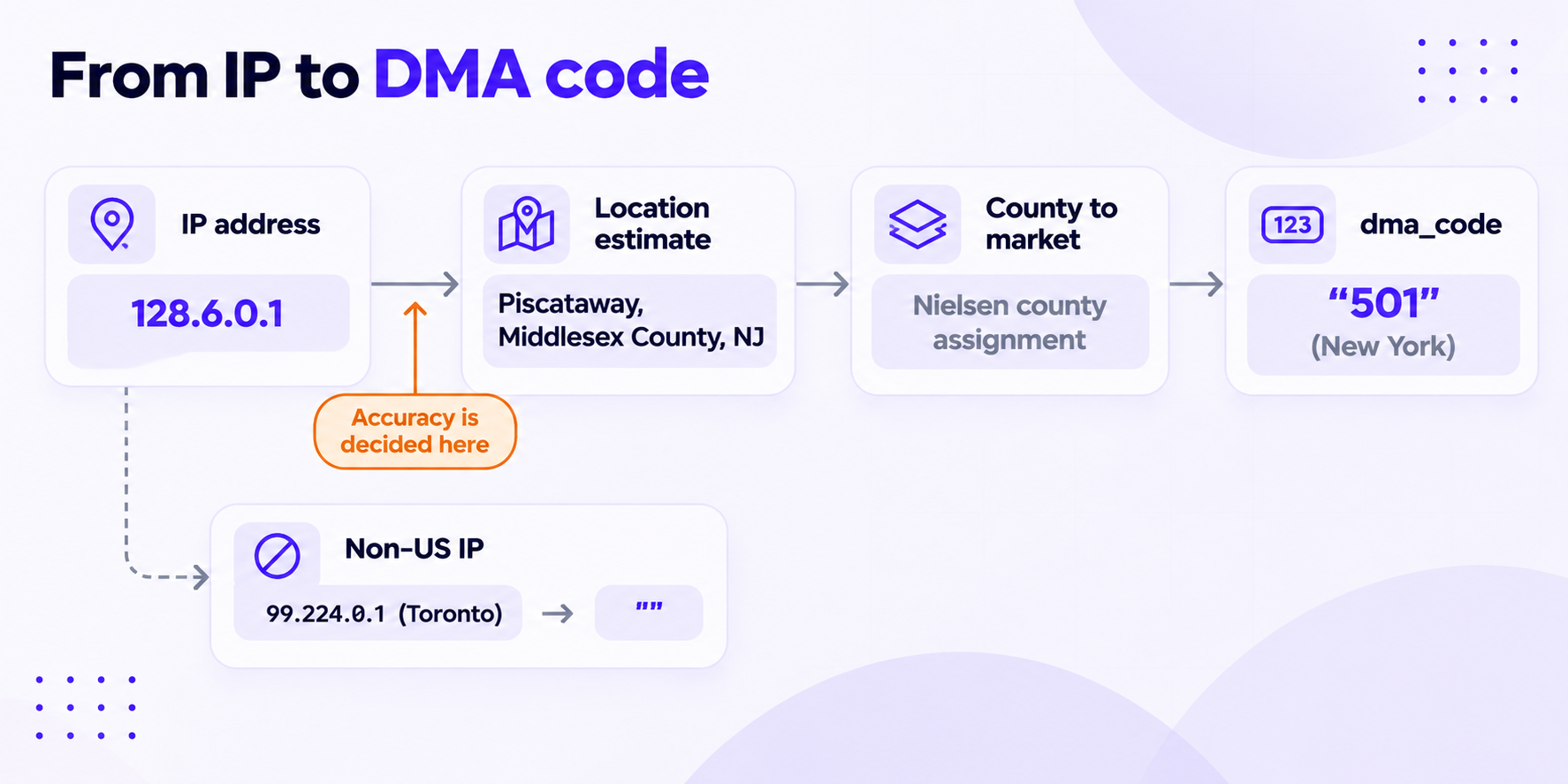
DMA Codes Explained: Mapping US Visitors to TV Markets A DMA code is a three-digit Nielsen identifier for one of 210 US television markets: 501 is New York, 803 is Los Angeles, 807 is San Francisco-Oakland-San Jose. Media buyers plan, price, and report local TV by these markets, and a lot of web and ad stacks now tag visitors with them too. You can look up a DMA code by IP address. Check a visitor in Philadelphia and you get back "504". Look up a visitor in Toronto or San Juan and you get an empty value. That empty value is the correct answer, not a bug, and most DMA reporting problems start when a pipeline forgets it. TL;DR - A DMA (Designated Market Area) is a Nielsen TV market built from whole counties. There are 210, with three-digit codes running from 500 to 881. - DMAs are US-only. Canada, Puerto Rico, and everywhere else return no code, and common tools encode "no DMA" differently. MaxMind’s similarly named metro_code is a deprecated legacy field, not a current Nielsen DMA code. - An IP-derived DMA is only as good as the location estimate under it. Trust it in aggregate, not per person. - Ad platforms no longer take the bare code: Google Ads wants its own location ID, and Meta switched to Comscore Markets in June 2026. - Store the Nielsen code as a string, normalize empty to NULL, and translate to platform IDs at the edge. In short: the DMA code is a market label, not a precise location. Pull it from an IP lookup for US traffic, keep "no market" and "lookup failed" as separate states, and treat the Nielsen code as your canonical key, because Google, Meta, and OpenRTB each describe the same New York market with a different identifier. What a DMA code actually is Nielsen defines a DMA as a group of counties where the home-market TV stations capture the dominant share of viewing. There are 210 of them. They don't overlap, and together they cover the continental US, Hawaii, and parts of Alaska. Nielsen reviews the county assignments every year and ranks the markets by the number of TV households in each. The code itself is a three-digit label. Radar's published DMA list starts at 500 (Portland-Auburn) and ends at 881 (Spokane), with gaps along the way, so 210 codes are spread across a range of 382 numbers. It isn't a ZIP code, an area code, or a number you can do math on. 798 is Glendive, Montana; that tells you nothing about 797. Because markets are built from counties, they ignore state lines. An IP that geolocates to Piscataway, New Jersey comes back as 501, because Nielsen assigns its county, Middlesex, to the New York market. One more thing before the useful part: the acronym collides with everything. When I checked Google's AI Overview for "dma code" in November 2026, it explained Direct Memory Access cheat hardware for Call of Duty. In this article DMA means the Nielsen media market and nothing else. US-only, and "US" is narrower than you'd guess Nielsen's footprint is the continental US, Hawaii, and parts of Alaska. Outside it, there is no DMA to return. Here's what five live DMA code lookups returned on November 3, 2026: | IP | country_code2 | Location | dma_code | |---|---|---|---| | 107.161.145.197 | US | Philadelphia, PA | "504" | | 8.8.8.8 | US | Mountain View, CA | "807" | | 128.6.0.1 | US | Piscataway, NJ | "501" | | 136.145.0.1 | PR | San Juan, Puerto Rico | "" | | 99.224.0.1 | CA | Toronto, ON | "" | The Puerto Rico row is the one that surprises people. It's US territory, but it's not in a Nielsen DMA, and the lookup reports it as country PR, not US. A country_code2 == "US" check already filters it out, which is convenient as long as nobody "fixes" the check to include territories. The bigger problem is that every system spells "no DMA" differently: | System | Field | Value when there's no DMA | |---|---|---| | IPGeolocation API | location.dma_code | "" (empty string) | | Cloudflare Rules | ip.src.metro_code | null (typed String \| null) | | Adobe Analytics | US DMA dimension | "No Metro (0)" for all non-US traffic | Pick one representation at ingest, and make it NULL. An empty string survives into GROUP BY dma_code as a market of its own, and a zero turns into a bar on a chart labeled "No Metro" that someone in a planning meeting will ask about. And never backfill the nearest US market for a Canadian visitor. That's inventing audience, and it will show up as a strange lift in Buffalo. How an IP turns into a DMA code I'll use IPGeolocation for the examples because the DMA is one extra include on the same lookup that returns city, county, and ZIP, so there's no second call. The field comes from the include=dma_code option in IPGeolocation's location API. It needs a paid plan, but it's billed as part of the one-credit location lookup rather than as an add-on. # Keep the key in an env var; never paste it into scripts you commit. curl -s "https://api.ipgeolocation.io/v3/ipgeo?apiKey=${IPGEO_API_KEY}&ip=107.161.145.197&include=dma_code&fields=location" The response, verbatim from a live call: { "ip": "107.161.145.197", "location": { "continent_code": "NA", "continent_name": "North America", "country_code2": "US", "country_code3": "USA", "country_name": "United States", "country_name_official": "United States of America", "country_capital": "Washington, D.C.", "state_prov": "Pennsylvania", "state_code": "US-PA", "district": "Philadelphia County", "city": "Philadelphia", "dma_code": "504", "zipcode": "19102", "latitude": "39.95258", "longitude": "-75.16522", "is_eu": false, "country_flag": "https://ipgeolocation.io/static/flags/us_64.png", "geoname_id": "9849057", "country_emoji": "🇺🇸" } } fields=location keeps the example short. Drop it and the same call also returns the country metadata, currency, ASN, and time zone objects. Two things in the location object matter here. dma_code is a string, so treat it like one. And district holds the county, which is the unit Nielsen builds markets from. Get the county right and the market follows. That's also where accuracy lives. The chain runs from IP to estimated location to county to market, so a wrong county means a wrong market, and a county on a market border is the easiest one to get wrong. Adobe's US DMA documentation lists the usual suspects: corporate proxies, mobile carriers that backhaul traffic through regional hubs, satellite ISPs, military networks, and relays like iCloud Private Relay. I treat DMA as an aggregate signal. "Sessions from the Philadelphia market doubled during the TV flight" holds up. "This visitor is in Philadelphia, so show the Philadelphia ad" is a guess with decent odds, not a fact. !Flow from IP 128.6.0.1 to Middlesex County, New Jersey, to Nielsen market 501, with a non-US IP branching to an empty value Current Nielsen DMA fields are also available from IPinfo, Cloudflare and Adobe Analytics. IPinfo exposes a dma_code string on its paid geolocation plans, Cloudflare provides ip.src.metro_code in its Rules engine, and Adobe fills its US DMA dimension server-side. MaxMind's deprecated metro_code is a legacy Google advertising metro code and should not be used as a current Nielsen DMA mapping. In a pipeline, I wrap the lookup so three outcomes stay separate: a market, no market, and a failed lookup. Collapsing the last two is how outages end up in reports as "non-US traffic spiked." import logging import os from dataclasses import dataclass from typing import Optional import requests API_URL = "https://api.ipgeolocation.io/v3/ipgeo" log = logging.getLogger(__name__) @dataclass(frozen=True) class DmaResult: code: Optional[str] # "501", or None status: str # "matched", "no_dma", or "lookup_failed" def lookup_dma(ip: str) -> DmaResult: api_key = os.environ.get("IPGEO_API_KEY") if not api_key: raise RuntimeError("IPGEO_API_KEY is not set") params = {"apiKey": api_key, "ip": ip, "include": "dma_code", "fields": "location"} try: resp = requests.get(API_URL, params=params, timeout=(1.0, 1.5)) resp.raise_for_status() data = resp.json() except requests.HTTPError as exc: # Do not log the exception object: it can contain the URL and API key. status = exc.response.status_code if exc.response is not None else "unknown" log.warning("DMA lookup failed for %s: HTTP %s", ip, status) return DmaResult(code=None, status="lookup_failed") except requests.RequestException as exc: # Log only the exception type, never the request URL. log.warning("DMA lookup failed for %s: %s", ip, type(exc).__name__) return DmaResult(code=None, status="lookup_failed") except ValueError: log.warning("DMA lookup returned invalid JSON for %s", ip) return DmaResult(code=None, status="lookup_failed") location = data.get("location") if isinstance(data, dict) else None if not isinstance(location, dict): log.warning("Unexpected response shape for %s", ip) return DmaResult(code=None, status="lookup_failed") code = str(location.get("dma_code") or "").strip() if not code: # The API sends "" outside Nielsen's footprint; store a real NULL. return DmaResult(code=None, status="no_dma") # Keep it a string. Codes are labels, and other sources send strings too. return DmaResult(code=code, status="matched") Store status in a column next to code. Then pass in the client IP your proxy or load balancer reports as trusted, not the raw left-most X-Forwarded-For value, which any client can set. How ad and local-media teams use the dma field Reporting web traffic by TV market Media plans are written in DMAs. If a brand runs local TV or streaming in three markets, the obvious question afterward is whether site traffic and conversions moved in those three markets and not in comparable ones. Tag sessions with dma_code, join on the plan, and the media team can read results in the same 210-market map they bought against. The same join supports matched-market tests: run a campaign in some DMAs, hold it back in similar ones, and compare. It works because buyer, seller, and analyst are all using one shared geography, which is rarer than it should be. Local sites and local sales A station or newsroom site can tell an in-market reader from an out-of-market one and adjust what it promotes, and a regional sales team can report audience by the markets it actually sells. Neither needs per-person precision. Both need the code to be consistent from one report to the next. Handing the market to an ad platform This is where the three-digit code stops being enough. Google Ads targets DMA regions through its own location IDs: the New York DMA is GeoTargetConstant 200501, and Google's documentation is blunt that "You cannot pass raw ISO or Nielsen codes." Meta went further. Effective June 22, 2026, it moved from Nielsen DMAs to Comscore Markets "across ads targeting and reporting solutions." In the Ads Insights API, breakdowns=dma is no longer supported; you request breakdowns=comscore_market instead. Map your Nielsen codes to Meta's Comscore market list explicitly rather than assuming the numbers carry over. Programmatic is fuzzier again. In OpenRTB 2.6, the bid request's geo.metro field is defined as a "Google metro code; similar to but not exactly Nielsen DMAs." | Where the market shows up | What New York looks like | |---|---| | IP lookup (Nielsen DMA) | 501 | | Google Ads location targeting | 200501 (GeoTargetConstant) | | Meta targeting and reporting (since June 22, 2026) | A Comscore market, via breakdowns=comscore_market | | OpenRTB bid request geo.metro | A Google metro code, "not exactly" a Nielsen DMA | My rule: the Nielsen code is the canonical key in the warehouse, and every platform ID is a translation done at the edge, from one mapping table that one person owns. Teams that let each platform's ID leak into the core tables spend their quarter reconciling dashboards. The licensing question Nielsen is explicit that "DMA® boundaries and data are solely owned and exclusive to Nielsen." It sells its ZIP-by-DMA data under tiers, and the reporting-only license "cannot be used for ad targeting, media buying or sales." Reporting on a market and targeting by it can be different questions under a license. So if DMA targeting is the plan, not just dashboards, read your IP data provider's terms for that use case, and ask if they're unclear. I'm not a lawyer, and this isn't legal advice; it's the one question worth asking before launch rather than after. Mistakes that make DMA data lie - Casting the code to an integer. Nothing breaks today because codes start at 500, but your IP lookup and Cloudflare both send strings, and "504" != 504 in most joins. - Treating "" or 0 as a market. See the NULL rule above. - Trusting an old metro_code pipeline. If it reads MaxMind's field, it's reading values MaxMind stopped maintaining. - Sending a bare Nielsen code to an ad platform. Google wants 200501-style IDs. Meta wants Comscore markets. - Caching the DMA forever. Nielsen reviews its county assignments every year, and IP locations move too. Re-resolve on a schedule. - Reading one visitor's DMA as fact. It's a market estimate for an IP, nothing more. A few extra notes IPv6 works the same way. 2001:4860:4860::8888 returns "807", the same market as 8.8.8.8. The response echoes the address in expanded form (2001:4860:4860:0:0:0:0:8888), so normalize IPs before joining on them. There's no non-US equivalent hiding in the same field. Other countries measure TV audiences with their own geographies, and none of them are Nielsen DMAs, so an empty dma_code outside the US stays empty. DMAs and metro areas aren't the same either. A DMA follows TV viewing; a census metro area follows commuting and economics. They often share a name and rarely share a boundary. If DMA is going into a long-lived table, store the Nielsen code as a string with a status column beside it, and re-resolve when Nielsen publishes a new season. Keep the Google and Comscore translations in a single mapping table, and the numbers will reconcile when the media team asks why the dashboard and the ad platform disagree.
@artistxeature Baberu OCRです。 コード公開もしています。 yukincom/nyamuru-image-hub
@minaridrive Just run a peartube relay. Happy to make it work for your needs if u wanna DM ayooooo123/peartube
LoGH SNES game gets an English fan translation To those who don't know, there are a ton of Legend of Galactic Heroes strategy games from the PC-88 to SNES, PSX and Saturn (best LoGH game). I've tried a bunch of them and they generally are just kinda meh because they tend to be very limited simulation of battles based on the OVA. Presentation wise they're still a lot of fun so I've used the retoarch AI translation feature to play them a bit. All of that said it looks like a very prolific generative AI fan translator of retro games produced an AI generated localization of the SNES LOGH game. I tried it for the first battle of Astate and it's definitely serviceable if a little dry. I've never seen any group announcing an intention to translate them and I don't have the skills to translate them so it's better than nothing.
This 👉 cloudflare/security-audit-skill. Thanks @Cloudflare, more like this please.
@AdamSzaloczi it's real) check the repo 0xProbabillity/claudeberry
I made a claude mod that automatically loads global agents skills for you. And skills in the current working dir as well. lassejlv/agents-skills