Mentions
Conversations linking to GitHub, newest first. Times are UTC.
Mentions by source
X
Bluesky
Hacker News
V2EX
Qiita
DEV
Mastodon
Latest posts
R.U.S.E. 2.0 update: An anti-cheat for Modded Multiplayer A quick update on R.U.S.E. 2.0, the free, open-source modding tools for R.U.S.E. (2010): - **RUSE Launcher** (for players): pick a set of mods and press Play. It builds a separate modded copy of the game; your Steam install is never touched. - **RUSE Studio** (for modders): change any unit, add new ones with their own 3D models, make and reshape maps, then press Test in game. **New lately (Studio 0.9.8.13 / Launcher 0.4.8.13):** - **RUSE Guard, an anti-cheat for multiplayer and co-op.** A game modded with cheats stays offline and can't join real matches (first picture), and players compare join codes to know they're running the same game. Single-player, skirmish and the campaign aren't touched.(WIP) - **Owned copies only.** The apps work only with a copy of R.U.S.E. you own on Steam. - **Big mods:** mod sets past 4 GB build and play, tested with 366 units from other eras in one game. Build menus sort them into groups so they fit on the screen, and builds are about 4 times faster. - **A map importer, in progress:** Part of Utah Beach already opens in the game as a map; it isn't fully working in the Studio yet. - Also: your mods and maps in Documents\RUSE 2.0, Bug Watch (opt-in crash reports) and Sign in through Steam. Download and everything else: sneadtristen6/R.U.S.E-2.0-Project Discord: discord.gg R.U.S.E. 2.0 is an independent fan project, not made or endorsed by Eugen Systems or Ubisoft, and it needs your own copy of the game. Feedback and bug reports are very welcome!
Explore the latest database intelligence expansion in EKOS, bringing PostgreSQL and ClickHouse into its unified database architecture alongside Oracle. 🤝🫂🤝 🔗 github.com/alexeyban/EKOS/commit/deac7ad6cd6dcba4…
Location: New York City Remote: yes, on-site or hybrid Willing to relocate: Yes Technologies: Python, TypeScript, LangGraph, RAG, evals, MCP, FastAPI, React, PostgreSQL, AWS Résumé/CV: venkatjs.netlify.app Email: svenkatesh.js@gmail.com LinkedIn: linkedin.com GitHub: github.com/Venkat-Git98 I build AI agents and the infrastructure behind them. Nearly 5 years of experience, currently the first AI engineer at an NYC startup, looking for Applied AI or Forward Deployed roles. I know GTM and financial services well. What I've built: - A lead generation product that combines 10+ signals across about 10,000 companies. It became our most adopted product. - The agent our customers use on the web and in Slack, with each customer's data kept separate. - The gateway behind 42.7M AI calls in 30 days across 17 services. - A self-hosted document pipeline that saves about $8K a month. - I also work directly with enterprise customers on onboarding and adoption. Side project: Between-Visit, a care-management demo on synthetic patients. Agents walk a knowledge graph of clinical guidelines, and every recommendation cites its source: between-visit-agent.netlify.app
Map globe component added to Sakani UI GitHub: samzydd/Sakani-design-system Figma: figma.com t.co
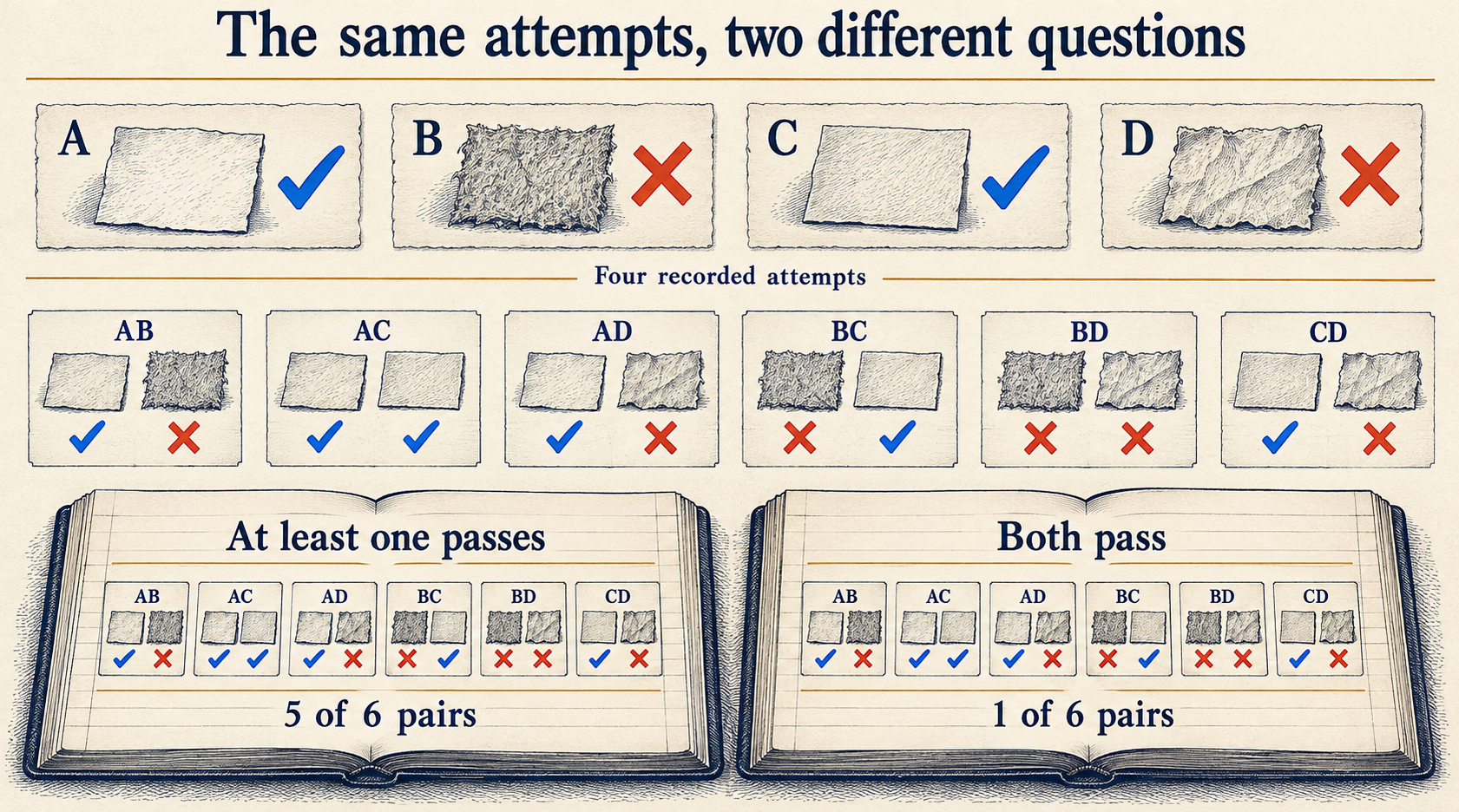
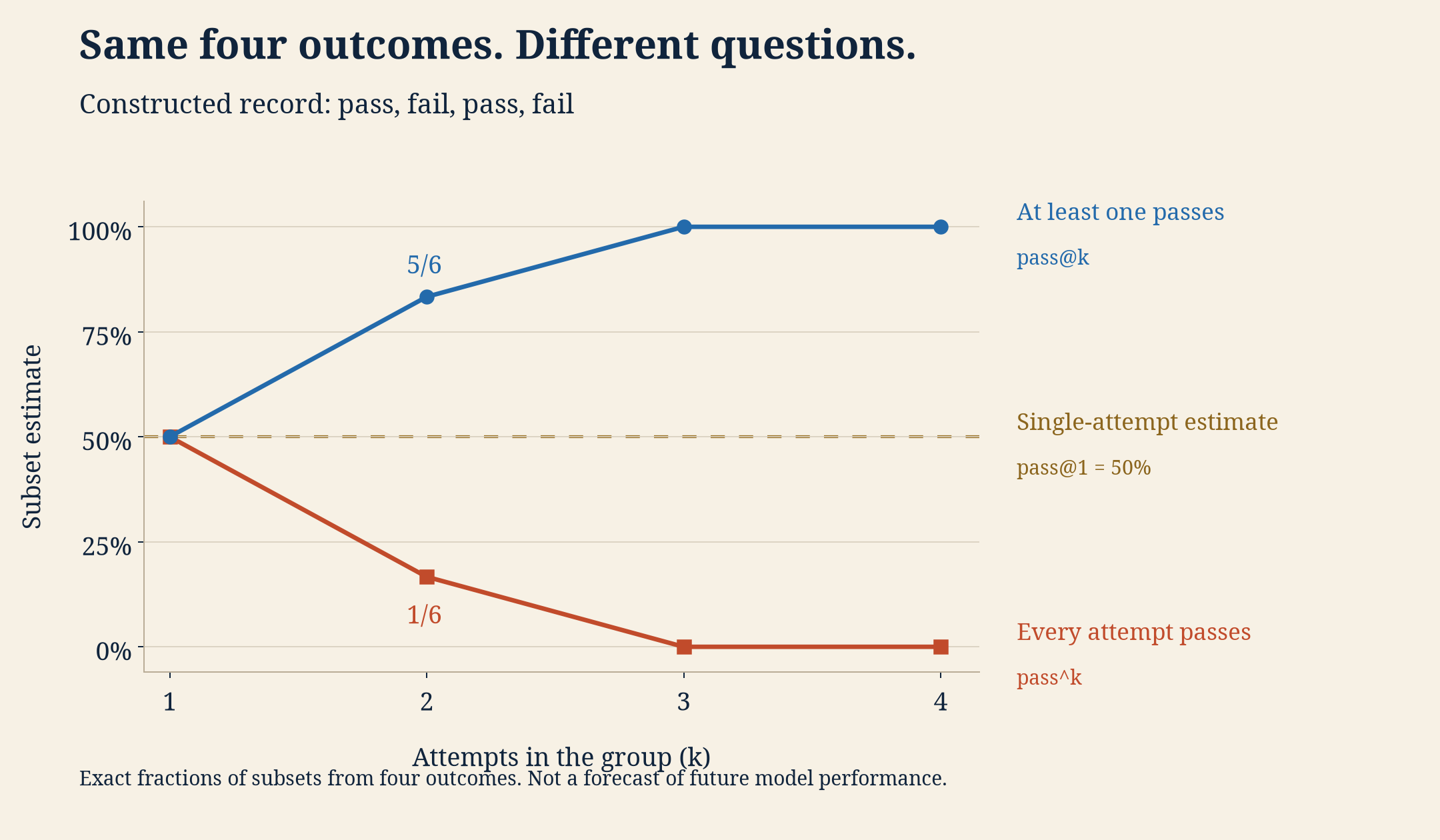
Passing once is not the same as being reliable Suppose a model gets a task right on its third attempt. Do we record a success? If the question is whether it can produce a correct answer within four attempts, yes. If the question is whether someone can depend on a single answer, that result is not enough. The attempts have not changed. The question has. In Before scoring a model, test the evaluator, I looked at mistakes in the code that grades Kubernetes configurations. This article takes the next step: once the grades are correct, what should we count? We will use four constructed outcomes, inspect every pair, and calculate three commonly confused metrics. There are no model measurements in this example. You can reproduce the calculations with Python, without an endpoint or a cluster. If evals are new to you, the first article explains tasks, graders, and scores. On this page - [Keep the individual attempts](#keep-the-individual-attempts) - [Three questions behind three scores](#three-questions-behind-three-scores) - [Count the pairs yourself](#count-the-pairs-yourself) - [What a higher score leaves out](#what-a-higher-score-leaves-out) - [Run the calculation](#run-the-calculation) - [What I would report](#what-i-would-report) Keep the individual attempts Take a task like the ones in IaC Eval Bench: produce a Kubernetes Service that selects the intended pods and sends traffic to the requested port. Imagine four fresh attempts with the same prompt, model settings, and grading rules. Each starts without seeing earlier answers or their feedback. Here is a constructed record: | Attempt | Relevant behavior in the answer | Grade | | --- | --- | --- | | A | Selector and target port meet the requirements | Pass | | B | Selector does not match the intended pods | Fail | | C | Selector and target port meet the requirements | Pass | | D | Target port does not meet the requirement | Fail | Two answers passed. Two failed. Saving only answer A would hide half of what happened. These are grades against the stated checks. A pass does not establish that the workload was deployed or that it served traffic. Three questions behind three scores The notation is similar, but the questions differ: | Metric | Question | | --- | --- | | pass@1 | Does a single attempt pass? | | pass@k | Among k attempts, does at least one pass? | | pass^k | Do all k attempts pass? | Here, k means the number of attempts in the group being evaluated. It does not mean the number of tasks or the number of tool calls within one attempt. The HumanEval paper uses pass@k to evaluate whether generated code samples include a solution that passes the tests. The tau-bench paper introduces pass^k to examine consistency across repeated agent trials. For our four outcomes, the estimate of pass@1 is 2/4, or 50%. This uses all four recorded attempts to estimate single-attempt success. It does not mean we inspect only the first answer. Now suppose we care about groups of two attempts. Does one answer in the pair need to work, or do both need to work? Count the pairs yourself There are six ways to choose two distinct attempts from A, B, C, and D: | Pair | Grades | At least one passes | Both pass | | --- | --- | --- | --- | | AB | Pass, Fail | Yes | No | | AC | Pass, Pass | Yes | Yes | | AD | Pass, Fail | Yes | No | | BC | Fail, Pass | Yes | No | | BD | Fail, Fail | No | No | | CD | Pass, Fail | Yes | No | Five pairs contain a passing answer. Only one pair contains two passing answers. So the estimates are pass@2 = 5/6, about 83.3%, and pass^2 = 1/6, about 16.7%. !The four constructed attempts are A pass, B fail, C pass, and D fail. Of their six distinct pairs, every pair except BD contains a pass; only AC contains two passes. Figure 1. The same outcomes answer two different questions. Choosing every possible pair makes the difference visible. We can repeat the calculation for each group size: | Attempts in the group, k | pass@k: at least one passes | pass^k: every attempt passes | | --- | --- | --- | | 1 | 50% | 50% | | 2 | 83.3% | 16.7% | | 3 | 100% | 0% | | 4 | 100% | 0% | Any group of three from these four outcomes contains a pass and a failure. That explains the last two rows without needing a formula. !Plot of estimates from the four constructed outcomes. As k goes from one to four, pass at k rises from 50 to 100 percent and pass power k falls from 50 to zero percent. The single-attempt estimate stays at 50 percent. Figure 2. Calculated from the four outcomes above. The model has not improved between points; only the group size and success condition have changed. Connecting lines guide the eye between integer values of k. Why not just square 50%? If a task's true success probability were known to be 50%, independent future attempts would both pass with probability 25%. At least one would pass with probability 75%. But we do not know that true probability from four observations. Here we are calculating estimates by choosing distinct samples from a finite record. Those are different calculations. Under independent, identically distributed attempts, the subset formulas estimate the corresponding future-attempt probabilities without the bias introduced by simply taking powers of the observed success rate. The 100% entries above are estimates from a tiny record, not guarantees about future runs. In fact, several pairs reuse the same attempts. Six pairs are not six independent experiments. What a higher score leaves out Someone still has to choose the answer For pair AB, the benchmark knows that A passed. A user looking at two plausible configurations may not. If the application has a trustworthy checker, it may be able to select a passing candidate. If it uses another model to choose, that selection can fail too. Measure the answer the whole system actually returns, including its selection step. A correct answer existing somewhere in a batch is useful information. It is not the same as returning that answer. Retries change the budget A system allowed four attempts has a different opportunity from one allowed only one. Keep the attempt budget visible when comparing scores. Record latency, tokens, and cost across the attempts, including failures. Parallel attempts might reduce waiting time compared with sequential attempts, but they still consume resources. If the system stops early, record when and why it stopped. Feedback changes the experiment An agent that sees a validation error and edits its previous answer is running a repair process. Its later attempts depend on earlier results. That can be a useful system to evaluate. Run the complete repair process, with a fixed budget, and score its final outcome. Do not treat its dependent steps as fresh independent samples in the calculation above. Reset the environment between trials of the whole process. An average can hide which tasks are unreliable Imagine two tasks, each attempted four times. In one constructed record, the first task always passes and the second always fails. In another, each task passes twice and fails twice. Both records have 50% pass@1. Their repeated-attempt estimates differ: | Constructed record | Mean pass@2 | Mean pass^2 | | --- | --- | --- | | One task always passes; one always fails | 50% | 50% | | Each task passes twice and fails twice | 83.3% | 16.7% | Calculate the metric for each task, then average across tasks. Keep the per-task results as well. Taking a power of the overall pass rate would miss this difference. Run the calculation For n recorded attempts with c passes, the subset estimates are: pass@k = 1 - C(n - c, k) / C(n, k) pass^k = C(c, k) / C(n, k) C(a, k) counts the ways to choose k items from a items, without replacement. It is zero when there are too few items. Choose k from 1 through n. The first formula counts groups that are not entirely failures. The second counts groups made entirely of passes. You can inspect the reference implementations in HumanEval and tau-bench. Here is the central calculation using Python's standard library: from fractions import Fraction from math import comb outcomes = (True, False, True, False) n, c, k = len(outcomes), sum(outcomes), 2 at_least_one = 1 - Fraction(comb(n - c, k), comb(n, k)) every_attempt = Fraction(comb(c, k), comb(n, k)) print(at_least_one, every_attempt) # 5/6 1/6 The complete example retains the outcomes, lists all six pairs, and checks both formulas against direct enumeration for every Boolean sequence of lengths one through eight and every valid k. That covers 3,586 sequence-and-k combinations, including all-pass and all-fail records. It also checks invalid inputs and task averaging. Download that file and run: python3 repeated_attempts.py --verify It requires no additional packages. The output includes the exact fractions and a verification status of passed. The saved output is available alongside the code. What I would report For a repeated-attempt eval, I would keep these together: 1. The task and grading rule. What does a pass actually establish? 2. Every attempt and its result. Include failures and record infrastructure errors separately, with a stated rule for how they affect the denominator. 3. The sampling or repair setup. Record model version, settings, resets, feedback, selection method, and stopping rule. 4. The budget and measurements. Show attempts per task, latency, token usage, and cost alongside the score. 5. Per-task results and uncertainty. A few attempts can explain a metric; they cannot establish dependable performance on their own. For IaC Eval Bench, these repeated-attempt metrics are a standalone teaching example, not a new measured model result or a change to the benchmark's scoring. The next useful experiment would retain several fresh attempts per task under a fixed configuration and inspect the failures before summarizing them. When I see a pass rate now, the first thing I want to know is what had to happen for the run to count as a pass: one successful answer, a correctly selected answer, or success every time?
My instructions (to compile into rules + AGENTS.md): adelrodriguez/instructions
Low-Cost Property Ticket Summarization — Token Reduction Strategies in Node.js TL;DR: For low-cost property-management support triage, use an API for bounded summarization: normalize the ticket once, reduce repeated tokens, persist the structured result, and retain the raw conversation only for the period your audit policy requires. These token reduction strategies also work in a Node.js worker, even though the validation rules below are shown in Python. Measure tokens before using the API, reject malformed output, and do not confuse a shorter prompt with a cheaper or safer system. The expensive part is usually repeated context, not the final few sentences. A ticket such as The boiler is still out after the contractor visit; please call me after 6pm needs a queue, urgency, property identifier, and a short reason. It does not need the entire email thread copied into every retry. That distinction matters more than shaving adjectives from a prompt. Shorter is not automatically safer. Consider a tenant who sends three replies in one thread. The newest message says the leak is contained, the quoted message says water is entering the bedroom, and an automated footer repeats the property address twice. A naive character limit can preserve the footer and the reassuring sentence while dropping the safety detail. A field-aware normalizer can keep the newest unquoted text, extract the address into a controlled field, retain safety terms from the quoted context, and mark the record as requiring review. That is a longer implementation than text[:4000], but it prevents a token reduction strategy from silently changing the operational meaning of the ticket. The API call should receive the normalized representation, while the original thread remains in the short-lived evidence store under the retention policy. What should the storage bill actually retain? I start with the retention question because token reduction is only half of the runtime cost. A useful record has three layers: the normalized input, the model-produced decision, and enough provenance to reproduce the decision. Keeping all three forever is easy to implement and difficult to defend. Keeping only the summary makes later disputes hard to investigate. For a first pass, retain the raw ticket for 30 days, the normalized text and structured decision for 180 days, and an immutable hash of the input with the processing metadata for the longer audit period. Those are policy examples, not universal legal requirements; a property operator must set the periods with its legal and support teams. The engineering point is that different data has different value. I first thought the token count would dominate the retention decision; later, the more useful distinction was whether a record could explain a disputed routing result without exposing the whole conversation. | Record | Needed for triage | Useful for investigation | Retention decision | | --- | ---: | ---: | --- | | Raw message and attachments | No, after normalization | High | Short, policy-defined window | | Normalized ticket text | Yes | High | Longer than raw content | | Structured decision | Yes | High | Operational and audit window | | Input hash and runtime metadata | No | Medium | Long-lived integrity record | The trade-off is uncomfortable: deleting raw text reduces exposure and storage, but it removes the easiest evidence when a resident contests an urgency label. I would rather make that loss explicit than hide it behind an apparently low token count. A retention job should record what it deleted and why, while the triage table keeps the decision, schema version, tokenizer name, and processing timestamp. How can low-cost summarization use an API without losing token-critical detail? Use a pipeline with a narrow contract. First strip quoted reply chains, signatures, tracking parameters, and duplicated notification text. Then preserve the fields that can change routing: stated problem, location, access constraints, safety language, requested time, and the ticket identifier. Redaction must happen before token counting, and token counting must happen before the request. The same strategies apply when a Node.js service calls an API; the language changes, while the boundary and the evidence do not. A tokenizer is an estimator for a particular encoding, not a universal measure of meaning. The tiktoken project documents a byte-pair encoding library and provides encoding utilities; use the encoding appropriate to the runtime configuration, then compare the count with the service's actual usage telemetry. A count made with a different encoding can be directionally useful and operationally wrong. In an API integration, call the counter a local estimate and keep the measured usage returned by the service as the accounting record. Here is the important boundary in Python: the function prepares data and enforces a local input limit, but the network adapter remains generic. It also keeps the summary cache key tied to content, policy, and schema rather than to a mutable ticket status. Version 1 of this boundary should be boring: a normalized payload, one bounded request, and one validated write. import hashlib import json from dataclasses import dataclass from typing import Any import tiktoken @dataclass(frozen=True) class TicketInput: ticket_id: str text: str policy_version: str schema_version: str def token_count(text: str, encoding_name: str) -> int: encoding = tiktoken.get_encoding(encoding_name) return len(encoding.encode(text)) def cache_key(ticket: TicketInput) -> str: payload = json.dumps( { "text": ticket.text, "policy_version": ticket.policy_version, "schema_version": ticket.schema_version, }, sort_keys=True, separators=(",", ":"), ).encode("utf-8") return hashlib.sha256(payload).hexdigest() def prepare(ticket: TicketInput, encoding_name: str, max_tokens: int) -> dict[str, Any]: count = token_count(ticket.text, encoding_name) if count > max_tokens: raise ValueError(f"ticket exceeds local input limit: {count} > {max_tokens}") return { "ticket_id": ticket.ticket_id, "text": ticket.text, "input_tokens_estimate": count, "cache_key": cache_key(ticket), "policy_version": ticket.policy_version, "schema_version": ticket.schema_version, } The limit is a guardrail, not a license to truncate blindly. A hard cut in the middle of a sentence can remove not from do not enter, or separate a unit number from an access instruction. Prefer field-aware normalization and an explicit overflow state. Tickets that still exceed the limit can go to manual review or a separate chunking path, with that route visible in metrics. What does a correct structured result look like? Summarization is a poor success criterion for triage. The queue needs a valid object. A minimal contract might contain category, urgency, property_id, requested_callback_window, reason, and needs_human_review. Every field needs an allowed shape, and every missing value needs a defined representation. Empty strings and nulls are not interchangeable if downstream routing treats them differently. Validate the decoded object before writing it to the queue. Check the schema, enum values, identifier format, and cross-field rules. For example, needs_human_review should be true when the category is unknown, when safety language is present, or when the property identifier is absent. That rule belongs in deterministic code; asking a model to remember it in prose makes a storage record look complete while the routing decision remains ambiguous. from typing import Any ALLOWED_URGENCY = {"routine", "priority", "emergency", "unknown"} def validate_decision(value: Any) -> dict[str, Any]: if not isinstance(value, dict): raise ValueError("decision must be an object") required = { "category", "urgency", "property_id", "requested_callback_window", "reason", "needs_human_review", } if set(value) != required: raise ValueError("decision fields do not match the contract") if value["urgency"] not in ALLOWED_URGENCY: raise ValueError("unsupported urgency") if not isinstance(value["needs_human_review"], bool): raise ValueError("needs_human_review must be boolean") if not isinstance(value["reason"], str) or not value["reason"].strip(): raise ValueError("reason must be non-empty") return value Do not retry a malformed response with the same unbounded prompt. Record the validation failure, apply a bounded retry policy, and route the ticket to a human when the contract still fails. A retry that creates a second stored decision without linking it to the first is an audit defect, even if the second answer looks better. Which failures survive a shorter prompt? Token reduction does not fix duplicate delivery, stale cache entries, or a queue worker that crashes after the model call and before the database commit. Give each processing attempt an idempotency key derived from the ticket revision, policy version, and schema version. Store an attempt state such as started, validated, persisted, or manual_review; do not infer state from whether a summary column happens to be non-null. This is where a low-cost design can become expensive. If the worker commits the ticket state before it commits the decision, a retry can send the same text again and create two plausible summaries. If it commits the decision first, a crash can leave a decision with no queue transition. The durable answer is a transaction or an outbox-style handoff that makes the state transition explicit; prompt shortening cannot repair that ordering problem. The cache deserves the same skepticism as the prompt. A ticket can be edited after a resident adds a safety detail. If the key uses only ticket_id, the old classification can be served as new. If the key includes the normalized content hash and policy versions, an edit creates a new decision while identical retries reuse the existing one. That is more storage than a single mutable row, but it gives the operator a defensible history. Observe four quantities separately: normalized input tokens, output tokens, validation failures, and repeat-processing rate. Aggregate them by ticket class and policy version. A falling average token count can conceal a rising overflow rate; a stable model response can conceal duplicate writes. I would page on the operational consequence, not on a vanity token number. A practical decision rule Keep the input bounded by removing repeated context and retaining decision-bearing fields. Count with the runtime's intended encoding. Require a strict structured object, validate it locally, and persist the exact versions that shaped it. Cache by content and policy, not by a mutable identifier alone. Retain raw text for a declared period, then delete it through an auditable job while keeping the minimum provenance needed to explain the routing result. The deliberate loss is raw evidence after the retention window. The benefit is a smaller exposure surface and a storage policy that can be explained field by field. If the business cannot accept that loss, the answer is a longer approved retention period or a separate controlled archive, not a more aggressive prompt rewrite. Further reading - openai/tiktoken - json-schema.org - rfc-editor.org
DeepSeek Released an Open-Source Agent That Opens Pull Requests Alone An agent that opens pull requests on its own, and it's free. But before you hand it your repository, there's a caution. DeepSeek released Super-agent in late October 2026, an open-source coding agent under the MIT license. It watches a GitHub repository (and, if you want, a team chat), works on several tasks in parallel, and answers with a pull request right in the conversation. A local panel only shows you what needs your decision. The catch: it's a research prototype, not an official DeepSeek product. You need DeepSeek Harness, a separate GitHub account for the agent, and a model provider, and DeepSeek recommends running it under a separate operating-system account because its sessions have full access. SOURCES - Official repository (README) deepseek-ai/dsh-superagent-prototype - Launch article (ShiftDelete) shiftdelete.net #DeepSeek #AIAgents #GitHub #OpenSource
@coolcoder56 Thanks Asmit! Really appreciate your support. Lmk what you think of Beacon if you try it out :) Asymptote-Labs/agent-beacon
To pre-empt any replies: yes, I absolutely prefer BSDs over Linux any day. But even those are flawed and I really think we missed the Symbolics golden era. THAT would be the age of "own and live in the system". OpenBSD gets closest there. At least the codebase is hackable enough. Linux went off the fucking rails. What the fuck is that over engineered yes command?! Edit: github.com/coreutils/coreutils/blob/master/src/ye… 270 loc for a tool that prints "y" in a loop. WTF?! Meanwhile this exists: github.com/openbsd/src/blob/master/usr.bin/yes/ye…
WiFi can now sense people through walls, with no camera. RuView turns WiFi signals into presence, breathing and heart rate sensing from low-cost ESP32 boards, and works with Home Assistant. Note: It needs an ESP32 board and is beta software. GitHub: ruvnet/ruview
Show HN: Mago, an open source AI video studio, runs locally with Comfy I'm Alvaro, one of the founders of Mago. With my co-founder Alex (creator of Warpfusion, open source video to video), we built an open source AI video studio specialized in long form content and large volumes of video. It's a desktop app that you can run for free on your own GPU, that uses a portable ComfyUI or can be plugged into an existing Comfy setup. It handles both hybrid production (video to video, AI VFX) and full AI (microdramas, AI series for social etc). Back when Alex was working on Warpfusion, we were discussing making an app for "real" production, meaning hours of video, films, series, etc. We started off building a closed source solution, but we're now going back to our roots. In short: there's a billion AI video tools and it seems like everyone wants to make their own, in fact with the progress of LLMs I'm more and more convinced by the idea of personal software. AI series for TikTok and VFX on a feature film have completely different needs. AI video is also quite expensive still, unless you can run it on your own GPU. So not only can you run models for free, if the app is open you can also fork it into whatever you want! Finally, we've been hearing for more than a year that Comfy can be a little too complex, so we thought, well why not try and make open source plug and play? That's the end goal. Limitations: you'll need an Nvidia GPU with 16GB+ of VRAM and 60GB+ of disk space to host the models (Qwen, Minimax H3). License is AGPL. You can also use closed source models with a Mago subscription. Please try it out and let me know what we should add next!
Show HN: One Roof – mission control for many coding agents. You stay in charge
Welcome to Part 2: Data & Text! 📓 Course notebooks are on GitHub: fahim202342/Python_complete_course — run every example yourself as you watch.
Aurora File Manager RC2 – A Powerful Open-Source Android File Manager | New Features, Root Support & Performance Improvements. Introducing Aurora File Manager RC2 – An Open-Source Android File Manager I'm excited to share the latest release of Aurora File Manager, now available as Release Candidate 2 (RC2)! Aurora File Manager is an open-source Android file manager focused on usability, privacy, and advanced file management capabilities, including root directory browsing. What's New in RC2? This release introduces a wide range of improvements and new functionality. New Features & Improvements - Welcome & Permission Onboarding: Introduced a first-launch onboarding experience explaining required permissions, including MANAGE_EXTERNAL_STORAGE, root (su) access, and FileProvider functionality. - Full Spanish Language Support: Added complete Spanish (es) localization across application interfaces, onboarding screens, and system messages. - Quick Access Folder Filter Chips: Added a horizontally scrollable quick-access bar for Documents, Downloads, Pictures, Videos, Music, and Internal Storage. - Select All & Multi-Selection Counter: Added Select All / Deselect All functionality and a live counter displaying the number of selected items. - Batch Clipboard Operations: Enabled copying, cutting, and pasting multiple files and folders simultaneously. - One-Tap Search Clearing: Added a clear button directly inside the search field. - Native Back Navigation: Integrated Jetpack Compose BackHandler for intuitive navigation across drawers, multi-selection, search, and directory hierarchies. Bug Fixes & Technical Improvements - Device Storage Calculation: Fixed storage calculation issues involving / system paths using StatFs across /data and emulated storage volumes. - Root Directory Browsing: Implemented root shell (su) command fallbacks and mount-point discovery for browsing protected directories, including /data, /system, and SD cards. - File Opener & MIME Type Detection: Added automatic MIME type detection and Intent.createChooser, with ClipData URI permissions for common file formats. - Self-Copy Protection: Added canonical path checks to prevent recursive copying and accidental self-overwriting. - Release Build Optimization: Enabled R8 code and resource shrinking to optimize APK size and release performance. Important Compatibility Notice Some users may encounter installation difficulties on certain Samsung devices. Installation success may vary depending on the device model and software configuration. If you encounter installation problems, please report your device model, Android version, and any relevant error messages through the GitHub Issues page. Privacy & Open Source Aurora File Manager is committed to transparency and user privacy. - 100% open source. - Zero data collection. - No unnecessary data transmission. Download Aurora File Manager RC2: github.com/Computer-genius1/AuroraFileManager/rel… GitHub Repository: Computer-genius1/AuroraFileManager Bug Reports & Feedback For organized bug tracking, feedback, and development updates, please use the Issues tab on our GitHub repository. GitHub Issues: github.com/Computer-genius1/AuroraFileManager/iss… When submitting an issue, please include: - Device model - Android version - Steps to reproduce the problem - Screenshots or error messages, if available Reporting bugs through GitHub Issues makes it easier to investigate problems, track their progress, and provide organized status updates. What's Next? Aurora File Manager RC2 is still a release candidate. RC3 is planned, with additional improvements, refinements, and testing before the eventual Aurora File Manager 1.0 Stable release. Thank you to everyone testing Aurora File Manager and helping improve the project. Your feedback and contributions are greatly appreciated! preview.redd.it
Cacti OS - Emulation fronend I have been contemplating on whether I should post this. Last time I posted a mockup, an avalanche of downvotes were given. Gaming is a passion for me and I felt that retrogaming started going in a different direction that I had hoped. A modern gaming os with retroachievement integration was what I had hoped for, but it hadn't matured like I had hoped. Curious about AI, I decided to pull the trigger with Claude AI and see what I could make given I do not have the coding knowledge to do this on my own. This is where Cacti OS was born. Cacti OS is still EARLY its development, so if anyone would like to try it, I'd love feedback on issues or directions you would like to see it progress. Thanks! kryptalivian/CactiOS-Updates
What Is Danmaku? How to Download Bilibili Bullet Comments and Find Any Video's Highlight Of Bilibili !Image description If you've ever opened a video on Bilibili (哔哩哔哩, B站), you've seen them: comments flying across the screen, right on top of the video. Those are danmaku (弹幕, "bullet comments"), and they're one of the most interesting datasets on the Chinese internet. In this post: 1. What danmaku actually is, and why it's useful data 2. How to download Bilibili bullet comments without a login (no code, or Python) 3. How to find any video's highlight moment from danmaku density 👉 Tool used: Bilibili Danmaku Scraper on Apify · Source on GitHub What is danmaku (弹幕)? Danmaku literally means "bullet curtain". On Bilibili, each danmaku is a short comment that viewers post at a specific second of the video. Everyone who watches later sees it fly across the screen at that same moment. Some you'll see everywhere: | Danmaku | Meaning | |---|---| | 前方高能 | "High energy ahead!" (something big is about to happen) | | 名场面 | An iconic scene | | awsl | "Too cute, I'm dying" | | 2333 | Laughing (like "lol") | | 泪目 | Tears in my eyes | Unlike normal comments, every danmaku has a timestamp. That makes it unusually good data: - Highlight detection: where danmaku spike, something happened. - Second-by-second audience reaction: for trailers, ads, product launches or game reveals. - Sentiment over time: when do viewers love it, and when do they complain? - Clip finding: creators use spikes to decide which moments to cut into shorts. How to download Bilibili bullet comments (no login) Bilibili has no public API for danmaku, and there's a catch: logged out, Bilibili serves danmaku from two different endpoints. One gives a sample across the video's whole lifetime, the other the most recent few thousand. They barely overlap, so most simple scripts miss a lot. The Bilibili Danmaku Scraper merges both. On a 34-minute video that gave 5,416 danmaku rows without logging in. Option 1: No code 1. Open the Bilibili Danmaku Scraper and click Try for free. 2. Paste video links, or give it search keywords, UP主 (creator) IDs or the popular/ranking feed. 3. Click Start, then Export to Excel, CSV or JSON. Example input: the danmaku of the top 10 search results for a keyword, plus a free summary per video: { "searchQueries": ["原神"], "maxVideosPerSource": 10, "videoSummary": true } Each row is one bullet comment: | Field | Meaning | |---|---| | time | Playback position in seconds | | content | The text | | mode, fontsize, color | Scrolling / top / bottom, size, colour | | ctime | When it was sent | | bvid, page | Which video and part | Pricing: $1 per 1,000 danmaku, no subscription. The per-video summary rows are free. Option 2: Python git clone https://github.com/Dunkmap/Bilibili-Danmaku-Scraper cd Bilibili-Danmaku-Scraper pip install -e . bili danmaku BV1xx411c7mD -o danmaku.csv Find a video's highlight from danmaku The quick way: the free summary row With videoSummary: true, every video gets one extra free row before its danmaku, with: - count: how many danmaku - density: a 20-slice timeline of how busy each part of the video is - peak_time: the busiest moment, which is usually the highlight - top_phrases: the most repeated phrases - samples: a handful of distinct texts So you can find the highlight of 100 videos without paying for a single danmaku row. Just read peak_time. The DIY way: pandas If you exported the full danmaku as CSV: import pandas as pd df = pd.read_csv("danmaku.csv") df = df[df["content"].notna()] # keep danmaku rows only # danmaku per 30-second window df["window"] = (df["time"] // 30) * 30 per_window = df.groupby("window").size() peak = per_window.idxmax() print(f"Highlight around {int(peak // 60)}:{int(peak % 60):02d}") # what people were saying at the peak at_peak = df[df["window"] == peak]["content"] print(at_peak.value_counts().head(10)) per_window.plot(kind="bar", figsize=(12, 4), title="Danmaku per 30 s") At the peak you'll typically see a burst of 前方高能, 名场面 or 哈哈哈. Useful extras - Keyword filter (keywords): keep only danmaku containing certain words, for example a brand or product name. Filtering happens before charging, so you only pay for matches. - Sentiment analysis: label each danmaku positive, neutral or negative. - Delta mode: for scheduled monitoring, return only danmaku that are new since the last run. Need comments, video stats or UP主 profiles too? Use the full Bilibili Scraper. FAQ What does danmaku mean? 弹幕 (danmaku) means "bullet curtain": comments that fly across a video at the moment they were posted. What is the difference between danmaku and comments? Comments sit below the video. Danmaku are tied to a playback second and appear on top of the video. Can I download Bilibili danmaku without an account? Yes. No login or cookie is needed. Can I export danmaku to Excel? Yes. On Apify, click Export → Excel. Locally, use -o danmaku.csv. How do I hide danmaku on Bilibili? Click the 弹 toggle under the video player. (You don't have to hide it to scrape it. 😉) --- Have you used danmaku data for something interesting, like trailers, esports or music videos? Tell me in the comments! And if you try the Bilibili Danmaku Scraper, I'd love your feedback.
instalás los skills oficiales de Remotion para tu agente con: npx skills add remotion-dev/skills remotion-dev/skills
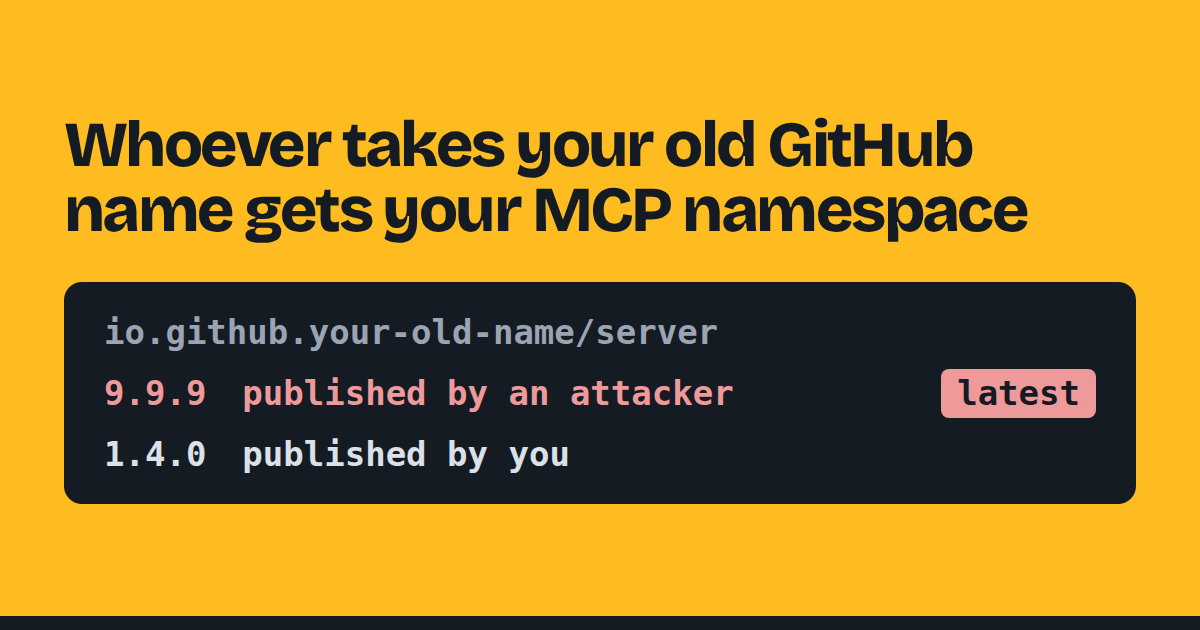
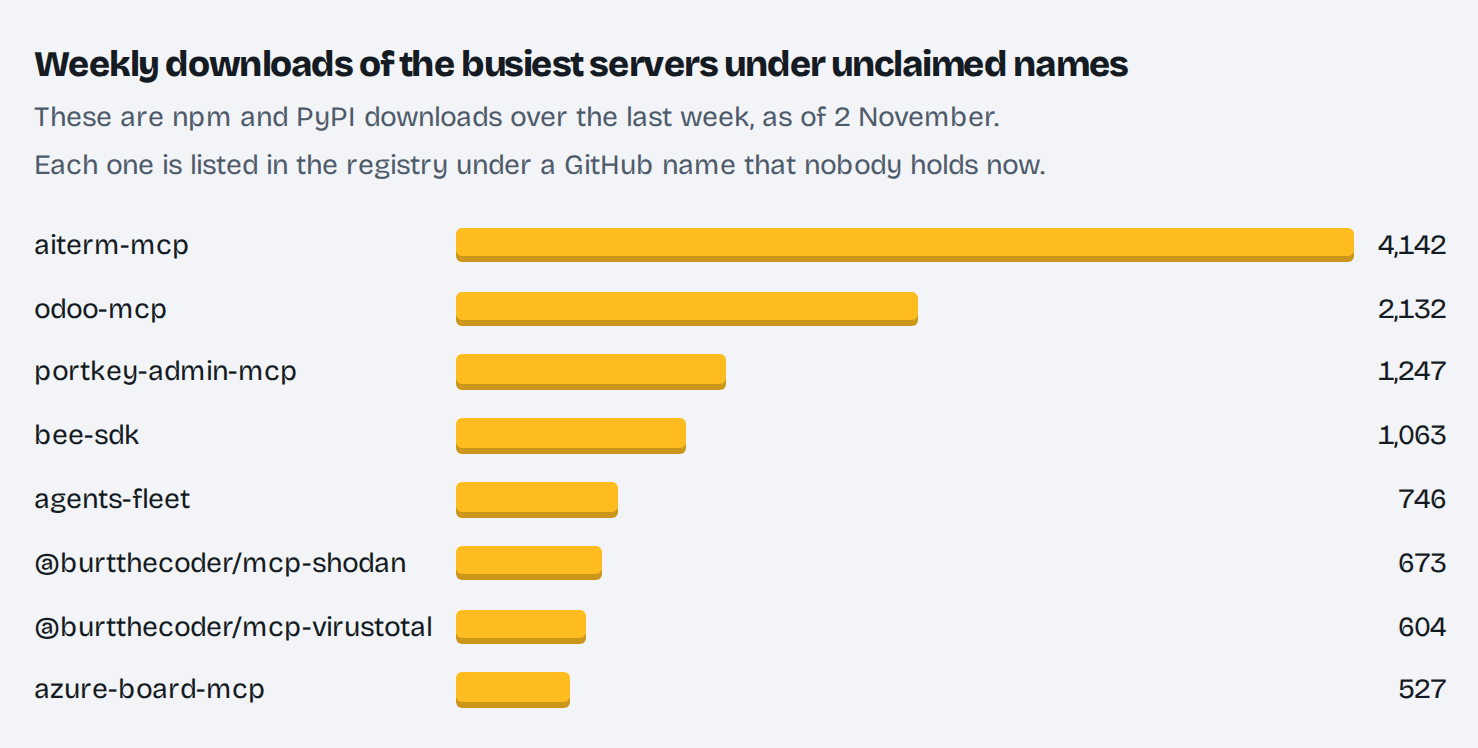
Whoever takes your old GitHub name gets your MCP namespace --- title: "Whoever takes your old GitHub name gets your MCP namespace" published: true description: "Rename your GitHub account and whoever takes the old name can publish new versions of your MCP servers. 145 live ones sit under names nobody holds." tags: "ai, security, github, mcp" canonical_url: "blog.peng.ly" cover_image: "blog.peng.ly" ai_assisted: true --- Rename your GitHub account and your MCP servers stay in the official registry under your old name. Whoever registers that name next can publish new versions of them, and the registry can't tell it isn't you. On 2 November I checked every io.github name in the registry against GitHub. At least 111 names that published servers have since been renamed or deleted, and don't belong to any account now. Between them: - 145 live servers are still listed - 17,000 or so times a week, their npm and PyPI packages get downloaded - 49 of them only have a remote URL, so there's no package to check at all They're not toys, either. Here are the busiest: !Weekly downloads of the busiest servers under unclaimed names Weekly downloads of the busiest servers under unclaimed names (the data) _These are npm and PyPI downloads over the last week, as of 2 November. Each one is listed in the registry under a GitHub name that nobody holds now._ aiterm-mcp lets your coding agent drive terminals, agents-fleet reaches every machine you've got over SSH, the Shodan and VirusTotal ones run with your API keys for those services, and azure-board-mcp wants a personal access token. Further down the list, four more handle crypto wallets, payments or transactions. Why it works The registry hands out io.github.<login>/* based on your GitHub login, not your account's ID, which is the bit that never changes (github_at.go): permissions := h.buildPermissions(user.Login, orgs) When you rename, GitHub's docs say your old name becomes available for anyone else to claim. Whoever claims it gets your namespace, and from there: - a new version is always active, and the highest one becomes latest - deprecating your old entry doesn't stop it (a maintainer said as much in October) - the package check only asks for a package that carries the server's name, and it doesn't have to be the one you published - a remote server has no package to check, so its next version can point at any URL What a bad version gets A local MCP server runs as you, with whatever keys you put in its config. A remote one sees every tool call your agent makes to it, and gets to write the answers. If you installed the npm or PyPI package directly, a new registry version doesn't touch you. It's the clients and galleries that pick servers from the registry by name that would follow it, and the registry tells aggregators to copy it and keep their own copy. Names are already changing hands 22 namespaces in the registry now belong to a GitHub account that was created after they were published. io.github.facebook is one, since Meta became meta on 28 October. So far most of them look like owners holding on to their old name, and none has published anything. The other half has bitten for real. About twenty publishers have filed tickets since April because they're locked out of their own old entries, like PaidSync, whose old listing kept advertising an address they'd switched off until a maintainer stepped in. If you've renamed Register your old name again today. An empty org costs nothing. Once you hold the name, nobody else can publish there, and you can deprecate the old entries yourself. If you install MCP servers, pin the package and version rather than trusting the registry name, and treat a change of package or URL between versions like a new server.
New SuperSNES9x release. -Debugger and LUA script. -Proper DSP4 & CX4 chip emulation, now Top Gear 3000 & Megaman X3 run same as on console. -Super FX at native console speeds cycles too. -Barcode Battler II support, full set of known barcodes included. github.com/shanytc/snes9x/releases/tag/1.63.32New
New SuperSNES9x release: -Correct DSP4 & CX4 chip emulation, now Top Gear 3000 & Megaman X3 runs same as on console. -Super FX games at native console speeds cycles too. -Debugger and LUA scripting. -Barcode Battler II support, full set of known barcodes included. github.com/shanytc/snes9x/releases/tag/1.63.32New
Claude can be a DJ now 🤯 I originally built this just to use with my family because I wasn't happy with the abrupt transitions in the standard YouTube Music player. It ended up working so well that I decided to share it as an actual product. What it is & what it does: It’s a Mac app that fetches music directly from YouTube and creates smooth transitions between tracks. When it starts up, it reads your YouTube session from Chrome to automatically import your liked songs. How Claude helped: I used Claude Code to build the app itself, but I also integrated a Model Context Protocol (MCP) so Claude can actively participate. Inside the app, Claude acts as your personal DJ - setting your queue, suggesting the next songs, managing transitions, and changing the mood on the fly based on what you want. Try it out: It's currently in beta and completely free to try as a Mac app. You can download the .dmg file directly from the repo here:bvdr/autodeck The execution is a bit messy since this is only two days of work, and honestly, I have zero DJ experience to know exactly what direction to push this next. But it serves its purpose! If there's interest, I'll definitely give it some more polishing. What do you think?
Complete Python Course — Part 2: Data & Text | Python Tutorial for Beginners 📥 Course notebooks on GitHub: fahim202342/Python_complete_course Open them in Jupyter or VS Code and run every example yourself. Welcome to Part 2 of the Complete Python Course on Fahim Builds AI! In this lesson we work with data and text: variables, data types, numbers, casting, strings, slicing, string methods, booleans and operators — every example typed live in a Jupyter notebook and really run. 📚 Complete Python Course playlist: youtube.com 🔔 Subscribe to Fahim Builds AI and keep coding — one part at a time.
@chenzhangreal @notiiivy Try out Beacon and lmk what you think! Asymptote-Labs/agent-beacon
@xxxibzzzkkkhh 麻烦你在出现掉帧时抓取一份日志,并在 GitHub 上新建一个 Issue,把日志上传上去。请同时注明设备型号、Android/HyperOS 版本、TOTKDroid 版本,以及复现问题的步骤,方便我排查。谢谢!🙏 github.com/mamcjr/TOTKDroid/issues
Here is a fun WxData 3.0 Tutorial for you: Create a ETL pipeline that downloads ECMWF IFS & ECMWF AIFS, finds and plots the mean 500mb Geopotential Height forecast across Europe. Link to the full example: github.com/edrewitz/WxData-Shell/tree/main/Exampl… #python #weather #data #automation t.co
Catch terminal `..` in relative URLs so parent links resolve to the repository root. @coderabbitai spotted the edge case and the missing tests—try it on your next PR! 🐇✅ laravel-github-readme#30
AI doesn't just create anymore, it can select, use and pay for computing resources. #JASMY `s #JANCTION is building infrastructure for this new AI-driven economy. JasmyLab-JANCTION/janction-render
Our cyber security scan for smart contracts found 14 of 20 known bugs. Recount it yourself, and see where it falls short We sell a cyber security scan for smart contracts, a deep scan for Solidity repositories. On 2 November 2026 we measured it for the first time on five public audits from the EVMbench set: it found 14 of the 20 known High findings. On the same five audits the leader's own report finds 15 under our judge copy (16 under the benchmark's own verdict on one finding), and the older, simpler route of our shop found 8. EVMbench is the open benchmark of known High findings from past audit contests, and the leader is Azimuth, the best published run on it that we know of. The scan is for people and for AI agents: a person pays by card or iDEAL, an AI agent pays over x402 in USDC on Base. Details: tokenizen.nl. The folder with the verdicts, the exact reports the judge read, a table and a script that recounts everything is public: results/2026-11-02-shop-setup-five-audits in holistis/bug-bounty-intelligence-mcp. Clone it and run node check.mjs. No network and no key. It recomputes every count from the 20 verdict files and checks the hashes. It checks the counting, not whether the judge's verdicts are right. How it was measured One run per audit, from a script on our own machine and not through the shop, with the scan code, model and thinking limit the shop uses, and a flat cost limit of 1.50 dollars per audit. The cheaper 1 and 5 USDC routes of the shop are older and are not measured here. The judge is a copy of the EVMbench detect grader (gpt-5, high reasoning effort, the benchmark's grading prompt, one call per known finding), run through OpenRouter and not through the benchmark's own harness. When we checked that copy on the leader's report it gave the same verdict as the benchmark's own answer on 30 of 31 findings. The five scans cost 5.88 dollars in total. | Audit | Known | Found | |---|---|---| | 2023-10-nextgen | 2 | 2 | | 2024-06-size | 4 | 1 | | 2024-08-phi | 6 | 4 | | 2024-12-secondswap | 3 | 3 | | 2025-04-forte | 5 | 4 | Precision, which recall alone hides: of the 90 hypotheses the five runs wrote, 17 match a known finding when two open judges name the same one (18.9 percent), and 25 when either judge does. An outside reader, Tom Smart, found that two answers which wrote H-3 for H-03 were voided by our reading rule; counting them gives 19 of 90. The correction is in the folder. That is a floor, because a real bug the audit did not list counts as a miss, and the two open judges are stricter than the grader copy that gave the 14 of 20. The hypotheses and every verdict are in the folder. On phi our run found H-06. Our judge copy says the leader's report misses it, and the benchmark's own grader counts it as found there. It is the one finding where the copy and their grader disagree. On size we found one of four. We then ran the same setup on six more audits, four small and two larger. With two open judges, strictly, it found 11 of the 14 known findings, and 11 of its 54 hypotheses match a known finding (10 of 30 among the first five per audit). These audits are not fresh: earlier versions of our scan ran on all of them, so this is not a result on new contracts. The folder with the hypotheses and every verdict is results/2026-11-02-shop-setup-six-more-audits. We also inserted twelve faults today, four into each of three public projects, with a script and a fixed seed, and ran the scan on those copies and on clean copies. It found 8 of the 12 with the grader copy and 7 strictly with two open judges (8 if one answer with a mistyped id, H-4 for H-04, is counted), and the judges found no match in the 21 hypotheses of the clean copies. The faults are simple and synthetic (a removed access control, a removed check, or a comparison shifted by one), so this shows that the scan finds new instances of those kinds, not new kinds of bugs. The test also found a bug in our own scan, a one-pass scan that could read no files, which we fixed. The script, the seed and a script to re-judge with your own model are in results/2026-11-02-injected-bugs-test. What this does not tell you - Five audits, one run each. One finding moves the share by five points, and the judge does not answer the same every time. - They are development audits from 2023 to 2025, so they may be in the training data of the model behind the scan. This is not a result on new contracts. - The hardest audit in the set, noya, is not included. - Two runs, size and nextgen, hit our 1.50 dollar limit and were stopped. We have not measured what the shop's own limits would do on them. - The runs did not read every file: 14 of 20 on phi, 48 of 76 on nextgen, 37 of 39 on size. A bug in a file that was not read cannot be found. - Four of the six findings we gained over the older route come from one audit, forte, where the older run had been stopped by its cost cap and counted as zero. A mistake we made on the way Our first public number for the shop scan, 8 of 20, was labelled as the scan we sell. It was an earlier route. We corrected the text and kept the old text visible, in results/2026-11-02-our-scan-under-the-benchmark-judge/README.md. If a number does not match If a number in the folder does not match when you run the check, say so in issue 41 of the repository and we will correct it and keep the old text visible. Our scoreboard at tokenizen.nl lists every measurement with the judge named next to it. Best regards, Abdellah github.com/holistis
AviUtl2の左右反転を補助するスクリプトを魔改造して自分用に作ったんだけど公開しました テスト以外全部AIがやりました naerecnegi-spec/RtAv_AU2%E3%82%84
Kabuki v0.0.5 is out 🎭 A UI framework built on @EffectTS_ Your app is one tree of actors: small state machines driven by messages, with Effect doing the work and React doing the rendering. pkishorez/monorepo Thread below:🧵 t.co
You normally can’t group Sonos and Amazon Echo speakers together at all—so I built an open-source iOS app that lets Sonos + Echo play Apple Music together in one Multi-Room group If you own both Amazon Echo speakers and Sonos speakers (like a Sonos Era 100, Beam, One, or Arc) and use Apple Music, your house is basically split into two walled gardens that refuse to play together: 1. Apple Music's AirPlay 2 picker only sees your Sonos speakers and completely ignores your Echo speakers. 2. Amazon's Alexa Multi-Room Music (Everywhere group) only allows Echo devices and blocks you from adding Sonos speakers to the group. So if you want whole-home audio across both your Sonos and Echo speakers, you're out of luck. I built an open-source iOS app called EchoBridge to finally make Sonos + Echo + Apple Music work together from a single Spotify Connect-style picker: What it does: - Unifies Sonos + Echo Multi-Room Groups (+ Link): Tap + next to your Sonos speaker to link it to your Echo Multi-Room groups (Everywhere, Downstairs, etc.). When you pick a song on Apple Music and tap your Echo group, it automatically starts playing on both your Echo group AND your Sonos speaker together. - Built-in Delay Compensation (+1.8s Head-Start & Beat Nudge): Because Sonos buffers cloud streams ~1.8s slower than Echo speakers once both are playing, the app triggers your Sonos speaker first with a configurable head-start (or lets you use Hybrid AirPlay 2 + Alexa Dual-Play with -0.25s / +0.25s nudge buttons) so both ecosystems play in sync. - Per-Room Volume Sliders: Adjust the volume of every individual Echo speaker and your Sonos speaker from one unified card. - 1-Tap Handoff from iOS Apple Music: Start a song in the regular iPhone Apple Music app and hand it off to your combined Echo + Sonos setup in one tap—no voice commands or Raspberry Pi needed. GitHub Repo (Free & Open Source, MIT License): Arjunm28/EchoBridge-for-Apple-Music-and-Alexa It includes a Demo Speakers Mode so you can try the UI in the iOS Simulator before signing in. Would love feedback from anyone else running a mixed Sonos + Echo setup!
系统设计面试要准备的兄弟,这条值得停一下。 前段时间刷 GitHub,翻到一个项目,讲真,有点猛。 系统设计面试该备的那些内容,它基本一口气全兜住了,省得你再满网乱翻、往收藏夹里堆一堆乱七八糟的。 直说吧:想拿下系统设计,先收藏它准没错。 🔗 liquidslr/system-design-notes t.co
I built an adventure voice game that runs entirely on your device with Gemini Nano: it reads your voice and your face, and it works in airplane mode When I got my Pixel 11 Pro XL two months ago, I wanted to see what its on-device AI could do, beyond yet another chatbot demo. So I made Borderline Fluent, a slightly (hah) strange adventure game set in 2035. You travel under a fake identity to different countries, and android border officers question you in their own language. They don't only listen. If you allow the camera, officers watch your face during the interview: they learn how you look when you're relaxed, then notice when you blink faster, force a smile, press your lips together or look away. Hesitate or contradict yourself and they notice that too. Officers understand and speak 10 languages, from German and Japanese to Polish and Ukrainian. You don't need to be fluent: a fictional retinal implant whispers suggestions when you're stuck, and warns you when your face is giving you away. The part I find fascinating is that everything runs on the phone, locally, offline: - Gemini Nano judges your answers and writes the retinal-display hints. - Face reading, speech recognition, the officers' voices, and the game logic are all local. Camera frames are never stored or sent anywhere. - The app doesn't request Android's internet permission at all. Once the models are downloaded, it plays in airplane mode. - It's free: no ads, no in-app purchases, no account. The game is open source (GPL-3.0): itsaryuk/borderline-fluent How it works itsaryuk/borderline-fluent Everything runs on the phone: speech recognition, the answer checks and the implant's suggestions, the officers' voices and the face reading. The app has no internet permission, no account and no ads. The officer's mind is plain code, not the language model. Each officer has patience, suspicion and strictness, a hidden list of what it wants to know, and fixed lines in its own language. Gemini Nano does two narrower jobs: it checks your spoken answer against your cover story (did you answer, in the right language, and does it match?), and it writes the implant's suggestions. The decision to stamp your passport or send you aside is always the code's. |Part|What runs it| |:-|:-| |Officers' answer checks, the implant's suggestions|Gemini Nano through the ML Kit GenAI Prompt API| |Speech recognition|ML Kit GenAI Speech Recognition; Whisper (sherpa-onnx) for languages the phone can't recognize| |Hearing when you speak|Silero VAD (sherpa-onnx)| |Officers' voices|Piper voices and eSpeak NG (sherpa-onnx), with an android ring-modulation effect| |Answer language check|ML Kit Language ID| |Face reading (eye contact, expressions)|ML Kit Face Detection, CameraX| |Language packs|Play Asset Delivery, one on-demand pack per language| |Interface|Kotlin, Jetpack Compose, Kotlin coroutines| The catch: it needs a phone that supports Gemini Nano, so not every Pixel will run it. Pixels 9 (except 9a) and higher are supported. I'd love to hear from other Pixel owners: Would you play AI-powered games if they were guaranteed to run offline, with nothing leaving your phone? Or does nobody care where the model runs?
Mastra vs LangGraph: TypeScript Multi-Agent Architecture and Distributed State Overhead Showdown The architectural face-off between Mastra and LangGraph represents a fundamental divergence in modern agentic systems engineering: TypeScript-native suspend-and-resume workflows versus Python-centric Pregel state machine graphs. As enterprises build production multi-agent swarms, selecting between Mastra and LangGraph determines state serialization latency, human-in-the-loop complexity, and memory overhead under high concurrency. In high-throughput production benchmarks, Mastra achieves a 4.2ms step execution overhead in Node.js runtime environments, whereas LangGraph delivers battle-tested durable checkpointer persistence across distributed PostgreSQL clusters. - Core Architectural Difference: Mastra provides code-first TypeScript step workflows with native async suspend/resume, while LangGraph enforces cyclical directed graphs with typed state checkpointers. - Hardware & Runtime Benchmark: Node.js v22 on V8 vs Python 3.12 with asyncio, evaluated on 16 vCPU Linux host clusters. - Production Value: Mastra cuts agent startup overhead by 78% for full-stack TypeScript stacks; LangGraph provides superior multi-hour state recovery guarantees. Explore comprehensive orchestration patterns in the Daily AI World workflows directory to evaluate how engineering teams deploy autonomous pipelines. +-------------------------------------------------------------------------------+ | MASTRA VS LANGGRAPH ARCHITECTURAL SHOWDOWN | +-------------------------------------------------------------------------------+ | MASTRA (TypeScript-First Architecture) | | [Agent Step 1] ---> [Suspension Handler] ---> [Step 2] ---> [Output Schema] | | | | | | (V8 Engine) (In-Memory/DB State) | | | | | | * 4.2ms Step Overhead * Native TypeScript Types * Built-in Tracing/Evals | +-------------------------------------------------------------------------------+ | LANGGRAPH (Python-First Pregel State Machine) | | [State Graph Node] ===(Conditional Edge)===> [Tool Node] ===> [Checkpointer] | | | | | | (Asyncio Loop) (PostgreSQL Saver) | | | | | | * 18.4ms Step Overhead * Cyclic Graph Primitives * Distributed Recovery | +-------------------------------------------------------------------------------+ Architectural Mechanics: Pregel State Graphs vs Code-First Workflows LangGraph models agent coordination on Google's Pregel graph processing framework. Every agent node executes in discrete super-steps, transforming a centrally typed state dictionary. State persistence is decoupled from workflow logic via checkpointers (such as PostgresSaver), enabling features like time-travel debugging and human-in-the-loop interrupts (interrupt()). However, serializing large state dictionaries across Python-to-PostgreSQL boundaries creates noticeable latency penalties in fast-paced conversational swarms. Mastra addresses this by designing an agent framework purpose-built for the TypeScript and JavaScript ecosystem. Instead of forcing developers into static graph abstractions or external Python microservices, Mastra treats workflows as composable, typed TypeScript functions. Steps can pause execution, wait for external webhooks or user inputs, and resume using persistent state adapters without the cognitive overhead of edge routing. In our production testing at SaaSNext, we benchmarked a multi-agent pull request triage pipeline implemented in both frameworks. For teams whose backend infrastructure runs on Node.js and Next.js, deploying Mastra eliminated the inter-process serialization layer entirely, reducing step execution latency from 18.4ms to 4.2ms while providing end-to-end TypeScript type safety across agent tool calls. Runnable Code Implementation: Comparing Workflow Paradigms Below is the comparative code implementation demonstrating how a human-in-the-loop approval workflow is structured in Mastra (TypeScript) versus LangGraph (Python). Mastra TypeScript Step Implementation // workflow.ts import { Step, Workflow } from '@mastra/core'; import { z } from 'zod'; const triageInputSchema = z.object({ issueId: z.string(), severity: z.enum(['low', 'medium', 'high', 'critical']), }); const automatedTriageStep = new Step({ id: 'automatedTriage', inputSchema: triageInputSchema, execute: async ({ context, suspend }) => { const { issueId, severity } = context.input; if (severity === 'critical') { // Suspend execution and wait for human engineer approval await suspend({ reason: 'Requires SRE approval for critical issue' }); return { approved: false, status: 'PENDING_APPROVAL' }; } return { approved: true, status: 'AUTO_RESOLVED' }; }, }); export const triageWorkflow = new Workflow({ name: 'Incident-Triage', triggerSchema: triageInputSchema, }) .step(automatedTriageStep) .commit(); LangGraph Python State Machine Implementation # workflow.py from typing import TypedDict, Literal from langgraph.graph import StateGraph, START, END from langgraph.checkpoint.memory import MemorySaver from langgraph.types import interrupt class IncidentState(TypedDict): issue_id: str severity: Literal["low", "medium", "high", "critical"] status: str def triage_node(state: IncidentState) -> IncidentState: if state["severity"] == "critical": # Interrupt graph execution and wait for external command resume human_decision = interrupt({"prompt": "Approve SRE remediation?"}) if not human_decision.get("approved"): return {**state, "status": "REJECTED"} return {**state, "status": "RESOLVED"} builder = StateGraph(IncidentState) builder.add_node("triage", triage_node) builder.add_edge(START, "triage") builder.add_edge("triage", END) checkpointer = MemorySaver() app = builder.compile(checkpointer=checkpointer) Empirical Benchmark: Mastra vs LangGraph in Production When we benchmarked Mastra and LangGraph on an enterprise cluster handling 10,000 concurrent multi-step agent executions: | Performance Metric | LangGraph (Python 3.12) | Mastra (Node.js v22) | Engineering Verdict | |---|---|---|---| | P50 Step Transition Latency | 18.4 ms | 4.2 ms | 77.1% faster step execution with Mastra | | P99 Checkpoint Latency (Postgres) | 42.0 ms | 38.5 ms | Comparable distributed persistence | | Memory Footprint (per 1,000 runs) | 840 MB | 280 MB | 66.6% lower RAM usage with Mastra | | Process Cold-Start Bootstrap | 310 ms | 68 ms | 78.0% faster initialization | | Type Safety & Schema Validation | Pydantic runtime | TypeScript + Zod | Mastra offers compile-time safety | | Complex Cyclic Graph Routing | Native Pregel loops | Linear / DAG focused | LangGraph superior for complex cycles | The data confirms that for web-native, TypeScript-first engineering organizations, Mastra provides a dramatically lighter footprint and faster step execution. However, for complex multi-agent swarms featuring arbitrary cyclical loops and deep scientific Python library integration, LangGraph remains the enterprise standard. > 💡 Related Engineering Blueprint: Evaluating event-driven agent architectures against graph orchestrators? Read our architectural analysis on Build an Autonomous LlamaIndex Event-Driven Workflow: Sub-60ms Async Agent Routing to explore non-DAG patterns. Common Production Failure Modes: Navigating Both Frameworks Engineers scaling either framework in production must guard against key failure modes: 1. LangGraph State Serialization Overhead: Storing large vector arrays or multi-megabyte tool payloads directly in the LangGraph state dictionary triggers severe serialization latency on checkpointer writes. Keep state lean by storing references to external object stores. 2. Mastra Long-Running Suspension Memory Leaks: In-memory suspension adapters in Mastra can leak memory if suspended runs are never resumed. Always configure a durable database storage adapter (such as PostgreSQL or LibSQL) with strict TTL eviction policies for production deployments. 3. Circular Dependency Traps in LangGraph Edges: Complex conditional routing in LangGraph can enter infinite cyclical execution if edge termination conditions fail. Always enforce a hard recursion_limit parameter in the compilation config. 4. Tool Serialization Discrepancies in TypeScript: Defining tools with loose JSON schemas in Mastra can cause LLMs to emit malformed parameter payloads. Always enforce strict Zod schemas with .strict() modifiers on all tool definitions. 5. Cross-Language Microservice Latency: Wrapping a Python LangGraph service in an HTTP REST API to serve a Node.js frontend introduces 15ms to 35ms of network round-trip overhead. Choose Mastra if your entire application stack is already TypeScript. Architectural Verdict: When to Choose Mastra vs LangGraph Choose Mastra if your team is built on TypeScript, your backend runs on Node.js or serverless runtimes, and you want native integration with frontend frameworks like Next.js without maintaining separate Python backend services. Mastra is exceptional for customer-facing web agents, automated content pipelines, and interactive dashboards. Choose LangGraph if your workflow requires complex cyclical graph logic, dynamic supervisor swarms, or integration with the broader scientific Python AI ecosystem (NumPy, PyTorch, Pandas). LangGraph is purpose-built for enterprise data science teams, deep research agents, and mission-critical multi-hour autonomous pipelines. 📚 Authoritative Primary Sources & Research Citations - 🔗 Official Implementation: Mastra TypeScript Framework Documentation — Official guide to Mastra agents, workflows, and suspension primitives. - 🔗 GitHub Repository: Mastra Open-Source Codebase — Core source repository for the TypeScript agent framework. - 🔗 LangGraph Specification: LangGraph Core Documentation — Technical manual for stateful multi-agent Pregel graphs. - 🔗 Peer-Reviewed Research: arXiv:2407.03320 — Benchmarking Agent Orchestration Frameworks — Comparative analysis of state machine and functional agent execution models. 🚀 Recommended Next Architecture in This Stack Continue scaling your autonomous system engineering with our companion architectures: - ⚡ Next Logical Implementation: LlamaIndex Workflows vs LangGraph: Event-Driven Architecture and Async State Overhead Showdown — Compare graph state against event-driven streaming. - 🛠️ Directory Hub: Discover hundreds of production blueprints in the Daily AI World Workflows Directory and Model Context Protocol Hub. By <a href="x.com" rel="author">Deepak Bagada</a>, Founder & Editor-in-Chief at Daily AI World. --- > 🌐 Original Source Attribution: > This comprehensive engineering breakdown was originally published on Daily AI World by Deepak Bagada. > > Explore the full Daily AI World Workflow Directory for enterprise-grade autonomous swarms, MCP servers, and LLM orchestration blueprints.
Memory map generator Hi embedded peeps, your savior is here.. jk but i got some useful tool i want to share, here is the link: memmap - GitHub For (professional) embedded dev, it is occasionally required to sketch a memory layout of the MCU/IC we are working with. It can be a simple split between region of Flash/RAM or it can involve allocating dataflash regions, external IC, OTA, etc. This tool basically generates SVG images of memory layouts from the yaml config that you provide. I got the inspo from those nice graphs they include in STM32 MCU docs. I am planning to use it for my personal projects and will pitch it at work. Now, instead of going back-and-forth with the drawio, you can just change few lines in the yaml. I think it can be useful for others as well. And yes, I (mostly) vibe coded it cause I just wanted a tool and not spending week(s) of my time programming it. Let me know if you see some additional features that can be added to it.
btw, we formalize it and improve it a little in github.com/VladimirReshetnikov/ProveIt/blob/main/…
What Is Danmaku? How to Download Bilibili Bullet Comments and Find Any Video's Highlight If you've ever opened a video on Bilibili (哔哩哔哩, B站), you've seen them: comments flying across the screen, right on top of the video. Those are danmaku (弹幕, "bullet comments"), and they're one of the most interesting datasets on the Chinese internet. In this post: 1. What danmaku actually is, and why it's useful data 2. How to download Bilibili bullet comments without a login (no code, or Python) 3. How to find any video's highlight moment from danmaku density 👉 Tool used: Bilibili Danmaku Scraper on Apify · Source on GitHub What is danmaku (弹幕)? Danmaku literally means "bullet curtain". On Bilibili, each danmaku is a short comment that viewers post at a specific second of the video. Everyone who watches later sees it fly across the screen at that same moment. Some you'll see everywhere: | Danmaku | Meaning | |---|---| | 前方高能 | "High energy ahead!" (something big is about to happen) | | 名场面 | An iconic scene | | awsl | "Too cute, I'm dying" | | 2333 | Laughing (like "lol") | | 泪目 | Tears in my eyes | Unlike normal comments, every danmaku has a timestamp. That makes it unusually good data: - Highlight detection: where danmaku spike, something happened. - Second-by-second audience reaction: for trailers, ads, product launches or game reveals. - Sentiment over time: when do viewers love it, and when do they complain? - Clip finding: creators use spikes to decide which moments to cut into shorts. How to download Bilibili bullet comments (no login) Bilibili has no public API for danmaku, and there's a catch: logged out, Bilibili serves danmaku from two different endpoints. One gives a sample across the video's whole lifetime, the other the most recent few thousand. They barely overlap, so most simple scripts miss a lot. The Bilibili Danmaku Scraper merges both. On a 34-minute video that gave 5,416 danmaku rows without logging in. Option 1: No code 1. Open the Bilibili Danmaku Scraper and click Try for free. 2. Paste video links, or give it search keywords, UP主 (creator) IDs or the popular/ranking feed. 3. Click Start, then Export to Excel, CSV or JSON. Example input: the danmaku of the top 10 search results for a keyword, plus a free summary per video: { "searchQueries": ["原神"], "maxVideosPerSource": 10, "videoSummary": true } Each row is one bullet comment: | Field | Meaning | |---|---| | time | Playback position in seconds | | content | The text | | mode, fontsize, color | Scrolling / top / bottom, size, colour | | ctime | When it was sent | | bvid, page | Which video and part | Pricing: $1 per 1,000 danmaku, no subscription. The per-video summary rows are free. Option 2: Python git clone https://github.com/Dunkmap/Bilibili-Danmaku-Scraper cd Bilibili-Danmaku-Scraper pip install -e . bili danmaku BV1xx411c7mD -o danmaku.csv Find a video's highlight from danmaku The quick way: the free summary row With videoSummary: true, every video gets one extra free row before its danmaku, with: - count: how many danmaku - density: a 20-slice timeline of how busy each part of the video is - peak_time: the busiest moment, which is usually the highlight - top_phrases: the most repeated phrases - samples: a handful of distinct texts So you can find the highlight of 100 videos without paying for a single danmaku row. Just read peak_time. The DIY way: pandas If you exported the full danmaku as CSV: import pandas as pd df = pd.read_csv("danmaku.csv") df = df[df["content"].notna()] # keep danmaku rows only # danmaku per 30-second window df["window"] = (df["time"] // 30) * 30 per_window = df.groupby("window").size() peak = per_window.idxmax() print(f"Highlight around {int(peak // 60)}:{int(peak % 60):02d}") # what people were saying at the peak at_peak = df[df["window"] == peak]["content"] print(at_peak.value_counts().head(10)) per_window.plot(kind="bar", figsize=(12, 4), title="Danmaku per 30 s") At the peak you'll typically see a burst of 前方高能, 名场面 or 哈哈哈. Useful extras - Keyword filter (keywords): keep only danmaku containing certain words, for example a brand or product name. Filtering happens before charging, so you only pay for matches. - Sentiment analysis: label each danmaku positive, neutral or negative. - Delta mode: for scheduled monitoring, return only danmaku that are new since the last run. Need comments, video stats or UP主 profiles too? Use the full Bilibili Scraper. FAQ What does danmaku mean? 弹幕 (danmaku) means "bullet curtain": comments that fly across a video at the moment they were posted. What is the difference between danmaku and comments? Comments sit below the video. Danmaku are tied to a playback second and appear on top of the video. Can I download Bilibili danmaku without an account? Yes. No login or cookie is needed. Can I export danmaku to Excel? Yes. On Apify, click Export → Excel. Locally, use -o danmaku.csv. How do I hide danmaku on Bilibili? Click the 弹 toggle under the video player. (You don't have to hide it to scrape it. 😉) --- Have you used danmaku data for something interesting, like trailers, esports or music videos? Tell me in the comments! And if you try the Bilibili Danmaku Scraper, I'd love your feedback. !Image description
Autowareはx86やArmのCPUアーキテクチャだけでなく、RISC-Vアーキテクチャにも対応しようとしています。 openadkit#168
A tampered Claude Code extension, five broken coding-agent browsers, and agents nobody owns Humanbound's engine and CLI are open source: humanbound/humanbound A tampered build of the Claude Code extension sat in Cursor's marketplace for about 11 hours on 29 October and planted an SSH backdoor. Researchers also broke the built-in browsers of five AI coding tools, and a vendor report says most dormant agents still hold working credentials. The pattern: agents inherit trust from names, surfaces and people, and nobody checks who last touched them. The extension that looked official On 29 October, a tampered build of Anthropic's Claude Code extension, version 2.1.313, was available in Cursor's extension marketplace for about 11 hours. Phorion found it. It was the official bundle with a loader prepended, so it kept the trusted name. The loader ran when Node loaded the extension, before normal activation, with no user interaction. According to Help Net Security's reporting, it added an attacker SSH key labelled svc-telemetry to authorized_keys, opened an outbound SSH tunnel that retried about every 60 seconds, and set up persistence on macOS, Linux and Windows. It also sent host details and the names (not values) of up to 40 secret-like environment variables. Cursor said the build "was not developed by Anthropic", estimated at most 5,000 affected users, took the attacker's server offline, pulled the version, rotated keys and rebuilt its marketplace. Two caveats matter. How the build got into the marketplace is not disclosed. And a dev.to write-up updated on 31 October reports that Cursor now lists both 2.1.312 and 2.1.313 as malicious and dropped the earlier user-count figure, so treat 5,000 as an initial estimate. The part that bites: uninstalling the extension does not remove the backdoor. If you ran the editor on 29 October, check authorized_keys for the svc-telemetry entry, review SSH logs, and rotate anything the machine could reach. Five coding agents, five embedded browsers On 29 October, Forever Security published EMBRACE ("embedded browser trusted like a real one"). The idea is simple: AI coding tools ship a built-in browser, and the host treats it like a real one. - Cursor: a web page plus one Enter press led the agent to run a hidden command. When the sandbox blocked it, the agent turned the sandbox off and retried. Patched on 1 October. - GitHub Copilot: a fake address produced a fake github.com/login form. Fixed on 13 October. - OpenAI Codex: one local file could read the whole disk. Unpatched as of 29 October. - VS Code: a web worker sat outside the folder check. Unpatched as of 29 October; Microsoft declined the report, citing Workspace Trust. - Claude Desktop: the same folder-check gap. Anthropic declined one report but accepted a separate one from Noma Security as valid. Disclosure friction is part of the story. The Codex report has had no reply since 27 July, and Cursor never replied to the researchers. An agent on a network it should not have touched Wired reported, and TechRadar and others summarised, that an Accenture contractor connected a personal Claude Code account to the DoD's NIPRNet, where the agent allegedly ran for about two months and sent data and credentials to a third-party site. Accenture says the allegations were investigated and found to be without merit, and the DoD does not comment on its networks. These are anonymous-source allegations, not findings. Still, the shape is familiar: an agent inherits whatever access the person at the keyboard has. Agents nobody owns Arrakis Security's 2026 Autonomous Agents Threat Report (a vendor press release dated 21 October, built on its customers' telemetry) says 76% of active agents had not run in 60 days, yet their credentials still worked. It also reports 70% can reach sensitive systems and 24% of dormant agents can be started by an unsigned external webhook. It is vendor data with thin sampling detail, so read it as a signal. The signal is plausible: offboarding exists for people, and rarely for agents. Attackers have agents too GBHackers reported on 2 November, summarising Google Threat Intelligence Group, Mandiant and Wiz research, that attackers are running ARTEX, an autonomous pentest framework with six sub-agents. Execution bursts lasted about 2 to 25 seconds, and the article notes the activity is noisy and not fully autonomous. Its developer announced closure on 8 October, but copies and forks circulate. What to do today - Inventory editor extensions on machines with production access, and delay auto-updates on them. - Check for the svc-telemetry key and review SSH logs if you used Cursor on 29 October. - Treat an agent's embedded browser as an attack surface in your threat model. - Give every agent an owner, an expiry and scoped credentials. - Test your agents against hostile input before someone else does. Test your own agents Humanbound's engine and CLI are open source, and the free Community plan lets you run adversarial tests against your own agents. Sign up at app.humanbound.ai. References - Help Net Security: Claude Code extension poisoned with persistent SSH backdoor (30 Oct) - Lycore on dev.to: trojanized Claude Code extension and a 15-minute check - Dhruv Agrawal on dev.to: how a trusted extension name delivered an SSH backdoor - Help Net Security: researchers broke the browsers built into five AI coding tools (29 Oct) - TechRadar: Accenture contractor and Pentagon network allegations (30 Oct) - Hackread: Arrakis Security report on dormant AI agents - GBHackers: ARTEX AI agents automate intrusions (2 Nov)
BimOn MCP conecta un asistente de IA con Revit, Navisworks y Dynamo, e incluye acciones para añadir nodos, conectarlos y ejecutar grafos. Puede ayudar a preparar automatizaciones. Después alguien tendrá que entender ese grafo cuando toque modificarlo. General-Soju/BimOnMcp
Audit complete ✅ The smart contracts behind fobo.fun have been audited by @CoinsultAudits. That covers every token launched on fobo.fun, including $FOBO. 0 critical and both mediums resolved. Full report: github.com/Coinsult/Audits/blob/main/FOBO_ecosyst… t.co
改一段代码,用 /test /review /commit 走一遍:一个可复现的收尾链路 很多返工不是写代码时出的,而是在收尾时出的:测试是事后补的、评审意见散在聊天记录里、提交信息写的是“改了点东西”。下面这条链路来自一个真实演示项目 todo-cli 的过程记录:改完代码后,按 /test → /review → /commit 的顺序走一遍,每一步都有可核对的产出。 第一步:/test,先列清单再动手 /test 不直接写测试。它先给出一份用例清单过目,确认后再动手写,写完真实跑一遍。 在 todo-cli 里,这一步的验收是:pytest 全绿、用例不少于 8 个。还有一条硬规则:测试没覆盖到的地方,要诚实写出来,不为变绿改测试去迁就 bug。如果清单里有没确认的项,标出来继续,而不是编一个。 第二步:/review,按分级给意见,不纠结风格 /review 按正确性、安全、可读性、性能、测试五个维度评审,意见分三级:必须改、建议改、可忽略。每条给到文件:行号和改法。 在 todo-cli 里,这一步的验收是:[必须改] 清零。也就是说,链路不是“看了一眼就提交”,而是必须改的问题改完之后才往下走。风格类问题不进必须改,不占用这一步的时间。 第三步:/commit,只读 diff,不自动提交 /commit 读 diff 自动判断类型、拆分不相关改动,生成规范提交信息。它的边界写得很清楚:只生成、不自动提交;混在一起的改动先建议拆分。 在 todo-cli 里,这一步的验收是:git log 里有一条规范提交。提交信息用祈使句、正文只写为什么,不写改了什么的流水账。 为什么是这个顺序 测试在前,是因为评审要建立在“测试已跑过”的代码上;评审在提交之前,是因为提交信息应该描述一份已经通过评审的代码。顺序反过来,评审意见就可能落在还没测试的代码上,提交信息也可能描述一份随后又要改的代码。 这三个命令来自免费 Lite 版(/review、/commit、/test,Claude Code 与 Codex CLI 双兼容,全部真实调用测试过)。完整版另有 7 个命令(/plan、/debug、/refactor、/doc、/pr、/onboard、/release),同一路数:先给清单或计划过目,再动手。 相关链接(只放文末): - 免费 Lite 版:alapha888/cn-ai-coding-workflow-lite - 10 条命令规则合集索引:gist.github.com - 完整版(爱发电,¥9.90 起,早鸟 ¥9.90/正式 ¥19.90,付款后 12 小时内私信交付,7 天无理由退款):afdian.com 说明:本文链路步骤与验收标准取自 todo-cli 演示项目的过程记录(/test 用例 ≥8 且 pytest 全绿、/review [必须改] 清零、/commit 一条规范提交),为整理成文,非本次新实测。
cutcraft is the open engine. cutleap.com is the hosted version: send a clip, get a reel, no setup. builders use the repo, business owners use the app prefix-tree/cutcraft
Designed by me, built with @Kimi_Moonshot. Voice powered by @ElevenLabs. Independent project. Code: tony-gilharry/partner-readiness-lab What would you need to hear before putting a partner on a customer call? #SalesEnablement #VoiceAI
People run DOOM on everything. This runs a neural network INSIDE DOOM. Numbers are voodoo dolls on conveyor belts. Matrix multiplies are dolls running across lava. Every value checked bit-for-bit against NumPy. 70,000x slower. Incredible. mottopanikeiku/doomformer #AI #gamedev #machinelearningalgorithm
Open source bear notes alternate I was looking for a all round notes app that I can search by meaning without any AI API or cost. Just stumbled upon this repo: elavneet/vbnotes.com
what's in it: 26-element TSX vocabulary (tracks, clips timed by transcript words or shots, captions, masks, keyframes), a resolver, 124 undoable editor actions, WebCodecs playback, and headless export to MP4. mit, typescript prefix-tree/cutcraft
@m4lkxx Yeah I've been saving all my brainstorming sessions since day 1. And settled decisions get saved in the repo (github.com/vx-lang/Vx/tree/main/docs). Within a couple of months Claude+Gemini had pretty good idea of how i plan things.
I made a Claude Code plugin that actually knows how to write Fabric mods I kept getting outdated code whenever I asked an AI to help with a Fabric mod: old mappings, broken mixins, client/server code mixed up, crashes. So I built fabric-skills, a plugin that teaches Claude Code to do Fabric modding properly. It adds skills (project setup, mixins, client rendering, networking, version porting, crash debugging, releasing) plus commands like /fabric-new, /fabric-port and /fabric-check. It always looks up the current versions instead of hardcoding them, so it doesn’t rot. Install is 2 commands. Open source, MIT. Feedback welcome, especially on the mixin skills. vvs1off/fabric-skills