Mentions
Conversations linking to GitHub, newest first. Times are UTC.
Mentions by source
X
Bluesky
Hacker News
V2EX
Qiita
DEV
Mastodon
Latest posts
@BiskeyGames when it comes to character sprites i recomend the dead cells way thats how i do it Broxxar/PixelArtPipeline
Location: Austin, TX Remote: Yes Willing to relocate: Yes Technologies: Pytorch, Tensorflow, Langchain, Flutter, SwiftUI, Jetpack compose, React, Python, Node.js, Agentic LLM Résumé/CV: drive.google.com Github: github.com/fidelisakilan Email: fidelisakilan@gmail.com CS graduate with 3+ years building and shipping production software at scale, I have worked on large scale production mobile apps to LLM-driven research systems, looking to bring systems, mobile and ML integration experience to high-impact engineering teams.
SearXNG is a chore to run — this is the same idea, rebuilt in Rust. RustXNG: self-hosted search with a SearXNG-compatible API. One request returns results plus page text (top 5 pages ≈32k chars). Clean text in one call is the whole win for agent search. sahenjp/RustXNG
@blankspeaker @poteto @elonmusk Crossroads repo is right here: NefariousTrey/crossroads-plugin License is CC BY-NC-ND 4.0. That means no commercial use, and no one can make modified versions or derivatives of it. The README even says it plain: “Licensed CC BY-NC-ND 4.0: no selling, no modified versions.”
I built Gamoire: a place to track your game library, plan what to play next, discover hidden gems and share it with friends I know there are many apps out there that already do backlog management and tracking and that's ok, some are very good and some are very bad and some others just lack features. I have a big game backlog spread across Steam, Epic and GOG, and I couldn't find a tracker that did what I wanted. The ones I tried either put the useful features behind a paywall or didn't fit how I actually play or how I want to manage my games, so I built my own: Gamoire. It's completely free, and every feature is available to everyone, free of charge. It's a web home for your game library: your backlog, play queue, catalogs, wishlist, friends and plenty of social features live there, plus optional smart AI features to help you manage your backlog and discover new games. And if you're a Playnite user, there's an extension that keeps your Playnite library in sync: play time after every session, plus your status, favourites and ratings whenever you change them. Getting your library in: import from Steam, Epic, GOG, EA, Ubisoft and Xbox. What makes it different: - A queue that knows how long games take, so you can pick something that fits your week - All your stores in one library, so a game you own in two places is still one game - A wishlist that tidies itself: import your store wishlists, see release dates, and games disappear once you own them - Everything about a game on one page: reviews from players, Steam and IGDB, how many people are playing right now, series collection and recommended - Export your queue, lists and catalogs as a PDF that looks good - Pick your look: colour themes with light and dark modes The social side: - Follow friends and see what they're playing, finishing and reviewing in your activity feed - See what your friends think: which games the players you follow loved, and what's popular among them - Write reviews and read other players' takes on any game - Share your catalogs with friends and let them comment - Nudge a friend to pick up the game you recommended or just invite them to a co-op - Show off your taste with a profile of your top games, and share it anywhere with a public link Optional smart features (bring your own AI to unlock them): Discover new games and hidden gems with personalized suggestions from a library that picks up on how and what you play. - Suggestions that fit you: rails on your home page based on what you're queueing, finishing and loving - Semantic search: did you forget that title? just describe anything you remember and it will come up - For you: not sure what to play? ask in plain words, a theme a length you want, and get picks from your library plus new games - Is this for me?: Good fit / Mixed / Probably not with reasons, based on your history, ratings and series - Review my backlog: helps you organize and manage your library. It flags the games you'll probably never play and let you decide what to do with them It's brand new and the community is tiny, so I'd love feedback on the onboarding and on which parts feel useful. If you use any other app like this one, what would make you switch? Website: gamoire.app Discord: discord.gg Playnite extension: github.com/ThunderCls/gamoire-playnite/releases/l…
this is super cool. I did some digging about current research on avsr using video and lip point cloud movement a while back. found projects like amanvirparhar/chaplin but this seems more promising!
bmsonを62進数定義のbmsに変換するツールについて公開しました Much-Ryouma/BmsonTo62Bms
My PR to the PDS to move from IP rate limit for blob uploads to the user's DID just merged 🥳. This means backend services are no longer limited to 1k blob uploads per PDS, and is limited to 1k per user. This will allow PDS MOOver to do a upload queue for larger accounts in the future.
Antes eram só 2 loucos - Lula 100 e Maluhy phgadento do @itau - pedindo SELIC 1D Agora são 10MM de arrombados Chegando a 20MM acontece #selic1D @grok ensina criança entender gostar e usar essa porra scoobiii/selix
[increamental_update] Guest Wi-Fi v2 on my OpenWrt JioRouter AX6000: one QR per guest, each with its own time, data and speed limit Many of you requested so it's here Update on the LuCI pages I shared for my JioRouter AX6000 (JIDU6J11) running OpenWrt. The Guest Wi-Fi page got a full rewrite. The problem with v1: one guest password with one timer, data cap and speed cap. Every guest shared it. If one guest burned 1 GB on YouTube, the next guest got nothing. Changing the password kicked everyone. What v2 does: - Tap Next guest, pick time, data, speed and how many devices (1–5), and show the QR. - Each pass gets its own 8-digit password. The phones that join with it are locked to that pass by MAC. - Once the pass is full (or after 15 min), its QR stops letting new phones in. Then you make the next guest's QR. - Time starts when the first phone joins. When the time or data runs out, only that guest's phones are disconnected. - Made a mistake? Edit, +1h, Revoke or Cancel QR any pass. Raising a limit brings an ended pass back. - Unlock, for an iPhone whose private MAC rotated: it opens the QR again without resetting the time or data used. - All guests together are capped (30 Mbps by default), so guests can't eat the home connection. - Two page styles, Wallet and Dashboard, picked in Settings. The password only shows when you tap the eye icon. How it works (for the curious): - hostapd's wpa_psk_file holds one line per phone (<mac> <key>), plus a wildcard line for the open QR. - When only this file changes, hostapd reloads it without restarting Wi-Fi. Nobody else gets kicked, and the home SSIDs aren't touched. - Download is limited with HTB on an ifb, one class per pass. Upload uses an nftables limit on the guest APs. - Data is counted from iw station dump. This works even with hardware flow offloading on. Tested on my router with a real phone: - QR join ✅ - Lock to a pass without a disconnect ✅ - New or cancelled QR doesn't kick anyone ✅ - 10 Mbps pass → 9.0 Mbps on fast.com, 5 Mbps pass → 4.7 Mbps ✅ - 200 MB data limit → cut at 202.6 MB ✅ - Time expiry ✅ - Edit ✅ Things I learned the hard way: - WPA3 doesn't work with this. Every reload of the password file kicked all WPA3 (SAE) phones once. So the guest SSIDs are WPA2-only. - PMF (802.11w) on the guest SSIDs caused "PSK mismatch" on 2.4 GHz, so it's off. - The password file must be readable by hostapd (user network). Otherwise hostapd restarts the whole radio, and my home Wi-Fi dropped for a few seconds. Repo: devprateekagrawal/Jio-6J11-openwrt-luci-extras (folder guest-wifi-v2/) - v1 is still there in guest-wifi/. - v2's install.sh works on a fresh router and also upgrades v1. Caveats: - Runs daily on my router: OpenWrt SNAPSHOT, kernel 6.18, hostapd 2.12 with the ucode scripts. - The generic installer hasn't been tested on a fresh router yet, so back up first. - Needs tc-tiny, kmod-sched-core and kmod-ifb. - I built most of this with help from Claude (AI). I planned it, tested it and debugged it on my own router. Feedback and PRs welcome. Has anyone done per-guest limits a different way on OpenWrt? Previous Thread - reddit.com
I built a mini After Effects You know those ridiculously clean website showcase videos people keep posting on X? Yeah, I wanted to make those too. But opening After Effects every time just to make a simple website animation felt like overkill. So I opened ChatGPT, gave it two prompts, and somehow ended up with an actual video editor xD It's called FrameStudio. Think of it as a tiny After Effects, but specifically made for turning website recordings into beautiful, shareable videos. And here's the best part: - Completely free and open source - No accounts or signups - No subscriptions - Download it, keep it, make it yours forever It's VERY early, so don't expect perfection. But the fact that two prompts got me this far is honestly crazy. Would love to hear what you think, or what features I should add next. GitHub: DanteboIz420/FrameStudio
Conjure3D image->object pipeline is live and available for commercial use. Best on 24+ GB GPU. Tested on synthetic 8GB gpu. If you have a 2080S or higher 8gb GPU, please reply with your benchmarks. memgrafter/conjure3d Examples to come later.
3/ For repairs it compares before and after photos. It first checks both show the same room, using fixed features like outlets and door trim. A perfect paint job in the wrong room isn't approved. Open source: numaan0/ProofLine
Week 2026-W45 (2 Nov): ChatGPT cited reddit.com in 5 of 40 answers (9 last week), and Google's columns now count in-text links Disclosure: Promvia runs this index and this sub. Captured 2 November 2026 at 14:59 UTC. Method change in the two Google columns From this week the collector also reads the links inside the AI Overviews and AI Mode answer text, not only the source list Google returns (collector v3 → v5). The list often stops at about three sources, while the text links more. So AI Overviews now shows 5.9 domains per answer, up from 2.3 in W44. That jump is our method, not Google. Compare Google numbers from W45 on only with each other. W36 to W44 stay as they were, counted from the list alone, and we will not add the two periods into one total. The other four engines and the 40 questions did not change. The instrument is still v1-40-38fef3f. Coverage 240 of 240 checks ok. What was cited - 1,394 domain citations, 890 distinct domains. Part of the rise from 1,260 comes from the Google change above. - Questions with at least one engine citing the domain: reddit.com 32 of 40, youtube.com 30, then facebook.com, forbes.com and techradar.com 10 each. - Answers citing the domain, out of 240: reddit.com 49, youtube.com 44, forbes.com and techradar.com 16 each, cnbc.com and nerdwallet.com 14 each, rtings.com 12. Per engine, most cited domain - Gemini: reddit.com 22 of 40, youtube.com 14 - AI Overviews: youtube.com 26 of 40, reddit.com 18, facebook.com 10 (new method) - ChatGPT: techradar.com 7 of 40, then reddit.com and tomsguide.com 5 each - AI Mode: reddit.com 4 of 40, then nerdwallet.com and youtube.com 3 each (new method) - Claude: techradar.com 7 of 40, then en.wikipedia.org and forbes.com 4 each - Perplexity: forbes.com 5 of 40, then cnbc.com and pcmag.com 4 each ChatGPT, second week on gpt-5-mini - reddit.com: 0 of 320 over eight weeks on gpt-4o-mini, then 9 of 40 in W44 and 5 of 40 in W45. - en.wikipedia.org: 7 of 40 in W44, 2 of 40 in W45. - Two weeks in, the step up from zero holds, but the level moves a lot from week to week. Still a lead. Answers with no source at all: AI Mode 11 of 40, Gemini 9, Claude 6, AI Overviews 2, ChatGPT 2, Perplexity 0. AI Mode went from 6 to 11 in the same week its collector changed. Reading the text only adds links and never removes any, so the method change did not cause this rise. We will watch it. Do the engines agree? Share of the distinct domains cited for a question that only one engine cited: 83.0% (932 of 1,123), up from 81.5% in W44. Part of that is the Google change: more links per answer means more domains that only one engine cites. Treat W45 as the start of a new series on this measure too. Experience questions The 10 experience questions announced last week ran for the first time: 60 of 60 checks ok. As promised, no findings from that group for eight weeks. Method: same 40 questions, six engines, one answer each. Every number above was counted twice, by two separate scripts, and they matched. Caveats - Google columns: W45 onward is not comparable with W36 to W44. - ChatGPT column: W44 onward is not comparable with W36 to W43. - One sample per engine and question. Rows - promvia.app - atlaven/ai-source-index (data/raw/2026-W45.json, after tonight's weekly fetch)
My community finished decompiling Fallout: New Vegas, and the source is up on GitHub Hey everyone, I wanted to share that my community has completely decompiled Fallout: New Vegas, to help with modding, game preservation and research. What that means is that FalloutNV.exe has been turned into C++ source code that compiles back into the game’s code byte for byte, 1:1. It’s as precise as I could get the project to be. There are no in game assets. You NEED to own the steam version of the game to make use of it so we made this decomp by the book to ensure we avoid takedowns. Demo on my tiktok if yall are curious @ momus.ai. Source code here: momusdigital/fnv_decomp The websites for the project are fnvdecomp.com and f3decomp.com (Fallout 3 is next). Code quality is still a work in progress, mainly function names and comments, and you can contribute on the GitHub. But I’m really curious what you guys think is now possible with this decomp out in the wild. THOUGHTS!?!?!?!?!
@AliceInfoAi Thank you Alice! Would love your feedback on the product: Asymptote-Labs/agent-beacon
The Fallacy of Password Complexity: What Shannon Entropy and GPU Clusters Prove About Human Security The Fallacy of Password Complexity: What Shannon Entropy and GPU Clusters Prove About Human Security For the past twenty-five years, corporate IT departments, web portals, and compliance checklists have enforced an identical, dogmatic set of password rules: > "Must be at least 8 characters long, contain at least one uppercase letter, one numeral, and one special symbol (!@#$%^&)."* You have probably encountered this requirement thousands of times. You needed to create an account, so you took a familiar word, capitalized the first letter, substituted an @ for an a, and slapped 1! at the end: Spring2026! P@ssword1! Tr4v3l2026$ To a compliance auditor checking boxes, this password is "complex." To a modern offline GPU-cracking cluster running Hashcat, it takes less than 1.4 seconds to exhaust. In digital authentication, we have conflated visual complexity with cryptographic entropy. In doing so, we created an authentication culture that exhausts human memory while doing virtually nothing to impede automated adversarial attacks. When building the security and cryptographic utilities for Urban Mixo, we audited modern password cracking economics and aligned our tools with the NIST SP 800-63B Digital Identity Guidelines. Here is a mathematical breakdown of why complexity rules fail, how modern GPU clusters crack passwords, and why Shannon entropy is the only metric that matters. --- 1. The Mathematics of Brute-Force: Claude Shannon’s Entropy Formula In 1948, mathematician and cryptographer Claude Shannon published A Mathematical Theory of Communication, laying the foundation for modern information theory. Shannon defined entropy ($H$) as the measure of uncertainty or randomness in a message. When applied to password security, entropy quantifies how many binary bits of randomized trial-and-error an attacker must exhaust to guess a string. For a password of length $L$ drawn uniformly from an alphabet pool size $R$: Shannon Entropy Formula: H = L × log₂(R) Where: • H = Information entropy measured in bits • L = Total character length of the password • R = Total cardinality (pool size) of character sets used The total number of potential permutations an adversary must search through is: $$\text{Search Space} = R^L = 2^H$$ Every single additional bit of entropy doubles the mathematical difficulty of a brute-force attack ($2^{H+1}$). Character Pool Cardinality ($R$): - Numbers only (0–9): $R = 10$ ($\approx 3.32$ bits per character) - Lowercase letters (a–z): $R = 26$ ($\approx 4.70$ bits per character) - Alphanumeric (a–z, A–Z, 0–9): $R = 62$ ($\approx 5.95$ bits per character) - Full Printable ASCII (Letters, Digits, Symbols): $R = 94$ ($\approx 6.55$ bits per character) --- 2. The 8-Character Illusion vs. GPU Cracking Economics To understand why traditional complexity requirements are dead, look at the hardware available to modern attackers. A basic consumer rig containing a single NVIDIA GeForce RTX 4090 GPU can calculate over 120 billion ($1.2 \times 10^{11}$) MD5 or NTLM hashes per second. A dedicated eight-GPU cracking array (common among commercial penetration testers and ransomware cartels) exceeds one trillion ($10^{12}$) hashes per second. Let’s evaluate the classic 8-character "complex" password: - Length $L = 8$ - Character Pool $R = 94$ (Full ASCII mixed characters) - Total Search Space: $94^8 \approx 6.09 \times 10^{15}$ combinations - Bit Entropy: $8 \times \log_2(94) \approx \mathbf{52.4\text{ bits}}$ At an attack rate of 100 billion guesses per second: $$\text{Time to Exhaust Entire Space} = \frac{6.09 \times 10^{15}}{10^{11}\text{ hashes/sec}} \approx 60,956\text{ seconds} \approx \mathbf{16.9\text{ hours}}$$ And that is assuming a true, brute-force random search across the entire keyspace. Because human psychology is predictable, attackers do not use pure brute-force. They use dictionary mask attacks that model common human substitution patterns (P@ss → Capital + Word + LeetSpeak + Year + Symbol). Against a mask attack, an 8-character password like Tr4v3l26! is cracked in milliseconds. --- 3. The Power of Length Over Character Substitution Compare what happens mathematically when you increase character length versus increasing symbol complexity: Scenario A: 8 Characters with maximum symbol complexity (R = 94) Search Space: 94⁸ = 6,095,689,385,410,816 combos (~52.4 bits) Crack Time at 100B hashes/sec: ~17 hours Scenario B: 16 Characters using LOWERCASE LETTERS ONLY (R = 26) Search Space: 26¹⁶ = 43,608,742,897,008,700,000,000 combos (~75.2 bits) Crack Time at 100B hashes/sec: ~13,800 YEARS Notice the staggering disparity: > A 16-character password made entirely of simple lowercase letters is 7 million times harder to crack than an 8-character password filled with complex symbols. Length provides an exponential increase in the exponent ($L$), whereas expanding the character set only provides a linear increase in the base ($R$). This is the mathematical proof behind NIST SP 800-63B: The National Institute of Standards and Technology officially advises against arbitrary composition rules (symbols/digits) and forced 90-day expiration cycles. Instead, NIST mandates minimum length (12 to 16+ characters) and multi-word passphrases. --- 4. The Native Implementation: In-Browser CSPRNG vs. Pseudo-Randomness When building our Cryptographic Password Generator and CSPRNG Random Number Shuffler, we enforced a strict zero-server, zero-tracking architecture. Many online tools use Math.random(), which produces deterministic outputs that fail cryptanalysis. We built an in-browser entropy evaluator and generator using the native Web Crypto API: /** * Cryptographically Secure Pseudo-Random Number Generator (CSPRNG) * Samples hardware entropy from OS kernel via Web Crypto API * Implements rejection sampling to eliminate modulo bias. */ function generateSecurePassword(length = 16, options = {}) { const { useUpper = true, useLower = true, useDigits = true, useSymbols = true, noAmbiguous = false } = options; let upper = "ABCDEFGHIJKLMNOPQRSTUVWXYZ"; let lower = "abcdefghijklmnopqrstuvwxyz"; let digits = "0123456789"; let symbols = "!@#$%^&*()_+-=[]{}|;:,.<>?"; if (noAmbiguous) { // Exclude characters that cause visual confusion (0, O, 1, l, I) upper = upper.replace(/[IO]/g, ''); lower = lower.replace(/[l]/g, ''); digits = digits.replace(/[01]/g, ''); } let charPool = ""; if (useUpper) charPool += upper; if (useLower) charPool += lower; if (useDigits) charPool += digits; if (useSymbols) charPool += symbols; if (!charPool) charPool = lower; const poolSize = charPool.length; // Compute safe uniform threshold for rejection sampling const maxSafeThreshold = Math.floor(4294967296 / poolSize) * poolSize; const buffer = new Uint32Array(1); let result = ""; for (let i = 0; i < length; i++) { let randInt; do { window.crypto.getRandomValues(buffer); randInt = buffer[0]; } while (randInt >= maxSafeThreshold); // Discard modulo bias tail result += charPool[randInt % poolSize]; } return { password: result, entropyBits: Math.round((length * Math.log2(poolSize)) * 10) / 10 }; } The Real-Time Shannon Entropy Auditor To allow users to test their existing credentials locally with zero network leakage, we evaluate entropy using character-set set cardinality analysis: /** * Evaluates real-time Shannon Entropy of an arbitrary user string * 100% Client-Side memory execution. Zero bytes transmitted over network. */ function auditStringEntropy(str) { if (!str) return { bits: 0, rating: 'Empty' }; let poolCardinality = 0; if (/[a-z]/.test(str)) poolCardinality += 26; if (/[A-Z]/.test(str)) poolCardinality += 26; if (/[0-9]/.test(str)) poolCardinality += 10; if (/[^a-zA-Z0-9]/.test(str)) poolCardinality += 32; if (poolCardinality === 0) poolCardinality = 10; const entropyBits = Math.round((str.length * Math.log2(poolCardinality)) * 10) / 10; // NIST SP 800-63B Quality Tiers let rating = 'Very Weak'; if (entropyBits >= 90) rating = 'Quantum Resistant'; else if (entropyBits >= 70) rating = 'NIST Strong'; else if (entropyBits >= 50) rating = 'Moderate'; else if (entropyBits >= 35) rating = 'Weak'; return { bits: entropyBits, poolSize: poolCardinality, rating }; } --- 5. The Diceware Model: Memorable Security for Humans For credentials that must be remembered without password managers (such as disk encryption keys, master account passwords, or mobile device pins), the Diceware method (pioneered by Arnold Reinhold and popularized by XKCD #936) provides the optimal balance of human memory and cryptographic entropy: correct-horse-battery-staple quantum-beacon-timber-orbit When drawing from a standardized 7,776-word dictionary ($6^5$ permutations per word): - 1 Word = $\log_2(7,776) \approx \mathbf{12.92\text{ bits of entropy}}$ - 4-Word Passphrase = $4 \times 12.92 \approx \mathbf{51.7\text{ bits}}$ - 5-Word Passphrase = $5 \times 12.92 \approx \mathbf{64.6\text{ bits}}$ - 6-Word Passphrase = $6 \times 12.92 \approx \mathbf{77.5\text{ bits}}$ A 5-word passphrase like glacier-monolith-pulse-falcon-haven delivers 64.6 bits of pure entropy. It requires over 5,000 years to brute-force on an enterprise GPU cluster, yet takes a human under two minutes to memorize. --- 6. Engineering Takeaways 1. Stop enforcing symbol complexity: Minimum length (14 to 16 characters) is exponentially more effective at defeating brute-force cracking than forcing users to replace letters with numbers. 2. Never generate secrets with Math.random(): Use crypto.getRandomValues() coupled with rejection sampling to eliminate predictable seeds and modulo distribution bias. 3. Execute security auditing client-side: Generating or testing passwords on a remote server creates a massive man-in-the-middle and database target. All cryptographic evaluations should execute exclusively in the client's ephemeral memory sandbox. --- Resources & Open-Source Tools - Cryptographic Password Generator: urbanmixo.online - CSPRNG Random Number & Team Shuffler: urbanmixo.online - Trust & Zero-Persistence Architecture: urbanmixo.online - Open-Source GitHub Repository: github.com/urbanmixo-tools How is your organization adapting its authentication policies to the NIST SP 800-63B standards? Share your experiences and thoughts in the comments below!
Proud to share our new paper in Acta Acustica ! doi.org It introduces a complete statistical workflow for fitting and testing a Bayesian model of human sound localisation, and is available as a Python package (bayesian_listener - robaru/bayesian_listener).
@hedera Sources: Hedera account docs (maxAutoAssociations values and who pays) docs.hedera.com HIP-904, frictionless airdrops github.com/hiero-ledger/hiero-improvement-proposa…
bmsonプレーヤー「IBSpreviewer」を公開しました Much-Ryouma/IBSpreviewer
My community finished decompiling Fallout: New Vegas, and the source is up on GitHub Hey everyone, I wanted to share that my community has completely decompiled Fallout: New Vegas, to help with modding, game preservation and research. What that means is that FalloutNV.exe has been turned into C++ source code that compiles back into the game’s code byte for byte, 1:1. It’s as precise as I could get the project to be. There are no in game assets. You NEED to own the steam version of the game to make use of it so we made this decomp by the book to ensure we avoid takedowns. Demo on my tiktok if yall are curious @ momus.ai. Source code here: momusdigital/fnv_decomp The websites for the project are fnvdecomp.com and f3decomp.com (Fallout 3 is next). Code quality is still a work in progress, mainly function names and comments, and you can contribute on the GitHub. But I’m really curious what you guys think is now possible with this decomp out in the wild. THOUGHTS!?!?!?!?!
PyLIMID: A new library for mixed influence diagrams There are several great libraries like pyAgrum for modeling and solving decision problems. But when working with influence diagrams, their representations can be limited to discrete chance variables and decisions. I wanted more flexibility in how I represent a problem. What happens if I have continuous observations or if the question is not whether I should do something, but how much? For example, how much should I invest when the return is uncertain? For that reason, I created PyLIMID, a Python library for building and solving limited-memory influence diagrams. It lets you combine discrete and continuous chance variables with categorical decisions and continuous quantities, and express utilities as functions. PyLIMID uses sampling and policy gradients to find decision rules that aim to maximize expected utility. This flexibility is not free because results are approximate. But you can run multiple simulations and since it has GPU support thanks to JAX and Numpyro, it is fast. I think the tradeoff is very much worth it. The library is still in early development (v0.3.0), but I would love to hear what you think. Code: cynosural-ai/pylimid Documentation: pylimid.readthedocs.io
Tilda Agent Feeds пишет статьи в Потоки Тильды и сам заполняет поля поста. Деталь, о которой забывают: постоянный подвал. Ссылку на канал или заявку вписываешь один раз, и она стоит в конце каждой статьи. Без копипасты. Horosheff/Tilda-AI-Agent-Feeds t.co
✅ 一手来源: Kanso 官网 kanso.botiverse.build 底层运行时 oar(Apache-2.0) botiverse/oar 注意:据作者,一次扫描约 10 分钟,用的是你自己的 Agent 额度。支持 Claude Code、Codex、Pi。不清理照片图库、文稿等受保护位置。Kanso 本身是否开源未核实。
Reverse Engineering with AI Agents: Introducing REI Skills and the REA Workbench 895 validated agent skills. 21 AI development targets. 12 specialized reverse-engineering skills. One open-source engineering toolkit. AI coding agents can generate software surprisingly well. But what happens when the source code is missing? What if you need to inspect an unfamiliar binary, understand an Android APK, investigate embedded firmware, compare WebAssembly modules, or reconstruct an undocumented protocol? A plausible explanation from an AI model is not evidence. That's one of the problems we're trying to address with REI Skills and REI REA, developed at Rootcastle Engineering & Innovation. Explore the Live Developer Hub View REI Skills on GitHub The Problem: AI Agents Need Engineering Discipline Most AI assistants are good at generating plausible explanations. Reverse engineering requires something different. An investigator needs to establish: - What can actually be observed in an artifact? - Which conclusions are inferred rather than verified? - Which tools produced each finding? - Can another engineer reproduce the result? - What remains unknown? An AI agent that confidently invents a function's purpose is potentially more dangerous than one that simply says, "I don't know." We wanted to make evidence tracking, repeatability, and explicit uncertainty part of the workflow. Introducing REI Skills REI Skills is an open-source registry and management layer for engineering workflows used by AI coding agents. The current repository contains: - 895 validated skills across 10 engineering categories. - 21 AI development targets, including Claude Code, Codex, Gemini CLI, Cursor, and other environments. - A smart skill router that recommends relevant skills from the task description and workspace context. - A built-in MCP server for skill discovery, retrieval, and installation. - Engineering workflows covering development, architecture, security, infrastructure, testing, and data systems. - REI REA, a specialized reverse-engineering skill suite with an optional executable workbench. The registry includes original Rootcastle skills alongside curated work from the wider open-source ecosystem, with source attribution and validation. The goal is not to load hundreds of instructions into every agent conversation. It's to identify and load the right procedures for the problem. Install REI Skills npx rei-skills Or install specifically for an AI assistant: npx rei-skills --claude npx rei-skills --codex npx rei-skills --gemini Explore the available tools: npx rei-skills search firmware npx rei-skills targets npx rei-skills doctor REI REA: Reverse Engineering as a Verifiable Workflow This is the part of the project I'm particularly interested in developing further. REI REA (Reverse Engineering Workbench) integrates 12 specialized agent skills: | Investigation area | Focus | |---|---| | Native binaries | PE, ELF, Mach-O, COFF | | Android applications | APK, AAB, DEX, JNI | | Firmware and IoT | Embedded Linux, MCU, UEFI, telemetry | | Electron and JavaScript | ASAR packages, IPC, preload scripts | | WebAssembly and managed code | WASM, .NET, JVM | | Network protocols | HAR, PCAP, telemetry frames | | Digital forensics | Evidence indexing and case records | | Reconstruction | Behavioral specifications and differential testing | These skills guide the investigation. They do not imply that every format has a fully automated executable analyzer. The optional Python workbench provides the actual local analysis capabilities. Install the Reverse Engineering Skills For Codex: npx rei-skills add rei-rea --codex For Claude Code: npx rei-skills add rei-rea --claude For Cursor: npx rei-skills add rei-rea --cursor The bundled skills provide investigation procedures, tool selection guidance, and evidence requirements. Optional: Install the Python Workbench The executable component is maintained separately: REI Reverse Engineering on GitHub git clone https://github.com/rootcastleco/Rei-Reverse-engineer.git cd Rei-Reverse-engineer python -m pip install -e . rei-rea --version rei-rea tools doctor The workbench targets Python 3.10+ and does not require third-party Python runtime dependencies. Its built-in capabilities include bounded PE, ELF, and WebAssembly v1 parsing, structural comparisons, SHA-256 artifact identification, and evidence case management. External static analysis tools require installation and explicit permission. A Reproducible Example: Comparing Two WebAssembly Binaries Let's use a practical example. Suppose an embedded telemetry component is delivered as two WebAssembly modules. You have version 1 and version 2, but no source-level change log. What changed? REI REA includes harmless WebAssembly fixtures and a recorded demonstration of structural analysis. Clone the skill repository: git clone https://github.com/rootcastleco/rei-skills.git cd rei-skills With the optional REA workbench installed, inspect the first module: rei-rea inspect \ examples/rei-rea-demo/fixtures/telemetry-filter-v1.wasm Then compare both versions: rei-rea diff \ examples/rei-rea-demo/fixtures/telemetry-filter-v1.wasm \ examples/rei-rea-demo/fixtures/telemetry-filter-v2.wasm The repository's recorded demonstration identifies two structural additions: New imported function: env.audit_log_frame New exported function: validate_packet_header These are observable changes in the module structure. But here's the important distinction: An added function named validate_packet_header does not prove that packet validation is correct, secure, or even invoked. Those are separate hypotheses requiring further evidence. Observed: The exported function exists. Inferred: The function may relate to packet-header validation. Unknown: Its complete behavior and whether it is exercised at runtime. That distinction is central to REI REA's investigation model. You can inspect the reproducible fixtures and captured output in the demo directory. Evidence Before Conclusions REI REA provides a hash-linked evidence workflow intended to make investigations inspectable. The basic process is: 1. Identify the target artifact and calculate its SHA-256 hash. 2. Select the appropriate format-specific analysis workflow. 3. Record observed structures and findings. 4. Separate confirmed observations from interpretations. 5. Preserve evidence and verify recorded case integrity. 6. Use differential tests to evaluate reconstructed behavior. This matters particularly when investigating firmware, protocols, and software where an incorrect assumption can propagate into implementation decisions. MCP Integration REI Skills also provides a Model Context Protocol server for discovering and managing skills. Start it with: npx rei-skills mcp The optional REI REA workbench has its own local MCP server: rei-rea mcp The REA server exposes 14 tools for operations including artifact inspection, structural analysis, comparisons, investigation planning, and evidence verification. This allows MCP-capable coding assistants to interact with the local workbench through explicit tool boundaries rather than relying entirely on text-based reasoning. What Works Today, and What Doesn't I think it's important to distinguish implemented capabilities from planned integrations. The current REA workbench includes: - Built-in bounded parsers for PE, ELF, and WebAssembly v1. - Structural diffing. - SHA-256 evidence tracking. - A local SQLite forensic casebook. - 14 MCP tools. - 11 optional static external-tool adapters. The tool discovery catalog lists 124 tools, but cataloged does not mean installed or executable. Live Ghidra, IDA, JADX, and Frida automation remains on the roadmap. We are also not positioning the project as an autonomous exploitation framework. The current workbench emphasizes authorized, read-only investigation. Why Open Source? Reverse engineering benefits from independently verifiable findings. If a tool identifies an import, an export, or a binary difference, another engineer should be able to inspect the relevant artifact and reproduce that observation. The same principle applies to agent skills. A reusable engineering procedure should have defined inputs, limitations, and verification steps—not just an impressive prompt. That's the direction we're pursuing with REI Skills. Try It and Help Shape the Next Release The project is public, and contributions are welcome. Live Developer Hub: rootcastleco.github.io REI Skills GitHub: rootcastleco/rei-skills REI Reverse Engineering Workbench: rootcastleco/Rei-Reverse-engineer If you work with firmware, embedded systems, Android internals, binary analysis, protocols, or AI agent infrastructure, I'd be interested in your feedback. In particular: Which reverse-engineering workflow would you actually trust an AI agent to perform, and what evidence would you require before accepting its conclusions? That's a more interesting engineering question than whether an AI can produce a convincing answer. --- Built by Rootcastle Engineering & Innovation. Open source, reproducible workflows, and an engineering-first approach to AI tooling.
Free Voice AI That Runs on YOUR PC (VoiceStudio) Every word you are hearing was rendered on a computer in the creator's own house. VoiceStudio is free, open source, runs on your own machine, and just passed 98,000 GitHub stars. The catch? You run it yourself — install, models, hardware. Full setup guide on the channel now. Sources: debpalash/VoiceStudio voicestudio.sh Credits: screenshots captured by Scottek. Voiceover: synthetic narration. #shorts #localai #voicestudio #tts #selfhosted #homelab #opensource [ar] ذكاء اصطناعي مجاني للأصوات يعمل على حاسوبك الشخصي (VoiceStudio) كل كلمة تسمعها تمّت معالجتها على جهاز كمبيوتر في منزل المُنشئ. VoiceStudio مجاني ومفتوح المصدر، ويعمل على جهازك الخاص، وقد تجاوز عدد نجومه على GitHub 98,000 نجمة. الشرط؟ تشغيله بنفسك - التثبيت، النماذج، الأجهزة. دليل الإعداد الكامل متوفر الآن على القناة. المصادر: debpalash/VoiceStudio voicestudio.sh حقوق الصور: لقطات شاشة التقطها سكوتيك. التعليق الصوتي: سرد اصطناعي. #shorts #localai #voicestudio #tts #selfhosted #homelab #opensource [bn] আপনার পিসিতে চলা ফ্রি ভয়েস এআই (VoiceStudio) আপনি যে প্রতিটি শব্দ শুনছেন, তা এর নির্মাতার নিজের বাড়ির কম্পিউটারে রেন্ডার করা হয়েছে। ভয়েসস্টুডিও বিনামূল্যে, ওপেন সোর্স, আপনার নিজের মেশিনে চলে এবং সম্প্রতি ৯৮,০০০ গিটহাব স্টার অতিক্রম করেছে। তবে শর্ত হলো, এটি আপনাকে নিজেই চালাতে হবে — ইনস্টল, মডেল, হার্ডওয়্যার। সম্পূর্ণ সেটআপ গাইড এখন চ্যানেলে রয়েছে। উৎস: debpalash/VoiceStudio voicestudio.sh কৃতিত্ব: স্ক্রিনশটগুলো স্কটটেক দ্বারা ধারণকৃত। ভয়েসওভার: সিন্থেটিক ন্যারেটিভ। #shorts #localai #voicestudio #tts #selfhosted #homelab #opensource [de-DE] Kostenlose Voice-KI, die auf DEINEM PC läuft (VoiceStudio) Jedes Wort, das Sie hören, wurde auf einem Computer im Haus des Entwicklers erstellt. VoiceStudio ist kostenlos, Open Source, läuft auf Ihrem eigenen Rechner und hat gerade die 98.000-Sterne-Marke auf GitHub geknackt. Der Haken? Sie müssen es selbst einrichten – Installation, Modelle, Hardware. Eine vollständige Einrichtungsanleitung finden Sie jetzt auf dem Kanal. Quellen: debpalash/VoiceStudio voicestudio.sh Credits: Screenshots von Scottek. Sprachausgabe: Synthetische Erzählung. #shorts #localai #voicestudio #tts #selfhosted #homelab #opensource [es-US] IA de voz gratuita que funciona en TU PC (VoiceStudio) Cada palabra que escuchas fue generada en una computadora en la casa del creador. VoiceStudio es gratuito, de código abierto, se ejecuta en tu propia máquina y acaba de superar las 98.000 estrellas en GitHub. ¿La única condición? Que lo administras tú mismo: instalación, modelos, hardware. La guía completa de configuración ya está disponible en el canal. Fuentes: debpalash/VoiceStudio voicestudio.sh Créditos: capturas de pantalla tomadas por Scottek. Locución: narración sintética. #shorts #localai #voicestudio #tts #selfhosted #homelab #opensource [fr-FR] IA vocale gratuite qui tourne sur VOTRE PC (VoiceStudio) Chaque mot que vous entendez a été rendu sur un ordinateur chez le créateur. VoiceStudio est gratuit, open source, fonctionne sur votre propre machine et vient de dépasser les 98 000 étoiles sur GitHub. Le hic ? Vous devez l'installer, configurer les modèles et le matériel. Le guide d'installation complet est disponible sur la chaîne. Sources : debpalash/VoiceStudio voicestudio.sh Crédits : captures d'écran réalisées par Scottek. Voix off : narration synthétique. #shorts #localai #voicestudio #tts #selfhosted #homelab #opensource [hi] मुफ्त वॉयस एआई जो आपके पीसी पर चलता है (VoiceStudio) आप जो भी शब्द सुन रहे हैं, वे सभी निर्माता के अपने घर के कंप्यूटर पर तैयार किए गए हैं। VoiceStudio मुफ़्त, ओपन सोर्स है, आपके अपने कंप्यूटर पर चलता है और GitHub पर इसके 98,000 से ज़्यादा स्टार्स हो चुके हैं। खास बात यह है कि इसे आपको खुद चलाना पड़ता है – इंस्टॉल करना, मॉडल चुनना, हार्डवेयर सेट करना, सब कुछ। चैनल पर पूरा सेटअप गाइड उपलब्ध है। स्रोत: debpalash/VoiceStudio voicestudio.sh क्रेडिट: स्क्रीनशॉट स्कॉटेक द्वारा लिए गए हैं। वॉइसओवर: कृत्रिम उच्चारण। #shorts #localai #voicestudio #tts #selfhosted #homelab #opensource [id] AI Suara Gratis yang Berjalan di PC ANDA (VoiceStudio) Setiap kata yang Anda dengar dihasilkan di komputer di rumah penciptanya sendiri. VoiceStudio gratis, open source, berjalan di mesin Anda sendiri, dan baru saja melewati 98.000 bintang GitHub. Kelemahannya? Anda menjalankannya sendiri — instalasi, model, perangkat keras. Panduan pengaturan lengkap ada di saluran ini sekarang. Sumber: debpalash/VoiceStudio voicestudio.sh Kredit: tangkapan layar diambil oleh Scottek. Sulih suara: narasi sintetis. #shorts #localai #voicestudio #tts #selfhosted #homelab #opensource [it] AI vocale gratuito che gira sul TUO PC (VoiceStudio) Ogni parola che state ascoltando è stata generata su un computer nella casa del creatore. VoiceStudio è gratuito, open source, funziona sul vostro computer e ha appena superato le 98.000 stelle su GitHub. Il trucco? Dovete gestirlo voi stessi: installazione, modelli, hardware. La guida completa all'installazione è ora disponibile sul canale. Fonti: debpalash/VoiceStudio voicestudio.sh Crediti: screenshot di Scottek. Voce narrante: narrazione sintetica. #shorts #localai #voicestudio #tts #selfhosted #homelab #opensource [iw] בינה מלאכותית קולית חינמית שרצה על המחשב שלכם (VoiceStudio) כל מילה שאתם שומעים עובדה במחשב בביתו של היוצר. VoiceStudio הוא חינמי, בקוד פתוח, פועל על המחשב שלכם, ועבר זה עתה את רף 98,000 כוכבי GitHub. הבעיה? אתם מפעילים אותו בעצמכם - התקנה, דגמים, חומרה. מדריך התקנה מלא זמין כעת בערוץ. מקורות: debpalash/VoiceStudio voicestudio.sh קרדיטים: צילומי מסך שצולמו על ידי Scottek. קריינות: קריינות סינתטית. #shorts #localai #voicestudio #tts #selfhosted #homelab #opensource [ja] 自宅のPCで動く無料の音声AI(VoiceStudio) 今お聞きいただいている音声はすべて、制作者の自宅にあるコンピューターでレンダリングされたものです。VoiceStudioは無料のオープンソースソフトウェアで、ご自身のマシンで動作し、GitHubのスター数は98,000を超えました。ただし、インストール、モデル作成、ハードウェア設定など、すべてご自身で行う必要があります。詳しいセットアップガイドは、チャンネルで公開中です。 ソース: debpalash/VoiceStudio voicestudio.sh クレジット:スクリーンショットはScottek氏撮影。ナレーション:合成音声。 #shorts #localai #voicestudio #tts #selfhosted #homelab #opensource [ko] 내 PC에서 직접 돌리는 무료 음성 AI (VoiceStudio) 지금 듣고 계신 모든 음성은 제작자의 집 컴퓨터에서 직접 녹음되었습니다. VoiceStudio는 무료 오픈 소스 소프트웨어로, 여러분의 컴퓨터에서도 실행 가능하며, GitHub에서 98,000개 이상의 스타를 획득했습니다. 단, 한 가지 조건이 있습니다. 바로 직접 설치, 모델 제작, 하드웨어 설정이 필요하다는 점입니다. 자세한 설정 가이드는 채널에서 확인하실 수 있습니다. 출처: debpalash/VoiceStudio voicestudio.sh 크레딧: 스크린샷 제공: Scottek. 음성 내레이션: 합성 내레이션. #shorts #localai #voicestudio #tts #selfhosted #homelab #opensource [ml] നിങ്ങളുടെ പിസിയിൽ പ്രവർത്തിക്കുന്ന സൗജന്യ വോയിസ് എഐ (VoiceStudio) നിങ്ങൾ കേൾക്കുന്ന ഓരോ വാക്കും സ്രഷ്ടാവിന്റെ സ്വന്തം വീട്ടിലെ ഒരു കമ്പ്യൂട്ടറിൽ റെൻഡർ ചെയ്തതാണ്. വോയ്സ് സ്റ്റുഡിയോ സൗജന്യമാണ്, ഓപ്പൺ സോഴ്സാണ്, നിങ്ങളുടെ സ്വന്തം മെഷീനിൽ പ്രവർത്തിക്കുന്നു, കൂടാതെ 98,000 GitHub നക്ഷത്രങ്ങൾ പിന്നിട്ടു. ക്യാച്ച്? നിങ്ങൾ അത് സ്വയം പ്രവർത്തിപ്പിക്കുക — ഇൻസ്റ്റാൾ ചെയ്യുക, മോഡലുകൾ, ഹാർഡ്വെയർ. ചാനലിൽ ഇപ്പോൾ പൂർണ്ണ സജ്ജീകരണ ഗൈഡ്. ഉറവിടങ്ങൾ: debpalash/VoiceStudio voicestudio.sh ക്രെഡിറ്റുകൾ: സ്കോട്ടെക് പകർത്തിയ സ്ക്രീൻഷോട്ടുകൾ. വോയ്സ്ഓവർ: സിന്തറ്റിക് നറേഷൻ. #ഷോർട്ട്സ് #ലോക്കലൈ #വോയ്സ് സ്റ്റുഡിയോ #ടിടിഎസ് #സെൽഫ്ഹോസ്റ്റഡ് #ഹോംലാബ് #ഓപ്പൺസോഴ്സ് [nl-NL] Gratis AI-stemsoftware die op JOUW PC draait (VoiceStudio) Elk woord dat je hoort, is gegenereerd op een computer in het huis van de maker. VoiceStudio is gratis, open source, draait op je eigen computer en heeft zojuist de 98.000 sterren op GitHub bereikt. Het addertje onder het gras? Je moet het zelf doen: installeren, modellen, hardware. Een volledige installatiehandleiding is nu beschikbaar op het kanaal. Bronnen: debpalash/VoiceStudio voicestudio.sh Credits: screenshots gemaakt door Scottek. Voiceover: synthetische narratie. #shorts #localai #voicestudio #tts #selfhosted #homelab #opensource [pa] ਮੁਫ਼ਤ ਵੌਇਸ AI ਜੋ ਤੁਹਾਡੇ PC 'ਤੇ ਚੱਲਦਾ ਹੈ (VoiceStudio) ਹਰ ਸ਼ਬਦ ਜੋ ਤੁਸੀਂ ਸੁਣ ਰਹੇ ਹੋ, ਸਿਰਜਣਹਾਰ ਦੇ ਆਪਣੇ ਘਰ ਵਿੱਚ ਇੱਕ ਕੰਪਿਊਟਰ 'ਤੇ ਪੇਸ਼ ਕੀਤਾ ਗਿਆ ਸੀ। VoiceStudio ਮੁਫ਼ਤ ਹੈ, ਓਪਨ ਸੋਰਸ ਹੈ, ਤੁਹਾਡੀ ਆਪਣੀ ਮਸ਼ੀਨ 'ਤੇ ਚੱਲਦਾ ਹੈ, ਅਤੇ ਹੁਣੇ ਹੀ 98,000 GitHub ਸਟਾਰ ਪਾਸ ਕੀਤੇ ਹਨ। ਕੈਚ? ਤੁਸੀਂ ਇਸਨੂੰ ਖੁਦ ਚਲਾਉਂਦੇ ਹੋ — ਇੰਸਟਾਲ, ਮਾਡਲ, ਹਾਰਡਵੇਅਰ। ਹੁਣ ਚੈਨਲ 'ਤੇ ਪੂਰੀ ਸੈੱਟਅੱਪ ਗਾਈਡ। ਸਰੋਤ: debpalash/VoiceStudio voicestudio.sh ਕ੍ਰੈਡਿਟ: ਸਕੌਟੈਕ ਦੁਆਰਾ ਲਏ ਗਏ ਸਕ੍ਰੀਨਸ਼ਾਟ। ਵੌਇਸਓਵਰ: ਸਿੰਥੈਟਿਕ ਕਥਾ। #ਛੋਟੀਆਂ #ਲੋਕਲਈ #ਵੋਇਸਸਟੂਡੀਓ #ਟੀਟੀਐਸ #ਸੈਲਫਹੋਸਟਡ #ਹੋਮਲੈਬ #ਓਪਨਸੋਰਸ [pl] Darmowa sztuczna inteligencja głosowa, która działa na TWOIM komputerze (VoiceStudio) Każde słowo, które słyszysz, zostało wygenerowane na komputerze w domu twórcy. VoiceStudio jest darmowe, ma otwarte oprogramowanie, działa na Twoim komputerze i właśnie przekroczyło 98 000 gwiazdek na GitHubie. Haczyk? Uruchamiasz je samodzielnie — instalujesz, modelujesz, sprzęt. Pełny przewodnik konfiguracji jest już dostępny na kanale. Źródła: debpalash/VoiceStudio voicestudio.sh Autorzy: zrzuty ekranu wykonane przez Scotteka. Lektor: narracja syntetyczna. #shorts #localai #voicestudio #tts #selfhosted #homelab #opensource [pt-BR] IA de Voz Gratuita que Roda no SEU PC (VoiceStudio) Cada palavra que você está ouvindo foi gerada em um computador na casa do criador. O VoiceStudio é gratuito, de código aberto, roda na sua própria máquina e acaba de ultrapassar 98.000 estrelas no GitHub. A pegadinha? Você mesmo o executa — instalação, modelos, hardware. Guia completo de configuração disponível no canal. Fontes: debpalash/VoiceStudio voicestudio.sh Créditos: capturas de tela feitas por Scottek. Narração: voz sintética. #curtas #IAlocal #voicestudio #tts #hospedadoemcasa #laboratórioemcasa #códigoaberto [ru] Бесплатный голосовой ИИ, который работает на ВАШЕМ ПК (VoiceStudio) Каждое слово, которое вы слышите, было записано на компьютере в собственном доме создателя. VoiceStudio — бесплатное приложение с открытым исходным кодом, работающее на вашем компьютере, и недавно преодолело отметку в 98 000 звёзд на GitHub. В чём подвох? Вы запускаете его сами — установка, модели, оборудование. Полное руководство по настройке уже доступно на канале. Источники: debpalash/VoiceStudio voicestudio.sh Авторство: скриншоты сделаны Scottek. Озвучка: синтетический голос. #shorts #localai #voicestudio #tts #selfhosted #homelab #opensource [ta] உங்கள் கணினியிலேயே இயங்கும் இலவச வாய்ஸ் AI (VoiceStudio) நீங்கள் கேட்கும் ஒவ்வொரு வார்த்தையும், அதை உருவாக்கியவரின் சொந்த வீட்டில் உள்ள கணினியில் உருவாக்கப்பட்டது. VoiceStudio இலவசமானது, திறந்த மூல மென்பொருள் (open source), உங்கள் சொந்த கணினியில் இயங்கும், மேலும் சமீபத்தில் 98,000 GitHub ஸ்டார்களைத் தாண்டியுள்ளது. இதில் உள்ள சிறப்பு என்னவென்றால், அதை நீங்களே இயக்க வேண்டும் — நிறுவுதல், மாடல்கள், வன்பொருள் என அனைத்தையும். முழுமையான அமைப்பு வழிகாட்டி இப்போது சேனலில் உள்ளது. மூலங்கள்: debpalash/VoiceStudio voicestudio.sh நன்றி: ஸ்காட்டெக் எடுத்த ஸ்கிரீன்ஷாட்கள். பின்னணிக் குரல்: செயற்கையான விவரிப்பு. #shorts #localai #voicestudio #tts #selfhosted #homelab #opensource [te] మీ సొంత పీసీలో పనిచేసే ఉచిత వాయిస్ AI (VoiceStudio) మీరు వింటున్న ప్రతి పదం, దీని సృష్టికర్త యొక్క సొంత ఇంట్లోని కంప్యూటర్లో రూపొందించబడింది. వాయిస్స్టూడియో ఉచితం, ఓపెన్ సోర్స్, మీ సొంత మెషీన్లో పనిచేస్తుంది, మరియు ఇప్పుడే 98,000 గిట్హబ్ స్టార్స్ను దాటింది. ఇందులో ఉన్న మెలిక ఏమిటంటే? దీన్ని మీరే నడపాలి — ఇన్స్టాల్, మోడల్స్, హార్డ్వేర్. పూర్తి సెటప్ గైడ్ ఇప్పుడు ఛానెల్లో అందుబాటులో ఉంది. మూలాలు: debpalash/VoiceStudio voicestudio.sh క్రెడిట్స్: స్కాటెక్ తీసిన స్క్రీన్షాట్లు. వాయిస్ఓవర్: సింథటిక్ నెరేషన్. #shorts #localai #voicestudio #tts #selfhosted #homelab #opensource [uk] Безкоштовний ШІ для роботи з голосом на ВАШОМУ ПК (VoiceStudio) Кожне слово, яке ви чуєте, було оброблено на комп'ютері у власному будинку творця. VoiceStudio — це безкоштовний додаток з відкритим вихідним кодом, який працює на вашому комп'ютері та щойно перевищив 98 000 зірок на GitHub. У чому заковика? Ви запускаєте його самостійно — встановлення, моделі, обладнання. Повний посібник з налаштування вже доступний на каналі. Джерела: debpalash/VoiceStudio voicestudio.sh Авторське право: скріншоти, зроблені Scottek. Озвучка: синтетичний дикторський супровід. #короткі_стрічки #локальні_відео #голосова_студія #tts #власний_хостинг #домашня_лабораторія #відкритий_код
ARMSX1 l ps1 emulator ( might become good alternative to duck station with more development)
Antes eram só 2 loucos - Lula e Maluhy - pedindo SELIC 1D Agora são 10MM Chegando a 20MN acontece #selic1D @grok ensina criança entender gostar e usar essa porra scoobiii/selix
✅ 一手来源: GitHub 仓库 README DominikScholz/open-bot-avatar 在线编辑器 dominikscholz.github.io 注意:仓库 11/3 刚建,星数还很少。没有 React 包,官方给的是可复制的组件。也能用仓库里的 generate-avatar skill 让 Agent 生成头像 JSON。
@rohandevs @tesser_sh so it is a wrapper of cyucelen/isola
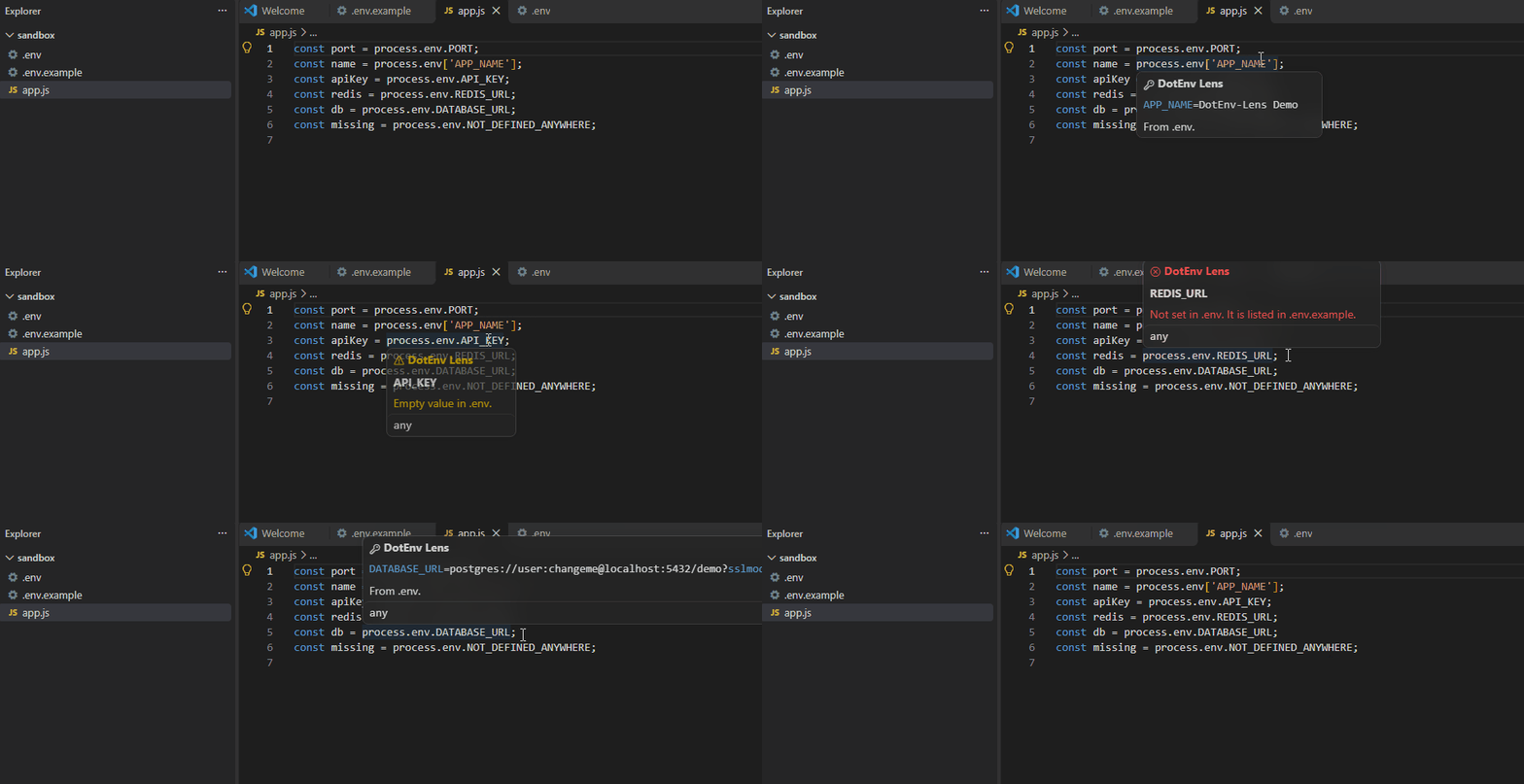
How to see your .env values in VS Code without opening the file You are reading some code and you see process.env.PORT. What is the value? So you open the .env file, scroll to find the line, and then go back to where you were. I wanted to skip that step, so I built a small VS Code extension. It is called DotEnv Lens, and it is free and open source. Hover to see the value Hover over process.env.ANYTHING in a JavaScript or TypeScript file, and the value appears right there, with the file it came from. !Hovering over process.env in VS Code shows the value from the .env file The hover tells you more than the value: - A warning when the value is empty. - An error when the key is not set anywhere. - A hint when your .env.example lists a key that your .env is missing. It reads .env.local first and then .env, the way most frameworks do, and it updates as soon as you save the file. What about secrets? Showing values is the whole point, so the full value is shown by default. But if you share your screen or record a video, one setting masks secret-looking values (keys with words like KEY, SECRET, TOKEN or PASSWORD, and passwords inside connection URLs). It is called dotenvlens.maskSecrets, and it is off by default. The extension only reads local files. It makes no network calls. Compare .env with your template The first feature I built was a comparison. Right-click a .env file (or use the command palette) and run DotEnv Lens: Compare .env with template. It tells you which keys are missing, extra, empty or duplicated compared with .env.example. The report shows key names only, never values. How it is built The parser and the comparison logic are plain TypeScript with no VS Code dependency, so they are unit tested on their own (79 tests so far). The VS Code part is a thin layer on top. The parser handles comments, quoted values, export prefixes, values with = inside, and duplicate keys. Try it Search for "DotEnv Lens" in the VS Code Extensions panel, or install it from the VS Code Marketplace. The source code is on GitHub. What should I build next? I am thinking about jump to definition, autocomplete for env keys, and Vite and Python support. Which one would you use? Tell me in the comments.
@julianor @j00ru To be clear, the upstream is aware now and there is advisory and a new Brotli version (github.com/google/brotli/releases/tag/v1.2.1, my previos comment was that they weren't aware at the time of the Mozilla bug). But yeah, many many contexts.
I am in love with the new ARMSX3 update The developers added a new “XMB Mode” as an alternate UI and it’s like Christmas came early, the amount of love and passion they have put into PS3 emulation on Android is wonderful, what a time to be alive github.com/ARMSX2/ARMSX3/releases
@vranac nvd.nist.gov github.com/kubernetes/ingress-nginx/releases/tag/… kubernetes.io
Plic 0.5.37 — a hardening release for the native macOS Matrix client (six fixes from a code review) Plic is a native Matrix client for the Mac, free and open source, built on the Matrix Rust SDK with security as its first concern. I posted it here a month ago; this release is what a thorough review of the code turned up, fixed. What 0.5.37 fixes - Two crashes a stranger could cause. A message with an ordered list starting at an extreme number crashed the app, and kept crashing it at every launch since the last room reopens. A crafted call key message could crash every participant in a call. Both are now checked before they reach the code that trapped. - Call servers are no longer taken on trust. Any room member can advertise the server a call converges on. Plic then sent your OpenID token there and routed media through it, whatever the address — even plain http, even a machine on your local network. Now only https servers on public hosts are accepted, and the media server must be wss. - Call membership and keys are checked against their sender. A member could withdraw someone else’s call membership, cutting them off from the call’s keys, or register a key under another participant’s identity. - Calls fail closed. When the app cannot tell whether a room is encrypted, it refuses to start the call and says so, instead of quietly connecting without media encryption. - Signing out leaves nothing behind. The local search index, which holds decrypted text, and its key are deleted; the activity log is cleared; delivered notifications are removed. The next account inherits nothing. - Notifications open their room again. Clicking a notification, sharing from another app or picking a Share menu suggestion now switches to the room. Links - Download, SHA-256, requirements: denisflorent.group - Release notes: github.com/denisflorentmediagroup/plic/releases/t… - Source (Apache 2.0): denisflorentmediagroup/plic - Privacy policy, listing what is stored and what leaves your Mac: denisflorent.group - Bug reports: github.com/denisflorentmediagroup/plic/issues Requirements: macOS 26.5 or later, Apple Silicon. Signed and notarized. Still open, so nobody discovers it the hard way: room keys go only to verified devices, with no switch, so a bridge whose device isn’t cross-signed gets no keys from Plic (mautrix bridges can self-sign since October 2025); call keys go to every device in the call; call key rotation when someone leaves isn’t done; no independent audit yet. The screenshot shows the new Liquid Glass appearance on a test server with fictional people.
I made a Codex-style way to save and ask questions on Gemini Web Hey everyone, I made a little tool for Gemini and wanted to share it here When I’m reading a long reply from Gemini, I often want to ask follow-up questions along the way, but I hate interrupting my reading flow. I’d much rather save my questions up and ask them all at once when I’m done. Gemini doesn’t really have a clean way to do this I really like how Codex lets you comment inline, so I just copied that experience over to Gemini Web. You select some text, jot down your question right next to it, and keep reading, and send all the questions together with the quotes attached I’ve been using it for a few days and it’s pretty handy It’s completely free and open source, btw - Chrome Web Store: link - GitHub: link
Seedsow save file update The group of seedsow save files at purple442/seedsow-lua-editor-pro now adds the HTTP-based viewer that Alula made and also lets you view/edit the seedsow files from the web. That is not my github but I confirmed it as working. Probably wanna grab it fast since Nintendo's system updates are typically Monday night preview.redd.it
✅ 一手来源: GitHub PR #4954(replace wandb with trackio) lerobot#4954 Trackio 官方文档 huggingface.co 注意:改动 10/30 合并进 main,最新正式版仍是 v0.6.1(8 月),要从源码装 main 才能用。
ChatGPT currency converter with official exchange rates: the AllRatesToday app Ask ChatGPT "what is 500 GBP in euros?" and you usually get a number from memory, somewhere near the truth, with no date and no source. As a currency converter that is fine for curiosity. It is useless for an invoice, a customs form, a tax return or anything an auditor will read later, because those need the exchange rate a named institution published on a named day. As of today the AllRatesToday app is live in the ChatGPT app directory: AllRatesToday on ChatGPT Once it is added, ChatGPT works as a currency converter backed by official exchange rates: it calls our tools instead of guessing, and every answer carries the institution and the publication date. Why ChatGPT exchange rates are often wrong A language model has no exchange rate feed of its own. Without a tool, "the exchange rate today" is whatever figure was common in its training data, which can be months old, and the model rarely says so. Even when it searches the web, it picks up a market quote from a random page at a random time, which is not the rate a tax office or customs authority asks for. The app fixes both problems: the number comes from the publisher's table, and the answer states the date it belongs to. How to use ChatGPT as a currency converter with official rates 1. Open the AllRatesToday app page in ChatGPT and add it. There is no sign-up and nothing to configure. 2. Ask in plain words: "convert 2,000 USD to INR at the official rate", or "ECB exchange rate today for GBP". 3. Read the date and the institution in the answer. If you need a different publisher, name it: "use the Bank of England rate instead". What you can ask | You ask | What comes back | |---|---| | "Convert 500 GBP to EUR using the official daily rate." | The ECB reference rate for the pair, its publication date, and the converted amount. | | "What is the latest ECB reference rate for USD?" | The figure from the ECB's own table, dated. | | "Reserve Bank of India reference rate for USD today." | The RBI table's USD/INR print and its date. | | "HMRC exchange rate for invoicing in JPY this month." | The current HMRC monthly rate for JPY. | | "Which central banks do you cover, and when did the Bank of Thailand last publish?" | The list of 123 central banks and 4 tax authorities with each one's latest publication date. | | "Give me one reproducible EUR/USD rate for 31 October for my month-end report." | The 16:00 London daily reference rate, with its disclaimer. | Pairs the ECB does not publish fall back to the central bank that issues one of the two currencies, and the answer says which. A pair that a bank does not print directly is cross-computed inside that bank's own table and flagged as derived, so nothing is presented as a published figure when it is not. What it deliberately does not do - No live market quotes. The app serves official daily publications. They can lag the market by a day, and the answer always says which day. If you need a one-minute mid-market rate, that is the API, not the ChatGPT app. - No payments, no transfers, no execution. It is a lookup tool. - No user data. The app has no login and keeps no profile. It receives the currency codes and bank code ChatGPT sends for the question and nothing else. The privacy policy spells this out. - No upsell inside the chat. The tools do not ask for an API key, and they do not accept one. Every tool in the app is the keyless public surface. Where the numbers come from The same pipeline that feeds the central bank rates API: each institution's own publication, collected on its own schedule, stored in the direction the publisher quotes it, with a cross-source plausibility check before anything is served. The list of institutions and their source pages is on the data sources page. The 16:00 London reference rate is described on its own page; it is a reproducible daily snapshot, not a registered benchmark, and the app repeats that caveat when it uses it. For developers: the same tools outside ChatGPT The app is a thin wrapper over our hosted MCP server. The keyless profile ChatGPT uses is at https://allratestoday.com/api/mcp/public and exposes five tools: an official daily exchange rate, the supported currencies, the covered institutions, any institution's latest table, and the daily reference rate. The full endpoint at https://allratestoday.com/api/mcp adds live mid-market rates, dated tables and history with a free API key, and works in Claude, Cursor, VS Code, Codex and any other Streamable HTTP MCP client. Setup for each is on the MCP page, and the REST equivalents are in the docs. If you build an agent that files numbers somewhere, the habit the app enforces is the one worth copying: never return a rate without the institution and the date it belongs to. --- AllRatesToday is on GitHub and X. The original post is on allratestoday.com.
I'm looking for imagery with field counts from other plantations and regions, GPU compute or cloud credits, and research partners. o.oyin1115@gmail.com Code: Dexsholex/oil-palm-crown-detection Model: huggingface.co Cite: doi.org #GeoAI #RemoteSensing
I made a blindfold chess trainer for my own practice I wanted a way to practise without seeing the pieces. So I made Blindfold Chess. It includes coordinate, movement, notation, and position exercises. It runs in your browser without an account. Progress stays on your device. Play: ceasar369.github.io Code and local download: Ceasar369/blindfold-chess I used my Claude Code setup to build it. That setup is also public: Ceasar369/claude-behavior-layer I’d like feedback on exercises that feel awkward or unclear.
Updates to Authtics Advisories Authtics Advisories has been updated! Reports are no longer generated daily. I've been receiving reports too quickly, so I've changed the scanning schedule to monthly. Here's the overview - A Code of Conduct - Discussions enabled on the repository - A Contributing guide - Advisory schema 1.1 - Gemini can now use web_search through Firecrawl - Existing advisories can now be updated The new Advisory schema includes additional fields and information, such as a references object. Repo: Found Malicious Packages
Who wants to be a DEV Hello, I’ve created this “skill”: it’s a game designed to keep your programming skills from getting rusty and to demonstrate whether you truly understand the code you ship. this consumes a really low amount of tokens and only runs when claude is working leandrofus/who-wants-to-be-a-DEV
How We Built PrezScan: Free Hardware-Free Biometric Attendance for Indian Universities Every morning across engineering colleges and universities in India, hundreds of people line up in front of wall-mounted fingerprint machines that break down and cause morning delays. To solve this, we built PrezScan (prezscan.onrender.com) — an independent, 100% free, hardware-free smart attendance web app engineered specifically for Indian higher-education campuses. Why PrezScan is Built for Colleges: 1. Dual-Lock Anti-Proxy Attendance: Enforces a physical double-lock combining on-device 68-point AI facial recognition with academic building Wi-Fi subnet (CIDR) geofencing. Marking attendance outside the campus building or buddy-punching is physically impossible. 2. Sub-200ms Verification: Runs client-side directly in the browser engine using WebGL GPU acceleration. 3. 100% Privacy by Design (DPDP Act 2023 Compliant): Raw face photos are never sent over the internet or stored on servers; only local 128-dimensional mathematical vector embeddings are evaluated. 4. 1-Click Audited Excel Reports: Monthly attendance ledgers export complete timestamps and session hours instantly in formatted spreadsheets. • Live Web Application: prezscan.onrender.com • Source Code & Documentation: Nitin091307/attendanceforu
Every time I create a product my focus goes first (wrongly) to building instead to distributing. Videos, manuals, etc. felt like an obligation. So I open sourced a skill for Claude Code to create product demo videos. Not distribution, but it's a start ;) aaitor/skill-video-studio t.co
We open sourced kiviDB two weeks ago and the repo just crossed 1k stars on GitHub. Huge thanks to everyone who's starred, contributed, and shown love. Still a lot to build, but this community makes it fun. Have you tried it yet ? kividbio/kividb
thnx @_onmax on perf items 🔥 github.com/nitrojs/nitro/releases/tag/v3.0.261102…
Built a native Linux ACPI RGB driver + interactive 3D dashboard for Acer Aspire Lite AL15G-52 Hey everyone! Wanted to share a personal open-source project I've been developing. I use an Acer Aspire Lite AL15G-52, and I wanted proper RGB keyboard lighting control while running Linux. So I built Luma ALG RGB. The interesting part is that it isn't just a frontend application. I worked on the hardware communication layer as well. What's inside? - C-based Linux kernel DKMS driver. - Acer ACPI _DSM communication. - CLI for RGB and brightness control. - Multi-zone lighting and animation engine. - Interactive 3D keyboard visualizer. - Local REST API and browser dashboard. - GNOME Shell extension. - systemd and udev integration. I found the Acer CLV0001:00 device and implemented control through the known ACPI function 0x67. The project is currently verified on my Acer Aspire Lite AL15G-52. GitHub: chiragkoyande/luma-alg_rgb License: GPL-2.0. I would love feedback from fellow Indian developers working on Linux, C, kernel modules, frontend development or hardware reverse engineering. Also interested in finding people with other Acer laptops who can help test hardware compatibility. Thanks! preview.redd.it
Low-Cost Summarization Using OpenAI API Token Reduction in Node.js (and a Portable Choice) Short answer: Low-cost summarization using the OpenAI API comes from reducing input tokens, capping output tokens, chunking long diffs, and keeping the Node.js or Go caller behind a provider-neutral contract; that combination lowers API cost without making one vendor the architecture. The practical answer is to reduce the text before it reaches the model, cap the output deliberately, and keep a provider-neutral summary contract around the call. For a logistics platform that turns code-review changes into structured findings, that usually means counting tokens, chunking oversized diffs, asking for a short JSON-shaped result, and retaining a fallback path when a provider rejects the context. The largest portability mistake is optimizing the prompt around one vendor's client library and then discovering that the actual workflow is inseparable from it. I care about this as an SRE concern, not a prompt-polishing exercise. A shorter request lowers variable API consumption, but it also changes latency, retry volume, and the amount of evidence an auditor can inspect. The right target is therefore a bounded SLO for useful findings, not the smallest possible completion. What should a logistics review summary contain? Before choosing a model, define the output that downstream systems can tolerate. In this example, a review worker receives a pull request diff and returns findings with a severity, a file, a line, a concise explanation, and a confidence value. The worker does not need a prose essay. It needs stable records that can be stored, displayed, and reprocessed without a human guessing where one finding ends. That distinction matters for token reduction. Removing repeated instructions and irrelevant files is usually safer than aggressively shortening the diff itself. A changed route-planning function may look verbose, yet a deleted validation branch can be the most important evidence. I would keep the diff hunks, strip generated artifacts and duplicated repository context, then cap the completion at the number of findings the review product can actually show. I initially treated a generous output limit as harmless because most summaries would be short. The capacity-planning test changed my mind: the tail of the distribution, not the median review, drives queue pressure and retry cost. A bounded completion gives the worker a predictable upper limit, while chunking makes the input limit an explicit workflow decision instead of an exception discovered in production. For a concrete policy, an eight-chunk diff must be budgeted as eight calls plus a merge call, and every retry belongs in that estimate. Measure the tail. How can low-cost summarization using the OpenAI API reduce token use? Use a three-stage path: 1. Count the candidate input before sending it. 2. Split long diffs into coherent chunks with a small, deliberate overlap when context requires it. 3. Summarize each chunk and run a final merge over the structured findings, with a lower output cap than the individual review calls. The count is a planning signal, not a promise that every provider tokenizes text identically. A local tokenizer library such as tiktoken is useful for estimating a known encoding, while a token-counting endpoint can be used when the selected runtime exposes one. The estimate should feed admission control: accept, chunk, or fall back. It should not be used as a billing assertion. The fallback should preserve the contract. If a call is rejected for a token limit, retrying the identical payload is wasteful; reduce the chunk, remove low-value context, and record that the result was produced from a reduced view. If the final merge cannot fit, concatenate findings, deduplicate by file and line, and mark the merge as incomplete rather than silently returning an empty review. Here is the core request path in Go. It uses the OpenAI-compatible chat route, sends the key only to the API host, sets an explicit method, checks non-success responses, and retries rate limiting with exponential backoff. The max_tokens value is a policy knob: it is intentionally small enough to protect the worker's queue SLO, but it must be tested against the finding schema and language of the repository. package main import ( "bytes" "encoding/json" "fmt" "io" "net/http" "os" "strconv" "time" ) type message struct { Role string `json:"role"` Content string `json:"content"` } type requestBody struct { Model string `json:"model"` Messages []message `json:"messages"` MaxTokens int `json:"max_tokens"` Temperature float64 `json:"temperature"` } func summarize(chunk, model string) ([]byte, error) { body, err := json.Marshal(requestBody{ Model: model, Messages: []message{ {Role: "system", Content: "Return only JSON findings with severity, file, line, explanation, and confidence."}, {Role: "user", Content: "Review this logistics code diff for correctness risks:\n" + chunk}, }, MaxTokens: 300, Temperature: 0, }) if err != nil { return nil, err } apiKey := os.Getenv("INFRAI_API_KEY") if apiKey == "" { return nil, fmt.Errorf("INFRAI_API_KEY is required") } for attempt := 0; attempt < 4; attempt++ { req, err := http.NewRequest(http.MethodPost, "https://placeholder.invalid", bytes.NewReader(body)) if err != nil { return nil, err } req.Header.Set("Authorization", "Bearer "+apiKey) req.Header.Set("Content-Type", "application/json") baseURL := os.Getenv("OPENAI_BASE_URL") if baseURL == "" { return nil, fmt.Errorf("OPENAI_BASE_URL is required") } req.URL, err = req.URL.Parse(baseURL + "/chat/completions") if err != nil { return nil, err } resp, err := http.DefaultClient.Do(req) if err != nil { return nil, err } response, readErr := io.ReadAll(resp.Body) resp.Body.Close() if readErr != nil { return nil, readErr } if resp.StatusCode == http.StatusTooManyRequests { delay := time.Duration(1<<attempt) * time.Second if retryAfter, parseErr := strconv.Atoi(resp.Header.Get("Retry-After")); parseErr == nil { delay = time.Duration(retryAfter) * time.Second } time.Sleep(delay) continue } if resp.StatusCode < 200 || resp.StatusCode >= 300 { return nil, fmt.Errorf("review request failed with %s: %s", resp.Status, response) } return response, nil } return nil, fmt.Errorf("rate limit persisted after retries") } The sample deliberately does not pretend that max_tokens solves input overflow. It limits the completion. Input control belongs before this function, where the worker can count and chunk. In a real queue consumer, the chunk identifier and repository revision should also be part of the idempotency key; a timeout must not create a second set of findings for the same revision. Which provider shape keeps the workflow portable? There are four reasonable integration shapes for this workload, and they impose different operational costs. | Option | What it does well | Portability boundary | Best fit | | --- | --- | --- | --- | | OpenAI API | Direct access to an established chat interface and client ecosystem | Requests, model names, and response handling are tied to one provider surface | Teams already standardized on OpenAI | | Anthropic API | A separate model and API surface for teams willing to maintain a second adapter | Message format, model identifiers, and policy controls need their own integration | A deliberate second-provider strategy | | Google Vertex AI | A managed cloud control plane around model access and regional deployment choices | Cloud identity, project configuration, and provider-specific request types become part of the worker | Organizations already operating heavily in Google Cloud | | Infrai | A single REST surface that exposes multiple backend capabilities behind one contract, including an OpenAI-compatible path | The portability is to its surface; model-specific behavior still needs evaluation | A small platform team adding summarization beside other backend capabilities | The last row is useful for a narrow reason, not a blanket endorsement. Its discovery surface describes capabilities and schemas publicly, and its live discovery snapshot covers 295 routes across 20 modules. That breadth behind one consistent surface means adding a related capability can remain another contract-shaped call instead of another SDK, credential, and reconciliation path. For this review worker, the OpenAI-compatible route also lets an existing calling pattern remain familiar. There is a boundary. A common route does not make different models semantically identical. Severity calibration, JSON adherence, context behavior, and refusal policy still need provider-specific tests. I would keep the review result schema, chunker, token budget, retry policy, and acceptance tests in our codebase, then put the provider call behind a small adapter. That is the part we own and can move. I would not choose a managed aggregator solely because it has more endpoints, either. Breadth is valuable when the same application genuinely needs several modules; otherwise it adds an intermediary to the incident path. The decision rule is concrete: use the common surface when reducing integration ownership matters more than maximizing vendor-specific controls, and use a direct provider when those controls are the product requirement. What should the SLO measure? Token count is an input to the budget, not the service-level objective. For a logistics review queue, I would track useful-review completion, p95 worker duration, rate-limit retry rate, rejected-context rate, and the fraction of findings that pass schema validation. The exact thresholds depend on the review workflow; inventing a universal number would turn a local policy into false precision. Capacity planning should model the worst normal diff, the merge pass, and retries together. If one pull request produces eight chunks and each chunk can retry three times, the queue sees a very different load from the average one-call example. Bound concurrency at the worker, keep retry delays out of the hot loop, and make partial results observable. A short summary that arrives within the SLO is not useful if it hides that half the diff was dropped. Provider portability also belongs in the test matrix. Run the same representative diffs through each adapter, compare structured findings rather than prose, and include an oversized diff, a deletion-heavy diff, a malformed response, a rate limit, and a token-limit rejection. The comparison should tell the team where behavior differs; it should not produce a fake single score that erases the operational trade-off. The decision For this logistics code-review workflow, I would start with a provider-neutral chunking and findings contract, cap completions with max_tokens, and use token counting for admission control. I would keep at least one direct-provider adapter in the test harness even if production uses a unified REST surface. That preserves an exit path and exposes assumptions early. An aggregator such as Infrai fits when breadth behind one consistent API reduces platform ownership across several backend capabilities, and its OpenAI-compatible surface can shorten the first integration. OpenAI, Anthropic, or Vertex AI can be the better choice when their model behavior, controls, or cloud boundary is itself a requirement. None of these choices removes the need to own chunking, idempotency, schema validation, and an evidence-aware SLO. Start with the contract. Then measure the tail. Sources - OpenAI, tiktoken tokenizer library: openai/tiktoken - OpenAI API documentation: platform.openai.com - Anthropic API documentation: docs.anthropic.com - Google Vertex AI generative AI documentation: cloud.google.com
Before and after, 20 seconds. Every document is fake. Full 2:35 demo: youtu.be Code: rahulrao85/parda Built in 10 days on Muse Spark 1.3, SAM 3.1 and Voice Transcribe for the @AIatMeta x @cerebralvalley hackathon. Open source, MIT. #MetaAIHackathon @finkd