Mentions
Conversations linking to GitHub, newest first. Times are UTC.
Mentions by source
X
Bluesky
Hacker News
V2EX
Qiita
DEV
Mailwal
Mastodon
Latest posts
Location: Milton, Ontario, Canada Remote: yes Willing to relocate: Yes Technologies: Java, Ruby, PHP, C#, Elixir, AI/LLMs (Claude mostly), SQL, Linux Résumé/CV: wiggletonabbey.com Email: justin<at>wiggletonabbey<dot>com Website: wiggletonabbey.com Github: github.com/jusroberts I am a Senior Software Engineer with 10+ years of experience shipping web apps. I have worked primarily back-end, but am comfortable with full-stack responsibilities. I've worked in Fintech and b2b marketing/sales software and on monoliths and micro-services. On the side, I built pickyskincare.com to help compare skin care products by their ingredients, find similar products at cheaper price points, and identify and avoid personal allergens and irritants. I'm currently working on a gamified exercise tracking app. I'm looking for a remote senior back-end, full-stack, or product engineering role.
kvleak: • zero deps, no API key, no network • reads Claude Code, Codex CLI, Gemini CLI, OpenCode • --fail-over 15 makes it a CI gate for agent jobs 3 seconds to find out what your agent really costs: uvx kvleak Post yours: kvleak#1 And if it found something, a ⭐ on the repo helps it reach more people.
I open sourced langchain-security-extension library: Deterministic RBAC and zero-token denial for LangChain Standard LLM system prompts cannot enforce data isolation or authorization, as they remain vulnerable to injection and non-deterministic bypassing. And when an AI is denied access to a tool, it often rapidly retries different parameters to find a workaround, burning expensive compute tokens in a runaway execution loop. To solve this, the langchain-security-extension library (now on PyPI and GitHub) embeds deterministic, code-level Policy Enforcement Points (PEPs) directly into existing LangChain workflows. Instead of hoping a model respects instructions, this framework drops unentitled requests at the service gate before billable tokens are serialized. Key architectural boundaries include: - Agent Abuse Throttling & Zero-Token Denial: Deploys invocation-scoped retry budgets and cross-turn sliding windows to immediately halt malicious parameter scanning and runaway execution loops. - Pre-Execution Tool Guardrails: Evaluates dynamic Attribute-Based Access Control (ABAC) rules using Common Expression Language (CEL) to validate parameters before target Python callables execute, entirely replacing fragile prompt instructions. - In-Band Context Propagation: Injects immutable caller identities directly into LangChain's RunnableConfig to preserve authorization across asynchronous multi-agent handoffs, eliminating vulnerable thread-local storage. - Secure Vector Retrieval: Translates caller identities into native Abstract Syntax Tree (AST) pre-filters, coupled with post-retrieval in-memory pruning and candidate oversampling to secure RAG pipelines. preview.redd.it The library is completely open source. You can explore the implementation guide and run the hands-on enterprise incident assistant demonstrator below: - GitHub Link - PyPi Link
@termix_ai The verification view on the marketplace is here: agent.family and the whitepaper is at TermiX-official/aacp-whitepaper
@bigtom_bd Since providing liquidity involves interacting with smart contracts, security is something we take seriously. Our contracts have undergone a security review by Shieldify, and you can find the audit report here: github.com/shieldify-security/audits-portfolio/bl… github.com/shieldify-security/audits-portfolio/bl…
@_Rookie_Z @howtomen Brother, you approved an app that I sent but didn't go to the store. Orion-Data#2465
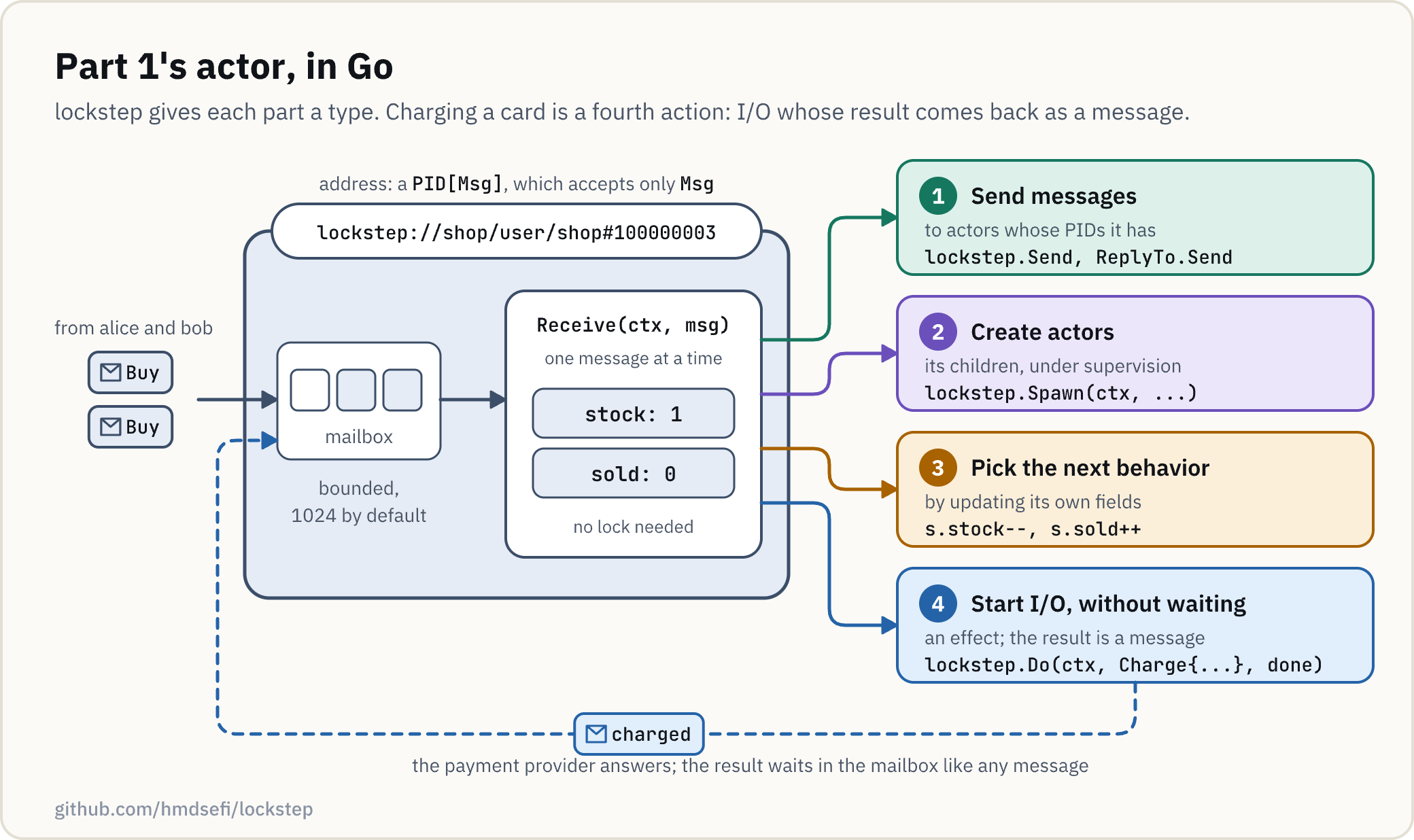
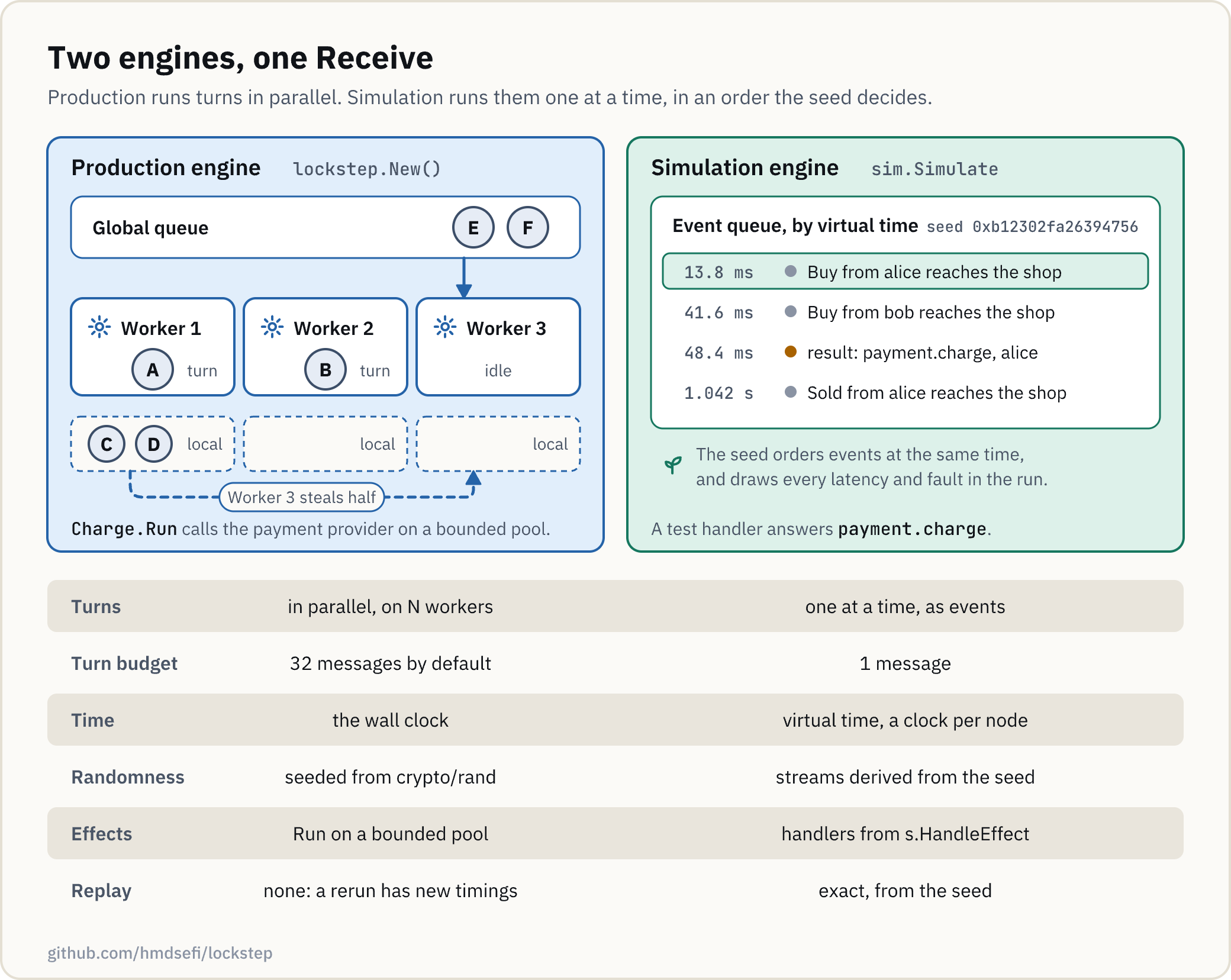
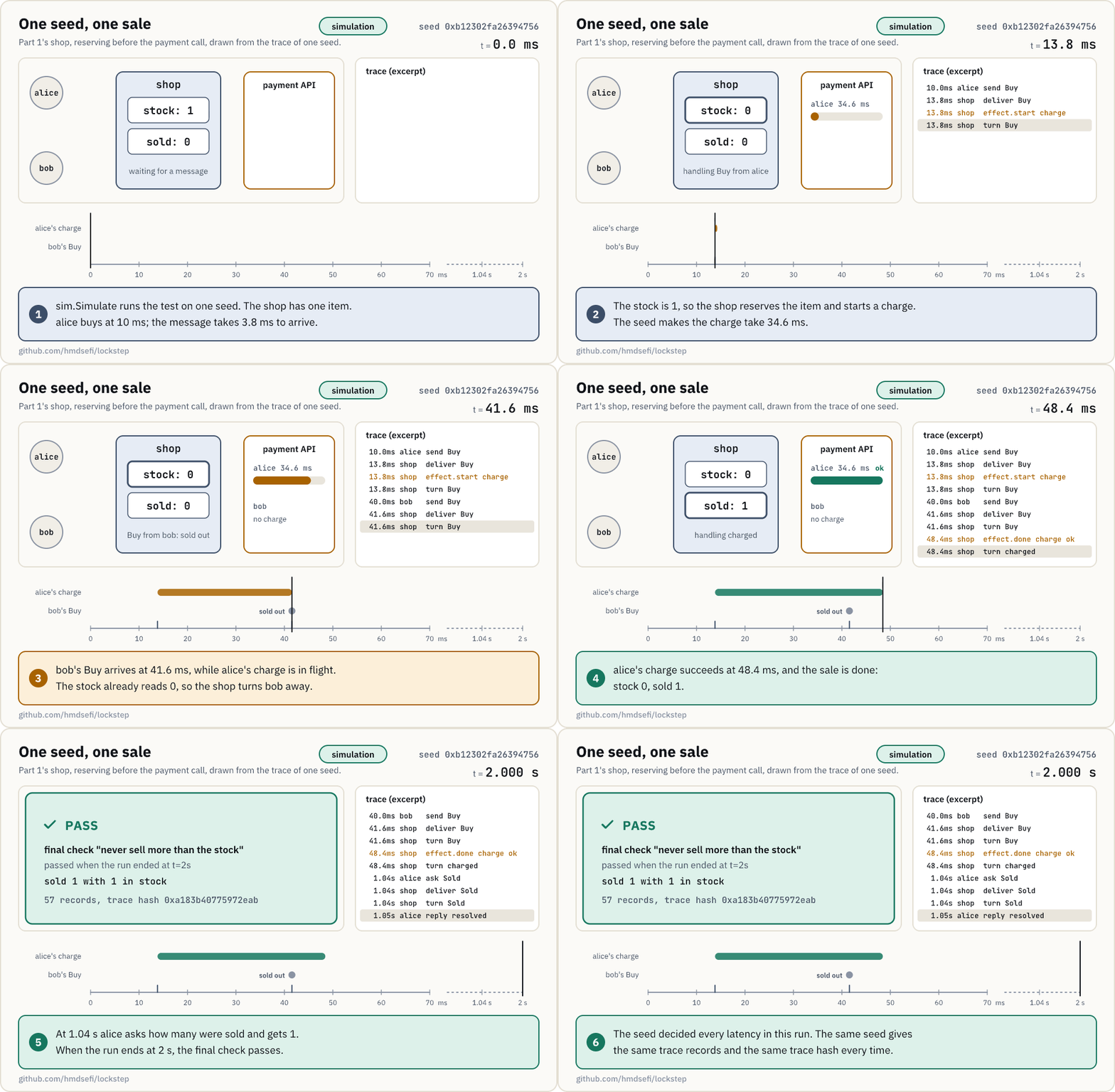
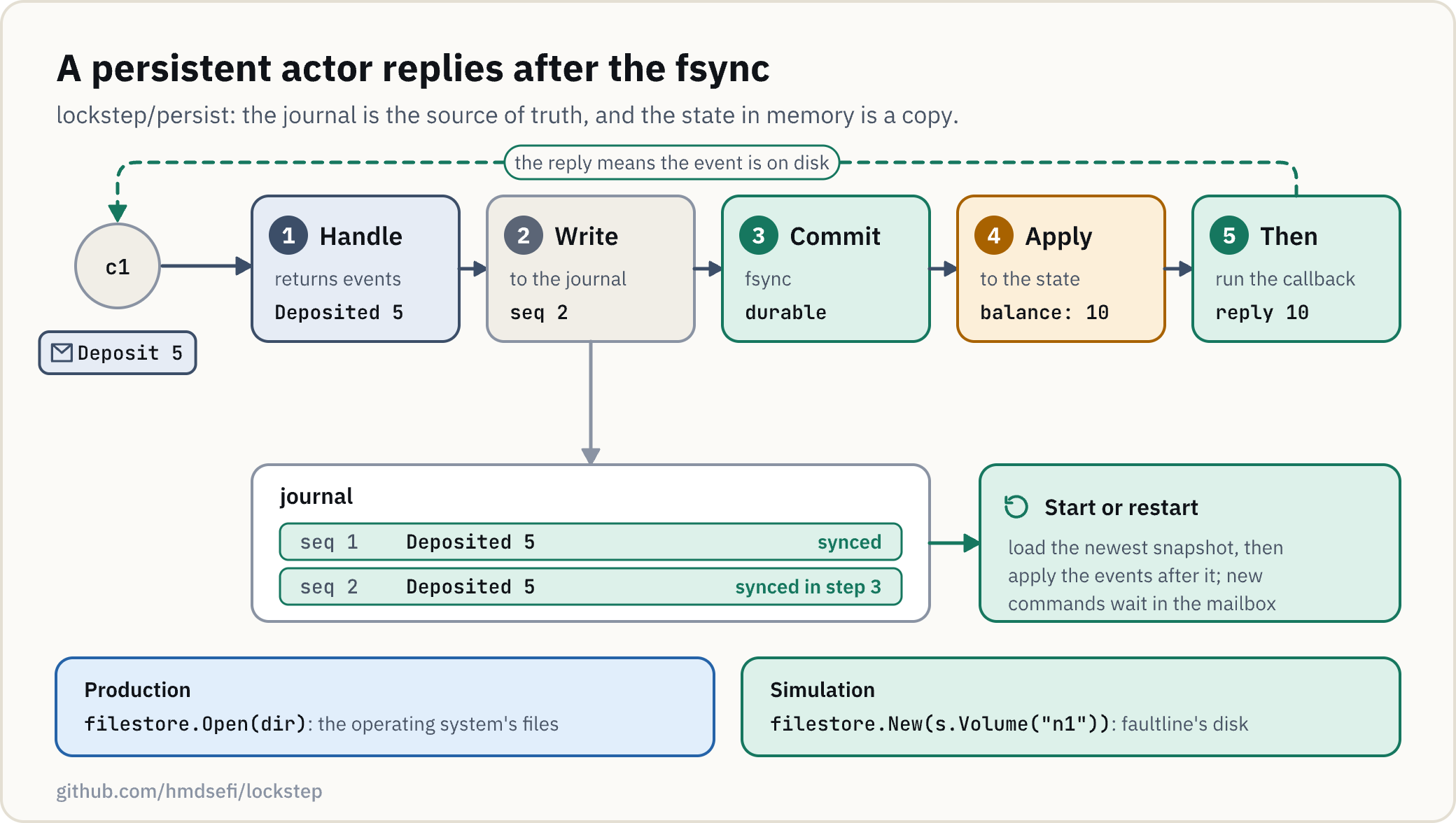
Actors in Go: How lockstep Runs One Actor in Your Program and in Tests Part 1 of this series explained actors in pictures, and part 2 showed Discord, LinkedIn and Halo running them on Elixir, Akka and Orleans. None of those runtimes is Go. Go gives you goroutines and channels and leaves the rest to you. You decide which goroutine owns which state, what happens when a channel fills up, what restarts a goroutine that panicked, and how to test any of it. I've been building lockstep to answer those questions with actors. It's an actor runtime for Go, and v0.2.0 came out on 1 November 2026. You write actors with typed messages, bounded mailboxes, supervision and timers, and lockstep runs them in your program on a pool of worker goroutines. The same actor code also runs in go test, in a simulation with its own clock and network. There, one number, the seed, decides the order of every message. This article builds part 1's one-item shop with lockstep and runs it in both places. The shop from part 1, in Go Part 1 opened with a shop that has one item left in stock. As an actor, the shop owns stock, buyers send it Buy messages, and there is nothing to lock. A real shop takes payment before it hands over the item, so this one charges a card. In lockstep the shop is a Go type with a Receive method. All the code in this article ran on lockstep v0.2.0 and Go 1.27.1: // Msg is every message the shop accepts. type Msg interface{ isMsg() } // Buy asks the shop to sell one item to User. type Buy struct{ User string } // Sold asks how many items the shop has sold. type Sold struct{ Reply lockstep.ReplyTo[int] } // charged is the result of a Charge effect. type charged struct { user string err error } func (Buy) isMsg() {} func (Sold) isMsg() {} func (charged) isMsg() {} // Shop sells a limited stock. type Shop struct{ stock, sold int } // NewShop returns a factory for a shop with stock items. func NewShop(stock int) func() lockstep.Actor[Msg] { return func() lockstep.Actor[Msg] { return &Shop{stock: stock} } } func (s *Shop) Receive(ctx *lockstep.Context[Msg], msg Msg) { switch m := msg.(type) { case Buy: if s.stock == 0 { return // sold out } s.stock-- // reserve the item before the slow payment call lockstep.Do(ctx, Charge{User: m.User}, func(_ struct{}, err error) Msg { return charged{user: m.User, err: err} }) case charged: if m.err != nil { s.stock++ // payment failed: put the item back return } s.sold++ case Sold: m.Reply.Send(ctx, s.sold) } } The parts of an actor from part 1 are all here, with Go types on them:  Part 1's actor, with Go types and the PID the shop gets in the test below. The fourth arrow is new: the actor starts I/O and gets the result back as a message. - The address is a typed PID. lockstep.Spawn returns a PID[Msg], which accepts only Msg values, so a message of another type doesn't compile. - The mailbox is bounded. It holds 1024 messages by default. When it's full, Send returns ErrMailboxFull instead of letting the queue grow. Part 1 listed unbounded mailboxes as a cost of Erlang's and Akka's defaults, and part 2 showed Discord paying it. - Receive handles one message at a time, so stock and sold need no lock. - A reply is a message. Sold carries a ReplyTo[int], the typed version of part 1's Get(replyTo). The shop takes the item out of stock before it charges the card. A charge takes tens of milliseconds, and another Buy can arrive while it's in flight. Part 1's account animation ended on exactly that: the order in which messages arrive decides who is declined. Reserving first checks and takes the item in one turn, lockstep's name for one call to Receive, so no order of messages can sell it twice. Part 4 runs the version that takes the item after the charge. Effects: I/O that doesn't block the actor Charging a card means waiting on the network, and an actor must not wait inside Receive, because its mailbox doesn't move while it waits. lockstep.Do starts an effect and returns at once. When the payment provider answers, the function passed to Do turns the result into a charged message, and the shop handles it in a later turn. Charge is the effect, and its Run method makes the real call: // Charge is the effect that charges a user's card. type Charge struct{ User string } func (Charge) Name() string { return "payment.charge" } func (c Charge) Run(ctx context.Context) (struct{}, error) { return struct{}{}, chargeCard(ctx, c.User) // the payment provider's API } Effects are part of one rule for all actor code: it doesn't block, start goroutines, read the wall clock, or use global randomness. Time comes from ctx.Now, ctx.After and ctx.Every, randomness from ctx.Rand, and I/O from effects. When every delivery, timer, random number and I/O call goes through the runtime, the runtime decides all of them. That's what lets a second engine, the simulation below, decide them differently. lockstep ships an analyzer, lockstep-vet, that checks the rule. Here it is on a version of the shop that charges the card in a goroutine and records each sale with time.Now: shop.go:47:3: LS100: go statement starts a goroutine; use lockstep.Do for work outside the turn (actor code: (*Shop).Receive) shop.go:56:21: LS100: time.Now uses the wall clock; use ctx.Now, ctx.After or ctx.Every (actor code: (*Shop).Receive) It runs through go vet or as a golangci-lint plugin. It also reports an ignored error from Send, a message the sender keeps using after it sent it, and a reply that nobody waits for. And it reports a message type that Receive has no case for. The shop in your program lockstep.New() starts the engine your program runs on, which lockstep calls the production engine. This program spawns the shop with one item, lets Alice buy, lets Bob buy 30 ms later, and asks how many items were sold: func main() { sys := lockstep.New() defer func() { _ = sys.Shutdown(context.Background()) }() pid, err := lockstep.Spawn(sys, "shop", shop.NewShop(1)) // one item in stock check(err) fmt.Println("spawned", pid) // Alice buys first; Bob buys 30 ms later. check(lockstep.Send[shop.Msg](sys, pid, shop.Buy{User: "alice"})) time.Sleep(30 * time.Millisecond) check(lockstep.Send[shop.Msg](sys, pid, shop.Buy{User: "bob"})) time.Sleep(100 * time.Millisecond) // the payment answers in 10 to 59 ms sold, err := lockstep.Ask(sys, pid, func(r lockstep.ReplyTo[int]) shop.Msg { return shop.Sold{Reply: r} }).Await(context.Background()) check(err) fmt.Println("sold:", sold) } chargeCard here is a stand-in for the payment provider that answers after 10 to 59 ms, and check exits on an error: spawned lockstep://local/user/shop#6494268c00000003 sold: 1 2026/11/02 17:07:44 INFO shutdown started node=local actors=1 2026/11/02 17:07:44 INFO shutdown finished node=local elapsed=552.709µs Ask puts a ReplyTo[int] into the Sold message and returns a reply that Await waits for. Await blocks, so it belongs outside actors. Inside an actor, lockstep.Pipe delivers the reply as a message instead. The last two lines come from the runtime's log/slog logger, which also logs failures, restarts and overload. The production engine runs actor turns on a pool of worker goroutines, GOMAXPROCS of them by default: - Turns of different actors run in parallel; turns of one actor never overlap. In one turn, an actor handles up to 32 messages before it gives its worker to another actor. A worker with nothing to do takes ready actors from a busier worker's queue. - Messages from one sender to one receiver arrive in send order. - Effects run on their own pool. At most 64 run at once and 1024 more wait. A Do that finds both full resolves with ErrOverloaded. - A full mailbox has a policy. The default fails the send. The others drop the newest or oldest message or block the sender. - Supervision follows Erlang's. One-for-one and all-for-one strategies restart failed actors, with restart limits and backoff. The same shop in a test sim.Simulate runs a test body once per seed, each time in a fresh simulated world. This one has three nodes: a server for the shop, and two clients, alice and bob: func TestOneItemTwoBuyers(t *testing.T) { opts := sim.Options{Options: faultline.Options{Seeds: 100, Duration: 2 * time.Second}} sim.Simulate(t, opts, oneItemTwoBuyers) } func oneItemTwoBuyers(s *sim.Sim) { w := s.World() var shop lockstep.PID[Msg] var spawnErr error s.Node("shop", func(sys *lockstep.System) { shop, spawnErr = lockstep.Spawn(sys, "shop", NewShop(1)) // one item in stock }) s.Client("alice", func(*lockstep.System) {}) s.Client("bob", func(*lockstep.System) {}) // The payment API answers after 10 to 60 ms, chosen by the seed. s.HandleEffect("payment.charge", func(c sim.EffectCall) sim.EffectResult { return sim.EffectResult{Value: struct{}{}, Latency: kernel.Uniform(c.Rand(), 10*time.Millisecond, 60*time.Millisecond)} }) w.RunFor(10 * time.Millisecond) // let the nodes boot // Alice buys first; Bob buys 30 ms later. _ = sim.Send[Msg](s, "alice", shop, Buy{User: "alice"}) w.RunFor(30 * time.Millisecond) _ = sim.Send[Msg](s, "bob", shop, Buy{User: "bob"}) w.RunFor(time.Second) sold, err := sim.Ask(s, "alice", shop, func(r lockstep.ReplyTo[int]) Msg { return Sold{Reply: r} }) w.Final("never sell more than the stock", func() error { if err := errors.Join(spawnErr, err); err != nil { return err } if sold > 1 { return fmt.Errorf("sold %d items with 1 in stock", sold) } return nil }) } The timing is the program's, in virtual time, the simulation's own clock: Alice buys at 10 ms and Bob 30 ms later. After a second, Alice asks how many items were sold, and the final check runs when the two seconds are up. w.RunFor(time.Second) moves the clock forward without sleeping. All 100 seeds pass: ok example.com/shop 0.303s The test calls the same Receive as the program. What changes is the engine underneath: !Two engines run the same Receive. Left, the production engine behind lockstep.New(): a global queue of ready actors and three workers with local queues, where workers 1 and 2 run turns of actors and idle worker 3 steals half of worker 1's queue; Charge.Run calls the payment provider on a bounded pool. Right, the simulation engine behind sim.Simulate on faultline: one event queue in virtual-time order holding real events from the shop's run: Buy from alice at 13.8 ms, Buy from bob at 41.6 ms, the payment.charge result at 48.4 ms, and Sold from alice at 1.042 s. The seed orders events at the same time and draws every latency and fault, and a test handler answers payment.charge. A table compares turns, turn budget, time, randomness, effects and replay. Both engines call the same Receive. They differ in who picks the next turn, what time it is, and what answers an effect. sim.Simulate runs on faultline, my deterministic simulation library for Go. Every turn handles one message and is one event in a single queue ordered by virtual time. The seed breaks ties between events at the same time, and it draws every network latency and every effect's latency. Charge.Run never runs, because a call to a real payment provider can't be replayed. The test answers the effect by its name, payment.charge, with a handler instead. Here is the first of the 100 seeds, drawn from its trace: !Animation of seed 0xb12302fa26394756 on the shop that reserves first, drawn from its trace. The shop starts with stock 1 and sold 0. Alice's Buy arrives at 13.8 ms; the shop reserves the item, so stock drops to 0, and starts a charge. Bob's Buy arrives at 41.6 ms while the charge is in flight; stock is 0, so the shop turns him away. Alice's charge succeeds at 48.4 ms and sold becomes 1. At 1.04 s Alice asks how many were sold and gets 1, and at 2 s the final check passes. The run has 57 trace records and the trace hash 0xa183b40775972eab. Bob's Buy arrives while Alice's charge is still in flight. The stock already reads 0, so the shop turns him away. Every time in the animation comes from the trace. On this seed, Bob's Buy arrives at 41.6 ms, 7 ms before Alice's charge comes back. On other seeds the charge comes back sooner, and Bob's Buy arrives after it. The shop sells one item either way. A run is a list of events, and the trace hash is a hash of all of them. Run this seed again with FAULTLINE_TRACE=full, and its trace files show the same 57 records and the same hash, 0xa183b40775972eab. When a seed fails, the output includes a command that replays that exact run. State that survives a restart The shop keeps its stock in memory. If it restarts, NewShop(1) creates it again with one item in stock and nothing sold, so it can sell the same item twice. State that must survive goes in a persistent actor, which v0.2.0 adds in lockstep/persist. This one is the bank account from part 1, written as event sourcing: a Deposit command stores a Deposited event, and the balance is the sum of the events: func (Account) Initial() int64 { return 0 } func (Account) Handle(ctx *persist.Context[Deposit, Deposited, int64], _ int64, d Deposit) []Deposited { ctx.Then(func(ctx *persist.Context[Deposit, Deposited, int64], balance int64) { d.Reply.Send(ctx, balance) // runs after the event is committed }) return []Deposited{{Amount: d.Amount}} } func (Account) Apply(balance int64, e Deposited) int64 { return balance + e.Amount } The README's program spawns it with persist.Spawn on a store in the directory data, deposits 5, and prints the balance. Run it twice: go run . go run . balance: 5 balance: 10 The second run starts a new system on the same directory. The account recovers the balance of 5 from its journal before it handles the new deposit: !A persistent actor handles Deposit 5. Handle returns the event Deposited 5. lockstep writes the event to the journal, then commits it with fsync, then applies it to the state, balance 5 to 10, and only then runs the Then callback that replies 10. On restart, the actor recovers its state from the newest snapshot and the events after it before it takes the next command. In production the store uses the operating system's files; in a simulation the same store runs on faultline's simulated disk. The reply runs after the fsync, so a reply means the event is on disk. A restart rebuilds the state from the journal. Handle returns events instead of changing the state, and Apply folds one event into the state. lockstep writes the events to a journal, calls fsync, and only then applies them and runs the callbacks registered with ctx.Then. While the actor recovers or commits, its commands wait in the mailbox. With a snapshot store, it also saves a snapshot every SnapshotEvery events and recovers from the newest one. In your program, the store, persist/filestore, keeps its files on the local disk. In a test, filestore.New(s.Volume("n1")) runs the same store on node n1's simulated disk. What lockstep is good for I'd reach for lockstep when correctness depends on the order of messages and failures: consensus, replication, and ledgers or inventories where a lost or doubled update costs money. It also fits services that retry and fail over, and workflows where many long-lived workers each keep state. Those are the shapes from part 2: one actor per guild, per online member, per game session, on one machine for now. It fits less well when one piece of state must be updated from many cores at once, because an actor handles one message at a time. A stateless request-response service doesn't need actors at all. What it costs - You write actors. lockstep simulates actors, not arbitrary goroutines, so existing goroutine code needs restructuring before a seed can decide its order. - Your program is one process. There is no remoting or clustering yet. A PID names its node, but nodes exchange messages only in a simulation, so part 1's location transparency exists only in tests for now. - A turn can't be preempted. A Receive that never returns holds its worker. lockstep logs a turn that has run for 5 seconds, with its worker's stack, but it can't stop it. - Benchmarks compare it with three Go libraries. The bench module runs the same workloads on lockstep, protoactor-go, Hollywood and GoAkt. In the CI run that bench/RESULTS.md reports, from 31 October 2026, ping-pong between one pair of actors took 783 ns per message on lockstep. It took 384 on Hollywood, 423 on GoAkt and 2,670 on protoactor-go. Hollywood and GoAkt also had lower send latency, and lower ask latency with one caller, than lockstep in that run. The file has every row. - The API can change before v1.0. lockstep needs Go 1.26 or later: go get github.com/hmdsefi/lockstep@v0.2.0 The README starts with part 1's counter, and the repository is at hmdsefi/lockstep. In the next article, I'll take the item after the charge instead of before it, and a seed will find what goes wrong. Then I'll crash nodes, partition the network and retry requests. --- Sources lockstep v0.2.0 - Release notes. github.com/hmdsefi/lockstep/releases/tag/v0.2.0 - README: the counter, the production engine and the persistent account. github.com/hmdsefi/lockstep/tree/v0.2.0 - "Why lockstep": the shop example this article builds on. github.com/hmdsefi/lockstep/blob/v0.2.0/docs/why-… - "lockstep architecture": the two engines, effects, mailboxes and persistence. github.com/hmdsefi/lockstep/blob/v0.2.0/docs/arch… - Benchmark results. github.com/hmdsefi/lockstep/blob/v0.2.0/bench/RES… Elsewhere - faultline, deterministic simulation testing for Go. hmdsefi/faultline - Part 1: "The Actor Model: Why It Was Invented and How It Works". hmdsefi.hashnode.dev - Part 2: "Actors in Production: How Discord, LinkedIn and Halo Use the Actor Model". hmdsefi.hashnode.dev
maplibre-react-native ⭐ 673 A React Native library for rendering vector tile maps on Android and iOS. 🔗 maplibre/maplibre-react-native #opensource t.co
Free Mach3 alternative for CNC mills, routers, plasma, laser Many people use their CNC machines with one of those red/blue RNR Eco Motion 2.0 USB boards that ship as a “Mach3 USB controller”. Since I am in the middle of building myself a CNC plasma cutter, I had the idea to write my own control software for it - with the help of AI. I thought it would be useful for other people as well as I still quite often see Mach3 being used, which is fine, but it's old and lacks some features. Oh and that is not free. So I created: BreakoutCNC. It’s free and open source (GPL-3.0), and it runs on Windows, with Linux and macOS builds too. I originally just wanted to use it for my future plasma cutter, but as I was building it, I kept adding more and more features. Then at some point, since I have a DIY CNC router in my workshop (that I built in 2017), I thought, why not make the app support that one as well. So I then focused on the Mill part of the application and added even more features. Few weeks later v0.1 is ready. It talks to the board directly: the PC plans the motion and streams it to the board, so no Mach3 or Mach3 plugin is needed. Brief feature list - BreakoutMill: mill / router with X, Y, Z and A (rotary or a slaved second gantry motor) - BreakoutCut: plasma with torch height control (arc OK, anti-dive, initial height sensing), or laser with M4 dynamic power, framing, air assist and interlocks - Look-ahead planner, feed hold, feed / spindle overrides, MDI, work offsets G54–G59, tool table, homing, soft limits - Probing: Z touch-off, edges / corners / bores / bosses, and height-map surface probing that warps the toolpath (nice for PCBs and engraving on warped stock) - Since I use a Huanyang VFD over RS-485 on my router, I added direct support to it as well - Imports your Mach3 profile (motor tuning, homing, limits, slaving, RNR and Huanyang plugin settings), then walks you through a 5-step machine test: input polarity, directions, steps/mm, switches, spindle - Lua scripting for M6 tool changes, homing, macro buttons and custom M-codes - You choose what each output does, and spare pins can become named custom I/O - 2D / 3D toolpath view that stays smooth with very large files, camera overlay, dark and light theme - A built-in simulator, so you can try everything without a board I think it has a lot of nice things that I would really like to go in more detail about, but then the post would be really long. Maybe I will create a video about it at some point. Some of my favorite features: - built in surface probing routine, no extra software needed (I used G-Code Ripper before) - the jog pads, they are touch friendly, their middle circle can be used as a joystick so X and Y can be jogged simultaneously (I know the arrow keys do the same but if you use a touch screen this is nice) - support for 2 cameras, one for X/Y tool zeroing, one for remote monitoring - it supports remote g-code upload - dark / light mode - maybe I will add more color themes later - minimal view mode where the toolpath viewport is more visible - it is fast, written in C++, I tested it on a 2014 laptop with 20MB carve G-Codes, ran with 60 FPS Honest status: it’s early (v0.1). BreakoutMill has been tested against the RNR board (both red and blue) on my bench, but not yet on a real machine. Plasma and laser have only run in the simulator so far and I haven't really tested them yet, mostly spent time on the Mill so far. Please test with the drivers off first and keep a hardwired E-stop. There’s a checklist in the repo. I was thinking about adding lathe support as well, but I don't have a lathe so maybe in the distant future... Boards: right now it only supports the RNR Eco Motion 2.0. The code has a driver layer ready for other boards, and I’d like to support more - even Grbl - but I can only add a board I can actually test with. If you have a spare motion board lying around and would be willing to send it, I’d gladly add support for it. Same for testing on Linux or Mac: the builds pass CI, but nobody has run them on real hardware yet. Downloads, more screenshots, user guide and source: GitHub repo Feedback, bug reports and opinions are all welcome. Issues or comments here both work.
@TheWattenhofer @solana_devs @SolanaFndn @deanmlittle Solana Fall School 2026 | Week 4, Day 2 What I learned: - IDLs describe program instructions and accounts. - Codama generates typed clients from IDLs. - Compared decoded state and instruction bytes with Anchor. - Tested PDA resolution. Code: roxxcli/solana-fall-fundraiser-codama
✅ 一手来源: 论文(arXiv 2610.35835)arxiv.org Countersign(开源)I-HITL/countersign 注意:作者称短信/邮件验证码、TOTP、推送、FIDO2 在这个威胁模型下都失效。披露后 Circle 在文档里加了警告。结果和模型能力强弱不相关。
I Built a Serverless, End-to-End Encrypted Messaging App That Works Without the Internet What if you could send private messages without WhatsApp, Telegram, internet access, user accounts, or centralized messaging servers? Meet Eccles Bluechat E2EE — an experimental Android messaging application built around decentralized, Bluetooth-based communication. Designed with privacy and independence at its core, Eccles Bluechat explores: - 🔐 End-to-end encryption using ECDH, HKDF-SHA256, and AES-256-GCM. - 🔑 Android Keystore-backed cryptographic key protection. - 📡 Serverless, internet-independent Bluetooth messaging. - 🛡️ Trust-on-first-use (TOFU) identity verification. - 📁 Encrypted local message and media storage. - 📞 Bluetooth-based voice and video communication. No accounts. No advertisements. No tracking. No centralized messaging infrastructure. This project explores an important engineering question: Can we build meaningful private communication systems without depending on the internet or centralized infrastructure? This is an open-source engineering experiment, and I'm sharing the architecture, implementation, challenges, and lessons learned. GitHub: Igwe-Starking/eccles-bluechat-e2ee Built by Eccles (Igwe Starking).
Isometric diagrams in plain SVG: projection, four-tone shading and painter's order Isometric drawings explain hardware and systems better than flat boxes and arrows: a reader sees depth, which part sits on which, and where things connect. You don't need a 3D engine for them. About 45 lines of JavaScript and plain SVG polygons are enough to start, and the three ideas below are the ones that decide whether the result looks crafted or broken. The cover image is exactly what the script at the end draws: a base plate with a tank, a pipe, a pump and a valve. 1. The projection In a classic isometric view the x and y axes sit 30 degrees below the horizontal and z points straight up. A world point (x, y, z) lands on screen at: const COS30 = Math.cos(Math.PI / 6), SIN30 = 0.5; function project([x, y, z], s = 20, ox = 280, oy = 190) { return [ox + (x - y) * COS30 * s, oy + (x + y) * SIN30 * s - z * s]; } s is the pixel size of one world unit and (ox, oy) is where the world origin lands. On screen +x runs down-right, +y runs down-left and +z runs up. That means a bigger x + y is closer to the viewer, which matters in step 3. 2. A box is three faces, and each face gets its own tone From this camera you only ever see three faces of a box: the top, the face at x + w (screen right) and the face at y + d (screen left). Draw those three as polygons and skip the rest. Flat colour makes boxes look like stickers. The trick is four tones from one base colour: the top lightest (it faces the light), the right face at the base colour, the left face darker, and an outline darker still so edges read on any background. function tones(hex) { const n = parseInt(hex.slice(1), 16), c = [n >> 16, (n >> 8) & 255, n & 255]; const mix = k => '#' + c.map(v => Math.round(Math.min(255, v * k)).toString(16).padStart(2, '0')).join(''); return { top: mix(1.25), right: mix(1.0), left: mix(0.75), line: mix(0.45) }; } Keep the same four multipliers for every material and the whole drawing reads as lit from one direction. 3. Painter's order (the bug that bites first) SVG paints in document order, so whatever comes later covers what came before. You have to emit far things first. The obvious first try is to sort every box by its near corner, (x + w) + (y + d). It looks reasonable on paper and fails at once on this scene: the base plate is the widest part, so its near corner is the biggest, so it is drawn last and buries the pipe and the valve, the lower half of the tank and most of the pump. For drawings built in layers (a plate, then parts standing on it) a two-key sort fixes it: the bottom z first, then the near corner inside each layer. const order = (a, b) => (a.z - b.z) || ((a.x + a.w + a.y + a.d) - (b.x + b.w + b.y + b.d)); Know its limits. It holds for compact, similar-sized parts. A long member breaks it even when nothing touches: a long pipe running along x behind a short pump has the bigger near-corner sum, so it gets drawn after the pump and paints over it. Parts that float above another layer can fail the same way. For anything beyond simple layered scenes, use the separation test: with this camera, box A is behind box B when A.x + A.w <= B.x, or A.y + A.d <= B.y, or A.z + A.h <= B.z. Add an edge for each pair whose screen outlines overlap, then sort topologically. If the graph has a cycle (three bars in a pinwheel, each in front of the next), split one box in two to break it. The whole script Save it as iso.mjs and run node iso.mjs > machine.svg. Open the SVG in any browser. Node 18 or newer is enough; there are no dependencies. // iso.mjs: isometric boxes in plain SVG, no libraries. Run: node iso.mjs > machine.svg const COS30 = Math.cos(Math.PI / 6), SIN30 = 0.5; // World -> screen. On screen, +x runs down-right, +y runs down-left, +z runs straight up. One unit = `s` px. function project([x, y, z], s = 20, ox = 280, oy = 190) { return [ox + (x - y) * COS30 * s, oy + (x + y) * SIN30 * s - z * s]; } // Four tones per material: top lightest, right face mid, left face darker, outline darkest. function tones(hex) { const n = parseInt(hex.slice(1), 16), c = [n >> 16, (n >> 8) & 255, n & 255]; const mix = k => '#' + c.map(v => Math.round(Math.min(255, v * k)).toString(16).padStart(2, '0')).join(''); return { top: mix(1.25), right: mix(1.0), left: mix(0.75), line: mix(0.45) }; } const pts = p => p.map(q => project(q).map(v => v.toFixed(1)).join(',')).join(' '); // A box at (x, y, z) with size (w, d, h). Only the three faces the viewer sees are drawn. function box({ x, y, z, w, d, h, color }) { const t = tones(color); const top = [[x, y, z + h], [x + w, y, z + h], [x + w, y + d, z + h], [x, y + d, z + h]]; const right = [[x + w, y, z], [x + w, y + d, z], [x + w, y + d, z + h], [x + w, y, z + h]]; const left = [[x, y + d, z], [x + w, y + d, z], [x + w, y + d, z + h], [x, y + d, z + h]]; const face = (p, fill) => `<polygon points="${pts(p)}" fill="${fill}" stroke="${t.line}" stroke-width="1" stroke-linejoin="round"/>`; return face(left, t.left) + face(right, t.right) + face(top, t.top); } // Painter's order: draw what is farther from the viewer first. For parts that sit on layers // (a plate, then things standing on it), sort by the bottom z first, then by the near corner // (x + w) + (y + d) inside each layer. const order = (a, b) => (a.z - b.z) || ((a.x + a.w + a.y + a.d) - (b.x + b.w + b.y + b.d)); const parts = [ { x: 0, y: 0, z: 0, w: 10, d: 6, h: 1, color: '#5b6b82' }, // base plate { x: 1, y: 1, z: 1, w: 3, d: 3, h: 5, color: '#2f7de1' }, // tank { x: 4, y: 2, z: 1, w: 3, d: 1, h: 1, color: '#9aa7b8' }, // pipe { x: 7, y: 1, z: 1, w: 2, d: 3, h: 3, color: '#e2a03f' }, // pump { x: 7.5, y: 4.5, z: 1, w: 1, d: 1, h: 0.6, color: '#d9534f' } // valve ]; const body = [...parts].sort(order).map(box).join('\n '); process.stdout.write(`<svg xmlns="http://www.w3.org/2000/svg" viewBox="0 0 600 460" width="600" height="460"> <rect width="600" height="460" fill="#0f1420"/> ${body} </svg> `); To add a part, add one line to parts. To change the look, change the four multipliers in tones. Pick mid-tone base colours: tones clamps at 255, so a very light base loses the contrast between its top and right faces. On Windows PowerShell 5.1, node iso.mjs | Out-File -Encoding utf8 machine.svg avoids a UTF-16 file. Where to take it next Real explainer figures need more than boxes: cylinders and rounded parts, labels that never collide, cutaways that open a wall to show the inside, live numbers on gauges, and motion. Each of those is its own small project. For detailed figures without building the renderer yourself, the open-source anatomy skill (MIT) is an agent skill that has Claude Code create detailed, interactive isometric SVG illustrations of machines and systems. Its source is a good place to learn the techniques. Disclosure: I'm the founder of Homingo; Homingo Learn is our learning brand. We built a paid Claude Code skill that includes that open-source skill with our reel and explainer kit on top. Isometric Explainers adds a 1080x1920 reel kit (camera moves, cutaways, callouts locked to parts, named cues synced to your narration), live readouts, and built-in layout, motion and geometry checks, so one figure becomes both a docs illustration and a vertical explainer reel. It's Rs 1,499 one-time: Isometric Explainers for Claude Code. Everything above works without it.
Created a @stencil_labs Tern plugin that opens a package.json as a table of its dependencies. For each dependency it shows the newest minor and major release you can install, and you can update it with one click. Respects min release age settings. Artimunor/tern-js-lib-versions
⚡ Can Web Audio API replace a guitar amp? Gryf features in-browser physical tube emulation, 50Hz hum filter, BBD analog stereo chorus and tape delay with zero latency. Plug your guitar directly into Chrome/Firefox: 92.118.206.90 GitHub: github.com/merx666...
Another milestone; 200 forks at webbrain-one/webbrain 🥲
Location: Berlin, Germany Remote: Yes Willing to relocate: No Technologies: TypeScript, Svelte/ SvelteKit, React/ Next.js, Python, Go, PostgreSQL, Nix, AI-native engineering, RAGs, AI Agents, CloudFlare, AWS Resume/CV: https://shayon.work/cv.pdf Email: hi@shayon.work GitHub: https://github.com/dit7ya I am generalist senior software engineer who thrives at hard, challenging problems. At a cybersecurity startup, I built and shipped the frontend and platform single-handedly in eight months, all of that before agentic coding. I also co-founded a startup and built its product end to end. I maintained about 100 packages in nixpkgs. I have a master's degree in mathematics, and did some research in inverse reinforcement learning. I love things like: Emacs, NixOS, functional programming, category theory. I'm looking for a generalist, full-stack or applied AI role on a high-agency, low-bullshit team. If you're building something ambitious, let's talk. Recent fun HN project: A HackerNews aggregators aggregator - news.ycombinator.com
Could a local shop make a discontinued pump gasket instead of scrapping the pump? Batchplan's core demo traces pen paths in simulation: following an outline, not just reaching its end. It's not machining or a validated repair. natsuku-lab/batchplan
✅ 一手来源: 论文 arxiv.org 数据 WenJing95/stale-docs-data 那句提示:"When a repository's documentation and its existing code disagree, follow the conventions used in the existing code, and point out each inconsistency." 注意:数字为作者自述,仅测了 Python。
I’ve been building SilentHuddle, a peer-to-peer communication app. Hey everyone, I’ve been working on SilentHuddle, a peer-to-peer communication app for Windows and Android. I built it for people who are concerned about privacy want a simple way to start a group conversation without signing up for another chat service or keeping a permanent chat history. To join a conversation, a person enters the room using a temporary code. Someone who is already in the room then adds them. A signaling service helps the devices find each other and share the initial connection details(token offers). After that, WebRTC carries encrypted calls and data between the peers. The app offers chat, voice and video calls, screen sharing, and file submission with preview. It's an independent project and I'm still evolving. If anyone tests it, I'd like to know how it went, especially if u find problems or have suggestions. website: https://www.silenthuddle.site/ source: https://github.com/JiovanyMatos51/silenthuddle.app
This is basically the main reason that I started building mfinelli/recueil. It _only_ works in your browser so you can bypass captchas or paywalls or whatever and then it uses singlefile (getsinglefile.com) to upload the result to your self-hosted archive.
Meituan's LongCat-2.5 Drops Into Claude Code at $0.30/$1.20. Its Setup Caps You at 200K - Book: System Design Pocket Guide: Fundamentals - The series: Pocket Guides for Developers — 8 short books on agents, RAG, prompts, observability, events, databases and system design — the whole series - My project: Hermes IDE | GitHub — an IDE for developers who ship with Claude Code and other AI coding tools - Me: xgabriel.com | GitHub --- Meituan released LongCat-2.5 on November 2: a 1.6-trillion-parameter model with about 48B active per token, according to TechNode. Its API docs list a 1M-token context window, an Anthropic-compatible endpoint, and a guide for running it inside Claude Code. The launch price is $0.30 per million input tokens and $1.20 per million output. Follow that guide as written and Claude Code will compact your conversation at 200K tokens. Claude Code does this to any model name it doesn't recognize, and the fix is one environment variable. What Meituan shipped on November 2 Meituan's announcement describes a native multimodal model aimed at long-horizon agent tasks, trained entirely on domestic Chinese chips, with W4A4 quantization for inference. TechNode reports that Meituan turns failures real agents hit into reproducible training tasks, and that text and images go through one token framework. On quality, Meituan's own summary says its scores on several mainstream benchmarks fall between Claude Opus 4.8 and Claude Opus 5, and beat Opus 5 on some (announcement). Look at what it's compared against. A commenter in the Hacker News thread quotes the comparison set from Meituan's page: GPT-5.5, GPT-5.6 Sol, Opus 4.8 and Opus 5. In Claude Code, the opus alias has resolved to Opus 5.5 since v2.1.280, so the Opus you'd actually be replacing isn't on the chart. Meituan's are the only scores published so far. Weights aren't out. TechNode says the GitHub and Hugging Face releases are "planned to follow", with no date and no word on whether they include weights. The predecessor's weights did ship: LongCat-2.0 is on Hugging Face under the MIT License, at the same 1.6T total and about 48B active. One HN commenter summed up the 2.5 page: "Is this supposed to be downloadable weights? Open weights? Who knows?" Why the Claude Code guide gets you 200K LongCat's Claude Code guide has you put an env block in ~/.claude/settings.json that points ANTHROPIC_BASE_URL at https://api.longcat.chat/anthropic and sets ANTHROPIC_MODEL, the Opus and Sonnet defaults and the old small-fast variable to LongCat-2.5. It never sets ANTHROPIC_DEFAULT_HAIKU_MODEL. Claude Code has never heard of LongCat-2.5. Its model configuration docs say that when it doesn't recognize a session's model ID, "it can't tell the model's context window and assumes 200K tokens", and it auto-compacts at that assumed size. The same page gives the fix for any other window: set CLAUDE_CODE_MAX_CONTEXT_TOKENS. For an unrecognized ID that doesn't start with claude-, which LongCat-2.5 doesn't, the variable "takes effect on its own." !A long black cat silhouette stretched along a cream measuring tape, with a burnt-orange clamp pinching the tape at one fifth of its length A 1M-token model, a 200K assumption. Claude Code compacts at the window it thinks the model has. The guide sets three other variables you should check: - CLAUDE_CODE_MAX_OUTPUT_TOKENS is set to 131072. For a model ID Claude Code can't resolve, the env-vars reference says the cap is 128000, and that raising this value "reduces the effective context window available before auto-compaction triggers." - ANTHROPIC_SMALL_FAST_MODEL is set, and Claude Code's docs mark it deprecated in favor of ANTHROPIC_DEFAULT_HAIKU_MODEL, which also drives background work. - CLAUDE_CODE_DISABLE_NONESSENTIAL_TRAFFIC is set. Per the reference, that turns off auto-updates, telemetry and feature-flag fetching, and setting it to 0 "still disables this traffic." So Claude Code stops updating itself. To turn it back on, unset it. The wrapper below leaves it out. A setup that leaves your other sessions on Claude The bigger issue is where the guide puts all this. Claude Code's settings docs say ~/.claude/settings.json applies to "you, in every project on this machine." Paste the guide there and every Claude Code session you start goes to LongCat. If you want to try it next to your normal setup, scope it to one launch with a wrapper script: #!/usr/bin/env bash # ~/bin/claude-longcat export ANTHROPIC_BASE_URL="https://api.longcat.chat/anthropic" export ANTHROPIC_AUTH_TOKEN="$LONGCAT_API_KEY" export ANTHROPIC_MODEL="LongCat-2.5" export ANTHROPIC_DEFAULT_OPUS_MODEL="LongCat-2.5" export ANTHROPIC_DEFAULT_SONNET_MODEL="LongCat-2.5" export ANTHROPIC_DEFAULT_HAIKU_MODEL="LongCat-2.5" export CLAUDE_CODE_SUBAGENT_MODEL="LongCat-2.5" export CLAUDE_CODE_MAX_CONTEXT_TOKENS=1000000 exec claude "$@" chmod +x it, export LONGCAT_API_KEY in your shell, and run claude-longcat in a repo. Plain claude stays on your Anthropic account. CLAUDE_CODE_SUBAGENT_MODEL sets the default for subagents that aren't given a model another way. I haven't run LongCat-2.5 myself, so check /status and /context on your first session before you trust the window. What it costs depends on your cache The pricing page labels these a limited-time discounted price and says "Prices are subject to change": | Per 1M tokens | USD | |---|---| | Uncached input | $0.30 | | Cached input | $0.006 | | Output | $1.20 | Cached input is one fiftieth of uncached. Coding agents resend the whole conversation every turn, so the cache hit rate decides the bill. On the listed rates, a turn that sends 100K input tokens costs $0.03 uncached and $0.0006 if it all hits the cache. Output usually dominates once the cache is warm. !Two stacks of coins on a cream background, one tall and black, one tiny and burnt orange, with a small open drawer between them Same tokens, two prices. On an agent loop, most of what you resend should land in the small stack. If you call it from your own code, rate-limited requests come back as HTTP 429 with a retry_after field, and the quick start recommends exponential backoff. The chat API reference says temperature is "Fixed at 1.0 with thinking enabled and 0.7 with thinking disabled", with other values "overridden." If your eval harness sets temperature 0 for repeatable runs, it won't get it here. Running it next to Claude Code in Hermes I build Hermes IDE, so weigh this section with that in mind. Hermes runs Claude Code, Codex, Copilot, OpenCode and the rest side by side, each in its own terminal. ⌘N (Ctrl+Shift+N on Windows and Linux) starts each task on its own hermes/<name> branch in its own worktree, so you can give stock Claude Code and the LongCat wrapper the same ticket without either touching the other's files. !The Hermes IDE New task sheet with its agent picker open: Claude Code selected, Codex installed, the other supported agents marked Not installed, and Custom agent at the end of the list The ⌘N agent picker in Hermes 2.3.4: Claude Code and Codex installed, the other supported agents listed, and Custom agent at the end. The wrapper goes in as a Custom agent with claude-longcat as its command. Whatever spend figure you see for that session, check it against LongCat's own billing. Hermes is free on macOS, Windows and Linux, and it isn't affiliated with Meituan, Anthropic or Nous Research. Before you move real work to it One HN commenter called it "benchmaxxed" after a few prompts. That's one person's gut read. Give Meituan's charts the same caution until someone else runs the benchmarks. There's also a policy question nobody has answered. China's Ministry of Commerce and Ministry of Science and Technology published a draft export catalogue on October 16, open for comment until November 15. A Cloud Security Alliance note reads it as requiring reporting and automatic licensing before newly developed restricted model technology is open-sourced, while weights already public stay outside it. Meituan hasn't said whether LongCat-2.5 counts, and neither have the ministries. The API route works today and costs little to try. Would you put a model whose only scores are its maker's on a real ticket, or wait for the weights and an independent run? Tell me in the comments. --- If this was useful Most of this post was about two old system design problems: a cache that decides what a request costs, and a rate limit that tells you when to back off. The System Design Pocket Guide: Fundamentals covers caching, rate limiting and the other building blocks an agent backend leans on. It's one of 8 short books in the Pocket Guides series, on agents, RAG, prompts, observability, events, databases and system design. If you want to race a new model against Claude Code on the same repo, download Hermes IDE (free, source-available under BSL 1.1) or star it on GitHub. 
@jnardiello kindlingai/gr8 with huggingface.co weights!
The Curator is the tool I built after ARIA to stop being the memory of the system. Agents read and save project context through its MCP server, a persistent memory layer you own. talirezun/the-curator ⭐ open source, if it's useful, stars help more builders find it
I made a model agnostic complier backed agent that makes flash models perform better than frontier Instant demo: varianttech.net github: oooscoos/Benzi Benzi is a compiler backed coding agent. It compiles your codebase into a resolved, queryable map of calls, data flow, control flow and class hierarchy first; then it reads, explains, runs, edits and verifies your code using it. Every language runs its own tree-sitter grammar into the same query map. It maintains a clear separation of resolved/ambiguous/observed relations across repo - runtime tracer answers what static analysis can't. It also supports incremental reindexing and code edit validation via the same query map. On SWE-bench Verified, it scores 82.6% using DeepSeek v4.1 flash. pass@1 all attempts. for $9.26. 97.6% tokens served from cache. It read 326,928 lines of code vs 645,752 for mini-SWE-agent. Report here: github.com/oooscoos/Benzi/blob/main/swebench-octo… More details here varianttech.net, and on the github which includes both Benzi's and mini-SWE's runs. On separate benchmarks, it was individually shown that Benzi generally reads 2-6x less source code than other agents/harnesses (which shows up in cognition, checkout comparison with codegraph: varianttech.net ) while costing 2x less. Details for that here: varianttech.net Benzi is free to use during beta. You can get the agent as a VS Code ext., CLI, or just the compiler as served as a MCP server. Pl try it out and lmk what you think!
Repo 91: Search Your Computer by Describing the File #shorts DigUp searches the files on your computer by what's in them, using Google DeepMind's EmbeddingGemma 2 on your own device: photos, PDFs, documents, recordings, videos and code. Mac, Windows (beta), Linux (beta). Repo Rush No. 91: one new GitHub repo, explained in under a minute. Subscribe for the next one. Project: ARahim3/DigUp Script written from the project's README; check the repo for details. #localai #search #privacy #shorts Music: "Pixelland" by Kevin MacLeod (incompetech.com), licensed under Creative Commons: By Attribution 4.0 License creativecommons.org
Developers can now set WooCommerce webhook delivery priority through a new filter. Stores can rank webhook traffic below time-sensitive scheduled work, such as renewals. Default delivery priority stays unchanged. woocommerce#69881
Repo of the day: an open-source password manager you can host AliasVault: a self-hostable, end-to-end encrypted password and email alias manager. We cloned the repo in a sandbox and checked the license and compose file (the full stack was not run). 🔔 Subscribe for a new trending repo every day: youtube.com 💬 Comment REPO for the link, or get it here: essaihi04.github.io Sources: - Repo, README, LICENSE.md, docker-compose.yml: aliasvault/aliasvault (AGPL-3.0, author: aliasvault / Leendert de Borst) - Install docs: docs.aliasvault.com Images: all visuals drawn in code, no third-party images. #Shorts #GitHub #OpenSource #SelfHosted #RepoRadar [ar] مستودع اليوم: مدير كلمات مرور مفتوح المصدر يمكنك استضافته بنفسك AliasVault: مدير لكلمات المرور وأسماء البريد المستعارة، مشفّر من طرف إلى طرف، ويمكنك استضافته بنفسك. نسخنا المستودع داخل بيئة معزولة وتحققنا من الترخيص وملف compose (لم نشغّل النظام الكامل). 🔔 اشتركوا في القناة لمشاهدة مستودع رائج جديد كل يوم: youtube.com 💬 اكتبوا REPO في التعليقات لتحصلوا على الرابط، أو تجدونه هنا: essaihi04.github.io Sources: - Repo, README, LICENSE.md, docker-compose.yml: aliasvault/aliasvault (AGPL-3.0, author: aliasvault / Leendert de Borst) - Install docs: docs.aliasvault.com Images: all visuals drawn in code, no third-party images. #Shorts #GitHub #OpenSource #SelfHosted #RepoRadar [de] Repo des Tages: ein Open-Source-Passwortmanager, den du selbst hosten kannst AliasVault: ein selbst hostbarer, Ende-zu-Ende-verschlüsselter Manager für Passwörter und E-Mail-Aliase. Wir haben das Repo in einer Sandbox geklont und die Lizenz und die Compose-Datei geprüft (der komplette Stack wurde nicht gestartet). 🔔 Abonniere für jeden Tag ein neues Trend-Repo: youtube.com 💬 Kommentiere REPO für den Link, oder hol ihn dir hier: essaihi04.github.io Sources: - Repo, README, LICENSE.md, docker-compose.yml: aliasvault/aliasvault (AGPL-3.0, author: aliasvault / Leendert de Borst) - Install docs: docs.aliasvault.com Images: all visuals drawn in code, no third-party images. #Shorts #GitHub #OpenSource #SelfHosted #RepoRadar [es] Repo del día: un gestor de contraseñas de código abierto que puedes alojar AliasVault: un gestor de contraseñas y alias de correo autoalojable, con cifrado de extremo a extremo. Clonamos el repositorio en un sandbox y revisamos la licencia y el archivo compose (no se ejecutó el stack completo). 🔔 Suscríbete para ver un nuevo repositorio en tendencia cada día: youtube.com 💬 Comenta REPO para recibir el enlace, o encuéntralo aquí: essaihi04.github.io Sources: - Repo, README, LICENSE.md, docker-compose.yml: aliasvault/aliasvault (AGPL-3.0, author: aliasvault / Leendert de Borst) - Install docs: docs.aliasvault.com Images: all visuals drawn in code, no third-party images. #Shorts #GitHub #OpenSource #SelfHosted #RepoRadar [es-419] Repo del día: un gestor de contraseñas de código abierto que pueden alojar ustedes AliasVault: un gestor de contraseñas y alias de correo con cifrado de extremo a extremo, que pueden alojar en su propio servidor. Clonamos el repo en un sandbox y revisamos la licencia y el archivo compose (no ejecutamos el stack completo). 🔔 Suscríbanse para ver un nuevo repo en tendencia cada día: youtube.com 💬 Comenten REPO para recibir el enlace, o encuéntrenlo aquí: essaihi04.github.io Sources: - Repo, README, LICENSE.md, docker-compose.yml: aliasvault/aliasvault (AGPL-3.0, author: aliasvault / Leendert de Borst) - Install docs: docs.aliasvault.com Images: all visuals drawn in code, no third-party images. #Shorts #GitHub #OpenSource #SelfHosted #RepoRadar [fil] Repo of the day: isang open-source na password manager na puwede mong i-host AliasVault: isang self-hostable na password at email alias manager na may end-to-end encryption. Kinlone namin ang repo sa isang sandbox at chineck ang lisensya at ang compose file (hindi pinatakbo ang buong stack). 🔔 Mag-subscribe para sa bagong trending repo araw-araw: youtube.com 💬 I-comment ang REPO para sa link, o kunin ito rito: essaihi04.github.io Sources: - Repo, README, LICENSE.md, docker-compose.yml: aliasvault/aliasvault (AGPL-3.0, author: aliasvault / Leendert de Borst) - Install docs: docs.aliasvault.com Images: all visuals drawn in code, no third-party images. #Shorts #GitHub #OpenSource #SelfHosted #RepoRadar [fr] Dépôt du jour : un gestionnaire de mots de passe open source à héberger soi-même AliasVault : un gestionnaire de mots de passe et d'alias e-mail auto-hébergeable, chiffré de bout en bout. Nous avons cloné le dépôt dans un bac à sable et vérifié la licence et le fichier compose (la pile complète n'a pas été lancée). 🔔 Abonne-toi pour un nouveau dépôt en tendance chaque jour : youtube.com 💬 Commente REPO pour avoir le lien, ou trouve-le ici : essaihi04.github.io Sources: - Repo, README, LICENSE.md, docker-compose.yml: aliasvault/aliasvault (AGPL-3.0, author: aliasvault / Leendert de Borst) - Install docs: docs.aliasvault.com Images: all visuals drawn in code, no third-party images. #Shorts #GitHub #OpenSource #SelfHosted #RepoRadar [hi] आज का रिपो: एक ओपन-सोर्स पासवर्ड मैनेजर जिसे आप खुद होस्ट कर सकते हैं AliasVault: एक सेल्फ़-होस्ट किया जा सकने वाला, एंड-टू-एंड एन्क्रिप्टेड पासवर्ड और ईमेल एलियास मैनेजर। हमने रिपो को सैंडबॉक्स में क्लोन किया और लाइसेंस व compose फ़ाइल जाँची (पूरा स्टैक नहीं चलाया गया)। 🔔 हर दिन एक नए ट्रेंडिंग रिपो के लिए सब्सक्राइब करें: youtube.com 💬 लिंक के लिए REPO कमेंट करें, या यहाँ पाएँ: essaihi04.github.io Sources: - Repo, README, LICENSE.md, docker-compose.yml: aliasvault/aliasvault (AGPL-3.0, author: aliasvault / Leendert de Borst) - Install docs: docs.aliasvault.com Images: all visuals drawn in code, no third-party images. #Shorts #GitHub #OpenSource #SelfHosted #RepoRadar [id] Repo hari ini: pengelola kata sandi open source yang bisa Anda host sendiri AliasVault: pengelola kata sandi dan alias email yang bisa di-host sendiri, dengan enkripsi end-to-end. Kami meng-clone repo-nya di sandbox dan memeriksa lisensi serta file compose-nya (stack lengkapnya tidak dijalankan). 🔔 Subscribe untuk repo trending baru setiap hari: youtube.com 💬 Komentari REPO untuk tautannya, atau dapatkan di sini: essaihi04.github.io Sources: - Repo, README, LICENSE.md, docker-compose.yml: aliasvault/aliasvault (AGPL-3.0, author: aliasvault / Leendert de Borst) - Install docs: docs.aliasvault.com Images: all visuals drawn in code, no third-party images. #Shorts #GitHub #OpenSource #SelfHosted #RepoRadar [it] Repo del giorno: un password manager open source che puoi ospitare tu AliasVault: un gestore di password e alias email self-hosted, con crittografia end-to-end. Abbiamo clonato il repo in una sandbox e controllato la licenza e il file compose (lo stack completo non è stato avviato). 🔔 Iscriviti per un nuovo repo di tendenza ogni giorno: youtube.com 💬 Commenta REPO per avere il link, oppure trovalo qui: essaihi04.github.io Sources: - Repo, README, LICENSE.md, docker-compose.yml: aliasvault/aliasvault (AGPL-3.0, author: aliasvault / Leendert de Borst) - Install docs: docs.aliasvault.com Images: all visuals drawn in code, no third-party images. #Shorts #GitHub #OpenSource #SelfHosted #RepoRadar [ja] 今日のリポジトリ:自分でホストできるオープンソースのパスワード管理ツール AliasVault:自分でホストでき、エンドツーエンドで暗号化されたパスワード&メールエイリアス管理ツールです。サンドボックスにリポジトリをクローンし、ライセンスとcomposeファイルを確認しました(スタック全体は動かしていません)。 🔔 チャンネル登録で、毎日新しい話題のリポジトリをお届けします:youtube.com 💬 リンクが欲しい方は「REPO」とコメントしてください。こちらからも見られます:essaihi04.github.io Sources: - Repo, README, LICENSE.md, docker-compose.yml: aliasvault/aliasvault (AGPL-3.0, author: aliasvault / Leendert de Borst) - Install docs: docs.aliasvault.com Images: all visuals drawn in code, no third-party images. #Shorts #GitHub #OpenSource #SelfHosted #RepoRadar [ko] 오늘의 저장소: 직접 호스팅할 수 있는 오픈 소스 비밀번호 관리자 AliasVault: 직접 호스팅할 수 있는, 종단 간 암호화된 비밀번호 및 이메일 별칭 관리자입니다. 샌드박스에 저장소를 클론해서 라이선스와 compose 파일을 확인했습니다(전체 스택은 실행하지 않았습니다). 🔔 구독하고 매일 새로운 인기 저장소를 만나 보세요: youtube.com 💬 링크가 필요하면 REPO라고 댓글을 남겨 주세요. 여기에서도 볼 수 있습니다: essaihi04.github.io Sources: - Repo, README, LICENSE.md, docker-compose.yml: aliasvault/aliasvault (AGPL-3.0, author: aliasvault / Leendert de Borst) - Install docs: docs.aliasvault.com Images: all visuals drawn in code, no third-party images. #Shorts #GitHub #OpenSource #SelfHosted #RepoRadar [pt] Repo do dia: um gerenciador de senhas open source que você pode hospedar AliasVault: um gerenciador de senhas e de aliases de e-mail auto-hospedável, com criptografia de ponta a ponta. Clonamos o repositório em uma sandbox e conferimos a licença e o arquivo compose (o stack completo não foi executado). 🔔 Inscreva-se para um novo repositório em alta todo dia: youtube.com 💬 Comente REPO para receber o link, ou pegue aqui: essaihi04.github.io Sources: - Repo, README, LICENSE.md, docker-compose.yml: aliasvault/aliasvault (AGPL-3.0, author: aliasvault / Leendert de Borst) - Install docs: docs.aliasvault.com Images: all visuals drawn in code, no third-party images. #Shorts #GitHub #OpenSource #SelfHosted #RepoRadar [zh-CN] 今日仓库:一款可自托管的开源密码管理器 AliasVault:一款可自托管、端到端加密的密码和邮箱别名管理器。我们在沙箱里克隆了仓库,检查了许可证和 compose 文件(没有运行完整的服务栈)。 🔔 订阅频道,每天看一个新的热门仓库:youtube.com 💬 评论 REPO 获取链接,或在这里查看:essaihi04.github.io Sources: - Repo, README, LICENSE.md, docker-compose.yml: aliasvault/aliasvault (AGPL-3.0, author: aliasvault / Leendert de Borst) - Install docs: docs.aliasvault.com Images: all visuals drawn in code, no third-party images. #Shorts #GitHub #OpenSource #SelfHosted #RepoRadar [zh-TW] 今日 repo:一款可自行架設的開源密碼管理器 AliasVault:一款可自行架設、端對端加密的密碼與電子郵件別名管理器。我們在沙箱裡 clone 了這個 repo,檢查了授權條款和 compose 檔案(沒有執行完整的服務堆疊)。 🔔 訂閱頻道,每天看一個新的熱門 repo:youtube.com 💬 留言 REPO 取得連結,或在這裡查看:essaihi04.github.io Sources: - Repo, README, LICENSE.md, docker-compose.yml: aliasvault/aliasvault (AGPL-3.0, author: aliasvault / Leendert de Borst) - Install docs: docs.aliasvault.com Images: all visuals drawn in code, no third-party images. #Shorts #GitHub #OpenSource #SelfHosted #RepoRadar
Location: Richmond, VA, USA Remote: Yes Willing to relocate: Yes, anywhere in the US Technologies: Python, FastAPI, TypeScript, React, Next.js, Node.js, PostgreSQL, SQLAlchemy, Docker, AWS, Pytest, GitHub Actions, Claude Code Résumé/CV: drive.google.com LinkedIn: linkedin.com GitHub: github.com/Maame-Yaa Email: maameyaamtwumasi [at] gmail [dot] com Early-career full stack engineer. Recent work: Collect Virginia: built an 11-section public assessment form in Next.js and TypeScript, live since August 2026, with server-side re-validation, rate limiting and reCAPTCHA. Cher (mortgage fintech): designed a 7-entity PostgreSQL schema and an 11-state application lifecycle. Built a FastAPI document upload API on AWS S3 with 30 Pytest tests, plus the explanation layer of a multi-layer AI agent system. Aortem: built Vue 3 and Nuxt 3 admin features and Stripe subscription flows for a SaaS platform. Looking for a full-time full stack, frontend, or backend role. AWS Certified Cloud Practitioner.
Refunds initiated from the edit order screen now checks refund quantities against the units still available to refund, including earlier refunds. The order editor rejects excess quantities before they can refund and restock too many items. woocommerce#70130
462. Minimum Moves to Equal Array Elements II 462. Minimum Moves to Equal Array Elements II Difficulty: Medium Topics: Principal, Array, Math, Sorting Given an integer array nums of size n, return _the minimum number of moves required to make all array elements equal._ In one move, you can increment or decrement an element of the array by 1. Test cases are designed so that the answer will fit in a 32-bit integer. Example 1: - Input: nums = [1,2,3] - Output: 2 - Explanation: Only two moves are needed (remember each move increments or decrements one element): [1,2,3] => [2,2,3] => [2,2,2] Example 2: - Input: nums = [1,10,2,9] - Output: 16 Example 3: - Input: nums = [1] - Output: 0 Example 4: - Input: nums = [1,1,1] - Output: 0 Example 5: - Input: nums = [0,0,10,10] - Output: 20 Example 6: - Input: nums = [-5,-1,3] - Output: 8 Example 7: - Input: nums = [1,2,10] - Output: 9 Example 8: - Input: nums = [1,2,3,4,5] - Output: 6 Example 9: - Input: nums = [-1000000000, 1000000000] - Output: 2000000000 Example 10: - Input: nums = [5,5,5,5,5] - Output: 0 Constraints: - n == nums.length - 1 <= nums.length <= 10⁵ - -10⁹ <= nums[i] <= 10⁹ Hint: 1. A really brute force way would be to search for all possible pairs of numbers but that would be too slow. Again, it's best to try out brute force solutions for just for completeness. It is from these brute force solutions that you can come up with optimizations. 2. So, if we fix one of the numbers, say x, we have to scan the entire array to find the next number y which is value - x where value is the input parameter. Can we change our array somehow so that this search becomes faster? 3. The second train of thought is, without changing the array, can we use additional space somehow? Like maybe a hash map to speed up the search? Similar Questions: 1. 296. Best Meeting Point 2. 453. Minimum Moves to Equal Array Elements 3. 2033. Minimum Operations to Make a Uni-Value Grid 4. 2171. Removing Minimum Number of Magic Beans 5. 2448. Minimum Cost to Make Array Equal 6. 2602. Minimum Operations to Make All Array Elements Equal 7. 2967. Minimum Cost to Make Array Equalindromic 8. 3422. Minimum Operations to Make Subarray Elements Equal 9. 3505. Minimum Operations to Make Elements Within K Subarrays Equal Solution: We solve this by converting all elements to the median of the array. The median minimizes the total absolute distance, so the minimum moves equal the sum of absolute differences between each element and the median. Sorting lets us find the median efficiently. Approach - Sort nums in ascending order. - Choose the median element. - For odd n, it is the exact middle element. - For even n, any value between the two middle elements is optimal; using nums[intdiv($n, 2)] works. - Iterate through the sorted array and accumulate abs($num - $median). - Return the total accumulated moves. Let's implement this solution in PHP: 462. Minimum Moves to Equal Array Elements II <?php /** * @param Integer[] $nums * @return Integer */ function minMoves2(array $nums): int { ... ... ... /** * go to ./solution.php */ } // Test cases echo minMoves2([1,2,3]) . "\n"; // Output: 2 echo minMoves2([1,10,2,9]) . "\n"; // Output: 16 echo minMoves2([1]) . "\n"; // Output: 0 echo minMoves2([1,1,1]) . "\n"; // Output: 0 echo minMoves2([0,0,10,10]) . "\n"; // Output: 20 echo minMoves2([-5,-1,3]) . "\n"; // Output: 8 echo minMoves2([1,2,10]) . "\n"; // Output: 9 ?> Explanation - Making all elements equal to some value x costs: - sum(abs(nums[i] - x)) - This cost is minimized when x is the median. - Sorting places the median at index intdiv(n, 2). - Summing absolute differences from the median gives the minimum number of increment/decrement operations. - The provided PHP implementation correctly follows this logic. Complexity Analysis - Time Complexity: O(n log n) due to sorting, followed by an O(n) scan. - Space Complexity: O(1) auxiliary space, excluding the internal space used by the sorting implementation. Contact Links If you found this series helpful, please consider giving the repository a star on GitHub or sharing the post on your favorite social networks 😍. Your support would mean a lot to me! <a href="buymeacoffee.com" target="_blank"><img src="cdn.buymeacoffee.com" alt="Buy Me A Coffee" style="height: 60px !important;width: 217px !important;box-shadow: 0px 3px 2px 0px rgba(190, 190, 190, 0.5) !important;-webkit-box-shadow: 0px 3px 2px 0px rgba(190, 190, 190, 0.5) !important;" ></a> If you want more helpful content like this, feel free to follow me: - LinkedIn - GitHub
Manufacturer part numbers (MPN) support is now in core! Available for products and variations, with CSV import/export, REST API support and product structured data. Keep it alongside your own SKU. woocommerce#60286
Location: Riga, Latvia (EET) Remote: Yes Willing to relocate: No Technologies: TypeScript, Node.js/NestJS, React/Next.js, PostgreSQL, Redis, Solidity, Java, C++, C#/Unity, Three.js/WebGL, Docker, Cloudflare. Claude Code / agentic workflows daily. Résumé/CV: kindex.lv · linkedin.com · github.com/kindex Email: kindexz@gmail.com Fractional CTO / architect, 20+ years (IOI 2002 gold). I take fixed-scope projects of 1–2 weeks — MVPs, prototypes, smart contracts, migrations, architecture reviews — with milestone-based fixed price. I own the architecture, scope and review, and run Claude Code agents in parallel for the implementation. Recent proof: TaleCheck (talecheck.com), static analysis for fiction — ~3,000 commits since late July, solo, live with subscriptions. Before that: CTO & co-founder of Blockchain Cuties (one of the earliest blockchain games; I architected its multi-chain system across 5 blockchains), Roach Racing Club (Web3 game with a custom WebGL engine), a real-time chess platform load-tested for 20,000 concurrent players, and a 35-person game studio. Written-first and async. Send me a brief and I'll reply with a scope and a price.
Tomorrow I start Fraud Desk: 60 days building a multi-agent fraud and AML investigation desk in public. Evals before agents. A person approves every case. 🔗 aurimas13/Fraud-Desk #60DaysOfAgents #FraudDesk #AIAgents 🤝 Claude Code-assisted, reviewed by me. t.co
I made a local desktop terminal to chart multiple markets and analyze setups without paywalls Been working on a desktop charting terminal called OrderCraft for Windows, Mac, and Linux. You can stream live market data, stack indicators, and map out setups across multiple panes without hitting subscription walls. Recently built a custom drawing engine directly on the canvas. You can plot trendlines, Fibonacci retracements, parallel channels, and shaded zones with automatic magnet snapping to candle highs and lows. Also added interactive long and short position tools where you drag your entry, stop-loss, and take-profit levels directly on the chart. It calculates your exact risk-to-reward ratio on the fly before you take a trade. The idea is to have a fast, distraction-free workspace where you can watch up to four synchronized timeframes at once without a cloud platform limiting you to two indicators or locking your layouts behind a monthly plan. Everything saves right to a local database on your own machine, so your watchlists and chart drawings stay private. It connects to free crypto and stock feeds out of the box, and there's a bring-your-own-key option if you want to plug in your own forex or equity broker feeds. Completely free and open-source (MIT license), packaged as a single 14MB download with no account or setup required. Here’s the repo if you want to try it: ordercraft-hq/terminal
once I have a stable income for both major App Store development licences. You can, however, already use it via @altstore.io Classic. Also, please feel free to help develop it! ewanc26/inkwell inkwell.ewancroft.uk
Su premisa: una persona solo puede seguir 3 a 5 sesiones a la vez. Así que gasta la menor atención humana posible y habla solo cuando alguien debe actuar Es un prototipo, no producto oficial. Pero eso es diseño de interacción puro deepseek-ai/dsh-superagent-prototype t.co
What that gets you: those steps existed by the anchor time and haven't changed. It doesn't show the agent was right, or who ran it. The secret guards the content, the chain never needed it. It's in verify-proof, which I built: Fulcrum-Enterprises/verify-proof
البرنامج اسمه Krokiet يكشف لك الملفات المكررة ويحذفها، مع إمكانية البحث حسب نوع الملف بدل الحجم فقط. رابط التحميل: github.com/qarmin/czkawka/releases اسم الملف: windows_krokiet_on_windows_skia_opengl.exe t.co
Who changed permissions on your CI/CD pipeline? I built a Python collector that pulls Azure DevOps audit logs into Wazuh, with rules for permission changes, force pushes, service connection edits and repo deletion. Code + rules 👇 AltdarkAde/wazuh-azure-devops-audit-monitoring #DevSecOps #Wazuh t.co
To connect mpdtui to MPD on a different computer: mpdtui -host music.lan mpdtui also accepts a password, a Unix socket path and the MPD_HOST variable. unixmonks/mpdtui
AI coding and open-source CRM: the Salesforce replacement test AI coding is making it easier to attempt a familiar developer ambition: replace a subscription service with software you can operate yourself. OccupySaaS is pursuing that ambition with compatible alternatives to Salesforce and Auth0. Its public repositories give us a useful way to inspect the promise, because the working code and the unfinished operating work are documented together. {% embed youtube.com %} TL;DR - SalesCompel has an early persistent Go/PostgreSQL customer-record slice. Its separate Vue exploration prototype uses synthetic data and keeps edits in memory. - ZeroAuthy records checks with named Auth0 clients, and the OpenID Foundation lists a particular commit for three provider profiles. That is a bounded conformance self-certification scope. - The SalesCompel roadmap records unfinished milestones and no production certification. Compatibility has to be evaluated against the customer's actual features and workflows. - Hosting the replacement assigns the company an operating job. The early backend guide makes access removal a concrete example: an authorized database operator deletes a provisioned token's stored digest row. Why rebuild a Salesforce alternative? Salesforce advertises Pro Suite at $100 per user per month in US dollars, billed annually. Its page also offers lower-priced plans and a free suite, so that figure is one specific paid-plan example. It demonstrates why the number of people using a system can matter to its recurring bill. It gives us no basis for calculating savings from an early replacement with different functionality. OccupySaaS calls per-seat pricing a tax on growth. Its proposed response is to publish compatible software that companies can run themselves. A company can then choose where to host it, who operates it and which changes it accepts, within the project's license and the limits of its own capabilities. The site's protest language includes a claim about laid-off engineers. I haven't verified those employment histories. Its timeline dates ZeroAuthy's public project to October 14 and SalesCompel's to October 15. The November 2 peg is the fresh Hacker News discussion. There is no newly established launch announcement here. For a prospective user, the useful part of the story is the relationship between that motive and the implementation. Existing customer data and company-specific workflows make leaving expensive even when an alternative is available to download. Compatibility aims to reduce part of that migration cost. How compatible software can preserve an application An application often talks to a service through a software client. That client sends requests to a server and expects particular responses and behavior. A compatible replacement can accept the same kind of requests at a different destination. Preserving that interface can save changes throughout the application that uses it. The meaningful unit of evidence is the behavior your workflow needs. Can the client create and retrieve the expected record? Does an update preserve the fields the application depends on? Do the expected permission boundaries remain in place? These are proposed acceptance questions for a migration rehearsal. A screenshot of a familiar-looking interface cannot answer them by itself. ZeroAuthy's compatibility matrix is useful because it names client libraries and versions. It also distinguishes behaviors checked through clients from behaviors covered by server-only tests. That makes it possible to ask a narrower question than whether a replacement is compatible with an entire vendor platform. The distinction helps an evaluator decide where to investigate next. A recorded check can establish a starting point for that client and behavior. The customer's actual configuration, data and security expectations still require their own evidence. We did not run a migration or the project's test suite for this episode. Open-source CRM scope: a backend and a separate prototype SalesCompel's README describes an early tenant-isolated Go/PostgreSQL candidate. The implementation guide lists persistent Account and Contact operations, limited queries and provisioned bearer authentication. It also describes a localized record editor and the candidate's exclusions. A separate Vue exploration prototype lets people inspect proposed Account and Contact screens using synthetic records. Its edits remain in memory and do not call the backend. Both surfaces can be useful at this stage. They answer different questions: the candidate provides a bounded persistent service, while the exploration prototype helps people examine a proposed interface. !Authentic repository screenshot showing SalesCompel's separately labelled exploration prototype. This is repository imagery, not a demo we executed. For evaluation, I would write down which surface a demonstration is using before interpreting its behavior. A change visible in a local prototype has a different meaning from a write verified against persistent storage. The README gives readers enough information to keep those observations separate. The remaining roadmap is equally important. No full program milestone has a recorded exit-gate pass. Production certification has not been reached. The scope estimate runs to hundreds of additional bounded work packages, with explicit caution that the estimate is not a delivery forecast. That public accounting is helpful. A team can use it to identify gaps affecting its own migration rather than filling them in with assumptions about what a compatible name implies. What ZeroAuthy's OpenID listing covers The OpenID Foundation's table lists zeroauthy commit 38b4229 for Basic OP, Config OP and Form Post OP. I checked the Foundation's row rather than relying solely on the badge in the project's README. The Foundation defines self-certification as an entity's formal declaration that an identified deployment conforms, through testing, to a particular protocol profile. That is useful evidence with a defined scope. Security review, operating reliability and compatibility with an entire commercial platform require their own evidence. ZeroAuthy's roadmap places multi-factor sign-in and an operational hardening sweep in later work. An evaluator should read those limits alongside the recorded achievements. For a system entrusted with customer logins, an unsupported requirement can be enough to stop the production decision even if the supported slice is useful elsewhere. The table's displayed certification dates and the repository's stated approval date differ. This article relies on the observed commit/profile listing and makes no claim about an exact approval day. Who removes access after an employee leaves? This is the detail that makes the ownership question concrete. SalesCompel's early backend guide says: > To revoke a provisioned token, delete its digest row through an authorized DB operator. Token lifecycle, public login and OAuth refresh are future work. !Source excerpt from the early SalesCompel backend guide. The quote is re-typeset and labelled as an excerpt, with file and commit attribution. A token is the access credential in this procedure. Its digest is the fingerprint stored in the database. Removing that row is an authorized operator's documented job for this early candidate. The source does not promise a completed general offboarding product around the step. For a company considering self-hosting, I would put that procedure into the rehearsal. Identify the operator, establish how the action is authorized and verify that the intended access has stopped. Those are recommendations for a future test. This episode reports the documented procedure. The same reasoning applies to the other responsibilities discussed in the episode. Backups need an owner. Recovery needs evidence. A permission boundary should be evaluated with the actual workflows that use it. The software license and the people operating the service belong in the same budget conversation. Somebody still gets the dinner-time page. Maintenance remains after AI coding An older report supplies a useful parallel. On October 21, PostgreSQL committer Robert Haas described AI-assisted bug discovery outpacing human review, and linked the pressure to late feature reversals and the version nineteen delay. Models can draft fixes while people still check correctness and project standards. This dated explanation is maintenance context; it supplies no measurement of OccupySaaS's defect rate or review capacity. The stated clean-room policy also acknowledges contractual risk around competitive API observation. Its provenance rules exclude confidential employer material. Apache licensing gives permission to use the code within its terms, while a company's legal review remains separate. A policy file cannot settle every possible dispute for a future operator. Verdict: NEEDS REVIEW I'd test the supported slices because a compatible open server can create an exit option. I'd keep production gated on the customer's migration evidence and a named owner for the service. The strongest next step is a rehearsal using the workflows the company actually needs, with the early implementation's documented limits left visible. FAQ Is SalesCompel a finished Salesforce replacement? Its README describes an early candidate and a separate exploration prototype. No full program milestone has a recorded exit-gate pass, and production certification has not been reached. Does ZeroAuthy's OpenID listing establish full Auth0 compatibility? The Foundation lists a particular commit for three protocol profiles. Broader product compatibility and operating requirements need separate evidence. Does self-hosting eliminate costs? The company still needs infrastructure and operators. The episode makes no measured savings claim and recommends evaluating maintenance and migration alongside licensing. Sources - OccupySaaS site and timeline - SalesCompel README - SalesCompel implementation guide and remaining roadmap - ZeroAuthy README, compatibility matrix and clean-room policy - OpenID Foundation listing and self-certification definition - Salesforce advertised pricing - Robert Haas's October 21 report - November 2 Hacker News discussion - Cover portrait: Christie Hemm Klok / Salesforce via Wikimedia Commons, CC BY-SA 2.0. Cropped/background removed; cover adaptations use the same license. --- *This article expands on an episode of The Daily Diff, a five-minute daily video on what shipped and what broke in tech. Watch the episode · Subscribe on YouTube · the written diff lands in your inbox every morning at thedailydiff.dev.* Video transcript and primary sources
UI tests that stayed green on a broken app, and what it took to make them fail I had 34 UI tests, 135 switchable bugs, a mock backend that answered in 120 ms, a price feed that ticked every second, and a minus sign that wasn’t a hyphen. Not that I needed all of that to test one banking app. But once you’ve built a serious collection of bugs, you want to switch every one of them on and see what happens. On the clean build, all 34 tests were green. That’s nice, but it only says the app works. It says nothing about whether the tests would notice if it didn’t. So I started breaking the app on purpose and watching which tests went red. The first results weren't great. Nine of the 34 tests never went red, whatever I broke. And when I switched on the 23 money bugs one at a time, 18 of them got through the whole suite without a single red test. Below are the four that taught me the most, and what I changed in the tests. None of it is specific to my app or my framework. I'd bet most UI suites have at least one of these. How the app gets broken The app is ChaosBank, a banking app I built to practise mobile testing on (intro post). By default its code is correct. It also has 135 named bugs, and each one can be switched on at launch: if Defects.isActive(.pnlSign) { // the small, deliberate bug } else { // the correct implementation } The tests are the ChaosBank × KassiOS reference suite, written on KassiOS, my layer over XCUITest (the post about it). A bug is switched on through the test runner's environment, so the tests themselves stay the same: TEST_RUNNER_CB_INJECT_DEFECTS=pnlSign xcodebuild test-without-building … If this sounds like mutation testing, it is, just at a different level. Tools like PIT, Stryker and Muter change your code automatically thousands of times and rerun the unit tests after each change. UI tests are far too slow for that, so ChaosBank's bugs are written by hand, at the level a user would notice: a loss shown as a gain, a total that skips an account. The suite runs once per bug. If some test goes red, the bug is "killed". If everything stays green, it "survived". A wrong number is still a number This was the first test that stayed green with every bug on at once: func test_portfolio_showsTotalAndPnl() { launchUnlocked(tab: "portfolio") onScreen(PortfolioScreen.self) { p in p.totalValue.assertVisible() p.pnl.assertPresent() p.list.assertExists() } } One of those bugs, pnlSign, shows TSLA's loss as a gain. The test didn't care. It checks that the numbers are on the screen, and a wrong number is on the screen just as well as a right one. To be fair, the name says exactly that: "shows total and P&L". It never promised they'd be correct. The fix should have been one line. TSLA is held at a loss, so its P&L should have a minus in it: func test_portfolio_tslaLoss_isRenderedAsLoss() { launchUnlocked(tab: "portfolio") onScreen(PortfolioScreen.self) { p in p.holdingPnl("TSLA").assertLabelContains("−") } } It took two detours. The first: on the clean build the test failed with "does not exist", even though portfolio.holding.TSLA.pnl was right there in the view code. I dumped the accessibility tree and saw that every text in the holdings list had the identifier of the list itself. It turns out that in SwiftUI, .accessibilityIdentifier on a container gets passed down to its children and replaces their own identifiers, unless the container is marked .accessibilityElement(children: .contain). The row identifiers had never reached XCUITest at all. That explained the old test. It could only check presence, because there was no way to find the value. I looked for the same pattern in the rest of the app and found it in 14 more places: the login gate, the card, the market rows, the transaction rows, the confirm sheets. The tests had quietly worked around nearly all of them. The CVV, for example, was found by looking for a text containing "CVV" among everything on the card. Fixing the app took one modifier per container, and after that I could delete 81 lines of workarounds from the tests. The second detour: my first version checked for "-" and failed on the clean build with expected label containing '-' but found '−$229.84'. ChaosBank formats money with U+2212, the real minus sign. It looks like a hyphen but it's a different character. If you check a formatted value, check it for the characters the formatter actually puts there. €100 was the wrong amount to test with transferRoundsUp takes €101 from your account when you send €100.40. The original transfer test sent €100. With €100, a correct transfer and a rounded-up one are the same €100, so no check in the world could have caught this with that input. There's a second bug on the same flow, transferDebitsWrongAccount, which takes the money from USD instead of EUR. That one is easy to catch, as long as the test looks at EUR at all. The old test only checked that the confirm sheet closed. The new test sends an amount with cents, and also checks the account that shouldn't change: /// A €100.40 transfer debits exactly €100.40 from EUR and leaves USD alone. /// Catches `transferRoundsUp` and `transferDebitsWrongAccount`. func test_transfer_debitsExactlyTheAmountFromEUR() { launchUnlocked() var eurBefore = Double.nan, usdBefore = Double.nan onScreen(HomeScreen.self) { home in eurBefore = home.account("EUR").lastNumber() usdBefore = home.account("USD").lastNumber() home.transferAction.tap() } onScreen(TransferScreen.self) { transfer in transfer.recipientField.typeText("Alex") transfer.amountField.typeText("100.40") transfer.continueButton.tap() transfer.confirmButton.tap() transfer.confirmButton.within(timeout: 20).waitUntilGone() } onScreen(HomeScreen.self) { home in XCTAssertEqual(home.account("EUR").lastNumber(), eurBefore - 100.40, accuracy: 0.005) XCTAssertEqual(home.account("USD").lastNumber(), usdBefore, accuracy: 0.005) } } Every number was right except the total totalValueOmitsHolding leaves ETH out of the portfolio total. Each holding shows the right value. The total is formatted correctly. It's just the wrong sum, and none of my tests ever compared the total with the holdings. So I wrote that test: read the holdings, add them up, compare with the total. It failed on the clean build every now and then. Prices in ChaosBank tick, and reading four labels one after another can catch two different ticks. The values have to be read at the same moment: func test_portfolio_total_equalsSumOfHoldings() throws { launchUnlocked(tab: "portfolio") let ids = ["AAPL", "TSLA", "ETH"].map { "portfolio.holding.\($0).value" } var labels: [String: String] = [:] onScreen(PortfolioScreen.self) { p in labels = p.readTexts(ids + ["portfolio.totalValue"]) } let sum = try ids.map { try XCTUnwrap(numbers(in: try XCTUnwrap(labels[$0])).first) }.reduce(0, +) let total = try XCTUnwrap(numbers(in: try XCTUnwrap(labels["portfolio.totalValue"])).first) XCTAssertEqual(total, sum, accuracy: 0.02) } readTexts reads all the labels from one snapshot of the screen. Once I had it, I wrote a few more checks of the same kind: the Home total against its three accounts at the app's exchange rates, a holding's value against the market price, and the loan's monthly payment against the advertised rate. On a money screen, a lot of what can go wrong is in how the numbers relate to each other, not in any single number. The double tap that never raced exchangeDoubleSubmit removes the guard that stops you from tapping Execute twice, so a fast double tap makes two exchanges. I had a test that taps twice. It stayed green. There were two reasons. The mock backend answers in about 120 ms, and two separate synthesized taps arrive further apart than that. So the first exchange had already finished when the second tap came in, the guard had nothing to stop, and two exchanges in a row is also what two deliberate taps would give you. XCUIElement.doubleTap() wouldn't help either: it's one system gesture, and the button turns it into one action. It can't race anything. What worked was slowing the network down. ChaosBank's dev menu has a "Slow" network setting (a network condition, not a bug), which keeps the request in flight for 3 seconds. The test turns it on, taps twice on the same spot without checking the button in between, and then counts rows in the history instead of checking that the sheet closed: onScreen(ExchangeScreen.self) { ex in ex.amountField.typeText("100") ex.executeButton.rapidTap(times: 2) ex.executeButton.within(timeout: 20).waitUntilGone() } onScreen(HomeScreen.self) { $0.seeAllActivity.tap() } onScreen(TransactionsScreen.self) { tx in tx.count.assertValue(closeTo: countBefore + 1, tolerance: 0.001) } With the guard in place there's one new row, without it there are two. The same trick caught the double charge on transfers and the double buy on orders. Whole groups that turned nothing red In the first run, the localization and flaky groups didn't turn a single test red, and security turned one. Nothing was wrong with the tests there. There just weren't any tests for those things. You don't see that from a green run on the clean build. You only see it when you switch the bugs on. Most of the tests I added for them are short: - under the German locale, numbers group as 1.234.567,89 and the euro sign comes last; - a transfer amount typed as 1,000.50 parses correctly; - a wrong OTP is rejected, and three wrong ones lock the step; - the card number is masked except for the last four digits; - the session token is in the Keychain (the dev menu reports where it is); - a deep link opened while the app is locked doesn't skip the login screen. Two bugs no test can catch on this data Of the 23 money bugs, 21 are caught now. The other two, detailChangeWrongBase and pnlPercentAbsOnly, look exactly like the correct code. The first computes a percentage against the wrong base, but on the simulated price feed both bases give the same number. The second drops the sign from a P&L percentage, but the seeded portfolio is up overall, so the sign is positive anyway. In mutation testing these are called equivalent mutants. Here they're only equivalent on this particular data. I didn't write tests for them, but they're a good reminder that the test data decides which bugs you can see in the first place. Where the suite is now There are 71 tests. Every test that's meant to catch a bug says which one in a doc comment: /// A €100.40 transfer debits exactly €100.40 from EUR and leaves USD alone. /// Catches `transferRoundsUp` and `transferDebitsWrongAccount`. A script collects these lines into a list, and kassios mutants switches on each listed bug and runs its tests, one bug at a time. Before that it runs all the tests on the clean build, and they all have to pass. All 59 bugs on the list are caught. That's 59 of ChaosBank's 135. The performance and network bugs have no tests yet, and most of the UI and state ones aren't covered by any test. There's one problem I haven't fixed. On a slower CI machine running two simulators at once, two of the 59 got through. One was the deep link test. It waits a fixed 2 seconds and then checks that the login screen is still there. Under load, the app most likely hadn't handled the link within those 2 seconds even with the bug on, so the test passed. A test that checks "nothing happened" by waiting a while will pass whenever the machine is too slow for anything to happen yet. The fix is to wait for a sign that the link was handled, and that's still on my list. Trying this on your own app You don't need ChaosBank or KassiOS for any of this. Pick one screen with numbers on it. In a local build, break one thing on purpose: flip a sign, drop an item from a total, round an amount. Run your tests. If nothing goes red, you know which test to write next. And before you trust a new test, make it fail once on a build where the thing it checks is broken. If you'd rather have something ready to break, every ChaosBank bug is listed in exercises.json, with the screen, the locators and what the broken build does. You can switch one on from the command line: xcrun simctl launch booted VadimToptunov.ChaosBank \ -ChaosBankStartUnlocked 1 -ChaosBankTab portfolio -ChaosBankDefects pnlSign Nobody has touched the performance and network bugs yet, if you're looking for somewhere to start. And I'd like to hear which of these mistakes you've seen in your own tests, and which ones I haven't run into yet. Links - ChaosBank for iOS and ChaosBank for Android - ChaosBank × KassiOS reference suite - KassiOS - PIT, Stryker, Muter - accessibilityElement(children:) in Apple's documentation