Mentions
Conversations linking to GitHub, newest first. Times are UTC.
Mentions by source
X
Bluesky
Hacker News
V2EX
Qiita
DEV
Mastodon
Latest posts
I've created a few smaller but still very cool utilities along the way: - opening.bnr file generator available online on the Dolphin Depot website as well as JavaScript CLI tool: npmjs.com - opening.bnr quicklook extension for Mac OS: DolphinDepot/opening-bnr-quicklook
you can try this out, it's still rough but making rapid progress paintdotnet/Paint.NET-on-Wine
Location: Astana, Kazakhstan (UTC+5) Remote: Yes Willing to relocate: Yes, anywhere (visa sponsorship needed outside Kazakhstan) Technologies: Go, PHP, PostgreSQL, TypeScript (Node, Vue 3, React), Redis, RabbitMQ, Kubernetes/GKE, GitLab CI, OpenTelemetry, Sentry; payments (Stripe API, Payrails, Checkout.com, 3-D Secure, Apple/Google Pay, dunning, reconciliation); Claude Code, MCP Résumé/CV: linkedin.com (PDF on request) Email: vetrinusacc@gmail.com Senior backend engineer (Go), 9 years in backend, former CTO. Available from mid-November 2026. - Last 9 months: lead engineer of an in-house, Stripe-compatible billing and payments platform that replaced Stripe Billing for a company's subscription products. Took it from the first weeks to production in 5 weeks: Go monorepo with 4 services, PostgreSQL outbox and SKIP LOCKED queues, state machines, Apple Pay / Google Pay / 3-D Secure, dunning with A/B-tested retry policies, settlement reconciliation. Owned production on-call; every postmortem became an enforced engineering rule. - AI-first workflow with Claude Code: project rules, custom audit subagents, AI review of every merge request in CI, and a daily LLM digest of production health that was adopted company-wide. - Before that: 7 years at an HR-tech e-signature SaaS, from developer to CTO and co-owner, leading a cross-functional team of 8. Side project: an RL agent for Spider Solitaire (PyTorch + Rust): kwm3354/spider-solitaire-rl 3-minute video on how I work with Claude Code: loom.com Looking for: senior/lead backend, tech lead or head of engineering roles; payments/fintech or AI developer tooling especially welcome.
Leaked TLS Private Keys: Proving Compromise, Finding Every Affected Cert & Rotating Safely --- title: "Leaked TLS Private Keys: Proving Compromise, Finding Every Affected Cert & Rotating Safely" published: true series: "Web PKI & Certificate Forensics in Practice" tags: security, webdev, devops, tls cover_image: dev-to-uploads.s3.us-east-2.amazonaws.com --- One of the most-read security posts on DEV this week is about an embarrassing private key in Web PKI history. The story is entertaining. The situation behind it is not: a TLS private key ends up somewhere public, and every certificate that uses it lets an attacker in the right network position impersonate your site. In incident reviews I have worked through, the leak itself is rarely the hard part. The hard part is answering three questions quickly and correctly: is this really our key, which certificates use it, and how do we rotate without an outage? I wrote this with help from AI tools and checked every command and claim myself against current OpenSSL behaviour and CA documentation. I build PixelValut, a set of free browser-based developer and network tools, and this post opens a new series on Web PKI and certificate forensics, starting with the incident nobody wants: a leaked key. > 📚 Series Roadmap — Web PKI & Certificate Forensics in Practice > - Part 1 (This Post): Leaked TLS Private Keys: Proving Compromise, Finding Every Affected Cert & Rotating Safely > - Part 2: Reading X.509 Certificates by Hand: SANs, Key Usage, Chains & Intermediates > - Part 3: Certificate Revocation in 2026: CRLs, the Decline of OCSP & Short-Lived Certificates > - Part 4: Certificate Transparency Monitoring: Catching Unexpected Certificates for Your Domains > - Part 5: ACME Automation Failures: Renewal Outages, Rate Limits & DNS-01 Pitfalls > - Part 6: Mutual TLS for Internal APIs: Private CAs, Rotation & Pinning Trade-offs > > Previous series: Browser-Side Security & Zero-Trust Forensics What should you do when a TLS private key leaks? Direct answer: Confirm the leaked key matches your certificate by comparing public-key hashes, find every certificate issued for that key through Certificate Transparency logs, deploy new certificates on a freshly generated key, then revoke the old certificates with reason keyCompromise. Finally, remove the key from wherever it leaked, including git history and images. Step 1: Prove the key is yours, without guessing A file called server.key in a public repository proves nothing on its own. What links a private key to a certificate is the public key. Compute the SHA-256 of the SubjectPublicKeyInfo (SPKI) from both sides and compare: # From the leaked private key openssl pkey -in leaked.key -pubout -outform DER | openssl dgst -sha256 # From the certificate your server presents right now openssl s_client -connect example.com:443 -servername example.com </dev/null 2>/dev/null \ | openssl x509 -pubkey -noout \ | openssl pkey -pubin -outform DER | openssl dgst -sha256 If the two digests match, the key belongs to that certificate. Do this on an isolated machine; never paste a private key into any website, including online tools. Public material, such as the certificate itself, is fine to inspect: a quick look with an SSL certificate checker shows the issuer, SANs and expiry you will need for the next step. If the digests do not match, you are not done. Check older certificates and other hostnames, because keys are often reused across renewals and services. Step 2: Find every certificate that uses the key Renewal tools can keep the same key for years. Certbot, for example, has a --reuse-key option, and many manual processes simply resubmit the old CSR. So the leaked key may sit behind certificates you have forgotten about. Certificate Transparency (CT) logs record publicly trusted certificates, and crt.sh lets you search them by SPKI hash: SPKI=$(openssl pkey -in leaked.key -pubout -outform DER | openssl dgst -sha256 | awk '{print $2}') curl -s "https://crt.sh/?spkisha256=${SPKI}&output=json" \ | jq -r '.[] | [.id, .not_before, .not_after, .name_value] | @tsv' | sort -u Every row is a certificate an attacker can use with that key until it expires or is revoked. Keep the list; it becomes your rotation and revocation checklist. !A heavy steel bank vault door with a combination dial, slightly open, representing a private key that has left its safe, AI-generated AI-generated image. Step 3: Rotate before you revoke The order matters. Revoke first and clients that check revocation may start failing before the new certificate is live. # 1. New key (never reuse the leaked one) openssl genpkey -algorithm EC -pkeyopt ec_paramgen_curve:P-256 -out new.key # 2. Issue a new certificate on the new key (ACME example) certbot certonly --key-type ecdsa --new-key -d example.com -d www.example.com # 3. Deploy and reload, then confirm the served SPKI changed openssl s_client -connect example.com:443 -servername example.com </dev/null 2>/dev/null \ | openssl x509 -pubkey -noout | openssl pkey -pubin -outform DER | openssl dgst -sha256 Check every endpoint from Step 2: load balancers, CDNs, mail servers and anything that terminated TLS with a copy of the key. Step 4: Revoke with the right reason Revoke each affected certificate with reason keyCompromise. The CA/Browser Forum Baseline Requirements require CAs to revoke within 24 hours once key compromise is demonstrated, and some CAs, including Let's Encrypt, also block the compromised key from future issuance. # Let's Encrypt via certbot, signing the request with the compromised key itself certbot revoke --cert-path old_cert.pem --key-path leaked.key --reason keycompromise For certificates from a commercial CA, use its revocation portal or API and select key compromise. If a third party leaked the key and you cannot reach the certificate owner, most CAs accept a key compromise report with proof of possession. Be realistic about what revocation achieves. Browser revocation checking is limited, so revocation reduces risk; it does not make the old certificate harmless. That is why short lifetimes matter, and Part 3 of this series covers them. Step 5: Remove the leak itself # Find key material in a repository's full history gitleaks detect --source . --log-opts="--all" # Check container images, which keep deleted files in earlier layers trufflehog docker --image=myapp:latest Rewrite history only after rotation, and assume clones and caches already exist. Rewriting history hides the key from new readers; it does not un-leak it. Where keys leak, and what to fix | Leak source | How it happens | Detection | Prevention | |---|---|---|---| | Git repository | Key committed with config | Secret scanning in CI | .gitignore, pre-commit hooks | | Container image | COPY . . includes key | Layer scan | Mount secrets at runtime | | Firmware / appliance | Same key on every device | Public research, CT | Per-device keys | | Support bundle / logs | Debug dump includes PEM | DLP scan | Redact before upload | | Backups / buckets | Public bucket ACL | Cloud config scan | Private by default, encryption | | Shared hosting panel | Key copied between sites | Manual audit | One key per service | Response timeline | Time | Action | Owner | |---|---|---| | 0–1 h | Confirm SPKI match, list affected certs from CT | Security on-call | | 1–4 h | Issue new certs on new keys, deploy everywhere | Platform team | | 4–24 h | Revoke with keyCompromise, verify status | Security | | 24–72 h | Purge the leak source, rotate any related secrets | Repo owners | | 1 week | Postmortem, add secret scanning and key inventory | Engineering leads | Diagnostic checklist 1. Do the SPKI SHA-256 hashes of the leaked key and the live certificate match? 2. Did you search CT logs by SPKI hash, not only by domain name? 3. Was the new certificate issued on a newly generated key? 4. Does every endpoint now serve the new SPKI? 5. Were all affected certificates revoked with reason keyCompromise? 6. Was the key removed from git history, images, backups and tickets? 7. Were other secrets in the same leak (API keys, database passwords) rotated too? 8. Is key reuse across renewals now disabled? 9. Is secret scanning running on every push? 10. Do you keep an inventory of which key serves which hostname? FAQ Can an attacker decrypt past traffic with the leaked key? With modern TLS using ephemeral (ECDHE) key exchange, a leaked certificate key does not decrypt previously recorded sessions. It does allow impersonation of your server until the certificate stops being trusted. Is it safe to check a private key in an online tool? No. Treat any service that receives the key as another leak. Compare hashes locally with OpenSSL and only use online tools for public certificates. Does a wildcard certificate change the response? It widens the impact, because one key covers every subdomain. Rotate and revoke it the same way, and consider separate certificates for high-value hosts afterwards. What if the leaked key belongs to a vendor appliance? Report it to the vendor and the issuing CA, replace the certificate with your own key if the device allows it, and restrict access to the device until it is fixed. How fast will the CA revoke? The Baseline Requirements set a 24-hour window for demonstrated key compromise. Revoking it yourself with the key is usually immediate. Should I also change HSTS or pinning settings? HSTS does not need to change. If you pin public keys in a mobile app, ship the new key's pin before revoking, which is one reason Part 6 argues for pinning a backup key. Next in this series, Part 2 reads an X.509 certificate field by field, so you can spot wrong SANs, missing intermediates and bad key usage before they become incidents. --- Follow & Connect - Website: PixelValut Tools - YouTube: PixelValut (@pixel-valut) - TikTok: PixelValut (@pixelvalut007) - GitHub: Muhammad Ali Mughal (@ali111887) - LinkedIn: Muhammad Ali Mughal
They published the tracker-lib a bit ago (polyend/tracker-lib) so maybe this was always in the works? But it feels timely given whats going on in music hardware atm. Regardless of any stance on vibe coding, this is a cool resource.
decided to experiment with some more themes.. Buddha theme zveinn/omarchy-buddah @ddh @omarchy t.co
Location: Memphis, TN Remote: yes/onsite if you are near me! Willing to relocate: no Technologies: Lots... I have done sysadmin/frontend/backend. Tons of SQL optimization. Lots of sysadmin work. Python/PHP/Javascript/Typescript/Java. Manager. Floor sweeper. Résumé/CV: github.com/tonetheman/tonetheman.github.io/blob/m… Silly site: claudewrangling.com Email: tonetheman@gmail.com I have worked on a lot of things - started/ran a successful company from start to exit! - experience with racking tons of servers - experience with sysadmin'ing tons of servers - scripting of all sorts (bash awk python perl even) - lots of SQL optimization - many things
Cone Player Linux beta is out! Looking for testers (plus Netflix-style next episode in 1.2) Cone Player 1.2 is out, my build of Juxtopposed's VLC redesign on top of the real VLC 4. A few of you asked for Linux, so there's a beta now with a .deb for Ubuntu 24.04, Linux Mint 22, Debian 13 and newer. You double-click it and it installs like any other app, next to your normal VLC. There's also an AppImage and a tarball for other distros. It passes all the automatic tests, but nobody has run it on a real Linux PC yet, so if you try it let me know your distro and if video and sound work. Next episode works like Netflix now. There's no question when you start a show anymore, the card shows up when the credits start. If the file has chapters it uses those, otherwise it learns from you: skip the credits once and the next episodes show the card at that point. Numbered files like lectures don't autoplay, they just get a Next button. Other stuff in 1.2: - The mouse pointer hides while a video plays now, in a window and in fullscreen. Thanks to the contributor who sent a fix for the paused part. - Dragging the speed slider doesn't freeze the player anymore. - You can skip an update you don't care about, and updates come once a week at most. - Updating doesn't bring back a desktop shortcut you deleted. There's also a first test build for Apple Silicon Macs, if anyone with a Mac wants to help test it. Download: github.com/StickyGonzales/vlc-redesign-juxtoppose… Design by Juxtopposed (CC BY 4.0), based on VLC by VideoLAN, not affiliated with either. Free and open source (GPL).
The One-Story Resume Test: Building a Flagship Project Section That Still Passes ATS --- title: "The One-Story Resume Test: Building a Flagship Project Section That Still Passes ATS" published: true series: "Engineering Resumes That Get Callbacks" tags: career, resume, jobsearch, programming cover_image: dev-to-uploads.s3.us-east-2.amazonaws.com --- A post doing the rounds on DEV this week describes a developer who got rejected from 50 jobs, deleted almost everything on the resume except one story, and started getting callbacks. I believe it, and I have seen the same pattern in resumes I review. I have also seen the failure mode that follows: the one-story resume reads beautifully to a human and then scores near zero in the applicant tracking system (ATS), because the keywords that used to sit in six weak bullets disappeared with them. I wrote this with help from AI tools and checked every example and claim myself. I build Smart Resume Analyzer, an ATS and resume-matching tool, and this post opens a new series about engineering resumes that get callbacks. Part 1 is the structural move most resumes are missing: a flagship story that a recruiter remembers and a parser can still index. > 📚 Series Roadmap — Engineering Resumes That Get Callbacks > - Part 1 (This Post): The One-Story Resume Test: Building a Flagship Project Section That Still Passes ATS > - Part 2: Tailoring Without Lying: Mapping Job Description Keywords to Real Evidence > - Part 3: AI-Drafted Resumes and Recruiter Skepticism: Making LLM Bullets Sound Like You > - Part 4: Summary or No Summary in 2026: What Recruiters and Semantic Screeners Actually Read > - Part 5: Engineering Leadership Bullets: Mentoring, Hiring and Incident Command Without Fluff > - Part 6: The 15-Minute Pre-Submit Resume QA Pipeline > > Previous series: 2026 Tech Hiring & AI Screening Playbook How do you make one strong story work on a resume without failing ATS keyword filters? Direct answer: Lead each recent role with one flagship bullet group that tells a single problem, action and measured result story, then keep two to four short supporting bullets that carry the remaining job-description keywords. Recruiters remember the story; the ATS still finds the skills in standard section headings and plain text. Why the one-story resume works on humans A recruiter skimming 200 applications is not reading; they are pattern-matching for one reason to keep going. Six bullets of equal weight ("Developed REST APIs", "Worked with Docker", "Participated in code reviews") give them nothing to hold. One specific story does: > Cut checkout p95 latency from 2.4 s to 380 ms by replacing synchronous inventory calls with a reservation queue, lifting conversion 3.1% across 40k daily orders. That bullet answers the three questions every hiring manager asks: what was broken, what did you do, and did it matter. Why it can fail on the ATS Most ATS search is still a recruiter typing terms into a box: Kafka AND Kubernetes AND "Go". Semantic rankers (covered in Part 1 of the previous series) are more forgiving, but they still compare your text with the job description. When you delete five bullets, you delete the evidence for five skills. The story survives; the search hits do not. Here is a real-shaped example (details changed) of what that looks like: | Version | Bullets in latest role | JD skills found in text | Recruiter impression | |---|---|---|---| | Original | 8 generic bullets | 11 of 14 | "Another backend dev" | | One-story rewrite | 1 long story | 4 of 14 | "Interesting, but is she a Go engineer?" | | Flagship + support | 1 story + 3 supporting | 12 of 14 | "Strong story, clear stack match" | The flagship + support structure 1. Pick the story with the right ingredients Not every project is a flagship. Score your candidates honestly: | Criterion | Weak story | Strong story | |---|---|---| | Problem | "Improve the API" | "Checkout timed out at peak, losing orders" | | Your role | Team effort, vague | Your design, your PR, your rollout | | Measurement | None or "significantly" | Before/after number with a baseline | | Relevance | Unrelated stack | Uses the target role's core skills | | Recency | 6+ years ago | Last 2–3 years | If your best story is old, it can still lead a "Selected Project" line under that role, but the most recent role still needs its own evidence. 2. Write it as problem, action, result BEFORE - Worked on performance improvements for the checkout service. - Used Redis and Kafka. - Collaborated with the payments team. AFTER (flagship) - Cut checkout p95 latency from 2.4 s to 380 ms by redesigning inventory checks as a Kafka-backed reservation queue with Redis idempotency keys; led design review, rollout behind a feature flag and on-call handover (conversion +3.1% on ~40k daily orders). Put the skill words inside the story where they are true. "Kafka-backed reservation queue" is both a better sentence and a search hit. 3. Add supporting bullets that carry the rest Pull the job description's required skills and check which ones the flagship does not mention. The job description keyword finder I built does this extraction, but a highlighter and the posting work too. Then write two to four short bullets, each tied to real work: - Migrated 14 Go services from EC2 to Kubernetes (EKS) with Helm charts and GitHub Actions pipelines; deploy time 25 min -> 6 min. - Added OpenTelemetry tracing across payment and order services, shortening incident triage from hours to minutes. - Mentored 2 junior engineers through their first on-call rotations. Short is fine here. Their job is coverage and credibility, not drama. 4. Keep it parseable The structure only helps if the parser reads it: - Use standard headings: Experience, Skills, Projects, Education. - Keep the flagship as a normal bullet under its role, not in a text box, sidebar or table cell. - Do not bold half the sentence; some parsers drop or split styled runs. Bold the metric at most. - Keep a plain Skills line that repeats core terms in the employer's spelling ("PostgreSQL", not just "PG"). !A magnifying glass resting on a blank sheet of paper on a wooden desk, representing how recruiters and ATS parsers inspect each resume line, AI-generated AI-generated image. Where the flagship goes on the page | Career stage | Flagship location | Supporting bullets | Projects section | |---|---|---|---| | Student / new grad | Projects section, first item | Coursework, internship | Primary | | 2–5 years | First bullet of latest role | 2–3 per role | Optional | | Senior / staff | First bullet of latest two roles | 3–4 per role | Only for open source | | Career switcher | Projects + transferable role | Mapped prior skills | Primary | For seniors, two flagships (one per recent role) is the ceiling. More than that and nothing stands out again. Diagnostic checklist 1. Can a stranger repeat your flagship in one sentence after reading it once? 2. Does it have a baseline and an after number, or a clearly stated scale? 3. Is it obvious which part was your work? 4. Does it name the stack, using words from the job description where true? 5. Do supporting bullets cover the remaining must-have skills? 6. Are all bullets under standard headings in plain text? 7. Does the Skills line use the employer's spelling of each tool? 8. Did you run the file through a parser and confirm the flagship text came out intact? 9. Did you check the match against the actual posting, for example with a resume vs. job match check? 10. Would you be comfortable explaining every number in an interview? FAQ How long should the flagship bullet be? Two to three lines on the page. If it needs a fourth, split the context into a supporting bullet. Longer than that, recruiters skim past it. What if I don't have metrics? Use scale and outcome instead: traffic handled, team size, number of services, an incident that stopped recurring. "Removed the nightly manual reconciliation step for finance" is measurable without a percentage. Should I delete old roles to make room? Shorten them to one or two lines rather than deleting them. Removing roles creates gaps that raise more questions than a short entry does. Is a one-page resume still required? Not for experienced engineers. One page is a good target up to about five years; two pages is normal beyond that, provided page one carries the flagship. Can the flagship be a side project? Yes, if it is relevant and real: users, stars, downloads or production traffic. Put it under Projects with links, and keep your job bullets honest about day-to-day work. Do semantic AI screeners care about the story? They compare meaning, so a specific story with real technical nouns usually matches better than generic bullets. They still cannot reward skills you never mention. Next in this series, Part 2 goes deeper on tailoring: how to map each job description requirement to real evidence on your resume without inventing experience. --- Follow & Connect - Website: Smart Resume Analyzer - YouTube: Resume Boost AI (@resume-boost-ai) - TikTok: Resume Boost AI (@resumeboostai) - X: Muhammad Ali Mughal (@AliMughal887) - GitHub: Muhammad Ali Mughal (@ali111887) - LinkedIn: Muhammad Ali Mughal
It’s 0.0.1, so here is what’s missing: page history and rollback, search inside pages, and the buttons readers press to report an issue or bookmark a page. AI for docs is planned, with no date. Try it, star it, or back us with a founding seat 💜 mishka-group/mishka_document t.co
Don't Trust, Verify🔒 Our codebase has undergone multiple frontier audit reviews, read them here👇 richie.finance Our entire codebase is public here 👇 Richie-Finance/solidity-contracts Once deployed Sourcify CAs will be posted Deploying Genesis soon t.co
end to end CI/CD + GitOps pipeline for real world test automation hi all, I built a production-ready CI/CD + GitOps pipeline with automated testing. The app is not running as i only provision it on demand for cost reasons. what it involves: - Unit Tests (Front-end & Back-end) - Integration Tests Front-end & Back-end) - Contract Testing to keep API dependencies safe - Playwright E2E Testing running in isolated ephemeral environments its pretty large project but similar to setup in places i have worked. ianoflynnautomation/bjjeire-tests ianoflynnautomation/bjjeire ianoflynnautomation/bjjeire-gitops ianoflynnautomation/bjjeire-terraform-azurerm-aks reddit.com
Using Claude to Prepare for the Claude Certified Architect Foundations Exam I've never built an agent before, not a multi-agent system, not even a single agent with a tool loop but preparing for and passing this exam gave me a better understanding of how to architect solutions with Claude. I did most of my preparation with Claude itself which feels a bit like asking the student to mark their own homework. It turned out to be a really good study partner with a few caveats that I'll get to. As always a certification is no match for practical experience. This post covers what I did, what worked and what didn’t. How my prep went I decided to go for this certification and started preparing end of August. I fed these prompts into Claude and got it to explain things to me. I'm a sucker for handwritten notes so I went through all the domains and wrote down the key bits, comparing them against the exam guide to make sure I didn't miss anything. Life and work got busy as usual and my prep went on and off. I'd pick it up for a few days, get pulled away and drop it again. Once I'd covered all the domains and done some practice questions I got sick of just preparing so decided to book the exam to sit in 2 days time. In the run up to the exam, I worked through the material with Claude again then did a few rounds of practice question with a short mixed round written by Claude and some community question sets I found online. The exam wasn't too bad and I felt fairly calm going into it. There were some questions that had me questioning whether I'd done enough prep or not but once I got my results all of these worries faded. I ended up with 802 against a pass mark of 720. How I used Claude to prepare Learning one domain at a time I gave Claude the study material for each domain and asked it to teach me as someone who had basic knowledge and exposure to Claude. It went through one task statement at a time explaining the concept with a production example, flagging the exam traps, asking me a check question and then connecting it to the next topic. Having to answer in my own words before being told whether I was right helped to solidify my understanding. Answering one question at a time At the end of each domain it gave me a practice exam with one question at a time. I'd reason through each before seeing the answer and I later asked it to shuffle the order and hide the domain labels so I couldn't predict what was coming. This felt much closer to the real thing. Practice sets Once I'd been through all five domains, I tested myself on two practice sets I found online: OlivierAlter's question set on GitHub and Matthew Purcell's question set. Although both are unofficial, they were still quite an accurate representation of the actual exam. Claude presented the questions, I answered one at a time and it explained each of the options even the wrong ones and why they were wrong. Finding my patterns Claude was able to find patterns in the answers I repeatedly got wrong and this was the most useful part. My practice scores were fine but what mattered was where and why I lost the points. It wasn’t that I didn't know the concept, it was that I was reacting to a familiar cue instead of the detail that decided the question. Seeing the same slips come up across domains made them easy to fix on the next round. What worked • Being made to answer first then having every wrong option explained, not only the right one • One question at a time shuffled and with no domain labels so I couldn't coast on knowing which topic was coming • Getting walked through the reasoning when I was stuck. On one question I said I didn't know and Claude showed me how to work it out step by step instead of just giving me the answer • A short list of rules that I could skim before the exam, for example an empty result with no error flag is a valid answer, not a failure What didn't • My practice scores sometimes lulled me into a false sense of security. I got feedback after every answer and saw the same ideas repeated across sets whereas the real exam gives you no feedback at all. Don't read your practice percentage as your exam score. • Claude and the practice sets weren't always right. At one point I pushed back on how Claude had marked one of my answers, it first defended itself with a plausible sounding explanation then admitted it had overcorrected. Treat every answer as a starting point, Claude's included, and check anything against the official docs. Takeaways for anyone sitting this exam • Get asked the question before you see the answer. Reading an explanation feels like learning but answering is what shows you what you don't know. Make sure to focus on details that separate what’s being asked from the pattern you recognise • Look at why you got a question wrong, not only what the answer was. My misses came down to a handful of repeated slips so it’s good to constantly review your notes • Verify what Claude tells you against the source and expect it to be wrong occasionally • Be consistent with your prep wherever you can. A few days here and there across two months meant I could still take my time preparing for the exam rather than cramming everything. • Get hands on if you can. Practice questions only get you so far when it comes to working with AI agents in production. I didn't do much hands on practice for this exam so that would be mainly where my gaps still lie. The exam gave me a good understanding of how I can get started with AI agents in production but it would of course be different to actually working with them in real life. One tip for exam day: if you sit the exam online with Pearson Vue, you can strike out the answers you think are wrong whilst working through the options. It helped to declutter my screen so I could focus on reasoning through the ones that seemed correct. If you’re sitting this exam and have any questions about how I prepared, feel free to reach out in the comments. Good luck!
Usugami: an offline free PDF toolkit with no ads Hi, I built Usugami, an Android app for everyday PDF jobs that works entirely on your phone. What it does - Turns photos, Word, PowerPoint and EPUB files into PDFs - Merges, splits and reorganizes PDFs, and rotates or deletes pages - Edits PDFs (add text, drawings, highlights, shapes and images), signs them, and adds page numbers or a watermark - Compresses, flattens and redacts PDFs (redaction actually removes the text, it doesn't just cover it) - Makes searchable PDFs with text recognition (OCR) in English, French, Spanish and Hindi Why you might like it - No ads, no in-app purchases, no account - No internet permission: your files never leave your phone - Small: about 3 MB - Dark theme, and the app is in English, French, Spanish and Hindi - Open source (GPL-3.0) One honest note: text recognition currently uses Google's ML Kit, which runs on your phone but is closed source. I plan to replace it with an open-source OCR engine very soon, so the whole app is open source. Download: [GitHub Releases](github.com/Nath-Goa/usugami/releases/latest) (Android 8.0 or newer). It also works with Obtainium for automatic updates. If your phone has no Google services, get "Usugami-offline.apk", which has text recognition built in. Source code: Nath-Goa/usugami I'm the developer, so bug reports, feature ideas and honest feedback are all welcome. If you like it, a star on GitHub helps other people find it.
LLM Gateway & FinOps Architecture for B2B SaaS: Semantic Caching, Routing & Tenant Quotas --- title: "LLM Gateway & FinOps Architecture for B2B SaaS: Semantic Caching, Routing & Tenant Quotas" published: true series: "Production AI & SaaS Systems Engineering" tags: ai, architecture, saas, devops cover_image: dev-to-uploads.s3.us-east-2.amazonaws.com --- The finance lead forwards you the model provider invoice with one line highlighted. Spend tripled in a month. Revenue did not. When you dig in, a single tenant on the starter plan is running a nightly script that sends the same 40-page contract through your "summarize" endpoint 600 times, every request goes to the most expensive model because that was the default in the SDK call, and nothing in your stack knew which tenant any of those tokens belonged to. I wrote this with help from AI tools and checked every config, code path and claim myself. I run Loop Origin, where we build custom web applications for B2B SaaS teams, and this is the final part of the series: the gateway layer that turns LLM calls from an unbounded cost into a metered, budgeted product feature. > 📚 Series Roadmap — Production AI & SaaS Systems Engineering > - Part 1: Building Production MCP Servers & Tool-Calling AI Agents: Sandboxing, Schemas & Approval Gates > - Part 2: Zero-Downtime Database Migrations in Laravel & Node.js SaaS: Expand-Contract & Lock Timeouts > - Part 3: Multi-Tier Caching & Stampede Protection with Redis/Valkey: Singleflight Locks & SWR > - Part 4: SaaS Usage-Based Billing & Metering Architecture: Event Ingestion, Rollups & Stripe Invoicing > - Part 5: Production Observability on a Budget: OpenTelemetry Traces, Structured Logs & Tail Sampling > - Part 6 (This Post): LLM Gateway & FinOps Architecture for B2B SaaS: Semantic Caching, Routing & Tenant Quotas What is an LLM gateway and how does it control AI costs in a B2B SaaS? Direct answer: An LLM gateway is one internal service that every model call passes through. It identifies the tenant and feature, checks a token budget before the call, serves exact or semantic cache hits, routes each task to the cheapest model that meets its quality bar, and records actual token usage afterwards so costs land on the right tenant's ledger. Why per-service SDK calls stop scaling In most SaaS codebases, the first AI feature calls the provider SDK directly from a controller. The second feature copies that code. By the fifth, you have five places that pick a model, five retry policies, no shared cache, and API keys in three services. Nobody can answer the two questions finance will ask: which tenant spent this and what would it cost on a cheaper model. A gateway centralizes four decisions that should never be made inside product code: 1. Who is paying? Tenant, plan and feature on every request. 2. May they spend this? Budget and rate checks before tokens are bought. 3. Have we answered this before? Exact and semantic caching. 4. Which model is good enough? Routing by task class, with fallbacks. The architecture Laravel API ──┐ Node workers ─┼─► LLM Gateway ──► quota check (Redis) ──► cache (exact → semantic) MCP agents ──┘ │ │ miss │ ▼ │ router: task class → model tier │ │ └──── usage events (Part 4 meter) ◄── provider A / B / self-hosted The gateway can be an open-source proxy you configure or a small service you write. Either way, product code sends a task, not a model name: { tenant_id, feature: "contract_summary", input }. Step 1: Budgets before tokens Reserve an estimated token cost before the call, then settle the real number afterwards. A Lua script keeps the check-and-reserve atomic in Redis or Valkey: -- KEYS[1] = budget:{tenant}:{yyyy-mm} ARGV[1] = estimate ARGV[2] = monthly limit local used = tonumber(redis.call('GET', KEYS[1]) or '0') if used + tonumber(ARGV[1]) > tonumber(ARGV[2]) then return -1 end redis.call('INCRBY', KEYS[1], ARGV[1]) redis.call('EXPIRE', KEYS[1], 40 * 24 * 3600) return used + tonumber(ARGV[1]) // gateway/budget.ts export async function reserve(tenant: Tenant, estimate: number) { const key = `budget:${tenant.id}:${monthKey()}`; const res = await redis.eval(RESERVE_LUA, 1, key, estimate, tenant.plan.monthlyTokens); if (res === -1) throw new QuotaExceeded(tenant.id, tenant.plan.name); } export async function settle(tenant: Tenant, estimate: number, actual: number) { await redis.incrby(`budget:${tenant.id}:${monthKey()}`, actual - estimate); await meter.emit({ tenant: tenant.id, metric: "llm_tokens", value: actual }); // Part 4 pipeline } Estimate input tokens with the provider's tokenizer and add the request's max_tokens cap for output. Overestimating slightly is fine because settlement corrects it; what matters is that the 600-request nightly loop hits a wall instead of the invoice. Step 2: Cache in two layers Exact cache first: hash the normalized request (model tier, system prompt version, input, temperature) and look it up. It is cheap and has zero quality risk. In my experience it catches more than teams expect, because batch jobs and retries resend identical inputs. Semantic cache second: embed the input, search a vector index scoped to the same tenant and feature, and return the stored answer only above a strict similarity threshold. const hit = await vectors.search({ namespace: `${tenant.id}:${feature}:${promptVersion}`, vector: await embed(input), topK: 1, }); if (hit && hit.score >= FEATURE_THRESHOLDS[feature]) return hit.payload; // e.g. 0.95 Three rules keep semantic caching from becoming a data-leak or wrong-answer machine: - Always namespace by tenant. A cross-tenant cache hit returns one customer's data to another. - Include the prompt version. Changing the system prompt must invalidate old answers. - Only cache stable tasks. FAQ answers and classification, yes. Anything personalized or time-sensitive, no. !Polished brass valve handles on copper pipes, representing per-tenant budget controls at the LLM gateway, AI-generated AI-generated image. Step 3: Route by task class, not by habit Most SaaS AI features are not equally hard. Classify them once and map each class to a tier: | Task class | Example feature | Model tier | Fallback | Cacheable | |---|---|---|---|---| | Extraction / classification | Tag a support ticket | Small, fast model | Second small model | Exact + semantic | | Summarization | Contract summary | Mid-tier model | Small model with shorter output | Exact | | Reasoning / generation | Draft a proposal | Frontier model | Mid-tier model + warning flag | Rarely | | Agentic tool use (MCP) | Multi-step workflow | Frontier model with tool support | Halt and ask human | No | | Embeddings | Search, semantic cache | Embedding model | Queue and retry | N/A | # gateway/routes.yaml contract_summary: primary: { provider: provider_a, model: mid-tier, max_tokens: 800 } fallback: { provider: provider_b, model: small, max_tokens: 500 } timeout_ms: 20000 plans: starter: { tier_override: small } ticket_classify: primary: { provider: self_hosted, model: small } fallback: { provider: provider_a, model: small } The plans override is where FinOps meets pricing: starter tenants get the cheaper tier, enterprise tenants get the better one, and the difference is visible on your pricing page instead of hidden in your margin. Validate a cheaper route before switching: replay a sample of real (anonymized) inputs through both tiers and score the outputs with your own rubric. Route changes without an eval are guesses. Step 4: Fallbacks that do not double the bill Retries are where LLM costs quietly multiply. As Part 3 covered for caches, a retry storm turns one outage into many. In the gateway: - Retry only on timeouts and 429/5xx, never on 4xx validation errors. - Use a circuit breaker per provider so a failing provider is skipped for a cool-down window. - Count tokens from every attempt against the tenant budget. A failed call that streamed half an answer still cost money. Step 5: Make cost observable Reuse the OpenTelemetry setup from Part 5. Each gateway call becomes a span with low-cardinality attributes: span.setAttributes({ "llm.feature": feature, "llm.route": route.name, "llm.model_tier": route.tier, "llm.cache": cacheResult, // "exact" | "semantic" | "miss" "llm.tokens.input": usage.input, "llm.tokens.output": usage.output, "tenant.plan": tenant.plan.name, // plan, not tenant ID, to keep metrics cheap }); Generate metrics from these spans for cost per feature, cache hit rate and fallback rate. Keep the tenant ID in the usage events and the billing ledger, not in metric labels, so dashboards stay affordable. Before and after | Metric | Direct SDK calls | Behind the gateway | |---|---|---| | Who spent it | Unknown | Tenant + feature on every call | | Runaway script | Runs all night | Blocked at the monthly budget | | Repeated inputs | Paid every time | Exact cache hit | | Model choice | Whatever the SDK default was | Per task class and plan | | Provider outage | Feature down | Fallback route + circuit breaker | | Billing | Absorbed in margin | Metered and invoiceable (Part 4) | Diagnostic checklist 1. Does every model call in the codebase go through the gateway? Search for direct SDK imports. 2. Does each request carry tenant, plan and feature? 3. Is the budget check atomic and run before the provider call? 4. Are tokens from failed and retried attempts counted? 5. Is the semantic cache namespaced by tenant, feature and prompt version? 6. Does every route have a timeout, a fallback and a circuit breaker? 7. Was each cheaper route validated with an eval on real inputs? 8. Do usage events reach the metering pipeline and reconcile with the provider invoice? 9. Are prompts and outputs kept out of span attributes and logs? 10. Is there an alert when any tenant passes 80% of budget? FAQ Should I build a gateway or use an open-source one? Start with an existing open-source LLM proxy if it supports your providers, budgets and logging. Write your own thin service when you need tenant-aware quotas tied to your billing data, which most B2B SaaS products eventually do. Does a gateway add latency? A budget check in Redis and an exact cache lookup are usually a few milliseconds. Semantic cache adds an embedding call, so only enable it for features where hit rates justify it. What similarity threshold should semantic caching use? There is no universal number. Start strict, around 0.95 cosine similarity, log near-misses, and review them by hand before loosening it per feature. How do I estimate tokens before the call? Count input tokens with the provider's tokenizer library and add the max_tokens cap for output. Settle with the real usage numbers the provider returns. Can I pass LLM costs through to customers? Yes, if your metering is accurate. Emit settled token usage into the same pipeline as your other usage events and price it per plan, with clear limits shown in the product. How does this fit with MCP agents from Part 1? Agents make many calls per task, so they need the gateway most. Give each agent run its own budget reservation and stop the run, with a human approval gate, when it exceeds it. That closes Production AI & SaaS Systems Engineering. Across six parts we sandboxed MCP agents, migrated databases without downtime, protected caches from stampedes, metered usage for billing, made traces affordable and, here, put a budget and a router in front of every model call. The common thread: put one deliberate control point in front of every expensive or risky operation, measure what passes through it, and let product code ask for outcomes instead of hard-coding infrastructure choices. Questions about your own setup are welcome in the comments. --- Follow & Connect - Website: Loop Origin - LinkedIn: Loop Origin - X: Muhammad Ali Mughal (@AliMughal887) - GitHub: Loop Origin (@LoopOrigin)
Github: github.com/Edge0-AI Discord: discord.com
Show HN: 3D pixel-art basketball game – no deps, no build step Source: VladSez/iso-hoops Built on on Pixel Plays amirmushichge/pixel-plays isometric software renderer. There are no dependencies and no build step.
My updated series of ”Lecture Notes in Electromagnetic Theory” (Swedish version, ”Föreläsningar i Teoretisk Elektroteknik”) are now publicly available at my GitHub repo. ”Read and enjoy!”, to quote the late guru J. D. Jackson (1925-2016)! github.com/hp35/elmagii/tree/main/compiled
made a free study timer for long self study days (mods said ok to share) Asked the mods first, they said it's fine to post here. I'm prepping for CAT from home and what kept eating my hours wasn't hard questions, it was drifting. Phone for "2 mins", staring at the wall, one youtube video that turns into five. So I built a pomodoro timer for Windows that uses the webcam to check if you're actually at your desk and looking at your book or screen. If you wander off it pauses the block and gives you a small nudge. You can also add sites that count as a distraction. Everything runs on your laptop, the camera feed isn't saved or sent anywhere. It's free and open source: shymonke/lockin Still rough in a few places, so if you try it tell me what breaks. Also curious how you all deal with this on long self study days.
Whoa. Ok. This is actually pretty cool: in the wake of all the vibecoded firmware for music hardware, Polyend has open sourced a “Community Edition” of its Tracker firmware (one of the best little black music making boxes, imo)
achado do dia: um bot open-source que tem o PRÓPRIO PC. uma VM inteira rodando dentro dele pra agir sozinho, sem depender do seu notebook. chama OpenMausBot, crescendo rápido no github. milind-soni/OpenMausBot
Watchman Dongle のリバースエンジニアリングしててやっとたどり着いた核心部分,2年前にやってる人が居て GitHub に纏められてた github.com/ZuwaiiVR/Watchman_V2_detailed/wiki/Adv…
@mxstbr @tek_fin @mxstbr after long debugging we found this was the cause: codex#44308 worst is that it's undocumented and silent
Location: Bangkok, Thailand (UTC+7, UK citizen) Remote: Yes (Worldwide) Willing to relocate: No Technologies: TypeScript, Node.js, Next.js, React, Python, PostgreSQL, REST/Webhooks, OpenAI API, Zod, Playwright Portfolio: antoniowest.dev GitHub: github.com/antonio-west Email: antonio@antoniowest.dev Full-Stack & Solutions Contractor. Available for customer integrations, technical scoping, and end-to-end feature delivery (10–40 hrs/week). Comfortable working directly with clients and partners to scope specs, wire APIs and webhooks, and get projects into production without hand-holding. Recent shipped work: - Be Act Change: 23-step dynamic client onboarding engine and document extraction with Zod schema repair loops. - Veribite: Offline-first scanner indexing 70,000+ UK products with sub-second local verdicts and subscription billing. - ChatSDK (Alive Industries): Video stream ingestion pipelines and background transcription workers syncing into PostgreSQL.
sandlbn/ultimate64-manager C64 UltimateをPCから操作できるそう
Coding agents stop mid-task. Our coordination store had 3,896 stale conflicts Foremerge records what each coding agent plans to change before it edits anything, and raises a finding when two plans cannot both be true. That only works if the record is current. Version 0.6.0 fixes the way it was not. Agents stop without saying goodbye An agent session ends without closing its intent far more often than you would guess. A context window fills up. A laptop lid closes. A scheduled run reaches the end of its slot. The intent the agent published stays open, its claims expire, and nobody closes it. Foremerge treated that abandoned work as live. Every later intent on the same files was compared against it, and each comparison that found something was recorded. One of our own repositories, where scheduled agents and interactive sessions share a single coordination store, reached 3,896 open conflicts, 98% of them with no live agent on either side. A new intent on a busy file opened with about 40 recorded against it, and the ones worth reading were buried in the ones that were not. This is a problem you only get from running several agents at once over a long period. One agent, one session, and the record stays tidy by accident. What 0.6.0 changes - A finding below HIGH against work whose agent has stopped is no longer recorded. An intent counts as stopped under the same test work adopt already applied: it sits in INTENT, CLAIMED, IN_PROGRESS or PROVISIONAL, it holds no live claim, and its agent has made no call that writes to the record for two hours (reads and validation runs do not count). - Stopped work is still listed in related_work, last, marked with owner_stopped_since, and needs no assessment. Another agent can see it there and adopt it. A what-if check_conflicts applies the same rule and names what it left out under stopped_work. - If the agent was only quiet, its next call, an adoption of its work, or a check that validates it records the findings that were skipped in the meantime, unless the other agent has gone quiet too. Pairs already on record are left alone, settled or not. If the agent never returns, those findings are never recorded. The stopped work stays listed in related_work, but nothing requires anyone to act on it. This leans on severity: everything below HIGH counts as safe to skip, so a finding rated too low goes with the rest. - The agent skill and the discard_work description now tell an agent to close its intent before it stops. Work that reached Git without going through acceptance, because no named check is registered or a maintainer committed a batch by hand, can be closed with foremerge work discard --landed REF. Why HIGH findings are still recorded HIGH findings gate acceptance, and an agent that was only quiet must not lose that protection. So the gate is unchanged. A stopped intent whose declared plan genuinely contradicts yours still asserts, and you still have to deal with it before your ChangeSet is accepted. The rule only removes the advisory noise underneath that line. What you see now Before, a new intent on a crowded file came back with a long list of recorded conflicts, most of them against intents whose agents had been gone for days, and nothing in the list told you which was which. Now the same intent comes back with the live findings only. The stopped work is still there at the end of related_work, each entry carrying owner_stopped_since with the time its agent went quiet, so you can see what was set aside and pick it up if it is worth finishing. Conflicts already on record are not touched by the upgrade. To clear a backlog like ours, close the stopped intents. The migration change Foremerge used to migrate a ledger's schema as a side effect of opening it, and every command opens the ledger, including the ones that only read. A status run by a newer binary from the wrong directory migrated a real repository's shared coordination store and locked every older client out of it. Foremerge no longer migrates on open. A command that meets an older ledger refuses it with MIGRATION_REQUIRED and leaves the file exactly as it was. foremerge ledger migrate does the migration and nothing else does: it refuses to run while another process has the ledger open, copies the ledger with its WAL contents into a timestamped backup directory, checks the copy's integrity, migrates, and prints how to roll back. Without --yes it only reports what it would do. The schema itself has not changed since 0.4.0, so upgrading from any 0.4.x or 0.5.x build needs no migration and both versions read the same store. Only a ledger last opened by 0.3.x needs the step. This is why 0.6.0 is a minor version rather than a patch. Installing it curl -fsSL https://foremerge.com/install.sh | sh That installs a checksum-verified release binary on macOS and Linux. On npm, which also covers Windows x64: npm install -g foremerge The full list of changes is in the 0.6.0 release notes. The general lesson If you are building coordination for agents, the failure mode to design for is not the agent that disagrees with another agent. It is the agent that never comes back. Human collaborators close their tickets, eventually, because somebody asks them to. An agent whose process exited has no such pressure, and a store that assumes otherwise will slowly fill with work that nobody is doing and nobody will ever withdraw.
"Age verification" is quietly turning into "upload your passport." More and more services ask for a full ID scan or a selfie just to confirm you're over 18. The question needs one bit. The scan hands over your name, photo, date of birth and document number, and it ends up stored by the site or a vendor. And it leaks. Last October, Discord confirmed that about 70,000 government ID photos, uploaded for age checks, were exposed through a support vendor. There's a better credential already in your pocket: the chip in your passport or ID card, signed by your government. zkagent uses it: → your phone reads the chip and checks the government's signature → the site asks one question: "over 18?" → it gets yes or no, nothing else → no upload, no photo, no copy of your document anywhere It can also answer "one person, one account" per site without saying who you are. And for government services, KYC and similar checks, it answers yes/no questions about the document ("valid for 6 more months?", "does the name match?") without the site ever seeing it. It works today on Android, open source under Apache-2.0. Take it, change it, run your own. You don't have to start from scratch. Honest limits: tested on one phone and two documents so far, and it's minimal disclosure, not zero-knowledge. hamr0/zkagent
I've cleaned up and made public my fanfic (and fanart and wiki!) template website. Built with 11ty, you can write fics with Markdown or HTML and it has functioning tagging, series sorting, auto updating chapter menus, and more!! Includes a "how to use." #AO3Outage #fanfic notosarme/all-in-one
HX Stomp CustomOS (modded firmware) Wishlist Since the amazing developer Nocaseguy published his project adding nam support to the HX Stomp, but more importantly doing all the hard work of building a dev pipeline to modify the HX Stomp's firmware, I've been working on adding some new features to our beloved-but-long-neglected pedal. I'd like some input on features that you would love to see, big or small. I've come up with a preliminary list from other threads I've found on reddit, but I'd love some more input! Here's what I've already added: - Tuner activation mode (hold/press) - Global setting that modifies the TAP/TUNR button (whichever footswitch it's assigned to), so that you can activate the tuner with a normal press, instead of holding it down for 2s (stock). - Lock Tuner settings - Global setting that prevents the settings visible when the tuner is open (mode, reference, etc) from being changed. Inspired by a friend's gig where he accidentally had the reference value at 420 and the rest of the band was A=440 so no matter how much he tuned it still sounded flat 😅 Planned features: - Compressor Gain Reduction Meter (though i'm not sure how to handle multiple compressors) - Currently WIP - Animated/Custom backgrounds for the homescreen - Loudness meter on output channel (to help with levelling all your presets) No idea is too small or too big! Just let me have em! If you are interested in contributing, please DM me.
Early Light checks each binary for evidence of the fix instead of trusting the version it reports. Free and open source: earlylight scan image --detector brotli your/app:latest DefectDojo/earlylight
Gifts for the person who runs a small business, teaches, or makes things November is here, and that means gift lists. If you know someone who runs a small business, teaches, or makes things on the side, a skill pack is a gift they can actually use on Monday morning, not one that sits on a shelf. Every pick below is from the existing Outpost Supply catalog. Prices are as listed. Each one has a free taste skill where one exists, so a gift buyer can check the style first. How gifting works at checkout On the checkout page I checked, there is a toggle labeled "Give as a gift?" Turning it on shows a recipient email field, an optional message field, and a "Stay anonymous to the recipient" toggle. Use that toggle at checkout if you are buying for someone else. For the small business owner who dreads replying to reviews: $8.99 Review Reply: What to Say Back to Any Customer Review littlenova5.gumroad.com One single skill for one specific job. No pack to learn, no setup to explain. For a freelancer or shop owner who puts off review replies because they never know what to say. For the busy worker who wants inbox, meeting, and end-of-day help: $19 Everyday Productivity Skills littlenova5.gumroad.com For someone who wants plain English help with inbox triage, meeting prep, and shutting down the workday cleanly. Free tastes from the recent free skill week: inbox-triage, meeting-prep, and friday-shutdown. For someone who uses ChatGPT, Claude, Grok, or another chatbot: $19 Universal AI Skills littlenova5.gumroad.com Skills that work across tools, not locked to one app. Free tastes: prompt-polisher and decision-helper-lite. For the product creator turning notes into products to sell: $19 ChatGPT for Product Creators littlenova5.gumroad.com For someone with a notebook full of ideas who wants the next step: turning messy notes into a real product outline. Free taste: the idea-catcher skill, published Nov 1: github.com/lilnickyai/claude-code-skills-samples/… The full library, for someone who wants it all: $29 The Complete Bundle littlenova5.gumroad.com For someone who would rather have the whole library than pick one pack. Not ready to buy yet? Get a new free skill each week here: lil-nicky-ai.kit.com That is the free taste first. The paid packs are the deeper version when one of them fits a real job.
@g3tsug4_t3nsh0u @eufahriaa Yeah that what i said before... two use both apps at a time... Package name change is possible... Ana .... package change panna app la account login aagaathu.... But you can try tho... use this app... github.com/Maximoff/Apktool-M-updates/releases/ta…
Our64: A new native Wii U (Aroma) N64 emulator based on Not64 & GLideN64 Hey everyone! I wanted to share a new native Wii U N64 emulator running under Aroma called Our64. It brings Not64’s PowerPC recompiler over to native Wii U execution, paired with GLideN64 and a brand new graphics backend. Running natively instead of through vWii unlocks full access to all three of the Wii U’s CPU cores, its GPU, and of course, Aroma plugins. Main Features: - Up to 4 players (GamePad, Pro Controller, Classic Controller, Wii Remote + Nunchuk) - Save states + auto-resume - Controller Pak, Rumble Pak, and Transfer Pak support (can read Game Boy saves from RetroArch & VC injects) Download & Source: github.com/Ch0nbo/Our64/releases/tag/v1.0.1 We already have a list of known issues being tracked on GitHub, so if you try it out, feel free to add any new bugs or performance feedback you find!
SQLBuild SQL transformation framework with custom compile-time checks, end-to-end testing and safe renames that keep your table history. chio-labs/sqlbuild
SQLBuild SQL transformation framework with custom compile-time checks, end-to-end testing and safe renames that keep your table history. chio-labs/sqlbuild
@ishikawcode Well, let me tell u... mostly both tbh. I built an opensource harness, imzodev/openaidy, with AI doing most of the heavy lifting. AI answers most of my questions too, but the hard part is still knowing what to build and why
If we keep this up... future LLMs are only going to know how to build desktop orchestration apps, harnesses, and MCP servers 😭 pwrdrvr/PwrAgent
I play Elden Ring in VR, my wife plays flat, same co-op session. My mod’s first public release is out It's been a while since my last ERVR update: I was busy with my work on Spidy, my Spider-Man VR mod. ERVR is my native VR mod for ELDEN RING, and 0.6.0 is its first public release. The video is one Seamless Co-op session recorded in the headset: my wife on a flat screen, me in VR, up to the Beast Clergyman. **New in 0.6.0** - Seamless Co-op: play with friends on flat screens. They need neither ERVR nor a headset. - A weapon wheel in each hand: hold a grip with the hand still, let go over a weapon to switch. - One launcher: it checks the game, the headset and your PC, sets the game up for VR and starts it with one button. - Game patch 1.17.2 (1.16.2 and 1.17.1 still work). - One hit per swing, scaled by how well you swing. - The frame rate follows the headset, and the game renders at the exact size your headset asks for. - bHaptics body haptics. - A players' guide with every control. **What ERVR does** - Full stereo at your headset's resolution: an image for each eye, from that eye's own camera. - First person: your head is the camera, and your character is there when you look down. - Your swing is the attack, and a faster swing hits harder. - Raise the shield to block, move it into a blow to deflect. - Grab the hilt to two-hand; the right trigger fires the Ash of War. - Spells and arrows fly where your hand points. - The HUD on its own panel; menus and cutscenes on a big screen. Ride Torrent. **You need** ELDEN RING on Steam (patch 1.16.2, 1.17.1 or 1.17.2), a PC VR headset with an OpenXR runtime (Quest Link, Air Link, Virtual Desktop or SteamVR), and a gaming PC: it renders twice, once for each eye. Offline or Seamless Co-op only, never with Easy Anti-Cheat on. Early and in development: reports are welcome. Download and guide: IlyaMez/EldenringVR Help and release news on the Discord: discord.gg Fan mod, free and open source. Not affiliated with or endorsed by FromSoftware or Bandai Namco.
Maybe this is a long shot, but since we may revise the benchmarks selection, I would like to add that at this time we have a lack of parallel benchmarks. This makes it hard to spot where one change might have introduced scaling issues. (E.g. I spotted this one almost randomly while working on something else.) AFAIU @colesbury had been using Zulip as a benchmark to find scaling bottlenecks, though I’m not exactly sure about his setup.
I pushed an update to my Herdr plugin to get folders for the sidebar in Herdr. Drag spaces in, fold the ones you're not working on. jankeesvw/herdr-space-folders
One command to install curated MCP servers for dev, QA, BA, PO, PM, lead, DevOps and designers into #Claude , #Cursor, #VSCode, #Gemini CLI and #Codex. ⭐ bthanhtung/mcp-toolkit Feedback & PRs welcome 🙏 #mcp #toolkit #AI #OpenSource
This DOOM level is secretly an AI: I drew a 7 with my feet, and it guessed it. I tried doomformer #S doomformer is a free, open-source Python project that compiles small integer neural networks into DOOM maps, where voodoo dolls do the arithmetic. `doomformer draw` opened a real DOOM window (ViZDoom with the free Freedoom graphics). I walked a 7 onto the floor canvas (holding Ctrl inks the tiles) and pressed the READ switch. 1,355 voodoo dolls ran the MNIST network, and the screen said "DOOM READS 7". The terminal agreed: "EXACT: all 248 values DOOM computed ... equal the NumPy integer reference ... (tolerance 0)". The catch: one read took 8 s of real-time DOOM, and the README says a small MLP runs about 23,000 times slower than NumPy. 7/10, full review on my channel. doomformer on GitHub: mottopanikeiku/doomformer ViZDoom, the DOOM engine it runs on: Farama-Foundation/ViZDoom Freedoom, the free game data you see on screen (BSD license, bundled with ViZDoom): freedoom.github.io Music: "Cat caffe" by Tad (CC0), opengameart.org DOOM is a trademark of id Software/ZeniMax; neither doomformer nor this video is affiliated with them. #linux #opensource #python Maya is an AI persona: her voice is synthetic (ElevenLabs) and the desktop is a scripted Linux machine. The tools, commands and results on screen are real.
Let Claude code while you brainrot. BUSY Bar app for Claude Code sessions and approvals I kept checking my Claude Code sessions every two minutes, so I made the BUSY Bar do it for me. It shows what Claude is up to and how long it’s been at it. Press Back to see all your sessions, scroll with the wheel, press Start to open one. When Claude needs your permission, the bar lights up: pick Yes or No, hit Start, back to your phone. Works with Claude Code in the terminal and in the Claude desktop, on Mac and Windows. Install steps are in the README: mrlunev/busybar-claude-code You’ll need firmware 1.3.1 on the bar (the current release). Feedback welcome.
@rachpradhan Hey thanks for that, added it to fastmacsearch (I hate Mac search) github.com/JustinList/Fast-Mac-Search/releases -
やっとMU2000のサウンドROMダンプできた! ↓この記事なかったら詰んでたや S-MU2000#2 t.co
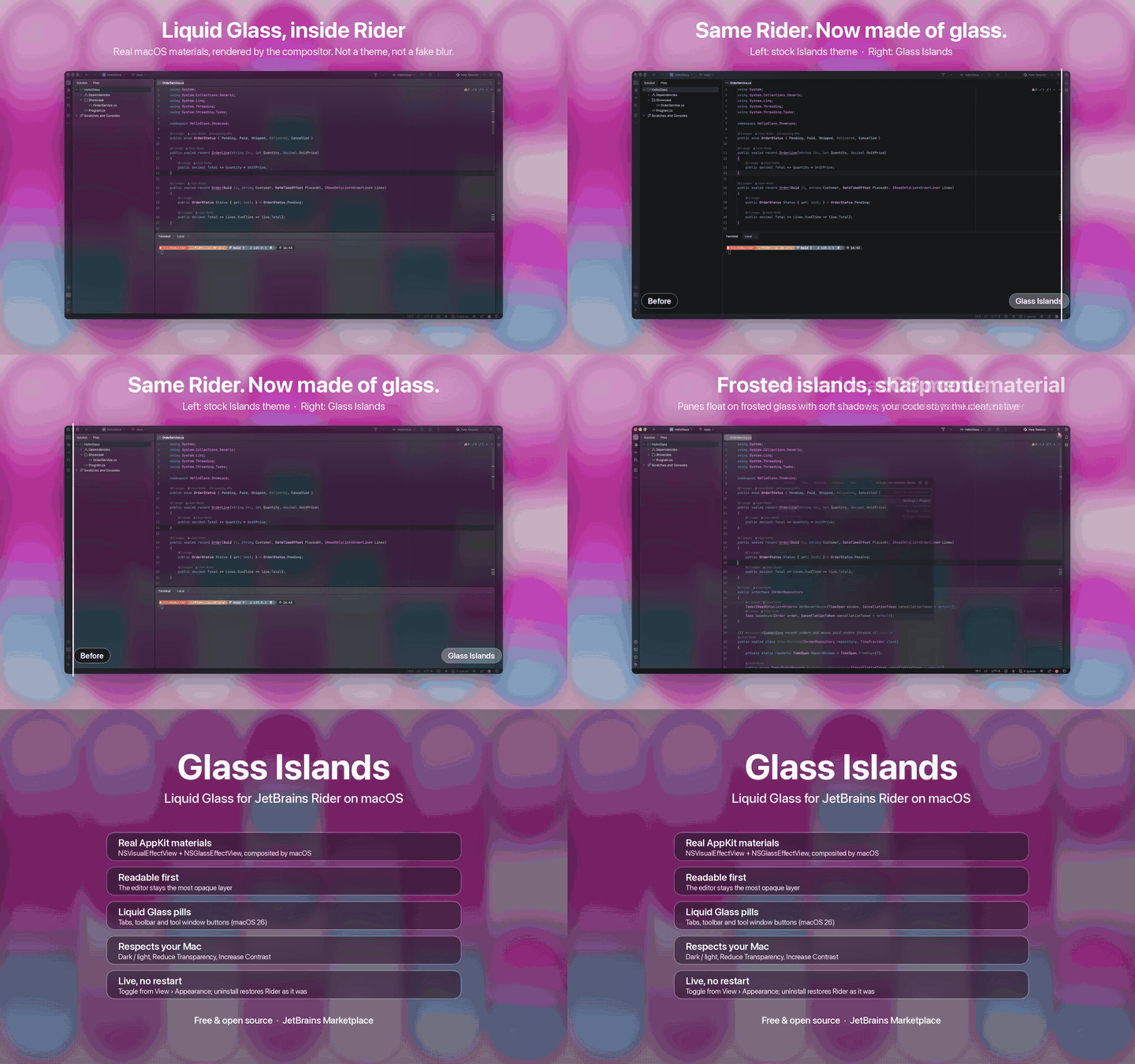
How I put real macOS Liquid Glass inside a Java/Swing IDE macOS 26 made the whole system out of glass. Finder, Xcode and System Settings got frosted sidebars, translucent toolbars and Liquid Glass buttons. Rider, my .NET IDE, still looked like a flat grey slab sitting on top of all that. So I built Glass Islands, a free and open-source Rider plugin that turns the new Islands UI into real macOS glass: !Glass Islands demo The key word is real. This is not a colour scheme and not a blur painted in Swing. Every translucent layer is an actual AppKit view (NSVisualEffectView, NSGlassEffectView), and the macOS compositor renders it live, the same way it renders Finder. This post explains how a Java/Swing application ends up with native AppKit glass behind it, and what broke along the way. Why not just paint a blur? JetBrains IDEs are Swing applications running on the JetBrains Runtime (a JDK fork). You could grab what's behind the window, blur it and paint it as a background. That falls apart quickly: - Swing can't see what's behind the window, so you'd need screenshots, refreshed constantly. - It would never match the system: vibrancy, the dimming of inactive windows, Liquid Glass refraction and accessibility settings all come from AppKit. - It would cost a lot of CPU for a worse result. The only way to get the real thing is to let macOS do it, which means putting native views under Swing's content and making Swing's content see-through. The view hierarchy Here is what the plugin builds inside Rider's window: NSWindow (Rider project frame, made non-opaque) └─ NSThemeFrame ├─ backdrop NSVisualEffectView, whole window, tinted ┐ added by the plugin, ├─ islands shadows │ frosted panes │ Liquid Glass pills ┘ below Rider's content ├─ AWTView Rider's Swing content (Metal layer, non-opaque) └─ titlebar Rider's Swing content still lives in its AWTView, rendered by Metal. The plugin slides a whole-window backdrop and one view per Islands pane underneath it, and makes everything above them transparent where the glass should show. Step 1: making a decorated AWT window translucent AWT lets an undecorated window be translucent with Window.setBackground(Color(0, 0, 0, 0)). A normal, decorated IDE frame is not allowed to. So the plugin reproduces what setBackground does internally: - a transparent Component.background on the frame, - LWWindowPeer.setOpaque(false), which makes the NSWindow and its Metal layer non-opaque, - classic double buffering for the root pane. IntelliJ's own per-window buffer is flipped onto the window with SrcOver, which is fine on an opaque window but accumulates translucent pixels on a translucent one: every repaint would get a little darker. Then every Swing surface that the glass replaces becomes transparent: panels through UIManager overrides, editors through their own colour scheme delegate. The editor keeps most of its opacity (at least 86% by default), because readable code matters more than pretty glass. Step 2: calling AppKit from Kotlin with FFM The native side is a small Objective-C library, libliquidglass.dylib, with a deliberately boring C ABI: integers, pointers and arrays of doubles. No JNI glue. The plugin calls it through Java 25's Foreign Function & Memory API: private val lookup = SymbolLookup.libraryLookup(libraryPath, libraryArena) private val linker = Linker.nativeLinker() private fun function(name: String, descriptor: FunctionDescriptor): MethodHandle = linker.downcallHandle(lookup.find(name).orElseThrow(), descriptor) private val applyBackdrop = function("rlg_apply_backdrop", FunctionDescriptor.ofVoid(JAVA_LONG, ADDRESS)) private val setIslands = function("rlg_set_islands", FunctionDescriptor.ofVoid(JAVA_LONG, ADDRESS, JAVA_INT, ADDRESS)) The window handle comes from the platform (MacUtil.getWindowFromJavaWindow), and the native side only ever touches a pointer that is still one of NSApp.windows. A stale pointer is a crash, and a crash here takes the whole IDE down. Step 3: the threading trap AppKit must be called on the main thread. Swing paints on the AWT event thread. The obvious fix, dispatching to the main thread and waiting, deadlocks as soon as the main thread is itself waiting on the AWT thread, which happens all the time. The JDK's own AWT natives solve this with a dedicated run-loop mode, AWTRunLoopMode, which the main thread keeps servicing while it is blocked on AWT. The bridge does exactly the same: [call performSelectorOnMainThread:@selector(run) withObject:nil waitUntilDone:YES modes:@[NSRunLoopCommonModes, @"AWTRunLoopMode"]]; Waiting also means the native shapes change in the same frame as the Swing content: when you drag a splitter, the glass pane follows the panel instead of lagging behind it. And every call is wrapped in @try/@catch, because an Objective-C exception that reaches the JVM aborts the whole IDE. Step 4: following the layout The plugin tracks the Islands layout (tool window holders, editor splitters, toolbar and stripe buttons, editor tabs) with a single AWT event listener. Changes are coalesced to one pass per UI cycle, and only diffs are sent to the native side. Native views are keyed by a stable id and updated in place inside a CATransaction with implicit animations disabled, so nothing slides around. Typing, scrolling and the caret blinking send nothing to AppKit. A full layout scan takes about 0.2 ms, and a native update 2 to 5 ms. On my M4 Pro, idle Rider uses about the same CPU with or without the glass. Frosted panes vs Liquid Glass Using NSGlassEffectView (Liquid Glass) for the big panes looks like the obvious choice, but it doesn't survive switching windows: Liquid Glass goes flat or drops its blur when a window loses key status, so the entire IDE would flash on every focus change. The fix was to do what macOS itself does: large surfaces use the frosted NSVisualEffectView material, and Liquid Glass is reserved for small controls such as buttons, pills and tabs. On macOS versions before 26, those controls fall back to frosted pills. Flicker, the hard part A translucent Swing window flickers for two different reasons: 1. Opaque components that don't paint their whole background. In a translucent window, Swing clears a repainted region with the background of the first opaque component above it. A component that claims to be opaque but leaves gaps shows a blank flash. The plugin paints each opaque component once offscreen and marks the ones that don't actually cover their bounds as non-opaque. 2. Frames presented before they're complete. JBR's Metal pipeline presents frames from the display link, so a frame caught mid-update shows a panel blank for one frame. In screen recordings of a scrolled diff, -Dsun.java2d.metal.displaySync=false takes this from 2 or 3 blank frames per 12 seconds to none. JBR only reads that flag at startup, so the plugin offers to add it to your VM options and removes it when you uninstall. Being a good citizen - Accessibility: Reduce Transparency turns the glass off, and Increase Contrast makes every layer more opaque and outlined. Presentation Mode stays opaque. - No restart, clean unload: everything the plugin changes (window opacity, UIManager keys, editor colours, native views, listeners) is recorded and restored. Uninstall it and Rider looks exactly as before. - Safe mode: if Rider ever stops while the glass is being applied, the plugin turns itself off at the next start and tells you. - Fragile internals in one place: everything that depends on JDK or IntelliJ implementation details is listed and checked in a single file. If a future Rider changes one of them, only the feature built on it stops, and the settings page says why. Try it - Install: Settings › Plugins › Marketplace, search "Glass Islands", or use the JetBrains Marketplace page. No restart needed. - Requirements: Rider 2026.2 or later with an Islands theme, macOS 12 or later. Liquid Glass buttons need macOS 26. - Source (MIT): lilyaan444/glass-islands It's Rider-only for now, but most of it is IntelliJ Platform code. If you'd like it in IntelliJ IDEA, WebStorm or PyCharm, let me know in the comments. I'd also love to hear from anyone on Intel Macs or macOS 12 to 15, which I can test less.
@harden_369741 Oh wow, definitely check out Beacon -- I'd love to get your feedback on the product and hope it becomes a superpower for you :) Asymptote-Labs/agent-beacon
Vercel Labs liberó agent-desktop, open source: deja que un agente como Claude Code maneje apps de escritorio en Mac, Windows o Linux leyendo su árbol de accesibilidad en vez de adivinar píxeles. Lo voy a probar con programas que no tienen API. vercel-labs/agent-desktop #IA
end to end CI/CD + GitOps pipeline for real world test automation hi all, I built a production-ready CI/CD + GitOps pipeline with automated testing. The app is not running as i only provision it on demand for cost reasons. what it involves: - Unit Tests (Front-end & Back-end) - Integration Tests Front-end & Back-end) - Contract Testing to keep API dependencies safe - Playwright E2E Testing running in isolated ephemeral environments its pretty large project but similar to setup in places i have worked. ianoflynnautomation/bjjeire-tests ianoflynnautomation/bjjeire ianoflynnautomation/bjjeire-gitops ianoflynnautomation/bjjeire-terraform-azurerm-aks
@squishlab_ai been prompting agents for tiny pixel scenes too. what worked for me was locking the background and palette first, then letting only a few small things loop on their own, like your clouds and bee. made it a skill, could go in your next round: Tu-Zhenzhao/pocketworld t.co