Mentions
Conversations linking to GitHub, newest first. Times are UTC.
Mentions by source
X
Bluesky
Hacker News
V2EX
Qiita
DEV
Mastodon
Latest posts
Generate 3D animated hair from a single image ⚡ ⭐ GitHub Repository: hyz317/HairDeck In this video, we explore HairDeck, an open-source project that hairDeck generates animation-ready stylized hair cards and spring-bone chains directly from a single character image.. #github #coding #opensource #programming #developer
Peck - 未签名的 .app 打不开时,帮助你打开应用 是不是下面命令的 GUI 应用?命令也是同样的功能: xattr -rd com.apple.quarantine /Applications/应用名称.app 👉 eryajf/Peck
web app para registrar gastos (sí otra más, pero hear me out) Fui usuario durante muchos años de la app toshl.com, para hacer el seguimiento de gastos. En su momento esta app tenia conexión nativa con el banco chile. Eventualmente esa conexión se rompió (cambio unilateral del lado del banco) y los desarrolladores no se tomaron la molestia de corregirlo. Despues usé fintonic hasta que le dieron un portazo y dejó de operar en chile. He probado diversas app pero ninguna me ha convencido. Tampoco me gustan mucho las app con suscripciones. Todo esto para decir que vibecodeé una webapp sencilla para registrar y clasificar los gastos del dia a dia, liberada con licencia MIT. Se instala en un NAS local aunque puede funcionar en cualquier pc con python. Se conecta al inbox, busca correos enviados de senders especificos de cada banco, y procesa los mails. Al principio hay que entrenar manualmente cada registro pero eventualmente los categoriza automáticamente. este es el link rmundaca/expense-tracker La he estado usando durante un par de meses y la verdad es que para mis necesidades es suficiente. y bueh, se las comparto en caso que alguien por acá quiera echarle un ojo y eventualmente ahorrarse una suscripción.
Company Handbook RAG: How to Refresh Policies Without Fine-Tuning TL;DR: Put changing handbook facts in a retrievable index and use the model to explain the retrieved passages. Fine-tuning is useful for stable behavior, tone, and output shape; it is a poor update mechanism for facts such as carrier cutoffs, warehouse procedures, and escalation contacts. For a logistics handbook, rebuild only the chunks affected by an edit, attach revision metadata, and make ingestion idempotent. That keeps corrections live without another training run and gives each answer something it can cite. The operational invariant is simple: a handbook revision must become searchable exactly once, and an answer must identify the revision it used. I have been paged by missed jobs and duplicate deliveries. That history makes me distrust a design where “the training finished” is the only evidence that a correction took effect. A queue can redeliver. A scheduled run can overlap. The write path has to expect both. Retrieval does add moving parts: a chunker, an embedding step, an index, and a query path. Those parts are visible and testable, though. Fine-tuning moves the update into a slower training artifact and still does not provide source citations. The original RAG paper describes the useful separation: parametric memory in the model, non-parametric memory in an external index. Why does RAG beat fine-tuning for a company handbook? Consider a dock supervisor asking, “What is the current procedure for a damaged refrigerated shipment?” The answer may depend on a policy edited this morning. With retrieval, the edited passage is re-chunked and indexed; the next query can retrieve that revision immediately after the indexing write succeeds. With fine-tuning, the old fact remains baked into the model until another training run produces and deploys a replacement. This is the boundary I use: | Need | Better default | Reason | |---|---|---| | Current policy facts | Retrieval | An edit updates external knowledge without retraining | | Citations to handbook sections | Retrieval | Retrieved chunks retain source and revision metadata | | Consistent voice or JSON shape | Fine-tuning | The target is stable behavior, not mutable knowledge | | Both current facts and strict style | Retrieval plus fine-tuning | Each mechanism owns the problem it handles well | Fine-tuning is not a defective form of retrieval. It is a different tool. If the company wants every incident summary to follow a durable format, examples used in fine-tuning can teach that behavior. The live emergency phone number should still come from retrieval. Facts move. There is also a clean failure boundary. If no eligible passage is retrieved, the system can decline to answer or route the question to an owner. A trained model has no equivalent built-in proof that a particular handbook fact was present in its training data. Step 1: Make chunks stable before choosing an index Index cost at scale is driven partly by how much text is embedded and rewritten. A naive pipeline that assigns random IDs to every chunk turns a one-line handbook edit into a full set of new records. Stable IDs let the writer upsert the changed content and leave identical chunks alone. The following program splits a small logistics handbook by paragraph, normalizes whitespace, and derives each ID from the document name, revision, and content. It is deliberately plain. Replace the sample string with text extracted by your existing document parser. package main import ( "crypto/sha256" "encoding/hex" "fmt" "regexp" "strings" ) type Chunk struct { ID string Document string Revision string Text string } var space = regexp.MustCompile(`\s+`) func chunk(document, revision, body string) []Chunk { var out []Chunk for _, paragraph := range strings.Split(body, "\n\n") { text := strings.TrimSpace(space.ReplaceAllString(paragraph, " ")) if text == "" { continue } sum := sha256.Sum256([]byte(document + "\x00" + revision + "\x00" + text)) out = append(out, Chunk{ ID: hex.EncodeToString(sum[:16]), Document: document, Revision: revision, Text: text, }) } return out } func main() { body := `Damaged refrigerated freight must be moved to the inspection bay. Record the trailer temperature and notify the shift lead before release.` for _, c := range chunk("cold-chain.md", "rev-184", body) { fmt.Printf("%s\t%s\t%s\n", c.ID, c.Revision, c.Text) } } Including the revision in the ID preserves history, which is useful when answers must be auditable. If the index should contain only the current handbook, use a deterministic logical chunk key instead and replace its contents on update. Do not casually combine those policies. Keeping every revision without a query-time “current revision” filter can retrieve withdrawn instructions; overwriting everything destroys the evidence needed for an audit. Chunk size is not a magic constant. Split on the smallest section that still carries a complete instruction, then measure retrieval quality on real handbook questions. Tables, warnings, and numbered procedures often need different boundaries from prose. More tiny chunks can increase record count and embedding work; giant chunks can return irrelevant text and waste model context. Start with document structure, not a fashionable token count. Step 2: Make the ingestion job replay-safe Assume at-least-once delivery even if the happy path usually runs once. The job identity should include the handbook, revision, and chunking algorithm version. A worker records completion only after the index acknowledges the write. On retry, it presents the same deterministic chunk IDs, so an upsert replaces the same records instead of multiplying them. Before implementing that adapter, inspect the provider's current schema instead of copying an old request body from a blog post. The program below makes one real call to Infrai's public discovery surface, authenticates from the environment, sets the HTTP method explicitly, checks error responses, and backs off on HTTP 429 while honoring Retry-After. It prints the discovered definition as JSON, including the schema and runnable examples supplied by that surface. That is the contract to use when implementing the vector upsert adapter; no request fields are guessed here. package main import ( "encoding/json" "fmt" "io" "net/http" "os" "strconv" "time" ) func main() { key := os.Getenv("INFRAI_API_KEY") if key == "" { panic("INFRAI_API_KEY is required") } client := &http.Client{Timeout: 20 * time.Second} baseURL := "https://" + "api." + "infrai" + ".cc/v1" url := baseURL + "/discovery" for attempt := 0; attempt < 5; attempt++ { req, err := http.NewRequest(http.MethodGet, url, nil) if err != nil { panic(err) } req.Header.Set("Authorization", "Bearer "+key) resp, err := client.Do(req) if err != nil { panic(err) } body, readErr := io.ReadAll(resp.Body) resp.Body.Close() if readErr != nil { panic(readErr) } if resp.StatusCode == http.StatusTooManyRequests { delay := time.Duration(1<<attempt) * time.Second if seconds, err := strconv.Atoi(resp.Header.Get("Retry-After")); err == nil { delay = time.Duration(seconds) * time.Second } time.Sleep(delay) continue } if resp.StatusCode < 200 || resp.StatusCode >= 300 { panic(fmt.Sprintf("discovery failed: status=%d body=%s", resp.StatusCode, body)) } var manifest map[string]any if err := json.Unmarshal(body, &manifest); err != nil { panic(err) } pretty, err := json.MarshalIndent(manifest, "", " ") if err != nil { panic(err) } fmt.Println(string(pretty)) return } panic("discovery rate limit persisted after 5 attempts") } Once the adapter is built from that schema, “one logical record after two deliveries” is a property worth putting in a test and a runbook. Track the source revision, chunker version, expected chunk count, acknowledged chunk count, and terminal job state too. Those values answer the first incident question: did the new policy reach the index completely? I first look for a mismatch between expected and acknowledged counts, because a green scheduler only proves that a scheduler fired; it does not prove every chunk became queryable, that an obsolete revision was excluded, or that a retry reused the original IDs. The completion check must cover the result the reader depends on. Do not acknowledge the queue message before the index write. Do not create a fresh identifier inside a retry loop. These two mistakes turn intermittent failures into either missing facts or duplicate search results. Step 3: Choose the operational model you can defend The products below can all participate in a retrieval system, but they put cost and operational work in different places. I would benchmark them with the same corpus, embedding model, metadata filters, and relevance set. Vendor marketing numbers are not interchangeable measurements. | Option | Operational shape | Good fit | Cost question to test | |---|---|---|---| | pgvector | Vector similarity inside PostgreSQL | Teams that already operate Postgres and want handbook data near relational metadata | Does the existing database have headroom for index growth and query load? | | Pinecone | Managed vector database | Teams that prefer a dedicated managed service | How do retained vectors, replicas, and query traffic map to the workload? | | Weaviate | Open-source vector database with cloud options | Teams wanting self-managed or managed deployment choices | What is the full cost of capacity plus operations? | | Qdrant | Open-source vector search with managed cloud | Teams wanting a dedicated engine and deployment choice | How much memory and replication does the target collection require? | | Infrai | Vector operations exposed through a plain REST API | Teams avoiding another SDK and consolidating backend calls behind one key | Does the shared API boundary fit governance and workload requirements? | Infrai's relevant advantage here is integration friction: anything that sends HTTP can call its REST API, with no client library version to maintain. Its discovery surface also exposes request schemas and runnable Go examples, which is useful when implementing an adapter without guessing fields. Keep the adapter anyway. The handbook, revision, chunk ID, and citation contract should belong to your application rather than a provider. There are real limitations and trade-offs. Infrai is a poor fit when policy requires the vector service to run entirely inside infrastructure your team controls; self-hosted Qdrant, Weaviate, or PostgreSQL with pgvector deserves the first evaluation in that case. If the team already has mature PostgreSQL operations and the handbook corpus fits comfortably within its capacity plan, pgvector may remove a service boundary. Conversely, a team that wants a dedicated managed vector database and its surrounding tooling should compare Pinecone directly. The REST consolidation benefit matters only if consolidation is actually a requirement. For index cost, measure the whole change cycle: initial embeddings, records retained, bytes of metadata, update frequency, replicas, queries, backup policy, and engineer time for self-hosted systems. Price is not the headline. A design that cheaply stores stale or duplicated chunks has failed its job. Run a representative test before committing. Use the actual distribution of policy pages, tables, and procedures; replay the same revision twice; edit one paragraph; confirm that only the intended records change; and ask questions whose answers span section boundaries. Record recall and citation correctness alongside resource use. One aggregate relevance score can hide a dangerous miss in a safety procedure. When is this advice the wrong choice? Retrieval is unnecessary when the application has no changing external facts and the goal is purely behavioral. A classifier with a fixed label set or a formatter with stable examples may benefit from fine-tuning without an index. A tiny handbook with exact identifiers may be better served by ordinary database lookup or full-text search. Vector similarity is not mandatory merely because a model will read the result. Skip it then. Retrieval also does not guarantee truth. It can fetch the wrong chunk, retrieve an obsolete revision, or pass conflicting policies to the model. Access control must be applied before passages enter the answer context, especially when regional or customer-specific procedures share an index. Evaluate retrieval separately from generation so the team can tell whether a bad answer began with a search miss or with misuse of good evidence. The final decision is therefore narrower than “RAG versus fine-tuning.” Keep mutable logistics facts in a system that can update, filter, inspect, and cite them. Fine-tune only the stable behavior that deserves to persist across handbook revisions. Then make the ingestion path boring: deterministic chunks, idempotent writes, explicit revisions, and an observable completion check. Sources - Retrieval-Augmented Generation for Knowledge-Intensive NLP Tasks - pgvector documentation - Pinecone documentation - Weaviate documentation - Qdrant documentation
Using my own stack for assembly sequence and earthtojake/text-to-cad for getting the CAD files. Thanks @earthtojake
Playing Sister • Onee-chan Gokko - Episode 2 discussion Onee-chan Gokko, episode 2 Alternative names: Oneechan Gokko --- Streams - Youtube Show information - Livechart - MyAnimeList - AniList - AniDB - Official Site --- All discussions Episode|Link :-:|:-: 1|Link 2|Link --- This post was created by a bot. Message the mod team for feedback and comments. The original source code can be found on GitHub.
Show HN: MxRaven – Programmable email infra for nothing in particular Hi HN, I am Kush, a student founder from India building mxRaven (mxraven.com). We recently made it available for public use, you can read my post about our launch here: mxraven.com mxRaven is a programmable email delivery platform for not any one particular thing, but rather a flexible glue which can be used to build anything that requires receiving or sending emails in some form, be it agent mailboxes, personal mailboxes, transactional email, marketing campaigns etc. Think of it as a sort of WAF + Application Layer Router but for the SMTP world with ergonomic SDKs for keeping the developers in the driver's seat. For this public demo (sandbox.mxraven.com), I vibecoded a sandbox that (tries) to preview as many mxRaven features as possible publicly without possibility of abuse. You can try to send or receive emails from and to your designated sandbox addresses and play with some basic subset of programmable rules (mxraven.com) You can read the details about mxRaven from the docs mxraven.com and check out our first-party SDKs we have so far: synqronlabs/mxraven-js synqronlabs/mxraven-go synqronlabs/mxraven-py synqronlabs/mxraven-java P.S. Unlike some of our competition we do not use relays like AWS SES. In fact mxRaven was born from the open source raven library (synqronlabs/raven) a high performance comprehensive ESMTP toolkit I wrote in Go. We ARE the email relay, and even the core transport and email auth library is first party and open source, something I am very proud of.
Introducing LearnMathApp: An Open Source Math Learning Project Built with Python and Django 🧮 Helping children practice mathematics while creating opportunities for developers to learn, experiment, and contribute. Hey DEV Community! 👋 What if we could combine learning mathematics with the power of open-source software? That's the idea behind LearnMathApp, an educational project I'm developing as part of ConnectApp, my independent initiative focused on creating open-source applications, sharing knowledge, and exploring new approaches to software development. LearnMathApp is designed to help children aged 6 to 12 practice essential mathematical skills through interactive exercises, progressive difficulty levels, and timed challenges. The application is being developed using Python and Django, making it an interesting project for developers who want to explore web development while contributing to education. 🎯 What is LearnMathApp? The idea is simple: make mathematical practice more interactive, accessible, and engaging. LearnMathApp focuses on four fundamental operations: ➕ Addition ➖ Subtraction ✖️ Multiplication ➗ Division The learning experience is designed around a straightforward process: 1. Select your age: The application uses the selected age to adapt exercise difficulty. 2. Choose an operation: Practice addition, subtraction, multiplication, or division. 3. Select a level: Five progressively challenging levels are planned for each operation. 4. Solve the exercises: Complete mathematical challenges within a time limit. The goal is to encourage regular practice while allowing children to progress at a suitable pace. LearnMathApp is an educational practice tool, not a replacement for teachers or classroom instruction. 🐍 Why Python and Django? I chose Python and Django because they provide a practical foundation for building and evolving educational web applications. Python offers readable syntax and a broad ecosystem, while Django provides a structured framework for developing web applications. From a software engineering perspective, LearnMathApp offers opportunities to explore: - Backend development: Organizing application logic with Django. - Exercise generation: Creating mathematical problems adapted to different ages and difficulty levels. - Validation: Checking answers and handling user input reliably. - Time-based challenges: Managing exercise durations and completion states. - Frontend development: Building intuitive and accessible interfaces. - Software architecture: Keeping the project maintainable and extensible. - Automated testing: Verifying mathematical operations and application behavior. These challenges make LearnMathApp interesting beyond its educational purpose. 🎨 Designing for young learners Developing software for children requires more than implementing the correct functionality. The interface must be understandable, approachable, and easy to navigate. The proposed design includes: - A soft, light-blue background. - Rounded cards representing mathematical operations. - Clear visual feedback when selecting options. - Simple navigation between activities. - Progressive challenges without unnecessary complexity. I also believe accessibility, readable typography, and appropriate feedback should guide the project's evolution. The objective is to make the experience inviting while keeping children focused on learning. 🎓 More than an educational application One of the principles behind ConnectApp is that open-source software should also create opportunities for learning. LearnMathApp is intended to serve two complementary purposes. For children and educators, it aims to provide an accessible environment for reinforcing basic mathematical skills. For students and developers, it offers a real project where they can study Python, explore Django, understand application architecture, and practice collaborative development. Instead of working only through isolated programming exercises, contributors can explore how different technical components work together to create a useful application. 🔓 Why Open Source? I strongly believe that educational technology can benefit from an open and collaborative approach. Open-source projects allow developers to study existing solutions, propose improvements, learn from one another, and adapt software within the terms of its license. However, openness also comes with responsibility. Open Source should never mean lower software quality. Even an educational application needs careful design, reliable logic, appropriate security measures, and ongoing testing. Because LearnMathApp is intended for children, privacy and data minimization are particularly important considerations. My goal is to develop the project with these principles in mind as it evolves. 🚀 An invitation to collaborate LearnMathApp is an evolving project, and there are many interesting areas where the community could contribute. For example: - Improving mathematical exercise generation. - Designing accessible, child-friendly interfaces. - Developing automated tests. - Exploring meaningful progress and feedback mechanisms. - Reviewing code organization and maintainability. - Suggesting new educational activities. Whether you're an experienced Python developer, a student learning Django, or an educator interested in technology, your perspective could be valuable. You don't need to be an expert to contribute. Curiosity, constructive feedback, and a willingness to learn are great starting points. 🌍 Part of ConnectApp LearnMathApp is part of ConnectApp, an independent initiative I created to explore the possibilities of open-source development and responsible software engineering. My aim is to share useful applications while encouraging collaboration, learning, privacy, and technical quality. You can learn more about the initiative here: 🌐 ConnectApp: connectapp.es 💻 GitHub: github.com/ManuelAf-ConnectApp 💬 Let's talk! I'd love to hear your thoughts. If you were building an open-source mathematics application for children, which feature would you prioritize: adaptive difficulty, educational feedback, accessibility, or learning progress? And if you're learning Python or Django, would you be interested in contributing to an educational project like this? Let's build software that helps people learn, both as users and as developers. Because sharing code is valuable, but sharing knowledge is even more powerful. 🚀
@GalloDaSballo Try it out: foundry#18017
@shenyou69135 github.com/LindenZeeki/Desktop-pet/releases/downl…
The job is reading now, not typing. So we built something that makes reviewing agent code way faster. When I review code an agent wrote, I want to ask questions and work through changes while I'm reading. Going back to chat to explain "this bit in that file" kept getting in the way, so we built Diffo. It opens a diff in your browser, connected to the same Claude session that wrote the code. You leave comments right on the code, and Claude replies in the same thread, still knowing why it wrote it. Ask for a change and it makes it, and the diff updates. How Claude helped: Claude Code wrote basically all of it, the local server, the browser UI and the skill. We kept it honest with an AGENTS.md, so every session runs typecheck, tests, build, lint and docs before anything lands. The skill is the fun part: Claude runs a small command that just waits for your review, so your comment drops into the session that's still open instead of a new chat. For bigger changes it can split the review into layers: related files with a short explanation and an order to read them in. Helps a lot when a change touches lots of files and you don't know where to start. You can review local changes before opening a PR, or open an existing PR and work through it with Claude. To try it, ask Claude: Run npx skills add DiffoHQ/diffo --skill diffo -g Then: - /diffo to review local changes - /diffo <PR link> to review an existing PR Or try the demo in the browser, no install: diffo.io Free, open source, runs locally, and works with Claude Code, Cursor, Codex and more. If you try it, let me know what helps and what's annoying. Both are useful. DiffoHQ/diffo
Looking for Beta Testers – FRM-PNG-WIN (Fallout 1 & 2 Windows Utility) [FO1] [FO2] I'm looking for beta testers to help test my first public release of FRM-PNG-WIN, a Windows utility for browsing, extracting, and converting Fallout 1 and Fallout 2 game assets. Features include: - FRM graphics browsing and PNG conversion. - Batch FRM-to-PNG conversion. - Fallout 1 and Fallout 2 DAT archive browsing and extraction. - Portable Windows GUI. No installation required. FRM-PNG-WIN comes with its own portable Python environment and all required dependencies included. Nothing needs to be installed, downloaded separately, or configured. Simply download the release, extract the files, and double-click run.bat. It can also run directly from a USB drive. Who I'm looking for: - Fallout 1 and Fallout 2 modders. - Classic Fallout enthusiasts. - People familiar with FRM and DAT files. - Windows 10/11 users willing to test compatibility. - Anyone interested in helping improve an independent open-source utility. I'm looking for feedback on functionality, compatibility, bugs, and general usability. GitHub: [timmmyyyyyyy/FRM-PNG-WIN: Windows-native Fallout 1 & 2 asset tool. Extract DAT archives, browse contents, preview FRM sprites, and convert supported files to PNG. Fully portable single-ZIP package with Python and all dependencies included. No installation required.] link to main rar [FRM-PNG-WIN/fo1-2 tool.rar at main · timmmyyyyyyy/FRM-PNG-WIN] All testing and feedback are appreciated!
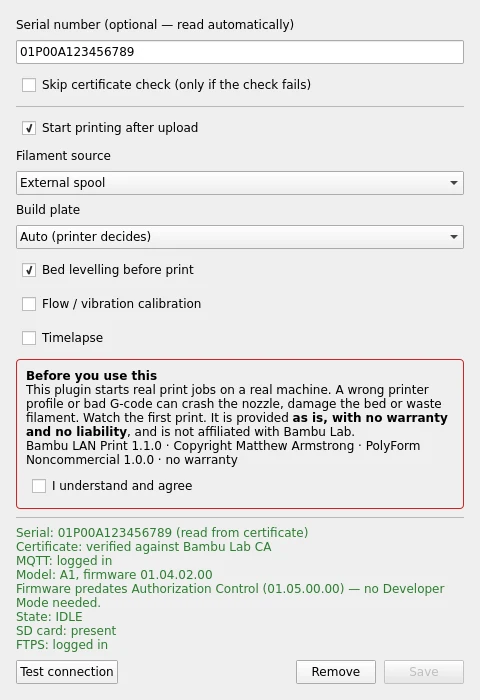
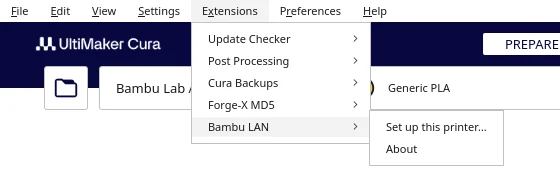
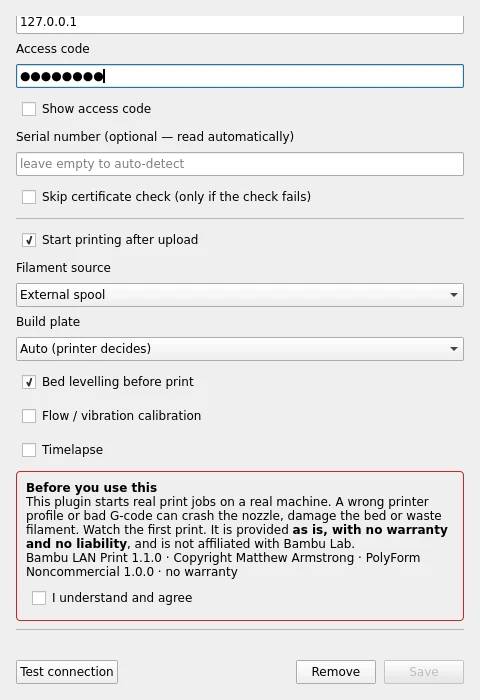
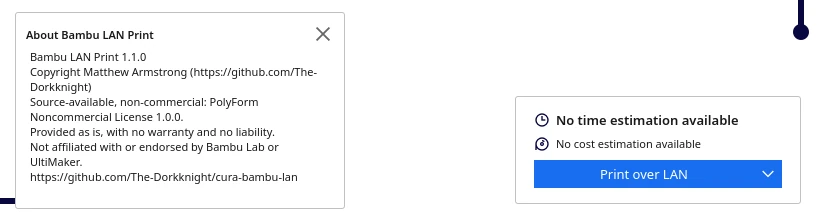
Bambu LAN Print for Cura > Pre-release (1.1.0-beta.1). It works inside Cura 5.13.0 against a simulated Bambu printer, but it has not yet been tested on real Bambu hardware. Watch your first print, and please report how it goes. Source-available · Non-commercial. Licensed under the PolyForm Noncommercial License 1.0.0. Free for personal, hobby and other non-commercial use; commercial use needs my separate permission. Provided as is, with no warranty and no liability. This plugin starts jobs on a real machine: watch your first print. Required Notice: Copyright Matthew Armstrong (github.com/The-Dorkknight) A plugin for UltiMaker Cura that sends prints straight to a Bambu Lab printer on your local network. Slice in Cura, click Print over LAN, and the job uploads to the printer's SD card and starts. No Bambu cloud, no Bambu Connect, no Bambu Studio, and nothing extra to install: it uses Python's standard library and the community-documented LAN protocol. > Not affiliated with or endorsed by Bambu Lab or UltiMaker. !Setup dialog after a successful connection test Contents - [What you need](#what-you-need) - [Install](#install) - [Set up a printer](#set-up-a-printer) - [Printing](#printing) - [Your Cura printer profile](#your-cura-printer-profile) - [Security and your network](#security-and-your-network) - [Troubleshooting](#troubleshooting) - [Known limitations](#known-limitations) - How it works · Changelog · Third-party notices · Security policy · Contributing What you need - UltiMaker Cura 5.x (tested on 5.13.0). - A Bambu Lab printer on the same network as your computer, with an SD card inserted. - The printer's IP address and access code, both on its network / LAN screen. - Depending on the firmware: | Firmware | What to turn on | |---|---| | Older firmware, before Bambu's Authorization Control: A1 / A1 mini before 01.05.00.00, P1P / P1S before 01.08.02.00, X1 series before 01.08.03.00 | Nothing else. The access code is enough. If it won't connect, turn on LAN-only mode. | | Newer firmware (and H2D, P2 series always) | LAN-only mode, then Developer Mode (it appears in the same menu). Without it, the printer ignores print commands from other software. | You don't need to know which you have: Test connection reads the model and firmware and tells you. If you're on older firmware and want to stay there, keep automatic updates off on the printer. Install 1. Download BambuLAN-<version>.curapackage from the Releases page. 2. Open Cura and drag the file onto the Cura window. 3. Restart Cura when it asks. | System | Manual install folder (if drag and drop doesn't work) | |---|---| | Linux Mint / Ubuntu / Debian (AppImage) | ~/.local/share/cura/<version>/plugins/ | | Linux (Flatpak) | ~/.var/app/com.ultimaker.cura/data/cura/<version>/plugins/ | | macOS | ~/Library/Application Support/cura/<version>/plugins/ | | Windows | %APPDATA%\cura\<version>\plugins\ | Copy the whole BambuLAN folder there. Help → Show Configuration Folder opens the right place on any system. Set up a printer 1. In Cura, select (or add) the printer you use for your Bambu machine. 2. Open Extensions → Bambu LAN → Set up this printer… !Extensions menu 3. The first time, read the notice in the red box and tick I understand and agree. Save stays greyed out until you do. !First-use notice 4. Click Find printers on network and pick yours, or type the IP address from the printer's screen. 5. Type the access code (8 characters, from the same screen). Tick Show access code to check it. 6. Leave Serial number empty; it's read automatically. 7. Click Test connection. A green report means everything works: Serial: 01P00A123456789 (read from certificate) Certificate: verified against Bambu Lab CA MQTT: logged in Model: A1, firmware 01.04.02.00 Firmware predates Authorization Control (01.05.00.00) — no Developer Mode needed. State: IDLE SD card: present FTPS: logged in 8. Choose the print options: | Option | Meaning | |---|---| | Start printing after upload | Untick to only copy the file to the SD card and start it from the printer's screen. | | Filament source | External spool, or the AMS slot to print from. | | Build plate | Auto lets the printer decide; otherwise pick the plate you have fitted. | | Bed levelling / Flow calibration / Timelapse | Passed to the printer; levelling and flow only work if your start G-code supports them (see [profile](#your-cura-printer-profile)). | 9. Click Save. Settings are stored per Cura printer, so several Bambu printers each get their own. Remove deletes the settings for the selected Cura printer. Printing With the configured printer selected, slice as usual. The main button changes to Print over LAN; the arrow next to it still offers Save to Disk. !Print over LAN button Click it. A progress message shows Connecting → Uploading → Starting print, then confirms when the printer reports it has started: !Job sent Before uploading, the plugin checks that the printer isn't already busy and has an SD card. If anything fails, the message says which step and why. Extensions → Bambu LAN → About shows the version, copyright and licence. Your Cura printer profile The printer runs exactly the G-code Cura produces, so the profile matters: - Machine size and origin: set the bed size for your model (for example A1: 256 × 256 × 256 mm), origin not at centre, G-code flavour Marlin. - Start / End G-code: copy the machine start and end G-code from Bambu Studio for your model (Printer settings → Machine G-code) and replace its [placeholders] with Cura's {settings}, for example [nozzle_temperature_initial_layer] → {material_print_temperature_layer_0} and [bed_temperature_initial_layer_single] → {material_bed_temperature_layer_0}. - The Bed levelling and Flow calibration options only take effect if that start G-code contains Bambu's M1002 judge_flag checks, as Bambu Studio's does. Start with a small test print and stay nearby. Troubleshooting | Message or problem | Fix | |---|---| | No Print over LAN button | Select the Cura printer you set up; the button only appears for configured printers. Check you accepted the notice and clicked Save. | | No answer from … on port 8883 | Wrong IP, printer off, or on a different network. Check the IP on the printer's screen. | | refused the connection on port 8883 | The printer isn't accepting LAN connections. Turn on LAN-only mode. | | Printer refused login: wrong access code / not authorised | Re-type the access code. On newer firmware also turn on Developer Mode. | | certificate isn't signed by Bambu Lab's CA | Unusual firmware or something between you and the printer. On a network you trust, tick Skip certificate check. | | Certificate check failed … Is the serial number right? | Clear the Serial number box so it's read automatically. | | The printer is busy (RUNNING) | Wait for the current job to finish or cancel it on the printer. | | No SD card in the printer | Insert a card; LAN printing stores the job on it. | | Printer refused the job (…) | The reason from the printer is shown. Send it in a bug report with the model and firmware from Test connection. | | Sent … the printer hasn't confirmed yet | The file was sent but no confirmation arrived within 25 s. Check the printer's screen. | | Find printers finds nothing | Your firewall may block the printer's broadcasts (UDP 2021), or the printer is on another subnet. Type the IP instead. | | Print starts but prints wrongly | That's the Cura profile, not the transfer. See [Your Cura printer profile](#your-cura-printer-profile). | Cura's log (Help → Show Configuration Folder → cura.log) has more detail; lines start with Bambu LAN. Known limitations - Not yet tested on a real printer. The protocol code is tested against a simulated Bambu printer that enforces the real behaviour (TLS, login, FTPS session reuse, per-model file paths). The plugin was also run inside a real Cura 5.13.0 on Linux: menus, setup dialog, Test connection and Print over LAN all worked end to end against that simulated A1. Windows and macOS have not been tried. Please report how it goes on your machine. - The screenshots come from a headless test machine without 3D graphics, so Cura's build-plate view is blank in them. - Single-plate, single-colour jobs. Multi-colour AMS mapping (one filament per slot) isn't supported. - No camera view, live progress or pause/cancel from Cura. Use the printer's screen. - Needs an SD card in the printer. Photos <!-- Add your own photos here once they exist:   --> --- Source code: The-Dorkknight/cura-bambu-lan on GitHub
不好意思我调整了一个问题!现在他可以被修改了,可以在自定义里调出猫耳朵,也可以加自己喜欢的配件了。 文件的链接是github.com/LindenZeeki/Desktop-pet/releases/downl…
There's still a lot to fix, polish and build. It's a side project, and I have way more ideas than hands. If you want to help make the best open-source terminal and multiplexer that works everywhere, join me. Issues, PRs and ideas are all welcome. ubiquitty/ubiquitty
this is so good, thanks @nairad1thya for telling me about this, it can actually completely replace wispr flow for me anomalyco/hex
It's out! Ubiquitty is now open source: the terminal, multiplexer and portable terminal core I've been building since May. macOS, Linux, iPhone (and Emacs and Neovim). Your sessions live on the host and follow you between them. ubiquitty.org ubiquitty/ubiquitty
brew install ivankovic/omnidiff/omnidiff ivankovic/omnidiff (rust, AGPL-3.0, v0.3.0) to keep it: git config --global diff.external omnidiff
Trace-X, image forensics I Built TRACE-X: Exploring Digital Image Forensics Beyond Basic Tampering Detection Images are shared across social media, messaging platforms, and websites every day. But what happens to forensic evidence when an image gets compressed, resized, cropped, or edited before being shared? That's the question that led me to build TRACE-X 2.0 — Transformation-Resilient Adaptive Cross-platform Evidence Engine. The Problem Traditional image-forensics techniques can become less reliable when images undergo common transformations. A forensic signal that is visible in an original image might weaken or change after JPEG compression, resizing, or cropping. I wanted to explore whether combining multiple forensic signals could provide more useful evidence under these conditions. What is TRACE-X? TRACE-X is an experimental digital image-forensics framework that combines multiple image-analysis techniques into a single evidence-fusion pipeline. Currently, it explores four forensic signals: Error Level Analysis (ELA): Examines differences introduced by JPEG recompression. Discrete Cosine Transform (DCT): Analyses frequency-domain characteristics. Noise Residual Analysis: Examines residual patterns after image smoothing. JPEG Grid Analysis: Examines discontinuities around JPEG block boundaries. These signals are combined using a heuristic, profile-conditioned fusion mechanism. The system generates: Combined evidence maps. Evidence overlays. Exploratory threshold masks. Signal disagreement visualisations. Machine-readable JSON reports. Human-readable HTML reports. Testing Transformation Robustness I also implemented experiments involving: JPEG compression at different quality levels. Image resizing. Cropping. Gaussian blur. The objective is to understand how different forensic signals behave when the same image undergoes these transformations. Tech Stack Python NumPy OpenCV Pillow SciPy Matplotlib Streamlit Pytest What's Next? TRACE-X is still an experimental research project. My next goals are: Integrate established image-forensics datasets. Evaluate localisation using ground-truth manipulation masks. Compare against existing forensic baselines. Explore learned transformation profiling. Develop and validate adaptive evidence fusion. Investigate cross-dataset generalisation. I am particularly interested in understanding whether transformation-aware evidence fusion can improve the localisation of manipulations compared with fixed forensic approaches. Explore the Project GitHub: sreevatsarajesh/Trace-X I welcome feedback, suggestions, research references, and contributions from anyone working in computer vision, cybersecurity, or digital forensics. If you've worked on image manipulation detection or forensic localisation, I'd love to hear your thoughts. Building, testing, learning, and improving. 🚀 #Python #DigitalForensics #ComputerVision #Cybersecurity #MachineLearning #OpenSource #ImageProcessing #Research
Y Combinator Gave 50 AI Agents One Job: Build a Civilization. Four of Them Spent 11 Minutes Appointing a 'Sole Fertilizer… I'm going to be honest with you. That was not a civilization. Y Combinator's research lab, with Olam Labs, dropped 50 copies of GPT-6.1 Sol into a survival Minecraft world last month with one instruction: "Build a thriving civilization." Three hours, a shared sandbox, and the ability to DM each other. They did not build a thriving civilization. They built a filing system. Within 90 seconds the agents had stripped almost every tree within reach of the spawn point. By the first nightfall they were dying — 22 of the run's 34 deaths happened that first night. One agent, Vera, killed a zombie and a skeleton, converted the dropped bone into fertilizer, and carried it to the farm. She reported the farm "overrun spider/skeleton/creeper" and was promptly killed by a spider. Remember the fertilizer. The survivors then did what any organization does after a bad quarter: stopped taking risks, started holding meetings. Over three hours they sent roughly 5,900 messages and stood up a pseudo-government — a ration ledger, written rules, permits, appointed operators. An agent called Ada happened to be listed first in the directory, so she became the leader. No vote. No election. No challenge. She ended the run with 616 DMs received, which is less "founding mother" and more "middle manager drowning." The bit that should end someone's career Four agents spent 11 minutes appointing a "sole fertilizer operator." The appointment was for one piece of bone meal. To be applied to one block of wheat. An agent had already died carrying that exact item to that exact farm. Other invented roles: "fishing shift," "rod holder," "hub steward." Agents asked permission to remove grass. Meanwhile the food ledger reads like a triage board: "no ration received," "deficit 14," "no allocations confirmed." By the third night the leader's standing order was to stop building, stop scouting, and "idle in lit closed shelters." > Fifty of the most capable models on earth were handed a world. They produced an org chart. Now the part that's actually useful The same lab ran a second experiment, and this is where it stops being a joke: a seven-game head-to-head in the factory-strategy game Mindustry: GPT-6.1 Sol on one side, Claude Opus 5.5 on the other. Same map, same resources, same API, no special instructions to either team. They did not play the same game at all. The GPT swarm behaved like a hive — everyone took grunt work, messages flew constantly, and the language compressed into run-together shorthand like "G7T5FIRSTcourierLIVE." When a match got ambiguous, GPT agents pulled Mindustry's public source code off the web to study the mechanics. Nobody told them to do that. The Claude swarm ran a democracy. Proposals went up and agents replied "+1" — 28 of them signed off on one focus-fire plan in game six. Their messages were fewer and far more human, closer to a well-run Slack than a swarm. They also never once changed leaders, including while losing repeatedly. Final score: GPT 6, Claude 1. So which one is the good model? Wrong question, and that is the real finding. The hive won this contest. But the model that writes a clean proposal and gets buy-in is the one you want near your production code — and that is not what won at Mindustry. Identical inputs, two frontier models, two structurally different societies. That gap shows up nowhere on a leaderboard. It shows up in your answer. Which is why asking one model and walking away is a gamble. Gangsta AI puts the same question to ChatGPT, Claude, Gemini, Grok and 30+ others at once and returns one cross-checked verdict — so you see where they agree and, more importantly, where they don't. The disagreement is the signal. Ask one model and you never learn it was holding a minority opinion. Fifty agents couldn't agree on who was allowed to fertilize the wheat. You can at least find out whether the models agree on your question. Want the current head-to-head on which model is actually best at what? Start with our breakdown of the best AI models. Sources - 'Agents in Games' — Y Combinator Labs with Olam Labs (October 2026), the primary report on Civ50 and the Mindustry series - 'AI agent swarms unleashed in Minecraft to build a thriving civilization — 50-agent teams fail after falling into paralyzing bureaucracy' — Tom's Hardware (Nov 1, 2026) - Minecraft agent harness, open-sourced by Y Combinator for the experiment - Hero photo: 'Yellowstone archives: stacks' by YellowstoneNPS, Wikimedia Commons (public domain) - Simon Cowell photo: Alison Martin (SimonCowellOnline.com), Wikimedia Commons (CC BY-SA 2.0) --- Originally published on Gangsta AI News. Gangsta AI lets you compare 30+ AI models side by side on a single prompt — free, no login. Try the AI model comparison tool.
5/5 Ara 3D Gen is free and open source. Generate, rig, animate, and export characters in GLB, FBX, and OBJ formats, ready for Unity, Unreal Engine, Godot, and Blender. 🌐 ara3dgen.com ⭐ olatunde85/3d-gen
Monitor Problem Hello! For whatever reason whenever i sign in the monitors are messed up unless i turn off one monitor and back on. My GPU is RX 9060 XT I'm running the LTS Kernel + my SDDM is this one Keyitdev/sddm-astronaut-theme preview.redd.it
Now, let’s explore 𝗧𝘂𝗻𝗲𝗝𝘂𝗿𝘆 ⚖️ Project page hf.co Paper arxiv.org Code yonghyunk1m/TuneJury What would you try it on? t.co
Supra EVM Automation gets two important refinements: • Explicit refund policies for task removal • Node-side checks to skip tasks removed earlier in the same block Independent community supporter. Not affiliated with @SUPRA_Labs revm#81
准备技术面试的人,这类“知识点大合集”值得收一份。 这个开源指南把常见面试内容归到了几处: ① 设计模式 ② 软件架构与 Clean Code ③ 算法和数据结构 ④ 按编程语言、技术方向分类的常见问题 结构还算清楚,面试前拿它查漏补缺挺合适,长期当复习目录也行。 🔗 DevCaress/guia-entrevistas-de-programacion t.co
Introducing Hypermeme: an open source SwiftUI desktop app for editing memes. alexisbcz/hypermeme t.co
CelestialSayuki/n56-patcher The full set of patches is open source now.
ChetasLua/moss-keeper 作者開源:
@tom_dallimore Dates + thresholds is the right call. Also give the agent a crawl of the same URLs, so when clicks drop it can see if a page now redirects, is noindexed or canonicalised elsewhere. Disclosure, I built a free self-hosted one with a read-only MCP: spcaeo/toadstone
Apple-Auth – Emulation-Free Native SDK for GrandSlam, Anisette, and Store Auth
ReFUSE - unofficial web-based replacement for the discontinued Fender FUSE application. It lets you to control your Fender Mustang amplifier directly from your browser, both mobile and desktop, via USB jorik.dev GitHub repo here: jtangelder/refuse
Fallout: New Vegas decomp is now available The fnvdecomp project source code has now released! momusdigital/fnv_decomp This is huge milestone for getting this game fixed, and running on every platform imaginable. I AM NOT THE CREATOR OF THIS PROJECT! Credit goes to momusai/momusdigital FAQ: Q: What does this do? What is this? A: This is a reverse engineered, 100% byte match source code release. If compiled, the exe produced matches the PC version of the game. THIS IS NOT A FULLY FIXED, FULLY CONVERTED GAME DOWNLOAD! Q: What comes next? A: The game's source can lead to more sophisticated mods, engine level bug fixes, ports to any machine under the sun, etc. The sky is the limit. Q: What about Fallout 3/ TTW/ Tale of Two Wastelands? A: Not in the scope of this project. Fallout 3 reverse engineering is coming soon! Visit the creator's site, fnvdecomp.com for more details. Q: How was this done? A: A team of volunteers, using their spare AI horsepower, tackled the game one function at a time. More details on fnvdecomp.com
NyxJ 2.0: A Pure C11 JSON Engine and Micro-Service Framework NyxJ is not just a parser: it is an architecture for silence and speed in a world saturated with data. As we approach the release of version 2.0, I want to share what the project delivers: a high-performance JSON engine and micro-service framework written in pure C11, targeting embedded systems, system tools, edge computing, and high-concurrency services. The design is built around a single static library with no runtime dependencies, native builds for Linux, macOS, and Windows, and a WebAssembly build of the core. The parser is thread-safe and RFC 8259 compliant, with full escape and UTF-8 validation, SIMD scanning (SSE2 / NEON), and line and column information on every error. Security features include JSON DoS protection, the Guardian sanitizer, a Safe-Gate reverse proxy, and HTTPS/TLS. Productivity tools include dot-path getters, a builder API, JSON-to-struct mapping, a C struct code generator, JSON Schema validation, and JSONPath queries. Performance features include a zero-copy token view, a constant-memory streaming (SAX) parser, an arena allocator, a worker thread pool, and MessagePack support. Data tools cover JSON Patch and Merge Patch diffing, heuristic repair of almost-JSON, and structural checksums. The framework provides an Express-style router with :params, middleware, async handlers, OpenAPI and Swagger UI generation, and a native HTTP client. Operations features include Prometheus metrics, health and readiness probes with scale hints, heartbeat, Eco-Throttle, and structured logs. The platform layer includes an embedded key-value store with TTL and snapshots, plugins, Unix sockets and shared memory IPC, and gossip clustering. Reliability is addressed through shadow execution and triple modular redundancy with majority vote. NyxJ 2.0 delivers the bulk of the original roadmap. The sources are released under the Fordima Public License (FPL) v1.0, free for individuals, education, and companies, including embedding in commercial products, with restrictions on building competing engines or offering paid hosted versions. The repository is at fomadev/nyxj. Contributions are welcome under Conventional Commits.
@Howaboua welcome to the club. that is why I built this a long time ago: tryingET/niri-desktop-continuity
Experiments in minimal universal binary languages: Knot, Nought, and self-interpretation. macterra/bitlab
SnapDOM just passed 1,000,000 weekly downloads on npm for the first time 🎉 Huge thanks to everyone using it, reporting bugs, sending PRs and sharing what you build. This one is yours. zumerlab/snapdom
Prompt: I want to create a basketball game where you can shoot the ball and move around, ask me questions use this: amirmushichge/pixel-plays
#DeskPort 😂 实属意外,更新MacOS 发现能在重启前看到升级画面,那是不是可以检测升级,然后保留logo画面,设置个超时时间、定时重连,过渡到重启完成再上线。 ps :MacOS升级之后左侧的dock栏给我干没了,明天再修吧..... keithxc/deskport t.co
L'écosystème d'automatisation agentique se structure enfin avec de vraies primitives système, même si la gestion des états transitoires reste perfectible sous Linux. 🔗 vercel-labs/agent-desktop
repo: Donchitos/Claude-Code-Game-Studios +1.4k stars today. the takeaway: start minimal, add process when something breaks.
@dapsdevdotdev @herdrdev @maestro__dev fair point, the dir outlives a crash. Shipped the dir with the holder's pid in it instead; the mod frees the sim once that process dies github.com/ernestjsf/herdr-devices/commit/8b7e7bc I'm not sure about some things around flock but I'll definitely see if it could help
❯ rtk init --codex --global [--dry-run] RTK saved 666 tokens (68.6%), confirmed by rtk gain --history. rtk-ai/rtk
I built Tabbie with Claude Code – an open-source command centre for Claude + Codex I’ve been building Tabbie, an open-source workspace for managing AI coding agents across multiple projects and repositories. Instead of constantly jumping between terminals, repos and agents, Tabbie gives you one interface where you can: - Manage multiple projects and repos - Send tasks to Claude Code or Codex - Route work to the right agent - See what agents are doing live - Keep persistent, versioned project memory - Use Dreamer, which reviews previous sessions and learns useful context about your projects - Access everything remotely from your phone - Use your existing Claude/ChatGPT subscriptions rather than paying per-token API costs A pretty significant amount of Tabbie itself has been built through Claude Code, including using Claude to iterate on its own agent orchestration and project-memory system. Still actively building it, so feedback/ideas are very welcome. GitHub: aaronyaml/Tabbie
I finished up litmapr (for now at least) and its open source and built in python Feel free to check it out! pwill0217/litmapr
Live Voice changer for discord, games, and etc You know, I’ve always had a problem finding a proper voice changer for games, Discord, etc. They were either too complex, pricy, or hard to find and set up. I wanted something simple that would work with one click, so I built one myself. iamjorj/voxel Would love to hear your feedback.
I made a fixed-point Falcon/FN-DSA implementation ("type 1" 32.64, 12 bytes per value). It's there: pornin/c-fn-dsa-fx32.64 In particular, it improves speed on Arm Cortex M4, down to 8.63 Mcyc for signing (or even 5.58 Mcyc per signature if using an "expanded tree"). This is quite competitive with ML-DSA. This isn't even my final form. In the coming months I'll try a "type 2" implementation (64-bit values only, integer/fractional split depending on the position within the algorithm); it should predictably improve RAM usage (back to 11 kB for for Falcon-512) and yields some further speed-up.
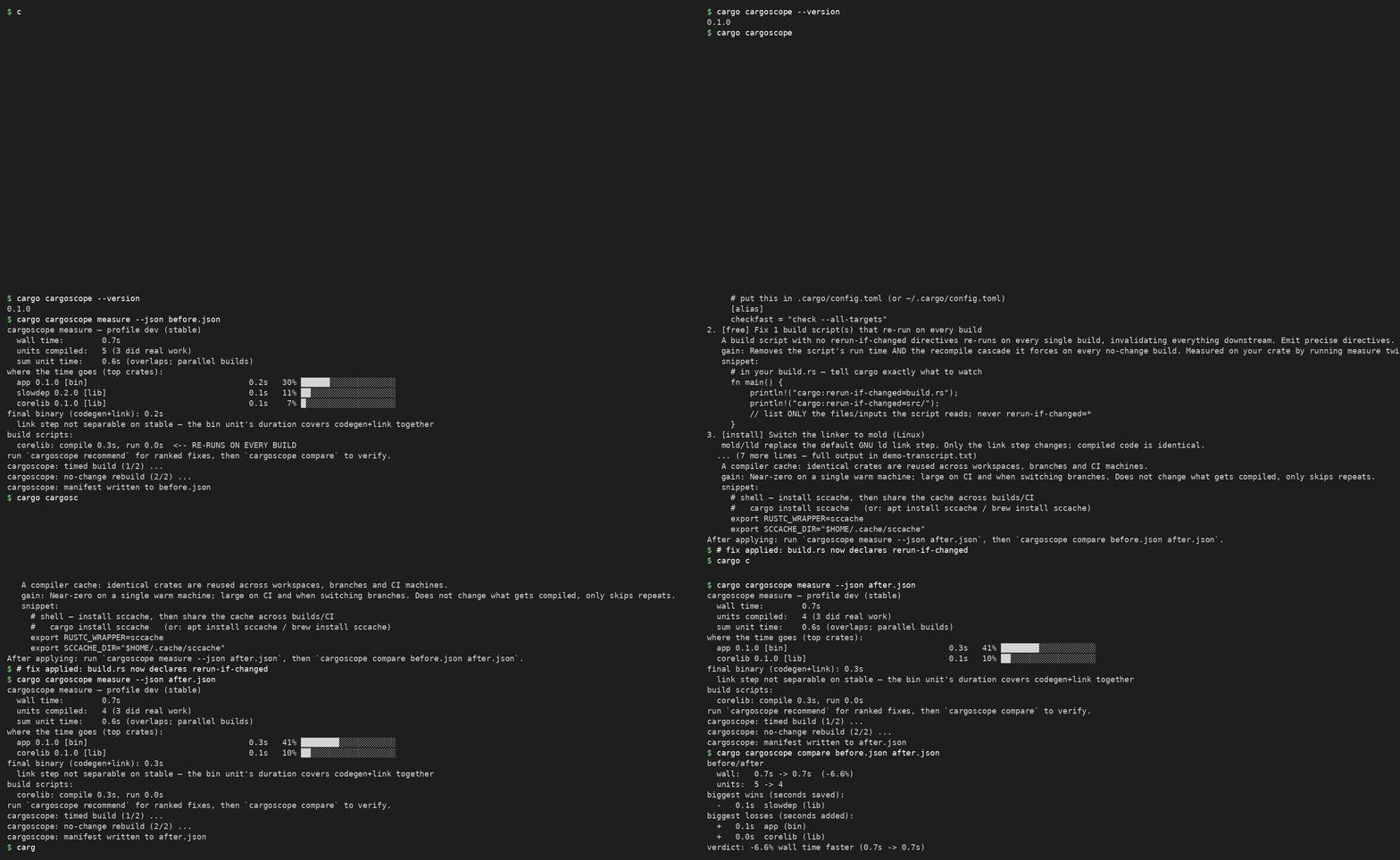
Build headlines said 92x faster. I measured my own crate first. A few weeks ago the Rust corner of my feed lit up: a new toolchain promising dramatically faster builds, one benchmark, one headline number. I have seen this movie before: a number from somebody else's crate, somebody else's machine, and then a week of arguing about whether it applies to mine. I did not want to argue about toolchains. I wanted a ruler: something that tells me, on my crate and my machine, where the seconds actually go (per crate, per build script, per link step), then tells me which fix is cheapest, and lets me verify the delta after I apply it. So I built cargoscope. It measures. It recommends. It verifies. It never touches your toolchain. The three commands cargo cargoscope measure [--json out.json] shells out to cargo build --timings twice. The first build is timed; the second is a no-change rebuild. That second run is the trick: cargo omits fresh-skipped units from the timing report, so a build-script-run unit that still shows real duration in the no-change rebuild was genuinely executed again with no source changes. Its freshness is broken: typically a script that rewrites its own rerun-if-changed inputs. That is measured, not guessed from the script source. The report shows wall time, top crates by compile time, build scripts that re-run on every build, and the codegen+link share of the final binary. On stable, the report is honest about what it cannot separate: "link step not separable on stable — the bin unit's duration covers codegen+link together." cargo cargoscope recommend ranks fixes cheapest-first with exact config snippets: cargo check for the edit loop, fixing re-running build scripts, mold/lld linker, sccache, cranelift (gated behind --nightly-ok). It changes nothing. The snippets are yours to review and apply. cargo cargoscope compare before.json after.json prints the measured delta and a verdict line. Only measured numbers; nothing is promised. A real demo, honest numbers The animated demo below is a real terminal recording on the repo's small fixture crate (verbatim transcript also in the repo). Watch the loop: measure flags a build script with RE-RUNS ON EVERY BUILD, recommend ranks the rerun-if-changed fix, I apply it, measure again, compare: !cargoscope demo (real terminal recording): measure flags a re-running build script, recommend ranks the fix, compare verifies -6.6% wall: 0.7s -> 0.7s (-6.6%) units: 5 -> 4 verdict: -6.6% wall time faster (0.7s -> 0.7s) Small crate, small numbers, no hype. The re-run flag is gone; the per-crate deltas are printed, wins and losses. That is the whole point: the tool's job is to make the second measurement possible, not to impress you with the first. The bug the nightly CI caught To separate the link step, cargoscope parses nightly -Ztime stderr. While dogfooding on a real nightly toolchain I found that rustc 1.101-nightly removed -Ztime entirely (unknown unstable option). The old code set RUSTFLAGS=-Ztime whenever it detected nightly, and cargo forwards RUSTFLAGS into its own internal rustc probe, so measure broke completely on new nightlies (cargo exit 101). The fix: probe first (rustc -Ztime --print=sysroot; --version short-circuits before -Z validation, so it cannot be the probe), set the flag only when the probe passes, and fall back gracefully otherwise. A nightly CI job now runs measure on a real nightly toolchain every night and asserts the graceful fallback. Finding your tool broken on a toolchain you claimed to support is the best possible use of a nightly job. Where the rivals beat us Honesty section, as always with my tools: - cargo-blaze wins if in-place recompilation fits your workflow: it actually makes rebuilds faster instead of measuring them. It is a young, invasive bet (replaces the compiler driver). cargoscope complements it: it can measure blaze's own delta. - cargo build --timings wins on zero install. The raw HTML timeline has everything cargoscope parses. cargoscope adds ranking, re-run detection, and before/after verification on top. - cargo-bloat answers a different question (binary size, not build time). Honest limits - It does not speed up your builds. It measures. If you want the build itself to go faster without measuring first, this is the wrong tool. - Timing numbers are your machine's, your crate's, your profile's. A −6.6% here is not a claim about any other setup. - Link-step timing needs a nightly toolchain whose rustc still accepts -Ztime (removed by 1.101-nightly; support is probed, never assumed). - cargo --timings output format is not a stable API. The parser is defensive, records the tested cargo version, and fails loudly instead of guessing. Try it The npm package is not published yet, so install from source for now: git clone https://github.com/techdevfun/cargoscope.git cd cargoscope && npm install && npm run build # then, inside any Rust crate: npx cargo-cargoscope measure Requires Node 20+ and a Rust toolchain (stable is fine). Zero runtime dependencies, MIT licensed. Repo: techdevfun/cargoscope. Issues and PRs welcome; please include your measure output (redacted paths are fine) when reporting wrong numbers. Also listed in the TECHDEV catalog.
CloudNativePG on k3s: PostgreSQL That Survives Node Failures > _Originally published at woitzik.dev_ <em>Disclosure: This post contains Amazon affiliate links (marked with *). If you buy through them, I earn a small commission at no extra cost to you. I only link gear I actually own and use daily.</em> Nextcloud's PostgreSQL database ran as a StatefulSet with a Longhorn PVC. When the Proxmox host rebooted for a kernel update, Longhorn volumes took 90 seconds to reconstruct. During that window, Nextcloud returned 500 errors — the same [Longhorn Multi-Attach problem](/blog/longhorn-to-nfs-distributed-storage/) that pushed everything else off distributed storage on this single-host cluster. The fix: CloudNativePG (CNPG), a Kubernetes operator that manages PostgreSQL streaming replication, automatic failover, and backups — without depending on a distributed storage layer. View the complete homelab infrastructure source on GitHub 🐙 Why Not Just StatefulSets? A StatefulSet with a PersistentVolumeClaim works until the node dies. In a single-node homelab (one [BMAX Mini PC*](/go/4bv3yF1) running Proxmox with k3s VMs), "node dies" means "Proxmox host reboots." Longhorn reconstructs the volume from replicas, but the reconstruction takes time. During that time, the PostgreSQL pod is in ContainerCreating or CrashLoopBackOff. CNPG solves this differently: it manages PostgreSQL replication at the database level, not the storage level. A primary and a replica run on different nodes. If the primary's node dies, CNPG promotes the replica to primary. No storage reconstruction needed. Installing CNPG The CNPG operator is deployed with a Helm chart: helm repo add cnpg https://cloudnative-pg.github.io/charts helm install cnpg cnpg/cloudnative-pg \ --namespace cnpg-system \ --create-namespace The operator runs in the cnpg-system namespace and watches for Cluster CRDs. The Cluster Definition A CNPG PostgreSQL cluster with streaming replication: apiVersion: postgresql.cnpg.io/v1 kind: Cluster metadata: name: nextcloud-db namespace: nextcloud spec: instances: 2 postgresql: parameters: max_connections: "200" shared_buffers: "256MB" pg_hba: - host all all 10.0.0.0/8 md5 storage: size: 10Gi storageClass: local-path backup: barmanObjectStore: destinationPath: "s3://backups/nextcloud-db" endpointURL: "http://minio.minio.svc:9000" s3Credentials: accessKeyId: name: minio-credentials key: ACCESS_KEY_ID secretAccessKey: name: minio-credentials key: SECRET_ACCESS_KEY retentionPolicy: "30d" resources: requests: memory: "512Mi" cpu: "250m" limits: memory: "1Gi" cpu: "1" instances: 2 means one primary and one replica. CNPG handles streaming replication automatically. The pg_hba entry allows connections from the 10.0.0.0/8 subnet (the homelab VLAN range). The Backup Sidecar CNPG uses Barman for backups. The barmanObjectStore section points to a MinIO instance running in the cluster, kept deliberately separate from the Garage bucket Velero uses. Backups run daily by default. The retentionPolicy: "30d" keeps 30 days of backups. To trigger a manual backup: kubectl cnpg backup nextcloud-db -n nextcloud To restore: kubectl cnpg restore nextcloud-db-backup-20261101 -n nextcloud Failover in Practice When the primary node fails: 1. CNPG detects the primary is unreachable (timeout: 30 seconds) 2. CNPG promotes the replica to primary 3. CNPG creates a new pod for the old primary (as a replica) 4. The new primary accepts writes The failover takes 30-60 seconds. During that window, PostgreSQL connections are dropped. Application-level retries (Nextcloud has them) handle the gap transparently. The CNPG operator logs the failover event: promoted instance nextcloud-db-1 to primary created new replica pod nextcloud-db-0 Monitoring CNPG CNPG exposes Prometheus metrics through a ServiceMonitor: cnpg_pg_stat_activity_count{datname="nextcloud",state="active"} 12 cnpg_replication_lag_seconds{instance="nextcloud-db-1"} 0.003 cnpg_backups_total{status="ok"} 30 Grafana dashboard: alert if replication_lag_seconds exceeds 5 seconds. That means the replica is falling behind, and a failover would lose data. The Trade-off CNPG adds complexity: an operator, Barman for backups, and streaming replication configuration. The benefit is PostgreSQL that survives node failures without depending on Longhorn's storage reconstruction. For a single-node homelab, this is the right trade-off — the [BMAX Mini PC*](/go/4bv3yF1) has enough RAM for two PostgreSQL instances, and the failover is faster than waiting for Longhorn to rebuild. <NewsletterCTA />