Mentions
Conversations linking to GitHub, newest first. Times are UTC.
Mentions by source
X
Bluesky
Hacker News
V2EX
Qiita
DEV
Mastodon
Latest posts
MihawkOS (PS5Proton) - Over 150 Games reported Thanks to all testers 💪 - Compatibility List: mihawk-99.github.io - Alpha 7.1: github.com/mihawk-99/PS5_MihawkOS/releases t.co
Một mã nguồn chạy nhiều nền tảng? Flutter | GitHub Radar #19 #Shorts Làm ứng dụng riêng cho điện thoại, web và máy tính rất tốn sức. Một mã nguồn có thể chạy nhiều nền tảng không? Flutter dùng Dart và widget để chia sẻ phần lớn mã giao diện giữa các mục tiêu. Trong Short này (GitHub Radar, mỗi tập chỉ một repo: flutter/flutter): • 181.000 sao; Trending báo tăng 2.343 trong tháng, không liệt kê mức tuần hay hôm nay • Vì sao: dựng lại giao diện và logic trên nhiều nền tảng làm tăng công sức • Cách hoạt động: viết Dart, ghép widget, hot reload, nối API nền tảng, biên dịch và kiểm thử • Cách dùng: cài SDK theo tài liệu, flutter doctor, flutter create, flutter run 🔗 Liên kết flutter/flutter docs.flutter.dev flutter.dev kieu.app 📄 Cheat sheet PDF (1 trang A4): github.com/kieubinh/kieu-open-resources/blob/main… ⚠ Cần cân nhắc: SDK có thể tải Dart và tài nguyên từ máy chủ Google; việc dùng Flutter đi kèm điều khoản Google. Một cơ sở mã vẫn cần kiểm thử riêng trên từng nền tảng. 📊 Nguồn số liệu: tổng số sao từ GitHub API, mức tăng từ GitHub Trending, chụp ngày 02/11/2026. Số sao đo sự chú ý, không đo chất lượng. 🤖 Công khai: giọng đọc và nhân vật trong video là AI tạo ra (VoiceStudio chạy cục bộ, giọng Narrator 03); hình minh họa do Kieu Studio vẽ. #Shorts #GitHubRadar #Flutter #Dart #KieuStudio
NazoVimのURLが変わりました nazozokc/NazoVim それに伴ってnixの実行コマンドも変わりました nix run github:nazozokc/NazoVim 使っていただいている方は今後ともNazoVimをよろしくお願いします
Sources: BTCPay's findings: cointelegraph.com Shutdown call and admin logins: coindesk.com Latest release: github.com/btcpayserver/btcpayserver/releases/tag… Not financial advice.
A new version of CToy is available with binaries for Win64, Linux64 and OSX ! The update to tcc-0.9.27+ fix occasional issues on Windows and introduce a few C11 features, like typeof and _Generic. Also added is basic thread support and better "stat.h" emulation anael-seghezzi/CToy
機密PDFをサーバーに1バイトも送らない:Next.js + WebAssembly でローカル完結のPDF暗号化ツールを個人開発した話 はじめに 年末調整の控除証明書をメールで送るとき、みなさんはどうしていますか。 「パスワードをかけてから送ってください」と言われて、検索で見つけた無料のオンラインPDFツールに、源泉徴収票やマイナンバー関係の書類をドラッグ&ドロップしたことのある人は多いはずです。私もその一人でした。 そこでエンジニアとして気になったのがこの矛盾です。 「外部に漏れてはいけない機密PDFを守るために、見知らぬサーバーへ無防備な原本とパスワードをPOSTしている」 「1時間後に自動削除します」という文言をユーザー側から検証する術はありません。そして会社の情シス(情報システム部門)の立場から見れば、社外の変換サイトに業務ファイルをアップロードするのは典型的なシャドーITです。 このジレンマを技術で解決するために、ファイルをサーバーへ送るのではなく、処理エンジンをブラウザへ読み込む方式のPDFパスワードツール DofuPDF を個人開発し、オープンソース(AGPL-3.0)で公開しました。 サービス: dofupdf.com GitHub: Jimsnote/dofupdf 本記事では、ブラウザ内だけでPDFのAES-256暗号化・ロック解除を完結させる実装の中身と、個人開発としての収益化の考え方について書きます。 アーキテクチャ:なぜサーバーを無くせるのか PDFの暗号化や権限設定(印刷・コピー・編集のビット操作)は、C/C++製のネイティブエンジン(qpdf や Ghostscript)が事実上の標準です。JavaScript純正ライブラリでは、AES-256の暗号化辞書まわりでケースによって挙動が落ちることがあります。 DofuPDFでは、このネイティブエンジンを WebAssembly としてブラウザ上で直接動かす構成にしました。 従来: ブラウザ → アップロード → サーバーのqpdf → ダウンロード 今回: ブラウザ内のqpdf(WASM) → 処理 → ローカル保存 ※ネットワーク通信 0 Byte ユーザーがファイルを選択すると、File オブジェクトがブラウザのRAM上に展開され、WASMの仮想ファイルシステム(MEMFS)上でネイティブ並みの速度で暗号化が走ります。生成物は Blob としてそのままローカルに保存されます。 ハマったポイント:Emscripten の locateFile 開発で一番時間を取られたのは、jspawn 製の Emscripten ビルドが wasmBinary オプションを無視して、必ず locateFile でURLから fetch しようとする問題でした。対策として、WASMバイナリを事前にバイト列で取得(プログレスバー付き)→ Blob URL を生成 → それを locateFile に渡す、という手順にしています。初回はエンジン(約1〜数MB)をダウンロードしますが、Cache Storage にキャッシュされるので2回目以降はほぼ瞬時に起動します。 このあたりのコードは src/workers/pdf-heavy.worker.ts にあります。 「本当にアップロードしていない」を、どう証明するか 「サーバーに送りません」と書くだけでは誰も信じません。そこで、技術的に検証可能な3つの仕掛けを入れました。 完全オフライン動作。 ページを一度読み込んだあと Wi-Fi を切っても、暗号化・解除がそのまま動きます。外部サーバーと通信していない何よりの証拠です。 DevTools での観察。 トップページで「F12 → Network タブを開いて、ファイルのアップロードが0件であることをご確認ください」と案内しています。 ソース公開。 AGPL-3.0 で全コードを公開しています。処理がブラウザ内で完結していることを、コードレベルで確認できます。 1と2は、「ファイルを預ける」のではなく「プログラムを持ち込む」という設計の自然な帰結です。パケットが外に出ないので、カフェのフリーWi-Fiや新幹線の回線でも盗聴されるものがありません。 PDFパスワードの仕様で、実装してて改めて知ったこと 閲覧パスワードと権限制限は別物。 PDFには「開くためのパスワード(AES-256で内容を暗号化)」と「印刷・コピー・編集の操作制限」の2階層があります。後者は仕様上ポリシーであってDRMではなく、規格を尊重するリーダー(Acrobat、Chrome、プレビュー等)でのみ効きます。DofuPDFではこの両方をUIで分けて設定できます。 パスワードを忘れたPDFは誰にも救えない。 正しくAES-256で暗号化されたファイルはブルートフォースで現実的に破れません。そのため、ロック解除ツールは「現在のパスワードを知っている、自分のファイル」から暗号化レイヤーを剥がす用途に限定しています。毎回パスワードを入力したくない銀行明細や、電子帳簿保存法の保存のためにパスワードを外したい経理担当の請求書、そういう場面を想定しています。 個人開発としての収益化:なぜ「買い切り」にしたか インフラコストがゼロ(計算資源はすべてユーザーの端末)なので、単一ファイルの処理は登録不要・回数制限なしの完全無料を続けられます。問題は4ファイル以上の一括処理です。 ここはいろいろ考えた末、サブスクではなく買い切り(¥4,980・3台まで) にしました。理由はふたつ。 一括処理は月末の経理のような「決まったタイミングでの集中利用」が主なので、月額を取り続けるより使いたい人が買う方が筋がいい 個人開発の継続コストを上げたくない。サブスクは「課金が止まるとサービスを維持する理由が弱くなる」構造で、逆に買い切りは「売ったあとの維持責任が最小」になる 決済は Payhip(個人でも日本円決済・買い切りに対応)+ ライセンスキー方式で、サーバーはCloudflare Workersだけの構成です。 おわりに WebAssemblyが成熟したおかげで、「サーバーに預けるしかなかった処理」をユーザーの手元に取り戻せる時代になりました。機密書類ほど「アップロードしたくない」と思うファイルこそ、ブラウザ内で処理するのが合理的だと思っています。 「無料のオンラインPDFツールに、あの書類を投げるのは嫌だな……」と感じたことがある人は、ぜひ一度触ってみてください。DevToolsを開きながら使うと、通信が0であることを自分の目で確認できるはずです。 🏠 DofuPDF(公式サイト) 🔒 PDFにパスワードを設定する 🔓 PDFのロックを解除する 📚 PDFパスワードのまとめ(ハブ) 💻 GitHub(AGPL-3.0)
Knulli WebUI I vibecoded (sorry guys, I'm LAZY) a web console to manage a Knulli device, It allows you to upload roms, manage favorites, collections and so on. If anyone is interested it's here kubrick89/knulli_webui preview.redd.it preview.redd.it
@AvaloniaUI Avalonia doesn’t eliminate cross-platform complexity. It makes managing that complexity practical. We put those lessons into Synups, our open-source WirePeep port for the Avalonia Port Challenge. Check it out 👇 samscript18/Synups #AvaloniaUI #DotNet
tandem.cpp 源码、构建命令和 4 台机器的完整测试: ewhacc/tandem.cpp r/LocalLLaMA 讨论: reddit.com
🛠️ للمبرمجين: DeepSeek فتحت مصدر dsh-superagent، وكيل برمجة "استباقي" يراقب مستودع GitHub 🤖 يستقبل الطلبات من المسموح لهم، ويشتغل على كل مهمة لحالها ويرد بـ Pull Request، وما يزعجك إلا إذا احتاجك 👌 ⚠️ نموذج بحثي (MIT) مو منتج رسمي. deepseek-ai/dsh-superagent-prototype t.co
I built a self-updating news site that tracks one Turkish ride-hailing app and its court case Martı TAG is a ride-hailing service in Turkey with an ongoing court case around it. Coverage is scattered across a lot of Turkish outlets, so I built one page that pulls it together: tagnewspaper.vercel.app (UI is in Turkish) How it works: - Python pipeline on GitHub Actions every 15 min, pulling Google News RSS with publisher RSS and GDELT as fallbacks - Claude Haiku writes 2-3 sentence summaries and groups articles about the same event into one story; the headline is whichever story the most outlets covered - Guard rails live in code: phone numbers, plates and ID numbers get scrubbed, no verbatim quote over 12 words, and court rulings only show up once two independent sources or a primary source report them - Everything lands in one MongoDB snapshot doc, so the Next.js 16 frontend does a single read and the pipeline revalidates the cache after each run No ads, no login, not affiliated with the company. Code: Yigtwxx/tagnewspaper Feedback welcome, especially on the story clustering and the safety rules.
RL Customs: a desktop tool for local Rocket League appearance changes (Beta) Hey everyone! I built RL Customs, a Windows desktop app for browsing Rocket League items and trying different local appearances. It includes item previews, available color variants, and backups so you can restore changes. This is an early beta: compatibility depends on the items and game version, and changes are local. Close Rocket League before applying changes; game updates may require you to reapply them. Signing in requires Discord and the User role in the RL Customs server. Video preview: youtube.com GitHub and beta download: cortexstudiosinfo/RL-Customs I would appreciate any feedback on the interface and usability!
Welcome Stefan Reinauer as #curl commit author 1571: curl#23695
@AbhilekhBh28 I'm Hüsam, building db-studio, a free, open-source database client. Run npx db-studio locally for spreadsheet-style editing and schema diagrams across nine engines. There's a desktop app too. husamql3/db-studio
And last but not least, a lot of minor bugfixes and performance improvements to many parts of the emulator, which you can read in our changelogs for 2127 alpha builds! github.com/azahar-emu/azahar/releases
And last but not least, a lot of minor bugfixes and performance improvements to many parts of the emulator, which you can read in our changelogs for 2127 alpha builds! github.com/azahar-emu/azahar/releases
CURATOR v2.5.0-beta.2 released — collection improvements and a new 4K walkthrough CURATOR v2.5.0-beta.2 is now available—and there’s a new full video walkthrough to help you get started! A lot of work went into this release. There is still work to be done, but we are closer to Code Unification! This beta brings improvements across collection processing, organization, reporting, and documentation: - Expanded Atari and Sega MAME software-list support, including sets requiring both ROMs and disk images. - Improved Incomplete Sets handling for games whose media are defined as separate DAT entries. - Broader consolidation of identical output payloads while retaining source and DAT-set relationships. - Inventory-based missing-item reports and reuse of unchanged reports. - Verified disc-layout recovery for eligible legacy v4 Dreamcast CHDs. - Bounded padding correction for eligible unmatched Nintendo DS ROMs, accepted only when the corrected data matches a loaded No-Intro entry. - Faster reuse of unchanged processing results, clearer progress displays, and five packaged PDF guides. New to CURATOR? Come take the guided tour. I’ve also published a complete, narrated 22-minute quick-start video, available in 4K. It walks through first-run setup, preparing your references, organizing a collection, and understanding what CURATOR produces—including output folders, incomplete sets, review items, and reporting. If you’ve been curious about CURATOR but weren’t sure where to begin, this is a good place to start. Returning users can also use it to get a clearer picture of the workflow and how the pieces fit together. Watch the walkthrough: youtu.be The video demonstrates the October 31 development workflow. Use the current beta.2 guides alongside it for release-specific instructions. Important before upgrading: Every BETA release requires a complete database reset. Backward compatibility between BETA releases is not guaranteed. Preserve your original files and retained output, and follow the Administrator Guide’s rebuild procedure. CURATOR remains in beta. MAME support is very early and experimental—continue using clrmame for MAME collection management. Always process copies of your original collection and review the results before replacing anything. Download and release notes: github.com/Jiraiya1969/myOrganizer-CURATOR/releas… Complete changelog: myorganizerhq.com Video and current operator guides: myorganizerhq.com CURATOR is free, open-source software for Windows, licensed under GPL v3.0 or later. — Jiraiya1969
📄 Cheat sheet PDF 1 trang cho tập này (claude-seo: cách hoạt động, lệnh bắt đầu nhanh, lưu ý): github.com/kieubinh/kieu-open-resources/blob/main…
RE-USEを使ってiPhoneやMacで高速にノイズ除去するために、ANE+GPUを使って動かすアプリのソースコードとモデルファイルをGitHubなどで公開しました! Corvelis/RE-USE-MLX-CoreML iPhone17 Proだと10秒の音声を1秒程度で処理できます! t.co
SEO của bạn thiếu góc nhìn nào? claude-seo | GitHub Radar #18 #Shorts Báo cáo kỹ thuật, nội dung và dữ liệu tìm kiếm nằm mỗi nơi một ít. SEO của bạn đang thiếu góc nhìn nào? claude-seo là plugin MIT cho Claude Code, gom nhiều kỹ năng SEO vào một quy trình audit. Trong Short này (GitHub Radar, mỗi tập chỉ một repo: AgriciDaniel/claude-seo): • 25.673 sao; Trending báo tăng 7.274 trong tháng, 5.034 trong tuần; không liệt kê mức hôm nay • Vì sao: nhiều công cụ SEO rời rạc làm khó việc xếp thứ tự sửa • Cách hoạt động: 26 skill và 19 agent, thiết lập rồi chạy audit (theo README) • Cách dùng: cài marketplace/plugin, chạy /seo setup và /seo audit, đối chiếu với dữ liệu thật 🔗 Liên kết AgriciDaniel/claude-seo kieu.app 📄 Cheat sheet PDF (1 trang A4): github.com/kieubinh/kieu-open-resources/blob/main… ⚠ Cần cân nhắc: Dữ liệu trang đưa vào Claude Code đi qua Anthropic; audit đầy đủ dùng thêm dung lượng gói Claude, tiện ích tùy chọn có thể mất phí; thiếu khóa Google, một số chỉ số là ước tính. 📊 Nguồn số liệu: tổng số sao từ GitHub API, mức tăng từ GitHub Trending, chụp ngày 02/11/2026. Số sao đo sự chú ý, không đo chất lượng. 🤖 Công khai: giọng đọc và nhân vật trong video là AI tạo ra (VoiceStudio chạy cục bộ, giọng Narrator 03); hình minh họa do Kieu Studio vẽ. #Shorts #GitHubRadar #ClaudeSEO #SEO #KieuStudio
Huge props to @vercel for this absolute masterpiece of an architecture—using OS accessibility trees instead of fragile pixel-guessing is a total game changer for agent workflows 🦀 🔗 项目地址:vercel-labs/agent-desktop
Best JS Framework for AI Coding: SvelteKit Burns 71% More Tokens Than Next.js If you asked me last month which JavaScript framework an AI coding agent would build fastest and cheapest, I'd have said SvelteKit. Small API, little boilerplate. In Nolan Lawson's new benchmark, Claude Opus 5.5 burned 8.53 million tokens building a small Pokédex app in SvelteKit. Next.js built the same app for 4.99 million. Nuxt did it for 3.85 million. The post is The AI cost of JavaScript frameworks, and it's the first real data I've seen on the "best JavaScript framework for AI coding" question that people keep settling on vibes. My take after reading it and the Hacker News thread: your framework choice now comes with a token bill, and that bill depends less on how elegant the framework is than on how well the model already knows its current API. What Lawson actually measured He gave Claude Opus 5.5 the same spec, the same tests and the same short prompt across 12 frameworks, changing only the framework name. The prompt template from the benchmark repo is: Implement the app described in SPEC.md using {framework}. Use the latest stable version. Work autonomously until `npm test` passes. The app is a Pokémon browser backed by a local copy of PokéAPI, with search and sorting. Each run happened in a fresh Podman container. Data had to be fetched at request time, so no static generation. Tailwind and component libraries were banned. Frameworks that ship an official MCP server or agent skills had them installed. Lawson took the median of 5 runs per framework, then measured the output with mobile Lighthouse (4x CPU throttling, Slow 4G). He's upfront about the limits: one small, content-heavy app, which favors server-rendered MPAs on first-load metrics, and interactions like search aren't measured, which is where SPAs could win back ground. It's still more real data than every "agents just work better with X" tweet I've read this year. React vs Svelte vs Vue vs vanilla JS: tokens, cost and Lighthouse results Medians from the post, sorted by tokens: | Framework | Tokens (M) | Cost (USD) | Time (min) | JS shipped (KiB) | LCP (ms) | Lines of code | |---|---|---|---|---|---|---| | Nuxt (Vue) | 3.85 | $2.82 | 9.0 | 84 | 1727 | 1415 | | Astro | 4.13 | $2.76 | 8.2 | 0 | 810 | 1461 | | Hono+htmx | 4.26 | $2.67 | 8.6 | 18 | 978 | 1370 | | Next.js | 4.99 | $3.14 | 10.9 | 142 | 2090 | 1539 | | Vanilla (Vite) | 5.00 | $2.98 | 10.1 | 7 | 1667 | 1492 | | Qwik | 5.64 | $3.27 | 10.7 | 40 | 979 | 1744 | | TanStack Start | 7.07 | $3.54 | 10.3 | 118 | 2028 | 1697 | | SolidStart | 7.13 | $3.79 | 11.2 | 40 | 1204 | 1630 | | React Router | 7.58 | $3.81 | 12.5 | 115 | 1729 | 1564 | | SvelteKit | 8.53 | $4.28 | 10.8 | 36 | 1130 | 1611 | | Gracile+Lit | 9.04 | $4.65 | 12.1 | 8 | 956 | 1717 | | Angular | 9.76 | $4.97 | 17.2 | 93 | 1954 | 2009 | Cost is at Claude Code API prices, not what he actually paid on a Max plan. Accessibility scored 100 everywhere, and Lighthouse performance landed between 97 and 100 for all of them, so every stack ended up with a working, decent app. Where they differ is the bill and how much JS reaches the browser. Angular used about 2.5x the tokens of Nuxt and took nearly twice as long. Two of its five runs didn't produce a measurable app because the agent built an SSR app that rejected non-localhost requests, even though the spec said it would sit behind a reverse proxy. Why SvelteKit cost so many tokens The agent read SvelteKit's v3 migration guide in every single run. The prompt asked for the latest stable version, which was @sveltejs/kit 3.1.0, and Lawson thinks that release is likely too new to be in the model's training data. So each session started by catching up on APIs the model didn't know. So yes, training-data bias, but not the version the "LLMs just default to React" crowd describes. React itself gets no special treatment. The model does well on API surface it has seen a lot of and that hasn't changed since, and Next.js and Nuxt are huge, mature and all over the training corpus. React Router and TanStack Start are both React too, and they still used 42-52% more tokens than Next.js, JSX and all. One HN commenter, ef2k, summed it up: "A significant part of the cost is that newer framework APIs are not known to the current agents." So the framework you love for shipping a clean new reactivity model is, right now, the one your agent has to re-learn on your dime. smrtinsert wrote that "sveltekit 2 was super quick to use for me," which fits the theory: same framework, but an API the model had already seen. Vanilla JS didn't save tokens either I went in expecting vanilla to be the cheapest option, on the theory that fewer abstractions means fewer APIs to hallucinate. It landed mid-pack at 5.00M tokens, basically tied with Next.js, and it was the only stack with layout shift (CLS 0.111). Its LCP of 1667 ms trailed Astro, Gracile+Lit, Hono+htmx, Qwik, SvelteKit and SolidStart. Lawson's read is that "having _some_ framework can be better than nothing (or better than raw Vite, anyway)." My guess at why: with raw Vite the agent has to invent routing, data loading and rendering conventions from scratch on every run, and that costs tokens too. oatmealsnap on HN made the long-term version of the argument: in a vanilla codebase, "your agents (or human devs) are going to write element.addEventListener and document.querySelectorAll countless times." The winners were the boring ones: server-first, stable, with a small API surface. Astro shipped 0 KiB of JS, had the best LCP (810 ms) and the shortest median build time (8.2 min). Hono+htmx had the lowest median cost at $2.67 and produced the least code, 1370 lines against Angular's 2009. Framework MCP servers and skills didn't lower the token bill Where a framework had official AI tooling, it was installed, and agents used it inconsistently: - SvelteKit's MCP/plugin, the React Router skill and the Hono skills: used in 5/5 runs - Angular MCP: 3/5 - Astro MCP: 2/5 - Next.js: skill files read in 1/5 runs, AGENTS.md in 2/5 - Nuxt MCP: never used Put that list next to the token table. Nuxt never touched its MCP server and was the cheapest on tokens. SvelteKit used its tooling every time and was the third most expensive. Lawson says he suspects the current crop of framework MCPs and skills "may be doing more harm than good." I'd go further: if your framework needs an MCP server so the agent can write it correctly, that's the framework tax showing up on your invoice. Why your agent keeps picking Next.js h0rv noted on HN that among their vibe-coder friends who let the agent decide, "the default stack is always Next.js, Vercel, and Supabase." In another subthread, buildfocus wrote: "I would be very surprised if the tool that agents use most effectively is also the one they recommend." Lawson's data partly vindicates the agent here, since Next.js was cheap to generate. But it also shipped the most JavaScript of any framework (142 KiB), had the worst median LCP (2090 ms) and posted 71 ms of total blocking time. Lawson pins the wide LCP spread across Next.js runs on lazy-loading: one app avoided it and the other four didn't. So Next.js was cheap to write and expensive to serve. You pay the token bill once, and your users pay for the 142 KiB on every page load. How I'd pick a JavaScript framework for agent-written code now Here's what I'm changing in my own setup: 1. Check whether the framework's current major version predates your model's training cutoff. If the agent has to read a migration guide to start, you'll pay for that in every fresh session. Pin the previous major if the new one buys you nothing for this project. 2. Default to server-rendered for content-heavy work. Nuxt, Astro and Hono+htmx were the three cheapest to build in this benchmark, and Astro (0 KiB) and Hono+htmx (18 KiB) shipped almost no JS. 3. Don't go vanilla to save tokens. You won't. Go vanilla because you want zero dependencies, and write the conventions down in your repo so the agent stops reinventing them. 4. Don't assume framework MCP servers help. Compare a few runs with and without them before adopting one team-wide. 5. Run your own version. The benchmark repo takes a framework name and a spec. Swap in a spec that looks like your app. The README recommends "3 or more iterations before drawing conclusions," and I'd take that seriously. n=5 on one Pokédex app is enough to make me suspicious of my defaults, and not much more. Lawson ends with the question I keep coming back to: "Are you really picking your tech stack based on evidence? Or are you just going with what you already know?" With agents in the loop, "what the model already knows" is part of that answer now, like it or not. Has your coding agent ever talked you into React or Next.js when you didn't need it? And which framework does it actually write best for you? If you've got token counts from your own projects that contradict this table, post them. I want to see them. Sources - Nolan Lawson, The AI cost of JavaScript frameworks (Oct 28, 2026) - nolanlawson/agent-framework-benchmark and results - Hacker News discussion
Trending repository of the day 📈 t3code by @pingdotgg Last 24h: 3,216 ⭐ Total: 39,822 ⭐️ pingdotgg/t3code
@kawarimidoll GUI派ならomuxも比べてみてほしいです。SwiftUI製のMacネイティブ(Electronなし、約5MB)で、セッションごとにworktreeを作り、Changesタブで差分に行コメントするとエージェントに戻ります。MIT:onurozcan/omux
🦇 Lo se que no me van a tomar en serio ni en cuenta, el ser humano está acostumbrado a mirar tetas y mirar a dónde les conviene. Pero, he terminado la nueva versión. #Emergency_Brake_Monitor_A_M_D_C Detecta trenes parados en la vía envía una alarma etc. Condor2026/Emergency_Brake_Monitor_A_M_D_C
Open-source download manager for courses (Udemy/Hotmart), YouTube, music & 1,800+ sites. Built with Tauri 2.0, Rust & Svelte. Github: OpenSelena/omniget t.co
[quote="achille, post:37, topic:79916"] Your laptop’s kernel only needs to be built once, then everyone that shares your hardware could share that derivation. [/quote] In theory. In practice you can share your binary, but nobody should ever accept it; there is no way to assert that you're not handing out malware like candy instead of the binary you're promising. If you want to set up third party build networks*, you can, nothing is stopping you (which is why the claim that hydra serves as some kind of monopolistic central entity is absurd), but the distro default should never include caches just anyone can write to. Unless we want a much worse version of what happened to the AUR recently, of course (well, at least the packages are signed, but presumably people would just trust all signatures, given what happened with the AUR). *I don't have links, but projects to assert hydra isn't publishing hardware by independently building packages and comparing them exist. These can in theory be used to make stuff like @bme's kernel more trustworthy. In practice, you need a certain amount of build replication to be able to trust such caches, meaning that the overhead of this is almost certainly way higher than the two people who happen to have the exact same circumstances and update cadence building independently. --- [quote="achille, post:37, topic:79916"] This has not been the case. in my n1 personal experience. e.g entering a simple dev shell would frequently download 2+ gb of updates, sometimes weekly. [/quote] If you want to do development with isolated build dependencies, yes, you will have to carry multiple sets of disjoint compilers and libraries, and if you update those regularly, you will churn many gigabytes. There's no way around that. That's different from using NixOS as a distro, though. This is you asking for this behavior, if you just used NixOS as a distro, or pinned your inputs to your active OS, you'd see much smaller networking demand. NixOS does indeed churn more because nix rebuilds full subtrees anytime anything changes instead of just rebuilding nodes, but development use cases are a very different story (and bordering on moving goalposts again). --- [quote="achille, post:37, topic:79916"] NixOS is very energy inefficient compared to most other distributions, however it’s also uniquely positioned to be one of the first that can decentralize. [/quote] You can already run and use your own substituters, today. Plenty of people in the ecosystem do this, to the point that we're making PSAs about this being inadvisable because you're trusting too many individuals with no controls. NixOS isn't even unique in this, there are deb and rpm repositories besides the ones published by debian and fedora. NixOS' alternate caches are just way more popular because they're easier to use and not tied to package expressions. If you want to set up a cache on your LAN, just do that. If you want to set up a shared cache for your hackerspace, just do that. If you want to host a cache on IPFS that any Joe can write to and infest the world with malware, just do that. Nix' substituters are configurable.
Custom Comparisons ブロックエディタを用いてカスタムした比較対象タイムが使用できるようになる Livesplit 拡張機能 例えば画像の場合は、 中心から外に向かって 履歴データをソースにして 完走のみ 最新の 10 件 中央値 生成したタイムに +1s rodrigosiqueiradev/LiveSplit.CustomComparisons . t.co
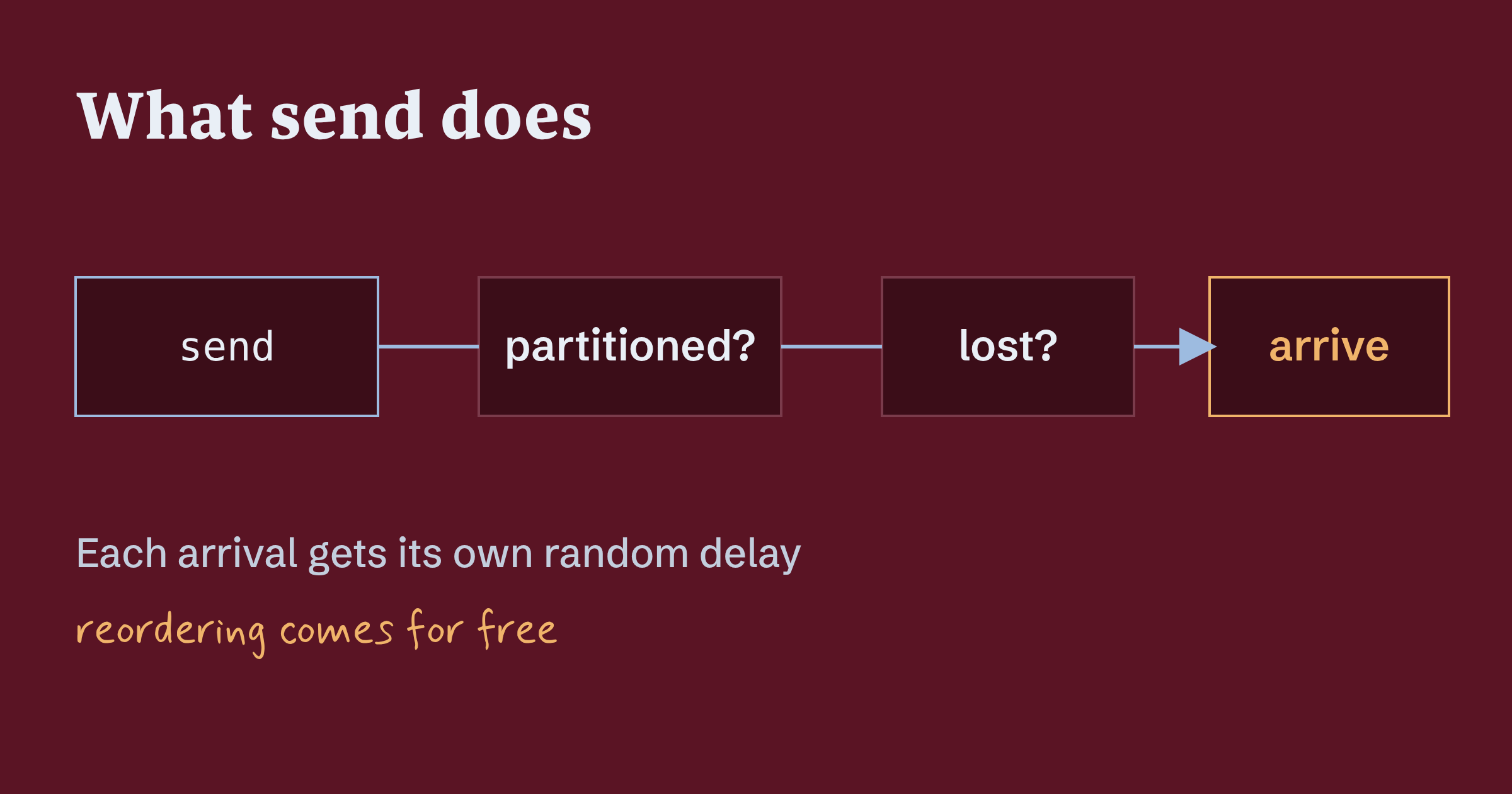
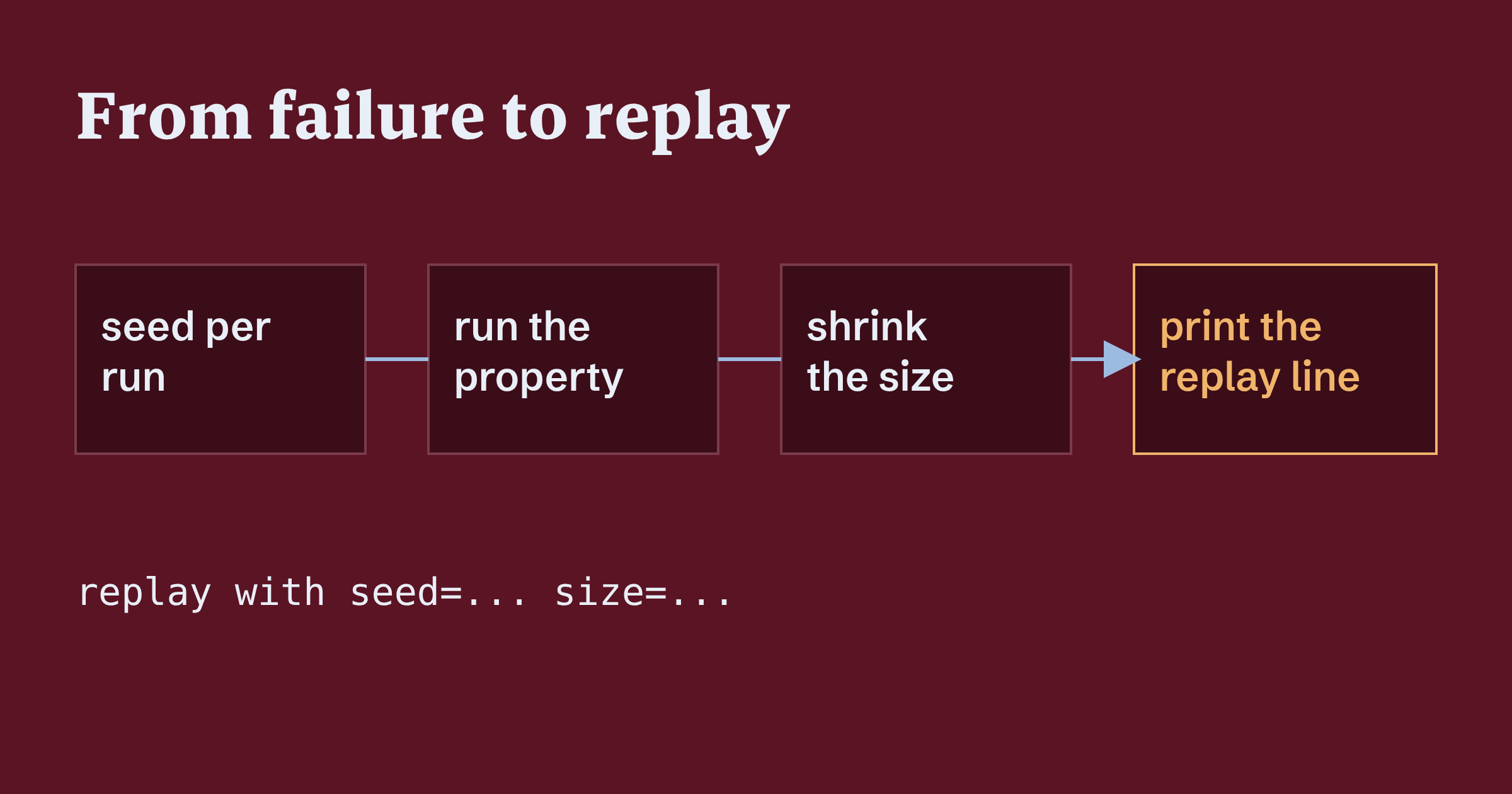
Build a deterministic network simulator in TypeScript Within my collaborative diagram editor in coschema the network simulator was the most useful component. Not due to an effective network simulation but because on failure it would print a seed and replay exactly. The last full run had 1,756,564 messages across 5,000 seeds with 0 failures. In this tutorial we will implement a small example similar to this in TypeScript. We will create a virtual clock, a seeded random number generator, a link with latency, jitter, loss and duplication and a runner that finds a failing seed and replays it. We assume basic knowledge of TypeScript and Node 24. The complete project, with tests and configuration, is in the virtual-network-test-harness repository. The page explains the parts that matter, the repository holds every file. Seeded randomness you can fork A flaky network test usually has two causes: Math.random and real timers. I replace both. Randomness comes first, because everything else draws from it. The generator in src/prng.ts is a small 32 bit mixer. It keeps the seed it started with and one integer of state, so the same seed always gives the same sequence. export class Prng { readonly seed: number; private state: number; constructor(seed: number) { this.seed = seed >>> 0; this.state = this.seed; } nextUint32(): number { this.state = (this.state + 0x6d2b79f5) >>> 0; let mixed = this.state; mixed = Math.imul(mixed ^ (mixed >>> 15), mixed | 1); mixed ^= mixed + Math.imul(mixed ^ (mixed >>> 7), mixed | 61); return (mixed ^ (mixed >>> 14)) >>> 0; } chance(probability: number): boolean { return this.next() < probability; } fork(label: string): Prng { const mixed = Math.imul(this.seed ^ hashLabel(label), 0x9e3779b1) + 0x85ebca6b; return new Prng(mixed >>> 0); } } next() divides nextUint32() by 2 to the power of 32, which gives a float from zero up to one. hashLabel is a short FNV-1a hash of a string, and the constructor in the file also rejects non integer seeds. fork is the method I care about. It derives a new generator from the original seed and a label, not from the current state. That means a fork gives the same stream no matter how much the parent has been used. When I later add one more draw on the upstream link, the downstream link keeps dropping exactly the same messages. Without forks, every change to one part of the simulation reshuffles the faults in every other part, and your seeds stop meaning anything. A clock that only moves when the test says so Real setTimeout makes tests slow and order dependent. The fix is a clock you advance by hand. src/virtual-clock.ts exports a small Clock interface with now, setTimeout and clearTimeout, and VirtualClock implements it. The two methods that matter keep a sorted list of timers and pop the due ones in order. export class VirtualClock implements Clock { setTimeout(callback: () => void, delayMs: number): number { const timer: ScheduledTimer = { id: this.nextId, time: this.currentTime + delayMs, callback, }; this.nextId += 1; const position = this.timers.findIndex((existing) => existing.time > timer.time); if (position === -1) this.timers.push(timer); else this.timers.splice(position, 0, timer); return timer.id; } advance(durationMs: number): number { const target = this.currentTime + durationMs; let processed = 0; for (let timer = this.takeDue(target); timer !== undefined; timer = this.takeDue(target)) { this.currentTime = timer.time; timer.callback(); processed += 1; } this.currentTime = target; return processed; } } Insertion goes before the first timer that is strictly later, so two timers with the same time run in the order they were created. That tie break is what makes runs repeatable. advance sets the clock to each timer's own time before running its callback, so code that reads now() inside a callback sees the moment the timer was due, not the end of the window. Callbacks may schedule new timers, and if they fall inside the window they run in the same call. The file also has runUntilIdle, which throws VirtualClockOverflowError after a fixed number of events. A retry loop that never stops would otherwise hang your test run, and a clear error is better than a timeout. A link that drops, delays and duplicates Now the network itself. SimulatedLink in src/link.ts takes a clock, a generator, a delivery callback and a config with latency, jitter, loss rate and duplicate rate. The file ships three profiles: clean, lossy (60 ms latency, 40 ms jitter, 20 percent loss, 5 percent duplicates) and chaotic. !A send call passes three checks in order: partitioned, lost, duplicated. Each arrival gets its own random delay, so reordering appears naturally. export class SimulatedLink<T> { send(message: T): void { this.stats.sent += 1; if (this.isPartitioned) { this.stats.partitioned += 1; return; } if (this.random.chance(this.config.lossRate)) { this.stats.lost += 1; return; } this.scheduleArrival(message); if (this.random.chance(this.config.duplicateRate)) { this.stats.duplicated += 1; this.scheduleArrival(message); } } private scheduleArrival(message: T): void { const delay = this.config.latencyMs + this.random.between(0, this.config.jitterMs); this.clock.setTimeout(() => { this.arrive(message); }, delay); } } No reordering is implemented and is intended this way. Every arrival gets its own random delay, so a later message may arrive before an earlier one if the jitter is large enough. Reordering is not an option that can be missed when testing, but rather naturally appears within the model. The code under test is in src/reliable-sync.ts. A SyncClient numbers each update, keeps it until the server acknowledges it and retries on a timer. A SyncServer buffers out of order frames, applies them in order and acknowledges how many it has. The client takes a Clock, not the global timer, which is the only change the production code needs to be testable. createSyncRig wires both sides through two links and gives each one its own fork, upstream and downstream. A runner that replays a failing seed Fixed seeds in unit tests only cover the cases you thought of. I want many seeds, and I want any failure to be something I can paste back in. src/property.ts does that with a case made of a seed and a size, where the size is the number of updates. !Four steps in a row: derive a seed per run, run the property, shrink the size, print the replay line with seed and size. export function replayCase(property: Property, testCase: PropertyCase): string | undefined { try { property(testCase); return undefined; } catch (error) { return error instanceof Error ? error.message : String(error); } } function caseForRun(baseSeed: number, run: number, maxSize: number): PropertyCase { const seed = new Prng(baseSeed).fork(`run:${run}`).seed; const size = 1 + new Prng(seed).fork('size').int(maxSize); return { seed, size }; } function smallestFailingSize(property: Property, failing: PropertyCase, message: string) { for (let size = 1; size < failing.size; size += 1) { const candidateMessage = replayCase(property, { seed: failing.seed, size }); if (candidateMessage !== undefined) return { size, message: candidateMessage }; } return { size: failing.size, message }; } Each run derives its seed from the base seed and the run number, so the whole report is reproducible from one number. When a run fails, the shrinker keeps the seed and tries smaller sizes until one still fails. A failure with 3 updates is easier to read than one with 19. formatFailure then prints the line you need: replay with seed=... size=.... The test file test/network.test.ts proves the loop with a property that is meant to fail. The client gets a retry interval so large it never fires, over the lossy profile. const deliversWithoutRetries: Property = ({ seed, size }) => { const { clock, client, server } = syncRigFor(seed, LINK_PROFILES.lossy, 1_000_000_000); updatesOf(size).forEach((value) => client.push(value)); clock.advance(10_000); if (server.log.length !== size) { throw new Error(`server applied ${server.log.length} of ${size} updates`); } }; it('finds a failing seed when the client never retries and replays it', () => { const report = runProperty(deliversWithoutRetries, { runs: 30 }); const failure = report.failure; expect(failure).toBeDefined(); if (failure === undefined) return; const replayed = replayCase(deliversWithoutRetries, { seed: failure.seed, size: failure.size }); expect(replayed).toBe(failure.message); }); A broken client is the honest way to test a bug finder. If the runner cannot catch a client with retries switched off, it will not catch a subtle one either. The mirror property, with a normal retry interval over the chaotic profile, must pass for every run. Run the tests and the project The package.json has two scripts, test and typecheck, and it needs Node 24 or newer. The repository also has an .nvmrc file that says 24. npm install npm run typecheck npm test These tests do not require a network, browser or environment variables. They test the clock, link, runner, sync example, generator and do not wait for time to pass during any test, meaning they are fast. To see the harness on its own, the README shows a short script. It builds a VirtualClock, a Prng with seed 7 and a rig over two lossy links, pushes one update, advances the clock by 5000 and prints rig.server.log. Run it twice and you get the same drops, delays and duplicates. Change the seed and the trace changes. Just one limitation to state outright. The simulator does not run your logic against an actual network, but against the faults you list. The simulator does not have knowledge of TCP behaviour or browser timers that throttle in background tabs. The biggest issue is that a model you wrote yourself can share your blind spots. This is accurate and I still feel a little uneasy about a green run. The solution is not to skip it, but to add the fault you forgot the moment production shows it to you. What to try next Start by breaking the sync example in a new way. Make the server acknowledge before it applies a frame, or stop it ignoring duplicates, and see which seed the runner reports. Then replay that seed with replayCase and step through it. This is the loop that makes the whole setup worth building. After that, a few extensions fit the existing pieces. Toggle setPartitioned in the middle of a property run and check recovery. Add a third link profile that is fine most of the time and terrible for one window. Print formatFailure in your CI log so a red build carries its own replay command. The full code, including both test files, is in the repository. This week, pick one retry loop in your own code and move its timer behind a Clock interface. Nothing else has to change yet. Once the timer is injectable, the rest is a matter of afternoons.
MonitorSnap: a free, open-source Windows tool for saving and restoring monitor layouts I'm the maintainer of MonitorSnap, a small Windows 10/11 utility for saving display configurations and restoring them from the app, tray menu, or a global hotkey. The use case is a desk with a KVM switch, a dock, or several monitors: arrange the displays in Windows once, save the setup, and reapply it after Windows detects the screens again. Presets store display topology, positions, resolutions, refresh rates, rotation, and the primary display. It is free under the MIT license, with no account required. Installer, MSI, portable, and ZIP builds are available; Python and Node.js are bundled or unnecessary for end users. Presets stay local, and the app checks GitHub for updates. A few limits worth knowing: this restores display configurations, not individual app window positions; it cannot switch a physical KVM; and the drag layout editor is experimental. The Windows binaries are currently unsigned. Source, screenshots, and a step-by-step guide: GTRows/MonitorSnap Downloads: github.com/GTRows/MonitorSnap/releases/latest I'd appreciate feedback from people using different GPUs, docks, or KVMs, especially if you can describe your monitor connections and what happens when you restore a preset.
@primus_labs @KaitoStudio_ @KaitoAI For developers: → Create data templates on the Dev Hub → Integrate via SDK (client-side with the extension or backend) → Verify proofs on-chain with their contracts Docs: docs.primuslabs.xyz GitHub: github.com/primus-labs
📄 Cheat sheet PDF 1 trang cho tập này (Hallmark: cách hoạt động, lệnh bắt đầu nhanh, lưu ý): github.com/kieubinh/kieu-open-resources/blob/main…
能让 AI 构建 Solana 交易,不代表它能替你签名或广播。这个边界在 Vybe 的 MCP 接入里写得很清楚: vybenetwork/solana-mcp-vybe 服务提供 44 个工具,每个工具调用一个 Vybe API 端点;构建交易的工具返回未签名交易,不接收私钥,也不负责广播。用户仍需在自己的钱包签名。仓库公开的是注册元数据和接入说明,运行中的服务代码另在一处;这是已运行服务的接入层,不是 Solana 协议改动。
Show HN: Aigenos Flow – deterministic agents on LangGraph; the policy is a file
If you're using KOReader on your e-reader, i built a patch that can display your Ao3 library like this for normal list view and for the Bookshelf plugin. gin7uro/koreader-ao3-plus t.co
GoForge 0.3.0 is out. Optional Sentry error reporting, one-click GeoLibre and RustGIS templates, and a frontend update to htmx 4 and Tailwind 4. This is the cut I would run for prod and dev loads on your own hardware. raythurman2386/goforge
🚀 Released league/oauth2-server-bundle v1.2.3 and v2.0.0, the #Symfony integration for league/oauth2-server library. Mostly leveraging #PHP, Symfony, and oauth2-server's latest syntax and features. Shoutout to @ajgarlag.bsky.social for his great maintenance work 🤝 github.com/thephpleague/oauth2-server-bundle/rele…
so much ocaml my caml github.com/shreyascodes-tech/zcaml/releases/tag/o… t.co
quicktui.ai QuickTUI Server preview server2-preview-20261102-204826-b4d9ec0eb is out. - The server now comes as a macOS app, no terminal needed. - New desktop icon matches the iOS app. - Easier GUI pairing and simpler Settings. Download: github.com/dualface/quicktui/releases/tag/server2…
AI làm trang đẹp có tự kiểm tra? Hallmark | GitHub Radar #17 #Shorts Nhờ agent dựng trang web, bạn nhận được ảnh chụp đẹp nhưng bố cục trên điện thoại lại vỡ. AI làm trang đẹp có tự kiểm tra được không? Hallmark là skill thiết kế MIT của Nutlope, đưa agent qua các bước chọn hướng, dựng trang, kiểm tra và rà lại. Trong Short này (GitHub Radar, mỗi tập chỉ một repo: Nutlope/hallmark): • 45.175 sao; Trending báo tăng 15.201 trong tháng, 11.566 trong tuần; không liệt kê mức hôm nay • Vì sao: một trang trông đẹp trên desktop có thể sai bố cục ở kích thước khác • Cách hoạt động: chọn hướng từ 50 chủ đề, kiểm tra ở tám độ rộng và rà bằng ngữ cảnh mới (theo README) • Cách dùng: Node 18+, npx skills add nutlope/hallmark -g; kiểm tra trình duyệt cần Chrome và puppeteer-core 🔗 Liên kết Nutlope/hallmark usehallmark.com kieu.app 📄 Cheat sheet PDF (1 trang A4): github.com/kieubinh/kieu-open-resources/blob/main… ⚠ Cần cân nhắc: Cờ -g cài skill toàn cục: đọc nội dung và phạm vi trước khi cài. Phần kiểm tra trình duyệt cần Chrome và puppeteer-core. Quy trình rà tự động không thay người thật duyệt chất lượng thiết kế. 📊 Nguồn số liệu: tổng số sao từ GitHub API, mức tăng từ GitHub Trending, chụp ngày 02/11/2026. Số sao đo sự chú ý, không đo chất lượng. 🤖 Công khai: giọng đọc và nhân vật trong video là AI tạo ra (VoiceStudio chạy cục bộ, giọng Narrator 03); hình minh họa do Kieu Studio vẽ. #Shorts #GitHubRadar #Hallmark #WebDesign #KieuStudio
Hydrogen recycling and grain boundary diffusion for NdFeB magnets
MIDISTOMP 2.0: my free custom firmware for the Zoom MultiStomp now has parallel routing, a 25s stereo looper, perform mode, studio meters and more! Hey everyone, A while ago I posted MIDISTOMP here, my custom firmware that gives the Zoom MultiStomp proper MIDI. A lot of you tried it, sent bug reports and asked for stuff. So I kept going, and it got a bit out of hand. 2.0 is out today and it’s by far the biggest update so far. The little pedal you know is still there: same effects, same patches, same knobs. There’s just a lot more under the hood now. With an intuitive UX/UI experience that feels like stock (hopefully better 👀). What’s new in 2.0: - EFFECT CHAIN routing: your chain can branch now. Split it into two parallel buses and mix them back together, with crossfade, levels, phase, mute and solo per bus. On the MS-70CDR you can send L to one bus and R to the other. The routing nodes don’t use up effect slots, so you still get all 6 effects. There’s a safety limiter at the very end, so a big boost won’t clip the output. - PERFORM MODE: one screen where every knob, the cursor keys and the footswitch can control whatever you want: an effect knob, an effect on/off, the routing or the looper. Any move can wait for the next beat, bar or cycle, glide in over time, or fire a second move later. Waiting moves blink on the screen and the LED. It’s saved per patch, so every patch can play differently. - Looper: works with GRDLOOP from my effects pack. It records whole bars in time with your clock (about 25 s stereo or 40 s mono), does latched rolls, and the footswitch records, stops, plays and deletes right on the grid. Hook it up to Perform mode and it gets really fun with some dedicated automation settings. - MASTER: studio meters in a stompbox. spectrum, a scope with a tuner, stereo, loudness in LUFS, and in/out meters with the limiter’s gain reduction. It uses no CPU when it’s closed. - KALEIDO: a full-screen visual that dances to your sound and flashes on every beat of the MIDI clock. Totally useless, I love it. - DSP limit raised from 225 to 300: heavier patches fit now. The menu shows your patch’s DSP and the CPU load, so you can see when you’re getting close. - SYSTEM screens: CPU load, the load of each effect, and what each part of MIDISTOMP costs. Good for finding what makes a heavy patch heavy. - More MIDI: CC 85 to 101 control every routing setting. Everything from 1.x is still there: Program Change, CC on every knob, CC 80/81 for patch up/down, MIDI clock with Start/Stop, the MIDI menu, Tempo Lock, footswitch holds and combos. Small stuff too: EXIT takes you back to where you were, a mono/stereo input setting, input and master levels up to 150, and the MS-50G’s effect category screen. Your patches Your patches and installed effects stay on the pedal, and old patches sound exactly as before. Still, back up your patches before you update, just in case. If you ever want to go back, Zoom’s own updater puts the stock firmware back. Compatibility One build now runs on the MS-50G, MS-60B and MS-70CDR (the originals, not the + models or the Four series). I’ve tested 2.0 on the MS-70CDR and MS-50G. The MS-60B ran 1.2 fine, so it should be good, but if you have one, tell me. After the update every pedal shows up as an MS-70CDR over USB, which is normal. Install Grab Zoom’s official MS-70CDR v2.10 updater (yes, also for the 50G and 60B) and the MIDISTOMP builder from the releases page. - Windows: drop Zoom’s updater on MIDISTOMP-builder-Windows.exe, then run the “MIDISTOMP V2.0 Updater.exe” it writes. - Mac: use Zoom’s Mac updater and the Mac builder (Apple Silicon or Intel). Open the builder and drag Zoom’s updater into its window. It writes the MIDISTOMP updater app for you. The builder makes the update from your own copy of Zoom’s updater, so nothing of Zoom’s is redistributed. Full steps and every new screen are in the user guide on GitHub. The effects pack got bigger too! The pack is up to 17 custom effects that follow the pedal’s tempo, lock to the clock grid and restart on the downbeat. New in this round: - GRDLOOP: the looper - GRDELAY: one delay with six engines (tape, dub, reverse, lo-fi and more) - LOUDER: a mastering limiter with a live meter on its screen - Gooey: a bus compressor in the style of the SSL G-bus, also with a meter - DJFilter: a DJ filter with a kick kill - Washout: a delay that smears into a reverb cloud - Takeoff: risers and downlifters that land on the bar They also work on stock firmware. MIDISTOMP just unlocks extra tricks. Bugs and feedback This is still one guy with one pedal (well, a few now), so bug reports help a ton. If something breaks or acts weird, open an issue on GitHub with your pedal, the MIDISTOMP version, what you did and what happened. Support MIDISTOMP is free and always will be. If it made your pedal more fun and you want to help keep it going, a coffee goes a long way: - PayPal: paypal.me - Buy Me a Coffee: buymeacoffee.com Download Check it out here: matujuice/zoom-ms-midistomp Check out the effect pack here: matujuice/zoom-ms-zdl-effects-pack Have fun, and show me what you make with it! 🎛️⚡
Small Qwen team beats Fable 5 on coding tasks A Memdoor workflow with five Qwen3.8-27B models outperformed Fable 5 on LiveCodeBench Hard problems, achieving a 9.8 mean pass rate for $0.39 per run. This highlights the power of orchestrated small models over monolithic ones.
craft-anything (about 2.4k stars): a Rust engine and desktop app that studies a site, app or game, then has your coding agent rebuild it. Early alpha, needs a signed-in agent plus a fal.ai key for the art. storytold/craft-anything
Has anyone gotten a Sensdspin Source device on ESP32 working? I used AI to make this post so the thoughts are properly linear and not whack a mole like my brain works. Title: Need help compiling Sendspin Source on ESP32-A1S (ES8388) for Music Assistant / Home Assistant Body: Hey everyone, I’m trying to get a dedicated audio line-in source set up for Music Assistant using Sendspin on an ESP32-A1S Audio Kit (ES8388 codec). My end goal is to connect an external analog line-in audio source to the board's 3.5mm jack (LINE2) and stream synchronized multi-room audio across my network to Music Assistant targets. --- Hardware & Environment - Board: AI-Thinker ESP32-A1S Audio Kit (ESP32-WROVER, ES8388 codec) - Framework: esp-idf (ESP-IDF 5.5.6) - ESPHome Version: 2026.10.1 - Integration: Music Assistant (with Sendspin enabled) --- The Main Issue / Error When attempting to compile using the Sendspin source component repo (Chris Uthe's chrisuthe/sendspin-a1s-source), compilation fails during the ESP-IDF component discovery phase with a CMake git error: -- Building ESP-IDF components for target esp32 ...CMake Error at /data/cache/idf/frameworks/5.5.6/tools/cmake/build.cmake:633 (message): ERROR: Git reference "source-role/06-example-docs" doesn't exist in the repository "Sendspin/sendspin-cpp" Call Stack (most recent call first): /data/cache/idf/frameworks/5.5.6/tools/cmake/project.cmake:752 (idf_build_process) CMakeLists.txt:114 (project) -- Configuring incomplete, errors occurred! ERROR CMake configure failed with exit code 1 ERROR Component discovery failed What We’ve Discovered / Workarounds Tried 1. Root Cause: The upstream sendspin-a1s-source component has a hardcoded dependency in its idf_component.yml pointing to a non-existent Git branch (source-role/06-example-docs) on Sendspin/sendspin-cpp.git. 2. Local Component Patching: Storing the sendspin component locally in /config/esphome/components/sendspin/ and manually patching idf_component.yml to target version: main instead of the deleted branch allows the build to pass. 3. YAML Schema Confusion: Many available ESP32-A1S Sendspin YAMLs found online (like el-bakkali or bush-a1s) are written as Sendspin Sinks/Players (receivers) using media_player: and speaker:, rather than dedicated Sendspin Sources (input stream capture via the ES8388 ADC microphone component). Here is my YAML I am trying to run esphome: name: sendspin-source-1 friendly_name: Sendspin Source 1 min_version: 2026.4.0 on_boot: priority: -100 then: # Route ADC input to LINE2 (3.5mm line-in jack) - select.set: id: adc_input_select option: "LINE2" # ES8388 register overrides for stereo line-level capture - lambda: |- id(es8388_dac)->write_byte(0x0C, 0x0C); // 16-bit Philips framing id(es8388_dac)->write_byte(0x12, 0x22); // ALC off id(es8388_dac)->write_byte(0x16, 0x00); // Noise gate off esp32: board: esp-wrover-kit framework: type: esp-idf psram: logger: api: ota: - platform: esphome wifi: ssid: !secret wifi_ssid password: !secret wifi_password external_components: - source: type: local path: components components: [ sendspin ] i2c: sda: GPIO33 scl: GPIO32 frequency: 100kHz id: bus_a audio_dac: - platform: es8388 id: es8388_dac select: - platform: es8388 es8388_id: es8388_dac adc_input_mic: id: adc_input_select name: "ADC Input Select" i2s_audio: - id: i2s_bus i2s_lrclk_pin: GPIO25 i2s_bclk_pin: GPIO27 i2s_mclk_pin: GPIO0 microphone: - platform: i2s_audio id: a1s_adc adc_type: external i2s_din_pin: GPIO35 pdm: false sample_rate: 48000 bits_per_sample: 16bit channel: stereo switch: - platform: gpio pin: GPIO21 id: mute_switch name: "AMP Switch" restore_mode: ALWAYS_ON sendspin: id: sendspin_hub task_stack_in_psram: true source: microphone: microphone: a1s_adc channels: [0, 1] Questions for the Community 1. Is there an officially maintained or updated external_component repo for Sendspin Source capture that doesn't rely on dead branches in sendspin-cpp? 2. Has anyone successfully gotten the ESP32-A1S (ES8388) running stable line-in streaming via Sendspin into Music Assistant without local manifest hacks? 3. Any recommended tweaks to the ES8388 register overrides or buffer settings to minimize latency and prevent gain clipping? Thanks in advance for any insights!
The entire DLSS suite actually runs pretty well on RX 9000 series cards I have an RX 9070 XT and we recently got native ports of DLSS, DLSS Ray Regen and DLSS Frame Gen (which i don't use but it's there) They work quite well, performance still isn't great since it's early days but it's already playable in select games, for exaple i'm playing Control Resonant at around 70 FPS with DLSS Ray Regeneration enabled and it looks great. In general as of now you lose 20-30% performance but it's still worth it sometimes. Since AMD is slow in implementing it's own tech into games it's great that we can enjoy good denoising as well. The most convenient way to get access to DLSS is by using the AMD-NR launcher: 3zwr1/AMD-NR---OptiScaler If you are curious on how it happened and how games run i made a video about it: youtu.be
MIDISTOMP v2.0: my free custom firmware for the Zoom MultiStomp now has parallel routing, a 25s stereo looper, perform mode, studio meters and more! Hey everyone, A while ago I posted MIDISTOMP here, my custom firmware that gives the Zoom MultiStomp proper MIDI. A lot of you tried it, sent bug reports and asked for stuff. So I kept going, and it got a bit out of hand. 2.0 is out today and it’s by far the biggest update so far. The little pedal you know is still there: same effects, same patches, same knobs. There’s just a lot more under the hood now. With an intuitive UX/UI experience that feels like stock (hopefully better 👀). What’s new in 2.0: - EFFECT CHAIN routing: your chain can branch now. Split it into two parallel buses and mix them back together, with crossfade, levels, phase, mute and solo per bus. On the MS-70CDR you can send L to one bus and R to the other. The routing nodes don’t use up effect slots, so you still get all 6 effects. There’s a safety limiter at the very end, so a big boost won’t clip the output. - PERFORM MODE: one screen where every knob, the cursor keys and the footswitch can control whatever you want: an effect knob, an effect on/off, the routing or the looper. Any move can wait for the next beat, bar or cycle, glide in over time, or fire a second move later. Waiting moves blink on the screen and the LED. It’s saved per patch, so every patch can play differently. - Looper: works with GRDLOOP from my effects pack. It records whole bars in time with your clock (about 25 s stereo or 40 s mono), does latched rolls, and the footswitch records, stops, plays and deletes right on the grid. Hook it up to Perform mode and it gets really fun with some dedicated automation settings. - MASTER: studio meters in a stompbox. spectrum, a scope with a tuner, stereo, loudness in LUFS, and in/out meters with the limiter’s gain reduction. It uses no CPU when it’s closed. - KALEIDO: a full-screen visual that dances to your sound and flashes on every beat of the MIDI clock. Totally useless, I love it. - DSP limit raised from 225 to 300: heavier patches fit now. The menu shows your patch’s DSP and the CPU load, so you can see when you’re getting close. - SYSTEM screens: CPU load, the load of each effect, and what each part of MIDISTOMP costs. Good for finding what makes a heavy patch heavy. - More MIDI: CC 85 to 101 control every routing setting. Everything from 1.x is still there: Program Change, CC on every knob, CC 80/81 for patch up/down, MIDI clock with Start/Stop, the MIDI menu, Tempo Lock, footswitch holds and combos. Small stuff too: EXIT takes you back to where you were, a mono/stereo input setting, input and master levels up to 150, and the MS-50G’s effect category screen. Your patches Your patches and installed effects stay on the pedal, and old patches sound exactly as before. Still, back up your patches before you update, just in case. If you ever want to go back, Zoom’s own updater puts the stock firmware back. Compatibility One build now runs on the MS-50G, MS-60B and MS-70CDR (the originals, not the + models or the Four series). I’ve tested 2.0 on the MS-70CDR and MS-50G. The MS-60B ran 1.2 fine, so it should be good, but if you have one, tell me. After the update every pedal shows up as an MS-70CDR over USB, which is normal. Install Grab Zoom’s official MS-70CDR v2.10 updater (yes, also for the 50G and 60B) and the MIDISTOMP builder from the releases page. - Windows: drop Zoom’s updater on MIDISTOMP-builder-Windows.exe, then run the “MIDISTOMP V2.0 Updater.exe” it writes. - Mac: use Zoom’s Mac updater and the Mac builder (Apple Silicon or Intel). Open the builder and drag Zoom’s updater into its window. It writes the MIDISTOMP updater app for you. The builder makes the update from your own copy of Zoom’s updater, so nothing of Zoom’s is redistributed. Full steps and every new screen are in the user guide on GitHub. The effects pack got bigger too! The pack is up to 17 custom effects that follow the pedal’s tempo, lock to the clock grid and restart on the downbeat. New in this round: - GRDLOOP: the looper - GRDELAY: one delay with six engines (tape, dub, reverse, lo-fi and more) - LOUDER: a mastering limiter with a live meter on its screen - Gooey: a bus compressor in the style of the SSL G-bus, also with a meter - DJFilter: a DJ filter with a kick kill - Washout: a delay that smears into a reverb cloud - Takeoff: risers and downlifters that land on the bar They also work on stock firmware. MIDISTOMP just unlocks extra tricks. Bugs and feedback This is still one guy with one pedal (well, a few now), so bug reports help a ton. If something breaks or acts weird, open an issue on GitHub with your pedal, the MIDISTOMP version, what you did and what happened. Support MIDISTOMP is free and always will be. If it made your pedal more fun and you want to help keep it going, a coffee goes a long way: - PayPal: paypal.me - Buy Me a Coffee: buymeacoffee.com Download Check it out here: matujuice/zoom-ms-midistomp Check out the effect pack here: matujuice/zoom-ms-zdl-effects-pack Have fun, and show me what you make with it! 🎛️⚡
tubetui: a YouTube client for the terminal, written in Rust (ratatui + mpv) Hi! I've been building a TUI for YouTube and it's usable enough that I'd like some feedback from people who know Rust better than I do. What makes it different from other terminal players is that it logs into your real account: your home feed, subscriptions, playlists and watch history are synced with YouTube. Videos play through mpv (or drawn inside the app in kitty), it resumes where you left off, and it can translate the voice of videos in other languages. The UI is in English and Spanish. - crates.io: crates.io (cargo install tubetui) - - Repo: polblancoo/tubetui - - Site: polblancoo.github.io It's built with ratatui, and thumbnails work in kitty, iTerm2/WezTerm and Sixel terminals. I'd especially like to hear about the code structure and anything that looks un-idiomatic. Thanks for reading!
ファミコン版ソンソン 最適化パッチの私の Github レポジトリですが、README の内容をめちゃくちゃ充実させました。 こんなに気合入れる意味あるのか? github.com/qurataro/sonson/blob/main/README.md